THOUGHTS ON THE FUTURE OF BALANTA EDUCATION: DEVELOPING CONSCIOUSNESS IN THE AGE OF ARTIFICIAL INTELLIGENCE

Guinea Bissau Liberation School.JPG

“Those living on earth rank, in fact, after the dead. The living belong in turn to a hierarchy, not simply following legal status, but as ordered by their own being in accordance with primogeniture and their vital rank: that is to say, according to their vital power.”

- Principle #14 of the 26 Principles of the Great Belief of the Balanta Ancient Ancestors

From the Balanta worldview or perspective, all behavior is centered around a single value called “vital force”. The purpose of human existence or life is to increase this vital force and assure that force shall remain perpetually in one’s posterity. According to principle #6, “Supreme happiness, the only kind of blessing, is, to possess the greatest vital force: the worst misfortune and, in very truth, the only misfortune, is, he thinks, the diminution of this power.” All behavior, all prayers, invocations to God, to the spirits, and to the dead, as well as of all that is usually called magic, sorcery or magical remedies are aimed at increasing one’s vital force. Binham B’rassa (Balanta people) will go to the diviner or spirit man or mystic to learn the words of life, so that he or she can teach them the way of making life stronger.

According to our ancient ancestors great belief, all beings in the universe possess vital force of their own: human, animal, vegetable, or inanimate. Each being has been endowed with a certain force, capable of strengthening the vital energy of the strongest being of all creation: man. More than any other creature on earth, man has the ability to direct its behavior in such a way as to have the greatest impact on the environment. Principle #15 states,

Man lives on his land, where he finds himself to be the sovereign vital force, ruling the land and all that lives on it: man, animal or plant.”

The concept of separate beings, of substance (to use a scholastic term) which find themselves side by side, entirely independent one of another, is foreign to our ancestors. Created beings preserve a bond one with another, an intimate ontological relationship, comparable with the causal tie which binds creature and Creator. For our ancient ancestors, there is interaction of being with being, that is to say, of force with force. Transcending the mechanical, chemical and psychological interactions, they see a relationship of forces which we modern scholarship calls “ontological.”

Principle #13 states,

“Above all force is God, Spirit and Creator, the N’ghala N’dang ,It is he who has force, power, in himself. He gives existence, power of survival and of increase, to other forces. In relation to other forces, he is “He who increases force”.

The quality of a person is determined by his or her vital force and its ability to strengthen and maintain everything which falls ontologically within his or her domain. A general principle of Balanta spirituality and ontology is that “every man can be influenced by a wiser one.” Such a man possesses a clearer than usual vision of natural forces and their interaction, the man who has the power of selecting these forces and of directing them towards a determinist usage in particular cases.

Principle #23 states,

“Study and the personal search for knowledge does not give wisdom. One can learn to read, to write, to count: to manage a motor car, or learn a trade: but all that has nothing in common with ‘wisdom’. It gives no ontological knowledge of the nature of beings. There are many talents and clever skills that remain far short of wisdom. “

Thus, the goal of Balanta education is NOT the accumulation of knowledge from reading books or from going to school. The goal of Balanta education is to produce wisdom.

This is expressed in by the ancient Balanta Ancestors’ Principle #24:

“The moral conscience, the consciousness of being good or bad, of acting rightly or wrongly, likewise conforms to their philosophical views, to their wisdom. The idea of a universal moral order, of the ordering of forces, of a vital hierarchy, is very clear. They are aware that, by divine decree, this order of forces, this mechanism of interaction among beings, ought to be respected. They know that the action of forces follows immanent laws, that these rules are not to be played with, that the influences of forces cannot be employed arbitrarily. They distinguish use from abuse. They have a notion of what we may call immanent justice, which they would translate to mean that to violate nature incurs her vengeance and that misfortune springs from her. They know that he who does not respect the laws of nature becomes a man whose inmost being is pregnant with misfortune and whose vital power is vitiated as a result, while his influence on others is therefore equally injurious. This ethical conscience of theirs is at once philosophical, moral and juridical. “

Such and education will give the future generation of Balanta children their notion of duty, expressed in Principle #25:

The notion of duty: The individual knows what his moral and legal obligations are and that they are to be honored on pain of losing his vital force. He knows that to carry out his duty will enhance the quality of his being. As a member of the clan, the person knows that by living in accordance with his vital rank in the clan, he can and should contribute to the maintenance and increase of the clan by the normal exercise of his favorable vital influence. He knows his clan duties He knows, too, his duties towards other clans. However hostile in practice inter tribal relations may be, he or she knows and says that it is forbidden to kill an outsider without a reason. Outsiders, in fact, are equally God’s people and their vital force has a right to be respected. The diminution and destruction of an outsider’s life involves  disturbance of the ontological order and will be visited upon him who disturbs it.”

Cabral and students.JPG

Currently, the human being with one of the highest or greatest amount of vital force energy consistent with the 26 Principles of the Great Belief of the Balanta Ancient Ancestors as objectively observed is Sadhguru Jaggi Vasudev, founder of Isha Foundation. He is neither a buisness leader or a political leader. He is not an athlete or movie star. However, in every field of human activity, Sadhguru is respected as among the highest men of wisdom on the planet. He has written over 100 books translated into eight different languages. He has spoken at the  the United Nations Millennium World Peace Summit and has addressed the ‘World Economic Forum’ in 2006, 2007, 2008, and 2009. His public talks frequently draw crowds of over 300,000 people. Any search of Sadhguru on Youtube will result in keynote addresses given at the world’s most prestigious colleges and universities, business schools, professional and social forums, and spiritual centers from around the world. Nine million people serve as volunteers of of his Isha Foundation. Since 2004, his positive impact on the environment includes planting over 35 million trees. Such are the objective standards of Sadhguru’s vital force and wisdom. It is, therefore, worthwhile to listen to such a man on the future of humanity and education:

“Any intelligence is good. If you do not have natural intelligence, then artificial; if you do not have organic intelligence, then synthetic. But any intelligence is good if it is intelligence. . . . Without intelligence, there is no truth. Lies have not always happened because of deceit. Lies have also happened because of ignorance. Intelligence, intelligence and intelligence is the only solution to make truth mainstream.

 Especially, as external technologies grow, suppose robots start doing all the work you are doing now, what are human beings going to do? 

Technology is moving in a direction where artificially, a computer will be able to think a million times better than human beings, because thought is fundamentally computing. Data is assimilated and then it comes out with something sensible from that. As computers evolve, a computer will be able to do this far better than a human being. This evolution is not even going to take a very long time. It will happen in a short time. Then there will be no value for human thought. All the thinkers will be out of business!

But that is only intelligence. That is not consciousness.

Fourth Industrial Revoultion.JPG

Our thought, our emotion, these have nothing to do with consciousness. Once everything is well, what are human beings supposed to do? Human beings are supposed to be joyful, blissful and do something that no mechanical thing can do. A robot can do everything that you can do – except it cannot meditate because there is no consciousness. So, ultimately, only meditators will be employed!

Emphasis should not be only on factual learning. These days information accumulation is considered equivalent to intelligence and therefore there is a greater thrust on data accumulation, assimilation and use. However, this kind of knowledge or scholarship is going to become defunct in near future. What will have a greater value and premium is human intelligence — the ability to handle human emotions. The choice to have the highest level of pleasantness is within oneself. . . .

Man’s experiences should be the way he wants it to be. A human being cannot unfold oneself in an ambiance of unpleasantness. As human beings we tend to suffer because of our enhanced memory and imagination. . . Hence, educational institutions should come forward to shift the present learning process to enhance human perception which is blessed with different faculties so as to explore human intelligence for a better handling of human emotions.

Educational institutions should make a paradigm shift from information loading to exploring human intelligence. . . . Memory is not intelligence... Having more information does not make one more intelligent.

Alertness and consciousness are what will make a person superior, as artificial intelligence takes up the task of remembering and carrying information.

In the era of technology, man has become a slave to machine . . . Artificial intelligence and robots doing most work on earth is the golden age of consciousness. This is the time human beings can focus on consciousness. Everything that human beings are doing right now by gathering data, analyzing and processing will become irrelevant. . . .10 years down the line humanity will be at its best time, because

a person with greater consciousness will be valued over a person with knowledge.

People who read and accumulate memory are going to fall . . .”

Now we can put in context the words of Amilcar Cabral:

“But for a struggle really to go forward, it must be organized and it can only really be organized by a vanguard leadership. . . . Leadership must go to the most aware men and women, whatever their origin, and wherever they come from: that is, to those who have the clearest concept of our reality and of the reality that our Party wants to create. We are not going to look to see where they come from, who they are and who their parents are. We are looking only at the following: do they know who we are, do they know what our land is, do they know what our Party wants to do in our land? Do they really want to do this, under the banner of our Party? So they should come to the fore and lead. Whoever is most aware of this should lead. We might be deceived today, or deceived tomorrow, but the proof of the pudding is in the eating, it is practical experience which shows who is worthy and who is not. . . . Our struggle demands enlightened leadership and we have said that the best sons and daughters of our land must lead. . . .So far as we are able to think of our common problem, the problems of our people, of our own folk, putting in their right place our personal problems, and, if necessary, sacrificing our personal interests, we can achieve miracles. . . .

Balanta do not need university trained men and women. They only need men and women that “know who we are, do they know what our land is, do they know what our Party wants to do in our land”. Thus, Balanta children need to be taught agriculture and how to access faculties other than their intellect to access gnosis or knowledge of the universe contained in the inner intelligence in every atom and cell that is superior to human intellect.

Remember, the intelligence, knowledge and wisdom contained within the human body is smart enough and capable enough to build the human being from the inside out from one cell, and manages trillions of functions that occur every instant within the body, including the contraction and expansion of heart muscles which keep the blood circulating, and the inhale and exhale of the lungs, which keeps you breathing, along with all metabolic processes, immune system functioning, all sensory perception, brain functions, etc., ALL WITHOUT THE INVOLVEMENT OF HUMAN INTELLIGENCE. Hence, it is obvious that learning from the intelligence inside of one’s body is the basis of the future education and evolution of humanity.

In this sense, then, the lack of Balanta formal education and literacy since Guinea Bissau independence can be viewed as a blessing in disguise. The lack of such formal educational infrastructure in rural Balanta village means that less dismantling and deprogramming of outdated pedagogy and curriculums need to take place. More than most, Balanta children can operate from a “clean slate” having been less indoctrinated, programmed, and dumbed down by the current western-dominated educational system. As a result, the native intelligence and native faculties have been less damaged by intellect-dominated education. This is a case where “the last shall become the first, and the first shall become the last.”

The future of Balanta education will center around developing inner consciousness, agroforestry, and ecological wisdom. What will that look like? Take a peek:

MORE SADHGURU

“Consciousness is an intelligence beyond your physiological and psychological structure. So, when we sit here, your body is your body, my body is my body. There is no way these two things can be one. . . . Only when we are buried we become one. . . . But as long as you and me exist here, that’s your body , this is my body. Let’s be very clear – that’s your mind, this is my mind. Let’s be clear. These things can never be one. We can agree on a few things, but my mind is my mind, your mind is your mind. Isn’t it?

But there is no such thing as my life and your life. This is a living cosmos. You have captured some, I have captured some. . . . If you are depending upon how much you capture, that will be the scale and scope of your life. . . .

See, thought is happening only from the limited data that you have gathered in your head, isn’t it so? But there is something more phenomenal happening all across, isn’t it? The intelligence of the creation is functioning right now here [in the body], is it or not? If you can transform a piece of bread into a human being that means the very intelligence of the source of creation is traveling within you right now. Instead of identifying with THAT, we unfortunately are identified with what we accumulate, with the car we have, with the house we have, with the relationships we have, with the body we have, the accumulated knowledge that we have. We have gotten identified with the things we have acquired rather than being identified with the source of who we are. So, this is what consciousness means. But this will not come by thinking differently. YOU MUST TOUCH THE DIMENSION BEYOND PHYSIOLOGICAL AND PSYCHOLOGICAL PROCESS. THIS IS SOMETHING THAT MUST HAPPEN. . . .

What a vision means is . . . . Say everyone has desires. Desire is an incremental way of enhancing our life. Today you desire “I must have a home.” Tomorrow you desire “I must have this money.” Tomorrow you desire I must have something else. These are incremental ways of arranging and rearranging our lives because I need it to do a few things.

When you say I am a VISIONARY what you are saying is, I HAVE A LARGER DESIRE which is not about just incremental improvement of MY LIFE . . . Desire is about “me” always. VISION is an ALL-INCLUSIVE PROCESS. So, this itself is a phenomenal thing if people, instead of having desires, if they have a VISION. Vision is always all-inclusive. Desire is personal. Desire leads to incremental changes and improvements. VISION CAN TRANSFORM THE WHOLE SITUATION. . . .”

THE CALL TO ORGANIZE BALANTA PEOPLE WORLDWIDE: BRASSA MADA N’SAN KEHENLLI BAM’FABA – MESSAGE #3

BRASSA MADA N’SAN KEHENLLI BAM’FABA – MESSAGE #3

(He Who Knows How To Do Speaks to The Children of the Same Father – Message #3)

updatedted Balanta flag.jpg

N’ghala N’dang Tchimna. Abeneh Binham N’yo Wule.

In my first message to Bam’Faba after my visit to Guinea Bissau, I stated:

“Balanta are more United than ever before! We are calling all Balanta descendants in America to join the Balanta B’urassa History & Genealogy Society in America.

We are calling all Balanta in the North, South, East and West of Guinea Bissau to work as Bam’Faba.

There are still more Balanta in South and Central America as well as in the Caribbean. Soon we will be calling them.

This is a historic moment in the history of Balanta people.

We have a great task to accomplish right now. We must produce a development plan for the Balanta people in Guinea Bissau.”

We agreed on the following process to ensure the development of all Balanta people in Guinea Bissau:

1.      Each local Balanta community will determine its priority needs and make a full, detailed report and submit it to section coordinators.

2.      Section Coordinators will collect all local reports and submit them to the Regional Coordinator.

3.      The Regional Coordinator will collect all sectional reports and submit them to the Bam’Faba Coordinating Council.

In this way, for the first time ever, Balanta people in Guinea Bissau will have a national development plan.

In my second message to Bam’Faba, I stated:

During our initial meeting in Guinea Bissau, I requested two things.  1) a map of Balanta villages with some basic demographic information; and 2) a song, in K’rassa, that was easy to learn that we could use as an anthem to unite us.

Now, as a result of the COVID-19 Pandemic, our development efforts have been focused on sending emergency food aid relief.  

We sent an Open Letter to the United States Congress, The Congressional Black Caucus, and the United States Agency for International Development (USAID).

We donated $500 to the food distribution efforts of Tadja Fomi.

We sent $1,000 for food distribution in Tchokman village

We sent another $1,000 for food distribution for Samodje, Sintcham and Tande in Ingoré, Bígene sector.

Following this we will proceed to Quibat in Tombali region, the east into Bafata region and back to Fanhe and Encheia in Oio region.

In this way we will begin to help all Balanta communities in north, south, east, west and central Guinea Bissau.

After conversations with Camais Blinque Nafanda, José Nafafé and Iemna N’fade, we realized

IT IS NOW TIME TO DEVELOP THE GLOBAL BAM’FABA COUNCIL

One organizational structure of Binham B’rassa to take responsibility for the development of all Balanta People Worldwide

The Global Bam’Faba Council will be structured as follows:

1.       Bam’Faba Coordinating Council – consists of Bam’Faba Central (Guinea Bissau) and Bam’Faba Global

2.       Bam’Faba Central (Guinea Bissau) – consists of 9 Administrative Regional Coordinators, 39 Sector coordinators, and as many Village Coordinators as necessary.

3.       Bam’Faba Global – consists of Coordinators for North, South and Central America, the Caribbean, Africa, Europe, and Asia. Under each Continental Coordinator will be a Country Coordinator, and under each Country Coordinator will be City Coordinators.

Our single objective is to develop a Balanta National Development Plan for Guinea Bissau, finance it and complete its projects.  The Global Bam’Faba Council is not a political organization, it is a development organization.

In order for The Bam’Faba Coordinating Council to function effectively, information needs to be shared with every Balanta person in the world. This is the reason for the structure of the communications network.

Messages will be sent to and from Bam’Faba Coordinating Council through the Bam’Faba Central (Guinea Bissau) and Bam’Faba Global Continental Coordinators, who will then send the messages to the Country Coordinators, who will then send the messages to the City Coordinators and Village Coordinators. Likewise, information from Balanta communities throughout the world, including the most rural villages, will be sent through the Village Coordinators to the City Coordinators to the Country Coordinators to the Continental Coordinators to the Bam’Faba Coordinating Council. In this way, every Balanta is part of Bam’Faba.

What needs to be done now?

1.       Balanta people in each city around the world need to organize and centralize themselves by conducting a census and select or recognize someone as their City Coordinator. Do not make this a complicated or contentious process. Anyone who takes initiative, who has good organization and communication skills and regular access to internet, Facebook, Messenger and WhatsApp, who can respond to timely messages, is eligible to serve as a City Coordinator. Anyone who wants to be a City Coordinator must be able to conduct a Balanta City Census to identify how many Balanta there are in the city and communicate with most of them. When this is done, when a City Coordinator, has conducted a reasonable account of the Balanta population in that city and submits it to Bam’Faba Coordinating Council, that city and the Coordinator will be listed on the Bam’Faba Global list.

2.       We need to complete the Bam’Faba Central Map. Anyone who can contribute by listing Balanta villages and their location to the nearest cities should do so.

Balanta Map.JPG
BamFaba Map.JPG

The Global Bam’Faba Council will use its connections to identify Village Coordinators in Guinea Bissau who will communicate the priority needs and make a full, detailed report and submit it to the section coordinators. When all communities have done this and all reports have been submitted up the network to the Bam’Faba Central, we will then submit this Balanta National Development Plan to the United States Agency for International Development (USAID) for US $1 million in development funding.

This is the work that the government of Guinea Bissau is supposed to do. But Balanta people will not wait for them; Balanta people will do it themselves. In so doing, Balanta people will set an example for all people in Guinea Bissau and throughout Africa.

Consider now why this is so important. As stated in my first message to Bam’Faba:

1.       According to Toby Green (Guinea Bissau: ‘Micro-State’ to “Narco-State’) total external investment in Guinea Bissau reached a high of US $46 million in 2014 but fell to just US$12 million by September of 2015. How much of that reached rural Balanta communities?

2.       USAID, the greatest source of foreign investment in the world, has no office in Guinea Bissau, and there is no direct assistance program from the economic superpower to Guinea Bissau.

3.       In 2001 the total from the Economic Support Fund and the Special Self-Help Fund to Guinea Bissau was $250,000. In 2002 it was just $20,000.

4.       The United States lacks a permanent diplomatic presence in Guinea Bissau. They have only a small Bissau Liaison Office with 14 local staff (including seven security guards and two drivers). USAID, CDC, DoD, DOS, USCG and USDA each manage programs in Guinea Bissau from Dakar.

5.       On September 13, 2018, The U.S. Department of State issued its Integrated Country Strategy report for Guinea Bissau to help “integrate Guinea Bissau into the greater regional and global economy and promote institutional governance and the rule of law within its borders” and “develop a mature diplomatic and economic partnership with Guinea Bissau.”

6.       Specifically, Objective 3.2 of the Report details its goal to improve the Health of the Population of Guinea Bissau. Objective 3.3 details its goal to improve Education, Training, and Leadership for Bissau-Guinean Children and Youth.

7.       The report states that the US State Department seeks “Broad USG engagement . . . with public . . . and Private (e.g. NGO’s, the media) stakeholders at the national and sub-national level . . . .”

8.       Since 1970, Africare has been the most experienced and largest African American led non-profit international development organizations and leaders in development assistance to Africa. Since their founding in 1970, Africare has delivered more than $1 billion in assistance to tens of millions of men, women and children across the African continent.

9.       While on an official mission to the U.S. in the spring of 1988, the late President of Guine-Bissau, Joao Bernardo Vieria, visited Africare headquarters in Washington D.C. and asked the organization to support the people of Guinea-Bissau in its development efforts. A grant from USAID allowed Africare to quickly respond to President Viera’s request and implement a pilot PL 480, Title II program to promote the development of the local communities.

10.   In September of 1988, the Guinea-Bissau government approved the juridical position of Africare as a non-government international development organization. Since then Africare expanded its interventions nation-wide, having marked a strong and respectful presence in the country by implementing development and humanitarian programs. Assistance provided included agricultural production and food security, communities’ managerial skills training, literacy, nutritional education, health and HIV & AIDS, development of infrastructure (roads, foot bridges, community health posts, wells, rural marketplaces and village schools), legalization, organizational capacity building, and credit. Special emphasis was placed on women and youth participation and agricultural product diversity as two important activities for providing employment and skills enhancement for income-generation. While many regions in Guinea-Bissau benefitted from Africare assistance, this assistance was impeded by the status of insecurity that prevailed in the country, rendering it difficult for development activities and forcing Africare to phase-out of Guinea-Bissau in 2003.

11.   In February 2010, Africare responded to a Requested for Application (RFA) posted by UNHCR and was subsequently selected to receive funding to assist the Senegalese refugees hosted in Guinea-Bissau since 1992. After providing 45,000 Senegalese refugees with assistance in farming, microenterprise development, health and primary education, Africare phased out of Guinea-Bissau once again in December in 2010.

12.   Thus, is the status of previous development initiatives by USAID and African Americans.

13.   On January 22, I receive the following message from E. Rose Custis, Cultural Affairs Officer at the Embassy of the United States of America for Senegal and Guinea Bissau:

USAID message from Rose Custis.jpg

14.       With the recent recognition of the Balanta B’urassa History & Genealogy Society in America (BBHAGSIA) by the United States Government as a 501c3 non-profit organization eligible to work with USAID, as well as with the recent success of the BBHAGSIA President’s Mission to Guinea Bissau and the Goodwill shown by the Balanta communities, the people of Guinea Bissau, the media in Guinea Bissau, and especially the Ministry of Sport, the Ministry of Culture, and the Ministry of Tourism, along with the National Research Institute, Amilcar Cabral University, and Lusofona University, and the Mayor of Cacheu, the BBHAGSIA is now in position to become the premiere development channel between the United States and Guinea Bissau.

15.       Unlike the previous initiatives which were not initiated by the communities themselves, the Bam’Faba Development Plan represents the first ever national development plan conceived by the local communities themselves. This plan will serve as an example to the other ethnic groups.

16.       Should the other ethnic groups follow the example of the Bam’Faba Development Plan, the people themselves will have provided the government of Guinea Bissau with both the national development plans and the foreign development aid from USAID and other such donor institutuions in America. This, then is a new model for development planning in Africa and Guinea Bissau can serve as an example for all of Africa.

17.       It is for this reason, then, the most important objective of Balanta people right now in Guinea Bissau is to conduct and complete the local development assessment reports with all due speed and thoroughness.

18.       With such a plan and with all Balanta united, we will not need to depend on donor funding to complete small projects step-by-step. Donor funding is useful, but we, the Balanta people must achieve our development goals with or without it.

Listen now to the words of His Imperial Majesty, Ethiopian Emperor Haile Selassie I on Development Planning:

Our concern is with the many and not the few.” H.I.M. Haile Selassie I, November 3, 1966

“The ownership of a plot of land must be brought within the capacity of everyone who so desires.”     H.I.M. Haile Selassie I, November 3, 1966

“It is Our task and responsibility, as it is of Our Government, to transform these objectives into coherent, acceptable and realistic legislative and financial programmes and to see to their accomplishment. If this is done, the duty owed to the Ethiopian nation and people will be discharged. To succeed will require the single-minded, tenacious, and unselfish dedication of each one of us.”      H.I.M. Haile Selassie I, November 3, 1966.

“In this noble task each one of Our people, men and women, young and old, rich and poor, able and disabled, has a role to play and We are sure Our Empire will march ahead towards prosperity and progress through united efforts of all Our citizens.”    H.I.M Haile Selassie I, July 7, 1964

“Even assuming, however, that the will and the desire exist, there remains the immensely difficult and complex task of organizing the nation’s energies and resources and directing them in a well-conceived and fully integrated fashion to the achieving of carefully studied and clearly defined ends.”     H.I.M. Haile Selassie I, November 4, 1967

“In Ethiopia, increased emphasis is currently being given to the concept and function of planning.”   H.I.M. Haile Selassie I, November 4, 1967

“Planning ensures a simultaneous accomplishment of developmental projects with a view to achieving accelerated progress, thus avoiding wastage of financial resources, labour and time.”    H.I.M. Haile Selassie I, March 23, 1966.

“As has already been manifested by your endeavours the people themselves must come to realize their own difficulties in the development of their community and try to solve them by collective participation following an order of priority and taking their potentiality into account.”     H.I.M. Haile Selassie I, January 12, 1963

“When people express their felt needs, these have to be formulated into plans.”       H.I.M. Haile Selassie I, July 7, 1964

“ . . . Any plan which does not have the proper personnel to execute it will remain a mere plan on paper.”     H.I.M. Haile Selassie I, July 2, 1963

“We prepare development plans for our country with the understanding that our people will take an active and substantial part in carrying out the plans to successful conclusions.”             H.I.M. Haile Selassie I, January 1, 1967

Every Ethiopian has a social obligation to contribute as much as possible in financial, material or physical aid for road construction and other projects which add to the progress of the country.”   H.I.M. Haile Selassie I, January 1, 1967

“Self-help thus is the quintessence of community development programmes. It is, therefore, essential that initiative and desire for improvement should emanate from the people and not be superimposed from outside. It is of course the primary task of community development workers to motivate and stimulate the people to cross barriers of apathy and helplessness.”     H.I.M. Haile Selassie, July 7, 1964

“The key to the attainment of any goal lies in one’s ability to learn to direct one’s objectives towards clearly defined ends and to pursue them in an orderly, rational and coordinated fashion. The means which modern economic philosophy have devised for the attainment of such goals is the preparation of long-term projects and plans and their execution to the extent possible.”             H.I.M Haile Selassie I, November 3, 1968

“Our utmost interest now is focused upon economic development. It is quite necessary for those of you who have studied economics to be masters of your art in using both in private life as well as in the service of the government which you are serving.”                              H.I.M. Haile Selassie I, December 20, 1963

“Let us not, however, be misled. The preparation of an economic plan is only half the task, and perhaps not even that. The real test comes in the implementation, and here even the best of plans can be subverted and destroyed. Once an overall economic plan is adopted, the nation’s budget must be tailored to the implementation of the plan. Individual development projects must be fitted into the priorities established in the plan. Haphazard and ill-coordinated economic activity must be avoided at all costs. Investment must be controlled and directed as the plan dictates. And, most important, all of this must be accomplished in a coordinated and efficient fashion. The responsibility of the plan does not rest upon any single ministry or department; it is a collective responsibility, shared by all development ministries concerned with economic and social development, indeed by all departments and officials.”                          H.I.M Haile Selassie I, November 4, 1967.

“If Our aims and objectives are to be realized, each one of us must labour and assume his share of responsibility for the progress and prosperity of the nation. If We do so, We are satisfied that acceptable results will follow.” H.I.M. Haile Selassie I, March 23, 1966

“This is the new attitude which must be encouraged: the communal as opposed to the individual approach, the spirit of working together that all may benefit.”                                                  H.I.M Haile Selassie I, November 4, 1967

“What Our country needs now is an increase in the supply of trained and skilled manpower, men, of professional integrity.”    H.I.M. Haile Selassie I, July 16, 1969

“We need well-qualified people who are proud of being Ethiopians; people who are proud of being Africans; people who are prepared to execute the plans that have already been envisioned.”  H.I.M. Haile Selassie I, July 2, 1963

If this is true for the Ethiopian, who defeated the Italian invaders, this is also true of the Balanta, who defeated the Portuguese colonizers.

Finally, these are the words of Amilcar Cabral:

“THE STRUGGLE UNITES, BUT IT ALSO SORTS OUT PERSONS, the struggle shows who is to be valued and who is worthless. Every comrade must be vigilant about himself, for the struggle is a SELECTIVE PROCESS; the struggle shows us to everyone, and show who we are. . . . .We are making an effort for the unworthy to improve, but we know who is worthy and who is not worthy; we even know who may tell a lie. . . . There are others of whom some are afraid, because they know that their only merit is the power they wield. . . . Whether we like it or not, the struggle operates a selection. Little by little, some pass through the sieve, others remain. . . . Only those will go forward who really want to struggle, those who in fact understand that the struggle constantly makes more demands and gives more responsibilities and who are therefore ready to give everything and demand nothing, except respect, dignity, and the opportunity to serve our people correctly. . . But for a struggle really to go forward, it must be organized and it can only really be organized by a vanguard leadership. . . . Leadership must go to the most aware men and women, whatever their origin, and wherever they come from: that is, to those who have the clearest concept of our reality and of the reality that our Party wants to create. We are not going to look to see where they come from, who they are and who their parents are. We are looking only at the following: do they know who we are, do they know what our land is, do they know what our Party wants to do in our land? Do they really want to do this, under the banner of our Party? So they should come to the fore and lead. Whoever is most aware of this should lead. We might be deceived today, or deceived tomorrow, but the proof of the pudding is in the eating, it is practical experience which shows who is worthy and who is not. . . . Our struggle demands enlightened leadership and we have said that the best sons and daughters of our land must lead. . . .So far as we are able to think of our common problem, the problems of our people, of our own folk, putting in their right place our personal problems, and, if necessary, sacrificing our personal interests, we can achieve miracles. . . . It is not enough to say ‘I am African’ for us to say that person is our ally: these are mere phrases. We must ask him frankly: ‘Do you in fact want the independence of your people? Do you want to work for them? Do you really want our independence? Are you really opposed to Portuguese (American) colonialism? Do you help us? If the answers are yes, then you are our ally. . . . We can only genuinely achieve what we want in our land if we form a group of men and women who are strong, able not to cheat their comrades and not to lie, able to look their comrades straight in the eye . . . .”

The struggle now is for the development of the people of Guinea Bissau and Balanta must take responsibility for the well-being of Balanta people and set an example for the rest of the people of Guinea Bissau.

BALANTA SOCIETY IN AMERICA SENDS EMERGENCY FOOD AID TO TCHOKMON VILLAGE

Our food distribution on May 17th in the Balanta village of Tchokmon, in Guinea Bissau, was successful. This was our second contribution of emergency food aid to the people of Guinea Bissau in the past few weeks.

They are calling us "the children of Tchokmon" All of this started with the work of brother Richard Curtiss II. After getting his African Ancestry results, he went to Tchokman village in Guinea Bissau in 2014. They gave him the name Ngadesa Tchokman. He prophesied to them that we (Balanta people from the United States) would be returning. Since then, several of our members have returned, including four of us in 2020. The country of Guinea Bissau was preparing for our first large group tour scheduled for May 30th when the COVID-19 pandemic escalated. During my visit in January, the Alante N'dang Council of Elders told me,

“Our ancestors saw in a vision that one day this thing will happen. This is an open door that people will come. And when the Balanta come there has a people that will take them saying, ‘this is your people.”

In April we started receiving messages that as many as 70% of the people of Guinea Bissau may face starvation. Our organization, the Balanta B'urassa History and Genealogy Society in America sent an Appeal for Emergency Food Aid For the People of Guinea Bissau to Congress and the Congressional Black Caucus, but we were not waiting on them to help our people. Our members started donating $5, $10, $20, $100 and $200 to our fundraising campaign.

So we must look at this from the perspective of the people of Tchokmon village and reflect deeply on this. Now, we, the prophesied children, are sending food and feeding the village of Tchokmon. I try to imagine what the people are thinking in Tchokmon village when this food suddenly appeared from their lost sons and daughters who have been separated from them from over 200 years . . . . we will continue our work and hope that the other African Ancestry communities organize themselves and establish similar networks so that the Pan African vision can be realized.

NON-GOVERNMENTAL ORGANIZATION - BAMFABA 

Report of the first phase of distribution of "Tchoquemon" products

INTRODUÇAO

The NGO Bamfaba is a non-state organizationof socialcarís , which emerged after the contacts that are being taken with the Balantas of the United States, since 2014, which has its heyday with the arrival of Siphiwe Ka Baleka in January 2020. Since then, the organization has begun to outline strategies in different social areas to mitigate some of the needs of the country's vulnerable communities. It is in this context of the contacts with the U.S. partners to raise funds to support the vulnerable communities of the country, within the scope of the COVID-19 pandemic. Thus, it obtained a sum of 1000 USD that was raised for the proper purpose, and that began with the first tabanca identified in the north of the country, bula sector, specifically in Tchoquemon.

Development

Given the urgency of the needs of vulnerable communities:

On 7 May of the current year, our partners in the USA sent the amount in the above-mentioned amount allocated for pandemic relief in the country. In which, Bamfaba's council proceeded  with the creation of a commission, in which it carried out the distribution of the first needs products and subsequently the reference to the commission continued with the purchase and assignment of these products after having raised at the Bank 570,000 XOF. Throughout this process the commission mobilized the Guinea-Bissau television team (TGB) and a technician from the GB Ministry of Public Health (MINSAP/HNSM). The committee headed by the chairman of the installation committee Mr. Bicoliof Sanhá, went when it was 10 h 20min in Bairro Militar on May 16 and arrived 12 h 10min, where the team was received by the community in Tchokmon in the presence of the elders. In the act of distribution, Bicoliof Sanhá and Mário Cissé , both thanked and warned of fair sharing.

Tchokmon distribution2.JPG
Tchokmon distribution.JPG

On behalf of the beneficiary community, an elder and a woman were used to behalf of women who did not hide their satisfaction with this help from the Brothers and Sisters of the United States. Thus, 750 kgs of rice, 15 buckets, 2 boxes of bleach and 2 boxes of soap were returned to 76 households. Of which, 250 kg of rice and 05 buckets, the community of Bairro Militar were donated, a total of 35 households.

CONCLUSION/ RECOMMENDATION

The team concluded that this work of designing basic genders to communities and in particular of Tchoquemon and a portion of the Military Quarter in this first phase of donations from Brother and Sister Balantas of the USA was important, in the crisis of this pandemic.

It should be noted, on the other hand, the cry for help of these and others who so badly needed this small and great support was answered. However, the commission on behalf of BF recommended the proper use and containment of the products delivered.

Therefore, the beneficiaries thanked and appealed for more extensive support to the other Balantas community.

Tchokmon distribution3.JPG

WHERE ARE THE REVOLUTIONARIES?: MALCOLM X AND THE COVID-19 PANDEMIC AS A WEAPON AGAINST THE PLUTONOMY OF THE BEFERA OF WHITE SUPREMACY, CAPITALISM AND IMPERIALISM

“As B.F. Skinner so aptly implied in Beyond Freedom and Dignity, the safeguarding of human dignity and freedom for all Americans depends on the slave being conscious of his misery. The real threat to human dignity and freedom is not the slave revolt, but that system of slavery or oppression so well designed that it does not breed revolt. The happy slave or the satisfied oppressed people is a blasphemy against the freedom and dignity of all people, and particularly against the equality of the group to which he belongs. Again, Dr. Skinner rightly calls our attention to the futility, even on the individual level, of seeking equality by accepting oppression. . . . Jean Jacques Rousseau, in his celebrated work, Emile, caught the essence of what occurs when humans are successfully subjugated: ‘Let him believe that he is always in control, though it is always you who really controls. There is no subjugation so perfect as that which keeps the appearance of freedom, for in that way one captures volition (the will) itself. . . .”

- Y.N. Kly, Former Chairman, Canadian Branch of the Organization of Afro-American Unity (O.A.A.U.), The Black Book: The True Political Philosophy of Malcolm X

Perhaps the most famous words ever spoken by Malcolm X were, “By any means necessary!” By the end of his life, it was clear that Malcolm X had moved from a position of black nationalism to internationalism, and his command to struggle using any means necessary was meant in an international context in the struggle of the world’s oppressed against the foe of the international capitalist system. That system which has created the greatest level of of global inequality on earth since the time of the old kingdom in Egypt, has clearly been exposed by the COVID-19 pandemic. If Malcolm X, and many others, are correct that it is the Befera - the international capitalists and imperialists and their SYSTEMS that is our greatest enemy - then any means available to shut down that system and overthrow it should be used against it. Until now, the world’s oppressed have proved ineffective in shutting down global capitalism. However, where the people have failed, the COVID-19 has proved successful. Were Malcolm X alive today, he would be exhorting African Americans and all the world’s oppressed, to weaponize the COVID-19 pandemic by refusing to return to work and refusing to feed the system of exploitation. Unfortunately, such visionary revolutionaries are completely absent from the global conversation concerning the pandemic. So one must ask, “Where are the revolutionaries?”

Where are the revolutionaires.jpeg

Excerpt from Maclom X: An International Man by Ruby M. and E.U. Essien-Udom

“On January 7, 1965, or abut forty-five days before his assassination, Malcolm X spoke in New York City on the topic ‘Prospects for Freedom in 1965.’ This address as well as others he made and his public activities in the period following his rupture with the Nation of Islam in March 1964 until the time of his assassination on February 21, 1965, clearly mark him out as ‘an international man,’ a leader and spokesman of the oppressed and exploited peoples of the world. In that address there was something of world leader about his survey of international affairs in 1964, something of an intellectual in his analysis of the prospects for freedom and peace in 1965, and something of a convinced and committed world revolutionary. For Malcolm 1964 was important because of the measure of progress he believed the oppressed people in Africa, Asia, Latin America, and the Caribbean had made. Comparing the progress made by the oppressed elsewhere in the world with that of Afro-Americans, he said 1964 was for the latter the ‘Year of Illusion and Delusion,’ although in official American circles it was regarded as the ‘Year of Promise” for them. In Africa, Zambia and Malawi had gained political independence and were admitted to membership of the United Nations, a revolution had swept out a reactionary, neocolonialist government in Zanzibar, and the Union of Tanganyika and Zanzibar - named the Republic of Tanzania - was a reality. He spoke of the treacherous repression and defeat of the revolution of the People’s Republic of the Congo at Stanleyville by Moise Tshombe aided by ‘hired killers from South Africa’ and the combined Belgium - United States paratroop assault of 1964. In spite of American military might, the oppressed of South Vietnam had continued their resistance to United States imperialism in 1964. He was especially delighted over the fact that the Chinese people who had been oppressed for many centuries, generally regarded as poor and backward, had made a scientific breakthrough with the explosion of the atomic bomb. Concluding this review of world affairs in 1964, he acknowledge that these were ‘tangible gains,’ and these gains, he said, were possible because the oppressed had realized that’power in defense of freedom is greater than power in behalf of tyranny and oppression, because power, real power, comes from conviction which produces action, uncompromising action."‘

By the time of his untimely death Malcolm X had moved from black nationalism to internationalism, and had completely identified himself as well as the Afro-American struggle with the revolution of the ‘wretched of the earth’ - the exploited people of the Third World. He had become a foe of the international capitalist system and a staunch Pan-Africanist. . . . In the light of this analysis, Malcolm’s stature as an international man clearly emerges. . . . The break with Elijah Muhammad’s Muslim movement was the necessary precondition for this intellectual and ideological transformation because it released Malcolm from the constrictive doctrines of a religio-racial nationalistic mystique that had been a straitjacket to both his ideological growth and his nationalistic activities. . . . once he had made the break, Malcolm passed successively from a narrowly defined black nationalist outlook to a Pan-Africanism that merged into a Third World political perspective. And at the time of his death he was on the verge of becoming a revolutionary socialist.

Malcolm x on internationalism 1.jpg

At the Grass Roots Leadership Conference, Malcolm urged his Afro American audience to unite as the ’Nations of Bandung’ had done in 1955:

‘In Bandung back in, I think 1954, was the first unity meeting in centuries of black people. . . . At Bandung all the nations came together, the dark nations from Africa and Asia . . . despite their economic and political differences they came together. All of them were black, brown, red or yellow. . . . They realized all over the world where the dark man was being oppressed, he was being oppressed by the white man; where the dark man was being exploited, he was being exploited by the white man. So they got together on this basis - they had a common enemy.’

Five months later, in Cleveland after he severed relations with Elijah Muhammad, Malcolm explained to his audience who the participants of the Black Revolution were and what the objective of the Revolution was:

Malcolm X on internationalism 3.jpg

Now the black revolution has been taking place in Africa and Asia and Latin America: when I say black, I mean non-white - black, brown, red or yellow. Our brothers and sisters in Asia who were colonized by the Europeans, and in Latin America, the peasants who were colonized by the Europeans, have been involved in a struggle since 1945 to get the colonialist or the colonizing powers, the Europeans off their land, out of their country.’ . . .

In this view the Black Nation is currently engaged in a world-wide revolution to overthrow an international political and economic system which enriches the white world of Europe and American and leaves the darker peoples underdeveloped and impoverished. Largely because Malcolm had already been predisposed to think in such terms, he regarded the Afro-American liberation movement as part and parcel of this Black Revolution or the Third World rebellion against colonialism. . . . .

Malcolm believed that the world was in the throes of a profound revolution: the colonized and newly independent nations were rebelling and were seeking a way out of their economic and political subordination to the Euro-American powers. He felt that the darker nations were losing their fear of the invincibility of the white man and were successfully engaging him in guerrilla warfare, as attested by the French defeat in both Indo-China and Algeria, and the indecisive military contests of America in Korea and South Vietnam. For Malcolm not only were the colonial powers threatened with losing all their colonies, but they were aware of being minorities in a world sharply divided between the haves and have-nots. In his view the European monopoly of power was not only being challenged, but the balance of power was shifting in favor of the numerically superior darker nations. In the light of the above analysis of the balance of forces in the world, Malcolm saw the necessity of linking up the Afro-American freedom struggle with those of the colonized and newly independent peoples of the world. He felt that the problem of the subordination of the Afro-American community to the dominant white majority could be resolved by linking it to this worldwide struggle. This shift in tactics was stressed in a speech entitled ‘The Ballot of the Bullet’ given under the auspices of CORE in Cleveland on April 3, 1964. In this speech Malcolm discussed the necessity for black Americans to reinterpret the nature of the civil rights struggle and to seek new allies. He believed that the civil rights struggle should be seen in the context of a worldwide human rights struggle. Accordingly he proposed that the race problem in America should be brought before the United Nations where

‘. . . our African brothers can throw their weight on our side, where our Asian brothers can throw their weight on our side, where our Latin American brothers can throw their weight on our side. . . . ‘

Malcolm believed that by viewing the race problem in America in terms of the violation of human rights and by seeking understanding and support from countries of the Third World, the Afro-American would strengthen his relative position vis-a-vis the white majority in America. A broader human rights perspective wold enable black Americans to realize that they are part of a global majority. Thus their approach to the freedom struggle would be a demanding rather than a supplicating one. . . . As part of the global revolution, Malcolm believed that the Afro-American struggle would take on the same complexion as that manifesting itself in other parts of the world. He warned white America not to presume that the same guerrilla warfare tactics which have been successfully employed by peoples in the Third World were not a distinct possibility in the United States:

‘Just as guerrilla warfare is prevailing in Asia and in parts of Africa and in parts of Latin America, you’ve got to be mighty naive, or you’ve got to play the black man cheap, if you don’t think someday he’s going to wake up and find that it’s got to be the ballot or the bullet..’

When Malcolm left America in April 1964 he thought of himself as a black nationalist in an inclusive racial and political sense of being connected with the darker, underdeveloped world of Asia, Latin America, and particularly Africa. His international activities grew out of his identification with Africa as well as his conviction that any progress that Afro-Americans had made between World War II and 1964 had come about largely because of international pressures on the United States. . . .

Malcolm’s experiences in the Middle East and Africa strengthened his conviction about the necessity to internationalize the Afro-American problem, and underscored the possibility of getting African support at the United Nations for a charge of human rights violation against the United States. When Malcolm arrived at Kennedy Airport, he told a large press audience that it was no longer necessary to continue thinking about the struggle in America purely in domestic terms, and stressed that a precedent had already been established internationally by the cases involving violation of human rights against South Africa and Portugal. He saw no reason why America could not be charged similarly. . . . He said - and the Kerner Commission Report on the Riots in America has recently affirmed this - that the seeds of racism were so deep in America that few whites were free of it; those who were not conscious racists were subconsciously so. He said that he had nevertheless withdrawn the blanket indictment of white Americans and would in the future judge a man by his deeds, and expressed a willingness to cooperate with those few whites who did not fall into either of the two categories. Malcolm would later make the observation that those whites who seemed to be free of racist bias were usually socialist because it was impossible to be a capitalist without being a racist. Malcolm observed that the peoples of African heritage were presently in a state of disunity. . . . .

On May 29, 1964, Malcolm spoke at a symposium sponsored by the Militant Labor Forum on ‘The Harlem Hate Gang Scare.’ Malcolm’s speech on the ‘Hate Gang’ reflects a synthesis of the insights which he had gained abroad with his understanding of the American situation. His foreign experience had led him to see that the Afro-American problem is a part of a ‘system.’ both domestic and international, in which there is a vital relationship between capitalism, colorism, and racism. He became convinced that the capitalist system fosters racism and uses it as an instrument of economic exploitation and political subjugation.. The system establishes a colonial relationship between a dominant and subordinate group that is sustained by police brutality, calculated to keep the subjugated people terrified and psychologically castrated. . . .

Malcolm X on internationalism 2.jpg

Malcolm did not present himself as a convinced socialist at this time, but he did say he noticed when he was traveling that some of the formerly colonized countries were turning away from capitalism and moving toward socialism. He said he did not quite know what kind of political and economic system could cure America of her racism, but he did know that the Afro-American could not achieve freedom under the present economic and political arrangements in America, and clearly asserted that there is a close connection between capitalism and racism. Two months later when he went to Cairo to attend the summit meeting of the Organization of African Unity in (OU), he summed up his opinion on the ‘American system’ in an article published in the Egyptian Gazette:

‘The present American ‘system’ can never produce freedom for the black man. A chicken cannot lay a duck egg because the chicken’s ‘system’ is not designed or equipped to produce a duck egg. . . .The American ‘system’ (political, economic, and social) was produced from the enslavement of the black man, and this present ‘system’ is capable only of perpetuating that enslavement. In order for a chicken to produce a duck egg its system would have to undergo a drastic and painful revolutionary change. . . . or REVOLUTION. So be it with America’s enslaving system.’

In the memorandum which Malcolm submitted to the Summit Meeting . . . Malcolm ended his memorandum with the warning ‘Don’t escape from European colonialism only to become even more enslaved by deceitful, ‘friendly’ American dollarism

mALCOLM x AND DOLLARS.jpg

When Malcolm returned to the United States after his eighteen weeks abroad, he saw his major task as educative. The Sunday evening talks at the Audubon Ballroom in New York were designed primarily to enlarge the consciousness of Afro-Americans and to reshape their sense of identity so that they would see themselves as an extension of the African peoples and part of the Black Revolution. . . . But Malcolm admits in his Autobiography that he ad to be honest and frank - he knew that Afro-Americans were not going to rush to take their problem before the United Nations. Two of the ‘big six’ civil rights leaders had already indicated in 1963 that Chairman Mao Tse-tung’s statement of support was not the kind of assistance they needed or were looking for. It was also clear from some of the comments of leaders and ordinary people who asked him about his program that the Afro-American community by and large did not see what could be gained by going to Africa and the Middle East instead of going into the ghetto and trying to forge some kind of program that would create better opportunities for jobs, housing, and education. Malcolm insisted that unless the Afro-Americans understood their problems in the context of the world struggle, they would not really understand the possibilities open to them. He believed that once a man really understood his problem, he will do whatever is necessary to solve it. Consequently, he spent a great deal of time trying to explain the broad political and economic picture as it affected oppressed people throughout the world, and tried to show the Afro-American the connections between his situation and the Third World struggle for decolonization. It would not be an exaggeration to say that Malcolm’s main effort was to transform the consciousness and identity of the Afro-American and to prepare him for a revolutionary struggle in America.

Malcolm x on bleeding.jpg

Malcolm was convinced that the Western imperialist system was faced with an ‘external’ rebellion in the colonial and ex-colonial areas that had affected and intensified the rebellion of the colonized peoples inside the imperialist nations. The effect of this rebellion was to intensify the Afro-American’s drive for his own freedom. What Malcolm envisioned was the linking up of the external and internal rebellions against the imperialists in as many places as possible to exert pressure both on the domestic and international scene. . . . .

‘The newly awakened people all over the world pose a problem for what is known as Western interests which are imperialism, colonialism, racism and all these other negative isms or vulturistic isms. Just as the external forces pose a grave threat, they can now see that the internal forces pose an even greater threat only when they have properly analysed the situation and know what the stakes really are.’

America, Malcolm felt, was the real bastion of international imperialism, and the Afro-American once he appreciated the overall global revolution and understood his relation to it would realize his strategic position in relation to the international power system. On this regard Malcolm was also concerned with the problem of method and insisted that Afro-Americans should employ whatever means were necessary to win freedom. The means Malcolm envisioned seem to have included violence, which he felt had proved effective abroad. . . . Malcolm rendered this advice . . . .

‘You may say, ‘Well, how in the hell are we going to stop them? A great big man like this?’ Brothers and sisters, always remember this. When you’re inside another man’s house, and the furniture is his, curtains, all those fine decorations, there isn’t too much action he can put down in there without messing up his furniture and windows and his house. And you let him know that when he puts his hands on you, it’s not only you he puts his hands on, it’s his whole house, you’ll burn it down. You’re in a position to - you have nothing to lose. Then the man will act right. . . . he will only act right when you let him know that you know that he has more to lose than you have. You haven’t got anything to lose but discrimination and segregation.’

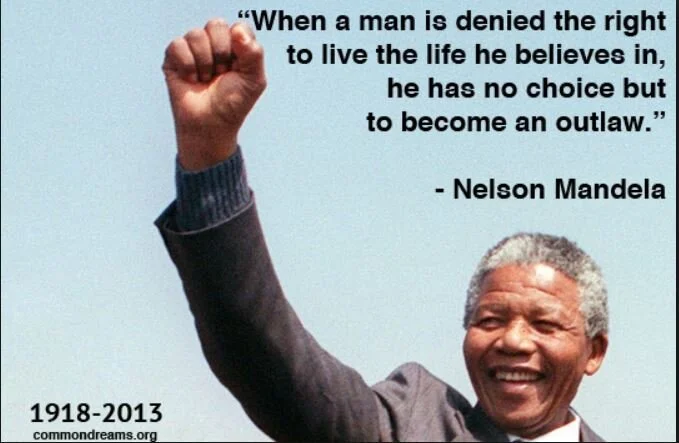
Nelson Mandela outlaw quote.JPG

In the summer of 1964 Malcolm predicted that the Afro-Americans would eventually be forced to resort to terroristic tactics as other colonized peoples had done to achieve their freedom. . . . By November 1964 he had become convinced that revolutionary struggle was the only alternative that Afro-Americans had in the face of the continued repression and resistance to their efforts to gain their rights within the established political system. The refusal of the Democratic Party leaders to seat the black representatives of the Mississippi Freedom Democratic Party at the Democratic Convention in August 1964 coupled with the brutalities inflicted on black people during and after the Mississippi elections, underscored the futility of trying to work with a corrupt and morally defunct political system. After listening to Fannie Lou Hamer’s account of her experience both in Mississippi and in Atlantic City with the leaders of the Democratic Party, Malcolm concluded that to communicate with white America, Afro-Americans needed to change to the language of force and brutality, and adopt methods such as those used by the Kenya freedom fighters:

Musa and Jomo.JPG

‘ . . . .you and I can best learn how to get real freedom by studying how Kenyatta brought it to his people in Kenya, and how Odinga helped him, and the excellent job that was done by the Mau Mau freedom fighters. In fact, that’s what we need in Mississippi. In Mississippi we need a Mau Mau. Right here in Harlem, in New York City, we need a Mau Mau. I say it with no anger; I say it with careful forethought . . . . We need a Mau Mau.If they don’t want to deal with the Mississippi Freedom Democratic Party, then we’ll give them something else to deal with; if they don’t want to deal with the Student Non-violent Coordinating Committee, then we have to give them an alternative.’

Republic of New Afrika3.JPG

The most remarkable thing about Malcolm’s brilliant but short career of dedicated leadership was his capacity for constructive intellectual development. After his break with the Muslims Malcolm underwent an ideological transformation. He came to understand the latent implications of his basic concept of the Black Revolution. When Malcolm spoke of the Black Revolution prior to his visit to the Middle East and Africa he used the words in the framework of political independence or decolonization. At this time he was an advocate of black nationalism in a racially inconclusive sense of the black, yellow, brown and red peoples - the colonized of the earth. The shift from black nationalism occurred as a result of his African and Middle Eastern experience, which enabled him to see that the basic problem confronting the unindustrialized or colored world was not race but the disadvantageous economic effects of the international capitalist system. This insight strengthened Malcolm’s earlier conviction about the need for the people in the underdeveloped world to unite not only to destroy colonialism but capitalism as well. In August 1964 when Malcolm said that it would take REVOLUTION for the black man to achieve freedom in America, he meant the destruction of the capitalist system both domestically and internationally.

It was not a question of winning through the ballot anymore but of using the bullet to destroy an economic system that is nationally and internationally incompatible with freedom for the oppressed peoples of the world. . . .

But Malcolm was not thinking solely in racial terms toward the end of his life. He very clearly indicated that the oppressed might find allies both in America and in Europe that were opposed to the capitalist system. Several times he reiterated that he would be willing to cooperate with any person or group that was honestly willing to fight against the American system that oppressed its black citizens at home and other peoples abroad.

The revolutionary struggle in the world, as Malcolm saw it, revolved around power - power to control human material resources and to determine the rate and path of economic development so that the peoples in the underdeveloped areas (including all the Harlems in the United States) might extricate themselves from the impoverishing colonial economic relationship whereby they have remained suppliers of raw materials and have in turn served as markets for the finished products of the developed countries. . . . He frequently argued that unless Afro-Americans understood their relation to the Congo, they would not be able to deal effectively with their problem in Mississippi since the same domestic racist interests are linked up internationally with similar interest that combine to oppress the darker races. He tried to destroy the image of America’s invincibility in the minds of the Afro-Americans and make them realize that the American, French, British, and other European imperialist powers were being successfully challenged by formerly colonized peoples. He felt that as these newly independent states assumed control over their own resources they were weakening the international capitalist system. When he was asked in an interview what he thought about the struggle between capitalism and socialism, Malcolm remarked:

‘It is impossible for capitalism to survive primarily because the system of capitalism needs some blood to suck. Capitalism used to be like an eagle, but now it’s more like a vulture. It used to be strong enough to go and such anybody’s blood whether they were strong or not. But now it has become more cowardly, like the vulture, and it can only suck the blood of the helpless. As the nations of the world free themselves then capitalism has less victims, less to suck., and it becomes weaker and weaker. It’s only a matter of time in my opinion before it will collapse completely.’

THE REAL REASON THEY KILLED MALCOM X

In Reflections of a Resolute Radical, Donald Freeman writes,

“The Afro-American Student Conference was held in Nashville, May 1 -May 3, 1964. It was the first time that northern and southern African American militants convened about Black nationalism. It commenced the ideological conversion of many activists from civil rights to Black Power (Black nationalism). . . . By its end, RAM (Revolutionary Action Movement) convinced the conference that young revolutionary nationalists were the vanguard of a Black revolution in the United States which embodied cultural revolution and promoted Pan African socialism. . . .

ASM FISK 1964 1.JPG

Then Max (Stanford, aka Muhammad Ahmad) and Roland Snellings met with John Lewis, Chairman of SNCC, in Atlanta. Lewis them work as part of SNCC’s field staff, although he disagreed with RAM ideology. So they went to Greenwood, Mississippi and started a freedom school . . . .

Their nationalist and armed self-defense advocacy disturbed the White SNCC staff and evoked an intense internal debate. Concurrently the Klu Klux Klan (KKK) perpetrated church bombings and harassment throughout Mississippi. Thus, Max emphasized the urgency for a major meeting in Detroit, prior to Memorial Day, 1964.

Our proceedings occurred at the home of James and Grace Boggs. Based on a thorough assessment of the state of the struggle for Black America’s liberation in the North and South, we instituted a national organization with the name Revolutionary Action Movement (RAM). Max Stanford was elected National Field Chairman, I as Executive Chairman, James Boggs, Ideological Chairman, Grace Boggs, Executive Secretary, and Milton Henry/Paul Brooks, Treasurer. RAM’s international representatives were El Hajj Malik Shabazz (Malcolm X), International Spokesman, and Robert F. Williams, International Chairman. . . .

In December, 1964 Doug Andrews, Paul Brooks, Tom Higginbotham, Max Stanford, and other members met in Cleveland to refine RAM’s 1965 priorities and strategy. . . . We discussed how to galvanize the energy of young urban African Americans, thereby enhancing the applicability of Rob Williams’ explosive advocacy in the United States and our coordination with El Hajj Malik Shabazz’s Organization of Afro-American Unity (OAAU).

I was pleased with our youth and young adult penetration among college students stemming from the spring, 1964 Nashville conference and gangs, which was a byproduct of my work with others in Chicago during the summer. I hoped that this progress was the prelude to a significant conversation of young Black men and women to RAM’s ranks in 1965.

As January, 1965 began, Malik Shabazz was busy seeking the backing of Ghana, Algeria and more African government to bring about the condemnation of the United States’ oppression of Black America in the UN. Such internationalization of the African American liberation struggle as a human rights issue was a principal objective of the OAAU.

By that time Max Stanford had become one of Malik Shabbazz’s constant Harlem companions. Their communication was continuous. Hence RAM’s agenda was an integral part of his activities.

SEE: How I Met Malcolm X

Then a series of ominous events beset El Hajj Malik Shabazz. In late November 1964 he had been invited to speak in France and Great Britain. February 8, 1965 he spoke again in London, but was not allowed to return to France the next day. On February 14th, his East Elmhurst, New York home was firebombed.

A further foreboding misfortune was the February 16th, 1965 New York City arrest of Walter Bowe, Robert Collier, Khaleel Sayyed, and Michelle Duclos, a French-Canadian woman, for allegedly plotting to bomb the Statue of Liberty.

What these menacing omens portended was actualized by the assassination of El Hajj Malik Shabazz at the Audubon Ballroom, on Sunday afternoon, February 21, 1965. The bourgeois (capitalist) mass media claimed that the Nation of Islam perpetuated that heinous crime. However, RAM asserted that its perpetrators were the CIA and FBI.

Decades later in ‘The 1960’s: From a Radical Perspective’, an article of mine published in Vibration, January 2000 – June 2000 Issue, I wrote ‘He (Malik Shabazz) was killed . . . . a few months before the major escalation of the United States’ military aggression in Vietnam during the spring of 1965.’

Such a sequence of events was probably not coincidental. The power elite of the American Empire did not want Malik Shabazz to still be around when they intensified the brutal imperialism in Indo-China. Therefore, they made sure that he was not on the scene to tell African American males not to go to Vietnam and die while carrying out the deadly orders of their oppressor.

El Hajj Malik Shabazz was the radical with the most mass media (television etc.) exposure and public appeal. Hence he was the political agitator with the potency to raise the consciousness of African Americans to the highest degree. His potential to radicalize Black America, especially youth and younger adults, made him an Ideological and political menace.

Such radicalization of Black Americans could have contributed to the emergence of a powerful liberation movement that would seriously destabilize the American Empire. That kind of turbulence could not be tolerated. His death precluded it.

The arrests of Walter Bowe, Robert Collier, Khaled Sayyed, and Michelle Duclos in the so-called bombing of the Statue of Liberty plot and the murder of Malik Shabbaz marked the prelude to the Counter Intelligence Program (COINTELPRO) of the FBI, which eventually engineered the liquidation of Fred Hampton, the head of the Black Panther Party (BPP) of Chicago.”

Alone, or almost single-handedly, Malcolm sought to link the Afro-American liberation movement with the liberation movement of the Third World, or what he called the Black Revolution. In his effort to internationalize the Afro-American problem Malcolm added a new and powerful dimension to a worldwide struggle that could take on more meaning as the racial conflict in the United States intensifies. . . . In other words, he sought to foster a world-wide revolutionary fraternity that would grow in strength and size as the conflict between the haves and the have-nots intensifies. The radical wing of the Black Power advocates in the United States appears to be executing the ideas implicit in his geopolitical analysis of the Black Revolution. In May 1967, SNCC declared that it was no longer a civil rights organization but a human rights organization interested in human rights not only in the United States but throughout the world, and declared its support for liberation groups struggling to free people from racism and exploitation. In July 1967, Stokely Carmichael attended the Organization of Latin American Solidarity Conference in Havana. When Carmichael left Cuba, he visited Vietnam, Algeria, Syria, Egypt, Guinea, Tanzania, Scandinavia, and France. He talked with leaders in all these countries, including Fidel Castro, Ho Chi Minh, Sekou Toure, Kwame Nkrumah, and Julus Nyerere. In August 1967, James Forman and Harold Moore, Jr. represented SNCC at a seminar sponsored by the United Nations in Kitwe, Zambia, on ‘Apartheid, Racial Discrimination and Colonialism in Southern Africa.’ . . . .

A logical extension of Malcolm’s basic concept of the Black Revolution is revolutionary socialism. He believed that eventually the oppressed peoples of the world must come to grips with the cause of their exploitation. The only way out for the ‘haves and have-nots’ cycle is through a radical break by the latter with the colonial economic relationship. The disappointing results of the recent UNCTAD (United Nations Conference on Trade and Development) point up the far-reaching implications and visionary scope of Malcolm’s concept of the Black Revolution. After the conference Dr. Raul Prebish, Argentine general secretary predicted:

‘If we do not succeed in effective and vigorous economic development the alternatives are clear. The deteriorating situation in the have-not countries will demonstrate that the extremists are right. Black power - now merely a U.S. phenomenon - will become brown, yellow and black power on a global scale.’

BLACK AMERICA CHOSE THE BALLOT AND THAT STRATEGY FAILED

“It has taken a while to reach this conclusion, but upon reflection it is inescapable. Why, after over a half century of Black voting, and the election of more Black political leaders than at any time since Reconstruction, are the lives, fortunes, prospects , and hopes of Black people so grim? . . . One is forced to conclude that Black America suffers maladies similar to those faced by continental African nations: a segregated neocolonial system in which a political class gives the appearance of freedom and independence while perpetuating racial oppression and financial exploitation. . . . If Black politicians are to do the very same thing as their white colleagues, why have them at all? What’s the difference? Neocolonialism at home and abroad.”

- Mumia Abu-Jamal, “While Rage Bubbles In Black Hearts”, August 20, 2011 in Have Black Lives Ever Mattered?

THE BLACK BOOK: THE TRUE POLITICAL PHILOSOPHY OF MALCOLM X

The Black Book The True Political Philosophy of Malcolm X.jpg

"The revolutionary individual does not come to be so because that individual chooses to accept or expound revolutionary ideology or actions but rather because certain keenly sensitive and intelligent individuals perceive societal injustices to such a point that they are trapped in a situation wherein their personal morality and rationality is threatened by having to accept the injustices perceived. The result is the Franz Fanon concept of mental contradictions arising within the individual to the point whereby the rationality-saving way is to 'act out' against oppression and injustices. The only way out of the dilemma then is national liberation or revolutionary change. The revolutionary individual thus is nothing more than the product of environmental factors. He or she is a natural outgrowth of a situation wherein the peoples' ideals and the societal written law differ too greatly. After attempting to straddle these contradictory laws (supported by hope of reform), the revolutionary individual then finds himself mentally unable to envision a reform that is adequate to bridge the gap between the societal law and structures that are out of step with the desires and needs of the people. He thus declares the former unjust and unjustified, and falls back on the ideals of the masses to sustain his humanity and rationality. In this way, he is an automatically-produced potential intellectual, statesman or soldier of the people. According to Franz Fanon, if such an individual refused to reject the oppressor's institutions, he is likely to suffer from an unresolved mental conflict, or from some form of serious psychosis. The essential understanding is that a revolutionary individual is the natural product of a situation wherein severe collective oppression dominates, which he cannot accept, and he has no choice other than to become revolutionary or mentally ill, whether he realizes it or not."

- Dr. Y. N. Kly

In the The Black Book, The True Political Philosophy of Malcolm X, Dr. Kly writes,

“We would like to thank all those individuals and former members and associates of the O.A.A.U. in New York’s Harlem, in Montreal, Quebec, and in Chicago whose cooperation makes this book possible. We call special attention to the cooperation and assistance given to us by Albert Jabera, Dr. Charles Knox, Dr. Yvonne King, Qasem Mahmoud, Ibn Sharieff and Diana Collier. . . .

At the beginning of the spring of 1961, shortly after completing the B.A. in Political Science and International Relations from the University of Iowa, I began to attend various Islamic and community meetings and conferences in which I had the opportunity to attempt to Bundestag the political nature of the philosophy that Malcolm X expounded. Between the years 1961 up to 1964, I, like thousands of other Americans, joined the fight against the apartheid system in the U.S. South which had forced many into the North or foreign exile. I posed a series of questions to Malcolm twice during private interviews, but most often in open meetings. Thus the responses which I received were not focused on me but rather were the message he wished to convey to everyone. In the fall of 1964, my recording and study of Malcolm’s responses and my understanding of their political meaning led me to enter the U.S. struggle by seeking and receiving the chairmanship of the Montreal International Branch of Malcolm X’s organization, the O.A.A.U. (Organization of Afro- American Unity). Recently in reviewing the 87 recorded questions that I had posed and Malcolm’s responses to same, i realized that many of the questions posed were for the most part essentially the same question asked in different ways to secure a fuller understanding, and thus could be logically reduced to approximately twenty questions and responses. The Black Book of Malcolm X is no more than the faithful combining of the 87 questions and responses received, and an abstraction of the political philosophy from the responses given.”

OAAU Aims and Objectives 3.JPG

In my book, From Yale To Rastafari: Letter to My Mom, 1995-1998 I wrote,

“I met Hondo (member of the Spear & Shield Collective and publisher of their Crossroads underground newsletter) the last time I was in Chicago, back in 1995. He was the only dreadlocked brother at the Sunday afternoon National Coalition of Blacks for Reparations in America (NCOBRA) meetings. I remember vaguely him telling me about this radical community school that was trying to throw safe, weekly parties for the youth. On our way to the Dixon Correctional Center to visit political prisoner Atiba Sana, we talked about the challenges of community work smack in the middle of heavy gang-activity. . . . Crazy as I was, I was attracted to it. Having been one of a handful of black students in a rural Chicago suburb, and later at Yale University, I was after what Marcus Garvey calls a “racial re-education.” I saw it as a manifestation of God’s will when Hondo picked me up at Chicago’s Union Station and drove me to political education class (PE Class) at the Nkrumah Washington Community Learning Center (NWCLC). About the man who governs the center and would become my mentor, Hondo had only one thing to say – he’s intense!

I quickly found out exactly what he meant. After introducing me to Irish “El-Amin” Greene, I was invited to sit in PE Class. For the next four hours, El-Amin talked – fast, loud and hard. His voice is neither deep nor soft. It is full of a thousand clear and emancipated thoughts travelling at a thousand miles a second. . . . El-Amin offered me a place to stay. . . . I was especially excited to have access to their cases of books on black, African and world history. . . .If I was scared then, I was absolutely frightened by the prospect of the future – less jobs, less money, no welfare, more people, more prisons, more babies being raised without any adult guidance, more drugs, guns and homegrown militias and terrorists amid the backdrop of global imperialism and the threat of a nuclear Holocaust, all started by the genocide of African Americans by white supremacists in the U.S. and its government. There was little difference to me between the area around 51st Street and Ada and pictures I saw of Liberia, Sierra Leone and Zaire. I remember vividly as El-Amin walked me around the neighborhood pointing out lines of gang demarcation. He showed me houses in the area and introduced me to the families that lived in ratted out, broken down houses in the area and introduced me to the families that lived in them. . . . El Amin had begun to direct my studies towards the law. Taking me to its old location, El-Amin explained to me the history of the National Council of Black Lawyers Community College of Law and International Diplomacy where he used to work. He provided documents about its co-founders Dr. Charles Knox and Dr. Y.N. Kly, both distinguished experts in international law and diplomacy, and provided me with textbooks on the U.N. and its procedures. One book in particular would change my life the way the Autobiography of Malcolm X had done: International Law and the Black Minority in the U.S. by Dr. Y.N. Kly. Along with another of his books, The Black Book (which details Malcolm X’s program to internationalize our struggle through the Organization of Afro American Unity), I gained some clarity on what must be done and what I must do, in order to gain relief from genocide and win reparations. I thus began writing Ras Notes: Conceptualizing Our Case for the U.N. At this time, I established communication with Dr. Kly’s International Human Rights Association of American Minorities (IHRAAM) and UHRAAP. I then began researching U.N. resolutions through the internet at DePaul University, and obtaining articles, petitions, and reports from NGO’s concerning our case. From these I began drafting the Petition of the Nkrumah-Washington Community Learning Center on Behalf of their Members, Associates and Afro-American Population Whose Internationally Protected Human Rights Have Been Grossly and Systematically Violated By the Anglo-American Government of the United States of America and Its Varied Institutions.

NCBL Law School2.JPG
NCBL Law School.JPG
El Amin Greene.JPG

Thus is my story of how I came into the direct lineage teachings of Malcolm X and inherited his legacy - From Malcolm X himself, to Dr. Kly to Dr. Knox, through IHRAAM to El Amin Greene to myself. Interestingly enough, like Malcolm who traveled to east Africa as the lone observer at the Second Summit of the Organization of African Unity (OAU), I too traveled to east Africa and attended the 1st Extra-Ordinary Summit of the Assembly of the African Union in Addis Ababa and began issuing reports to the African Diaspora via the internet. Thus, I share a unique relationship with Malcolm X, being the lone representative of the African American people at the seminal moment in the African liberation project to develop a United States of Africa. I returned with the same “educative” mission and responsibility as Malcolm. In this respect, I would like to return to some of Malcolm’s fundamental teachings as set forth in Dr. Kly’s The Black Book:

“‘We are living in an era of revolution, and the revolt of the American negro is part of the rebellion against the oppression and colonialism which has characterized this eraIt is incorrect to classify the revolt of the Negro as simply a racial conflict of black against white, or as a purely American problem…. The Negro revolution is not a racial revolt. We are interested in practicing brotherhood with anyone really interested in living according to it. But the white man (Anglo American) has long preached an empty doctrine of brotherhood which means little more than a passive acceptance of his fate by the Negro. (The Western Industrial Nations have been) deliberately subjugating the negro for economic reasons. . . .

Power in defense of freedom of freedom is greater than power in behalf of tyranny and oppression because power, real power, comes from conviction, which produces action, uncompromising action. It also produces insurrection against oppression. This is the only way you end oppression - with power. Power never takes a back step - only in the face of more power. Power doesn't back up in the face of a smile or in the face of a threat, or in the face of some kind of nonviolent loving action. It's not the nature of power to back up in the face of anything but more power - Malcolm X Speaks’

PROBLEM: Should the problem of the black minority in the U.S. Be limited to solutions suggested in the U.S. historical development, such as assimilation and the equality of all individuals before the law?

RESPONSE: No!. . . Malcolm thought of the black minority in the U.S. as a national minority or people (not a state) under the domination and oppression of the generally white Anglo-Americanized majority in the U.S.. Thus the problem of the black minority in the U.S. should be formulated in such a manner as to coincide with the universal problem of oppressed peoples or minorities or nations without states in multi-national states. . . . the U.N. General Assembly has recently seen fit or necessary to interpret the U.N. Charter as providing for the right of oppressed peoples or nations within multi-national states to employ force if required to obtain equality. . . . Above all, Malcolm’s fundamental teaching was that the problem of minority protection is primarily an international responsibility. . . .

PROBLEM: Why not just struggle to reform the civilization in which Afro-Americans are? Must they introduce another civilization?

RESPONSE: Yes. Although Afro-Americans are presently physically within western civilization, and in general subjectively feel completely a part of that civilization, there is every proof that the free peoples of this civilization have never accepted Afro-Americans as members of their civilization. Instead, history seems to confirm that they see Afro-Americans as belonging to them, like possessions or tools that provide useful services. In other words, neither Afro-Americans nor their true heritage play any conscious positive role in determining what the U.S. is or will be, but instead it is the social, political and material needs of the Anglo-American nation that determines the Afro-American. . . . What does this mean? For one thing,it means that the way Afro-Americans see themselves and the way the world, particularly the western world of which they purport to be a part, sees them, is not the same. Thus, living to a large degree in isolation (in the black community) from equal status contact with members of the Anglo-American community, it has been easy for Afro-Americans to create the delusion that they are a part of this civilization composed of people who never know slavery, because it was easy to feel a part of the isolated black community in which they lived. . . . The only way that Afro-America could become an equal status member of western civilization would be through the creation of a situation permitting it and the civilization it represents to enter into a social contract (equal status relationship) with other peoples of that civilization, and this could be done only through what Afro-Americans may consider ‘reform’ but which the other members of that civilization would see as national liberation or struggle for self-determination. . . . In the truest sense, national liberation or self-determination is the minimum reform necessary.

PROBLEM: if Afro-Americans followed Malcolm, then it would necessitate a political or perhaps political and military struggle, which in either case would cause great suffering. Why not do like many of their fore-parents did, and accept the status quo while pushing for better treatment rather than equal status or functional equality?

RESPONSE: Afro-Americans must struggle because even to guarantee the maintenance of the relational status quo and better treatment requires the Afro-American community or nation to increase its centralization of political power over the resources and people in its own nation or community. . . . In order to achieve this greater centralization of political power, the community must demand a significant degree of political autonomy or independence from the Anglo-American community. The demand for this greater degree of political autonomy or independence would be resisted, and of course require struggle. Therefore, even to guarantee the maintenance of the status quo and better ‘treatment’, the Afro-American must engage or continue to engage in struggle. Otherwise the relational status quo and treatment will change according to the needs and whims of the Anglo American community as has historically been the case. . . . For nothing good can come from the willing acceptance of oppression and enslavement. It can be demonstrated that more than twice the number of Africans died because of their acceptance of slavery than would have died in a struggle against enslavement. Also, the oppressor did not become a better people or nation due to African non-violent acceptance of enslavement and inequality, but instead the U.S. became one of the most insensitive nations in the world to the needs and plight of non-European and non-Anglo peoples. As Malcolm would say, the acceptance of evil begets greater evil. Thus the Afro-American acceptance of inequality and enslavement has not only served as the human capital and original resource through which was brought into existence the world’s greatest military, technological and social world power, but it is also a chief cause of the U.S. being a nation that insists on the feasibility of using its power for the worldwide benefit of maintaining the Anglo-American ideology of ‘white racism,’ oppression and exploitation of the non-European and non-Anglo-American world at a point in history when such notions are clearly passe. . . .

PROBLEM: Is there a difference between revolution and national liberation?

RESPONSE: Yes. Revolution involves the entire society in question, and always means rapid institutional, social, political and economic change, while national liberation usually involves only a group or nation within the entire society involved, and may or may not involve rapid social and economic change. For example, when Algerians were considered as French citizens, the Algerian national liberation movement successfully demanded the total political independence of the so-called Algerian French from the other French. They succeeded without bringing about a revolution in France. This has been the case with almost every Asian and African people claiming the right to statehood at the conclusion of the classical colonial period. . . . However, for a people to demand national liberation, it usually means that rapid or slow revolutionary change has taken place within the ranks of the people asking for national liberation. This is true although the revolutionary orientation may have been compromised, delayed or defeated in the struggle to obtain self-determination or political independence. Thus, a revolution must occur in the political institutions of the oppressed in order to effectively effect self-determination through national liberation or political independence. This simply means that the responsible leadership of people in need of self-determination must unite and replace the irresponsible leadership opposing self-determination by all means necessary. . . . We have often heard the word revolution, and when we reflect on the historical usage of the word, we immediately realize that no one revolution has succeeded in bringing about the ideal system or set of conditions. Instead, history demonstrates that revolutions are followed by more revolutions. Why? Revolutions have resulted from the efforts of the people to realize their ideal, as understood through their prophets, current moral convictions and religions. In the most fundamental sense, it is the continuing effort of the people to fulfill the mission of their continuously changing material and spiritual needs, culture, and ideals that causes revolution. . . .

EPILOGUE

What happens when a nation or people are effectively suppressed, yet their objective existence is neither absorbed nor eliminated? When the oppressor’s system is believed by him and by the world to be everlasting and, on the whole, successful, and given all (save the oppressed) favorable to human progress? When the oppressor is able to successfully prevent the oppressed from organizing a legitimate intellectual or armed resistance? When the God-given collective human right to exist of the oppressed cannot be expressed because of the overwhelming domestic and international character of the wealth, influence and power possessed by the oppressor, which allows him to orchestrate the orientation of minds in such a manner as to make a central mass leader such as [Malcolm X] appear insignificant, to make the legitimate and human aspirations of the oppressed appear illogical or universally undesirable? When this has occurred, has the oppression achieved ultimate victory? The current norms of western world thought in relation to such areas as Palestine or South Africa leave us with the impression that a political ‘fait acoompli’ against the right of a people to exist means that the oppressor has won and that the people whose existence in oppression nevertheless remains an objective fact, must and will accept the imposed political ‘reality’ in perpetuity. . . . Malcolm knew that this period is a truly difficult period for Afro-American liberation organizations. However, he believed that as the U.S. capitalist elite loses its military, social and political hold on the minds of the majority of Americans and the world, each day becomes better. Tomorrow, he told us, would see turbulent environmental changes in the international system, and it is there that Afro-Americans, other oppressed minorities, and the Anglo-American working class must and can act to free themselves. . . . “

John Africa on Government.JPG
COVID Revolution.JPG

THE SYSTEM MUST BE DESTROYED!

Let us pray that COVID -19 wipes out and completely destroys the Plutonomies. Clearly the People are unable or unwilling to revolt. COVID-19 is the revolution!

“In October 16, 2005, Citigroup came out with a brochure for investors called “Plutonomy: Buying Luxury, Explaining Global Imbalances” urging investors to put money into a ‘Plutonomy Basket”.

Here is an excerpt from Citigroup’s report:

“The World is dividing into two blocs – the Plutonomy and the rest. The U.S., UK, and Canada are the key Plutonomies – economies powered by the wealthy. Continental Europe (ex-Italy) and Japan are in the egalitarian bloc.

Equity risk premium embedded in “global imbalances” are unwarranted. In plutonomies the rich absorb a disproportionate chunk of the economy and have a massive impact on reported aggregate numbers like savings rates, current account deficits, consumption levels, etc. This imbalance in inequality expresses itself in the standard scary “global imbalances”. We worry less.

We project that the plutonomies (the U.S., UK, and Canada) will likely see even more income inequality, disproportionately feeding off a further rise in the profit share in their economies, capitalist-friendly governments, more technology-driven productivity, and globalization.

In a plutonomy there is no such animal as “the U.S. consumer” or “the UK consumer”, or indeed the “Russian consumer”. There are rich consumers, few in number, but disproportionate in the gigantic slice of income and consumption they take. There are the rest, the “non-rich”, the multitudinous many, but only accounting for surprisingly small bites of the national pie.

To continue with the U.S., the top 1% of households also account for 33% of net worth, greater than the bottom 90% of households put together. It gets better (or worse, depending on your political stripe) – the top 1% of households account for 40% of financial net worth, more than the bottom 95% of households put together. This is data for 2000, from the Survey of Consumer Finances (and adjusted by academic Edward Wolff).

Most “Global Imbalances” (high current account deficits and low savings rates, high consumer debt levels in the Anglo-Saxon world, etc) that continue to (unprofitably) preoccupy the world’s intelligentsia look a lot less threatening when examined through the prism of plutonomy.

The reasons why some societies generate plutonomies and others don’t are somewhat opaque, and we’ll let the sociologists and economists continue debating this one. Kevin Phillips in his masterly “Wealth and Democracy” argues that a few common factors seem to support “wealth waves” – a fascination with technology (an Anglo-Saxon thing according to him), the role of creative finance, a cooperative government, an international dimension of immigrants and overseas conquests invigorating wealth creation, the rule of law, and patenting inventions. Often these wealth waves involve great complexity.

Society and governments need to be amenable to disproportionately allow/encourage the few to retain that fatter profit share. The Managerial Aristocracy, like in the Gilded Age, the Roaring Twenties, and the thriving nineties, needs to commandeer a vast chunk of that rising profit share, either through capital income, or simply paying itself a lot.

We have all heard the lament. A bearish guru, somber and serious, spelling out that the end is near if something is not done urgently about those really huge, nasty “Global Imbalances”.

Almost all the smart folks we know – our investors, our colleagues, our friends in academia, politicians believe in some variant of these two stories. There are very few exceptions who consider these “Global Imbalances” not scary but perfectly natural and rather harmless.

To summarize so far, plutonomies see the rich absorb a disproportionate chunk of the economy, their decision to lower their savings rate, often corresponding to the asset booms that often accompany plutonomy, has a massive negative impact on reported aggregate numbers like savings rates, current account deficits, consumption levels, etc. We believe the key global imbalance is that some large economies have become plutonomies, and others have not — this imbalance in inequality expresses itself in the standard scary “global imbalances” that so worry the bears and most observers. They do not worry us much. In addition, the emerging market entrepreneur/plutocrats (Russian oligarchs, Chinese real estate/manufacturing tycoons, Indian software moguls, Latin American oil/agriculture barons), benefiting disproportionately from globalization are logically diversifying into the asset markets of the developed plutonomies. They are attracted by the facets that facilitated the re-emergence of plutonomies in the U.S., UK, and Canada – technology, internationalism, the rule of law, financial innovation and capitalist-friendly cooperative governments. This further inflates the asset markets in these plutonomies, enabling the rich there to lower their savings rates further, and worsening their current account balances further. Just as misery loves company, we posit that the “plutos” like to hang out together.

At the heart of plutonomy, is income inequality. Societies that are willing to tolerate/endorse income inequality, are willing to tolerate/endorse plutonomy.

Corporate tax rates could rise, choking off returns to the private sector, and personal taxation rates could rise – dividend, capital-gains, and inheritance tax rises would hurt the plutonomy.

Indeed, in the U.S., the current administration’s attempts to change the estate tax code and make permanent dividend tax cuts, plays directly into the hands of the plutonomy.

Protectionism or regulation. Here, we believe lies a cornerstone of the current wave of plutonomy, and with it, the potential for capitalists around the world to profit. The wave of globalization that the world is currently surfing, is clearly to the benefit of global capitalists, as we have highlighted. But it is also to the disadvantage of developed market labor, especially at the lower end of the food-chain.

A third threat comes from the potential social backlash. To use Rawls-ian analysis, the invisible hand stops working. Perhaps one reason that societies allow plutonomy, is because enough of the electorate believe they have a chance of becoming a Plutoparticipant. Why kill it off, if you can join it? In a sense this is the embodiment of the “American dream”. But if voters feel they cannot participate, they are more likely to divide up the wealth pie, rather than aspire to being truly rich.

Could the plutonomies die because the dream is dead, because enough of society does not believe they can participate? The answer is of course yes. But we suspect this is a threat more clearly felt during recessions, and periods of falling wealth, than when average citizens feel that they are better off. There are signs around the world that society is unhappy with plutonomy – judging by how tight electoral races are. But as yet, there seems little political fight being born out on this battleground.

Our overall conclusion is that a backlash against plutonomy is probable at some point. However, that point is not now. So long as economies continue to grow, and enough of the electorates feel that they are benefiting and getting rich in absolute terms, even if they are less well off in relative terms, there is little threat to Plutonomy in the U.S., UK, etc.

If we are right, that the rise of income inequality, the rise of the rich, the rise of plutonomy, is largely to blame for these “perplexing” global imbalances. Surely, then, it is the collapse of plutonomy, rather than the collapse of the U.S. dollar that we should worry about to bring an end to imbalances. In other words, we are fretting unnecessarily about global imbalances.

There are rich consumers, and there are the rest.”

JUBILEE DEBT RELIEF FOR COVID 19

Calling ALL people. This needs to be a massive movement NOW.

Listen to the explanation from Michael Hudson, author of “… and forgive them their debts” and “Killing the Host,” and president of the Institute for the Study of Long-Term Economic Trends and is distinguished research professor of economics at the University of Missouri at Kansas City. Read the article or listen to the interview on NPR.

WE DONT WANT TO RETURN TO LIFE AS WE KNEW IT. WE DONT WANT LEADERS TO SAVE THE SYSTEM. WE WANT LEADERS WITH A VISION FOR A NEW KIND OF SYSTEM

Black Nationalism in America - Cultural, Religious, Economic, Revolutionary: The Need for a Black United Front

“Students . . . are unable to take advantage of the lessons offered by previous successes and failures because they lack knowledge of their history, especially their history as students in one wing of the liberation struggle. This is to say that historical discontinuity is another characteristic feature of the present wave of student activism. And it means that unless students begin to learn from the past, they/we face the danger of taking roads that lead to dead-ends, diversions, co-optation, and prolongation of national independence. To be properly oriented, we have to know that we are an oppressed nation. To be oriented is to know who we are; where we are; how we got here; why we got here; where we need to go; and how to get there. We have to know all this so that we can correctly interpret and understand local struggles and issues, and so we can make the proper connections between all struggles and issues in our thinking and practice. All local struggles are parts of the national liberation struggle.”

Atiba Shanam, Vita Wa Watu Book Ten

Black Nationalims in America.JPG

“Black men, throughout their history in America, have manifested nationalist sentiment. Some have always leaned toward separatist ideology and solutions . Even essentially integrationist and assimilationist thinkers have often had nationalist strains in their social philosophies. Thus, in 1897, W. E. B. Du Bois wrote : .

. . One ever feels his two-ness-an American, a Negro; two souls, two thoughts, two unreconciled strivings ; two warring ideals in one dark body, whose dogged strength alone keeps it from being torn asunder . The history of the American Negro is the history of this strife,- this longing to attain self-conscious manhood, to merge his double self into a better and truer self . In this merging he wishes neither of the older selves to be lost. He does not wish to Africanize America, for America has too much to teach the world and Africa. He does not wish to bleach his Negro blood in a flood of white Americanism, for he believes . . . that Negro blood has yet a message for the world. He simply wishes to make it possible for a man to be both a Negro and an American without being cursed and spit upon. . . .” W. E. B. Du Bois, "Strivings of the Negro People," Atlantic Monthly, LXXX (August 1897), 194-195. xxvi

Khalid Muhammad.JPG

Nationalist ideologies have been in the ascendant only at certain historical periods ; in others, the major emphasis has been on racial integration and assimilation. During four periods, nationalist sentiment in various forms has been prominent in Negro thought: the turn of the eighteenth century, roughly from 1790 to 1820; the late 1840s and especially the 1850s; the nearly half-century stretching approximately from the 1880s into the 1920s; and since the middle 1960s. In general, nationalist sentiment, although present throughout the black man's experience in America, tends to be most pronounced when the Negroes' status has declined, or when they have experienced intense disillusionment following a period of heightened but unfulfilled expectations.

This introductory essay will describe the chief recurring varieties of black nationalism and trace black nationalism as a whole in the main periods of black history in the United States . In a concluding section the three editors will present their differing interpretations of the nature and pattern of the phenomena they first describe.

The term "black nationalism" has been used in American history to describe a body of social thought, attitudes, and actions ranging from the simplest expressions of ethnocentrism and racial solidarity to the comprehensive and sophisticated ideologies of Pan-Negroism or Pan-Africanism . Between these extremes lie many varieties of black nationalism, of varying degrees of intensity.

The simplest expression of racial feeling that can be called a form of black nationalism is racial solidarity . It generally has no ideological or programmatic implications beyond the desire that black people organize themselves on the basis of their common color and oppressed condition to move in some way to alleviate their situation. The concept of racial solidarity is essential to all forms of black nationalism. The establishment of mutual aid societies and separatist churches in the late eighteenth century had little ideological justification beyond that of racial solidarity .

A more pronounced form of black nationalism is cultural nationalism. Cultural nationalism contends that black people in the United States or throughout the world-have a culture, style of life, cosmology, approach to the problems of existence, and aesthetic values distinct from that of white Americans in particular and white Europeans or Westerners in general. Mild forms of cultural nationalism say merely that the Afro-American subculture is one of many subcultures that make up a pluralistic American society. The most militant cultural nationalists assert the superiority of Afro-American culture usually on moral and aesthetic grounds-to Western civilization . Programmatic or institutional manifestations of cultural nationalism include the development of a body of social-science literature-history, philosophy, political science, and the like written from the Afro-American point of view; the unearthing and publicizing of all the past glories of the race; the development of a distinct Afro-American literature, art, and music; the formation of appropriate vehicles for the transmission of Afro American culture-newspapers, journals, theaters, artistic workshops, musical groups; the assertion of a distinct lifestyle and world view in such ways as assuming African or Arabic names, wearing African clothes, and speaking African languages.

Closely linked in forms and function to cultural nationalism is religious nationalism. Within the theological boundaries of Christianity are such nationalist assertions as that blacks should establish and run churches of their own, for their own people; that God, or Jesus, or both were black (the "Black Messiah" theme) ; that Afro-Americans are the chosen people . Religious nationalism has also taken non-Christian forms, as can be seen in such twentieth-century groups as the Nation of Islam, the Moorish Science Temple, the several varieties of black Jews, and the Yoruba Temple. A milder expression of religious nationalist feeling is manifested in the recent formation of black caucuses within the major Christian denominations. In Chicago in 1968 black Catholic priests conducted a "Black Unity Mass" to the beat of conga drums; they wore vestments of colorful African cloth and shared the altar with, among others, a Baptist preacher.

Economic nationalism includes both capitalist and socialist outlooks. The capitalist wing, or the bourgeois nationalists, advocates either controlling the black segment of the marketplace by attempting to establish black businesses and by "buy black" campaigns, or establishing a black capitalist economy parallel to the economy of the dominant society. Slightly to the left of the bourgeois nationalists are those who contend that formation of producer and consumer cooperatives is necessary. Further to the left are black nationalist socialists who feel that abolition of private property is a prerequisite for the liberation of the Negro people. (Such socialists should be distinguished from black integrationist socialists like A. Philip Randolph and Bayard Rustin .) At the opposite extreme are those who call for the reinstatement of preindustrial communalism. Black nationalist socialists tend to coincide with revolutionary nationalists who apply Marxian theory to the experience of Afro-Americans, whereas those who favor preindustrial African economic forms tend also to be militant cultural nationalists . Negro capitalists tend to be bourgeois in their political and cultural outlooks as well.

In the area of politics, black nationalism at its mildest is bourgeois reformism, a view which assumes that the United States is politically pluralistic and that liberal values concerning democracy and the political process are operative. Programmatic examples of such a view are the slating and supporting of Negro candidates for political office ; the drive for black political and administrative control of local and county areas where Negroes predominate; and the formation of all-black political parties. In contrast, revolutionary black nationalism views the overthrow of existing political and economic institutions as a prerequisite for the liberation of black Americans, and does not exclude the use of violence.

Where are the revolutionaires.jpeg

A most significant variety of black nationalism is emigrationism. From the earliest attempts of slaves to capture the ships bearing them to the New World in order to steer them back to Africa, a substantial number of black people have wanted to return to the ancestral homeland. However, to emigrationists for whom Africa was too far away in time and space, or unacceptable for other reasons, the West Indies, South America, Mexico, Canada, and even the island of Cyprus have been touted as potential homelands.

Related to emigration is what we may call territorial separatism, a term best applied to the view of those blacks who wanted a share of the country that their labor had made so prosperous but who had no illusions about living in peace and equality with white Americans . Territorial separatists advocated the establishment of all-black towns, especially in the South and Southwest, all-black states, or a black nation comprising several states . Recent and milder forms of territorial separatism are often linked to the concept of political pluralism and advocacy of "black control of the black community."

Republic of New Afrika3.JPG

Implicit in many of these varieties of black nationalism is the international extension of racial solidarity in the doctrines of Pan-Negroism, or Pan-Africanism . Both foster the belief that people of African descent throughout the world have common cultural characteristics and share common problems as a result of their African origins, the similarity of their political oppression and economic exploitation by Western civilization, and the persistence and virulence of racist theories, attitudes, and behavior characterizing Western contact with people of African descent. Afro-American advocates of Pan-Negroism historically assumed that Afro-Americans would provide the leadership for any worldwide movement. Only recently, with the political independence of African nations, have Afro-Americans conceded that Africans themselves might form the vanguard in the liberation of all peoples of African descent.

The varieties of black nationalism are often not sharply delineated, nor are they mutually exclusive categories . Any one individual may assume any number of combinations of black nationalism. Moreover, nationalism and racial integration as ideologies or as programs have often coexisted in organizations, in theories, and in the minds of individual Negro Americans. To deal exclusively with the varieties of black nationalism in American history is not to suggest that only black nationalism existed. In fact, a book of documents on black nationalism is needed to correct the generally held view that integration and assimilation had an undisputed reign in the minds of black Americans. This book can serve to remind the reader that the problems of the complexities of human behavior are no less formidable where black folk are concerned. “

The challenge today is to unite all the diverse political energies of the black people in the United States of America in order to develop enough COMPELLING FORCE to achieve all the diverse aims. As I said previously,

“The essential point is this: the current world order is run according to COMPELLING FORCE. Now, who among us has enough COMPELLING FORCE to COMPEL the system of white supremacy to submit to our interest? Come on - which group? Jamaicans? African Americans? New Orleanians? Afro Cubans? Temne? Balanta? Nigeria? South Africa? Ghana? ....when you stop all the nonsense you are talking, you will realize that if any one group had enough COMPELLING FORCE to safeguard its interest, IT WOULD ALREADY HAVE DONE SO. So, when you all are finished with petty emotionalism and how you feel about it, and either return to or come up to both a common and scientific understanding of the COMPELLING FORCE of white supremacy used against ALL of us, then you will realize that the reason why we come together and forget all the distinctions between us is because of the overriding imperative to develop enough COMPELLING FORCE to effectively oppose white supremacy and all the nations it has built.”

Consider the issue of COMPELLING FORCE with regard to the Reparations Movement. In the book, The Wealth of Races: The Present Value of Benefits from Past Injustices edited by Richard F. America, William Darity, Jr writes:

"The later 1960s and early 1970s - a period of great social activism and ferment in the United States -witnessed a surge in calls from black Americans for reparations. . . . The rationale was twofold. First was a 'moral justification deriving .... from the debt owed to Blacks for the centuries of unpaid slave labor which build so much of the early American economy, and from the discriminatory wage and employment patterns to which Blacks were subjected after emancipation.' Second was a justification based on 'national self-interest' . [Robert S. Browne, director and founder of the Black Economic Research Center] perception that such 'gross inequalities' in the distribution of wealth would only further aggravate social tensions between black and whites.

Apparently, neither justification subsequently has proved COMPELLING for American legislators. No scheme of reparations of the type Browne advocated [wealth transfers] ever has been adopted in the United States."

How can sufficient COMPELLING FORCE be created? For starters, this can best be done through unification - there is strength in numbers. But what framework allows such diverse political interests to unite? The answer is through the process of a

UNITED NATIONS SPONSORED PLEBISCITE FOR SELF-DETERMINATION FOR DESCENDANTS OF PEOPLE WHO SURVIVED THE CRIMINAL AND GENOCIDAL MIDDLE PASSAGE TO THE COLONIES THAT BECAME THE UNITED STATES OF AMERICA

The following article will take a historical look at nationalism and the failure to develop a BLACK UNITED FRONT by focusing on the era from 1792 to 1861.

LEARNING THE LESSONS OF HISTORY: SLAVE SONGS, REPATRIATION, INSURRECTION, INTEGRATION, NATIONALISM & THE ORIGINAL #ADOS MOVEMENT FROM 1792 TO 1861

The-Nature-and-Purpose-Black-United-Front.jpg

LEARNING THE LESSONS OF HISTORY: SLAVE SONGS, REPATRIATION, INSURRECTION, INTEGRATION, NATIONALISM & THE ORIGINAL #ADOS MOVEMENT FROM 1792 TO 1861

History of Black Nationalism Books.JPG

“The first Dutch slave ship, Jesus, reached Jamestown in 1619. During the middle passage - the term used for the voyage of the slave ship -many members of its African cargo jumped overboard and died in a vain attempt to swim back home. Those Africans who arrived in the New World brought with them their culture. . . . Slave ships became the incubators of slave unity across the cultural lines which divided them in Africa. The shared experience erased barriers between one group and another and fostered resistance thousands of miles before the land of enslavement appeared on the horizon. “

- Sterling Johnson, Black Globalism: The International Politics of a Non-state Nation

I am writing this article because of the tragic, lamentable state of division and hostility that exists within the “black” community, both in and outside of Africa, and specifically in the United States of America, recently intensified because of the #ADOS movement. The massive amount of non-constructive conversation and activity is preventing the development of substantial COMPELLING FORCE that could be harnessed and used in the collective liberation of all people who continue to be dominated by the global system of white supremacy. The infighting among some members of ALL of our groups and movements - #ADOS, Pan African, Black Nationalist, Aboriginal, Native American, Kemetians, Nation of Islam, Black Hebrews, Moors, Washitaw, Christians, Rastas, Black Greek Fraternities, Democrats, Republicans, Conservatives, Hip Hop, Entertainers, Sports Stars, Politicians, Facebook Groups, etc…. - is definitive PROOF that collectively, we have not LEARNED THE LESSONS OF HISTORY. All of the debates that we are having now we had during the period of 1792 to 1861. The fact that we are still having the same debates and have failed to create a UNIFYING platform that does not require homogeneity or “sameness of thought” has prevented us from developing the COMPELLING FORCE necessary to achieve each group’s goals. A UNIFYING PLATFORM whose aim is to gain all that each group desires IS POSSIBLE if we LEARN THE LESSON. So I offer the following review of history to illustrate this:

1444 to 1619 - Slave ships became the incubators of slave unity across the cultural lines which divided them in Africa.

1619 to 1792 - In her article, Voodoo: The Religious Practices of Southern Slaves in America, Mamaissii Vivian Dansi Hounon writes

“Contrary to popular belief, the Africans enslaved [in] America were not Christians. . . .the builders of this . . . nation were practitioners of the various African religions . . . . These spiritual practices of the Africans enslaved in America, have their ancestral origins. . . . directly from Dahomey, Nigeria, Senegal, Ghana, The Congo and other West African nations. . . . Though some forms of westernized Christianity made its way to many West African nations prior to the trans-Atlantic voyages, IT EFFECTED LITTLE INROADS into the lives of the millions of traditionalists Africans captured and enslaved in America.”

In his book, Religion of the Slaves, Professor Terry Matthews writes,

“In the early decades of the nineteenth century, Christianity had made LITTLE OR NO IN-ROADS among Blacks for fear that they might take literally such narratives as the exodus . . . Various plantation owners expressed the concern that ‘the superstitions brought from Africa have not been wholly laid aside . . . .’[This was] often cited as evidence that the plantation slave refused to abandon African paganism for American Christianity. . . . Long before their contact with whites, Africans were a strongly religious and deeply spiritual people. . . . Indeed, the religion of modern Blacks represents a RELATIVELY MODERN DEVELOPMENT that dates back to the last several decades before slavery was brought to an end.”

The desire of every slave, both aboriginal (native) and those captured from the continent now called “Africa” was to defeat and/or kill the white people (Christians) who enslaved them. The desire of the people taken from their ancestral homelands was to return to their home on the continent now called “Africa”. Largely, because he or she left no written records, little is known about the black man and black woman’s thoughts while he or she was a slave. Oral evidences, however, especially oral traditions and folk tales, tend to reveal that “Africa” was central to the slave’s longing for his freedom.

Terry M. Turner and Paige Patterson write in God’s Amazing Grace: Reconciling Four Centuries of African American Marriages and Families,

During this era, the concept of African-Americans as chattel became ingrained in the minds of European-Americans, both Christians and non-Christians. As a result, state laws legislated Black people as inferior, which promoted the idea they deserved slavery over Christianity. Additionally, it was believed that to be a Christian, one needed to complete a catechism; therefore, they must be able to read and understand the Bible. As a result, colonial states passed laws that forbade slaves from reading and writing, imposing hefty fines towards violators. South Carolina’s Act of 1740 legislated that, because chattel could not be educated, African- Americans could not be educated. This law stated that African-Americans were human, but were to be held in chattel-hood and not receive an education:

‘Whereas, the having slaves taught to write, or suffering them to be employed in writing, may be attended with great Inconveniences; Be it enacted that all and every person and persons whatsoever, who shall hereafter teach or cause any slave or slaves to be taught to write or shall use or employ any slave as a scribe, in any manner of writing whatsoever, hereafter taught to write, every such person or persons shall, for every such offense, forfeit the sum of one hundred pounds, current money.’

During slavery, Christian doctrines were used to justify slavery and oppression. . . . Those who became converted Christians found mental escape from the hardships of slavery . . . .Although their inability to read and write left them with little or no theological understanding, they had an excess of spiritual songs that were sung to help them endure their suffering.”

In a song called “Deep River” that originated in Guilford County, North Carolina, a conservative slave told his Quaker benefactor that he wanted to ‘cross over’ to Africa, the home of camp meetings.

Deep River, my home is over Jordan, Deep River,

Lord, I want to cross over into camp ground;

Lord, I want to cross over into camp ground;

Lord, I want to cross over into camp ground;

Lord, I want to cross over into camp ground;

1792, January - 1,130 slaves who sympathized with the British during the American Revolution, led by Thomas Peters and David George departed from Canada to Sierra Leone. They were followed by nearly 500 maroons from Jamaica in 1800. [2019 years later, there is not a single organization that has repatriated this many people to Africa]. Both Peters and George can be regarded as prototypes of the Negro leaders who sought to lead Negroes out of “bondage” and back to the “fatherland” in Africa.

1815 - Paul Cuffe takes thirty-eight Negro colonists to Sierra Leone. In a letter dated May 18, 1818, Samuel Wilson, one of Cuffe’s emigrants, asked Richard Allen and other free Negro opposers of the American Colonization Society, “Do you not know that the land where you are is not your own? Your fathers were carried into that to increase strangers’ treasure, . . . ” He added that Negro ministers were not doing the will of God by remaining in the United states. Another emigrant, Perry Locke, wrote, “Your mother country. . . . is like the land of Canaan.”

1816, December - a Society for Colonizing Free People of Color of the United States (American Colonization Society) is organized by Robert Finley, a Presbyterian minister, as a result of advocacy of Samuel Hopkins and Thomas Jefferson. Bushrod Washington, one of the judges of the Supreme Court, was elected President of the society. Okon Edet Uya writes in Black Brotherhood, that, “Despite the propaganda efforts of that unfortunate amalgam of white racists, philanthropists, and enthusiastic blacks, emigration to Africa in the first part of the nineteenth century evoked a wide variety of responses from articulate black leadership ranging from outright rejection to uneasy enthusiasm.”

1817 - “The free people of Richmond, Virginia, thought it advisable. . . to make public their sentiments respecting the movement (to be colonized/integrated into America.) William Bowler and Lentry Craw were the leading spirits of the meeting. They agreed with the Society that it was not only proper, but would ultimately tend to benefit and aid a great portion of their suffering fellow creatures to be colonized; but they preferred being settled ‘in the remotest corner of the land of their nativity.’ As the president and the board of managers of the Society had been pleased to leave it to the entire discretion of Congress to provide a suitable place for carrying out this plan, they passed a resolution to submit to the wisdom of that body whether it would not be an act of charity to grant them a small portion of their territory, either on the Missouri River or any place that might seem to them most conducive to the public good and their future welfare, subject, however, to such rules and regulations as the government of the United States might think proper.” (Louis Mehlinger, The Attitude of the Free Negro Toward African Colonization)

[Siphiwe Note: Here we see the viewpoint of one class of the original #ADOS movement - the free people of color. Largely composed of people who purchased their freedom or were manumitted by their slave masters, many of them owned some land and had their own business. Many were ministers and could read and write. Thus “educated”, their viewpoint represented that of the small group of Negro people who had been most thoroughly indoctrinated with the en-slavers’ religion (Christianity) and education. Today they would be considered the “black bourgeoisie”. Their views, as we shall see, did not represent the vast majority of Negro people who were slaves and had not been so influenced by the white man’s religion and “education”.]

“When the people of Richmond, Virginia, registered their mild protest against (emigration), about 3,000 free black of Philadelphia took higher ground. The leaders of this meeting were: James Forten, chairmen, Russel Parrott, secretary, Rev. Absalom Jones, Rev. Richard Allen, Robert Douglass, Francis Perkins, Rev. Joen Gloucester, Robert Gordon, James Johnson, Quamony Clarkson, John Sommerset, and Randall Shepherd. Because their ancestors not of their own accord were the first successful cultivators of the wilds of America, they felt themselves entitled to participate in the blessings of its ‘luxuriant soil’ which their blood and sweat had moistened. They viewed with deep abhorrence the unmerited stigma attempted to be cast upon the reputation of the free people of color ‘that they are a dangerous and useless part of the community,’ when in the state of disfranchisement in which they lived, in the hour of danger, they ’ceased to remember their wrongs and rallied around the standard of their country.’ They were determined never to separate themselves from the slave population of this country as they were brethren by the ‘ties of consanguinity, of suffering, and of wrong.’ They, therefore, appointed a committee of eleven persons to open correspondence with Joseph Hopkinson, member of Congress from that city, to inform him of the sentiments of the meeting, and issued an address to the ‘Humane and Benevolent Inhabitants of Philadelphia,' disclaiming all connection with the society, questioning the professed philanthropy of its promoters, and pointing out how disastrous it would be to the free colored people, should it be carried out.” (Louis Mehlinger, The Attitude of the Free Negro Toward African Colonization)

1820, winter - First shipload of eighty Negro colonists shipped from New York by the American Colonization Society. Since then, slaves listened intently to news coming to them from the continent now called “Africa” about those who escaped slavery and returned home to be free. For an illiterate and disenfranchised people,

the only means of “reporting” the news of the repatriates was through song.

Thus, a substantial amount of Negro slave songs were code for talking about Africa. According to black theologian Mark Miles Fisher,

“In song, Negroes followed closely what the American Colonization Society was saying and doing. When they knew that Liberia had been established, the slaves burst forth in a spiritual about this African home. The last words of the song, ‘at last,’ indicate that it was a late contemporary of ‘Sinner, Please,’ which also ended with the words ‘at last.’ On the Port Royal Islands, South Carolina, during the Civil War Negroes sang a simply conceived song about their African home which their forefathers knew about in 1823.

I am huntin’ [see] for a city, [home] to stay awhile,

I am huntin’ [see] for a city, [home] to stay awhile,

I am huntin’ [see] for a city, [home] to stay awhile,

O Believer [Po’ sinner] got a home at las’

So many months passed before the third colonization ship sailed in June, 1822, taking out only twenty-five emigrants from Maryland and twelve from Pennsylvania, that Negroes in regions farther south felt that they might never get a chance to go. It was not, indeed, until 1827 that a few Negroes as far south as Georgia went to Africa. Yet, with great faith, Negroes of Florida said ambiguously, in song, that they were patiently waiting for their masters to manumit them for emigration . . .

O brothers, don’t get weary,

O brothers, don’t get weary,

O brothers, don’t get weary,

[Us] We’re waiting for the Lod.

[Us] We’ll land on Canaan’s shore,

[Us} We’ll land on Canaan’s shore,

When we [us] land on Canaan’s shore,

[Us We’ll meet forever more.

Negroes in the United States were not easily discouraged; they intended to follow earlier colonists and traditionally expressed their intentions in words like ‘efn I live and nothing happens.’ About 1824 a song which Negroes sang on the Port Royal Islands echoed the colonization propaganda that emigrants were doing their Father’s will by expatriating themselves to Liberia. This spiritual was made almost endless by repeating the same verse for each person present., like ‘Titty Mary’ and ‘Brudder William’.

Titty Mary, you know I gwine follow,

[Tity Mary, you know] I gwine follow,

[Tity Mary, you know] I gwine follow,

Brudder William, you know I gwine to follow,

For to do my Fader will.

‘Tis well and good I’m a-comin’ here tonight,

I’m a -comin’ here to-night, I’m a-comin’ here to-night,

‘Tis well and good, I’m a-comin’ here tonight,

For to do my Fader will. (Siphiwe Note: Fade here can be interpreted as the Ancestor that came off the slave ship)

There was a lingering tradition with Negro soldiers of Col. Thomas Wentworth Higginson’s regiment in the Civil War that when a Negro called by them ‘Moses’ got an opportunity to go to Africa, he readily accepted. Negro thinking about Moses reached its height between 1824 and 1827. up to that time, only two boys by that name had sailed to Africa; one, four years old, from Maryland, and the other, fifteen years old, from Virginia. the soldiers were simply elated that ‘Brudder Moses’ . . . had gone to Africa:

Brudder Moses gone to de promised land,

Hallelu, Hallelujah.

It was inspiring to other Negroes that slaves whom they familiarly knew as Stephen and George knew in advance that they were going to Africa. They sang:

Brudder George is a-gwine to glory,

Take car’ de sinsick [o’he] soul

Brudder George is a-gwine to glory,

Take car’ de sinsick [o’ he ] soul

Brudder Stephen’s [George] gwine to glory,

Take car’ de sinsick [o’ he] soul.

No matter how roseate slave life had become under a very few beneficent masters, slaves in Virginia at the same time of the ‘hallellu, hallelujah’ rejoicing of the song aobut ‘Brudder Moses’ knew that they wanted to go to Africa because they were forced to work in the rain and in the burning sun for long hours at a time. Families were broken up by the slave system, and Negroes seeking preferment tattled on one another. Slaves imagined that in Liberia, ‘every day shall be Sunday,’ the day they were legally forbidden to work.

No more rain fall for wet you,

Hallelu, hallelu,

no more rain fall for wet you,

Hallelujah.

No more sun shine for burn you . . . .

No more parting in de kingdom . . . .

No more backbiting in de kingdom. . . .

Every day shall be Sunday . . . .”

1823 - Newport Gardner writes, “I go to set an example to the youth of my race. I go to encourage the young. They can never be elevated here. I have tried for sixty years - It’s in vain.” [ Note: 197 years later, black youth are the worst educated, least employed, and most imprisoned in the United States]. Continuing with black theologian Mark Miles Fisher,

“After 1823 most of the Liberian colonists sailed from southern ports. The departures of colonization ships, bearing mostly southern Negroes, were very dramatic. Some of the farewell songs of the emigrants have been preserved in Negro churches as parting spirituals. One song from the southeastern slave states was as follows:

O fare you well, my bruddr,

Fare you well by de grace of God,

For I’se gwinen home;

I’se gwinen home, my Lord,

I’se gwinen home.

The parting songs of Negroes who sailed to Africa conditioned the remaining slaves for colonization. These people compared the difficulty of securing manumissions for expatriation to the deliverance of Daniel from the den of lions. This early concept about Daniel was heard in a Negro song in Florida during the Civil War days:

You call yourself church-member,

You hold your head so high,

You praise God with your glitt’ring tongue,

But you leave all your heart behind.

O my Lord delivered [saved] Daniel,

O [my Lord saved] Daniel, O Daniel,

O my Lord delivered [saved] Daniel,

O why not [Lord] deliver [save] me too.

During the Civil War Negroes on the Port Royal Islands were understood to sing that Daniel locked the lion’s jaw, though the thought was not clearly expressed. Their song, however, was saying that Negroes could afford to wait until opportunity came for them to go home.

Wai’, poor Daniel,

He lean on de Lord’s side;

(Say) Daniel rock de lion joy,

Lean on de Lord’s side.

By late 1824 the interest of Negroes was waning in African colonization. A transport ship had sailed for Africa in January, 1824; the next one did not arrive there until more than twelve months later. Some slaves imagined that they were to blame for not being transported home. They used their farewell songs for parting hymns at their religious gatherings. One of the Negroes of Charleston, South Carolina, asked the Lord, meaning, perhaps, both God and his earthly master, to make him willing to wait like ‘poor Daniel.’

Lord, make me more patient (or holy, loving, peaceful, etc.) [wait],

Lord, make me more patient [wait].

Lord, make me more patient [wait]’

Until we [us] meet again;

Patient, patient, patient,

Until we meet again.

Such a spiritual may have been the genesis of the familiar hymn, "‘God Be with You ‘Til We Meet Again.’

In such an emergency Negroes began about 1824 to implore Moses to come over from Africa to the North American shores and to work another one of his miracles by delivering Negroes from slavery. Now, ‘don’t get lost,’ Moses, they sang over and over again. To this primary thought more than one Negro added that he, too, was a child of God who knew that Negro emancipation was just. God was pleading that cause for Negroes by sitting down in Africa, answering black people's prayers. So ‘come across,’ Moses, and “Stretch out your rod.’

This evolution of ideas which had come with the years eventually lost its significance . . . .

For the immediate present slaves were spared speculation as to why bitter slavery had been fastened upon them. Instead, they gossiped about what they overheard was happening in Liberia. Although the American Colonization Society had attempted to select only deeply religious (and thus pacific) Negro emigrants, a colonizing missionary preacher in Liberia, Lott Cary, led his fellows in mutiny in 1823 and 1824 because the colonists were denied their expected home rule, for which they had often petitioned the Society’s slave-holding Board of Managers. . . .

In the latter months of 1824 or early in 1825 when slaves in the southeastern states heard distant rumblings of what had happened in Liberia, many of them wished that they had been there. It was necessary for their safety that the songs of that ‘wish’ should be veiled. Years afterward, during the Civil War, Negroes were still singing the ‘too pretty’ spiritual, wishing they had been there:

O my sister light de lamp, and de lamp light de road;

I wish I been dere for to hearde Jordan roll.

It was not long before this song, ‘The White Marble Stone,’ recorded verses about every person who was present:

Sister Dolly (or Believer, Patty, etc.) light the lamp,

and the lamp light the road,

And I wish I had been there for to yedde Jordan roll.

O the city light the lamp, the white man he will sold,

And I wish I been ther, etc. . . .

O the white marble stone, and the white marble stone.

At first slaves wished that they had been in Liberia during the mutiny because they would gladly have laid down their lives in what they believed a righteous war. Fighting to make that country right for its people would have been progress, that is, climbing Jacob’s ladder, and, being engaged in this holy war, they would have merited ‘de starry Crown.’ This is expressed in the song which follows:

My mudder, you follow Jesus,

My sister, you follow Jesus,

My Brudder, you follow Jesus,

To fight until I die

[Chorus:]

I wish I been dere (yonder),

To climb Jacob’s ladder,

I wish I been dere (yonder),

To wear de starry crown.

These ‘wish’ songs heard on the Port Royal Islands, South Carolina, must have provoked a number of broad smiles. Some were on the faces of the singers who were saying something which their masters or overseers did not understand. Others were those of white persons who saw slaves dancing around to something seemingly unintelligent. It was funny, as one traveler said, because ‘there is nothing more futile, more completely stupid, than a negro’s ideas. He will talk for two hours about a mosquito, about the buttons on his coat, or the length of his nails.’ . . .

For two years, beginning in 1823, not a word was heard directly from the Liberian colonists. Then, in 1825, the censorship on African news was removed. The recipients of mail from Africa called the Negroes together, probably to decipher the letters. Negroes on the Port Royal Islands were still singing in freedom that they had heard directly ‘from heaven’ in 1825.

[Chorus:]

Hurry (or Travel) on, my weary soul,

And I yearde from heaven to-day,

Hurry on, my weary (or M brudder, Sister) soul,

And I yearde from heaven to-day.

  1. My sin is forgiven and my soul set free,

    And i yearde from heaven to-day,

    My sin is forgiven, and my soul set free,

    And I yearde from heaven to-day.

  2. De trumpet sound in de oder bright land (or World).

  3. My name is called and I must go.

  4. De bell is a-ringing [rings] in de oder bright world [land].

This song is extremely important even though each verse except the last is a late addition. The first verse preserved the conversion formula of Negro secret meetings, but its conclusion about the ‘free’ soul suggests emancipation. . . . The trumpet idea and African colonization reached their climaxes about 1831 in the aftermath of Nat Turner’s rebellion. The ‘oder bright land’ is a characteristic Negro expression of the first quarter of the nineteenth century. . . .

Slaves knew that the [American Colonization] Society was not removing a large number of Negroes to Africa. From 1823 to 1827 only one ship a year took colonists to Liberia, except in 1826 when two ships sailed, one of these vessels going from Boston with Rhode Island Negroes. Southern Negroes felt a severe spiritual strain. They had begged Moses to ‘come across’ and perform another one of his miracles, but it had been all to no avail. In sheer desperation they added Jesus to their already full pantheon of worthies. Him they pathetically entreated to ‘come along [across]’ and lead Negroes back to Africa. As in the ‘Hurry (or Travel) on’ spiritual, also of 1825, they imagined that they heard the church bell ringing in Liberia as it rang for convocation in the United States. They later likened themselves to those who knew which road to take to get ‘home’. A singer from the Port Royal Islands said that in spite of their Christian worship Jesus just sat ‘on de waterside’ and paid them no attention:

Heaven bell a-ring, I know de road.

Heaven bell a-ring, I know de road.

Heaven bell a-ring, I know de road.

Jesus sittin’ on de waterside.

Do come along [across], do let us go,

Do come along [across], do let us go,

Do come along [across], do let us go,

Jesus sittin’ on de waterside.

Despite the propaganda efforts of that unfortunate amalgam of white racists, philanthropists, and enthusiastic blacks, emigration to Africa in the first part of the nineteenth century evoked a wide variety of responses from articulate black leadership ranging from outright rejection to uneasy enthusiasm.”

1826 - Although a few persecuted Negroes of Maryland from the very beginning believed it advisable to emigrate, the first action of importance observed among colored people of Baltimore, favoring colonization in Africa, was that of a series of meetings held there in 1826. The sentiment of these delegates as expressed by their resolutions was that the time had come for the colored people to express their interest in the efforts which the wise and philanthropic were making in their behalf. Differing from the people of Richmond they felt that, although residing in this country, they were strangers, not citizens, and that because of the difference of color and servitude of most of their race, they could not hope to enjoy the immunities of freemen. Believing that there would be left a channel through which might pass such as thereafter received their freedom, they urged emigration to Africa as the scheme which they believed would offer the quickest and best relief. (Louis Mehlinger, The Attitude of the Free Negro Toward African Colonization)

The desire of every person captured from the continent now called “Africa” was to escape and return to their home on the continent now called “Africa”. According to traditional AFRICAN SPIRITUALITY, the ancestors live inside each and every one of their descendants because those descendants are carrying the actual blood and breath that contains the ancestors’ life force energy. Moreover, energy is neither created or destroyed. Thus, the ancestor, as an energetic being is very much alive, and thus the spirit of that ancestor can not rest until it is returned home. This is the reason that

“practically all Negro organizations in the United States up to about the third decade of the nineteenth century had the word ‘African’ in their titles. . . . Some examples are: Prince Hall’s African Lodge No. 1, the Free African Societies of Philadelphia and Newport, the African Institutions of New York and Philadelphia, various independent African Baptist churches, and the African Methodist Church. From about the third decade on, when American Negroes became convinced that the American Colonization Society (founded in 1817) wished forcibly to deport them to Africa, the title ‘African’ became less popular among them and was replaced by ‘Colored’.” (Hollis Lynch, The Search for a Homeland, in Black Brotherhood: Afro-Americans and Africa by Okon, Edet Uya, 1971)

August 1831 - Southampton Insurrection aka Nat Turner’s Rebellion. Rebel slaves killed from 55 to 65 people, at least 51 being white. There was widespread fear in the aftermath, and white militias organized in retaliation in opposition to the slaves. The state executed 56 slaves accused of being part of the rebellion, and many non-participant slaves were punished in the frenzy. Approximately 120 slaves and free blacks were murdered by militias and mobs in the area. State legislatures passed new laws prohibiting education of slaves and free black people, restricting rights of assembly and other civil liberties for free black people, and requiring white ministers to be present at all worship services. Enter Dr. Reverend Charles Colcok Jones.

To the question, why? Why did we become Christians, again, Kamau Makesi-Tehuti writes in his book How To Make A Negro Christian,

“A ‘crisis of fear’ spread across the South, suddenly rather impressive efforts were made to address the ‘needs’ of the souls of black folk. These were well organized evangelistic endeavors, particularly in those areas with large plantations. Congregations stepped up their appeals, and refined their approaches to African-Americans. Preachers and planters alike urged them to fill the gallerys, and special seating that was set aside for these honored guests. Some owners were even motivated to build ‘praise houses’ on their land, and recruited black preachers to proclaim the Lord’s name (as long -of course- as a white foreman was present to monitor things so that they did not get out of hand). Large slaveholders like the Rev Chales Colcok Jones worked to comprise a Christian primer for slaves to instill teachings that were designed as a response to the portents of revolution, and to serve as preventive measures to any insurrection.’

Here is an excerpt of what Dr. Carter G. Woodson had to say about him in his grossly under-read & under-appreciated prelude to the Miseducation of the Negro . . . :

“Jones thought that the gospel would do more for the obedience of slaves and the peace of the community than weapons of war. He asserted that the very effort of the masters to instruct their slaves created a strong bond of union between them and their masters. History, he believed, showed that the direct way of exposing the slaves to acts of insubordination was to leave them in ignorance and superstition to the care of their own religion. . . . .He conceded that the Southampton Insurrection in Virginia in 1831 originated under the color of religion. It was pointed out however, that this very act itself was a proof that Negroes left to work out their own salvation, had fallen victims to ‘ignorant and misguided teachers’ like Nat Turner. Such undesirable leaders, thought he, would never have had the opportunity to do mischief, if the masters had taken it upon themselves to instruct their slaves. He asserted that no large number of slaves well instructed in the Christian religion and taken into the churches directed by White men had ever been found guilty of taking part in servile insurrections. . . . . . . ‘his [the Negro} instruction must be an entirely different thing from the training of the Caucasian,’ in regard to whom ‘the term education had widely different significations.’ For this reason these defenders believed that instead of giving the Negro systematic instruction he should be placed in the best position possible for the development of his imitative powers - ‘to call into action that peculiar capacity for copying the habits, mental and moral, of the superior race.’ . . . Directing their efforts thereafter toward mere verbal teaching religious workers depended upon the memory of the slave to retain sufficient of the truths and principles expounded to effect his conversion. Pamphlets, hymn books, and catechisms especially adapted to the work were written by churchmen, and placed in the hands of discreet missionaries acceptable to the slaveholders. . . . Among other publications of this kind were Dr. Capers’s Short Catechism for the Use of Colored Members on Trial in the Methodist Episcopal Church in South Carolina.; A Catechism to be Used by Teachers in the Religious Instruction of Persons of Color in the Episcopal Church of South Carolina; Dr. Palmer’s Catechism; Rev John Mine’s Catechism; and C.C. Jones’s Catechism of Scripture,’ Doctrine and Practice Designed for the Original Instruction of Colored People. . . .”

According to Reverend Jones, the benefits of such instruction were:

1) There will be a better understanding of the mutual relations of Master and Servant;

2) There will be GREATER SUBORDINATION and a decrease of crime amongst the Negroes;

3) Much unpleasant discipline will be saved to the Churches;

4) The Church and Society at large will be benefited;

5) The Souls of our Servants will be saved and,

6) We shall relieve ourselves of great responsibility.

Specifically, Reverend Jones stated that,

obedience will never be felt and performed to the extent that we desire it, unless we can bottom it on religious principle.. . . It will be noticed that obedience is inculcated as a Christian duty, binding on the Servants, and thus the authority of Masters is supported by considerations drawn from eternity”

1831 1832- A turning point. Louis Mehlinger, The Attitude of the Free Negro Toward African Colonization

". . . there arose among the colored people of the South advocates of colonization, setting forth the advantages of emigration . . . . Such was a free man of color of Savannah in the year 1832. He had always viewed the principles on which the American Colonization Society was grounded as one of large policy, though he saw it was ‘aided by a great deal of benevolence.’ And when viewing his situation with those of his colored brethren of the United States he had often wondered what prevented them from rising with one accord to accept the offer made them, although they might sacrifice the comforts of their present situation? . . . Another such freeman spoke from Charleston the same year. He had observed with much regret that Northern States were passing laws to get rid of the free people of color driven from the South on account of hostile legislation. He was also fearful as to the prospects of the free blacks even in favorable Southern cities like Charleston, where they were given a decided preference in most of the higher pursuits of labor. He believed, therefore, that emigration to Africa was the solution of their problem. He urged this for the reason that the country offered them and their posterity forever protection in life, liberty, ‘and property by honor of office with the gift of the people, privileges of sharing in the government, and finally the opportunity to become a perfectly free and independent people, and a distinguished nation.’ The letters of Thomas S. Grimke written to the Colonization society during these years show that other freedmen of Charleston driven to the same conclusions were planning to emigrate. Conditions in that state, however, forced some free Negroes to emigrate to foreign soil. A number of free colored people left Charleston, and settled in certain free States. After residing tow or three years in the North, they found out that their condition instead of improving had grown worse, as they were more despised, crowded out of every respectable employment, and even very much less respected. On reaching Charleston, however, they were still dissatisfied with their condition. Changes, which had taken place during their absence from the State, made it evident that in this country they could never possess those rights and privileges which all men desire.

The Negroes in Alabama had also become interested in the movement during these years. In writing to Mr. McLain, of Washington, S. Wesley Jones, a colored man of Uscaloosa, said that . . . . there was no subject of so much importance and that lay so near his heart as that of African Colonization. All that was necessary to change the attitude on the part of the colored people was a ‘move by some one in whom the people have confidence to put the whole column in motion.’ . . . . Although thus favorably received in the South, however, the Colonization Society met opposition in other parts. The spreading of the immediate abolition doctrine by men like Garrison and Jay had a direct bearing on the enterprise.

The two movements became militantly arrayed against each other and tended to inflame the minds of the colored people through the country.

The consensus of opinion among them was that the Colonization Society was their worst enemy and its efforts would tend only to exterminate the free people of color and perpetuate the institutions of slavery. So general was this feeling that T.H. Gallaudet, a promoter of the colonization movement, writing to one of its officers in 1831, said that something must be done to calm the feelings of the colored people in the large cities of the North. Their resentment seemed to be due not so much to the fact that they were urged to emigrate, but that a large number of the promoters of the enterprise seemed to feel that the free Negroes should be forced to leave.

Considering themselves as much entitled to the protection of the laws of this country as any other element of its population they took the position that any free man of color who would accept the offers of the colonization movement should be branded as an enemy of his races. They not only demonstrated their unalterable opposition but expressed a firm resolve to resist the collaborationists even down to death.

The proceedings of these meetings will throw much light on the excitement then prevailing among the free people of color in the border and Northern States. In 1831 a Baltimore meeting led by William Douglass and William Watkins expressed the belief that the American Colonization Society was founded ‘more upon selfish policy than in the true principles of benevolence; and, therefore, as far as it regards the life-giving spring of its operations,’ that it was not entitled to their confidence and should be viewed by them with that caution and distrust which their happiness demanded. They considered the land in which they had been born and bred their only ‘true and appropriate home,’ and declared that when they desired to remove they would apprise the public of the same, in due season. That same year a large meeting of colored people of Washington, in the District of Columbia, convened for the purpose of expressing their opinion on this important question. Although they knew that among the advocates of the colonizing system, they had many true and sincere friends, they declared that the efforts of these philanthropists, though prompted no doubt by the purest motives, should be viewed with distress. They further asserted that, as the soil which gave them birth was their only true and veritable home, that it would be impolitic, if they should leave their home without the benefit of education. A meeting of the very same order of the free people of color of Wilmington, Delaware, the same year, led by Peter Spencer and Thomas Dorsey, took the position that the colonization movement was inimical to the best interests of the colored people, and at variance with the principles of civil and religious liberty, and wholly incompatible with the spirit of the Constitution and the Declaration of Independence of the United States.

A meeting of free colored people held in Boston, Massachusetts, in 1831, was of the opinion that none should leave the United States, but if there were or should be any expatriated in consequence of abuses from their white countrymen, it was advisable to recommend them to Haiti or Upper Canada where they would find equal laws. In regard to their being sent to Africa, because they were natives of that land, they asked: ‘How can a man be born in two countries at the same time?’ . . . . Because there were in the United States much better lands on which a colony might be established, and at a much cheaper expense to those who promoted it, than could possibly be had by sending them into ‘a howling wilderness across the seas,’ they questioned the philanthropy of the promoters of African colonization and adopted resolutions in opposition to the movement.

A public meeting of colored citizens of New York, with Samuel Ennals and Philip Bell as promoters, referred to the Colonizationists as men of ‘mistaken views’ with respect to the welfare and wishes to the colored people. The meeting solemnly protested against the address of the colonization of the people of color on the ground that it was ‘unjust, illiberal and unfounded; tending to excite prejudice of the community.’ At a meeting of the free colored people of Brooklyn, promoted by Henry C. Thompson and George Hogarth, it was resolved that they knew of no other country in which they could justly claim or demand their rights as citizens, whether civil or political, but in the United States of America, their native soil; and that they would be active in their endeavors to convince the members of the Colonization Society, and the public generally, that being men, brethren and fellow citizens, they were like other citizens entitled to an equal share of protection from the federal government.

The sentiment of a meeting at Hartford, Connecticut, in 1831, was that the American Colonization Society was actuated by the same motives which influenced the mind of Pharaoh, when he ordered the male children of the Israelites to be destroyed. They believed that the Society was the greatest of all foes to the free colored people and slave population; and that the man of color who would emigrate to Liberia was an enemy to the cause and a traitor to his brethren. As they had committed no crime worthy of banishment, they would resist all attempts of the Colonization Society to banish them from their native land. A New Haven meeting of the Peace and Benevolent Society of Afric-Americans, led by Henry Berrian and Henry N. Merriman, expressed interest in seeing Africa become civilized and religiously instructed, but not by the absurd and invidious plan of the colonization society to send a ‘nation of ignorant men to teach a nation of ignorant men.’ They would, therefore, resist all attempts for their removal to the torrid shores of Africa, and would sooner suffer every drop of their blood to be taken from their veins than submit to the sincere opinion that the Colonization Society was one of the wildest projects ever patronized by enlightened men. The colored citizens of Middletown, chief among whom were Joseph Gilbert and Amos G. Beman, inquired ‘Why should we leave this land, so dearly bought by the blood, groans and tears of our fathers? Truly this is our home, ‘ said they, ‘here let us live and here let us die.’ . . .

A few weeks later a meeting was held at Pittsburgh under the leadership of J.B. Vashon and R. Bryan. The colored people of this city styled themselves as brethren and countrymen as much entitled to the free exercise of the elective franchise as any other inhabitants and demanded an equal share of protection from the federal government. They informed the Colonization Society that should their reason forsake them, then might they desire to remove. They would apprise them of that change in due season. As citizens of the United States they mutually pledged to each other their lives, their fortunes, and their sacred honor, not to support a colony in Africa nor Upper Canada, nor yet emigrate to Haiti. Here they were born- here they would live by the help of the Almighty God - and here they would die.’ . . .

Doubtless the best expression of antagonism to the American Colonization Society came from the Annual Convention of the Free Colored People held first in 1830 and almost annually thereafter in Philadelphia and other Northern cities almost until the Civil War. The Second Annual Convention showed an attitude of militant opposition by emphatically protesting against any appropriation by Congress in behalf of the movement. The Third Annual Convention which met in Philadelphia in 1833 probably represented the high water mark of their antagonism to this enterprise. There were 59 representatives of the free people of color from eight different states, namely, Pennsylvania, Maryland, New Jersey, Delaware, Rhode Island, New York, Connecticut, and Massachusetts. The leaders of the movement were James Forten, Robert Douglas, Joseph Cassey, Robert Purvis, and James McCrummell. At an early stage in the proceedings of this Convention there prevailed a motion that ‘a committee consisting of one delegate from each of the states represented in the Convention, be appointed to draft resolutions expressive of the sentiments of the people of color in regard to the subject of colonization.’ Although these men were opposed to emigration to Africa, they favored a sort of colonization in some part of America, for the relief of such persons as might leave the United States on account of oppressive laws like those of Ohio. The colored people would in this case give such refugees all aid in t their power.’ . . . they still declared to the world that they were unable to arrive at any other conclusion than that the life-giving principles of the Society were totally repugnant to the spirit of true benevolence:

that the doctrines which the Society were hostile to those of their holy religion (i.e. indoctrinated Christianity) and in direct violation of the golden rule . . . . All plans for actual colonization, therefore were rejected.”

Although antagonism to African Colonization was pronounced in the Northern free States, there were several intelligent colored men who were strongly in favor of it. . . . One of this class of spokesmen was George Baltimore, of Whitehall. . . . Another spokesman of this order was Alphonso M. Sumner, of Philadelphia. Personally he was in favor of emigrating from the United States and was of the opinion that, at that time at least, colonization in Liberia offered the only tangible means of attaining their wishes.. . . . Writing from Hartford in 1851, Augustus Washington stated that he was well aware that there could be nothing more starling than that a Northern colored man, considered intelligent and sound in faith, should declare his opinion and use his influence in favor of African colonization. He maintained, however, that the novelty of the thing did not prove it false . . . .He urged the free colored people to emigrate from the crowded cities to less populous parts of the United states, to the Great West or to Africa, or to any place where they might secure an equality of rights and liberties with a mind unfettered and space in which to rise. Moreover, from the time he was a lad of fifteen years of age, and especially since the Mexican War, he had advocated the plan of a separate State for the colored people. . . .

The efforts toward emigration too took organized form during the forties and fifties. In 1848 the free colored people of Dayton, Ohio, held a meeting to express their sentiments in favor of emigration to Africa, and to ask white citizens to aid them in going there. the movement also reached the colored people of Cincinnati, Ohio. At a meeting held in that city on the 14th of July, 1850, they adopted a preamble and resolutions expressing similar sentiments. Going a step further, in 1850 a number of free Negroes of New York formed and organization called the New York and Liberian Agricultural and Emigration Society to cooperate with the Colonization Society. Considerable money was collected by the organization to aid emigrants whom they sent to Liberia.

In July, 1852, there was held in Baltimore, a meeting of delegates from the city and different sections of the State of Maryland. After heated discussion and much excitement they passed resolutions to examine the different foreign localities for emigration, giving preference to Liberia. It seemed that although a majority of the delegates present desired to cooperate with the American Colonization Society, they were afraid to do so because of the opposition of the Baltimore people, who in a state of excitement almost developed into a mob intent upon breaking up the meeting. . . .

To carry out more effectively the work of ameliorating the condition of the colored people, a National Council composed of two members chosen by election at a poll in each State, was organized in 1853. As many as twenty State conventions were to be represented. Before these plans could be well matured, however, those who believed that emigration was the only solution of the race problem called another convention to consider merely that question. Only those would not introduce the question of African emigration but favored colonization in some other parts, were invited. Among the persons thus interested were Reverend William Webb and Martin R. Delaney of Pittsburgh, Doctor J. Gould Bias and Franklin Turner of Philadelphia, Reverend August R. Greene of Allegheny, Pennsylvania, James M. Whitfield of New York, William Lambert of Michigan, Henry Bibb, James Theodore Holly of Canada, and Henry M. Collins of California. Frederick Douglass criticized this step as uncalled for, unwise, unfortunate, and premature. . . . James M. Whitfield, the Negro poet of America, came to the defense of his co-workers, he and Douglass continuing the literary duel for a number of weeks. The convention was accordingly held. In it there appeared three parties, one led by Doctor Delaney who desired to go to the Niger Valley in Africa, another by Whitfield, whose interest seemed to be in Central America, and a third by Holly who showed a preference for Haiti. . . . “

Hollis Lynch writes in Pan-Negro Nationalism in the New World Before 1862 that,

“Before Delany could act on his scheme, the largest Negro national conference up to that time was convened in Rochester, New York, in 1853, and the persistent division between emigrationists andanti-emigrationists was forced into the open. The anti-emigrationists, led by the Negro leader Frederick Douglass, persuaded the conference to go on record as opposing emigration. But as soon as the conference was over, the emigrationists, led by Delany, James M. Whitfield, a popular poet, and James T. Holly, an accomplished Episcopalian clergyman, called a conference for August 1854, from which anti-emigrationists were to be excluded. Douglass described this action as ‘marrow and illiberal,’ and he sparked the first public debate among American Negro leaders on the subject of emigration.

Until its independence, the supreme authority in the colony [of Liberia] was the American Colonization Society. Independence came from the demand by Liberians. . . . And so on July 26, 1847, Liberia became a sovereign nation with a constitution modeled on that of the United States.. . . . The independence of Liberia in 1847 could hardly have come at a more opportune time for the cause of emigration from the New World. . . . The new interest in Liberia reflected itself in a substantial increase in the annual number of American emigrants, which rose from 51 in 1847 to 441 in 1848. This increase in emigration was maintained throughout the next decade. . . .

The new Liberian republic, of which so much was hoped, had a disappointing beginning. In 1850, three years after independence, it was a country of roughly 13,000 square miles, with a coastline of approximately 300 miles. Its emigrant population, depleted by a high mortality rate, was about 6,000. Since 1827 the majority of those sent out by the Colonization Society had been slaves who were emancipated expressly for that purpose, and many were unfit for pioneering. It is not surprising then, that the sense of mission and destiny which inspired the early emigrants, was largely missing among the later ones. . . .

With renewed support from New World Negroes, however, the new nation could have retrieved itself. Such was the view of Edward Wilmot Blyden, probably the most articulate advocate of pan-Negro nationalism in the nineteenth century. He wanted to see ‘the young men of Liberia, like the youth among the ancient Spartans, exercise themselves vigorously in all things which pertain to the country’s welfare.’ An opportunity for him to act as a defender of Liberia came in 1852. . . . . Colonization in Africa, he contended, was ‘the only means of delivering the colored man from oppression and of raising him up to respectability.” Blyden would not accept the advice that free Negroes should retire to Canada to await the outcome of the issue of slavery.

It is hardly surprising that Blyden and Delany came into conflict. Blyden defended the American Colonization Society and Liberia with some spirit. Delany’s plan was a diversion, he wrote, and doomed to failure in any case. Only in Africa could the Negro race rise to distinguished achievement.’

As the conflict between Delany and Blyden show, it was not merely a dispute between emigrationists and their opponents that was preventing a rapid flow of Negroes back to Africa. The emigrationsists were quarreling among themselves. Fortunately for those who wished emigration to Africa, Delany abandoned his scheme for an empire in the Americas, soon after the National Emigration Conference in Cleveland..”

Returning to Mehlinger,

“Among the colored people of the Northwest there appeared evidence of considerable interest in emigration. . . . The next emigration convention was held at Chatham, Canada West in 1856. One of the important features of this meeting was the hearing [of] the report of Holly who went to Haiti the previous year. From this same meeting, Martin R. Delaney proceeded on his mission to the Niger Valley in Africa. There he concluded a treaty with eight African kings, offering inducements to Negroes to emigrate.

Considering the facts herein set forth we are compelled to say that the colonization movement . . . did not materialize on account of the outbreak of the Civil War occurring soon thereafter.”

Hollis Lynch again writes,

“The emigrationist position was generally strengthened by the Dred Scott decision of 1857, which led directly to the founding of the Weekly Anglo-African and the Anglo-African Magazine by Robert Hamiltion, who in 1859 urged Negroes to ‘set themselves zealously to work to create a position of their own - an empire which shall challenge the administration of the world, rivaling the glory of their historic ancestors.’ Meanwhile, Holly was leading his campaign and in 1857 wrote of Haiti’s revolution: ‘This revolution is one of the noblest, grandest and most justifiable outbursts against oppression that is recorded in the pages of history . . . [it] is also the grandest political event in this or any other age . . . it surpasses the American revolution in an incomparable degree. Never before in all the annals of the world’s history did a nation of abject and chattel slaves arise in the terrific might of their resuscitated manhood, and regenerate, redeem and disenthral themselves; by taking their station at one gigantic bound, as an independent nation among the sovereignties of the world.’ His object in recounting this phase of Haitian history was to arouse Negroes of the United States ‘to a full consciousness of their own inherent dignity.’ . . . As a tactical measure, Holly was against immediate American Negro emigration to Africa: for a start, efforts should be concentrated on building a ‘Negro Nationality in the New World.’ Such a successful state would then ‘shed its . . . beams upon the Fatherland of the race.’ . . .

Events in the United States were continuing to give impetus to the emigration movement: the failure of John Brown’s raid, the split in the Democratic Party, and the founding of the avowedly anti-slavery Republican Party had both exacerbated feelings against Negroes and increased the interest in emigration. By January 1861, the Haitian emigration campaign seemed to be succeeding. . . . . Indeed, by 1861 almost all American Negro leaders had given some expression of support to Negro emigration. Even the formidable Frederick Douglass gave in and accepted an invitation by the Haitian government to visit the country. Thus, when Delany and Campell returned to the United States in Late December 1860, they found that the feeling for emigration was stronger than ever . . . ‘Africa is our fatherland, we its legitimate descendants, and we will never agree or consent to see this . . . step that has been taken for her regeneration by her own descendants blasted.’ . . .

There is one more Negro leader who should be mentioned here, Alexander Crummell. He left the United States in 1847 at the age of thirty-six; after graduating from Queens College, Cambridge, he went to Liberia in 1853. . . . In September 1860 he published an open letter to win the support of all the American Negro leaders, both emigrationists and anti-emigrationists, for Africa. To appease the anti-emigrationists, he rejected the idea that America could never be the home of the Negro, but he maintained that the task of civilizing Africa was peculiarly that of westernized Negroes: ‘without doubt God designs great things for Africa and . . . . black men themselves are without doubt to be the chief instruments.’ The civilizing process could be accomplished by voluntary emigration, by the pooling of economic resources and inauguration of trade between America and Africa, and by support of the missionary activities of American Negro churches. . . .’All through this country the coloured churches of America can send their missionaries, build up Christian churches, and lay the foundation of Christian colleges and universities.’ By utilizing this combination of commerce and Christianity, not only would Africa be civilized, but American Negroes would gain in wealth and respect. . . .

Crummell and Blyden left Liberia in February , 1861 for England and America. . . .When Blyden and Crummell arrived in the United States in June 1961, war had already begun between the Union and the Confederacy. But this seemed to make no difference to the plans of the emigrationists. By May, Delany and Campell had joined forces with Garnet’s African Civilization Society in an attempt to raise funds to promote colonization in the Niger Valley. . . . In November the African Civilization Society increased its strength by gaining the support of men who held high offices in the African Methodist Episcopal Church. Blyden and Crummell joined with the other emigrationists. Blyden himself welcomed the civil war as the ‘purifier of a demoralized American conscience,’ and no doubt as a means of bringing slavery to an end. However, he warned Negroes that they were deceiving themselves if they thought they could earn proper respect in the United States. He urged them to be makers and witnesses of history: ‘It need not imply any pretensions of prophetic insight for us to declare that we live in the shadows of remarkable events in the history of Africa.’ Crummell asserted that ‘the free black man of this country . . . .is superior to the Russian, the Polander, the Italian,’ and was now ‘in a state of preparedness for a new world’s history, for a mission of civilization.’ He saw the decline of Anglo-Saxon civilization in ‘the moral and political convulsion’ within the United States. . . .

When Blyden and Crummell returned to Liberia in the fall of 1861, they reported the support of American Negroes for emigration. The Liberian government decided to act: legislation was passed by which Blyden and Crummell were appointed commissioners ‘to protect the cause of Liberia to the descendants of Africa in that country, and to lay before them the claims that Africa had upon their sympathies, and the paramount advantages that would accrue to them, their children and their race by their return to the fatherland.

The action of the Liberian government had little effect. The outbreak of the civil war was the turning point after which there was a fairly sharp decline in pan-Negro nationalism. At the start of the war, Douglass canceled his trip to Haiti, and urged American Negroes to stay and help to decide the outcome of the struggle, advice that apparently found quick response. The emigrationists, who had at first regarded the war as irrelevant to their plans, were unable to act because of lack of funds. The war apart, emigration to Haiti had by December 1861 virtually come to an end because of reports of the high mortality rate among the emigrants and attractiveness living conditions. There was a correspondingly swift decline in emigration to Liberia. By early 1862, Negro leaders were again united to work for the victory of the North.

Indeed, when in the summer of 1862 Lincoln decided to put into effect his scheme for gradual Negro emancipation with colonization, he received no support from American Negro leaders.

Lincoln on colonization4.jpg
Lincoln on colonization2.jpg
Lincoln and others on the black man.jpg
Lincoln on colonization.jpg
Lincoln on colonization3.jpg

Thus when Blyden and Crummell returned to the United States as official commissioners in the summer of 1862, to urge American Negroes to ‘return to the fatherland,’ they found ‘an indolent and unmeaning sympathy - sympathy which put forth no effort, made no sacrifices, endured no self-denial, braved no obloquy for the sake of advancing African interests.’ Further, Lincoln’s proclamation of January 1, 1863, ending slavery, and the use of later in that year of Negro troops in the Union army, made American Negroes feel sure that a new day had dawned for them.

In this they were wrong, of course. Although Negroes were awarded political and civil rights during the period of Reconstruction (1867 -1877), their hopes of full integration within American society were largely frustrated. This disappointment, continuing throughout the nineteenth century and into the twentieth, again resulted in a desire to leave for other parts of the Americas or for Africa.”

Miles Mark Fisher writes in “Deep River”,:

“The task of the colonizationists was yet incomplete. They had to supply Negroes with actual ships on the ocean, and they did so. Nine transport ships went to Liberia under the auspices of the American Colonization Society between 1827 and 1830. . . . Notwithstanding, its evolution was in conformity with what Negroes wanted, and its permanent organization to send Negroes outside the United States provided that it be ‘with their consent.’ Richard Allen and William Lloyd Garrison should not be considered interpreters of the aspirations of Negroes to the neglect of colonizationists like Lott Cary and Jehudi Ashmun. Nineteenth-century North Americans were persuaded that free Negroes could not become better than they were in the United States.

Free Negroes as well as slaves were misrepresented.”

The Civil War and Reconstruction brought about a marked shift in black ideologies. Emancipation, congressional legislation, the Constitutional amendments, and the perceptible increase in white support for the black man's rights produced an overwhelmingly non-nationalist outlook in the overtly expressed ideologies of Negro leaders and spokesmen.

The following should now be clear. Up until 1832:

  1. The people captured from their homelands in Africa and brought to the American colonies were not Christian.

  2. Oral history, slave songs (coded), and modern scholarship record that the desire of the slaves was to return to Africa.

  3. The enslaved people from Africa were willing to rebel, revolt, risk death and kill their white Christian enslavers in order to obtain their freedom.

  4. Christianity was formally introduced TO PREVENT INSURRECTIONS AND TO ENCOURAGE DOCILITY, OBEDIENCE TO THE WHITE SLAVE MASTER, and INTEGRATION while COLONIZATION was adopted for the same purpose by removing free blacks who were considered the most troublesome segment of the population as well as slaves who desired to return to their homelands.

  5. The indoctrinated Christian free colored people held meetings which the enslaved population could not do, and based on a Christian idealism and an extremely naive understanding of the US Constitution, decided that the white slave masters would be persuaded to grant them all the rights and privileges provided for in the U.S Constitution.

  6. The United States, through the American Colonization Society, were prepared to grant the desire of the slaves and begin returning them to Africa (repatriation as a form of reparation). Rightfully suspect and critical of the Society’s motives, some indoctrinated Christian free Negroes used their advantage of position to propagandize and misrepresent the will of the vast majority of slaves and free Negroes. These indoctrinated Christian free Negroes sabotaged the return of tens of thousands of slaves just prior to the Civil War.

  7. So-called Black Leadership, instead of working together to see that all interests were advanced, instead fought bitterly against each other.

  8. The current #ADOS movement is making the same arguments and the same mistakes as the first #ADOS movement.

  9. The lesson to be learned is that what is needed is enough COMPELLING FORCE to exercise SELF-DETERMINATION so that all groups and interests are achieved. Black people, African American people - whatever you want to call them - must stop framing all the issues as EITHER/OR and instead frame them as EACH/AND/ALL. Such a framework and corresponding organization/centralization of political energies, could bring about the long desired, never achieved UNITY of black people in America.

  10. THE FRAMEWORK FOR UNITING BLACK PEOPLE IN AMERICA IS THROUGH A UNITED NATIONS SPONSORED PLEBISCITE FOR SELF DETERMINATION FOR THE DESCENDANTS OF PEOPLE WHO SURVIVED THE CRIMINAL AND GENOCIDAL MIDDLE PASSAGE TO THE COLONIES WHICH BECAME THE UNITED STATES. Such a process will unite all the diverse political energies around the four basic natural choices: (1) US citizenship with ALL rights, privileges and protections, (2) return to Africa, (3) emigration to another country and (4) the creation of a new African nation on American soil.

The-Nature-and-Purpose-Black-United-Front.jpg

UNITED NATIONS SPONSORED PLEBISCITE FOR SELF-DETERMINATION FOR DESCENDANTS OF PEOPLE WHO SURVIVED THE CRIMINAL AND GENOCIDAL MIDDLE PASSAGE TO THE COLONIES THAT BECAME THE UNITED STATES OF AMERICA

Imari Obadele.JPG

The Dred Scott Supreme Court decision attempted to settle the legal status of slaves in free territories to avert a civil war, but it provoked one instead. Dred Scott, who was born a slave in Missouri, traveled with his master to the free territory of Illinois. As a result, Scott later sued his master for freedom, which the lower courts usually granted. However, when the case reached the U.S. Supreme Court, it ruled that Scott would remain a slave because as such he was not a citizen and could not legally sue in the federal courts. Moreover, in the words of Chief Justice Roger Taney, black people free or slave could never become U. S. citizens and they “had no rights which the white man was bound to respect.” The dissenting justices pointed out that in some states people of color were already considered citizens when the Constitution was ratified. In 1868, the Fourteenth Amendment overturned the Dred Scott decision by “granting” citizenship to all those born in the United States, regardless of color. But was the 14th Amendment a “grant” of citizenship?

1865, the year of Emancipation, is the critical point of departure. No African who was taken captive and transported against his will to the Americas ever renounced their tribal identification and status vis-à-vis their original "citizenship". From 1444 up until Emancipation, all Africans held in slavery were not considered citizens of in the country of their captivity. The legal status of Africans in America after the Emancipation is undetermined. According to Imari Abubakari Obadele (founder of the Republic of New Africa):

"We are not American citizens... the Fourteenth Amendment, in an attempt to bestow citizenship upon the African newly freed from slavery, incorporated the rule of jus soli, 'all persons born or naturalized in the United States and of the state wherein they reside.' A sound principle of international law, the rule of jus soli was obviously intended to provide American citizenship for persons born in the United States through what might be termed 'acceptable accidents' of birth. Thus, a person born in the US as a result of his parents' having come to this country voluntarily -- through emigration and settlement or vacation travel or business -- could not be denied citizenship in the country of his birth. He might have dual citizenship, gaining also the citizenship of his parents, but he could not be left with no citizenship. His birth in the US under such conditions would meet the test of an "acceptable accident."

By contrast, however, the presence of the African in America could by no stretch of justice be deemed 'an acceptable accident' of birth. The African, whose freedom was now acknowledged by his former slavemasters through the Thirteenth Amendment, was not on this soil because he or his parents had come vacationing or seeking some business advantage. Rather the African -- standing forth now as a free man because the Thirteenth Amendment forbade whites (who had the power, not the right) to continue slavery -- was on American soil as a result of having been kidnapped and brought here AGAINST his will.

What the rule of jus soli demanded at this point -- at the point of the passage of the slavery-halting Thirteenth Amendment -- was that America not deny to this African, born on American soil, American citizenship -- IF THE AFRICAN WANTED IT. This last condition is crucial: the African, his freedom now acknowledged by persons who theretofore had wrongfully and illegally (under international law) held him in slavery by force, was entitled as a free man to decide for himself what he wanted to do -- whether he wished to be an American citizen or follow some other course.

The rule of jus soli, in protecting the kidnapped African from being left without any citizenship, could operate so far as to impose upon America the obligation to offer the African (born on American soil) American citizenship; it could not impose upon the African -- a victim of kidnapping and wrongful transportation -- an obligation to accept such citizenship. Such an imposition would affront justice, by conspiring with the kidnappers and illegal transporters, and wipe out the free man's newly acquired freedom.

Thus, the Fourteenth Amendment is incorrectly read when its Section One is deemed to be a grant of citizenship: it can only be an offer. The positive tone of the language can only emphasize the intention of the ratifiers to make a sincere offer. On the other hand, the United States government, under obligation to make the offer. also had the power to create the mechanism – a plebiscite-- whereby the African could make an informed decision, an informed acceptance or rejection of the offer of American citizenship. Indeed, Section Five of the Fourteenth Amendment makes clear that Congress could pass whatever law was necessary to make real the offer of Section One. (Section Five says, 'The Congress shall have the power to enforce, by appropriate legislation, the provisions of this article.)

The first 'appropriate legislation' required at that moment -- and still required - was that which would make possible for the now free African an informed free choice, an informed acceptance or rejection of the citizenship offer.

Let us recall that, following the Thirteenth Amendment, four natural options were the basic right of the African. First, he did, of course, have a right, if he wished it, to be an American citizen. Second, he had a right to return to Africa or (third) go to another country -- if he could arrange his acceptance. Finally, he had a right (based on a claim to land superior to the European's, sub- ordinate to the Indian's) to set up an independent nation of his own.

Towering above all other juridical requirements that faced the African in America and the American following the Thirteenth Amendment was the requirement to make real the opportunity for choice, for self-determination. How was such an opportunity to evolve? Obviously, the African was entitled to full and accurate information as to his status and the principles of international law appropriate to his situation. This was all the more important because the African had been victim of a long-term intense slavery policy aimed at assuring his illiteracy, dehumanizing him as a group and depersonalizing him as an individual.

The education offered him after the Thirteenth Amendment confirmed the policy of dehumanization. It was continued in American institutions . . . for 100 years, through 1965. Now, again following the Thirteenth Amendment, the education of the African in America seeks to base African self-esteem on how well the African assimilates white American folk-ways and values Worse, the advice given the African concerning his rights under international law suggested that there was no option open to him other than American citizenship. For the most part, he was co-opted into spending his political energies in organizing and participating in constitutional conventions and then voting for legislatures which subsequently approved the Fourteenth Amendment. In such circumstances, the presentation of the Fourteenth Amendment to state legislatures for whose members the African had voted, and the Amendment's subsequent approval by these legislatures, could in no sense be considered a plebiscite.

The fundamental requirements were lacking: first, adequate and accurate information for the advice given the freedman was so bad it amounted to fraud, a second stealing of our birthright; second, a chance to choose among the four options: (1) US citizenship, (2) return to Africa, (3) emigration to another country and (4) the creation of a new African nation on American soil.

On the other hand, the United States government still has the obligation under Section Five of the Fourteenth Amendment to ‘enforce' Section One (the offer of citizenship) in the only way it could be rightfully 'enforced' -- by authorizing US participation in a plebiscite. By, in other words, a reference to our own will, our self-determined acceptance or rejection of the offer of citizenship. There are further important ramifications. A genuine plebiscite implies that if people vote against US citizenship, the means must be provided to facilitate whatever decision they do make. Thus, persons who vote to return to Africa or to emigrate elsewhere must have the means to do so. . . .

Now then, we repeat: an obvious and important ramification of the plebiscite is that there must exist the capability of putting its decisions into effect. If the decision is for US citizenship, then that citizenship must be unconditional. If it is for emigration to a country outside Africa, those persons making this choice must have transportation resources and reparations in terms of other benefits, principally money, to make such emigration possible and give it a reasonable chance of success. If the decision is for a return to some country in Africa, the person must have those same reparations as persons emigrating to countries outside Africa PLUS those additional reparations necessary to restore enough of the African personality for the individual to have a reasonable chance of success in integrating into African society in the motherland. If, finally, the decision is for an independent new African nation on this soil, then the reparations must be those agreed upon between the United States government and the new African government. Reparations must be at least sufficient to assure the new nation a reasonable chance of solving the great problems imposed upon us by the Americans in our status as a colonized people."

After 1865 and the 13th and 14th Amendments, our legal status in the United States of America became “colonized people through forced integration.” This is your/our current legal status until one makes an informed free choice, an informed acceptance or rejection of the citizenship offer.

IF YOU DID NOT KNOW AND UNDERSTAND THE PRINCIPLE OF JUS SOLI AND THE LEGAL REQUIREMENT OF THE UNITED STATES OF AMERICA TO CONDUCT A PLEBISCITE FOR THE EXERCISE OF SELF DETERMINATION, THEN YOU DID NOT MAKE AN INFORMED FREE CHOICE, AN INFORMED ACCEPTANCE OR REJECTION OF THE CITIZENSHIP OFFER. THUS, YOUR AMERICAN CITIZENSHIP, IS NULL AND VOID UNLESS YOU WAIVE YOUR RIGHT TO MAKING A FREE AND INFORMED ACCEPTANCE OR REJECTION OF THE OFFER.

Republic of New Afrika4.JPG
Crossroad Plebiscite Campaign.JPG
Malcolm on Unity.jpg

Dr. Nana Kwame Leroy Frazier’s Visit to The Gambia, Senegal, and Guinea-Bissau

9.JPG

February 19, 2020 – March 17, 2020

(Extended to April 7, 2020 due to COVID-19)

“48 Days on the Ground in Africa”

Host: Mario Ceesay

With Mario

With Mario

Prior Research

Prior to traveling, I conducted a lot of research on food and water, transportation, and sleeping accommodation costs for locals in The Gambia, Senegal, and Guinea-Bissau.  The research included roundtrip economical travel cost for locals  from Banjul through Senegal to Bissau and back.  I was keenly aware of the average annual salary of locals in each country.  I desired to experience the everyday life of a local socially, economically, and culturally.  The research helped me to become an informed citizen.  I was aware of the currency exchange rate between each of these three countries and the United States.  I insisted on discussions using the local currency as opposed to the United States Dollar (USD).

Established Budget

On 24th January 2020, I informed my host (Mario Ceesay) what I could afford as my total budget.  He accepted the budget offer.  It covered light local transportation, round-trip transportation from Banjul, Gambia to Guinea-Bissau, local home eating, bottled water, and sleeping accommodations in his home or his family home.  I ensured him that I am an American-African and live a simple life like that of the average locals.  He could keep everything that was not spent.  After presenting him with the total budget amount upon arrival at the airport, he agreed to handle everything from that point.  The budget was to last from 19th February 2020 to 17th March 2020.

Original Plan

I  arranged with Mario Ceesay to engage in international travel and activities in The Gambia, Senegal, and Guinea-Bissau. 

The Fellowship in each country includes:

·       Conversing with locals on anything that they want to talk about as kinfolks

·       Meeting with small groups and discussing the future together

·       Visiting villages and other places of interest

·       Receiving translations from Mario

·       Relaxing at the beach

·       Eating local meals

·       Learning from each other

·       Seeking a total local everyday pure African experience as opposed to a tourist

·       Doing what the locals do daily

·       Living in the homes with the locals

·       Eating what the locals eat in their homes

·       Engaging in activities that are free

Plan Execution

I was able to accomplish everything in the original plan.  Some of them were accomplished to a greater extent than others.  The entire experience was very rewarding.  I kept my promise to operate as a local.  Mario kept his promise to ensure that I experienced the things in the original plan.  At the end of the assessment report, I will point out some challenges that could have been avoided through more effective communications

The Gambia

On 19th February 2020, I arrived in the Gambia.  I was met at the airport by Mario Ceesay and Victor Bamna.  The drive from the airport to Mario’s home was quite a distance.  It gave me an opportunity to observe the streets, towns, cities and communities along the way.  I observed many people on the streets and lots of traffic.  When we arrived at Mario’s home we were greeted by his family and a University of The Gambia Chemistry Professor  (Oladele Oyelakin).

I delivered a laptop computer with cover to Mario.  It was contributed by the Balanta Society in America.

On 21st February 2020, I presented a seminar in the Chemistry Department at the University of The Gambia.  It was entitled, “How I used Science to Transform my Life.  It was well attended and received.

10.jpg

On 22nd February, I traveled from The Gambia to Guinea-Bissau.

On 12th March 2020, I returned from Guinea-Bissau to The Gambia.  It was my intention to remain in The Gambia for one week.   Due to the COVID-19 pandemic throughout the globe,  was forced to remain in The Gambia until 7th April 2020. 

On 15th March 2020, Mario and I visited Holy Spirit Parish Catholic Church (the church of his Fiancée, Marie).  After service, we had a big Dinner at Marie’s home.  I met her family.  They were very nice people.

After 15th March 2020, life for me got very interesting in the Gambia.  I entered the period of the unknown and accepted it with grace.  Each day and each experience were creative and adventurous.  The airports and the borders were closed.  I embraced the life of the locals. 

On 28th March 2020, Mario’s Mom passed.  He had to return to Guinea-Bissau to funeralize and bury her.  For the first time, I had to separate from him.  I had to connect and communicate with his family in The Gambia.  His leaving created a great opportunity for me.  Marcel, Carol, Grenada, Augustus, Eddie, Marcelos, Takka, Paul and many others became my direct family inner-circle. 

The Balantas in The Gambia. They became my family when Mario left Gambia for his Mom's funeral.

The Balantas in The Gambia. They became my family when Mario left Gambia for his Mom's funeral.

Guinea Bissau

On 22nd February 2020, Mario and I traveled from the Gambia, through Senegal, to Guinea Bissau.  The complete journey took approximately six (6) hours.  

With Jorge and Mario

With Jorge and Mario

At the Senegal/Gambia Border, I met and sit beside a man called Jorge Ramos.  He was born in Guinea-Bissau and lived there through age 5.  He lived in several other countries, including the USA.  He served as a Martial Arts athlete in Spain, Portugal, and France.  He has extensive consulting and investment experiences in Europe, United States, Latin America, Asia and Africa.  He teaches classes on how to do business in Africa.  His family name is well known and respected in Guinea-Bissau history.  His Fiancée is Binta.  He speaks English very fluent and he is well informed on Guinea-Bissau, Africa, and world issues.  Jorge became an instant friend.  I introduced him to Mario and encouraged them to exchange phone numbers.  He arranged public transportation for us to travel from the Bissau public transportation drop-off spot to the place where Mario’s family lived.  He returned to the Gambia 5 years ago.  He is 55.

Mario and I visited Jorge’s home many times.  During those visits, we met and interacted with influential people like Binta (Jorge’s Fiancée, high-level officials from the Spanish Embassy in Guinea-Bissau, and Aldonca Ramos (Director General of Community Cultural Affairs in Guinea Bissau).  If Jorge knew something and Mario forgot to tell me, he would make it known to me. 

It was through Jorge that I learned that the Guinea Bissau ancestors never forgot their family members that were taken away during the transatlantic slave trade.  He shared a song that the locals sing to remember their kinfolks in the Diaspora.  He indicated that Guinea-Bissau does not have ethnic tribal problems like most West Africa countries.  He felt that it was important for the Balanta Society in America to know that.  He encouraged the Society to integrates all ethnic tribes in future projects and plans. 

Jorge and Mario disagreed on a lot of political issues and historical facts.  The current Guinea-Bissau administration and issues surrounding the Independence War with the Portuguese were two topics that were debated.       

On 29th February 2020, Peter (Sufri Afonso) accompanied me to the Seashore Memorial for 46 victims of the Portuguese Massacre against the local workers that were demanding payment for unpaid wages.  

On 8th March 2020, Mario and I visited Jorge and Binta.  Mario left me over to Jorge and went somewhere else.  I asked Jorge a lot of questions about two groups of soldiers that fought in the Independence War against the Portuguese.  Jorge conceded that most (if not all) of his family members joined with the Portuguese and fought against the Guinea-Bissau soldiers.  This was not an easy conversation, but it was necessary. 

On 10th March 2020, I talked with Mario about the pain of the separation of two military groups (the Guinea-Bissau Army and the local defectors that fought with the Portuguese side against their own people) during the Independence war (1960-1973).

On 12th March 2020, Mario and I traveled from Guinea-Bissau to the Gambia.  Mario appeared to have a problem with his country ID.  This created a problem passing through the Borders. 

Cultural Observations in Guinea-Bissau

On 22nd February 2020 (my first day of arrival in Guinea-Bissau), I observed that most young people in Guinea-Bissau dressed like young people in America.  Also, the hairstyles are similar. 

On 23rd February 2020, I observed that children played naturally in the home compound.  They wrestled, jumped roped and did other things for fun.  They would get upset with each other, but the anger would last less than 10 minutes.  After that, they were good friends again.  It reminded me of my childhood days in Mississippi, USA.  Most of the cooking was performed outside on a burner over charcoal and wood.  Refrigerators were scarce.

On 23rd February 2020, Mario and I walked to the home of his uncle, a member of the Bom-Faba Council.  Many people were present and celebrating the Last Ceremony of Mario Code  (a nephew of the uncle).  He died around age 40.  He was not married and did not have children.  The deceased had undergone the Balanta Fenado Initiation with Mario Ceesay two years earlier.  A cow and a pig had been slaughtered.  The attendees took different parts with them.  When I witnessed this, I felt totally indoctrinated into the Balanta Culture.

On 24th March 2020, I initiated my morning aerobics exercise routine.  On some occasions, the children would participate.  Also, I took long morning walks throughout the area that we lived in Bissau.

On 25th February 2020, Mario and I attended the Bissau Carnival.  It was a great cultural experience.  I observed a lot of diversity in every area of life.  Some men wore red streaks in their hair and earrings.  Guinea-Bissau is very liberal on human rights compared to the rest of West Africa.  The Country has a signed agreement with the United Nations to respect the human rights of people with respect to sexual orientation.  Most of the citizens can communicate with each other by speaking Creole.  I would like to become a citizen of Guinea-Bissau. 

Balanta Spiritual Life in Guinea-Bissau

On 29th February 2020, I met with Professor Robano Nhate, a member of the Bam-Faba Council.  He shared insights into spiritual practices in Guinea-Bissau.  Certain people in communities/villages have spiritual powers to address more complex problems experienced by locals.  In some cases, the affected person can be silent, and the spiritual leader knows the problem and the solution.  They use sacrifices to address the problems.

On 31st March 2020, I interviewed Augustus Sanyang, the youngest brother of Mario.  He informed me that he converted to Christianity at age 12.  He indicated that his family had a history of involvement in Christianity but the return to village life caused them to return to African Traditional Religions.  He indicated that Christian churches are present in most cities, town and villages in Guinea-Bissau and some Balantas attend them. 

Frazier’s Spiritual Life

On 21st March 2020, I made affirmations for myself:  I AM at home in The Gambia; I AM finding everything I need in The Gambia; I AM a part of God in The Gambia; All is working for my best good in The Gambia; I co-create with God in The Gambia.

On 23rd March 2020, I made the following affirmations: 

·       I AM healthy, whole and complete.  Everything in my body is functioning the way that it was designed to perform.  God within me is in control of everything.  Anything that should not be there has no power and no law to support itself.  It must flee.

·       I AM traveling home to the United States.  I AM safe, protected and whole.  I AM perfect from the Gambia all the way to America and to my bedroom in Atlanta. 

·       I AM Divinely supplied with food and water to nourish my body daily.

Cacheu Slave Castle

On 1st March 2020, we visited Cacheu Slave Castle (Cacheu Caminho De Escravos).  As we approached the area, I felt the vibrations (Presence) of the ancestral spirits.  When I exited the car and placed my feet on those historic grounds, I knew that my ancestors had walked those grounds over 200 years ago and some of the descendants might live there now.  It was a very powerful experience.  I made videos inside the compound and at the Gate of No return.  I called the names of my ancestors during that visit.  This was the highlight of my international journey.  I will never forget this experience.  I had to do it for the ancestors, the living descendants and myself. 

On 7th March 2020, Naiel Saiti Cassama visited Mario and I in Bissau.  He emphasized that now is the time for change in Guinea Bissau.  I regret that we did not include him in the visit to Cacheu Slave Castle.  He wanted to join us, but we did not keep him informed of our travel plans.  Naiel is well educated.  He owns his own construction business and would volunteer to help when needed.

Tchalana Village

The Tchalana Village elders and myself at the village school.

The Tchalana Village elders and myself at the village school.

On 3rd and 4th March 2020, Mario and I traveled to and lived in Tchalana Village in Guinea-Bissau.  We traveled several miles on motorbike from the highway into the Village.  I met Mario’s family (Mom, Brother, Sister, Sister-n-Laws, and nieces).  I met many people in the Village.  I bonded very well with a man name Martin.  He looks like my late Father.  He prophesized that God would bless me and give me more years for my mission.  He fought with the Guinea-Bissau Army against the Portuguese during the Independence War (1960-1973).  He recalled that his brother fought on the Portuguese side.  Also, he served in the Guinea-Bissau Army against the Senegal in 1999.  It lasted for 11 months.   The Village was like a therapeutic retreat.  There was no electricity in the Village.  We sat outside under the moonlight and the stars.  The family made a special fire in the yard to provide light and run the mosquitoes away.  I felt balanced in the natural habitat.  The palm wine relaxed me well.  I visited the Village school and promised that I would provide some financial assistance when I returned.     

Sports in Guinea-Bissau

On 28th February 2020, Mario and I met with Jorge Ramos and Dr. Sergio Mane (President of the Guinea Bissau Olympics Committee).  We were introduced to other members of the Guinea-Bissau National Olympics Committee.  We talked with Mohamed Diop, the President of the African Swimming Federation and a member of the Senegalese Swimming Committee.  We discussed what it would take for Siphiwe Ka Baleka to participate in the World Swimming match representing Guinea-Bissau. 

George Ramos served as a Martial Arts athlete in Spain, Portugal, and France.  He was the national champion four (4) times in Portugal.  His last appearance as a martial arts fighter was in the International Open of France in 1997, where he won a gold medal for the middleweight category and the MVP of the tournament.  He was the first African Master to achieve two gold medals with an African team at two consecutive Taekwondo World Championships (2007 and 2009).  In 2009, he was inducted into the Taekwondo Hall of Fame and awarded World Coach of the Year. 

The Challenge Returning to the USA

On 16th March 2020, I received an email from ASAP Travel Agency, that the travel schedule had changed for my return flight to the USA for the next day.  On the same day, Ethiopian Airlines emailed me to confirm that the flight from Togo to Newark, New Jersey was on schedule.  I called Asky Airlines in Banjul and they requested that I visit their office to get the details on the flight from Banjul to Togo.

On 16th March 2020, Mario and I visited Asky Airlines in Banjul.  They informed us that the flight from Banjul to Togo had been cancelled for the following day. 

On 16th March 2020, I emailed ASAP Travel Agency to get a revised Travel ticket.  They did not respond.  I asked an attorney friend in the USA to communicate with the ASAP Travel Agency to get the trip rescheduled.  She was not successful over a 4-day period. 

On 20th March 2020, Mario and I visited Asky Airlines and they provided conflicting information about flights leaving the Gambia.  I asked another friend in the USA to call ASAP Travel Agency and keep them on the line until we got a firm answer for my return travel to the USA.  The agency informed us that it would be April 2020 before I could get a flight to the USA and they could not guarantee that.

On 20th March 2020, the Banjul Airport closed.  I prepared my mind to stay in Banjul for an unknown period.  I kept Mario and his Banjul family informed of my progress. 

On 20th March 2020, I registered with the American Embassy in the Gambia.  I informed the embassy that I was running out of medication.  They told me that most medications can be purchased at the local pharmacist without a prescription.  They informed me that they are working on a flight to return American Citizens in the Gambia to America, but they did not know when such flight would happen. 

On 23rd March 2020, I requested assistance from the Offices of; Congressman John Lewis; Senator David Purdue, and Senator Kelly Loeffler.  When I traveled, I packed one month of prescribed medications. I had run out of medication.  Purdue’s office responded with a general message.  Lewis’ Office never responded.

On 24th March 2020, Charles Spry responded from Senator Kelly Loeffler’s Office within two hours.  He agreed to contact the State Department and the U.S. Embassy in the Gambia on ways that I could acquire the much-needed medications. 

On 25th March 2020, I received a call from the U.S. Embassy in the Gambia with specific instruction to make an appointment with a doctor at the Serekunda General Hospital.  The man indicated that he was following up on an inquiry that the Embassy had received from Senator Loeffler’s Office.  I inquired about cost.  He informed me that the cost was zero and tell the doctor that the U.S. Embassy sent me. 

On 25th March 2020, I set the appointment with the doctor at the Serekunda General Hospital for 10 a.m. the next day.

On 26th March 2020, I met with the doctor at Serekunda General Hospital and received a one-month complimentary supply all my medications.   I informed Mr. Spry that I had received the medications and thanked him for his intervention. 

On 30th March 2020, the U.S. Embassy in the Gambia informed me that the U.S. Department of State had arranged a special chartered flight for American Citizens in the Gambia to repatriate to the USA on 3rd April 2020.  The cost was 1,900 USD to travel to Washington Dulles Airport in Washington, DC.  I submitted my Passport and Promissory Note information.

On 1st April 2020, I received an email requesting that I come to the U.S. Embassy in Banjul, Gambia on the next day at 10 a.m.

On 2nd April 2020, Marcel accompanied me to the U.S. Embassy in the Gambia to review the paperwork and complete documents for repatriation to the USA on the next day.

On 6th April 2020, I assisted my Gambia doctor in finding medical sources in the USA for her medical patients that had moved to the USA.

On 7th April 2020, the Department of State and the U.S. Embassy in the Gambia arranged a special charter flight for me and other American citizens in the Gambia to return to the United States. I arrived at the Banjul  Airport at  11 a.m.  I stood in line outside in the sun until 4 p.m.  The flight DS 5528 boarded at 6 p.m. and departed Banjul around 8 p.m. In order to fly, the U.S. Government had to get approval from Senegal in order to fly over it.  Ethiopian Airlines was contracted to fly the American citizens home. 

On 8th April 2020, we (the American citizens in the Gambia) arrived at Dulles International Airport in Washington, DC around 1 a.m.  I completed Customs and Baggage Claims around 4 a.m. 

On 9th April 2020, I departed Ronald Reagan National Airport in Arlington, Virginia on American Airlines Flight 4525 at 4:59 p.m.  I arrived in Atlanta, Georgia at 6:59 p.m.

Education

On 4th April 2020, Augustus Sanyang (Mario’s Brother) presented a proposal for education in Guinea-Bissau.  We discussed a framework for education that started from early childhood through the university years.  I would strongly urge the Bam-Faba Council to include him in your discussions on Education in Guinea-Bissau. 

Bam-Faba Council

On 7th March 2020, Mario and I attended the Bam-Faba Council meeting.  Sixteen (16) members attended (all males).  They are very intelligent professionals that are serious about building a strong Council and a strong Balanta Ethnic Tribe.  They refined the proposed Bam-Faba Council Constitution using a Democratic approach. 

The Bam-Faba Council and myself.

The Bam-Faba Council and myself.

Financial

I am sharing the financial details in this section to show how I was keeping track of the financial accounting in my head based upon the prior agreed upon budget for the total trip.  It is not meant to suggest that funds were misused.  I am happy that the trip was successful, and I returned home safe to the USA.

On 24th January 2020, Mario and I agreed on a final budget for my on-the-ground trip in The Gambia and Guinea-Bissau.  It covered light local transportation, round-trip transportation from Banjul, Gambia to Guinea-Bissau, local home eating, bottled water, and sleeping accommodations in his home or his family home.  I ensured him that I am an American-African and live a simple life like that of the average locals.  At the end of the trip, he could keep everything that was not spent.  After presenting him with the total budget amount upon arrival at the airport, he agreed to handle everything from that point.  The budget was to last from 19th February 2020 to 17th March 2020.

On 11th March 2020, Mario requested additional funds from me (50 USD) to complete the Bissau activities and travel back to The Gambia.  I was shocked to receive the request because our prior agreement meant that the existing funds should have lasted until my arrival at the Gambia Airport on 17th March 2020.  In addition to that, I had no prior warning that he was running out of funds and he had no knowledge that I had additional funds.  I gave him 125 USD and hoped that he would not ask for more.     

On 20th March 2020, Mario informed me that he needed 25 USD to renew the router for another month.  I provided him with 50 USD so that 25 USD could be used for future operating expenses.  It is my preference that he use Gambian currency quotes rather than USD currency quotes.

On 24th March 2020, I purchased some of my prescriptions at a local pharmacist.  I gave Mario 100 USD to exchange to pay for my pharmacy meds.  The med cost was 24.70 USD.  The change left was 75.30 USD.  I was watching the change close during each transaction.    

On 25th March 2020, I asked Mario how long the funds on hand would last.  He said until next week.  At that point, I knew that he had enough funds to last until Friday (April 3rd).

On 27th March 2020, Mario agreed to accept 60 USD per week from me for food, water, and sleeping when the on-hand funds run out next week (3rd April 2020).  I made that offer because I realized that the original agreement was scheduled to end of 17th March 2020 and funds were on hand to last until 3rd April 2020.   With this accounting in mind, the 60 USD usage would start on 4th April 2020.

On 28th March 2020, Mario’s Mom passed.  He was in the room talking with his Fiancée (Marie) and forgot to tell me.  Marcel walked in and announced the sad news.  Mario said that he forgot to tell me.

On 29th March 2020, Mario decided to travel to Bissau to funeralize and bury his Mom.  He did not have the money to travel.  I offered the following to assist him while ensuring my continuous accommodations in Banjul, Gambia:

·       200 USD (9,800 GMD) to help him travel to Bissau and bury his Mom.  This replaced future funds that would help him expand his village farm expansion;

·       60 USD (2,800 GMD) to pay for my food, water, and sleeping for one week, starting 4th April 2020; and

·       20 USD (1,200 GMD) for incidentals for me.  This was the first time that I declared incidental funds for myself.  Prior to that Mario handled all my finances. 

On 30th March 2020, a young man stopped by the apartment and introduced himself as Mario’s Brother.  He indicated that he lived across the street from us and saw us often but was never invited over to be introduced.  I was confused because Mario never introduced him over the past five weeks and never asked for funds for the Brother to travel with him to the funeral.  The young Brother informed me that he did not rely on Mario to take care of his daily needs.  He has been independent since 2015. 

On the night of 30th March 2020, the power went out in the Banjul apartment.  Eddie and I assumed that it was out for the whole area.  I used a paper hand fan to generate mechanical air.  I did not sleep.

On 31st March 2020, it was discovered that only the power to our apartment was out.  I used approximately 160 GMD of my incidental funds to turn the power on.

On 2nd April 2020, Marcel and Augustine (Mario’s Brother) shared information about housing accommodations for my next visit.  It is best to travel during the non-tourist season (April – September).  The prices are much cheaper during that period.  I could do an annual lease on a residential space and sublease it to tourists during the tourist season (October – March).  The money received through subleasing could pay for my travel and living accommodations and still leave surplus profits for me.  During the conversation, I realized that I had paid enough on the current trip to have a nice place and live well.  In the future, I insist on using Gambian currency rather than USD currency when discussing finances in the Gambia. 

On 3rd April 2020, Carol indicated that Mario left enough funds to cover food for 5 days (ending today).  She needed an additional 200 GMD per day to provide food.  This was shocking to me because the 60 USD (2,800 GMD) should have started on 4th April and lasted until 10th April 2020.  It appears that Mario gave her 1,000 GMD thinking that I would return to the USA on 3rd April 2020.  I provided Carol with 400 GMD to cover Saturday and Sunday.  From that point forward, I decided that I will handle my own money and disburse as needed.  

On 5th April 2020, I paid Carol 200 GMD to cover eating cost for the next day (Monday).

Challenges / Suggestions

I am presenting the following challenges as feedback to help Mario continue to improve the delivery of effective services to his foreign clients.  I am presenting them in a spirit of love.  I believe in him.  I pray that they will be received in that way.

1.    Provide more translations for the guest.  During visits to most places, Mario spoke very fast in the local language for the most part and provided little translation for me.  It was hard to get him to pause and provide translation. 

2.    Provide periodic financial status reports to the guest.

3.    Mario needs to renew his passport or ECOWAS id card.

I am in a very comfortable space in Banjul, The Gambia.

I am in a very comfortable space in Banjul, The Gambia.

About Dr. Nana Kwame Leroy Frazier

The author was born in a shotgun house on the George Dixon plantation in Senatobia, Mississippi. He is the third of eight children born to sharecroppers with limited education and great wisdom. He was trained to perform farm work at the age of five. The activities included: plowing the farmland; chopping cotton; picking cotton; picking and shelling peas; grazing the mules; gathering the cows; milking the cows; feeding the hogs; and maintaining the gardens. The author's first year of schooling was in an old one-room building with one teacher. The one teacher taught eight different grades in the same day at Saint Mary's School in Nesbitt, Mississippi. The author received his elementary and high school education in the segregated public school system of DeSoto County, Mississippi. He graduated as valedictorian of his senior class. He led two major civil rights demonstrations against the school system during his tenure as a student. The author holds a Bachelor of Science degree in Chemistry; a Master of Science degree in Organic Chemistry; and a Ph.D degree in Organic Chemistry. He served as a college professor, division chair, dean, provost, executive vice president and interim president of higher educational institutions for more than 30 years. He is President of Divine Fulfillment Institute. He is an ordained minister. He filed and won a major federal lawsuit against the State of Mississippi in 1975. The lawsuit was titled, Frazier v. the State of Mississippi. The lawsuit addressed voter registration discrimination practices against Black College students who desired to register and vote in the city that they resided while attending college. The author's family has been traced back to the Mbundu ethnic tribe in Angola, The Akan ethnic umbrella of tribes in Ghana, and the Yoruba and Fulani ethnic tribes in Nigeria. His 256 great <6x>grandparents are believed to have been born and died in West Africa. He has reclassified himself as a Multi-Nationalist. He is on a mission to reconnect his family members across the world. He is the father of five adult children. He is the grandfather of nine grandchildren. He is the author of four books: “Journey into My Soul”, “Converting Thoughts and Words into Things and Advancements”, “Mississippi: Beneath the Surface!”, and “Branded with African Blood.”

From: Meet The Fraziers: The Balanta People

13.JPG

“When I was a young boy growing up in Mississippi, I wondered who my ancestors were. I knew my parents, grandparents, great <1x>grandparents, neighbors, church members, school mates and school teachers. My life was so simple at that time. It took fifty (50) years for me to learn where my maternal ancestors came from in Africa. My maternal ancestors originated from the Mbundu people in Angola, the Akan people in Ghana, and the Yoruba and Fulani people in Nigeria. I visited my Akan family in Ghana, West Africa in 2011. It took sixty (60) years for me to learn that my paternal ancestors originated from the Balanta ethnic tribe in Guinea Bissau, West Africa. This means that my paternal family lineage (Father Willie B, Grandfather Frank, Great <1x>Grandfather Ben, Great <2x>Grandfather Joe, Great <3x>Grandfather Camnateh, Great <4x>Grandfather Kufoyeh, Great <5x>Grandfather Be-Yayah, etc.) connect back to the Balanta ethnic tribe. This book is about the reunion of an African family that was force separated reluctantly in Africa and in the United States of America. The African American family discovers their African ancestral linage through DNA testing and reconnects more than 500 years of history. The African American family compiles a complete genealogy of their people from 1770 (in Africa) to 2012 (in the United States). The results are published in this book. Each family member is called by name and introduced to other family members. The purpose of this book is to introduce the Frazier descendants to their African roots in Guinea Bissau, West Africa (the Balanta people). In a similar manner, the purpose of this book is to introduce the Balanta people in Guinea Bissau, West Africa to their American roots in the United States. The book was designed to introduce the living descendants and descendants yet unborn to their paternal family lineage in the United States and in Africa. The purpose of this book is to bring Black families together under one love umbrella. We have been scattered and now it is time for us to come home in our hearts and minds. In coming home, we transcend the barriers of educational, spiritual, social and economic divide. We transcend barriers and limits that have been self-imposed and externally-imposed. Our struggles have been great”

Other books by Dr. Nana Kwame Leroy Frazier

14.JPG

DON'T LET THEM STARVE: AN APPEAL FOR EMERGENCY FOOD AID FOR THE PEOPLE OF GUINEA BISSAU

BBHAGSIA header.JPG

AN OPEN LETTER TO THE UNITED STATES CONGRESS, THE CONGRESSIONAL BLACK CAUCUS, AND THE UNITED STATES AGENCY FOR INTERNATIONAL DEVELOPMENT (USAID)

AN APPEAL

FOR EMERGENCY FOOD AID

FOR THE PEOPLE OF GUINEA BISSAU 

The people of Guinea Bissau are facing starvation as a result of the COVID-19 pandemic

Guinea Bissau, a small country on the western-most portion of Africa, has a population estimated at 1,957,113, ranking 150th in the world. According to the International Monetary Fund (IMF), Guinea-Bissau's GDP per capita ranks 174th out of 192 nations. The 2019 Human Development Index (HDI) of the United Nations Development Programme (UNDP) ranked Guinea Bissau 178th out of 189 countries. More than two-thirds of the population lives below the poverty line on less than $2 per day. Combined life expectancy for men and women is just 48.7 years. The World Food Program USA estimates that 27.6 percent of the country suffers chronic malnutrition. One in seven children still die before reaching the age of 5 and more than a quarter of all children under 5 are stunted.

Guinea-Bissau's poverty and malnutrition are exacerbated by chronic food insecurity. The Proteus Global Food Security Index ranks Guinea Bissau 148th out of 160 countries. The World Food Programme (WFP) national food security assessment conducted in 2013 revealed that only 7% of the population is food secure. Data from the Guinea-Bissau Nutrition and Food Monitoring System show that, in total, 11% of Guinea-Bissau households suffered from food insecurity in 2015. This figure, however, varies by region: in some areas, food insecurity affects about 51% of families. Rice is the staple food product and many Guinean families find it difficult to supplement their diet with other, more nutritious foods. The situation of food insecurity is made even more serious by irregular rains, by the volatility of imported rice prices and by an economy based on non-diversified local cashew production.

The economy of Guinea Bissau depends mainly on agriculture; fish, cashew nuts, and ground nuts are its major exports. Cashews account for about 90% of the country's exports and constitute the main source of income for an estimated two-thirds of the country's households. According the government, around 80% of the rural population work in the cashew harvest.

Guinean economist Aliu Soares Cassama has stated, “Our economy has had a deficit in the trade balance for a long time. In other words, we import more and export less. We know that economic agents do not have purchasing power due to the total paralysis of the State, and this situation will further complicate the economic weakness that the country is experiencing.” The decision to put the entire population in quarantine has led to runaway inflation. There is a food shortage and people can not afford to buy what food there is. The risk of starvation is growing daily for as many as 60% to 70% of the people of Guinea Bissau.

The United States can help save lives

The United States does not currently have an Embassy in Guinea Bissau. Nevertheless, on January 29, 2020 the U.S. Ambassador to Senegal and Guinea-Bissau, Tulinabo Salama Mushingi attended the launch of the USDA’s Food for Progress regional cashew value chain project, also called the Linking Infrastructure, Finance, and Farms to Cashews (LIFFT-Cashew). The program implementing a $38 million, six-year project in The Gambia, Senegal, and Guinea-Bissau will enhance the regional cashew value chain to improve the trade of processed cashews in local and international markets. However, the COVID-19 pandemic forced the closing of Guinea Bissau’s ports and delayed the campaign’s starting date. In addition, the government of Guinea Bissau has been forced to delay the 2020-21 reference price launch.

With no food imports or cashew exports, what is needed now, is an emergency airlift of food to prevent mass starvation. Unfortunately, you will not read any media articles about this because Guinea Bissau simply is not on the world’s radar. That is why I, as the President of the Balanta B’urassa History and Genealogy Society in America (BBHAGSIA), representing the descendants of Guinea Bissau’s Balanta people brought to America during the trans-Atlantic slave trade, am making this appeal.

From January 10th to the 17th, 2020, I returned to my ancestral homeland and to my Balanta people who are the largest ethnic group in Guinea Bissau. I was the first of my family to do so after nearly 250 years in America. I saw firsthand the richness in spirit of the people of Guinea Bissau and the beauty of their country, which does not match their economic and political condition. So welcoming was Guinea Bissau that government officials agreed to launch a “Decade of Return Initiative” for all African Americans whose ancestors originated in Guinea Bissau. That homecoming celebration was scheduled for May 31 to June 2. Due to the COVID-19 pandemic, however, the event, like every other international event, had to be cancelled. Now, the people, the country, needs help.

According to the report Integrated Country Strategy: Guinea Bissau,

“the United States works to enhance security, foster economic growth and trade, bolster democratic institutions, and spread American values. Partnering with the government and the people of Guinea Bissau where possible, the USG can help integrate Guinea Bissau into the greater regional and global economy. . . . The United States has interests in Guinea Bissau despite the country’s small size. . . . In a region susceptible to epidemics, poor public health infrastructure and personnel leave Guinea Bissau vulnerable to emergencies. . . . The lack of a permanent U.S. diplomatic presence in Guinea Bissau constrains the promotion of our interests there. . . . Guinea Bissau is a small country, where small efforts have a big public diplomacy impact. Bissau-Guineans aspire to partnership with the United States and want to see us more engaged. Our public diplomacy efforts build the people-to-people relationships that endure even when official engagement is difficult. . . . To succeed, our policies and actions should 1) strengthen democratic governance and the rule of law, 2) promote economic development, 3) improve the population’s health and educational status and 4) build public awareness of U.S. policy and trust in our partnership. . . .

Broad USG engagement in the health sector with public (Ministry of Health, National Institute of Public Health – INASA) and private (e.g., NGOs, the media) stakeholders at the national and sub-national levels within GoGB would strengthen healthcare delivery and increase GoGB health security capability to prevent, detect, and respond to public health threats that could severely impact the GB population . . . .”

Now is the hour of need in Guinea Bissau. The people of Guinea Bissau are already doing all that they can. Tadja Fomi (“Avoid Hunger”) is an initiative of volunteer Guinean citizens who have joined together to collect food in order to contribute to reducing the difficulties that vulnerable Guinean families are facing at this time. Melissa Rodrigues who coordinates this “Campaign for Raising Food Goods” has been working with NGOs to map the areas of the most needy. Bu their efforts will not be enough.

Prior to the Covid-19 pandemic, on February 14, BBHAGSIA set up the Balanta B’urassa 2020 Development Program GoFundMe campaign (https://www.gofundme.com/f/balanta-b039urassa-2020-development-program)  to support our work in Guinea Bissau. We are now using this campaign to raise funds to be directly transferred to Tadja Fomi. I ask all Americans of goodwill to donate whatever they can. But this, too, will not be enough.

The United States can prevent mass starvation and prove its good intentions by delivering emergency food supplies. I am calling on the United States Congress, especially the Congressional Black Caucus, as well as USAID to take the lead in this effort by sending an airlift of emergency food aid immediately,

Respectfully,

Siphiwe Baleka, Founder

Balanta B'urassa History & Genealogy Society in America

Senior Heritage Ambassador, Director of Research and Development Balanta

United House of Ancestry

balantasociety@gmail.com balantanation@houseofancestry.org

331-452-8360

cc:

CONGRESSIONAL BLACK CAUCUS

(click the link above to find the contact information for your representative and write, email and call them)

CBC1.JPG
CBC2.JPG
CBC3.JPG
CBC4.JPG

THE IMPORTANCE OF NARRATIVES: BASIC PRINCIPLES OF BALANTA ANCESTORS' ANCIENT SPIRITUALITY APPLIED TO MY DECISION TO ATTEND YALE UNIVERSITY IN 1989

WHY YALE?

Sip Yale Swimming.JPG
Yale Swimming 1988 89 Season.JPG

My decision to go to Yale, in 1989, was, in the swimming world, shocking. First, during my senior year in high school, Yale was the worst swim team in the Ivy League. Yale Men’s Swimming had only won a single swim meet that year against Ivy League and Eastern Intercollegiate Swimming League opponents. Why would I, a top-ranked high school swimmer, go to one of the worst swim teams in the country? Moreover, as an Ivy-League school, Yale did not offer athletic scholarships. Why would I turn down a full-ride scholarship to attend one of the worst swimming teams in the country?

In my book, From Yale to Rastafari: Letters to My Mom, 1995-1998, I wrote,

“I was one of the fastest and best all-around swimmers in the entire country. I was offered scholarships form small schools to big schools alike. . . . It was hard trying to decide which school to go to. My closest friends (two brothers) whose family I lived with from time to time both went to the University of Pennsylvania. I liked Columbia University the best, and my good friend and former Illinois High School State Champ Scott Kitzman went there and became their team captain. He showed me a really great time on my recruiting trip. My stepsisters went to Cornell, Grinnell, Spellman, and Harvard. . . . I only applied to seven schools: the University of Pennsylvania, Columbia, Princeton, Cornell, Yale, Stanford and the University of Virginia. I was accepted at all seven. Not a single rejection letter. . . .

On my recruiting trip to Yale I had a mystical “out-of-body” experience in the Kiphuth Pool inside the Payne Whitney Gymnasium. The pool is like nothing you’ve ever seen. It is named after Robert J.H. Kiphuth, the collegiate coach with the greatest coaching record in the history of American athletics. (From 1917 through 1959, Kiphuth won 528 meets while losing just 12.) The only way I can describe this pool is to imagine a dark, dirty dungeon in a medieval castle. Imagine in this dungeon a gladiator pit where dungeon battles are fought. Except, where you’d expect to see a battlefield there is a glowing pool of the most brilliant turquoise.

Payne Whitney Gym.JPG

In that Kiphuth pool, crowds witnessed 4 NCAA titles, 10 NCAA runner-up seasons, a 201 consecutive dual meet win streak, numerous All-Americans, Olympians, and Don Schollander who was once voted the world’s greatest athlete.

During my quest to reach the Olympic Trials, I set Yale pool records, team records and conference records. I won an Ivy-League title, was an Ivy-League champion and a member of the All-Ivy Team. I competed in the U.S. National Long and Short Course Championships and at the U.S. Open. Though I was not the first, I became, at 5’7” and 140 lbs., the greatest black swimmer to do battle in the Kiphuth pool.”

WHAT DOES THIS HAVE TO DO WITH BALANTA SPIRITUALITY?

It is only from the perspective of Balanta spirituality that my decision to go to Yale makes sense. Let me explain.

According to the second principle of the 26 Principles of the Great Belief of the Balanta Ancient Ancestors

“ [Balanta] behavior is centered in a single value: vital force. [The Balanta ancient ancestors] say, in respect of a number of strange practices in which we see neither rhyme nor reason, that their purpose is to acquire life, strength or vital force, to live strongly, that they are to make life stronger, or to assure that force shall remain perpetually in one’s posterity.”

Principle 3 states,

“Force, the potent life, vital energy are the object of prayers and invocations to God, to the spirits and to the dead, as well as of all that is usually called magic, sorcery or magical remedies. . . . “

Principle 4 states,

“The spirits of the first ancestors, highly exalted in the superhuman world, possess extraordinary force inasmuch as they are the founders of the human race and propagators of the divine inheritance of vital human strength. The other dead are esteemed only to the extent to which they increase and perpetuate their vital force in their progeny.”

Principle 5 states,

“all beings in the universe possess vital force of their own: human, animal, vegetable, or inanimate. Each being has been endowed by God with a certain force, capable of strengthening the vital energy of the strongest being of all creation: man.”

Principle 11 states,

“One force will reinforce or weaken another. This causality is in no way supernatural in the sense of going beyond the proper attributes of created nature. It is, on the contrary, a metaphysical causal action which flows out of the very nature of a created being. General knowledge of these activities belongs to the realm of natural knowledge and constitutes philosophy properly so called. The observation of the action of these forces in their specific and concrete applications would constitute [Balanta] natural science.”

Principle 19 states,

“In the mind of the [Balanta], the dead also live; but theirs is a diminished life, with reduced vital energy. This seems to be the conception of the [Balanta] when they speak of the dead in general, superficially and in regard to the external things of life. When they consider the inner reality of being, they admit that deceased ancestors have not lost their superior reinforcing influence; and that the dead in general have acquired a greater knowledge of life and of vital or natural force. Such deeper knowledge as they have in fact been able to learn concerning vital and natural forces they use only to strengthen the life of man on earth.  The same is true of their superior force by reason of primogeniture, which can be employed only to reinforce their living posterity. The dead forbear who can no longer maintain active relationships with those on earth is ‘completely dead’, as Africans say. They mean that this individual vital force, already diminished by decease, has reached a zero diminution of energy, which becomes completely static through lack of faculty to employ its vital influence on behalf of the living. This is held to be the worst of disasters for the dead themselves. The spirits of the dead (”manes’) seek to enter into contact with the living and to continue living function upon earth. “

Finally, Principle 21 states,

“. . . .the living being exercises a vital influence on everything that is subordinated to him and on all that belongs to him. . . . The fact that a thing has belonged to anyone, that it has been in strict relationship with a person, leads the Bantu to conclude that this thing shares the vital influence of its owner. It is what ethnologists like to call ‘contagious magic, sympathetic magic”; but it is neither contact nor ‘sympathy’ that are the active elements, but solely the vital force of the owner, which acts, as one knows, because it persists in the being of the thing possessed or used by him.”

Now we are ready to make sense of the “mystical experience” that caused me to choose Yale.

Since its inception in 1898, the Yale Bulldogs swimming and diving program has produced numerous champion athletes. The First Intercollegiate Swim Race was between Yale, Columbia and Pennsylvania in 1899 at Madison Square Garden in New York. Many Yale swimmers have gone on to earn All-American honors and even break world records. The team has won 4 NCAA championships, 30 EISL championships, and several AAU championships. Under legendary coach Robert J. H. Kiphuth, the Yale men swam to a record of 528 wins and 12 losses. The Payne Whitney Gymnasium is the gymnasium of Yale University. One of the largest athletic facilities ever built.. The building was donated to Yale by John Hay Whitney, of the Yale class of 1926, in honor of his father, Payne Whitney. Prior to my arrival in 1989, the Yale men’s swimming team had won 864 swim meets while losing only 147, producing 31 Olympic swimmers.

Thus, Yale Swimming is the original and oldest college swimming program in the United States. As such, according to Balanta Principle 4, Yale Men’s Swimming is the first “collegiate swimming ancestor” and thus, as an institution, possess extraordinary vital force.

By the time of my arrival, more Olympic swimmers had trained and competed in the Kiphuth pool than in any other pool in the United States.

According to Balanta Principle 5, achieving the status of an Olympian is the evidence of the extraordinary vital force of those swimmers.

By virtue of Balanta Principles 5, 11, and 21, the vital force of all these extraordinary Olympic swimmers influenced or strengthen the vital force of the Kiphuth Pool and the Payne Whitney Gymnasium.

Consider, for example, the vital force energy manifested in the finals of the 1961 AAU Championships in the Men’s 100 yard freestyle (which happened to be my best event). Announcers Bud Collier and Ohio State's coach Mike Pepe called it the fastest field in the history of swimming. Lane 1, Joe Alcar, 2 Frank Legacki, 3 Mike Austin, 4 Steve Clark, 5 Ray Padovin, 6 Dick Pound which was swimming in the Kiphuth pool which had absorbed the most amount of collegiate swimming vital force in the history of humanity. Not surprisingly, the extraordinary vital force energy propelled Steve Clark to set a new American record, becoming the first man in history to break :47 seconds.

Frank Keefe started coaching the Yale men’s swimming team in 1978. Coach Keefe, one of the most respected figures in American swimming, was head coach at the 1975 and 1979 Pan American Games, was an assistant coach at the 1978 World Championships and 1984 American Games, was an assistant coach at the 1978 World Championships and 1984 Los Angeles Olympics. He served as the head manager at the 1986 World Championships and the 1988 Olympics. Before coming to Yale, Frank had coached nine Olympic swimmers and later a gold and silver medalist. Though the Yale men’s swimming team was no longer the swimming powerhouse it used to be under Coach Kiphuth, Coach Keefe had a history of coaching Olympic teams and developing Olympic talent no matter if he had a winning team or a losing team.

According to Balanta Principles 4, 5 and 11, Frank Keefe was a senior Coach with extraordinary vital force energy at the time of my arrival.

Now it is time to consider Balanta Principle 19, The spirits of the dead (”manes’) that sought to enter into contact with the living (me) and to continue living function upon earth. “

Genealogy research revealed that my great, great, great, great, great grandfather lived in Nhacra near the mouth of the Cacheu River in the modern day country called Guinea Bissau. The Binham B’rassa (also known as Balanta) people in that area were called “Nchabra” which means crocodile because they were the strongest swimmers in the area.. They were the only ones that could swim across the river from one side to the other. Often times, spectators on the shore would lose sight of the swimmer, he being so far away that they would say that the swimmer turned into a crocodile and went under the water. The very first European account of Balanta people, written by Gomes Eannes de Azurara’s, the official royal chronicler of the King Don Affonso the Fifth of Portugal recounts a Portuguese attack against the Balanta:

“And with this design there put off six boats with thirty-five or forty of their company prepared like men who meant to fight; but when they were near, the felt a fear of coming up to the caravel, and so they stayed a little distance off without daring to make an attack. And when Alvaro Fernandez, perceived that they dared not come to him, he commanded his boat to be lowered and in it he ordered eight men to plane themselves, from among the readiest that he found for the duty; and he arranged that the boat should be on the further side of the caravel so that it might not be seen by the enemy, in the hope that they would approach nearer to the ship. And the Guineas stayed some way off until one of their boats took courage to move more forward and issued forth from the others towards the caravel, and in it were five brave and stout Guineas, distinguished in this respect among the others of the company. And as soon as Alvaro Fernandez perceived that this boat was already in position for him to be able to reach it before it could receive help from the others, he ordered his own to issue forth quickly and go against it. And by the great advantage of our men in their manner of rowing they were soon upon the enemy, who seeing themselves thus overtaken, and having no hope of defense, leapt into the water while the other boats fled towards the land. But our men had very great toil in the capture of those who were swimming, for they dived like cormorants, so that they could not get a hold of them;”

Sometime between 1760 and 1775, my great, great, great, great, great grandfather was captured as a young boy at the mouth of the Cacheu River on the Atlantic coast, put in chains, and placed on a boat headed for Charleston, SC. Terrorized and traumatized as the boat began to depart from his homeland, the last thought and unfilled prayer of my great, great, great, great, great grandfather was to escape his chains, jump overboard, and swim back to his homeland. That was the last time my family would see their homeland for the next 244 or so years until my return in January of 2020.

In 1975, at the age of 4, my family took a trip to Charleston, SC. My father, a former high school swimmer and diver (his father, my grandfather was a member of the US Coast Guard), was undoubtedly excited to bring his son to see the Atlantic ocean. However, when I was brought to the waters edge and touch the water where my great, great, great, great, great grandfather had arrived in America, I freaked out! I was deathly afraid of the water. So bizarre was my reaction that my father immediately resolved that I would start swimming lessons as soon as we returned home.

That was the moment when the spirit of my great, great, great, great, great grandfather entered me according to Balanta Principle 19.

What happened after that is described in the article A Swimmer’s Race.

Thus, the “mystical experience” experience that I had during my recruiting trip to Yale which I could only inadequately describe at the time, was another manifestation of Balanta Principle 19. When I walked alone onto the pool deck that day in early 1989, I had what I could only describe as an “out-of-body” experience (I knew nothing of my Balanta heritage or the secrets of their spirituality). I felt myself float out of my body and above the pool, hovering above it and watching a vision of myself swimming in the pool. I could hear crowds cheering. And something spoke to me. It wasn’t a “voice” per se, but it was as if an “understanding” was placed inside me: “if you want to reach your swimming goals, you must come here”. That was the message, clear as the water in the pool.

Now, thirty-two years later, I am able to better understand that experience. My ancestors who possessed “greater knowledge of life and of vital or natural force” made a calculation based on their “deeper knowledge as they have in fact been able to learn concerning vital and natural forces”. Such a calculation was at odds with conventional earthly thinking and swimming sensibility which dictated that I go to the best swimming school that would offer me a four-year scholarship. My ancestors used “their superior force by reason of primogeniture” to “strengthen the life of man (me) on earth” and “reinforce their living posterity (me)”. Without understanding the Balanta spirituality, without the narrative just described, my decision to swim for Yale University would have been relegated to another of the “strange practices in which we see neither rhyme nor reason.” That decision resulted in Yale Swimming improving from last place to Ivy League champions in the four year’s of my career at Yale. It had been twenty years (1973) since the Yale men’s swim team had won an Ivy League Championship, and up to now they haven’t won another since. . . . .

Yale Swimming 1992 93 Season.JPG
EISL Champions.JPG
Men EISL Champions.JPG

In From Yale to Rastafari: Letters to My Mom, 1995-1998, I wrote,

“After the 1990-1991 season I was awarded the MacLeish Memorial Swimming trophy, established in 1936 by Halsted R. Vanderpoel ’35, in memory of Kenneth MacLeish, 1918, who was killed in World War I. The trophy is awarded to “that member of the Yale swimming team, who through his efforts and high ideals in sportsmanship and loyalty, best exemplifies the spirit of Kenneth MacLeish.. Because of this honor, and because Yale university had a chance to win the Ivy League title for the first time in 20 years, I felt obliged to do my part to claim such a victory. This last effort – to win an Ivy-League Championship for the team and for Frank – is the sole reason why I stayed in school as long as I did my senior year. . . . Four days after winning the Ivy-League Championship- and just three months shy of graduation, I left school, sold my possessions, [and] vowed not to cut my hair in order to consecrate and symbolize my new-found freedom . . . “

ORDER

From Yale to Rastafari: Letters to My Mom, 1995-1998

book cover.jpg