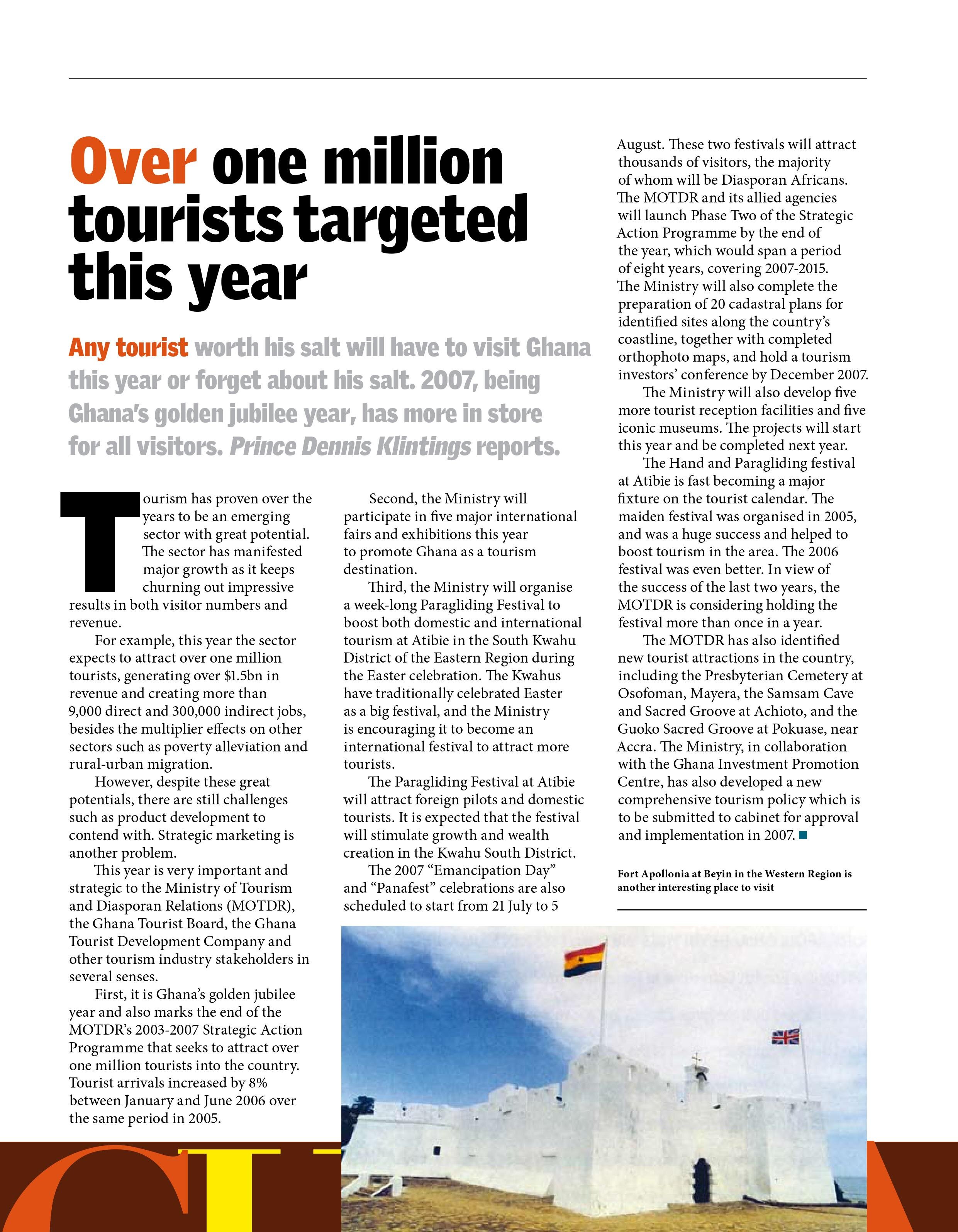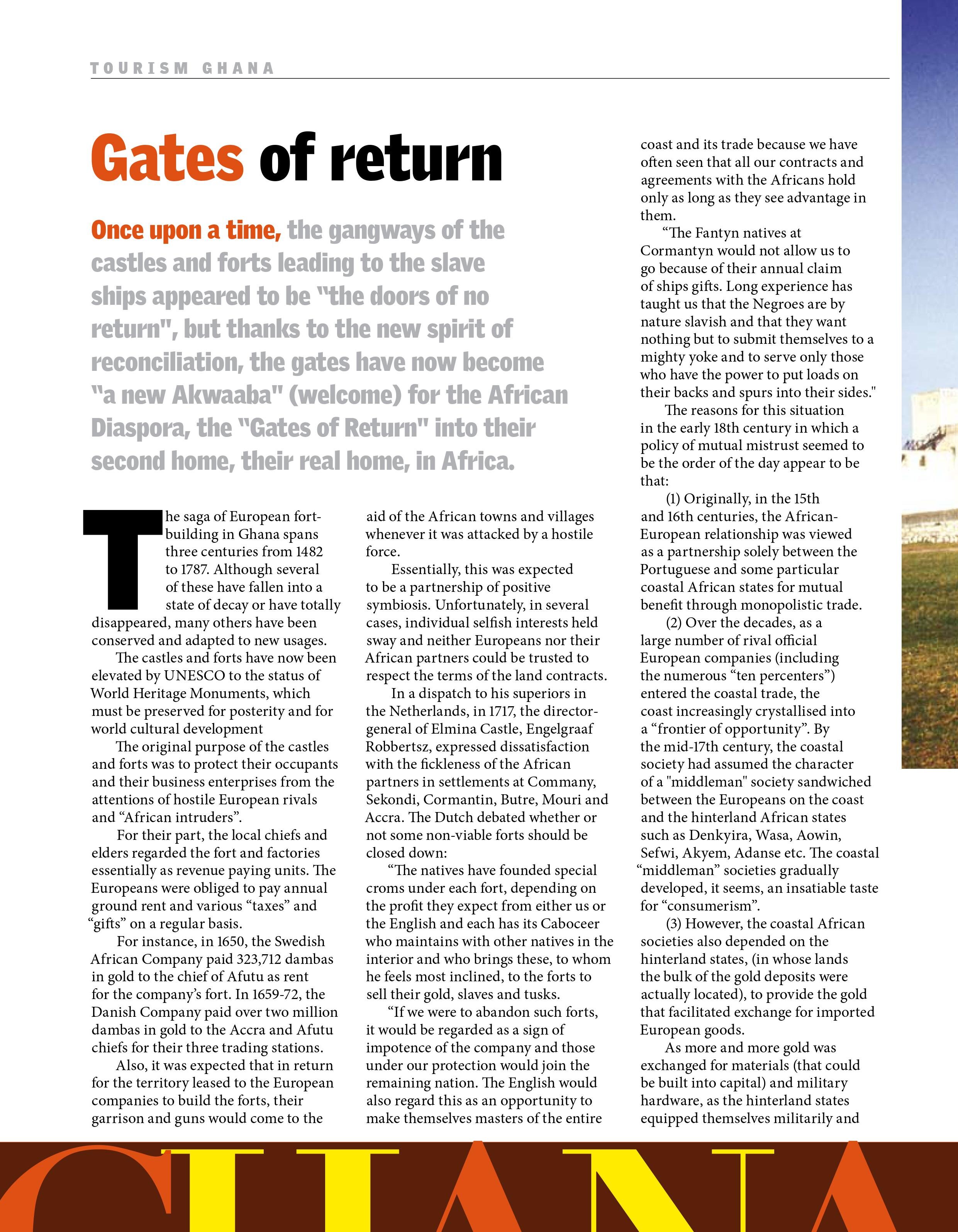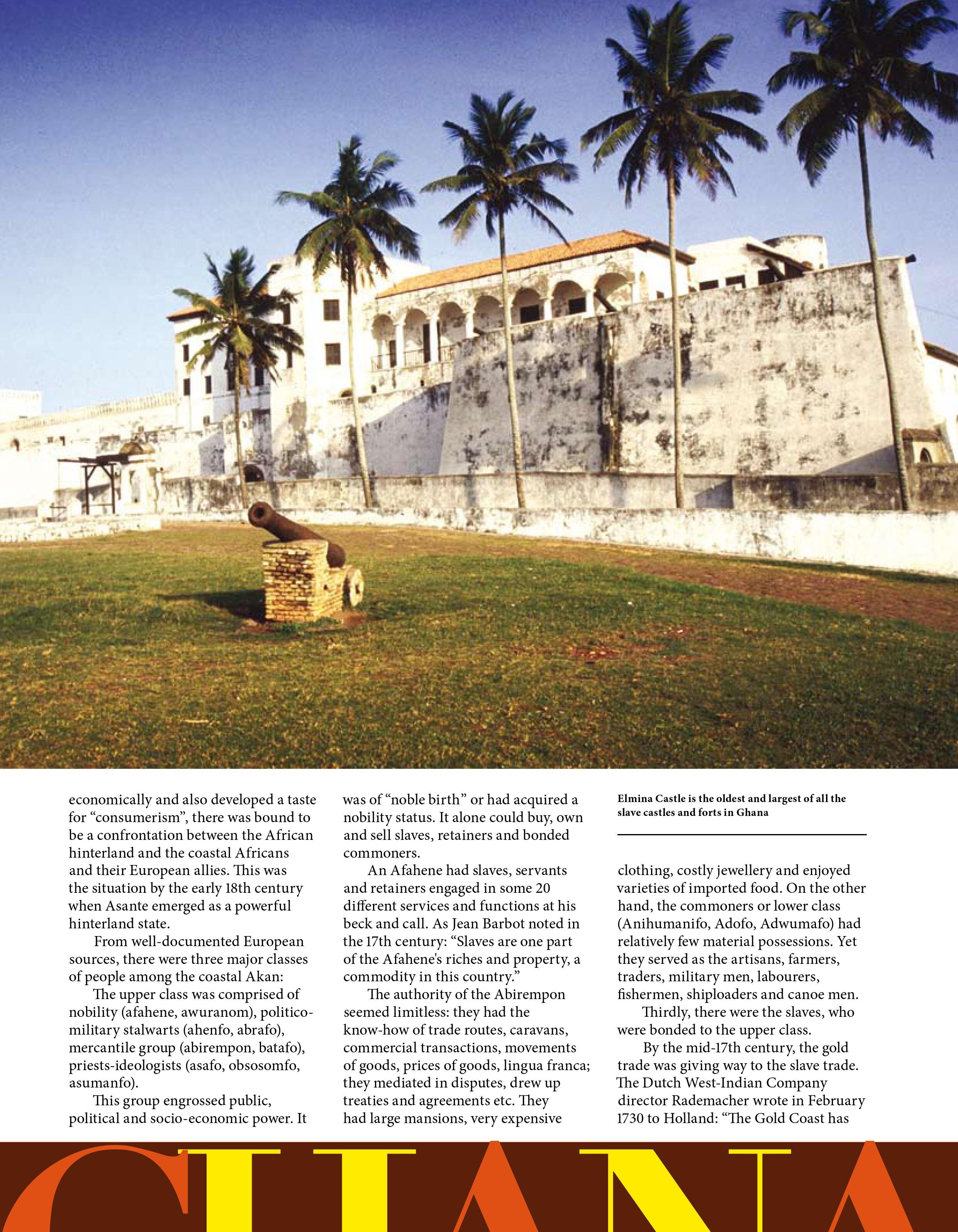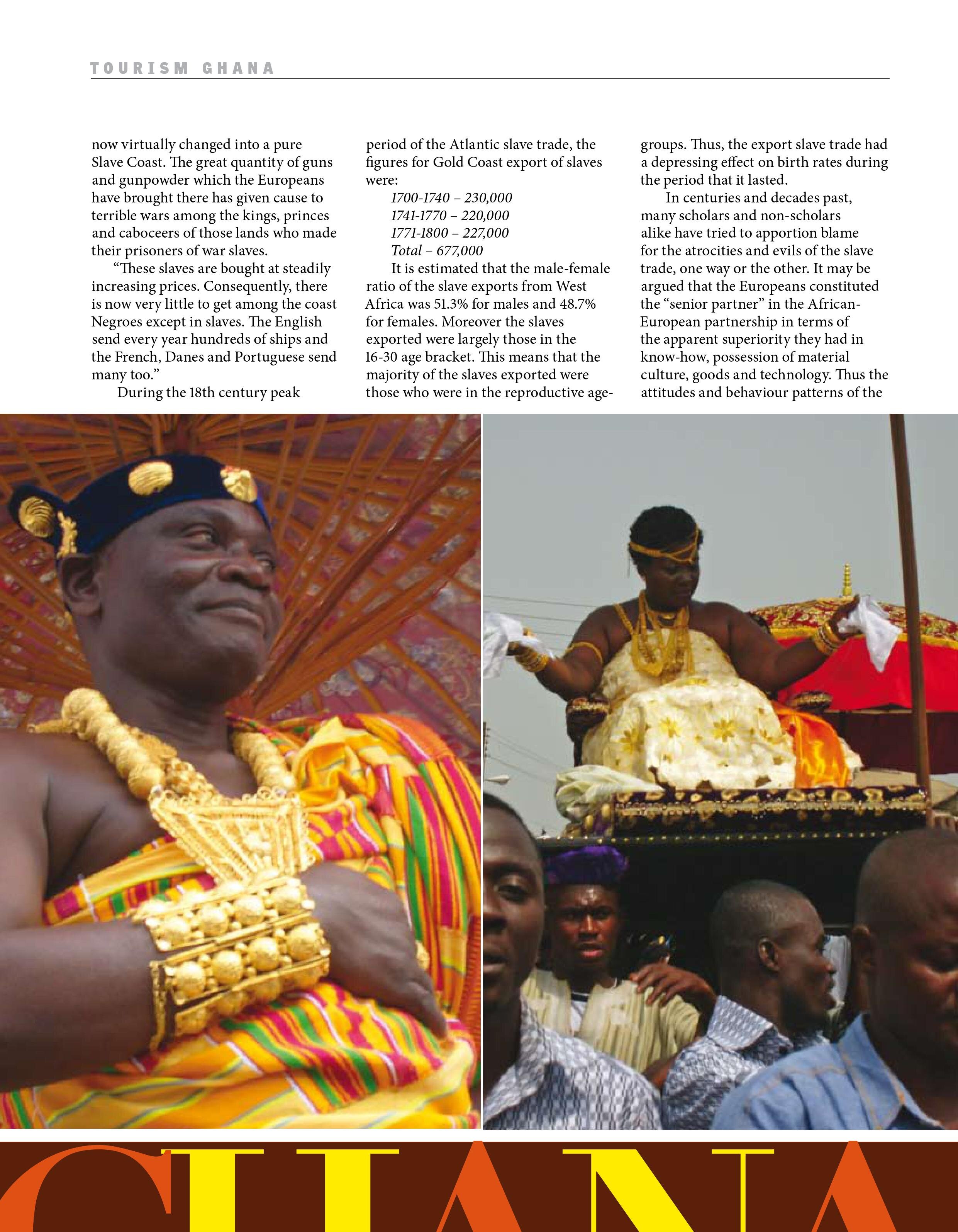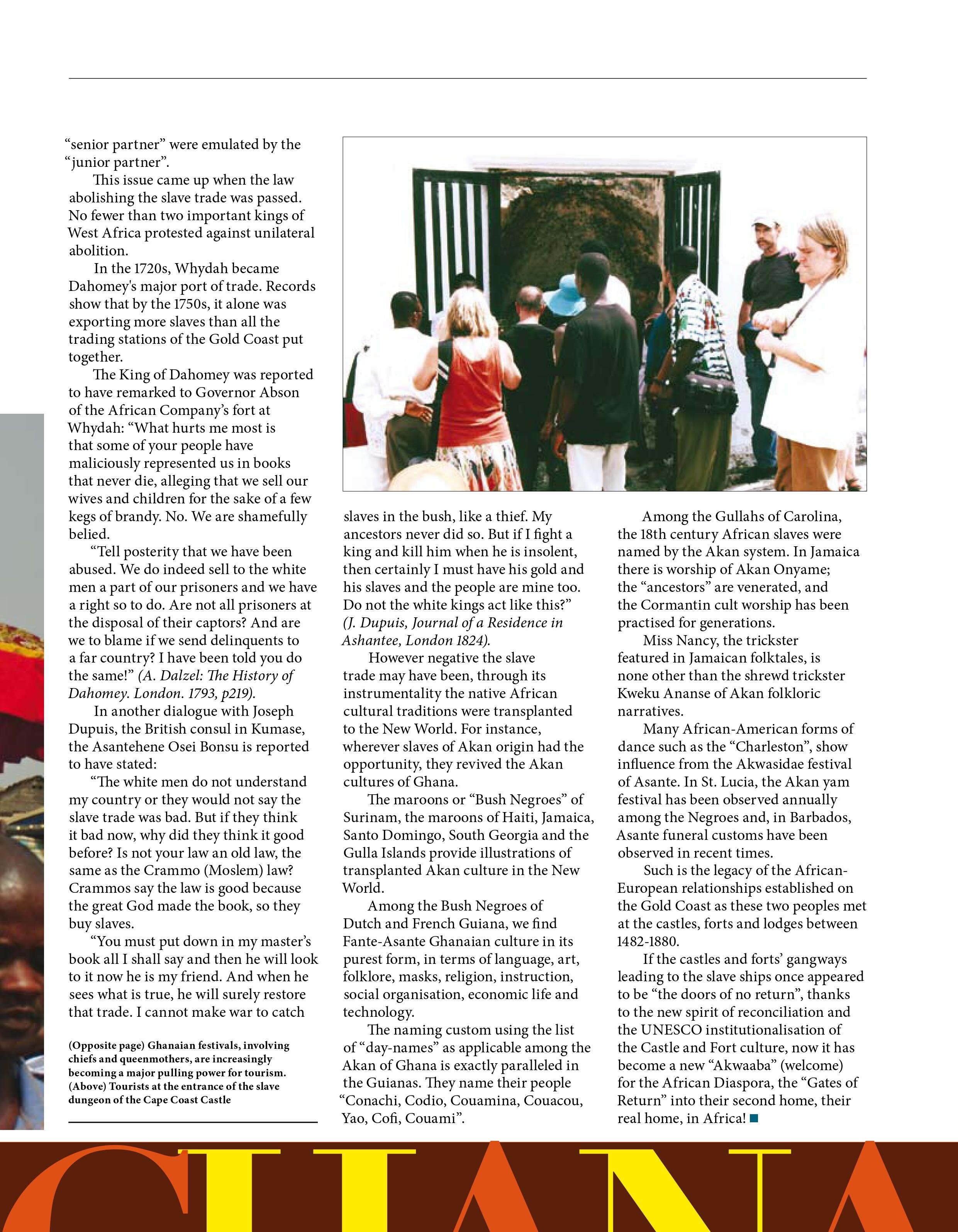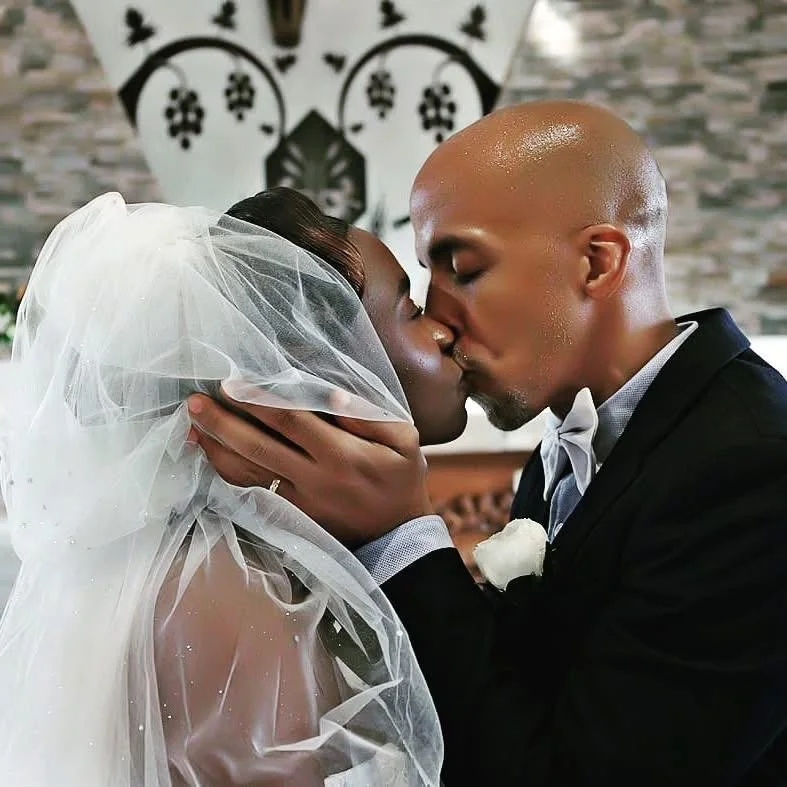
WOMEN'S HISTORY MONTH FEATURING BALANTA WOMEN: TRIMECHIAH LYNETTE ROGERS

Trimechiah Rogers.JPG

Today's women's history month feature is Trimechiah Lynette Rogers. Trimechiah, or Meca as close friends and family call her, was given her name by her mother and maternal grandmother. While not directly a biblical name, the ending of her name, "iah" is frequently found in the Old Testament of the Bible. The literal translation of her name means three eyes. The third eye (also called the mind's eye or inner eye) is a mystical and esoteric concept of a speculative invisible eye, usually depicted as located on the forehead, which provides perception beyond ordinary sight. This literal meaning resonates deeply with Trimechiah.  Professionally co-workers and colleagues refer to her by her last name, Rogers, which is her preference, depending on who’s addressing her.

Trimechiah currently resides in Baltimore, Maryland but was born and raised in Norfolk, Virginia. She has worked in Law Enforcement for the past fourteen years.  Currently, she serves on a special operations team as a Certified Hostage Negotiator.  Trimechiah views learning as a continuous, lifelong journey. Her formal education prepared her for a present career; this educational journey began at Baltimore City Community College, where she obtained an Associate of Applied Science Degree as a Microcomputer Specialist. She continued her studies and received a Bachelor of Science Degree in Special Education from Coppin State University. After a break, Trimechiah went back to school and obtained a Master of Science Degree in Criminal Justice also from Coppin State University. In addition, she has a post-graduate certificate in Business. Her academic and professional credentials are extremely impressive. However, she also dedicates equal time to serving others and serving the community.

While in college, Trimechiah became a member of Sigma Gamma Rho Sorority, Inc. She is still a highly active member of the organization and has served in various leadership positions.  She is also a member of the Order of the Eastern Star and is involved in her faith community. Besides her employment and community service activities, she also runs a small business specializing in tax preparation, developing professional documents, editing, tutoring, and consultation.

For fun, Trimechiah enjoys playing and watching sports; a big-time basketball fan, the NCAA men's and women's tournaments, and the NBA playoffs are a fascinating part of the sporting calendar. In addition to watching sports Trimechiah enjoys travel and engaging in intellectual conversation.  She also loves to learn new things, read and watch documentaries that expand her knowledge base.

Trimechiah has always wanted to know more about her ancestry.  It happened that during a trip to Ghana in 2011, she had the opportunity to meet and speak extensively with Dr. Ericka Bennett of Washington, D.C.  Dr. Bennett was at the time living in Ghana and serving as Director of the W.E. B. Dubois Center in Accra.  During her meeting with Dr. Bennett, they discussed many things, but one topic that they discussed moved her into action. That topic was discovering exactly where in Africa Trimechiah’s roots were.  Upon her return, she decided to take the African Ancestry DNA test and trace her maternal and paternal ancestry. She had her father take the paternal test, and she took the maternal test.  When the results were returned, she discovered that her maternal ancestry was 100% Balanta and her paternal was Yoruba. Learning that she had Balanta ancestry on her maternal side was somewhat of a shock as Trimechiah had spent considerable time in Ghana and learned about some of their customs and traditions. However, she has since been on a path to discover all the information she can about her Balanta Ancestry.  When asked what she has learned about her Balanta Ancestry so far Trimechiah states,

"I have learned that Balanta people are one of the largest groups/tribes in Guinea Bissau.  They are proud people and fierce fighters.  This resonates with me because I am them and they are me.  I am ecstatic to know where I come from; it gives me proper identity.  I do not have any problem fighting for what is just."

As one who has always identified with being African, Trimechiah rejects the labels of African American and Black and chooses to connect her identity with that of the African global community. She embraces the ideals of Pan-Africanism and desires to see them put into practice. Part of that involves breaking down any barriers between Africans on the continent and those in the diaspora.

Trimechiah looks forward to one day very soon making her pilgrimage to the land of her ancestors and is currently making plans to do so. In the meantime, she is learning all she can and finding as many ways as possible to contribute to work being done to support the Balanta people worldwide.

Women's History Month Featuring Balanta Women: Spectra Amanuri

Spectra Amunari.JPG

Women's History Month Featuring Balanta Women: Spectra Amanuri

Spectra is a woman of many interests, skills, and talents; for years now, she has splendidly blended her passion with her intuitive gifts.  She has helped people heal and grow into the best version of themselves as a Certified Hypnotherapist, Advanced EFT Practitioner, Kemetic Reiki Healer & Past Life Regressionist. The ability to help people overcome past traumas, break addictions, and develop healthy and productive habits versus destructive ones is something that her therapy provides.  Spectra became interested in hypnotherapy after successfully utilizing hypnosis to break her addiction to clove cigarettes.  While admittedly not an obsessive smoker, she did not like the idea of being bound to anything.  To quit smoking, a friend suggested she try hypnotherapy, and after one session, she was freed from her addiction. After overcoming her habit, she decided to learn the art and science of hypnotherapy so that she could help other people.  After dedicating herself to intense learning and study in one of the best therapy schools in the country, Spectra became certified to help others. Healing from traumas and breaking addictions is something that Spectra believes every person of African descent in America could benefit from as we are all victims of generational trauma. She believes that this healing modality could be utilized in our repair.  In addition to her passion for helping others, Spectra enjoys travel, music, concerts, festivals, the outdoors, and connecting with nature.

Originally from Southern Illinois, Spectra has been living on the West Coast for most of her adult life. She enjoys the weather and the opportunities she has been afforded in her current locale.  Like all of us, Spectra has always had a longing to know precisely where her African roots were.  To learn that, she decided to begin by tracing her father's ancestry. However, taking the test and learning her ancestry was at the time bittersweet. As soon as Spectra ordered the test from African Ancestry, her father became ill. Soon after he was diagnosed with pancreatic cancer. He took the test while he was in the hospital undergoing treatment. Sadly, he would pass away a short time after taking the African Ancestry test. He would not live to learn the results. Once Spectra received her results and learned she was Balanta, she wanted to share with her paternal relatives. She unexpectedly found that many of her family were less than enthusiastic upon discovering their ancestry; she knew her father would have been overjoyed with the discovery. However, this did not discourage her from desiring to know everything she could learn about her ancestry. She has been on that quest ever since discovering her ancestry.

Spectra's name is derived from the concepts of the light spectrum, visible and invisible and from the Kemetic concept of Amun. Claiming and affirming yourself versus having someone else decide your path for you has been a hallmark or Spectra’s journey thus far, and something that connects her with her father and a trait that connects her with her Balanta family worldwide.

You can learn more about Spectra and her hypnotherapy practice by visiting,  Transcendence Hypnotherapy .

Women's History Month Featuring Balanta Women: Jazzy Ellis

Jazzy Ellis 2.jpg

Today's feature for Balanta Women's History Month is Jazzy Ellis

Jazzy is a professional stunt actor who has starred in a host of films and television shows. Jazzy has worked as a stunt double for actresses such as Lynne Whitfield, Sania Lathan, and Cynthia Ervieo. She has worked on popular television series such as Greenleaf, Lovecraft Country, and The Haves and the Have Nots, to name a few.  Jazzy is also a trained and highly skilled martial artist, which is invaluable in her current profession.  However, Jazzy did not always aspire to work in the television and film industry. Her first career choice was to become a Medical Doctor. Jasmine attended Princeton University, where she majored in Religious Studies and minored in Spanish.  She planned to study a field in which she had a deep interest as an undergraduate and then attend medical school after completing her undergraduate degree. Her deep interest in religion was sparked by a longing to understand the world beyond what she knew and explore new ways of understanding. Jazzy grew as a Muslim and a registered believer in the Nation of Islam; she was deeply rooted in the teachings of The Most Honorable Elijah Muhammad.  Her desire to continue learning about religions, faith, and spirituality is something that she still possesses.  After college, Jazzy elected not to attend medical school and began teaching. The economic downturn of 2008 sparked another change in direction for Jazzy, one that led her into her current profession of acting and working as a stunt double.

Jazzy Ellis 1.jpg

While always having a deep desire to know from where she came, she was inspired to take the African Ancestry DNA test by a close friend. Jazzy's friend shared one day shared with her that she had not only learned that she descended from the Mende people of Sierra Leon but that she had also recently received citizenship in that country.  This revelation led Jasmine to decide to trace her ancestry and learn as much as possible about where she came from.  Also, to one day possibly obtain citizenship in the land of her ancestors.

Upon discovering her ancestry, Jazzy was thrilled beyond words. She immediately went about trying to learn everything she could about the Balanta people. The Balanta B'urassa History and Genealogy Society of America has been a tremendous resource in helping Jazzy discover information about the Balanta people. She and her family also plan to travel to Guinea Bissau this spring.

Until then, Jazzy is staying extremely busy with two new projects coming out this Summer.  Those films are, The Suicide Squad and Tomorrow War.  Please support these projects when they hit your local theater.   You can also review a list of projects Jazzy has worked on her IMDb page, http://www.imdb.me/jazzyellis.

 Jazzy and actress Sanai Lathan

 Jazzy and actress Sanai Lathan

Women's History Month Featuring Balanta Women: Melanie "Duturna" Young

Duturna profile.JPG

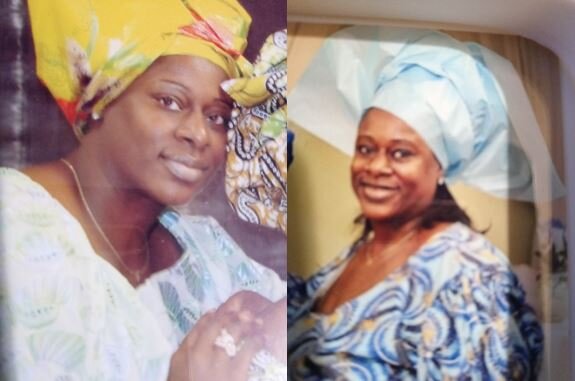
Today for Women's History Month, we are featuring Melanie [1] (Duturna) Young. Melanie is a native of Jersey City, NJ. She is a Veteran of the US Navy and presently works as a Clinical Intake Specialist. Working with Military Veterans and assisting them in identifying and utilizing resources and the necessary services to meet their unique needs is Melanie's passion. It is also a mission that her military service well prepared her to undertake. In addition to working with veterans, Melanie works a travel agent part-time. One of Melanie's near-term career aspirations is to create a business that combines her love of travel and her passion for aiding military veterans. This business would focus on hosting wellness retreats for veterans worldwide.

Some of Melanie's hobbies include collecting crystals/stones, candles, and incense. She also enjoys learning about other cultures, particularly the importance of food and its role in different cultures.  Since learning of her ancestry, she has also began studying African Spirituality and African Traditional Religions.

Melanie's Balanta ancestry is on her maternal side. She has one brother and two sisters, and a 13-year-old son. Both of her parents are also still living. Melanie learned of her Balanta ancestry this past September. She was motivated to discover her heritage after having conversations with her fiancée’s family about their lineage and ancestry, one day, she was asked about her own. Her inability to provide answers about her family's origin and ancestry set Melanie on a journey to discover her past.  She needed to know exactly where her story began.  That is when she decided to use African Ancestry services to pinpoint where her family did, in fact, originate.  When Melanie received her DNA test results and discovered her Balanta ancestry, she was overcome with joy.
 Melanie stated, "I cried; I was filled with a lot of emotions, to finally find a part of me that I didn't know was missing."

 Since learning of her Balanta ancestry, Melanie has been intent on learning as much as she can about the Balanta people. When asked what she has learned so far about the Balanta and the country of Guinea Bissau, Melanie stated.  "How they helped Guinea Bissau gain their independence, how they were initially colonized, and what the other countries the Balanta people may have come from before settling in Guinea-Bissau."

Melanie plans to one day soon visit Guinea Bissau and see the land and the people for herself. Being able to connect and with the land and the people and experience the culture firsthand and connect those experiences with her own is something she hopes to achieve one day very soon.   

[1]  Melanie received the Balanta name of Duturna during the naming ceremony in January of this year. The name Duturna means Duturna means - “shame is heaped upon those who captured your ancestor. “

Will Guinea Bissau's "Decade of Return Initiative" Be the Next Big Boon For This Small African Nation?

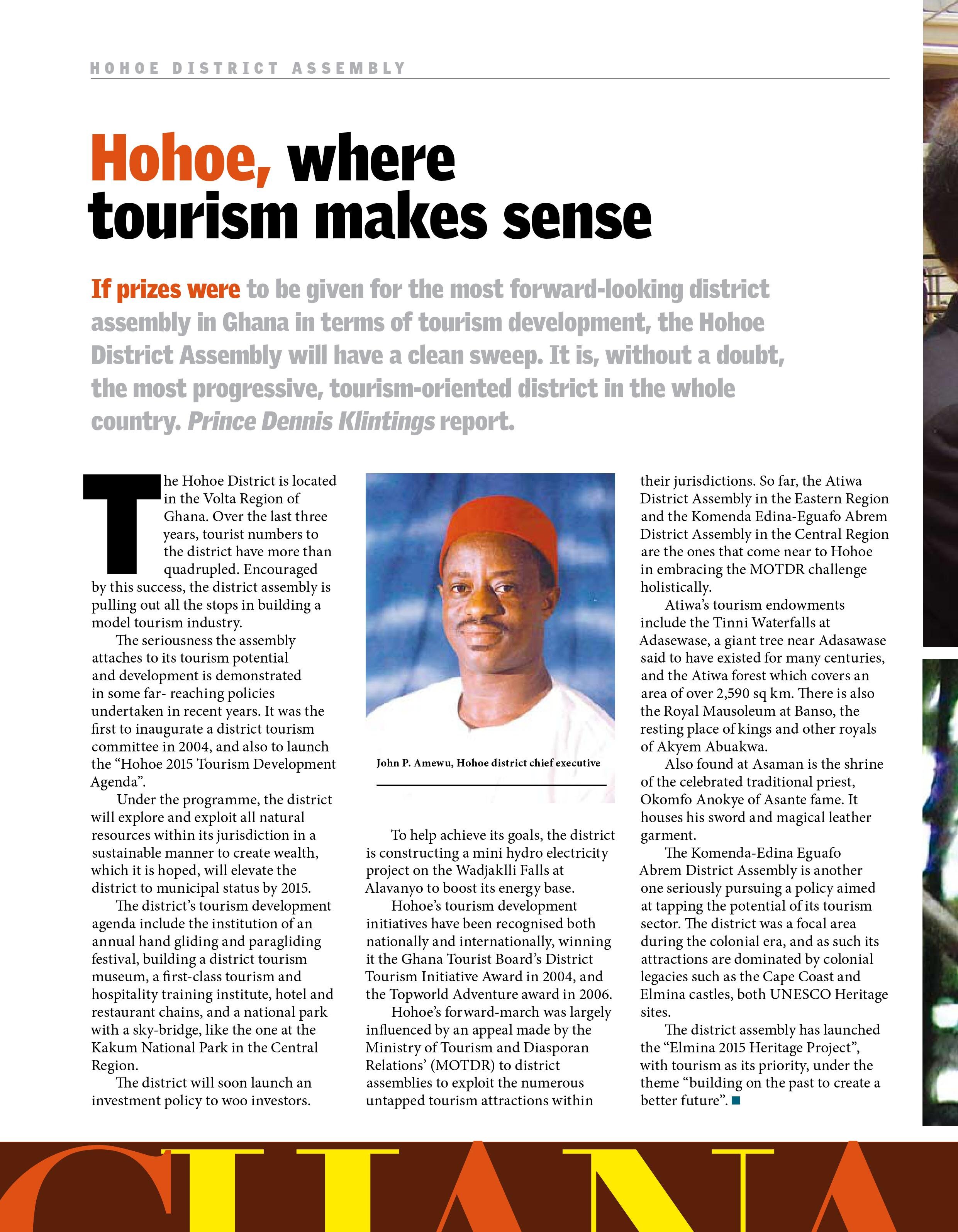
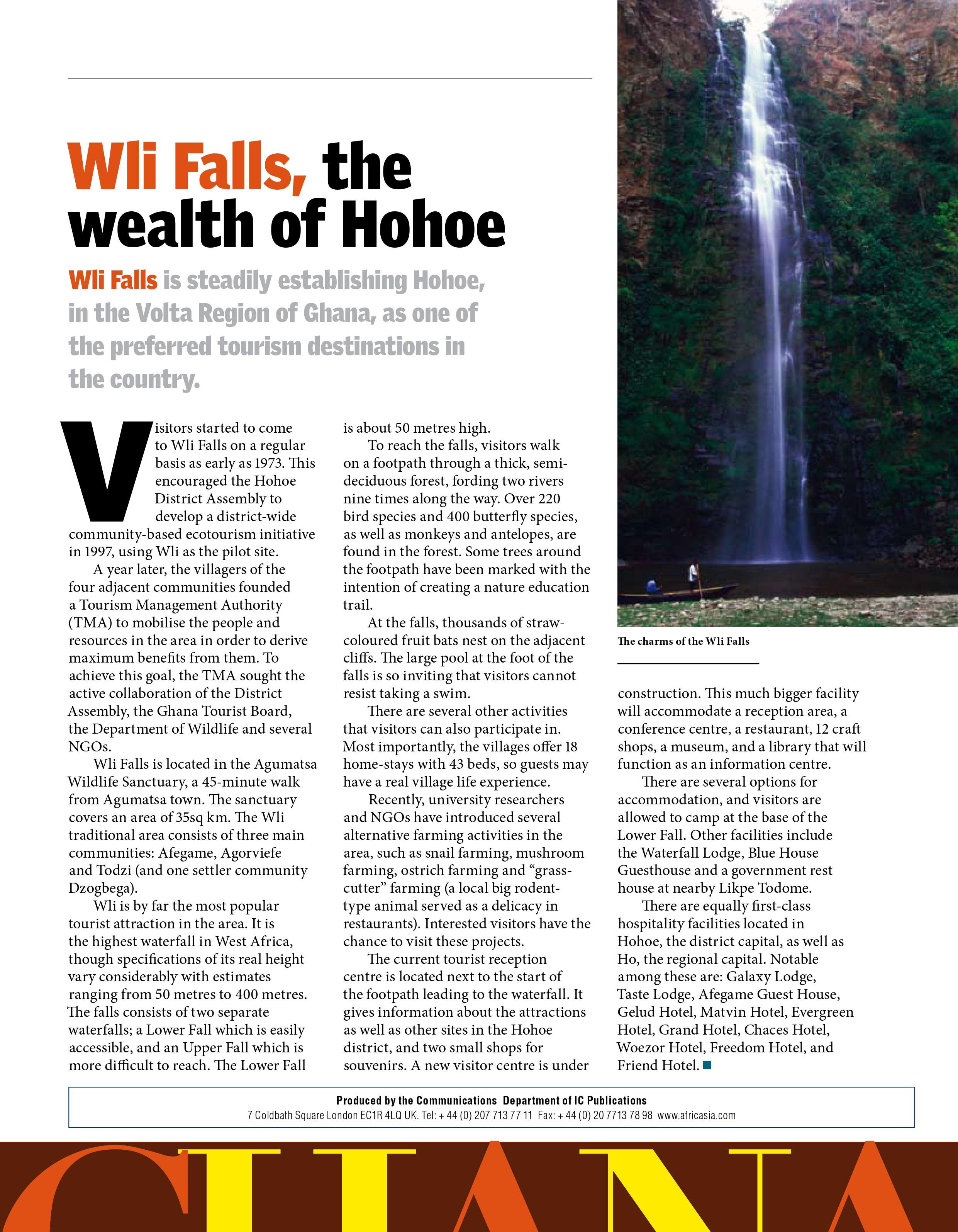
The Ghana Tourism Authority predicted its 2019 Year of Return initiative would attract 500,000 extra visitors. Official data from January to September 2019 showed an additional 237,000 visitors - a rise of 45% compared with the same period the previous year. Minister of Tourism Barbara Oteng Gyasi said the Year of Return had injected about $1.9bn (£1.5bn) into the economy. Now, Guinea Bissau is launching its “Decade of Return” Initiative. Will it have the same economic and social impact?

Discover Guinea Bissau.JPG

From 1668 to 1843, 126,000 people were shipped from the slave trading port of Bissau on the coast of modern day Guinea Bissau, West Africa to the Americas. Records show that 6,400 people were brought to the Gulf Coast, 10,000 people were brought to the port at Charleston, South Carolina, 4,500 people were brought to Chesapeake, and 1,400 people were brought to New York. On February 23, 2021 Nhima Sissé, Secretary of Tourism of Guinea Bissau officially welcomed the descendants of these people to return to their homeland to officially launch the Guinea Bissau Decade of Return Initiative.

According to Siphiwe Baleka, President of the Balanta B’urassa History & Genealogy Society in America (BBHAGSIA) and the brain behind the Guinea Bissau Decade of Return Initiative,

“From 1761 to 1815, records show that 6,534 Binham Brassa (Balanta people) were trafficked from their homeland and enslaved in the Americas. That’s an average of at least 121 Balanta per year. If you include Baga, Banhun, Biafada, Bijago, Bissau, Cacheu, Cassanga, Floup, Jola, Manjaco, Nalu, Papel, Sape, Bambara, Fula, Gabu, Geba, Jalonke, Mandinka and Mouro, it is estimated that in the United States there are as much as 500,000 people who are descendants of people taken from the ports of Ziguinchor, Cacheu, Bissau, Geba, St. Louis (Senegal). There are even more such people in the Caribbean Islands and in Brazil.”

Baleka believes that the return of these “lost sons and daughters” of Guinea Bissau is exactly what is needed by the people on both sides of the Atlantic.

GUINEA BISSAU

Guinea Bissau is a small country on the West Coast of Africa with just under two million people, ranking it 150th in the world in terms of population. The World Bank starts its country profile for Guinea Bissau by stating, "Guinea-Bissau, one of the world’s poorest and most fragile countries. . . .“ According to the International Monetary Fund (IMF), Guinea-Bissau's GDP per capita ranks 174th out of 192 nations. The 2019 Human Development Index (HDI) of the United Nations Development Programme (UNDP) ranked Guinea Bissau 178th out of 189 countries. More than two-thirds of the population lives below the poverty line on less than $2 per day. Combined life expectancy for men and women is just 48.7 years. The World Food Program USA estimates that 27.6 percent of the country suffers chronic malnutrition. One in seven children still die before reaching the age of 5 and more than a quarter of all children under 5 are stunted.

With a Gross National Income of US$570, Guinea-Bissau is the 12th poorest country in the world. The economy of Guinea Bissau depends mainly on agriculture; fish, cashew nuts, and ground nuts are its major exports. Cashews account for about 90% of the country's exports and constitute the main source of income for an estimated two-thirds of the country's households. According to the government, around 80% of the rural population work in the cashew harvest.

Guinean economist Aliu Soares Cassama stated, “Our economy has had a deficit in the trade balance for a long time. In other words, we import more and export less. We know that economic agents do not have purchasing power due to the total paralysis of the State, and this situation will further complicate the economic weakness that the country is experiencing.”

When the COVID 19 pandemic hit and the world went into a global lockdown, Guinea Bissau was hit hard. The decision to put the entire population in quarantine led to runaway inflation. There was a food shortage and people could not afford to buy what food there was. The risk of starvation grew daily for as many as 60% to 70% of the people of Guinea Bissau.

“We tried to call the attention of the world, and particularly the United States, to what was happening in Guinea Bissau. We made a humanitarian crisis intervention video and a GoFundMe campaign,” said Baleka. “We even published AN OPEN LETTER TO THE UNITED STATES CONGRESS, THE CONGRESSIONAL BLACK CAUCUS, AND THE UNITED STATES AGENCY FOR INTERNATIONAL DEVELOPMENT (USAID) pleading with them to send a plane filled with food. Our appeals fell on deaf ears.”

In the end, it was only BBHAGSIA that took any action, raising money and distributing food in nine rural villages in Guinea Bissau. “Guinea Bissau just isn’t on the radar for Americans,” Baleka said.

GUINEA BISSAU AND THE UNITED STATES

The United States does not currently have an Embassy in Guinea Bissau. According the the US Government’s Integrated Strategy for Guinea Bissau,

“the USG can help integrate Guinea Bissau into the greater regional and global economy. . . . The United States has interests in Guinea Bissau despite the country’s small size. . . . In a region susceptible to epidemics, poor public health infrastructure and personnel leave Guinea Bissau vulnerable to emergencies. . . . The lack of a permanent U.S. diplomatic presence in Guinea Bissau constrains the promotion of our interests there. . . .”

For fiscal year 2020, the only US foreign aid to Guinea Bissau was $150,000 from the Bureau of African Affairs for International Military Education and Training.

Nevertheless, on January 29, 2020 the U.S. Ambassador to Senegal and Guinea-Bissau, Tulinabo Salama Mushingi attended the launch of the USDA’s Food for Progress regional cashew value chain project, also called the Linking Infrastructure, Finance, and Farms to Cashews (LIFFT-Cashew). The program implementing a $38 million, six-year project in The Gambia, Senegal, and Guinea-Bissau will enhance the regional cashew value chain to improve the trade of processed cashews in local and international markets. However, this project only reinforces Guinea Bissau’s fundamental problem of mono-crop farming for export. And when the country went into lockdown, it had no effect on helping the people.

ENTER SIPHIWE BALEKA

In 2003, Ras Nathaniel Blake (whose named was legally changed to Siphiwe Baleka in 2008) was working as a journalist in Addis Ababa, Ethiopia covering events at the African Union and the Economic Commission for Africa.

Ras Nathaniel Ministers of Finance ID.JPG

“I started attending meetings with the Ministers of Finance and Planning and studying their proposals to increase capital inflow and reverse the brain drain,” says Baleka. “Some of these African leaders decided that cultural tourism could be a major engine for Economic growth. But their plans were targeting the wrong people and were very wasteful. Missing was outreach to the descendants of people who were trafficked in the criminal European trade of African people. I decided to help the governments truly value and focus on these members of the African diaspora.”

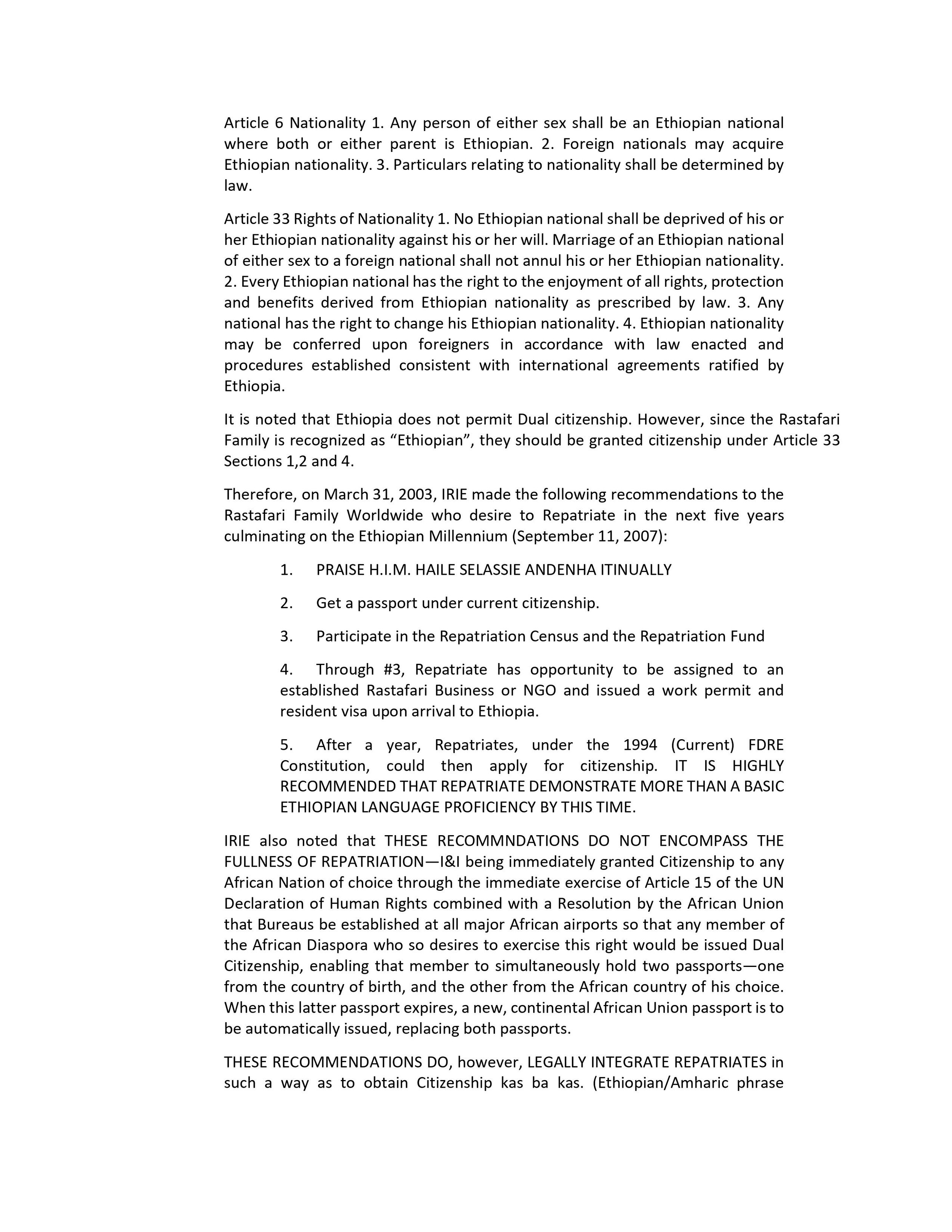
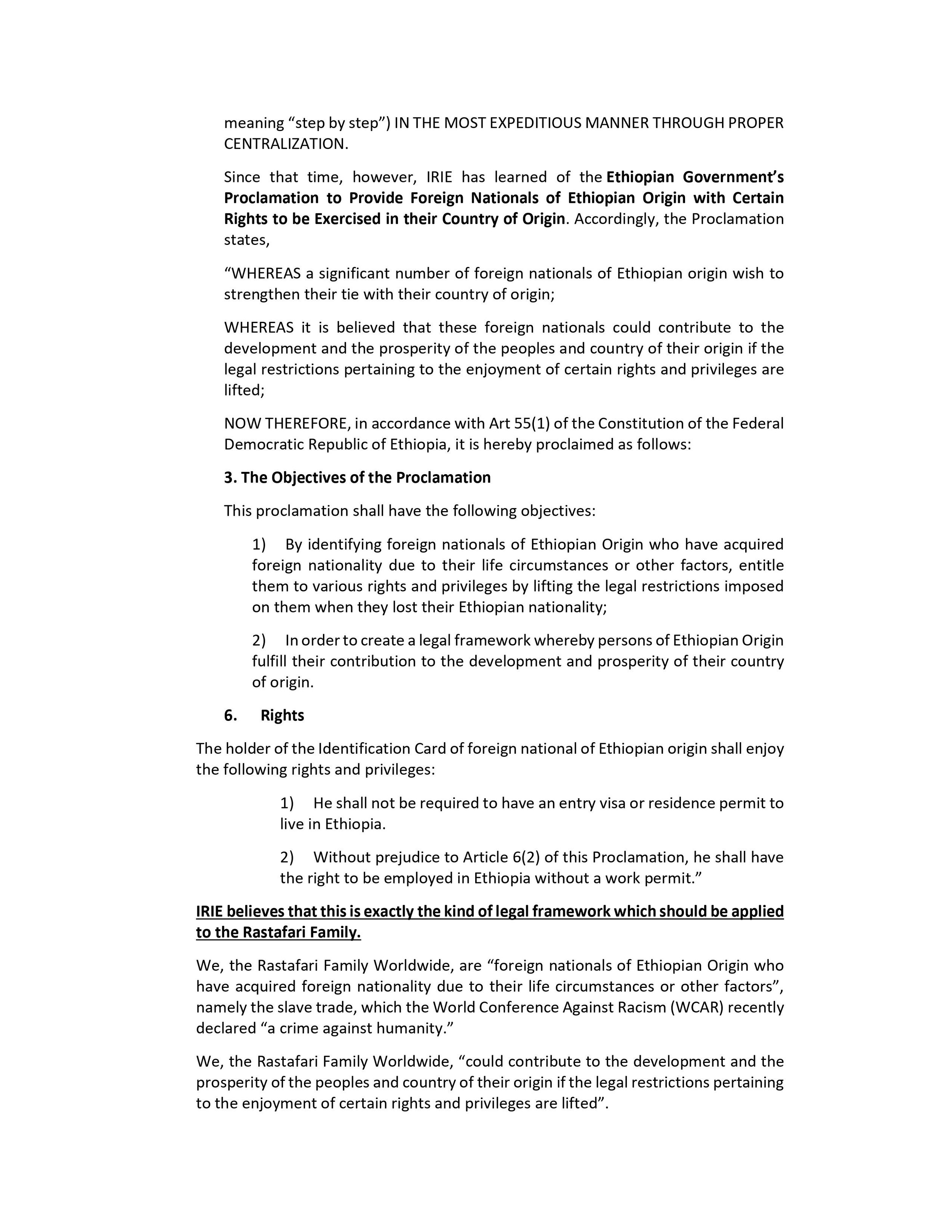
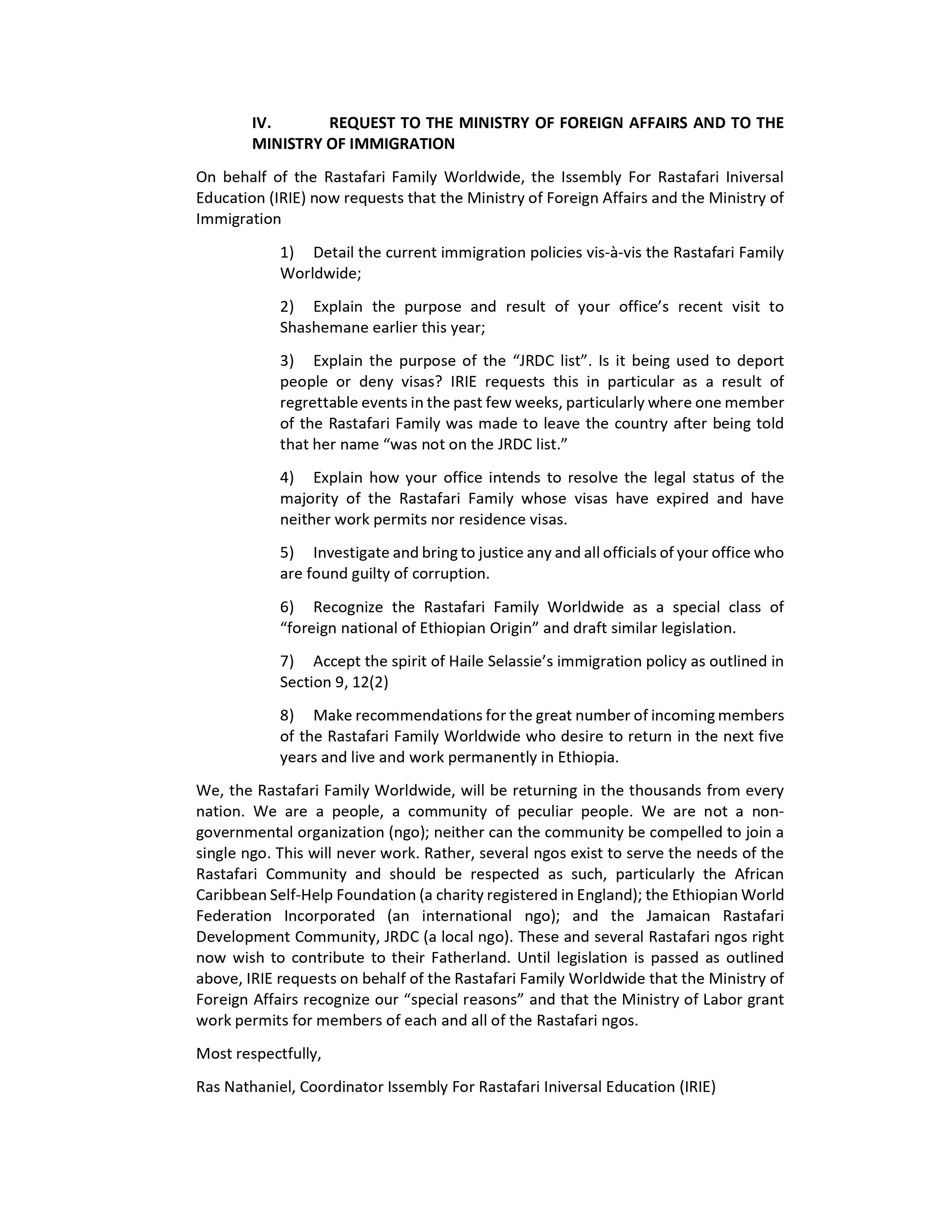
At that time, the repatriated Rastafari community was suffering from immigration issues, even though some of them had been in Ethiopia for more than twenty years. After immigration officials arrived in the Shashemane community to investigate, Baleka followed up by studying Ethiopian citizenship laws. He drafted citizenship recommendations that would recognize the repatriates as “Foreign Nationals of Ethiopian Origin.” (see below) Fourteen years later, Baleka’s recommendations were finally adopted by the Ethiopian government and they issued residence permits, a moment that was celebrated as a major step towards the community's recognition and integration.

Baleka also sent recommendations on behalf of the entire African Diaspora to the African Union and attended the African Union Grand Debate held in Accra, Ghana in 2007.

FIHANKRA AND AKWAABA ANYEMI IN GHANA: A CASE STUDY

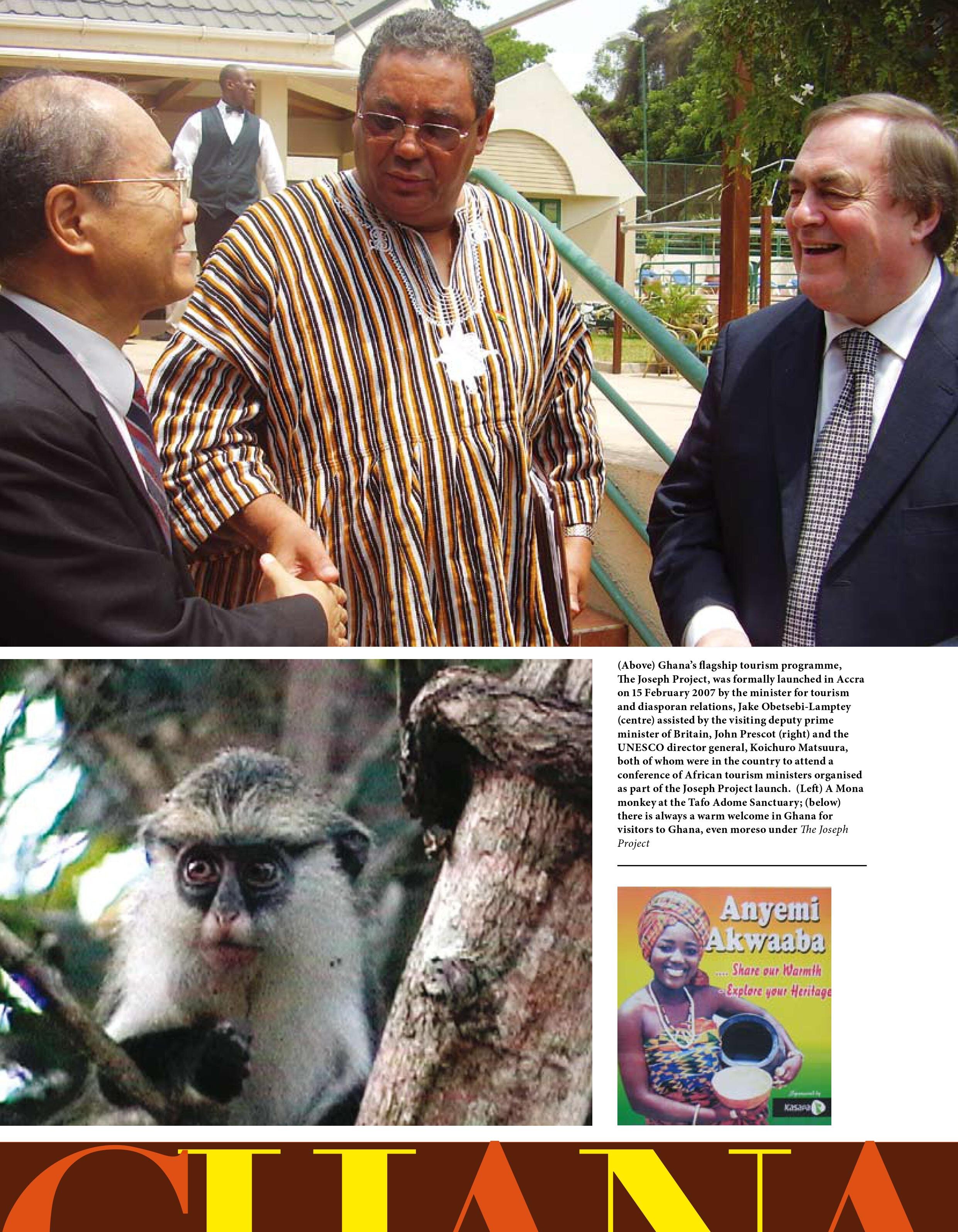
Ghana was one of the countries in 2003 that realized the impact that cultural tourism could have on the country. Jake Obetsebi Lamptey, the country's Minister of Tourism and Diasporan Relations in Ghana at the time, stated,

“We're interested in all the Africans in the Diaspora who were affected by the slave trade. And that includes in North America - not just the United States, but also Canada. It includes the whole of South America - who have big African populations - the whole of the Caribbean, and then those who went through the Western Hemisphere and are now in Europe. . . . Let them come back [to Ghana]. Let them get a taste and say okay, let me see something else about Africa. Let me find out where in Western Africa my people originally came from, and then themselves make the pilgrimages to those places.”

Ghana’s Ministry of Tourism and Diaspora Relations (MOTDR) created a 2003-2007 Strategic Action Programme that aimed at raking in about 4.5 billion dollars by 2007, and was geared towards putting the necessary infrastructures in place to make Ghana a first choice tourist destination. The plan included:

Creation of the Tourism Press Corps (August 2003): A special group of journalists were selected to inform and educate the public on tourism and related issues in Ghana.

Introduction of tourism and hospitality programmes of study in more of Ghana’s tertiary institutions to develop tourism human resource. An example is the Bachelor of Arts Degree Programme (Culture and Tourism) introduced in KNUST (2003).

Introduction of the National Chocolate Day (2006): To promote Ghana’s cocoa and consumption of cocoa products among Ghanaians.

Promotion of tourism to be added to Ghana’s Poverty Reduction Strategy (2005).

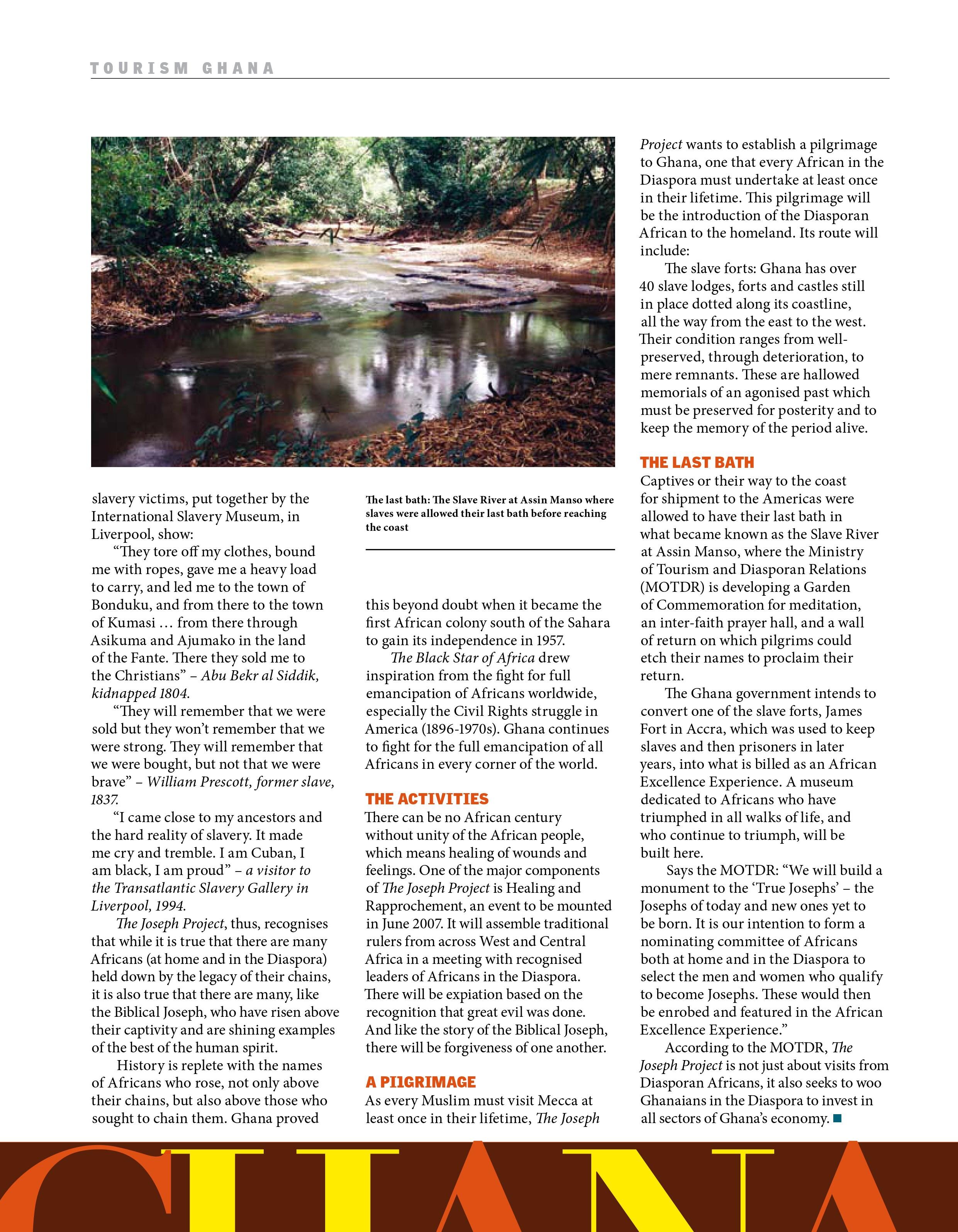
The construction and commissioning of the Assin Manso Slave Mausoleum and Reverential Gardens as Sites of Conscience. As well as the promotion of the Assin Manso Slave Route Project.

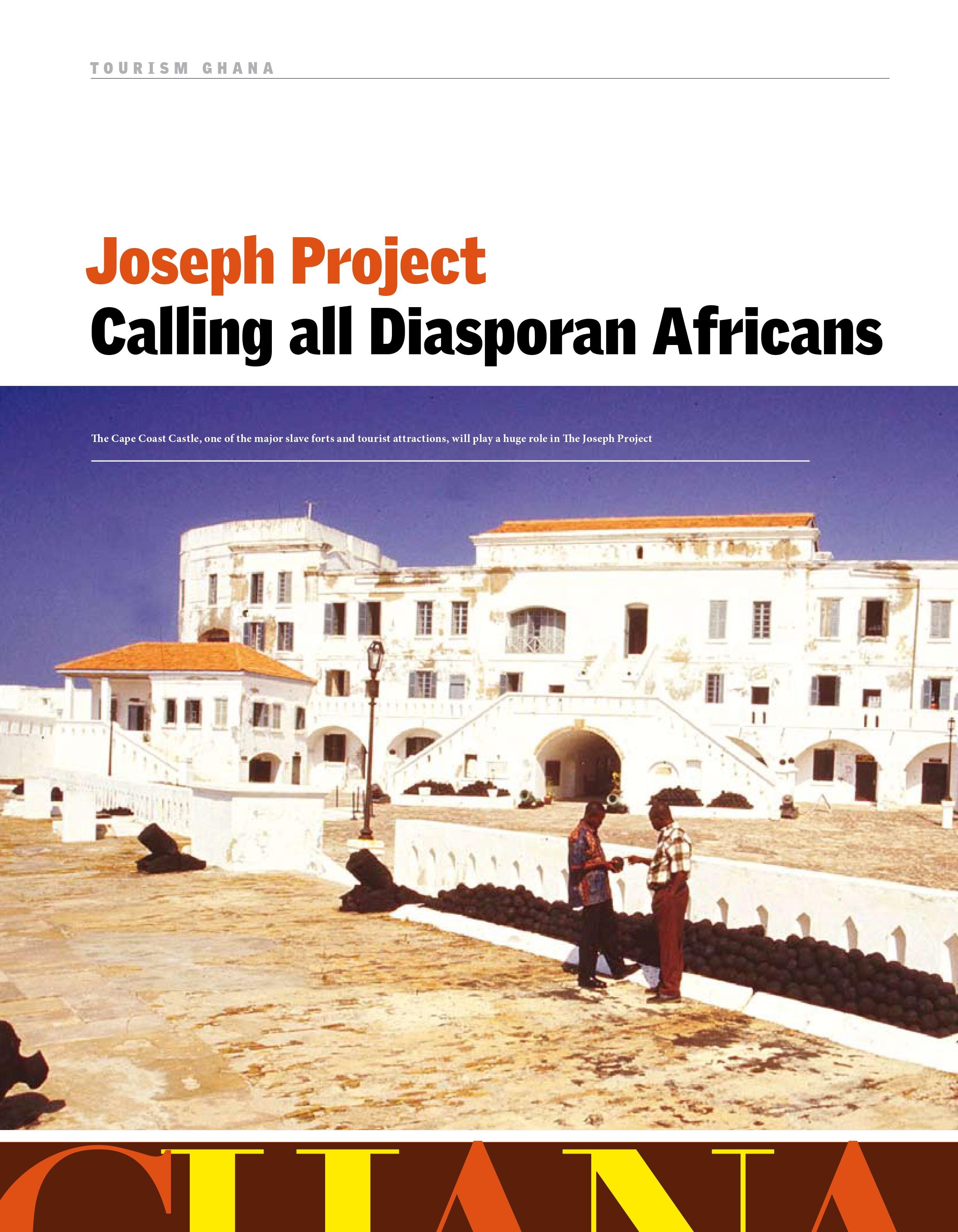
Ghana was ready to launch the Joseph Project in 2007 to coincide with the 200 year anniversary of the British abolition of the slave trade (1807) and the 50 year anniversary of Ghana’s independence (1957). Ghana had already passed their Right to Abode law offering people of African descent the opportunity to settle permanently in Ghana. (Note: many critics, complain, however, that legal technicalities make the process quite complicated.) Ghana created a marketing campaign utilizing the unfortunate data that between 10 and 28 million Africans are believed to have been shipped across the Atlantic between the 15th and 19th centuries from the Elmina Cape Coast Castle dubbed “The Door of No Return”. Ghana used this historical fact, along with the fact that W.E.B. DuBois, Martin Luther King, Malcolm X, Muhammad Ali, Maya Angelou and other African American celebrities had already visited Ghana to position itself as “The Gateway Back to Africa.” The 2007 Joseph Project was then marketed primarily to Afro-Brittans in England and her Commonwealth territories.

In response to criticism that Ghana was only seeking to get into the pockets of the African Diaspora as a source of revenue, a legitimate claim given the genesis of cultural tourism projects at the Economic Commission for Africa, Minister Lamptey, to his credit, emphasized the essential spiritual purpose of the project,

“With the launch, we're doing - essentially, we're doing a healing process because we feel that we're never going to get people coming together again until and unless we have put the spirits of our ancestors to rest. People are affected by violence, and no greater violence has been visited upon a people than the violence that our people suffered through capture, transportation and then what they suffered in the slavery here and post-slavery, and indeed, in many places where they're still suffering today.

So we want to start with a healing ceremony this year, and the healing ceremony will send a signal to the ancestors that the children and the grandchildren are now beginning the process of coming together.”

Minister Lamptey also highlighted the lack of education and knowledge about what happened to the lost sons and daughters of Africa,

“The Joseph Project, but it's part of a broader program called the Akwaaba Anyemi Program, which is welcome home brother or welcome home sister. And part of it, a major part of it, is teaching our people who the diasporans are. Because the colonials had a situation where - when the slave trade stopped, they drew a veil across it, as if it never happened. In our history books that we were - that our children were taught, there's about three lines about the slave trade, and that's all. You know, what they've been through, the struggles they've been through, we don't know about.”

The Akwamu people in Ghana, did remember, however. They knew that they sold their own brothers and sisters into slavery. The term Fihankra is a Ghanaian expression which means, “When leaving home no goodbyes were said.” Fihankra, then, refers to all Africans from the Diaspora who are descended from the trans-Atlantic slave trade. In December 1994, the Akwamu purified the skin and stool of Fihankra, the physical symbols which were purified to represent the apology given by several Ghanaian elders and the welcoming home of the Diaspora. The Akwamu also gifted land in Yeafa Ogyamu to represent their own personal atonement (for slavery). Promises to develop a fire station, police station, health facility, schools and various businesses were made. By 2006, Fihankra had become a disaster. Unfortunately, the sad history of that Fihankra land grant is a cautionary tale of what happens when economic development is prioritized over human development.

The Joseph Project was re-branded for 2019 as the “Year of Return” in order to commemorate the 400 year anniversary of the arrival of African people in the Jamestown colony in America. Ghana’s President Nana Akufo-Addo came to Washington DC in September of 2018 declaring and formally launching the “Year of Return, Ghana 2019” for Africans in the Diaspora, saying, “We know of the extraordinary achievements and contributions they [Africans in the diaspora] made to the lives of the Americans, and it is important that this symbolic year—400 years later—we commemorate their existence and their sacrifices.” US Congress members Gwen Moore of Wisconsin and Sheila Jackson Lee of Texas, diplomats and leading figures from the African-American community, attended the event. By December, Black Hollywood started its return. Ghanaian-Austrian actor Boris Kodjoe and Ghanaian-American Bozoma Saint John (formerly the Chief Branding Officer at Uber) hosted Christmas parties for an array of celebrities including the supermodel Naomi Campbell and actors Idris Elba and Rosario Dawson. By January, CNN had named Ghana as one of its 19 best places to visit in 2019. Lonely Planet organized a specific Year of Return tour.

By the end of 2019, the Year of Return had seen almost a million tourists, more than double what was expected, an increase of almost 50% from the previous year. US$1.9 billion dollars had been injected in the economy. On November 27, 2019, 126 African Americans and Afro-Caribbean, many of them members of the Rastafari community, were given citizenship.

Ghana citizenship.JPG

WHAT ABOUT GUINEA BISSAU?

“I was concerned about my ancestral homeland,” Baleka complained. “Every body was going to Ghana and then to Sierra Leone. People I know were getting citizenship in their ancestral homelands. Ghana was getting all this economic boost and development, and I was thinking, ‘What about Guinea Bissau?’ African Americans don’t even know about Guinea Bissau and the country was missing out on this opportunity. I wanted to help the Government get on board.”

And that’s exactly what Baleka did in January of 2020. He met with the then Secretary of Tourism Catarina Taborda and Secretary of Culture Antonio Spencer Embalo and explained to them a plan to launch Guinea Bissau’s “Decade of Return” Initiative. A great Africa Day 2020 Return to Guinea Bissau event was planned for May 25 to June 2, 2020 but then COVID 19 struck and the event had to be postponed. Meanwhile, a new administration came to power.

According to Baleka, “Things were moving in the right direction. I had given radio and tv interviews in Guinea Bissau explaining the importance of the Decade of Return. The Secretary of Sport, Dionisio Pereira, wrote a letter of invitation to Olympic Legend Jackie Joyner Kersee. Everyone was getting excited and then everything changed. When I went back to Guinea Bissau in December of 2020, I had to start all over again with the new administration.”

Baleka emphasized that Guinea Bissau had its own unique cultural attractions that would be of interest to the African Diaspora people and especially African Americans. “Everyone talks about Ghana’s ‘Door of No Return’. But if want to see where the slave trade started, you have to go to Senegambia - Senegal, Gambia and Guinea Bissau. That’s where the Portuguese came first,” said Baleka.

Baleka also explains that most African Americans know nothing about Amilcar Cabral and the successful liberation struggle waged by the people of Guinea Bissau against their Portuguese Colonizers.

“Cabral was Guinea Bissau’s Malcolm X, except that Cabral successfully liberated the people of Guinea Bissau before he was assassinated. Guinea Bissau achieved independence, not as a neo-colonial grant, but as the result of the courageous armed resistance to the Portuguese. African Americans tried armed resistance to the United States to liberate themselves, but lost and they are still colonized in America today as evidenced by the Black Lives Matter movement for justice. But they can learn a lot and be inspired by Cabral and Guinea Bissau. African Americans can come to Guinea Bissau, visit the Slave Museum at Cacheu, learn about Cabral, experience the cultural diversity of performance groups like Neto de Bandim, and of course, experience the eco-tourism of the Bijagos. But that won’t happen without an effective marketing campaign from the Ministry of Tourism and Ministry of Culture of Guinea Bissau.”

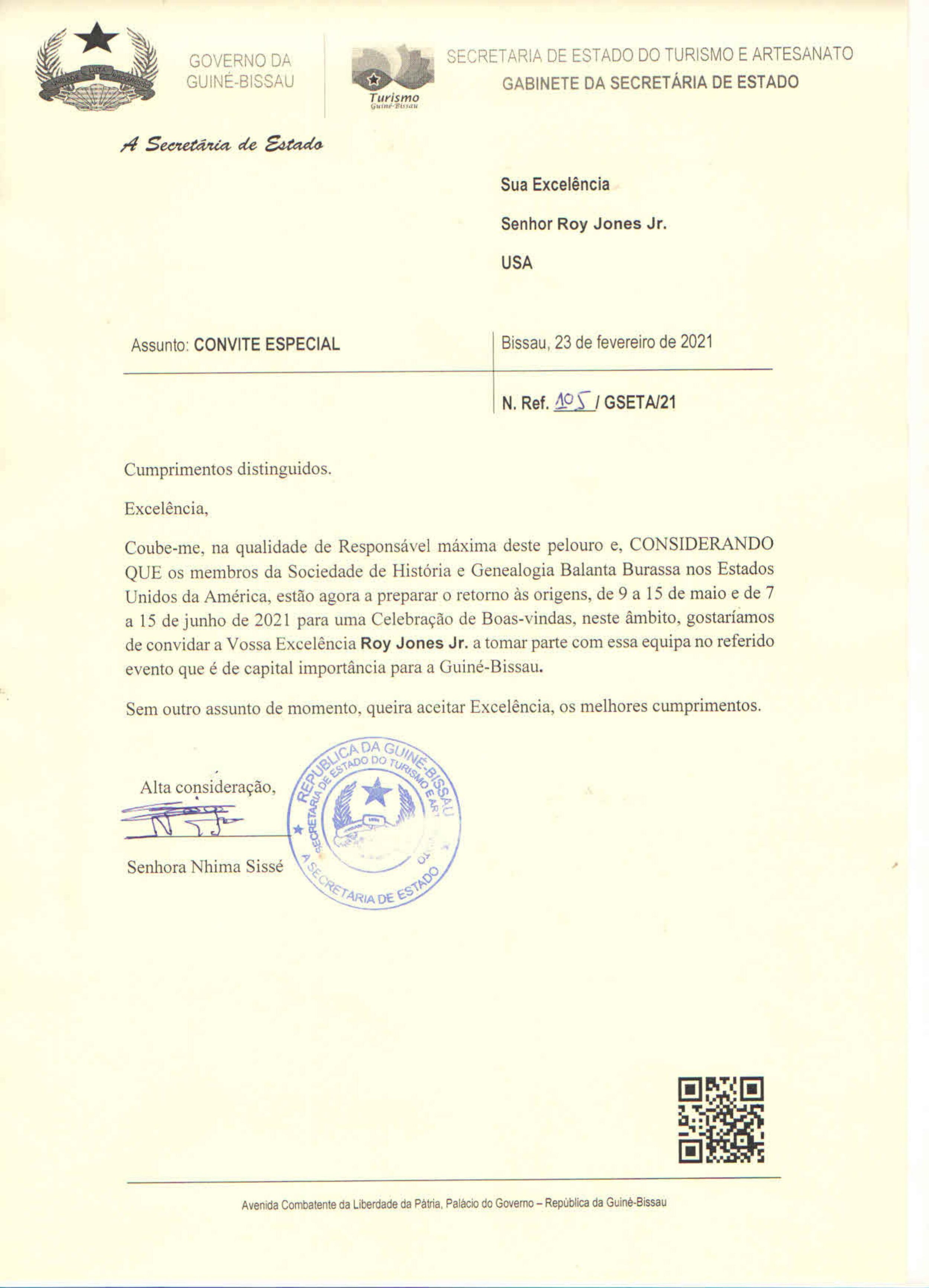
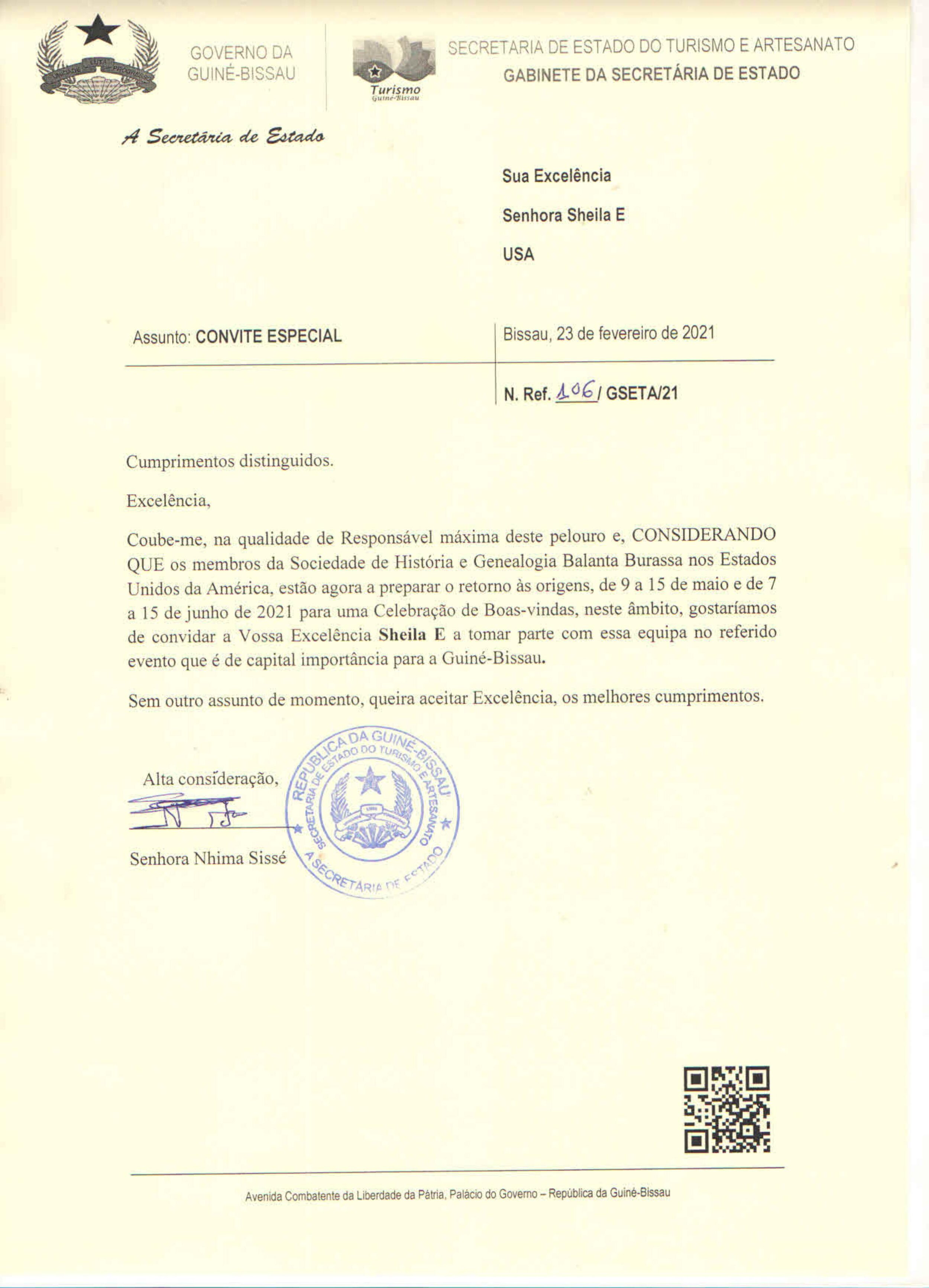
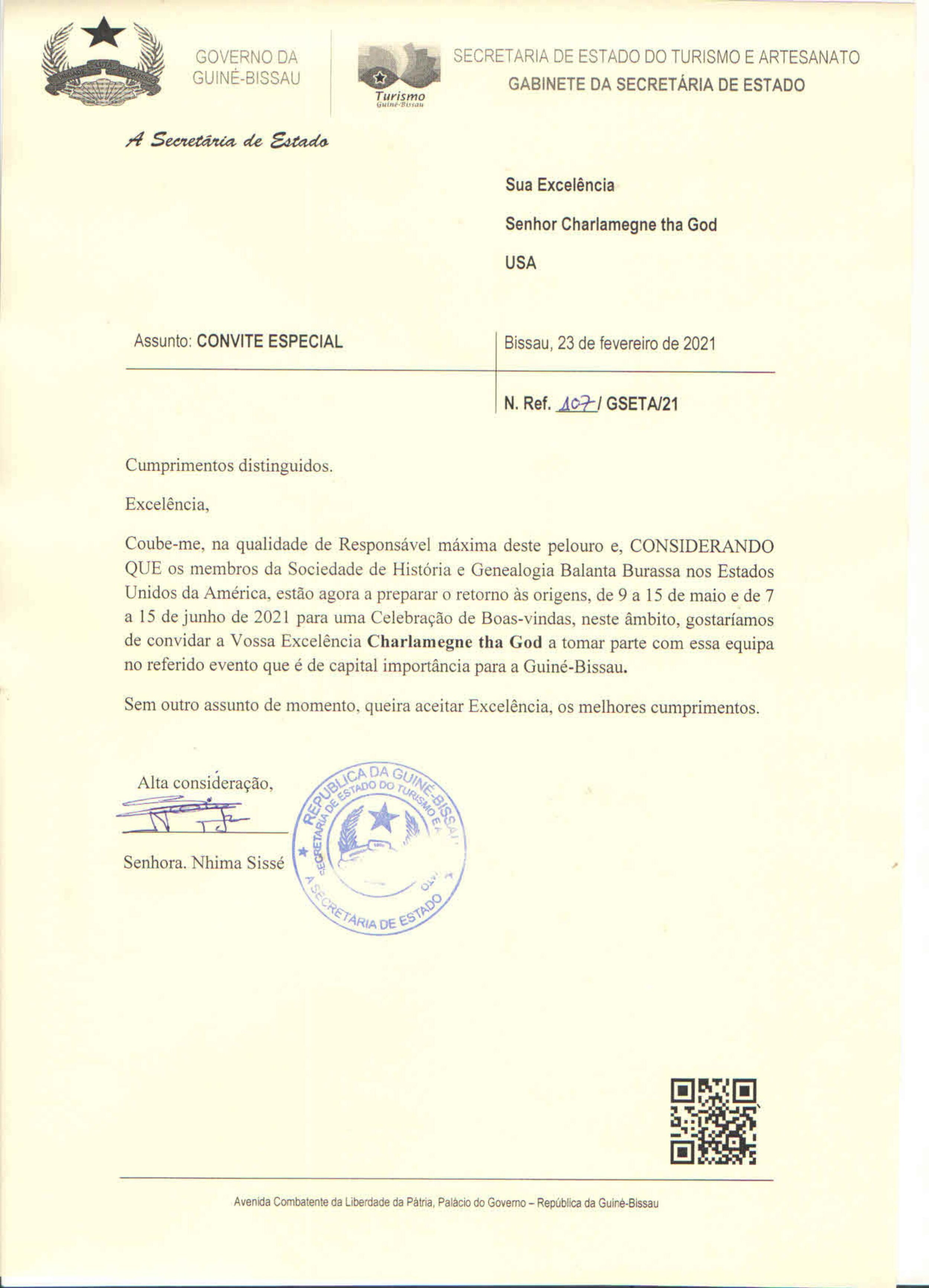
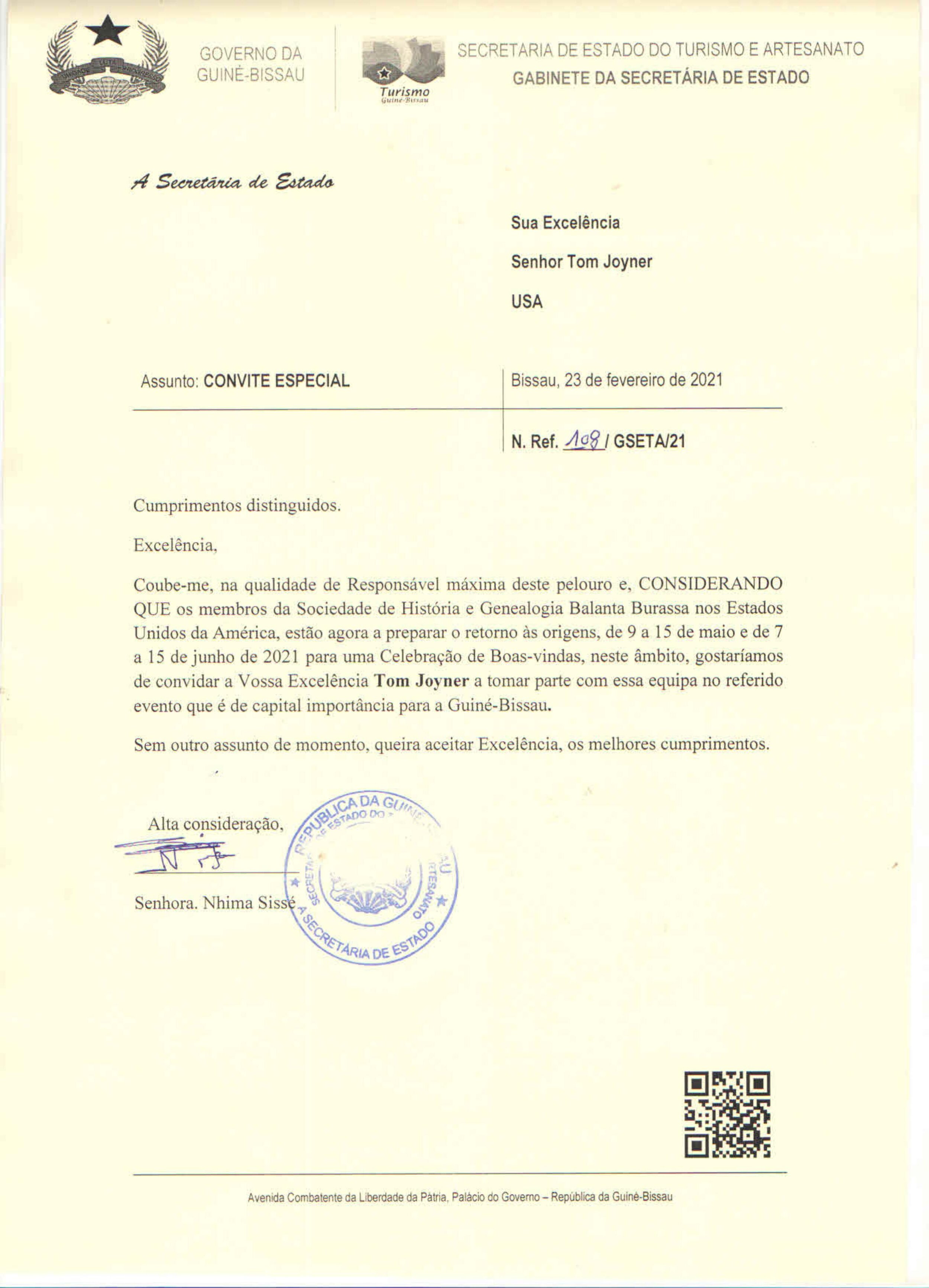
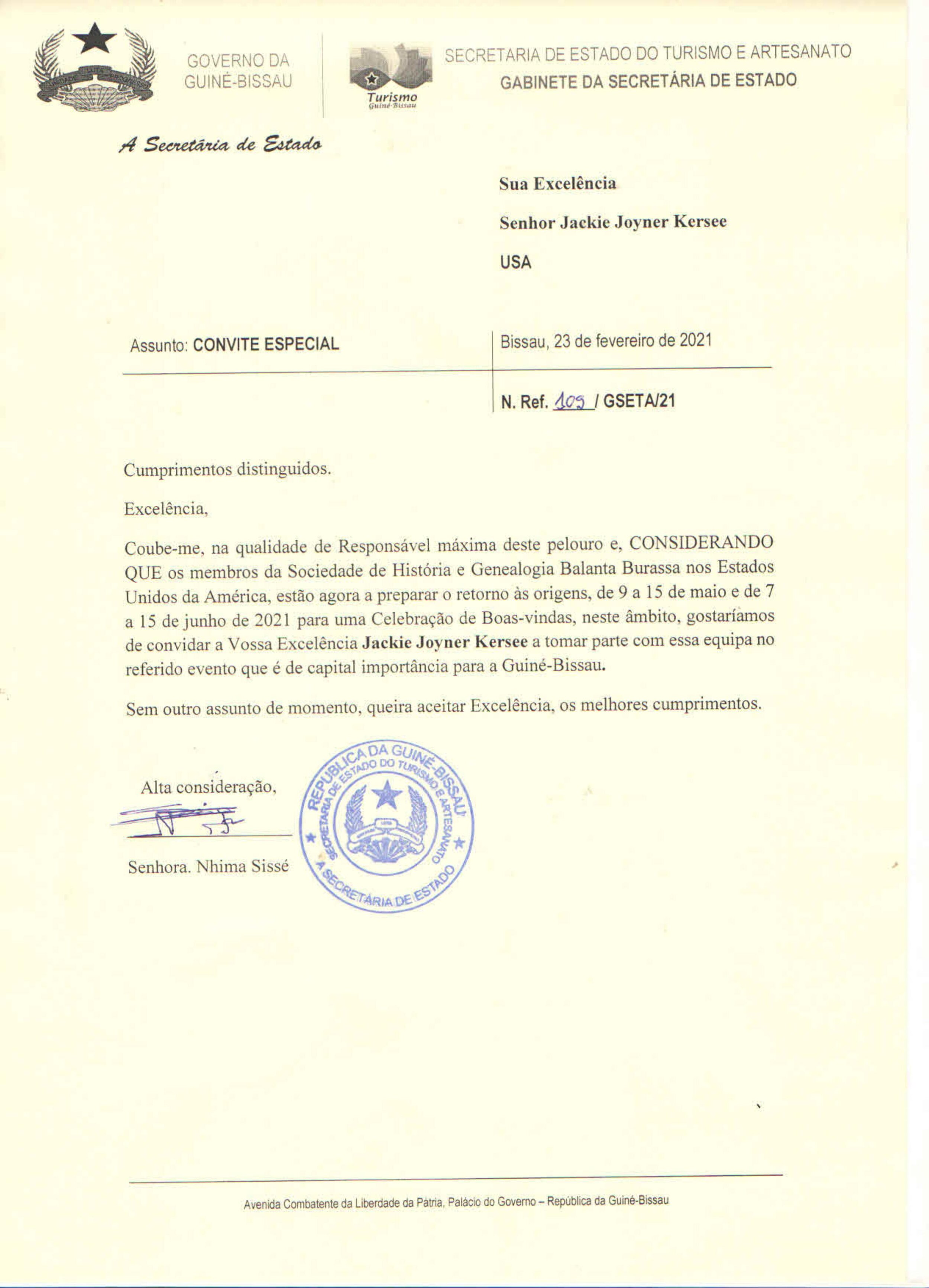
A savvy diplomat, Baleka has learned from Ghana’s example the things that they did correctly and also the mistakes that they made, and it seems that, so, too, has the current Secretary of Tourism, Nhima Sissé. To launch the initiative, Secretary Nhima Sissé has invited celebrities of Balanta descent in America including musician Shelia E, Olympic legend Jackie Joyner Kersee, boxing legend Roy Jones Jr., and radio personalities Tom Joyner and Charlamagne tha God, to attend the inaugural events in May and June.

Additionally, Baleka himself is doing his part to draw attention to Guinea Bissau by attempting to compete in the summer Olympics in Tokyo as a member of the Guinea Bissau Olympic Team, a feat that would make him the oldest swimmer in Olympic history. Already, Baleka’s effort has been picked up in the American press by both Sports Illustrated and Access Daily TV.

Siphiwe and Florentino.JPG

“People talk about conditions for a perfect storm, “ says Baleka,

“but Guinea Bissau has the conditions for a perfect harvest. There is new momentum in the Back-to-Africa movement. Stevie Wonder is just the latest Black celebrity to express the futility of living dignified lives in America, a sentiment articulated by Derrick Bell, the first tenured Black professor at Harvard Law School in 1992. 750,000 people have taken the African Ancestry DNA and tens of thousands have discovered that their ancestors came from the people of Guinea Bissau. In 2021, Guinea Bissau will have unprecedented positive media attention and publicity. If it can do what Ghana did, and do it better, then it will benefit both the people who are returning and the people of Guinea Bissau. This is an opportunity that Guinea Bissau can not afford to squander.”

Whereas Ghana was focused on courting wealthy members and business owners of the African Diaspora, Baleka believes that that approach is a mistake. “People went to Ghana who had no connection to the people. They didn’t even know if their ancestors were even from Ghana, no effort was made to learn any of the indigenous languages, and few traveled outside the capital and main tourist attractions. How did this help the average Ghanaian, the youth and the people in the rural villages?” asks Baleka.

Reporting on Ghana’s 2019 Year of Return publication, Equal Times wrote,

As a young woman with degrees from American universities, Marie has found making business connections in Ghana quite fruitful. She also notes that there are more opportunities and resources in Ghana than in her country of heritage, Jamaica. But she is aware of the privileges that being an expat affords her.

‘If you’re a local with a high school diploma or even with a college degree, the labour market can be tough. Finding a job or getting compensated at a level that makes sense can be very difficult,’ she says. “However, if you are foreigner...then your privileges are different. You have access to certain opportunities that locals might not. And because there are foreign companies coming in and setting up there might be more of a gap.” Because of this Marie says that she focuses on skills training and hiring locally.

[Akwasi Ababio, director of the Office of the Diaspora and chairperson of the Year of Return committee] says this is something that his office is keeping in mind. He is, however, excited by the possibilities the diaspora can bring to Ghana, through investment and business development. “For any government you would want people to contribute through its flagship programs,” he says, referring to the One District, One Factory’ industrialization initiative, for example, which aims to create as many as 3.2 million jobs by 2022.

The government is currently touting industry-led development with a focus on public private partnerships. But the country still faces huge challenges; with a large youth population and high levels of unemployment and poverty, the government will have to balance the potential that comes with enticing tourists and foreign investment without exacerbating the already entrenched inequality in the country.”

Baleka wants to change that very development model which has shown to breed xenophobia, inequality and corruption going all the way back to the mid 1800’s when slaves and freedmen began returning to Liberia and Sierra Leone. “The only way this is going to work in the long term and bring benefits to everyone, “ said Baleka, “is when people first connect with their ancestral lineage and attempt to integrate into the ethnic group from which they descend first. That is essentially the true meaning of the concept of Reparations. For this to happen, people have to first identify who their ancestor was that survived the middle passage. Where did he or she come from? What group of people did he or she belong to? That’s where you go because that is the requirement for connecting with ancestors and putting that spirit to rest that was traumatized by the slave experience. You have to go to the origin of that and connect with THAT ancestor specifically.”

Baleka is trying to set a personal example by establishing the Balanta B’urassa History & Genealogy Society in America and providing language training for its members who will be attending the inaugural event. And the micro development projects have already begun. Not only have the members distributed food in nine villages, they have raised money to help a family establish a guest house so that tourists can have a more authentic experience with the people and spend their tourist money in ways that help the people directly instead of going into the pockets of the foreigners who own the hotels. Baleka plans to use the renovated guest house to serve as his training camp in Guinea Bissau before the Olympics. “I realized I could spend $4,000 to stay in a hotel or I could give that same $4,000 to this family who shares my ancestry, so that they could start a bed and breakfast business,” Baleka added. “This is a better development model. It’s people to people who share the same ancestry and have a blood bond.”

Baleka says that Guinea Bissau must look at this long term. There isn’t going to be anything like the number of tourists that Ghana saw. But a successful event this year will put Guinea Bissau on the map, just like Ghana’s Joseph Project in 2007 paved the way for its massively successful 2019 Year of Return. According to the World Bank, international tourism receipts are expenditures by international inbound visitors, including payments to national carriers for international transport. These receipts include any other prepayment made for goods or services received in the destination country. They also may include receipts from same-day visitors, except when these are important enough to justify separate classification. Guinea Bissau’s tourism receipts in 2018 totaled just US $20 million and represents just 5.26% of its exports. By contrast, Ghana’s tourism receipts were $996 million in the same year. Neighboring Gambia saw $168 million in tourist receipts.

Guinea Bissau Tourism statistics.JPG
Tourism comparison.JPG

Baleka believes that Guinea Bissau needs to set goals and come up with a plan. “Within ten years,” he says, “they could be the gold star, flagship example for the new model of development and cultural tourism in Africa and for small, underdeveloped countries everywhere.”

Siphiwe Baleka’s Citizenship Recommendations to the Government of Ethiopia in 2003

DATA ON THE SLAVE TRADE FROM GUINEA BISSAU

Slave+Port+Map.jpg
From Africa to Brazil: Culture Identity, and an Atlantic Slave Trade, 1600-1830 by Walter Hawthorne

From Africa to Brazil: Culture Identity, and an Atlantic Slave Trade, 1600-1830 by Walter Hawthorne

Guinea Bissau Officially Welcomes Descendants for Decade of Return Events in May and June

On February 23, 2021, The Secretary of Tourism of Guinea Bissau sent the following message to the Balanta B’urassa History and Genealogy Society in America:

“Distinguished greetings,

Excellence,

It was up to me, as the maximum Responsible for this area and, WHEREAS the members of the Society of History and Genealogy Balanta Burassa in the United States of America, are now preparing to return to their origins, from 9 to 15 May and from 7 to June 15, 2021 for a Welcome Celebration, something unprecedented in the history of our young nation; in this context, we would like to invite Your Excellency Illustrious Siphiwe Baleka, founder, to be present with his members at the referred event, which is of major importance for Guinea-Bissau.

Without another subject at the moment, please accept Excellency, best regards.

High regard

Ms. Nhima Sisse”

Invitation Letter for Siphiwe.JPG

Letters of invitation to celebrities of Balanta descent in America were also sent, including musician Shelia E, Olympic legend Jackie Joyner Kersee, boxing legend Roy Jones Jr., and radio personalities Tom Joyner and Charlamagne tha God.

Editorial: A Stolen Legacy? - A Critical examination of Barak Obama Post Presidency, and his enduring impact on the collective Black Consciousness

The following editorial was penned by the Balanta B’urassa History and Genealogy Society in America Vice President Midana. He is also author of the exceptional Balanta novel, 13 Bars of Iron.

A Stolen Legacy? - A Critical examination of Barak Obama Post Presidency, and his enduring impact on the collective Black Consciousness

The legacy of President Barack Obama post-presidency is beginning to become increasingly complex. I believe this complexity will increase with the addition of time and retrospection.  An objective review of his prescriptions on foreign and domestic policies, in addition to the positions and policy platforms he presently endorses, will leave many objective observers in a place of leveling harsher criticism towards him than many were willing to level during his presidency. What makes criticizing our brother still so exceedingly difficult is the impact he had and continues to have on the psyche of Black America and the entire world.  Brilliant by every objectionable measure, Barack represented the Black genius that does not often get displayed to the rest of the world. Then there is the most impressive aspect of his story, his wife. His equal in every way, and most importantly, Black! Add to that two beautiful daughters, and this was the image that we wanted representing us, the optics, and the substance of it all.  That is why Barack and his family were and still are so especially important to us and why we, as Black people are so very protective of them.  It is also why it is nearly impossible for us to view him objectively or with the necessary criticality.

Tavis on Obama4.jpg
Cornell West on Obama2.jpg
Cornell West on Obama.jpg
Tavis on Obama3.jpg

 Like many, I was critical of people such as Cornel West and Tavis Smiley for their seemingly unfair and mean-spirited attacks that did not seem objective or necessary considering the political climate. It appeared they were simply on some hater shit, even if some of the criticism was legit. Many of their critiques seemed to cross the line; the stakes were too high, we needed him to succeed.  I like others continued to justify Obama's moderate right of center politics; his rising tide lifts all boats. I am the President for all of America rhetoric.   What did we know... none of us were in his shoes; we rode with it.

For this reason, when I heard Barack was coming out with a memoir detailing his time in the oval office, I could not wait to read it and get his side unfiltered.  I had read the book Dreams of my Father, his first memoir, and The Audacity of Hope, a policy book that contained all the necessary pre-presidential run content.   I also read Bob Woodward's Obama's Wars, biographies, Rising Star, and The Story. I was impressed at the many testimonies from friends, classmates, and colleagues attesting to his near genius-level intelligence and quick mastery of any academic subject matter put in front of him. His writings, both creative and scholarly, were without a doubt impressive. I was eager to receive the actual first-person recounting of the Obama presidency straight from the horse's mouth. However, after getting about a quarter of the way through the book, those hopes began to subside. It did not matter what lay in the remaining 3/4th of the book. He had set the tone and tenor within the first 200 pages.

While I fully expected the tact and the careful choosing of words, we who have listened to him have come to expect.  I did not expect President Obama to be an apologist for white people, white supremacist ideals, and white racism. To be entirely fair, some of this is understandable. As Obama points out repeatedly, he was raised by his white grandparents and white mother. He constantly referrers to being shaped by his midwestern values and roots. However, a particular point of contention was a theme that carried over from his book The Audacity of Hope. In this book, he referred to on more than one occasion his delightful and heart-warming encounters with voters in downstate Illinois as a State Senator and a US Senate candidate. For those not familiar, downstate Illinois typically refers to anything in the state south of the Greater Chicagoland area. More specifically and in the context he uses it, southern Illinois or the more rural areas.  He details how many of the people he met were indistinguishable from his very own family members. This retelling of these experiences might have served as just anecdotal for some readers. However, for me, it struck a particular chord. The fact that this seemed to be a reoccurring theme of his, one that spanned his last two publications, may provide us with insight into why his values and worldview may not be firmly in line with most Black Americans. The people who were his staunchest supporters and who hoped he would champion their causes.  For the record, I happened to have been born in raised in downstate Southern Illinois, the very place he references multiple times in his memoir and The Audacity of Hope.  My experiences and the experiences of others who look like me were quite different from those he recounted.

Obama in Southern Illinois.jpg

 My parents were both a part of the great southern migration to mid-western and northern industrial cities. My mother's parents came up from the south several years before her birth, and my father came up as an adult shortly after being discharged from the military after serving in Vietnam. My father often shared a particular story regarding his arrival to East Saint Louis; this experience left an indelible impression. When my father got off the bus, bags in tow, he witnessed several white police officers brutally assaulting an elderly black man with their nightsticks. It was mid-winter, and snow was on the ground, much like I imagine it is today in East Saint Louis. My father told of seeing blood staining the white snow as the officers beat the Black man in the head, and with each blow, additional bright red blood continued to color the white snow.  I can also recall having discussions with individuals who came of age in the 1940s, 50's 60's, 70's in Southern Illinois; and listening to them recount how segregated life in East Saint Louis was far more racist than life in the Jim Crow South.   I can also recall very clearly, as a child and teenager in the '80s 90's my encounters with very racist peers, adults, law enforcement, opposing coaches. I recall being called racial slurs during sporting activities while visiting towns like Shiloh, Lebanon, Freeburg, Red Bud, Mt Vernon, or, as President Obama referenced, downstate Illinois.  

 I can also recall harassing and illegal encounters by law enforcement, retail clerks, and other random white people, which informed my views on white people and race relations in the country.  These were the people who gave Barack Obama so much hope. He found relatable people who had given him faith and who he stated were owed his political loyalties. While in contrast, they were the people who had displayed nothing but racial animus and terroristic behavior towards people who shared my background for decades.  I will not even dive into the racial politics that led to my own hometown's economic and environmental conditions, or how the record will show that Barack Obama did mostly nothing to improve the Black citizens' needs in downstate Illinois as a State Senator, US Senator or President.

Obama and Lincoln.jpg

Throughout his memoir, President Obama consistently attempts to make the point that he was limited in his ability to affect direct and targeted change as a politician. He implored people to absolve him for his failures to accomplish progressive change for America's most disenfranchised citizens, but rather to be appreciative for change that aided everyone.  According to him, Black Americans, too, were likely to have experienced some residual benefit.  Not a sound argument for closing the racial disparities resulting from America's racist history from such a brilliant legal mind.  

The most troubling aspect of the book for me was the title itself, A Promised Land.  This title was lifted from the speech Dr. Martin Luther King gave the night before his assassination. Obama parallels himself to King and implies that he believes that the absolute best days for this country lie ahead. With patience, diligence, and collectively, WE as a Nation will one day come to experience this more perfect union. One day, someday in the future, even if that future is distant, we will reach that promised land. However, contrary to Obama's musings, when King stated, "I may not get there with you," it was not because he believed that this promised land lies hundreds of years in the future. That slow incremental progress was the only path to arrive at this fateful destination. It was because Dr. King knew that J Edgar Hoovers FBI was trying their damnedest to blow his head off and that they would likely soon be successful. Before making that speech, Dr. King had spent the past year railing and organizing against the very same Neoliberal forces that President Obama spent his entire presidency defending.  This rhetoric and organizing by King, combined with his opposition to the Vietnam War, would set him on a path that eventually inspired the frighteningly foretelling remarks on the night before his murder. It had nothing to do with his belief in non-revolutionary progress as Obama would have you believe. President Obamas's bastardazation and attempted co-opting of Dr. Kings' remarks and his effort to connect them to his own legacy is blasphemous.

The dream realized.jpg

 It is my sense that based upon the favorable reviews of President Obamas latest memoir and his continued personal high favorability ratings that President Obama's support among Black Americans will continue to remain high for some years to come.  However, the complexity referenced early will not begin to manifest until the pride and novelty of his groundbreaking accomplishment begins to subside, and the reality of what remains as a result of what he failed to achieve or advocate for in the interest of Black America has firmly set in.

BBHAGSIA Member Kamm Howard to Give Testimony at Reparations Hearing

Kamm Howard 1.JPG

Kamm Howard, a member of the Balanta B’urassa History and Genealogy Society in America, serves as the National Male Co-Chair of the National Coalition of Blacks for Reparations in America (NCOBRA). On February 17, 2021, he will be giving testimony to The House Judiciary Subcommittee on the Constitution, Civil Rights, and Civil Liberties.

The hearing will be broadcast live here: https://youtu.be/rSeFwdx4Xe0

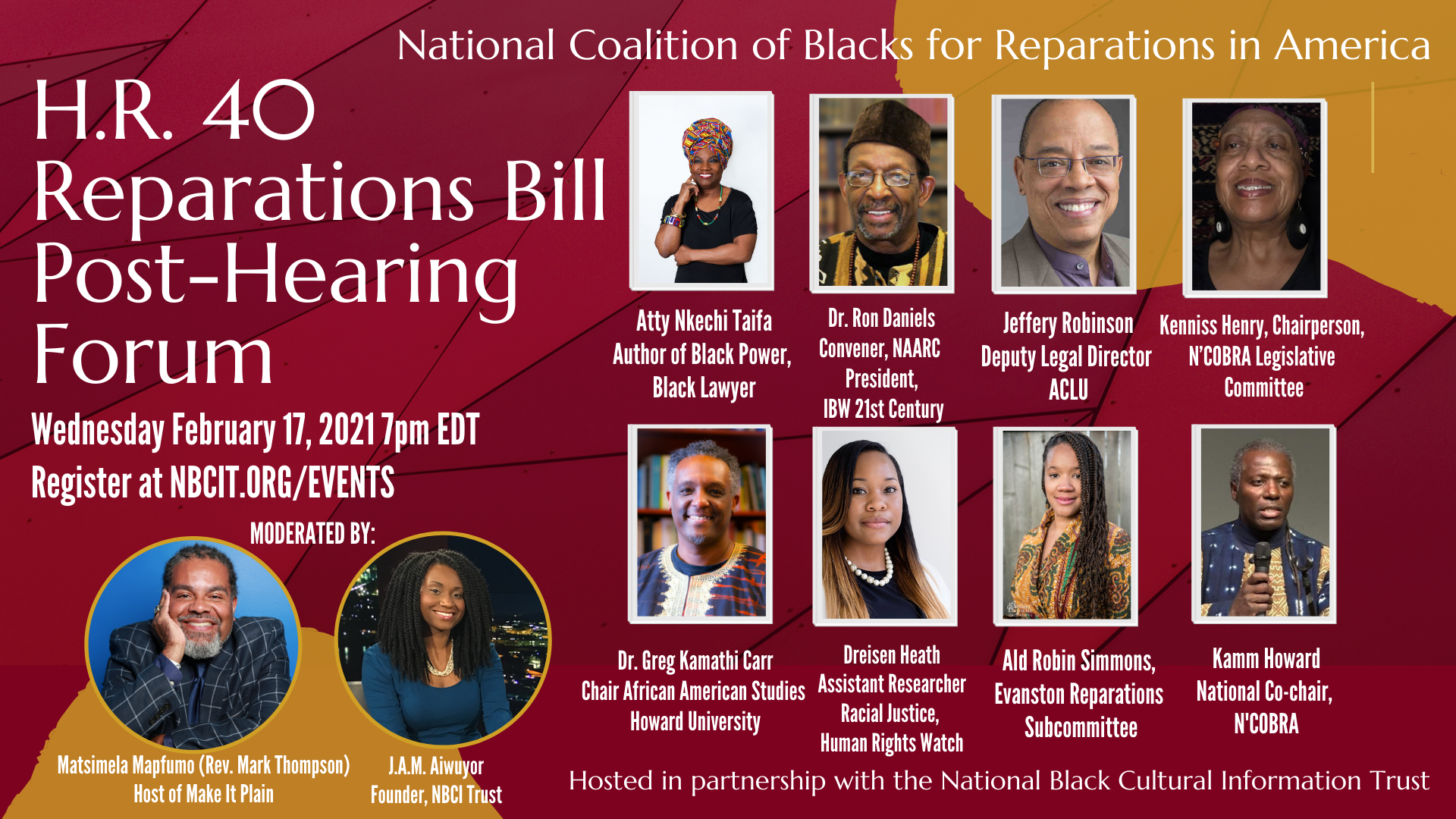
There will be a discussion Post Hearing at 7 pm EDT

H.R.-40-Reparations-Bill-Post-Hearing-copy.png

Listen to BBHAGSIA President Siphiwe Baleka and Latinya Channer discuss Reparations and the Lineage Restoration Movement with NCOBRA

REPARATIONS NEWS!!!

The House Judiciary Subcommittee on the Constitution, Civil Rights, and Civil Liberties will hold a hearing on H.R. 40, the Commission to Study and Develop Reparation Proposals for African-Americans Act, on February 17, 2021. The 10:00 a.m. ET hearing will examine the legacy of slavery, its continuing impact on the Black community, and the path to reparative justice.

Witnesses slated to testify at the hearing include:

The Honorable Norman Mineta, Former Secretary of Transportation, U.S. Department of Transportation;

The Honorable Dr. Shirley Weber, Secretary of State, State of California;

Professor E. Tendayi Achiume, Special Rapporteur on Contemporary Forms of Racism, United Nations Office of the High Commissioner for Human Rights;

Dreisen Heath, Racial Justice Researcher and Advocate in the US program at Human Rights Watch

Kamm Howard, National Male Co-Chair, National Coalition of Blacks for Reparations in America (N’COBRA); Member of the Balanta B'urassa History & Genealogy Society in America

Dreisen Heath, Program Advocate, Human Rights Watch;

Hilary Shelton, Director, NAACP Washington Bureau

Additional witnesses to be announced

If passed, H.R. 40 would establish an expert federal commission to study the legacy of slavery in the United States and its ongoing harm and develop proposals for redress and repair, including reparations.

The announcement of the hearing comes after more than 300 organizations, businesses, faith leaders, and city leaders – including Human Rights Watch, the American Civil Liberties Union, Color of Change, the Leadership Conference on Civil and Human Rights, and Amnesty International USA– sent Speaker Nancy Pelosi and House leadership a letter urging immediate congressional action on H.R. 40, as part of the We Can’t Wait project. Following the protests over the killing of George Floyd and other Black people at the hands of police, the bill garnered a record number of cosponsors.

“The historic racial and gendered injustices of slavery and its legacy, fueling the persistence of racial inequality today, remain largely accounted for,” said Heath. “The US must finally reckon with its long history of racial terror, indifference, and segregationist public policies that have created lasting harms within the Black community. That reckoning begins with H.R. 40.”

BBHAGSIA and the Special Rapporteur on Contemporary Forms of Racism, United Nations Office of the High Commissioner for Human Rights

Also giving testimony will be Professor E. Tendayi Achiume, Special Rapporteur on Contemporary Forms of Racism, United Nations Office of the High Commissioner for Human Rights. At the Reparations, Defund Movements, and International Human Rights Webinar held on October 29, 2020, BBHAGSIA President Siphiwe Baleka had the following exchange with Professor Achiume:

SIPHIWE BALEKA: (My question at 46:37)

African Americans have consistently used international forums including the United Nations, to petition for redress for genocide, slavery, etc. With all of the interventions since the We Charge Genocide Petition in 1951, why has the international community and the United Nations not initiated any process to force the United States to pay reparations? What will it take and what do you recommend that African Americans, and specifically, groups like the National Coalition of Blacks for Reparations in America (NCOBRA) do that they haven't already done, to make the international frameworks effective?

Tendayi Achiume, Professor of Law, UCLA School of Law and UN Special Rapporteur on Contemporary Forms of Racism, Racial Discrimination, Xenophobia and Related Intolerance:

"The project of Reparations is about undoing structures and remaking societies that were deliberately designed along logistics that reinforce racial subordination. . . . Another concrete way. . . to take advantage of the UN system is through the treaty body system. So we have the International Convention for the Elimination of Racial Discrimination which provides for individual petitions and you can bring claims at that body for violations of human rights at the national level. The challenge right now is that the U.S. . . . hasn't signed the provision that would make it possible for American citizens to be able to make those claims at the international level, but this might be something that, you know, IF THERE IS A CHANGE IN ADMINISTRATION IN THE NEXT YEAR DEPENDING ON WHO IS IN POWER, IT MIGHT BE PART OF THE CLAIMS THAT RACIAL JUSTICE ADVOCATES ARE MAKING IN THE US ARE REMOVAL OF THOSE KINDS OF BARRIERS AT THE INTERNATIONAL LEVEL FOR RELIEF . . . . SO ENSURING THAT NATIONAL CONVERSATIONS AROUND RACIAL JUSTICE ARE ALSO THINKING ABOUT HOW TO OPEN UP INTERNATIONAL PATHWAYS FOR SEEKING REMEDIES AND MAKING THAT A POLITICAL PRIORITY DOMESTICALLY. . . . From the perspective of lawyers and legal academics and legal advocates I would say we have invested far too much time in taking advantage of strategic opportunities and THAT HAS KEPT US IN THE REFORM FRAME. And I think one of the things that has been the most powerful about the defund movement is that it has shown just the transformative power that comes from ASKING FOR YOUR IDEALS AS YOUR STARTING POINT. . . . One of the things I am trying to challenge myself to do as a law professor, for example, is to think about what it might mean to teach law school classes that are MORE ABOUT IDEALS, THAT ARE MORE ABOUT REIMAGINED SOCIETIES AND HOW WE MIGHT GET THERE RATHER THAN THE FOCUS ON LITIGATION AND PLUGGING THE HOLES OF A SYSTEM THAT IS DESIGNED TO PRODUCE INJUSTICE. . . . WE ARE AT A MOMENT WHERE WE ARE BEING REMINDED OF WHAT CAN HAPPEN WHEN YOU INSIST ON THE IDEALS IN THE PRESENT."

Now, none of the so-called black leaders of our community made signing the provisions of the International Convention on the Elimination of Racial Discrimination or implementing any of the other international instruments related to our international civil, political, economic, social and cultural rights part of the BLACK AGENDA. No Presidential candidate was asked whether or not they would sign the provision if elected.... No one put forth a vision of the ideals we are demanding (in the context of our international human rights) except THE AGENDA FOR BLACK AMERICA'S RESTORATION AND SELF DETERMINATION

The reason for this failure is the Civil, Political and Legal Illiteracy of African Americans who have not done the work of internationalizing our struggle as Malcolm X instructed us to do.

However, BBHAGSIA has submitted the AFRODESCENDANTS' RESPONSE TO PRESIDENT BIDEN'S EXECUTIVE ORDER ON ADVANCING RACIAL EQUITY AND SUPPORT FOR UNDERSERVED COMMUNITIES THROUGH THE FEDERAL GOVERNMENT

Jahaziel 3.jpg
Kamm Howard 2.JPG

Guinea Bissau: Mbontol Fnhénhe (A Love Poem)

GUINEA BISSAU: MBONTOL FNHÉNHE (A LOVE POEM) is the first known work of poetry written in the Kentohe language by a Balanta survivor of the ethnocide committed by the United States.

Guinea Bissau: Mbontol Fnhénhe

Photo Dec 31, 6 52 59 PM.jpg

I.

N'hén-na

Nqpadn kbonh

Botchee ba swm!

Awila wobw ka wleti

Nhén-na bdali . . . .


II.

Hobw ka anin da

Hondi ka hinda

Hondi tenh liti Wbwdee

Krat nhon ka kmôn kpoot


Nhidi ka wrasse

Hondi ka Beafada

Hondi ma lôt swf fswmi 


III.

Yah Brassa Mada ka a Guiné Bissau?

Yiiih, hondi ka anwbw


Wkéye ktchosso, hondi woti ka Anwbw

Brassa Mada woti ka a Guiné Bissau


IV.

America dwka dâtcha Guiné Bissau

Wil wobo woti ka kbonh

Wil ma dwka sahrát na


V.

Willi Anang Yaha?

Nan toha gwa.

Tchôkee ma ka Wthértee


VI.

Anuma anan toha?

N'nan toha a kpol Kpân da

N'nan toha a kpol anin da

N'nan toha …

Kpân wbontche

Swf Fswmee

Ktchili kmonha


N'nan toha …Fnhénhi


VII.

N'siknh sibi lissi

N'ma siknh kmás

Hobw ka anin da

Hondi ka hinda

Hondi tenh liti Wbwdee

Krat nhon ka kmôn kpoot


Nhi nsim won kbonh wambw


(translation)

Guinea Bissau: A Love Poem

I.

I love you

I have returned

Our land is nice - where there is happiness.

This place is sacred.

I love you so much . . . .


II.

This is my wife

She is mine

She has a soft body

Her skin is very black.


I am Balanta

She is Beafada

She cooks delicious food.


III.

Is Brassa Mada in Guinea Bissau?

Yes, he is here.


It isn't true. No.

Brassa Mada isn't in Guiné Bissau.


IV.

America is too far from Guinea Bissau

This thing is not good.

It is a dreadful thing.


V.

What do you want to do?

I want to go swimming.

The sea is shallow.


VI.

Where do you want to go?

I want to go to my home

I want to go to my wife

I want …

a beautiful house

delicious food

many cows.


 I want … Love.


VII.

I drink palm wine

I take medicine

this is my wife

she is mine.

She has a soft body

Her skin is very black.


I am feeling good now.

Photo Jan 07, 9 38 38 AM.jpg