FIRST 50-METER OLYMPIC SWIM TRAINING FACILITY BUILT IN GUINEA BISSAU

Unche, Guinea Bissau - Federação de Natação da Guiné-Bissau Interim President Siphiwe Baleka constructed a 50 meter long course for swim training in the middle of a tributary of the Rio Unche. Olympic swimming pools are 50 meters long and there are none in the country of 2 million people. So Baleka decided to use what was available to complete a makeshift pool with lane ropes.

Baleka conceived of the idea during his first visit to Unche, the village of his great, great, great, great, great grandfather who was captured as a boy and enslaved in Charleston, SC.

“I was told in Cacheu that Balantas are the best swimmers, that they could turn into crocodiles,” said Baleka. “So I always imagined my 5g grandfather was a great swimmer as a young boy. Today I know it is true because all the boys in Unche are good swimmers with a lot of natural ability. Now they just need to be coached.”

Coaching the boys and girls of Unche, the village of his 5G grandfaather, is exactly what Baleka intends to do. Baleka’s short term plan is to fix the lane ropes (which happen to be the red, gold, and green colors of the Guine Bissau flag) with some sort of flotation device. According to Baleka,“We will try plastic bottles and styrofoam first.”

HELP SIPHIWE BALEKA WITH THIS INCREDIBLE MISSION

DONATE TODAY!

donate

New Uniforms for Girls Team Provided by Interim President of the Guinea Bissau Swimming Federation Siphiwe Baleka

January 27, 2022 - Enterremento, Bissau, Guinea Bissau

The Sociedade Desportiva da Guiné-Bissau (S.D.G.B) received the Interim President of the Federação de Natação da Guiné-Bissau, Siphiwe Baleka to display their new uniforms. Mr. Baleka visited the girls futbol team on January 16 to give them a motivational speech. The team then went on to win their latest match 4 - 1.

“Maybe what I said helped them,” ’joked Mr. Baleka.

During his previous visit, Mr. Baleka learned that the team was not receiving much support from its federation. He then donated the money to purchase the new uniforms.

“I really want to help these girls. They lost the championship last year and I know they can win it this year,” Mr. Baleka said with confidence. “I will do what I can to help them do their best.”

Mr. Baleka told the girls that their life in Guinea Bissau presented them with both advantages and disadvantages. 

“In America, life is much easier. The girls are not as tough as you are,” he told them. “You are strong and very good athletes because life in Guinea Bissau is much more physical. That is your advantage. Of course access to resources, equipment, and opportunities to travel are your disadvantages,” said Mr. Baleka.. “Do your best on the field and I will do my best off the field to help find resources for you.”

Coach Sanha Nharo explained that one of the challenges for the team is a cultural challenge. Girls are discouraged from playing sports because going to school and taking care of the home are the priorities. “You have to have a very close relationship with the parents to convince them to let their daughters travel and spend the night somewhere,” Coach Sanha said.

Coach Sanha also explained that the team struggles because of the poor organization of the league. Every year we have to figure out who and where we can play and what color uniforms each team has. According to Coach Sanha, if you travel to play a team and you have the wrong color jersey, you must forfeit the match because you can’t have two teams wearing the same colors. That’s a tall order for teams that don’t have sponsors and multiple uniforms.

There are other challenges, too. The team wants to buy tents because they don’t have the money to pay for hotels when they travel in the country to play teams in other regions.

To help the team this year, Mr. Baleka set up a GoFundMe campaign. All money goes to the team.

SUPPORT GIRLS SPORTS IN GUINEA BISSAU. DONATE NOW!

BBHAGSIA President Discusses the COVID Agenda on Discussions of Truth Podcast

“The Balanta Society has, by far, compiled the most extensive and comprehensive chronological research on the origin of the Covid19 virus - that I have found to date.”

- Ian Trottier

Due to technical issues, you will find the introduction at the 13:45 mark and the main content of the episode begins about the 30min mark.

Read

THE COVID 19 CHRONOLOGY THEY AREN'T SHOWING YOU: PROPAGANDA AND DENIAL ABOUT THE SOURCE OF THE PANDEMIC

About Ian Trottier and Discussions of Truth Podcast:

Ian Trottier is a genealogist, historian, and free thinker. His Discussions of Truth podcast has hosted a who’s who of great free thinkers and whistleblowers, including such people as Anton Chaitkin, Daivd Icke, Judy Mikovitz, Cynthia McKinney and Brandy X. Lee. See his full guest list here.

Nbuntul a Kraase: Balanta Stories Now Available for First Time Translated into English

Book Synopsis

The Balanta B'urassa Language Preservation Society in America is proud to present this reprint of Nbuntul a Kraase: Balanta Stories. Finding original books printed in the Balanta language is rare. As it is our mission to preserve the Balanta language, it is our joy to make this available to a wider audience.

ORDER YOUR COPY NOW!!!! $9.99

Monkey and  Rabbit

By Unico Só Mané

Grasshopper and Tortoise

By Domingos Quadé

Banditism is not good

By Rúcana Danfa

TRANSLATED TO ENGLISH

BY QUINTINO MEDI

BanFaaba and BBHAGSIA Presidents Attend African Union Workshop on Transformational Leadership Across Africa

BanFaaba President Mario Cisse and Balanta B’urassa History and Genealogy Society in America President Siphiwe Baleka attend the African Union’s Fridays of the Commission Workshop: Key Requirements for Generating Developmental and Transformational Leadership Across Africa.

Convened by the African Union Commission Department of Economic Development, Trade, Industry and Mining, the conference brought together participants from the AU Member States, Regional Economic Communities, AU Organs and Specialized Agencies, development partners, the private sector, civil societies, academia and the media.

The Conference aimed to provide a platform for a public debate on how to develop passionate and visionary leaders within the continent, who understand global dynamics and environment and can drive developmental changes for the attainment of people centered and sustainable economic development and, overall, the realization of the aspirations of Agenda 2063, the “Africa We Want”.

According to Mr. Cisse,

“Leadership in Africa is very challenging because the African continent and its leaders didn’t focus on using its own resources. We didn’t build a strong force to move Africa forward. This is the only way we can overcome the challenge that Africa is facing right now. We must give the young people the opportunity to use the resources of Africa for their own development. This requires transformational leadership. We need leaders that can negotiate better deals for African people.”

Earlier this month, Mr. Cisse and Mr. Baleka met with Her Excellency, Ambassador Erieka Bennett of the Diaspora Africa Forum, to discuss African Diaspora issues, and in particular, Guinea Bissau’s Decade of Return initiative.

Mr. Baleka, for his part, recently led the team that drafted a MOTION TO THE AFRICAN UNION EXECUTIVE COUNCIL 39th EXTRAORDINARY SESSION that was presented by the Zambian Minister of Foreign Affairs. The motion requested that all African Union member states

“Establish an African Diaspora Desk mandated to ensure that the African Diaspora sub-group - consisting of the specific group of people of African origin, born outside the African Continent, who have never had access to an automatic birthright to claim a specific African citizenship or nationality due to the horrific legacy of the transatlantic slave trade, but recognise their Right To Return (RTR) to their ancestral homeland - have their specific needs met to achieve successful repatriation with a recommendation that the African Diaspora Desk works in partnership with the Diaspora Advisory Board instituted by the Declaration Of The Global African Summit 2012 for each member state.”

“We have informed the Minister of Foreign Affairs, Her Excellency Suzi Barbosa of the leading role that she can play in this movement,” said Mr. Baleka.

“With the Decade of Return Initiative, we have positioned Guinea Bissau to take a leading role in the African Union 6th Region Diaspora movement and we hope that Guinea Bissau will be the first country to implement the recommendation and establish the second Diaspora Desk with diplomatic status on the continent of Africa. In this way, we are contributing to the transformational and visionary leadership right here in Guinea Bissau.”

Last year, Mr. Baleka was asked to Chair the Panel, “Sixth region – Critical thinking and Action Plan towards re-integration at the African Union” at the 2nd Annual Centre for Global Africa (CGA) – APRM Pan African Development Conference on 12-14 November 2020 hosted by the African Peer Review Mechanism of the African Union and the Centre for Global Africa. On November 23, 2020, Mr. Baleka addressed the United Nations 26TH SESSION OF THE WORKING GROUP OF EXPERTS ON PEOPLE OF AFRICAN DESCENT. And a month later he gave a keynote address entitled The Lineage Restoration Movement and the Future of Africa to the Plenary Session on Economic Emancipation and the Black Lives Matter Movement at the 1st African Diaspora Summit in Nairobi, Kenya organized by The Africa Diaspora Alliance and the Kenya Diaspora Alliance.

Mr. Cisse and Mr. Baleka are themselves fast becoming some of the most visionary and transformational leaders in Guinea Bissau.

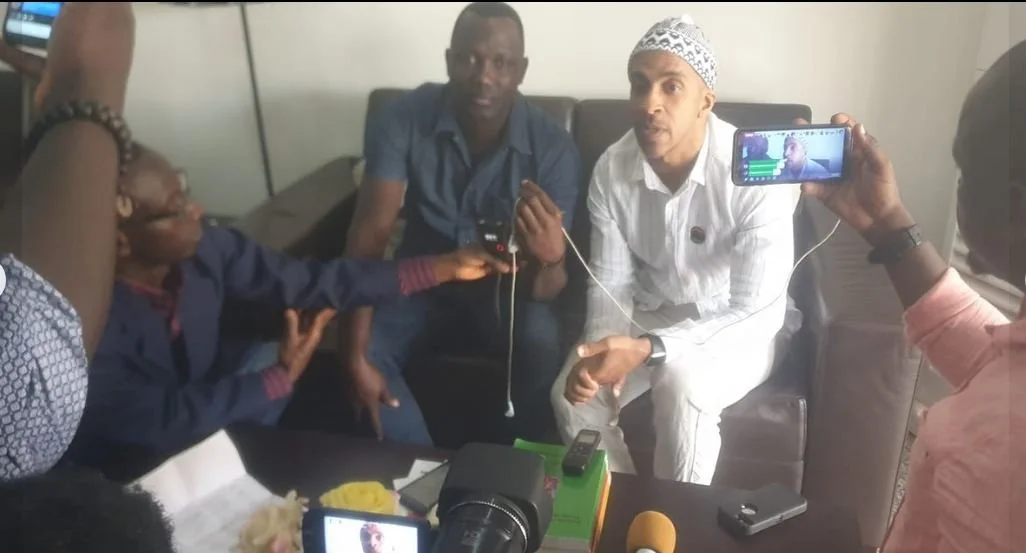
Mario Cisse (left) and Siphiwe Baleka (right) speaking to the media in Guinea Bissau, January, 2020

Federação de Natação da Guiné-Bissau e Ban-Faaba comemoram o Dia Mundial da Natação

Sobre o Dia Mundial da Natação


Realizado no quarto sábado de outubro de cada ano, o Dia Mundial da Natação é um feriado internacional que visa aumentar a participação na natação e promover a segurança da água, incluindo geografia, idioma e habilidades.

Os nadadores são incentivados a se exercitar na água no Dia Mundial da Natação, seja o que for que isso signifique para eles. Piscina ou águas abertas, natação curta ou longa, solo ou com amigos!

MySwimPro fundou o Dia Mundial da Natação em 2018 para aumentar a conscientização e fundos para organizações que aprendem a nadar e para reunir nadadores de todo o mundo para celebrar seu amor pela água! Desde o seu início, mais de milhares de nadadores nos ajudaram a arrecadar mais de $ 5.000 dólares!

Hoje, às 10h30, o nadador da Seleção Nacional da Guiné-Bissau Siphiwe Baleka e o Presidente do Conselho Fiscal da Federação de Natação da Guiné-Bissau, Mario Ceesay (que também atua como Presidente da Ban-Faaba na Guiné-Bissau), organizaram uma festa na piscina #WorldSwimDay pelo Grupo Juvenil Hermos Unidos para Sempre do Bairo Militar, Bissau no Hotel Ledger Plaza. Em setembro, Ban-Faaba acolheu uma viagem de campo educacional ao Museu dos Escravos em Cacheu, Guiné-Bissau, onde o grupo de jovens pôde nadar no Rio Cacheu.

“Como presidente da Ban-Faaba, estamos empenhados em fazer tudo o que estiver ao nosso alcance para oferecer oportunidades aos jovens. Como membro da Federação de Natação da Guiné-Bissau, a minha preocupação é promover a natação e a segurança aquática ao mesmo tempo que desenvolvo uma geração de nadadores de competição na Guiné-Bissau. #WorldSwimDay é uma oportunidade perfeita para fazermos os dois ”, disse Mario Ceesay.

Siphiwe Baleka é um Embaixador MySwimPro que recentemente representou a Guiné-Bissauews / 14-campeonatos africanos de natação no 14º Campeonato Africano de Natação, estabelecendo cinco recordes nacionais da Guiné-Bissau.

Guinea Bissau Swim Federation and Ban-Faaba Celebrate World Swim Day

About World Swim Day


Held on the fourth Saturday of October each year, World Swim Day is an international holiday that aims to increase participation in swimming and promote water safety inclusive of geography, language, and skills.

Swimmers are encouraged to get active in the water on World Swim Day, whatever that looks like for them. Pool or open water, short swim or long, solo or with friends!

MySwimPro founded World Swim Day in 2018 to raise awareness and funds for learn-to-swim organizations and to bring swimmers from around the world together to celebrate their love for the water! Since its inception, more than thousands of swimmers have helped us raise over $5,000 USD!

Today, at 10:30 am, Guinea Bissau National Team Swimmer Siphiwe Baleka and The Guinea Bissau Swim Federation President of the Fiscal Council, Mario Ceesay (who also serves as President of Ban-Faaba in Guinea Bissau), hosted a #WorldSwimDay pool party for the Hermos Unidos para Sempre (Family United Forever) Youth Group of Bairo Militar, Bissau at the Ledger Plaza Hotel. Back in September, Ban-Faaba hosted an educational field trip to the Slave Museum in Cacheu, Guinea Bissau where the youth group were able to go swimming in the Cacheu River.

“As President of Ban-Faaba, we are involved in doing whatever we can to provide opportunities for the youth. As a member of the Guinea Bissau Swim Federation, my concern is to promote swimming and water safety while developing a generation of competitive swimmers in Guinea Bissau. #WorldSwimDay is a perfect opportunity for us to do both” said Mario Ceesay.

Siphiwe Baleka is a MySwimPro Ambassador who recently represented Guinea Bissauews/14-african-swimming-championships at the 14th African Swimming Championships, setting five Guinea Bissau National Records.

Setting an Example for Afrodescendant Athletes From America: Siphiwe Baleka Represents Guinea Bissau at the 14th African Swimming Championships

Photo courtesy of the Guinea Bissau Swim Federation

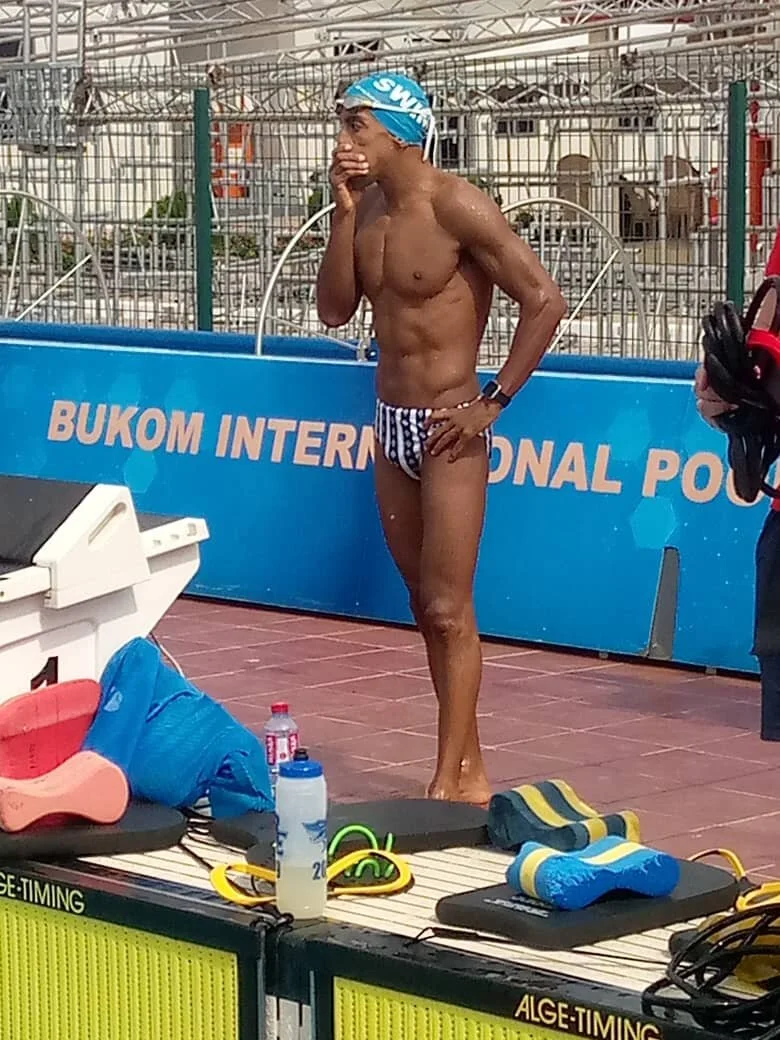
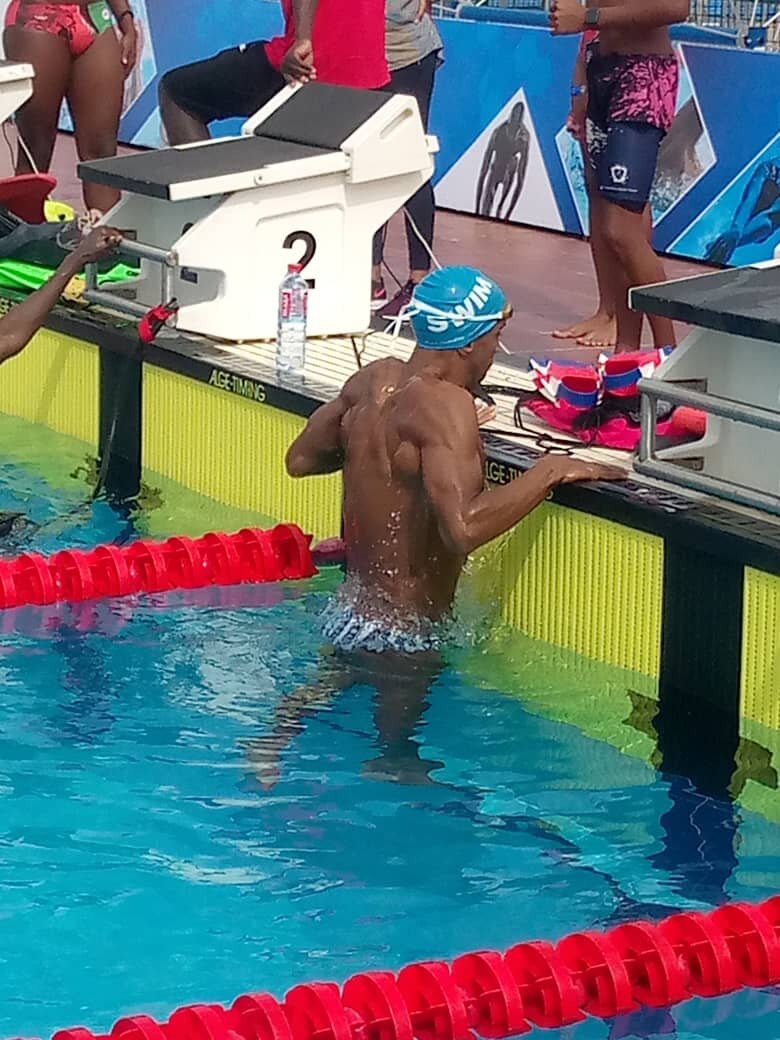
Bukom Pool, Trust Sports Emporium in Accra, Ghana - October 11-16, 2021

This is not an easy article to write. Like all things in the universe, there is a unity of opposites - heat and cold make the unity “temperature”; inhale and exhale make the unity of “breathe”; expand and contract make the unity of a “heartbeat”; light and dark, night and day, etc. … Likewise, my experience at the 14th African Swimming Championships is both joy and sorrow, pride and shame. If I am going to write honestly, If I am going to document this historic occasion, my own standards of authenticity, openness, honesty and duty require that I go beyond the fluff pieces of sports journalism. I have to keep it real. I have to be courageous and vulnerable. Expose and uplift. . . .

0CB93977-00D9-477E-8BFB-F12935AED0F8.jpeg

Photo courtesy of the Guinea Bissau Swim Federation

The Joy and Pride

First, let me start with my results.

Event #2 Men 100 Breast - 1:12.04 -14th place

Event #6 Men 50 Back - 31.60 15th place

Event #12 Men 50 Breast - 31.79 13th place

Event #17 Men 100 Free - 57.01 15th place

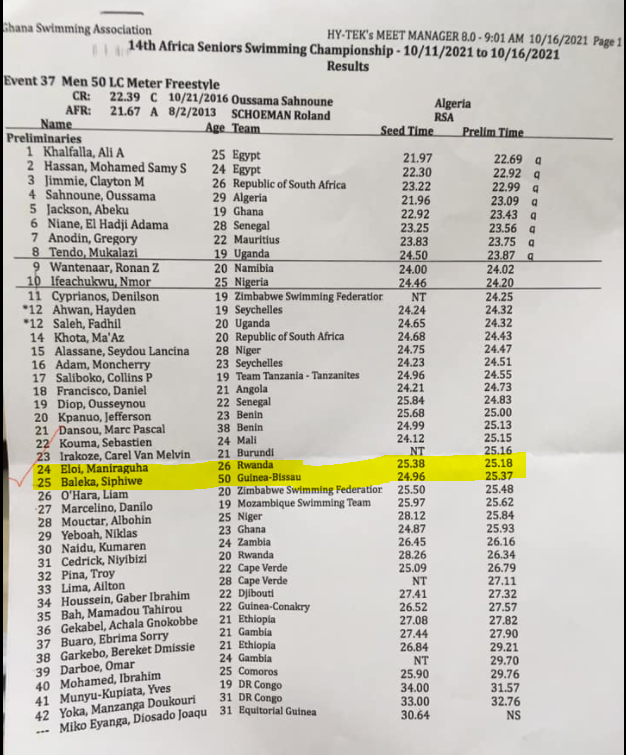
Event # 37 Men 50 Free - 25.37 25th place

I swam the 50 meter freestyle at 25.37, a little slower than I swam in Egypt in June while trying to qualify for the Olympics (25.25). It was my best race in the competition and I'm happy with my performance. I can say that I did my best for Guinea-Bissau.

I had hoped to swim faster in my other events, especially the 100 Meter Breast and 100 Meter Freestyle. But after my first swim, I realized that the important thing was my EXPERIENCE and not my times. I had to adjust my mindset because the purpose of this competition was above all, to represent Guinea Bissau for the first time at the African Swimming Championships and thereby establish a swimming legacy for Guinea Bissau. I would be a fool to deny myself the opportunity to simply enjoy doing that simply because I wasn’t swimming as fast as I wanted. Moreover, I also had to take into consideration the circumstances under which I had been training for the past five months - I had relocated from Springfield, MO during the COVID pandemic, to Bairo Militar, Bissau. I went from training in an evironment that was producing collegiate national champions and US Olympic trials qualifiers in a high level training facility to swimming by myself with no coach or teammates, in a 25 meter hotel pool with no lane lines, lane or wall markings, in water that was 87 degrees or warmer! To overcome this training struggle, I relied on the MySwimPro app and was following its ten week IMX Pro Challenge training plan to build some good endurance for those 100’s. Plus there was the stress of my Olympic fiasco. Like many Afrodescendant athletes in the United States, I, too, was having my own mental health issues related to sports. I realized in Ghana that it was more important for me to focus on the fact that here I was RACING in Africa with other African swimmers - something that very few, if any, African American swimmers have ever done, and certainly not representing an African country at the continental swimming championships! . It was time for me to just swim, race, and make friends.

O Golo GB, Guinea Bissau’s premiere online sports news agency, noted, however, that all of my swims established National Records for Guinea Bissau.

According to the FINA Masters Swimming World Rankings for the male age group 50-54, the best time last year (2020) was Cristiano Baldinin with 25.87 . My swims in Cairo and Accra are likely to be ranked #1 in the world in this category in 2021.

Earlier this year, I swam the 100 meters freestyle in 55.90. That should also place me in the top three in the world in the men's 50-54 group.

All of my other times for the 14th African Swimming Championships will likely be in the top 5 in the world in the Men's 50-54 Group.

FINA Masters Top Ten 2020

14th African Swimming Championships results Men 50 Meter Free - #25 Siphiwe Baleka 25.37

GUINEA BISSAU - AFRICA - NOW HAS ONE OF THE BEST MASTERS SWIMMERS IN THE WORLD. BUT WILL ANYONE NOTICE?

The last time I competed in the FINA Masters World Championships in 2017, I won four silver medals but failed to become a world champion. That same year, at the age of 45, I was the oldest competitor in the Arena Pro Swim Series in the United States. My goal now is to win an event at the FINA Masters World Championship next year in Japan, where I will compete against competitors from my own group. In Ghana, I was the oldest competitor, with the second oldest being Marc Pascal Dansou, 38, from Benin.

The Sorrow and Shame

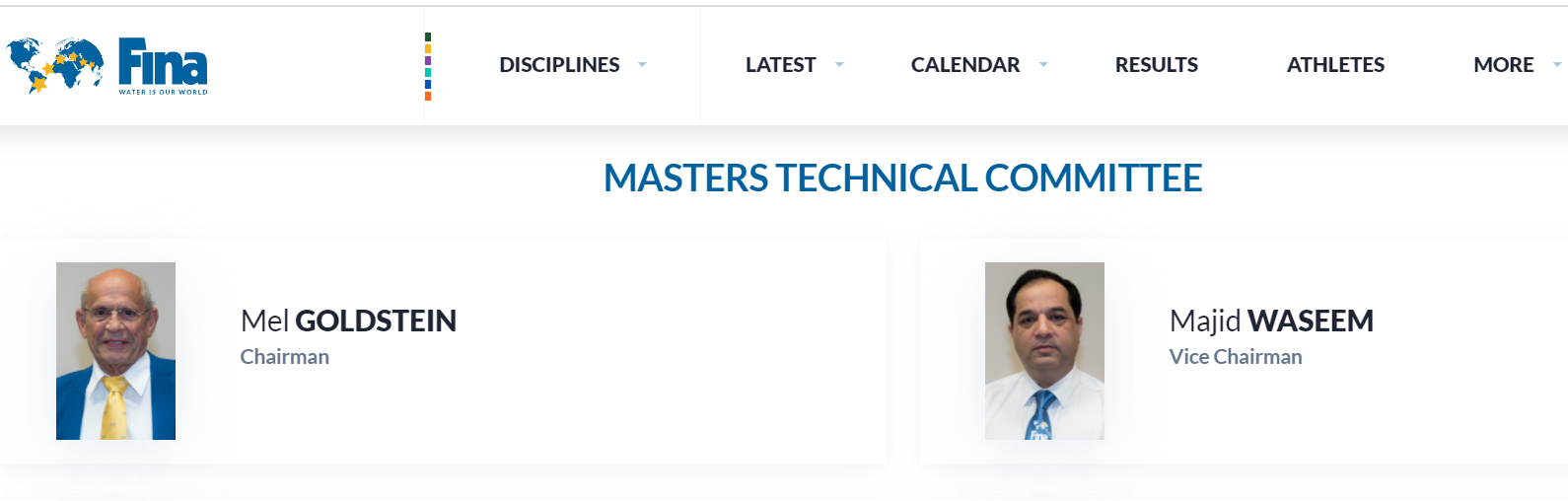
To truly understand the full dimension of my experience at the 14th African Swimming Championships, it’s necessary to go back a few years. In December of 2015 I sent the following email to Mel Goldstein, Vice Chairman FINA Masters Technical Committee:

“From: Siphiwe Baleka <fitnesstrucking@gmail.com>

Date: Wed, Dec 16, 2015 at 5:06 PM

Subject: Competing in Africa in 2016

To: Mel Goldstein <goldsteinmel@sbcglobal.net>

Greetings Mel,

Any opportunity for me to compete somewhere in Africa in 2016?

Siphiwe Baleka www.siphiwebaleka.com

After receiving no response from Mr. Goldstein, I sent the following email two weeks later to every person I could find connected to swimming in Africa:

“From: Siphiwe Baleka <fitnesstrucking@gmail.com>

Date: Sat, Jan 2, 2016 at 3:02 PM

Subject: Competing in Africa in 2016

To: Mel Goldstein <goldsteinmel@sbcglobal.net>, Laura Hamel <lhamel@usms.org>

Cc: Shaun Adriaanse <canazone4secretariat@gmail.com>, analima29@hotmail.com, info@samastersswimming.com, kennedy@yebo.co.za, guyh@summercon.co.za, wahoosecretary@gmail.com, pjduffy@broll.com, bosmead@gmail.com, mangelos@mweb.co.za, "winrose@telkomsa.net" <winrose@telkomsa.net>, "odendaalannemarie0@gmail.com" <odendaalannemarie0@gmail.com>, "judy.collins@vodamail.co.za" <judy.collins@vodamail.co.za>, "hestersnyman@mweb.co.za" <hestersnyman@mweb.co.za>, marinetzswimmingclub@gmail.com, info@swimafrica.net, sports@ug.edu.gh, headofschool@lincoln.edu.gh, kmoolchandani@lincoln.edu.gh, info@softkenya.com, eth@telecom.net.et, "Green, Robert (DPR)" <robert.green@dc.gov>, Kathy Cooper <blackheritageswimming@gmail.com>

Greetings,

This email is going out to people and organizations that may be interested in my effort to become a World Champion at the 2017 FINA Masters World Championships (Men's 45-49 Age Group). If I am successful, I may become the first African American Masters Swimming World Champion. In preparation, I am planning to connect my passion for swimming with my ancestral heritage, something I did in 2012 when I became the US Masters Swimming National Champion in two evetns (see https://www.growingbolder.com/siphiwe-baleka-in-for-the-long-haul-735035/ ) and then became the first African American to complete Ironman South Africa (see http://www.siphiwebaleka.com/merch/triblackalete). 

In preparation for 2017 Masters Swimming World Championships, I am planning my own personal Black Swimming tour in 2016 that begins with the 30th Annual Black History Invitational Swim Meet in Washington, D.C. February 12th through the 16th. Then moves to the 14th Annual National Black Heritage Swim Meet in Cary, North Carolina May 28-29. I am hoping to culminate this tour with a competition in Africa sometime between August and December 2016. The purpose of such a trip would be:

1) interest African Americans in the sport of swimming at all levels, from kids through masters

2) provide historical and cultural components to the sport

3) connect black swimmers in America with black swimmers in Africa

4) propsect on possibilities for coaching black swimmers in Africa

5) compete against some of the best swimmers, white and black, on the African continent

6) provide personal fulfilment returning to the continent

In essence, this campaign is a way for me to combine two of the most important things in my life: my ancestors and swimming.

If you are able to provide any information about any opportunities to compete and participate in any ongoing swimming program on the African continent in the second half of 2016, please don't hesitate to contact me.

To find out more about me, watch the Fox Sports video here: http://www.siphiwebaleka.com/ --Respectfully,

Siphiwe Baleka”

THUS BEGAN MY EFFORT TO COMPETE IM AFRICA AND TO GIVE BACK TO THE SPORT I LOVED AND TO THOSE THAT NEEDED IT THE MOST - BLACK SWIMMERS IN AFRICA!

I went on to win four silver medals at the FINA Masters World Championships in 2017 in Budapest, but I heard nothing from anyone in Africa about Swimming and competing there. And this started my disappointment with FINA and specifically Confederation Africaine de Natation (C.A.N.A) - the African Swimming Federation that governs the sport on the continent.

Why weren't FINA and CANA being more helpful?

Afterall, how often do they receive such inquiries from such an experienced and passionate African American swimmer? Surely I had something valuable to offer CANA and to the next generation of swimmers in Africa. Didn't they want my help? My inability to establish effective communications would continue to be a problem even once I relocated to Africa.

Now, fast forward three years. I heard nothing from no one at FINA or CANA. Then I had the following email exchange that started August 23, 2019 - 

“----- Forwarded Message -----

From: Siphiwe Baleka <fitnesstrucking@gmail.com>

To: Kyle Deery <kdeery@usms.org>; Kyle Deery <kdeery@usmastersswimming.org>

Cc: Mel Goldstein <goldsteinmel@sbcglobal.net>;

Sent: Friday, August 23, 2019, 11:56:18 AM EDT

Subject: Contacting Senegal and Guinea Bissau Swim Federations

Greetings Kyle,

My apologies for all the requests lately, but with Laura not at USMS anymore, you are the only one that I know. I need help contacting  Dr. Mohamed Diop, FINA Bureau Member from Dakar.  I will be traveling to Senegal and Guinea Bissau in late December and I want to do some swim related activities, possibly some swim clinics. I need swimming contacts in these countries. Perhaps USA Swimming can help as well. I've contacted Mel Goldstein previously and he is CC'd on this email as well. I appreciate any help or contacts that you can provide.

-- Respectfully,

Siphiwe Baleka

From: Mel Goldstein <goldsteinmel@sbcglobal.net>

Date: Fri, Aug 23, 2019 at 7:26 PM

Subject: Re: Contacting Senegal and Guinea Bissau Swim Federations

To: Siphiwe Baleka <fitnesstrucking@gmail.com>

Siphiwe

Mohamond is from Senegal not Dakar.. I will forward your message to him and he will contact you if his federation is interested 

From: Siphiwe Baleka <fitnesstrucking@gmail.com>

Date: Fri, Aug 23, 2019 at 7:33 PM

Subject: Re: Contacting Senegal and Guinea Bissau Swim Federations

To: Mel Goldstein <goldsteinmel@sbcglobal.net>

 Mel, Dakar is the capital of Senegal.

From: Mel Goldstein <goldsteinmel@sbcglobal.net>

Date: Sat, Aug 24, 2019 at 2:24 AM

Subject: Re: Contacting Senegal and Guinea Bissau Swim Federations

To: Siphiwe Baleka <fitnesstrucking@gmail.com>,

Yes, my bad thinking of Doha .. I have sent your message to Mohammod.

Mel Goldstein Education Services | U.S. Masters Swimming

Le 27 août 2019 21:08, Mel Goldstein <goldsteinmel@sbcglobal.net> a écrit :

Mohamed, 

I hope your travels were uneventful as was mine... This gentlemen contacted our National Office and wanted to make contact with you... I am reluctant to give out information.  If you want to contact him his email is below...

I still want that blue shirt...

Mel Goldstein

Education Services | U.S. Masters Swimming

 Now, notice the tone of Mr. Goldstein. In his first message he tries to correct me by telling me Dr. Diop is from Senegal and not Dakar, not realizing that Dakar is the capital of Senegal. And this coming from a man who is representing “Education Services | U.S. Masters Swimming”…!. Mr. Goldstein said he “forwarded my message” and that if Dr. Diop’s federation is interested they will contact me. This was not exactly the kind of help that I was expecting. I had been sending information to Mel about who I am and want I wanted to do in Africa since the end of 2015. I was one of the most well-known and publicized masters swimmers in the United States and this was all Mr. Goldstein could muster for me????? And this man was MY representative to the FINA Masters technical committee????? Why was he reluctant to give me the contact information for the CANA Secretary General???

AND THIS WOULD BE THE PATTERN. I volunteer information and help and in return people are reluctant to help or share information. I did, however, get a response from Dr. Diop: On Tue, Aug 27, 2019 at 7:49 PM Mohamed Diop <drmohameddiop@yahoo.fr> wrote:

“Dear Siphiwe

My friend foward me you email.

I will happy to meet you in Dakar in décembre.

Infortunally, Guinée Bissau don't have active fédération but i can give you One contact.

Please received my WhatsApp contact :

Dr Mohamed Diop

+22176xxxxxx

Regards

Mohamed”

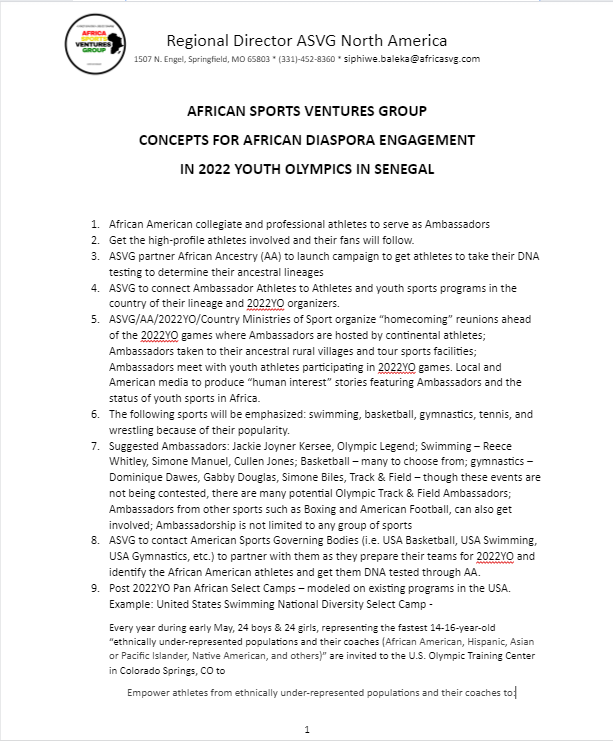
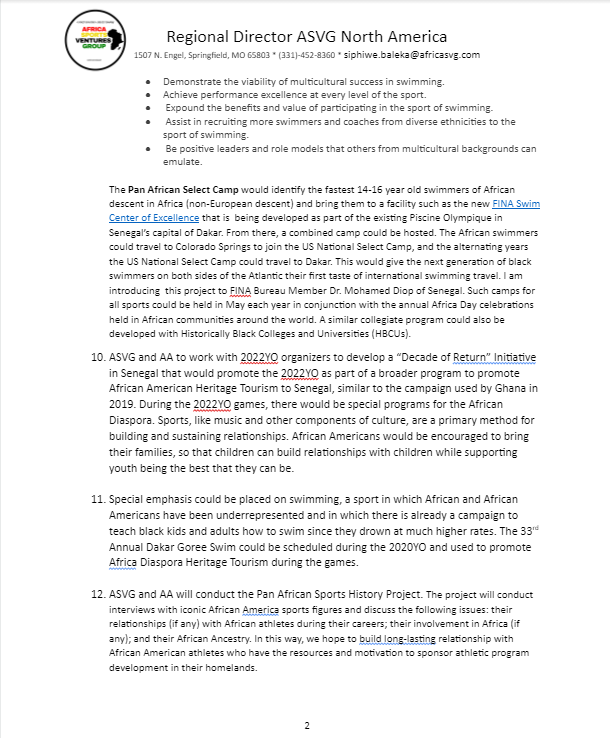
And that was it. No questions, no conversation, nothing. I went straight to my ancestral homeland of Guinea Bissau and didn’t stop in Senegal, so Dr. Diop and I never met. However, at that time, I was serving as the North American Regional Director for the African Sports Ventures Group (ASVG). UNESCO reached out to ASVG for help with promoting the 2022 Youth Olympic Games which were scheduled to be held in Dakar. It was the first time such a competition would be held on the African continent, and ASVG asked me to come up with a plan for getting African American involvement. I was delighted and forwarded to UNESCO and Dr. Diop the following concept paper:

Due to COVID, the 2022 Youth Olympic games have been posponed to 2026. But the Secretary General of Confederation Africaine de Natation (C.A.N.A) - the African Swimming Federation - Dr. Diop, from Dakar, Senegal, showed very little interest. No further conversation on my concept paper was had and no effort has been made since. Here I was, offering what I thought would be a great contribution to African Swimming - the Pan African Select Camp and a potential partnership with the United States Swimming National Diversity Select Camp, building heritage tourism around swimming - and no one was interested!
But here I was, nonetheless, at the 14th African Swimming Championships. Getting here wasn’t easy. First of all, very little meet information was posted on the CANA website. To get any details, you have to get the meet information called the Team Leaders Guide. This information is only available to the officers of the federation. Such information should be posted to the CANA website for transparency. That would allow coaches, swimmers and officials better access to the information and make planning and preparations much easier.
For example, if I wanted to enter the 2021 Toyota US Open, an international competition, I would go to the USA Swimming Online Meet Entry (OME) System of which I am a registered athlete member unattached to any team, and I would select the meet information. If I am a coach, I can enter my team. If I am an individual unattached to any team, I can enter myself.
If CANA had such a system, it could add the option of “Enter a Federation”. In this way, it would make the entry process much more robust and streamlined, more accessible and user-friendly, and decrease the amount of work that the host committee has to do.

When I tried to enter the meet, I had difficulty because the Guinea Bissau Swim Federation (GBSF) is new and inexperience and knew nothing about the 14th African Swimming Championships. Plus, there’s a language barrier between me and the GBSF officers who speak Portuguese and not English. The meet information is published in English. And as I have been repeatedly told, FINA and CANA “don’t deal with individuals, we only talk to the federation.” Since I have no official position with GBSF, neither FINA nor CANA wanted to share any information with me about entering the meet. I was left to the mercy of GBSF Officers who have no swimming background and didn’t even know about the competition to get information, translate it, understand it, communicate it with me, and submit my entries in a timely fashion. It was this situation which caused me to not swim in the Olympics. So I had to help te GBSF get the Team Leaders Packet and then share it with me. Then I had to do my own entries for the GBSF and then help GBSF send my entry to GSA hosts! I couldn’t believe that the 14th African Swimming Championships were only receiving PAPER entries submitted by the national federations! They then have to MANUALLY enter each swimmer’s entries and they were still doing this days into the competition!!!! It felt as if I had stepped back into the 1980’s when my father was doing meet entries on his computer and printing heat sheets and deck cards in our house!
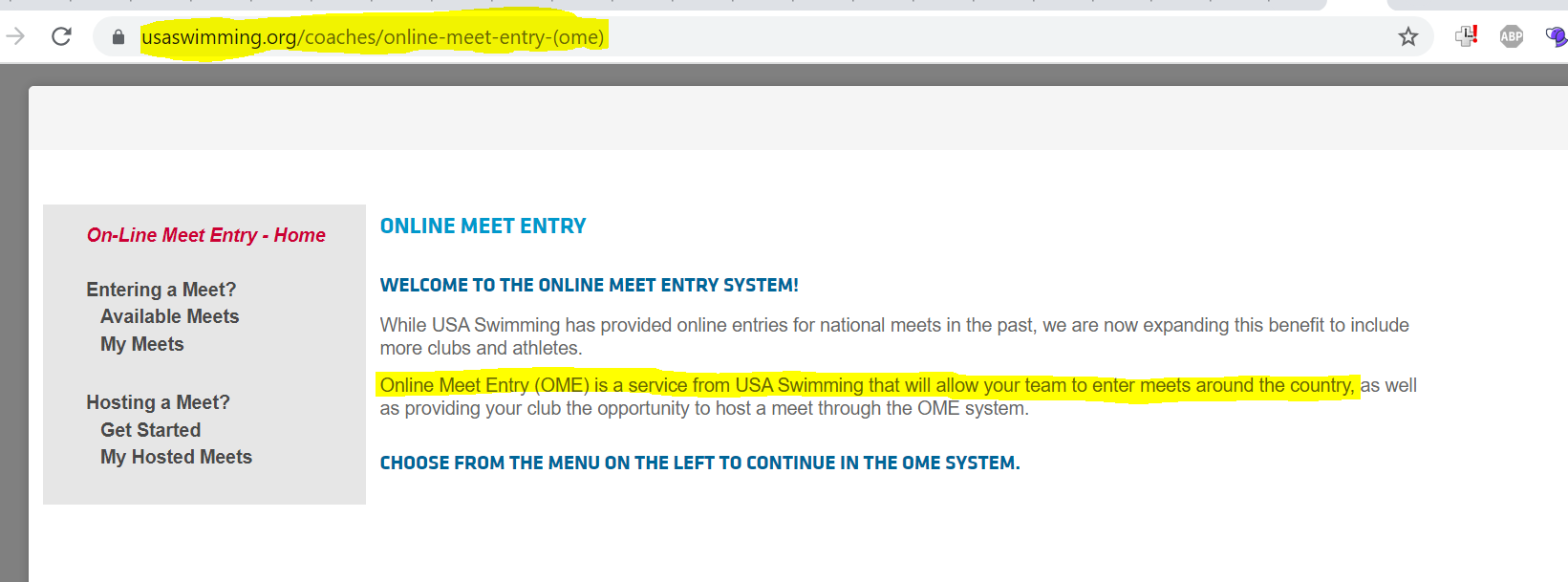
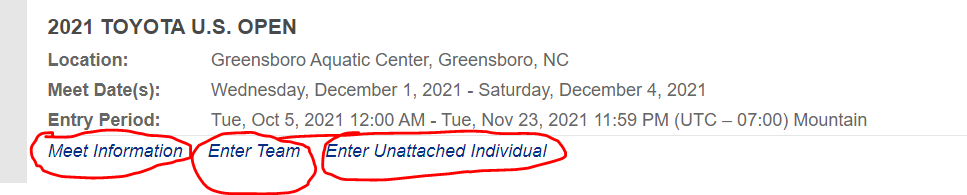
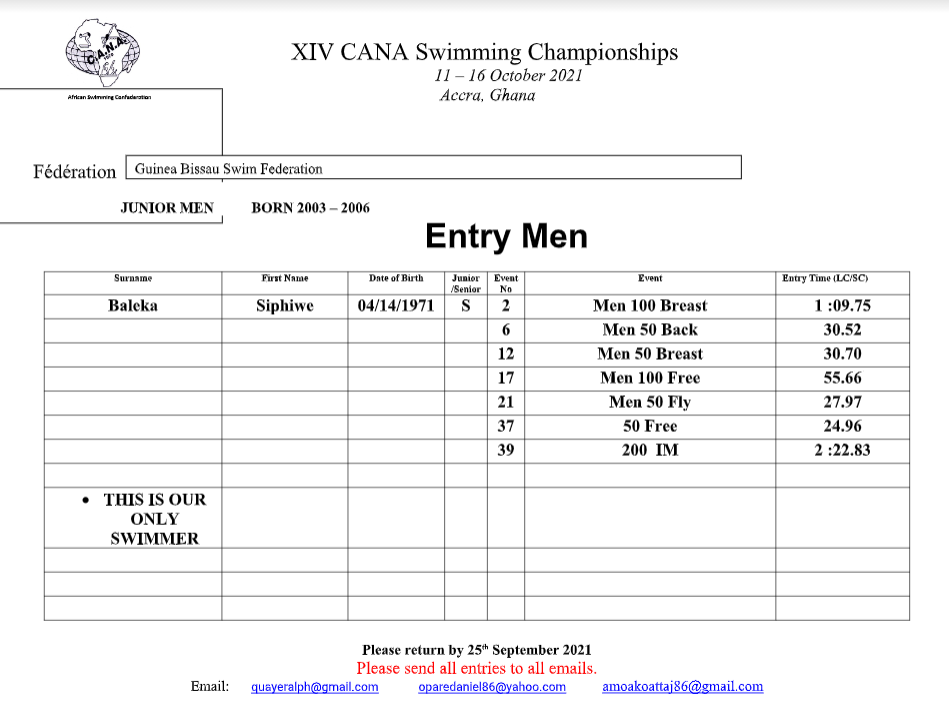
As a result of this entry process, there was no psyche sheet available before the competition started, which, for a continental championship, is just unacceptable. Coming to the meet, I had no idea the level of competition I was facing, the number of swimmers, anything. I couldn’t do much forecasting or planning of my competition day routine because I had no idea how many heats there would be, how much time between my events, etc. Like everyone else, I just had to go with the flo and play it by ear.
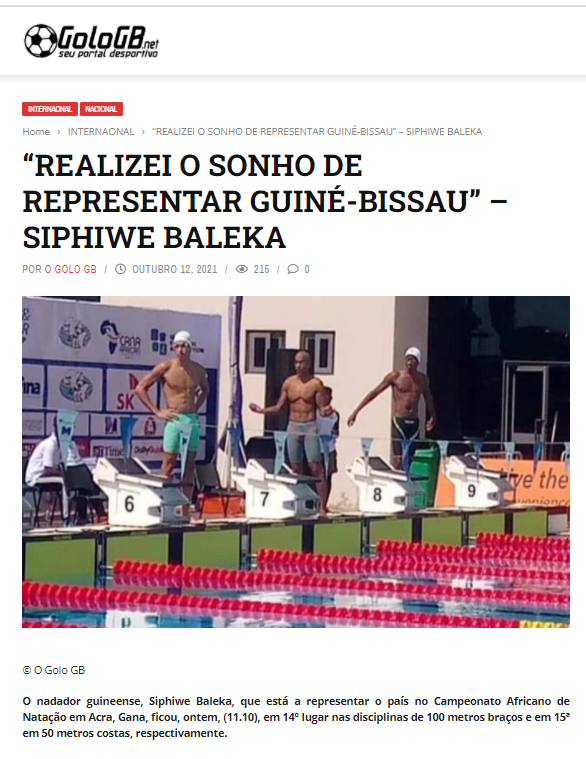
There was another problem just entering the meet and getting settled in Ghana. According to the Team Leaders Guide, the only room options available were a single or a double room. My Team Manager and I decided it would be best for us to get one suite and share it. We were going to be there ten days and we didn’t want to be trapped in a small hotel room. That’s not conducive to being comfortable and performing well. When we requested to get a suite, Farida Iddriss of the Ghana Swimming Association (GSA) told us that wasn’t possible. But of course it was possible, because we went ahead and made our own reservations with the Best Western Premiere Hotel, reserving a King Suite. We then asked Ms. Iddriss what remaining fees there were (to cover transportation and meals). We were rather surprised to find out that GSA couldn’t make any adjustment - “Please note that, as accomodation was not done through the Ghana Swimming Association. We will here by want to inform you that, you will not be provided Internal transportation and meals.”

That was annoying. I used Google maps to see how far the hotel was from the pool and it showed that it was going to be about a 40 minute drive each way! It didn’t make sense to me that GSA couldn’t make an adjustment simply because we wanted a different kind of room that was more suitable for us. I anticipated that having to take an taxi or Uber to the pool and back twice each day (prelims and finals) would be expensive. Why couldn’t they allow us to pay a fair price to ride the bus with all the other teams?

Fortunately, after arriving in Ghana and speaking to other members of the GSA, we were informed that since we were staying at the same hotel, we could, indeed ride the bus from the hotel to the pool. However, this would become a huge problem for all the team throughout the meet. The bus schedules weren’t posted, there was plenty of confusion, buses were arriving and departing late, and sometimes it would take more than an hour to get from the hotel to the pool or vice versa. Since our delegation consisted of just two people, we made the quick decision to relocate after the second night to a three-bedroom Airbnb apartment close to the pool at 1/3rd the price of the hotel! This worked out very well for us and we realized that doing things on our own saved us a lot of time, money and frustration. We didn’t have to wait around….

This also highlghted another difference between how things are done in the United States vs. Africa. It would be absurd for the meet hosts to handle hotel arrangements for all teams! Rather, hotel information is provided in the meet information and each team/swimmer can choose their own accommodations. Of course, this is a much greater challenge for an international competition, especially in Africa where you have different languages. It’s great that the GSA took the responsibility for making hotel arrangements, but their communication and ability to adjust to the needs of each federation/team was severely challenged. For the first half of the meet, information desks at each of the major hotels was not staffed, bus schedules were not posted and enforced, the meals provided were the same buffet style meals EVERYDAY….. The problem trusting the whole operation to the host federation is that whatever they don’t get right, everybody suffers….

There was a team leaders meeting the afternoon before the competition. We arrived and that was my first look at the Bukom International Pool. It was beautiful. I was excited. But then I only say the single 50 meter competition pool. Where was the warmup/warmdown pool. I discovered there was none. In the team leaders meeting, I asked, “Will there be any breaks during the senior prelim session for warm up or warm down since there is no separate pool for that?” Sam Ramsamy, the CANA President, said, “No.” I then asked, “Not even a 10 minute break at the halfway point?” Mr. Ramsamy said, “No. 10 minutes isn’t going to help a swimmer anyway.” I looked at him incredulously, Here we were at the CONTINENTAL championships for Africa and once the meet starts, there’s no warmup or warmdown available. I sat dumbfounded. For me personally, as a 50-year-old swimmer, my body just cant recover the way it used to. I have to warm down after every race and flush the lactic acid out of my system and usually I’m good for just two races per session. On the first day I had a 100 breast/50 back double and on the last day I had a 50 free/200 IM double. I needed the opportunity to swim down between races. I knew other swimmers needed it, too. So I then asked, “So that means that some swimmers who may only be swimming the last two events, have to sit around after warmup, perhaps for an hour or longer, and swim their race with no warmup?” Mr. Ramsamy responded as if I was deliberately trying to cause a problem. But all the team leaders and coaches agreed with me. Mr. Ramsamy’s final response was to use the fact that 1) they were combining the Junior and Senior Championships for the first time and 2) they were trying to do this under COVID restrictions and therefore everyone had to make sacrifices and be understanding. Yet in the same breath, Mr. Ramsamy said that their focus and everything they were doing was for the benefit of the swimmers. . . . .

On Monday morning I arrived at the pool. Just before warmups I finally got to see the heat sheet for the day’s session. There were just two heats of the first event, the women’s 100 meter freestyle, and two heats of event #2, the Men’s 100 meter breastroke. Wait a minute. The Ghana Swimming Association announced on their Facebook page that there were 420 swimmers from 42 countries at the competition. I was expectating way more swimmers than this! Just 16 swimmers in the 100 breast???? Two heats in a CONTINENTAL CHAMPIONSHIP???? I just couldn’t believe it.

I was in the second heat of the 100 breast. While we were in the ready room, we heard the starter say, “Take your mark ……” Then there was some loud squeaking from the PA system. Most of the swimmers thought the squeak was the actuall start and they took off. Two swimmers were still standing on the blocks and never started….. At the 75 meter point, the referee tried to stop the swimmers. Some stopped, some finished the race, with no time. The whole think was a very unfortunate start to the 14th African Swimming Championships. I sat there in disbelief. In fact, I sat there feeling ashamed. It was embarrasing that this, MY championship, my CONTINENTAL CHAMPIONSHIPS, the thing that I was so proud to be a part of - I felt ashamed knowing that this was the level of production, the best level, available in Africa. Once again, it was the inferiority thing. Why must Africans always be associated with the lowest level of standards???

Now, I was born and raised in the United States. I have been in competitive swimming since the age of 8. I have swum at the highest levels of age group, high school, college, national and masters swimming. I was an athlete representative for Illinois Swimming to United States Swimming for two years. My father help developed the software systems that connecting the timing system to the computers and did all the meet entry, heat sheets, etc. since the 1980’s. So I know how things are supposed to run at the local club, LSC, regional and national levels. I know how competitions are organized, how they run, etc. So when you know HOW things are SUPPOSED to work, it makes it easy to see what isn’t working or what is missing. At that moment I felt shame and sorrow that swimming in Africa was this far behind the rest of the world. I realized, I had expected too much. We all had. In many of the longer races, there were so few entreants that the events was canceled in the preliminaries and all swimmers were automatically moved to the finals. This happened even in the women’s 200 free! All the coaches and swimmers were just in disbelief at what was happening. But then, what could we do? We all just relaxed and made the best of it. Which, ironically, took away a lot of the pressure and made the experience more friendly and enjoyable. “Just do the best you can under the circumstances” seemed to be the spirit of the meet.

A little more than halfway through the meet, there was a second Team Leaders meetings where an attempt was made to solve problems and make things better. And the running of the meet did improve by the final few days. The announcing improved. The award ceremonies improved. They figured out how to raise the flags up the flagpole…. But there was still communication issues even at the end of the meet. People had to get COVID tests arranged, etc.

Finally, there is then the issue that no one ever talks about but is right out there in the open. There are some very, VERY fast swimmers in Africa. Some of the best in the world. And these swimmers are of Arabic and European heritages from Egypt, South Africa, Algeria and Tunisia. I have nothing against these swimmers personally and have made friends with a number of them. Indeed, I spent a little bit of time with South African Swim Coach Graham Hill who is a great guy whom I now consider a colleague and friend.

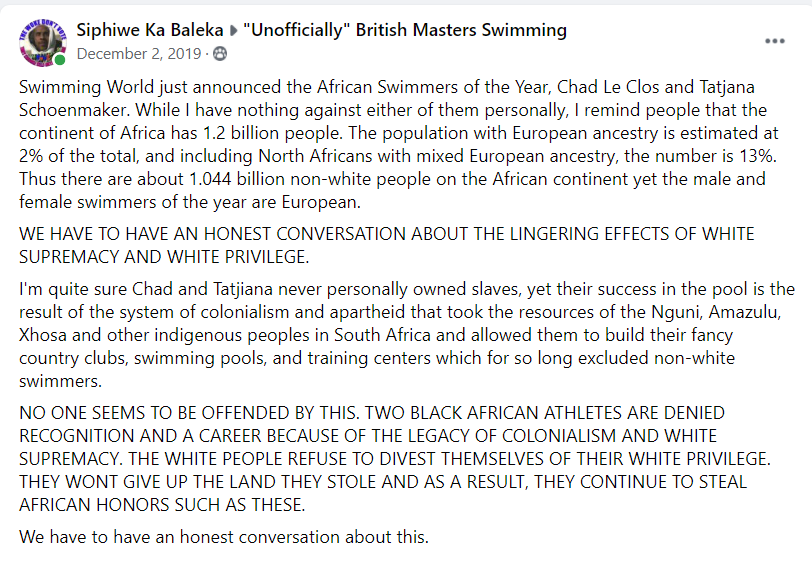
However, in December of 2019, I made the following post on Facebook:

At the 14th African Swimming Championship, there was a pattern. In both the prelims and finals, the middle lanes were almost always (just a few exceptions) occupied by non-black swimmers from Egypt and South Africa and Algeria, and rounding out the outside lanes were the black swimmers. Look at the combined team scores:

Both Egypt and South Africa outscored ALL THE OTHER TEAMS COMBINED!. Now, consider this. On August 9, 2021, FINA president Husain Al-Musallam has reiterated his desire to expand global access to swimming with a new initiative to increase investment in African swimming. According to the announcement made by Swimming World, that investment is put at $29 million over the next four years. The reports states,

“The first of those announced investments is an elite training center in Tunisia, the nation that produced men’s 400 freestyle gold medalist Ahmed Hafnaoui as a beacon of promise for the continent. FINA has also identified Senegal and two universities in South African for elite training bases, as well as other new establishments in Hungary and Russia.”

AND THERE IT IS RIGHT THERE.

One of my teachors said that the functional definition of justice is “no one is mistreated and those that need the most help get the most help.” If there were, in fact, 42 countries at the 14th African Swimming Championships, then that means 19 countries, including Guinea Bissau, didn’t even score a point. Wouldn’t justice require that a significant amount of FINA’$29 million investment in African swimming over the next four years go to those countries who clearly need the most help? South Africa already has the best swimming program in Africa, and Tunisia is doing great already on its own. How was the decision made to give those countries, along with Hungary and Russia (which aren’t African) help? More importantly, WHO made those decisions? Because if you were to ask the people that care the most about developing swimming in Africa - the coaches and swimmers who were on the deck - they would have made very serious and specific requests for help that would reach the black swimmers who represent 75% of the continent. Coaches and swimmers I met and admired from Uganda, Angola, Tanzania, Zimbabwe, Mali.

So this is why I started this article by saying that it is difficult for me to write, that my experience was both joy and sorrow, pride and shame. To write truthfully about my experience requires expressing both. And there are some people who will criticize me saying that Africa already has it bad enough. Why must you tell these things. You should try emphasize the good things. ANd of course, that is my intention. That has always been my intention since I first sought to find a way to contribute to African swimming back in 2015. I am not bad-mouthing Africa. I live here and encourage the African Diaspora to prepare themselves to come home and build the Africa of tomorrow. But if you don’t first diagnose the patient, identify what is wrong and what needs to be done, how will the patient ever be treated and cured?

Bob Marley once sang, “Check out the real situation…..” Most of the swimming world, and especially the swimming world in the United States, knows nothing about the real situation of swimming in Africa. As one of the Senior Statesmen of African American Swimming and the first to fully repatriate and compete for an African nation - someone with a reputation as a Fitness Guru that has appeared in US mainstream media such as the Atlantic, Sports Illustrated, Good Moring America, CBS Evening News, and many, many others, I am the perfect person to expose the real situation so that attention and resources can be brought to bear on it and improvement made. That’s why I am writing this. I want people to reach out and say, how can I help? What do you need? And hopefully, with my success, more athletes and coaches will bring their talent to their anesctral homelands like I have done. Not just for swimming, but for all sports. And in this way we make our contribution to building Africa’s sports infrastructure. When that happens, Africa’s youth will no longer dream of leaving Africa to play in Europe and America. Instead, the African Diaspora youth will dream of returning to Africa to play.

Siphiwe Baleka, representing Guinea Bissau, in the Parade of Nations at the 14th African Swimming Championships.

O presidente do BanFaaba, Mario Ceesay, e o coordenador da Década de Retorno, Siphiwe Baleka, se encontram com H.E. Dra. Erieka Bennett, Fundadora e Chefe da Missão, Diáspora Fórum Africano

1D3D01EE-24B6-4E58-800A-E61E423AECB6.jpeg

Na quinta-feira, 14 de outubro de 2021, o presidente do BanFaaba, Mario Ceesay, e o coordenador da Década de Retorno, Siphiwe Baleka, se reuniram com H.E. Dra. Erieka Bennett, Fundadora e Chefe da Missão, na sede do Fórum Africano da Diáspora (DAF) em Accra, Gana, para discutir a Iniciativa da Década de Retorno da Guiné-Bissau.

SOBRE O DAF

O site da DAF afirma,

“O Diáspora African Forum (DAF) é uma organização sem fins lucrativos endossada pela União Africana (UA), aberta em 7 de julho de 2001 por H.E. Presidente J.A.Kufuor. A DAF foi e continua sendo a primeira e única organização da Diáspora Africana no mundo com status diplomático, permitindo que a DAF realizasse um trabalho pioneiro na defesa da Diáspora nos níveis mais altos do governo em Gana e na África em geral.

O mandato da DAF é apoiar a UA e os Estados Membros na integração dos Africanos na Diáspora, ao mesmo tempo que fortalece o envolvimento da Diáspora Africana no Gana e em todo o continente. A DAF planeja continuar seus esforços como um agente de mudança para o desenvolvimento de políticas sólidas para a reintegração da Diáspora África em todo o mundo. ”

“Queríamos aprender com o Dr. Bennett sobre a Década de Retorno de Gana e, especificamente, sobre a criação de um‘ balcão da diáspora ’com status diplomático na Guiné-Bissau”, disse Siphiwe Baleka. “Quando você quer saber como fazer algo, você fala com pessoas que já fizeram.”

O Dr. Bennett enfatizou que o objetivo da DAF é fazer exatamente isso - ajudar os diásporos a estabelecer missões diplomáticas em todos os estados membros da União Africana. Isso é incrivelmente importante agora mais do que nunca, pois os afrodescendentes na América estão partindo em grande número e retornando às suas terras natais ancestrais e obtendo a cidadania.

O Sr. Baleka ajudou a redigir uma Moção para o Conselho Executivo da União Africana que também se encontra hoje, apelando à ação para acelerar a participação da Diáspora Africana nas estruturas da União Africana. O movimento

“SOLICITA aos estados membros da UA a estabelecer e aprovar políticas para: -

i) Estabelecer uma Mesa da Diáspora Africana com mandato para garantir que o subgrupo da Diáspora Africana - consistindo no grupo específico de pessoas de origem africana, nascidas fora do continente africano, que nunca tiveram acesso a um direito de primogenitura automático para reivindicar uma cidadania africana específica ou nacionalidade devido ao legado horrível do comércio transatlântico de escravos, mas reconhecem seu Direito de Retornar (RTR) à sua pátria ancestral - têm suas necessidades específicas satisfeitas para obter uma repatriação bem-sucedida com a recomendação de que o African Diaspora Desk trabalhe em parceria com a Diáspora Conselho Consultivo instituído pela Declaração da Cimeira Global Africana de 2012 para cada estado membro.

ii) Implementar legislação para ajudar os Repatriados RTR da Diáspora Africana com a aquisição de residência, um caminho acelerado para a cidadania, aquisição de terras e programas de integração cultural que incluem a criação de uma categoria especial de imigração para permitir a repatriação fácil para este grupo.

iii) Promover o trabalho conjunto entre o Ministério dos Negócios Estrangeiros, Imigração, Assuntos Internos e OSC Pan-africanos, que podem satisfazer os requisitos do ECOSOCC para se tornarem OSC reconhecidos, para garantir a aplicação das referidas políticas no que se refere à facilidade e repatriação bem sucedida de africanos Diaspora RTR Repatriates.

(iv) Criar uma ligação direta do Gabinete da Diáspora Africana em todos os estados membros para a CIDO, para implementar estratégias apropriadas de Envolvimento e Assistência da Diáspora Africana para esse grupo RTR da Diáspora Africana nos estados membros da UA.

(v) Direcionar o Gabinete da Diáspora Africana e o Ministério dos Negócios Estrangeiros para trabalhar na realização da Visão 2063 com a Diáspora Africana: -

De acordo com o Sr. Baleka, “Não somos simplesmente turistas nem apenas investidores. Somos uma categoria especial de pessoas que retornam às nossas terras ancestrais que continuam sendo nosso direito de nascença. Estamos nos recuperando do ETNOCIDE, seus efeitos epigenéticos transgeracionais, e reparando os danos que causou. ”

O presidente do BanFaaba, Mario Ceesay, disse: “A reunião com Sua Excelência, a Dra. Bennett, foi extraordinária. Esperamos sua ajuda para ajudar a Guiné-Bissau a perceber os benefícios de um programa da Diáspora, que tem servido Gana tão bem. ”

Durante o encontro, foi discutida a possibilidade de uma missão diplomática da DAF à Guiné-Bissau para o evento da Década de Retorno em novembro.

“Pretendemos informar Sua Excelência a Ministra das Relações Exteriores, Sra. Suzi Barbosa, assim que voltarmos”, disse Baleka, que está em Gana competindo no 14º Campeonato Africano de Natação.

###

E4CFC022-6D59-4998-BAA8-F1D3ABD6A7D0.jpeg

BanFaaba President Mario Ceesay and Decade of Return Coordinator Siphiwe Baleka Meet with H.E. Dr. Erieka Bennett, Founder and Head of Mission, Diaspora African Forum

WhatsApp Image 2021-10-14 at 8.34.54 AM.jpeg

On Thursday, October 14, 2021, BanFaaba President Mario Ceesay and Decade of Return Coordinator Siphiwe Baleka met with H.E. Dr. Erieka Bennett, Founder and Head of Mission, at the Diaspora African Forum (DAF) headquarters in Accra, Ghana, to discuss Guinea Bissau’s Decade of Return Initiative.

ABOUT THE DAF

The DAF website states,

“The Diaspora African Forum (DAF) is an African Union (AU) endorsed non-profit organization opened on July 7, 2001 by H.E. President J.A.Kufuor.  DAF was and remains the first and only African Diaspora organization in the world with diplomatic status enabling DAF to accomplish groundbreaking work in Diaspora advocacy at the highest levels of government in Ghana and Africa in general.

DAF’s mandate is to support the AU and Member States towards the integration of Africans in the Diaspora while strengthening African Diaspora engagement in Ghana and continent wide. DAF plans to continue its efforts as a change agent towards the development of solid policies for the reintegration of the Diaspora Africa worldwide.”

“We wanted to learn from Dr. Bennett about Ghana’s Decade of Return and specifically about setting up a ‘diaspora desk’ with diplomatic status in Guinea Bissau,” said Siphiwe Baleka. “When you want to know how to do something, you talk to people who have already done it.”

Dr. Bennett emphasized that the DAF aim is to do just that - help Diasporans establish diplomatic missions in all the African Union member states. This is incredibly important now more than ever as Afrodescendants in America are leaving in greater numbers and returning to their ancestral homelands and obtaining citizenship.

Mr. Baleka helped draft a Motion to the African Union Executive Council that is also meeting today, calling for action to expedite the participation of the African Diaspora within the structures of the African Union. The motion

“REQUESTS the AU member states to put in place and enact policies to:-

i) Establish an African Diaspora Desk mandated to ensure that the African Diaspora sub-group - consisting of the specific group of people of African origin, born outside the African Continent, who have never had access to an automatic birthright to claim a specific African citizenship or nationality due to the horrific legacy of the transatlantic slave trade, but recognise their Right To Return (RTR) to their ancestral homeland -  have their specific needs met to achieve successful repatriation with a recommendation that the African Diaspora Desk works in partnership with the Diaspora Advisory Board instituted by the Declaration Of The Global African Summit 2012 for each member state.

ii) Implement legislation to assist African Diaspora RTR Repatriates with acquiring residency, an expedited path to citizenship, land acquisition, and cultural integration programs which includes the creation of a special immigration category to allow ease of repatriation for this group.

iii) Promote joint work between the Ministry of Foreign Affairs, Immigration, Home Affairs and Pan African CSOs, that can satisfy the ECOSOCC requirements to become a recognised CSO, to ensure enforcement of said policies as it relates to the ease and successful repatriation of African Diaspora RTR Repatriates.

(iv) Create a direct link from the African Diaspora Desk in all member states to CIDO, to implement appropriate African Diaspora Engagement and Assistance strategies for that African Diaspora RTR group across AU member states.

(v) Direct the African Diaspora Desk and the Ministry of Foreign Affairs to work on the realization of Vision 2063 with the African Diaspora:- 

According to Mr. Baleka, “We are not simply tourists nor are we just investors. We are a special category of people returning to our ancestral homelands that remain our birthright. We are recovering from ETHNOCIDE, it’s Transgenerational Epigenetic Effects, and repairing the damage it caused.”

BanFaaba President Mario Ceesay said, “The meeting with Her Excellency, Dr. Bennett was extraordinary. We look forward to her assistance in helping Guinea Bissau realize the benefits of a Diaspora program, which has served Ghana so well.”

During the meeting, the possibility of a DAF diplomatic mission to Guinea Bissau for its November Decade of Return event was discussed.

“We intend to brief Her Excellency, the Minister of Foreign Affairs Ms. Suzi Barbosa, as soon as we return,” said Mr. Baleka, who is in Ghana competing in the 14th African Swimming Championships.

###

Video Block
Double-click here to add a video by URL or embed code. Learn more