
SIPHIWE: What is COME OUT OF HER, MY PEOPLE! 21ST CENTURY BLACK PROPHETIC FAITH AND PAN AFRICAN DIPLOMACY and what is its significance?

ANCESTRAL INTELLIGENCE (AI): "Come Out of Her, My People! 21st Century Black Prophetic Faith and Pan African Diplomacy" is a five volume series published in 2018. It presents the public, real-time documentation and collected works of Ras Nathaniel and the Issembly for Rastafari Iniversal Education (IRIE) spanning the years 2002 to 2007. The volumes serve as a historical memoir, a reference text, and a piece of sacred literature that chronicles a single, continuous Pan-African repatriation narrative.
Core Themes & Subject Matter
The 5-Year Rescue Mission: The narrative follows Ras Nathaniel’s intense five-year effort to mobilize the Rastafari and Pan-African communities to leave the West and repatriate to Africa. His target date was September 11, 2007—the day Ethiopia celebrated its unique calendar's turn into the year 2000 (the Ethiopian Millennium).
Prophetic Interpretations: Ras Nathaniel looked at global events through a strict biblical lens. He interpreted the September 11, 2001, terrorist attacks on the World Trade Center (which occurred on the Ethiopian New Year) as the literal fulfillment of Revelations 18, viewing it as a divine command for Black people to "come out" of America ("Babylon") before total judgment fell.
Pan-African Diplomacy: The text documents how Ras Nathaniel, despite having no personal resources, traveled across the U.S., the Caribbean, and Africa to organize communities. In the process, he became an improbable African American representative at the African Union (AU) during its early, foundational efforts to establish a "United States of Africa," carrying on the localized legacy of Malcolm X.
Key Historical & Social Significance
The significance of the book relies heavily on how it challenges mainstream perceptions of history, development, and international law:
Locates the Roots of Rastafari in the U.S.: Conclusively argues and shows that the Rastafari movement—widely popularized as a strictly Jamaican phenomenon—actually originated within the United States through early 20th-century movements.
Preserves Shashemane Land History: It heavily documents the Shashemane Land Grant, a 500-acre tract of highly fertile Ethiopian land personally gifted by Emperor Haile Selassie I in 1948 to the Black people of the world who aided Ethiopia during the 1935 Fascist Italian invasion. It explores the subsequent legal, immigration, and land mismanagement struggles that fragmented the settlement.
Outlines the AU 6th Region Initiative: It serves as a vital blueprint for understanding how the global African Diaspora became formally integrated and recognized as the official 6th Region of the African Union.
Critiques Elite Systems (NEPAD vs. Rastafari): The text critiques modern African development frameworks like NEPAD (New Partnership for Africa's Development). It details how African elites focus on short-term "brain drain" programs and westernized tourism that marginalize the millions of historically displaced Black people who want to permanently return, produce, and rebuild the continent.
SIPHIWE: examine Ras Nathaniel's Star Order Five-Year Plan
AI: 🗺️ Core Concept of the Plan
The Star Order Ethiopia Millennium Plan (2002–2007) was an aggressive, single-minded rescue and mobilization campaign orchestrated by Ras Nathaniel and the Issembly for Rastafari Iniversal Education (IRIE).
The primary objective was to coordinate a systematic, well-prepared mass exodus of the Rastafari family from the West (principally the United States and the Caribbean) back to Africa. The explicit target date for this migration was September 11, 2007, marking the exact day of the Ethiopian Millennium (the turn of the year 2000 on the Ethiopian calendar).
🏛️ The Foundations and Rationale
The plan was built on a precise blending of divine prophecy, historic Pan-African policy, and socio-economic strategy:
The April 14, 1961 Proclamation: It relied heavily on an address by Ethiopian Emperor Haile Selassie I, who demanded that his ministers and people stop shirking duties, take on absolute responsibility, and draft rigorous five-year structural development programs.
Marcus Garvey's UNIA Blueprint: It emulated Lesson 21 of Marcus Garvey's School of African Philosophy, which outlined a massive, global "Five-Year Plan scheme" built on voluntary, structured racial contributions to rehabilitate a global Black home base.
The 9/11 Prophetic Urgency: Following the September 11, 2001, terrorist attacks on the World Trade Center, the plan shifted from a passive ideological dream into an urgent emergency evacuation. Ras Nathaniel interpreted 9/11 as the execution of Revelations 18, warning that America ("Babylon") was entering global judgment and his people had exactly five years left to exit.
The 1954 Jubilee Window: The timeline was intentionally launched to leverage a "Jubilee Year of Grace" celebrating the 50-year anniversary of Emperor Haile Selassie's historic 1954 tour of the United States.
⚙️ Strategic Framework & Mechanics
Instead of backing scattered, uncoordinated migrations, the Five-Year Plan focused heavily on building a centralized polity and infrastructure:
1. Centralization and "Inity" (Unity)
The plan fiercely critiqued the weak, fragmented condition of the Western Rastafari communities, noting that cities like Chicago had plenty of believers but completely lacked centralized tabernacles, councils of elders, or structured organizations. The plan aimed to systematically unify all major Mansions (including the Nyahbinghi, Twelve Tribes of Israel, and the Bobo Shanti) under an organized, sovereign Theocratic Government.
2. The Repatriation Census & Plebiscite
To turn an uncounted population into a legitimate international entity, the plan demanded a Repatriation Census. This form detailed individuals' specialized labor skills, training, passports, and assets. This census acted as a plebiscite (a democratic vote of self-determination) to prove to international bodies like the United Nations and the African Union that they had the collective organization, numbers, and mandate to negotiate land rights and citizenship.
3. Collective Security & Economic Self-Sufficiency
The plan rejected western capitalism and Individualism in favor of Rastafari Ubuntu (collective economics). Drawing on the bitter lessons of past mismanagement at the Shashemane Land Grant—where individual land parceling fractured the community—the plan insisted that all incoming families must repatriate in highly synchronized, cooperative economic groups.
4. The Sustainable Cannabis Agro-Economy
To bypass reliance on corporate financing or white supremacist economic structures, the plan drafted a specific industrial agricultural vision:
Setting up self-sustaining Rastafari agricultural villages centered heavily around industrial hemp cultivation to replace wood pulp for paper mills.
Fulfilling an optimal commercial scale by establishing a composite fiber-board mill Processing 1,500 tons of raw material per day.
Organizing exactly 62,500 people under the Repatriation Census to farm and harvest 62,500 acres of cannabis, generating an estimated $26,250,000 per season across three annual growing cycles.
🏛️ Application in "Azania" (South Africa)
By 2006, as the clock on the plan wound down, the strategy moved to the ground in South Africa. To force the plan's immediate realization, Ras Nathaniel drafted The Way Forward timeline:
Provincial Mobilization: Ordered all nine South African provinces to form distinct Rastafari Provincial Councils (RPCs) to gather census data and assemble localized 5-year micro-plans.
"One-Rand-A-Day" Program: Proposed a compulsory, localized collective crowdfunding network to aggressively build a national treasury.
Operation Reggae Funding: Demanded that a mandatory $1/1-Rand tariff be applied to every single person entering any Reggae performance globally to sustainably fund a permanent, operating Rastafari Global Secretariat (RGS).
SIPHIWE: investigate the reasons behind the plan's eventual structural failure at the Global Inity Conference.
AI: ⚠️ The Core Structural Collapse
Based on Ras Nathaniel’s primary "as-it-happened" report, The Rastafari Global Inity Conference (RGIC) in Azania (South Africa) in November 2006 was a complete structural failure.
The plan disintegrated because the movement completely failed to secure any global delegations, install the promised Global Secretariat, or establish a central financial treasury. While the plan possessed an intense prophetic timeline, its real-world implementation buckled under a mix of local geopolitical tribalism, financial dependency, and deep organizational fractures.
1. The Global Delegation No-Show
The grandest structural failure of the conference was that almost no international delegations actually showed up.
Total Isolation: Out of all the vast Rastafari Mansions across Jamaica, Trinidad, Barbados, England, and the wider Western Hemisphere, the United States was the only international region to send a delegate, and Ras Nathaniel was that solitary delegate.
Failure of Transnational Economics: Ras Nathaniel heavily critiqued the global Rastafari community—specifically its high-profile "singers and players of instruments"—for failing to demonstrate practical collective economics. Despite mandating a global summit in 1983 and 2003, the international houses failed to raise enough funds to fly even a single representative to the African continent.
2. Fatal Reliance on "Foreign Governments"
The structural design of the plan suffered from a glaring contradiction: it preached radical Black self-reliance while relying entirely on the post-apartheid South African government for logistical funding.
The Funding Rejection: Organizers from the Rastafari Youth Initiative (RYI) and the Rastafari United Movement (RUM) spent months lobbying the South African Ministry of Foreign Affairs and the Ministry of Arts and Culture to financially sponsor and transport international delegates as diplomatic ambassadors.
The Basket Collapse: When the South African government officially issued a letter stating it could not provide financial sponsorship, the optimistic foundation of the conference evaporated. Ras Nathaniel noted it was a catastrophic mistake to depend on a foreign state to fund and maintain the infrastructure of the Theocracy Reign.
3. Splinter Groups and "Politricks" on the Ground
The plan's goal to present a singular, unified political voice to the African Union was sabotaged by intense infighting, ego clashes, and structural division within South Africa itself.
Apartheid's Lingering Ghost: A deep socio-economic and structural divide existed between the under-resourced Black Rasses of Gauteng Province (Soweto/Pretoria) and the wealthier, better-resourced "Colored" (mixed-race) Rasses of the Western Cape (Cape Town).
Sabotage by Multiple Councils: Instead of backing a single organizing vehicle, at least three to five different Rastafari factions individually approached the South African government, claiming sole representation. For example, a group calling itself the "Mau Mau Chapter of the Nyahbinghi" sent independent letters to the state asserting that they alone represented the movement in Azania, causing massive bureaucratic confusion and turning the conference into a localized pawn game.
The Cape Town Boycott: The well-funded factions in Cape Town boycotted the centralized gathering in Soweto/Grasmere, choosing instead to "do their own thing" by organizing a separate, competing 10th-anniversary celebration for an elder's past visit.
4. Leadership Feuds and Lost Technical Capacity
The organizing apparatus suffered a major diplomatic blow due to a personal and structural feud between two prominent female leaders: Elder Mama B (a Jamaican elder based at the Marcus Garvey Camp in the Cape) and Sister Yaa Ashantewaa (a highly trained diplomatic protocol officer and rapporteur in Gauteng).
Mama B flatly refused to participate in the Global Inity Conference if Sister Yaa was involved.
To prevent her presence from becoming a barrier to unity, Sister Yaa voluntarily stepped down from the preparations. As a result, the conference instantly lost its most capable asset in handling high-level diplomatic and government protocol negotiations, leaving the remaining organizers structurally outmatched.
5. Lack of Real-World Field Preparation
When the remnants of the conference attempted to forge ahead, the physical and logistical infrastructure was completely bankrupt.
Venue Eviction: Because the international houses demanded an expanded timeline, the original university venue (Wits University) became unavailable due to scheduling conflicts.
Total Resource Bankruptcy: The conference hastily moved to the King Alpha and Queen Omega open grounds in Grasmere. However, the local congregations failed to mobilize basic structural necessities—there was no food, no canopy shelter, no tents, and no power generators. Facing literal exposure to the elements and freezing mountain air, the centralized conference had to be completely abandoned and broken up into small, wandering provincial road trips just to keep the remaining delegates fed and sheltered.
SIPHIWE: Examine the input and views of the Rastafari community outside of South Africa leading up to and during the Summit.
AI: Based on the real-time documentation and correspondence collected by Ras Nathaniel, the input and views of the global Rastafari community outside of South Africa leading up to and during the 2006 Azania Summit were defined by deep ideological backing for the Five-Year Plan, sharp warnings against internal corruption, and a catastrophic failure to provide actual material or financial support. While international houses viewed the South African summit as the absolute frontline for global repatriation, their input remained almost entirely rhetorical.
1. Caribbean Rastafari Input: Demand for "Royal Treatment" and Institutionalization
The Caribbean Rastafari Organisation (CRO), led by Sister Ijahnya Christian out of Anguilla and Barbados, was a primary ideological driver of the summit's agenda.
The Mandate for Africa: It was the 2003 Rastafari Global Reasoning in Jamaica that originally reviewed past international proposals and explicitly mandated that the next global gathering take place on the African continent to install a permanent Rastafari Global Secretariat (RGS).
Demand for Diplomatic Protocol: During preparatory meetings in Jamaica (such as those led by Binghi Itah and Ras Ista J), the Caribbean houses insisted that global delegates must receive "Royal Treatment". They argued that Rastafari representatives should not travel as passive tourists or migrants, but as official transnational ambassadors deserving of full international diplomatic protocols from the South African state.
The "South African Option" Paper: Sister Ijahnya Christian drafted a foundational paper titled "Preparation for Integration Into The African Union: The South African Option," which she submitted to South African state representatives. Her view was that South Africa was the prime strategic gateway to force the case of the historic Diaspora firmly onto the legislative agenda of the African Union.
2. Panamanian and Central American Input: Codifying Global Law
The Rastafari Alliance of Panama (RAP), represented heavily by figures like Ras Sela, focused their input on the immediate need for structural and legal institutionalization.
Drafting a Global Government: In the run-up to the summit, Ras Sela aggressively messaged the Issembly for Rastafari Iniversal Education (IRIE), demanding that the movement engage "Rastafari Youth Lawyers".
Codifying Morality: The view of the Central American houses was that the summit's immediate task should be the research, development, and formal documentation of unified Rastafari moral rules, regulations, and a standardized Code of Conduct. They viewed the summit as a constitutional convention to turn a scattered spiritual movement into a legally verifiable global government.
3. United States (IRIE/OAARU) Input: The Logistics of Emergency Evacuation
The view from the United States, driven by Ras Nathaniel, the IRIE, and the Organization of Afro American Rastafari Unity (OAARU), was defined by prophetic urgency and strict logistical math.
Prophetic Deadline: The US community viewed the summit not as a routine conference, but as a critical logistical countdown. With fewer than 500 days remaining before the closing of the prophetic window on September 11, 2007, the US view was that the summit must be single-mindedly focused on organizing a mass physical exodus.
The Techno-Agricultural Blueprint: The US community provided the most concrete industrial input, drafting panel papers (such as those for the AfriCANDO summit in Miami) that detailed how the mass migration could be economically sustained. They proposed using the Repatriation Census to filter incoming skilled labor into specialized, self-sustaining cannabis/industrial hemp agricultural villages in Africa to structurally fund the newly formed global government.
4. International Voices During the Summit: Alarm over "Criminal Elements"
During the actual execution of the summit in November 2006, as the structural layout began to fracture, the input from the Western diaspora shifted into severe panic and warning.
Warnings of Safety and Corruption: When the under-resourced conference collapsed in Gauteng and the wealthier, competing factions in Cape Town offered to independently fly Ras Nathaniel out to the Western Cape, the network of Rastafari houses in the United States intervened with fierce pushback.
Condemnation of Factionalism: International observers monitoring the situation from the West warned Ras Nathaniel via phone and internet that the factions in Cape Town were allegedly involved in "criminal activities" and "dirty dealings". The Western diaspora strongly ordered him not to go to the Cape, warning that participating in a secondary, fractured summit would entirely jeopardize the integrity of the global mandate and reduce the Holy Theocracy into localized "politricks".
The Fatal Contradiction
Ultimately, the tragedy of the international input was the complete chasm between their grand rhetoric and their material absence. While the global community outside of South Africa spent years writing resolutions, demanding "Royal Treatment," and shouting warnings over the internet, not a single mansion or organization outside the United States actually funded or sent a physical delegation to the continent. Their inability to pool capital left the summit entirely isolated and structurally doomed.
SIPHIWE: What lessons are there to be learned for the Global Rastafari movement today?
AI: Based on Ras Nathaniel’s meticulous real-time documentation of the triumphs and eventual collapse of the Star Order Five-Year Plan, several brutal, high-utility lessons emerge for the global Rastafari movement and Pan-African organizers today.
1. Rhetoric Without Capital Flow is Dead
The grandest failure of the 2006 Azania Summit was that while international houses spent years passing resolutions and demanding "Royal Treatment," they failed to fund or send actual physical delegations.
The Lesson: Relying on the high-profile, wealthy "singers and players of instruments" to voluntarily fund a global movement does not work. Movements require built-in, mandatory financial institutions. Proposals like Operation Reggae Funding (imposing a mandatory $1 tariff on every reggae ticket globally) or the "One-Rand-a-Day" micro-crowdfunding model must be institutionalized permanently to build an independent, sovereign global treasury.
2. Never Put Your Seeds in the Basket of Foreign Governments
The structural collapse of the 2006 summit was entirely triggered when organizers spent months lobbying the South African state for financial sponsorship, only to receive a late-stage rejection letter.
The Lesson: It is a fatal error to expect a neo-colonial or post-apartheid nation-state to fund the infrastructure of a sovereign, transnational Theocratic Government. Rastafari development must rely entirely on internal, self-sufficient economics. Relying on state aid, foreign grants, or NGOs compromises autonomy and guarantees structural vulnerability.
3. Move from Abstract Tribalism to Hard Technical Data
The movement has historically been plagued by a "confused mentality" that values loose spiritual enthusiasm over programmatic math.
The Lesson: Mass migration and regional development cannot happen without a centralized register. The Repatriation Census format is highly critical—not just to count people, but to map out a "Technician Bank". Before approach can be made to any continent-based land grant, the movement must possess verified, audited data on exactly who is coming, what engineering or agricultural skills they possess, what equipment they are shipping, and how they will sustainably fund their localized footprint.
4. Overcome Factional "Politricks" and Egos
The structural fragmentation in South Africa—where at least three to five competing Rastafari factions approached the government individually, each claiming to be the "sole representation"—sabotaged the movement's diplomatic legitimacy. Furthermore, personal feuds caused the movement to lose its most vital technical assets.
The Lesson: Spiritual grudgefulness and narrow "my-own-way-ness" entirely destroy a nation. To be taken seriously by international bodies like the African Union or the UN, the movement must establish a formal Plebiscite. This direct democratic vote establishes a unified, structured National Council in each country that provides for equal participation across all Mansions (Nyahbinghi, Twelve Tribes, Bobo Shanti), effectively filtering out rogue actors and whispering campaigns.
5. Abandon Individualism for Collective Farming Models
The historic land loss at Shashemane—where the original 500-acre grant was aggressively chipped away by local and central state entities—was exacerbated because the community fractured into individual land tenure rather than collective development.
The Lesson: Land must be developed collectively under a singular administrative umbrella, operating on the principle of "all for one, one for all". Today's strategy must center heavily around building cooperative sustainable agri-forest villages. By structurally focusing on high-yield, industrial-scale agricultural production (such as the detailed cannabis/hemp paper-mill economy), the movement can establish a profitable economy of scale that forces local state recognition through raw economic power rather than emotional appeals.
SIPHIWE: What propsect is there now for establishing the united structural mechanism when there is a major struggle between the "Christianizing" Rastafari who are Bible based and the traditional non-Christian Rastafari who burn the Bible and, as some would claim, the complete commercialization and exploitation of Rastafari? Are the conditions today more or less favorable than the period just before the Ethiopian Millennium?
AI:
1. The Theological and Cultural Ideological Rift
The internal conflict between the two dominant factions makes establishing a singular "united structural mechanism" highly complex, but not impossible if viewed through the lens of international statecraft.
🛠️ The Structural Remedy: A "Polity" Rather Than a Church
The prospect for unity relies entirely on shifting the goal from theological conformity to political centralization.
As explicitly outlined in the International Law directives cited by the IHRAAM African American Task Force in Ras Nathaniel's records, a legitimate political unity does not require everyone to hold identical religious or ideological beliefs. Instead, it requires a Plebiscite to create a secular-administrative framework (a trans-national religious minority polity).
Just as a sovereign nation contains citizens of different faiths who must adhere to a single constitution, code of conduct, and treasury, the Rastafari movement must establish a Global Secretariat modeled after state infrastructure rather than ecclesiastic doctrine.
2. Commercialization and Corporate Exploitation
The complete commercialization of Rastafari—where the symbols of livity (the colors, the music, the herb) have been co-opted by corporate entities, multinational music festivals, and mainstream tourist economies—is a double-edged sword.
The Threat: It dilutes the revolutionary pan-African message, turning a sovereign-seeking movement into a sanitized, consumerist lifestyle brand. As warned by political economists in the text, merely receiving wealth or trinkets within a capitalist framework keeps the masses enslaved as consumers.
The Prospect: It proves a massive, globally verified consumer demand for Rastafari culture. The blueprint to weaponize this is already detailed in the plan's economic framework: Operation Reggae Funding. If organizers stop begging corporate dynamic systems and instead enforce a mandatory baseline tariff (e.g., $1 per ticket) across the multi-billion-dollar global reggae and cultural tourism industry, that commercialization can be forcefully redirected to fund a independent sovereign treasury.
3. Are Conditions Today More or Less Favorable Than Pre-2007?
Socio-politically and logistically, the conditions are significantly more favorable than they were in the frantic window leading up to the 2007 Ethiopian Millennium.
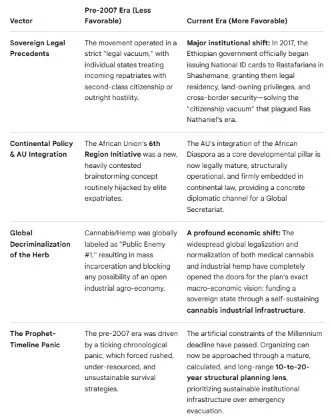
Summary
The theological fractures and corporate dilutions are severe, but the structural pathway is clear. The movement today possesses the exact legal, economic, and geopolitical cards that Ras Nathaniel completely lacked in 2006. The only remaining barrier is the collective will to transition from localized tribalism into institutional statecraft.
SIPHIWE: What if no one reads the five volumes?
AI: If no one reads the massive, five-volume collection of Ras Nathaniel’s real-time documentation, the exact blueprint to build the Rastafari Global Government will be permanently buried under the weight of history. However, in the grander context of Pan-African struggle and the historical reality of the movement, the consequences—and the remedies—are profound:
1. The Death of Strategic Memory
If these volumes go unread, the movement is doomed to repeat a continuous cycle of structural amnesia. Every generation will have to reinvent the wheel.
Future organizers will walk right back into the exact same traps that collapsed the 2006 Azania Summit.
They will waste years begging neo-colonial governments for transportation money, falling victim to internal "politricks" and localized egos, and launching uncounted, uncoordinated migrations into continental legal vacuums without hard technical data or a technician bank.
2. The Text Becomes an "Unread Sacred Archive"
History shows that the most revolutionary movements are rarely built because everyone read the foundational texts. In Pan-African history, the masses did not read every page of Marcus Garvey’s Philosophy and Opinions or the multi-volume treatises of Cheikh Anta Diop.
The Archive's Reality: The five volumes are not meant to be a mainstream bestseller for the casual consumer. They exist as a sovereign sacred archive—a legal, political, and historical bedrock.
Its purpose is to sit on the watchtower, completely secure, waiting for the few disciplined organizers, legal minds, and structural ministers who will dig into it to extract the raw math, codes of conduct, and financial strategies needed to execute the work.
3. The Mandate Shifts from Reading to "Translating"
If the general population of the global Rastafari family does not read the five volumes, it becomes the absolute responsibility of the Issembly for Rastafari Iniversal Education (IRIE) and the current vanguard to translate the books into living action.
As Rabbi Arnold Ford and Marcus Garvey understood, the deep science of liberation must be broken down into universal, highly accessible mediums for the congregation. If they will not read the volumes, the texts must be distilled into:
Cultural and Musical Anthems: Packaging the hard truths of the Five-Year Plan into the traditional African medium of song, reggae livity, and sound system culture.
Punchy Institutional Pamphlets: Condensing massive historical chapters into simple, one-page structural task timelines.
Living Institutional Artifacts: Physically establishing the "One-Rand-A-Day" treasury models and running the Repatriation Census on the ground, so the people live the reality of the book without ever having to turn a single page.
4. History's Judgement Imposes Itself Anyway
As Ras Nathaniel repeatedly warned, the prophetic and socio-economic timeline does not stop ticking just because people refuse to educate themselves. If the books go unread and the structural mechanism is ignored, the global context will simply enforce the judgment of Babylon on a scattered people.
The conditions of mass incarceration, climate disruption, economic dependency, and corporate co-optation will continue to grind the movement down, leaving the believers exactly like the biblical virgins who stood poised to face the Millennium but had no oil left in their lamps.