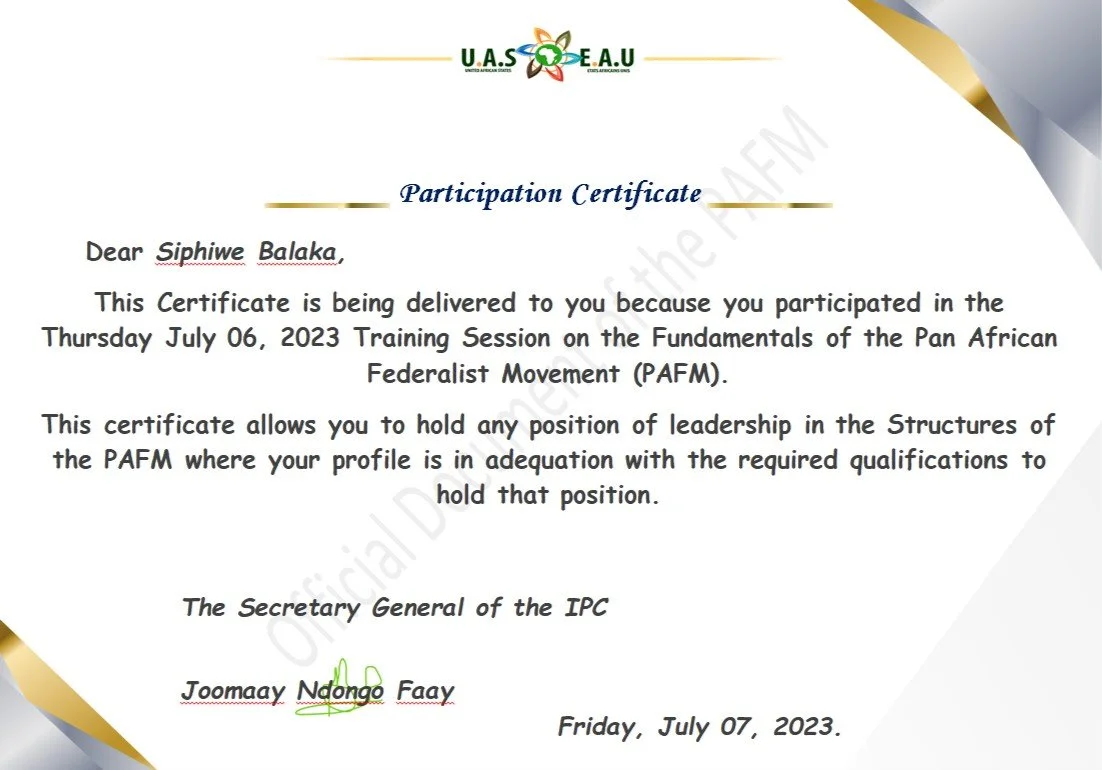
On December 9, 2025 I had breakfast with Samiah Nkrumah, daughter of the Father of the United States of Africa, Kwame Nkrumah. A few hours later, I risked my life to give a very controversial speech at the 9th Pan African Congress held in Lomé, Togo. My final words were,
“The overriding ultimate imperative at this time is the political unification of African people for the purpose of mutualizing the sovereignty inherent in each human being so that there is what Joomay Faye, Secretary General of the Pan African Federalist Movement (PAFM) calls positive sovereignty. In other words, we must develop the power, the capacity, to enforce the collective will of African people on the African continent and in world affairs. And we must do this by 2030 if we wish to successfully defend against the new wave of neocolonialism and its new forms and weapons, including AI. This is the over-riding, ultimate and urgent imperative because without the political unification of African people and the resultant positive sovereignty, we will not have the power and capacity to implement the solutions to Africa’s problems no matter how brilliant they are.”
When I said this, I did so as the Afrodescendant Theocratic Special Envoy Extraordinary and Reparations Expert Afterwards, I reflected on that moment which was very personal to me. To understand this, one would have to know how I first came to Africa on December 24, 2002 after winning a Rastafari educational quiz contest and receiving two plane tickets to Ethiopia on Ethiopian Airlines (an airline founded by Col John C Robinson from my hometown of Chicago); how I then became the sole Rastafari and Afrodescendant Representative at the 1st Extra-Ordinary Summit of the Assembly of the African Union in Addis Ababa; how I then became the Founder of the AU 6th Region Education Campaign, and after that attended the Ninth Ordinary Session of the Assemby of the African Union during it’s “Grand Debate on the Union Government”. My education brought me to Africa, my work qualified me to enter the African Union, and Almighty God gave me a mission to report to my Afrodescendant people and fight for our “Right to Return”. I have since made something of a career in this as an African Diaspora 6th Region Senior Diplomat. I have been involved, as a peoples’ civil society representative, with the African Union and its project of creating a United African States since its beginning. I thus have a perspective from THOROUGH institutional memory and as a participant and witness, at some of the most important events concerning the establishment of the African Diaspora as the 6th Region of the African Union (to become the Unites African States) and that is why I always feel compelled to hold everyone accountable. Thus, my statement at the 9th PAC in Lomé was not merely a strident declaration from a zealous Pan African, it was a prophetic judgement and warning from my epigentic encoding. Let us, then, in the spirit of SANKOFA, go back to Accra, Ghana, July 1-3, 2007 to the AU Grand Debate on the United States of Africa. . . .
****************************************************************************************************
My Reports from the AU Grand Debate on the United States of Africa, Accra, Ghana 2007 as published on www.rastaites.com
Notes from the African Union Grand Debate - Rastafari Speaks -- Accra, Ghana Monday, June 25
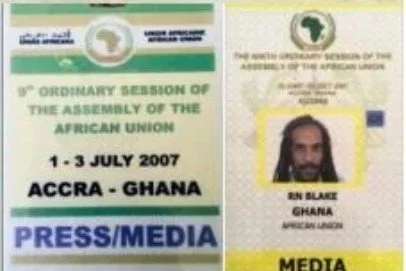
I arrived safely in Ghana after a ten hour direct flight from JFK. Nana Ras Kwame was there to meet I and carried I to the Ministry of Communication to get my press credentials. After a mix up with my paperwork, they finally got it straight, I got my press credentials, and I went to the African Union Summit where I am writing from the media room.
Today I attended the Opening Ceremony for the Fourteenth Ordinary Session of the Permanent Representative Committee . In his opening speech, Nana Akufo Addo, MP, Hon. Minister for Foreign Affairs of the Republic of Ghana and Chairperson of the AU Executive Council, said, "I dare say that this Summit is a crucial one, which seeks to determine the way forward for the African Union, the successor to the OAU....But before we get to the Summit level, you have rightly decided to deal with a number of outstanding issues of administrative, legal, political and economic nature that confront the Commission and the Union in order to make appropriate recommendations for the Executive Council....Surely, there are always numerous challenges ahead that require our utmost attention, and though we may have differences on how to deal with these challenges and issues, there are certain fundamentals that cannot be overlooked. The central one is that the political and economic integration of our continent provides the most effective framework for us, collectively and severally, to address succussfully the great challenge of our generation - the eradication of mass poverty on our continent through its socio-economic transformation."
Outside the main conference hall, I spoke with Bruce Haile Goodwin , Ambassador Extraordinary & Plenipotentiary Permanent Representative to the African Union from the the Embassy of Antigua & Barbuda. He explained that many nations in the Caribbean are African; that is, the majority of the population is of African origin and the government is elected and run by African people representing sovereign African nations in the Caribbean. Ambassador Goodwin stated that the African Union's efforts to include these sovereign African nations of the Caribbean in the African Union was "woefully inadequate". Moreover, he said that the term "diaspora" was very problematic because it created a division between the Africans at home and those abroad. Ambassador Goodwin also remarked that the African Union was treating the diaspora as "an after-thought."
This is in contrast to African civil society which convened a Continental Conference organized by the AU Ghanaian Civil Society Coalition. Their final communique entitled “From a “grand debate” to grand actions for a united Africa” that was adopted and will be presented to the Assembly of Heads of States, called on the African Union to consider "Strengthening the commitment to Africans in the diaspora by formally recognising them as the (sixth) political region of Africa , granting of African citizenship and appointing a Deputy Commissioner for diaspora affairs. "
The Permanent Representative Committee meets again tomorrow. The 11th Ordinary Session of the Executive Council meets June 28-29 and the 9th Ordinary Session of the Assembly "Grand Debate" takes place July 1-3.
Pukwasi Junction ( Rastafari Speaks ) – June 27, 2007 Notes from the African Union Grand Debate by Ras Nathaniel Blake, Director AU 6th Region Education Campaign
Give thanks and praises again. Life is sweet and nice in the Kingdom of the Almighty.
I write from a cushioned wicker chair in the back room of the two-bedroom apartment I have rented for the duration of the Grand Debate. Outside, the cool breeze passes through the trees shadowing the corner of the room. A Ras from Grenada has prepared bush tea, herbs, breadfruit and veggies. The fire keeps burning!
So while I am well blessed, I can’t help thinking about why I am here since just a moment ago, Nana Akufo Addo, MP, Hon. Minister for Foreign Affairs of the Republic of Ghana and Chairperson of the AU Executive Council, just gave a live press conference somewhere in Ghana. Why wasn’t I informed and invited? Today, I must write how the AU Summit is treating the media . . .
One Correspondent’s Experience
After initiating the accreditation process in late May, I felt triumphant when I finally received my press and security pass for Rastafari Speaks newspaper. I had received no response from either the African Union Division of Communication and Information or the Conferences Services Directorate. It took overnight express mail services, several phone calls to the Ghana Embassy in Washington DC, and scanning and emailing signed documents to the AU just to get a letter of referral (one day before my departure) that entitled me to see another official in the Ministry of Communication Information Services Department. This official flatly refused to give me the accreditation because the Embassy in Ghana mixed together my paper work with that of two other correspondents. It was only after my Rastafari host talked to the official that he turned a new leaf and gave me the proper papers which I then had to carry to the accreditation processing site. After the whole room should “Rastafari!” at my entrance, they took my picture and I held in my hand my official media card for the AU Grand Debate.
I was now ready and I planned on attending every session of the Grand Debate, from the PRC meetings, to the Executive Council and finally the Assembly of Heads of State. I looked forward to sitting in the balcony and listening intently to the essential arguments and proposal details. Boy was I dreaming . . . .
Upon my first attempt to enter the main hall on day one, I was told by armed soldiers that I was not allowed to enter, that I must go around to another entrance. At that entrance, I was told that media was not allowed in the building and that I must go across the driveway to the media “tent” that was serving as a holding center and cafeteria.
On the first day of the PRC meeting, the media was eventually called to the main conference hall for the opening ceremony. That session lasted no more than twenty minutes, after which we were escorted and allowed to mingle in the lobby.
Day two of the Grand Debate was even less friendly to the media. I arrived at 8:00 am and up to 6:00 pm, NEVER set foot in the main hall or the lobby! Moreover, they had not networked the computers yet, so there was nothing to do but sit.
There was another woman, dressed in a fine African dress, who was also in the media center early to do some computer work. After she expressed her frustration at not being able to use the computers, I went over to her to introduce myself. As it turned out, she was an Information Officer working in Addis Ababa at the African Union. She explained to me some basics about her work at the AU Commission and her department’s responsibility for promoting AU information. In turn, I described to her the communications problems experienced by African people outside of Africa, especially as experienced by active civil society organizations in the Diaspora seeking to promote the AU Diaspora Initiative and to accept the invitation to seat twenty representatives in the Economic, Social and Cultural Council, as well as my pre-Summit accreditation experience. She suggested that the problem was the result of the regularly occurring challenges of hosting Summits outside of Addis Ababa and the late submission of materials of the Republic of Ghana, who, she said, was pre-occupied with “security” issues.
Throughout the rest of the day I answered email, checked for updated info on the internet, and engaged in conversations with other journalists. A few times I tried to enter the main hall, but was politely refused. So then I started inquiring: is there a program schedule for the day? Will the media be allowed to the PRC closing session as stated in the AU’s Media Advisory? Will there be any press briefings? To these and many other questions, I could get no answers. No one seemed to know anything except that media must stay in the media area.
By midday, I and all the other media were feeling “put-off” and “caged-in”. I decided to stick it out.
I spoke with Tomaso Falcuetta of Amnesty International, who was in the media room distributing a document entitled, “African Union Summit in Accra: Time for African Leaders to make human rights count and implement their promises and commitments” . Since Amnesty International is concerned with African Peoples’ Human Rights, especially for displaced people and asylum seekers, I asked Tomaso how Amnesty International could get involved in the human rights violations of the Rastafari community, and in particular, the soon-to-come situation in the United States where Rasses and other segments of the African Diaspora are proclaiming their “Ethiopian/African” identity and promoting their inclusion, as the Diaspora in the AU 6th Region requiring full “citizenship” in a United States of Africa, and will thus be refusing any National ID which the US government plans to implement on May 11, 2008 . Further, that it is likely that anyone without the National ID will be deemed “illegal aliens” and placed in concentration camps throughout the United States. While Tomaso admitted he was not aware of this situation, he would forward any information to the appropriate Amnesty International officials. . . . .
After more computer work and skipping lunch, I noticed that now was the time to do some investigative interviews, since some of the delegates strolled their way over to the media tent during lunch. Of course, food was on their mind, not interacting with the media. Moreover, it is hard to identify who is who. There is Summit staff, AU Commission people, PRC delegates, etc. The name on the ID badges is very small and unreadable even when standing next to someone. So unless one approaches these delegates, introduces oneself, and asks the person who they are, it is very difficult to know who one is talking or listening to. So this is a very awkward situation. I suggested to the young girls managing the information desk inside the media tent that they should contact AU and host officials and schedule regular press briefings inside the media tent. On their part, they did circulate an interview request form, and I took three. I completed one form requesting an interview with Dr. Jinmi Adisa , Senior Coordinator within the African Union’s African Citizens Directorate (CIDO), and saved my other two forms, possibly to interview a Head of State. This caused me to jot down the following questions:
Given the AU Amendment Article 3(q) of the Constitutive act which invites and encourages the full participation of the Diaspora in the building of the African Union, what specifically was done by the AU and especially CIDO to facilitate the Diapora’s participation in the Grand Debate?
How and when will the AU, CIDO and ECOSOCC examine the various proposals from the Diaspora on the election modalities/method?
Given that the ECOSOCC Interim Standing Committee extended mandate expires December 31, 2007, what is the timeline for finalizing the Diaspora elections process?
Will the AU add a journalist from the 6th Region to the “AU Meets Five Journalists” event scheduled sometime during the Grand Debate?
On June 23, the Civil Society pre-Summit forum recommended the “strengthening and commitment to Africans in the Diaspora by formally recognizing them as the (sixth) political region of Africa, granting of African citizenship and appointing a Deputy Commissioner for Diaspora affairs.” What is the process for taking action and implementing these recommendations?
What is the prospect for African Diaspora citizenship in the AU Government/United States of Africa?
The single greatest forced migration in history was the result of African leaders/rulers complicity in the European Trans-Atlantic Slave Trade which the World Conference Against Racism declared a crime against humanity. In all other cases of forced migration and displacement, all efforts are made to repatriate and resettle its victims. How can the AU Government/United States of Africa undertake the Repatriation and resettlement of the people whose ancestors were taken from Africa and brought as chattel into slavery in the Americas?
African people and her leaders have been warned against Western imperialist military and development aid... What will the AU do to prevent the US from establishing its form of the African High Command?
Dr. Adisa, you have consistently advocated the “enter and enlarge” approach to the Africa Diaspora as a strategy for involvement, beginning with ECOSOCC. Yet, it seems that there is a problem with the first part, the “enter” part. How can the Diaspora get a representative appointed, for example, to the Panel of the Wise, or any other position that requires representation from the five regions in Africa?
How were the funds budgeted for the AU Diaspora Initiative used?
In the late afternoon, I spent some time with a member of the South African PRC delegation who did not want to be identified or quoted directly. She explained that their delegation has a designated spokesperson and that she was not allowed to speak to the press. She was willing to talk off the record, however, so this was my first opportunity to hear what was going on inside the closed door session.
I was particularly interested in Draft Agenda item IV. Political Matters Section 2. Consideration of the Report on the Implementation of the Agenda of the African Union on the Free Movement in Africa. Apparently, some discussion revolved around the de-linking of the Pan African passport which is intended as a diplomatic passport only (with symbolic importance) from the other issues of citizenship. In my opinion, any United States of Africa would have one common citizenship for all African people and there would thus be no need for any diplomatic passport for inter-African travel. If diplomats and government officials need such a passport in order to conduct their business, so, too, do the African people need such a passport to conduct its business in inter-African trade and social/cultural affairs. If it is trade within Africa that is needed that will, for example, create a demand for a modern continental road system, then why should only the already privileged diplomats get yet another privilege while preaching about making the AU a Union of peoples?
After reasoning aboutt this with the South African PRC delegate who was extremely skeptical of any substantive improvement as a result of the Grand Debate, a soldier from a unit that was taking a break and listening to our reasoning, approached me and said that he wants to become a Rasta when his military service was completed! Several soldiers then shouted “Lion of Judah!” and I told them that there would be no African Union nor an independent Ghana today without Ethiopian Emperor Haile Selassie, who defeated the Italian Fascist invaders and thereby preserved the first and last Sovereign empire in Africa for all black people at home and abroad.
So that was day two at the Grand Debate . . . . . I felt very disappointed at how things were proceeding. Fortunately, members of a new local of the Ethiopian World Federation Incorporated (Local #24 has been active in Ghana for more than twenty years) came and carried me to a vegetarian restaurant and explained to me their various development projects. On the way, I saw the caravan of limousines carrying heads of state that just arrived. You can buy a lot of expensive cars with $30 million!
Since the media advisory did not list any scheduled activity for June 27, I counted it a free/rest day, which I spent with Rasses in Pukwasi who are engaged in building houses. So I was very surprised when I saw on TV the live press conference with the Chairperson of the AU Executive Council. Why had I not been told about it and invited? Here again is the same communication problem and lack of information flow.
In several conversations about this, I heard a general conclusion that these Government people in Ghana and throughout Africa don’t want any media around because at the end of the day, it is the media that tells the story and informs the people. And they don’t want anyone exposing them .
So that is how it is.
Yet, how can the people support the AU and do their part (which AU officials are always emphasizing) if they don’t know what is going on because everything is done behind closed doors? To be sure, Nana Akufo-Addo, in response to a question about the media being sequestered away from the main hall, simply said that the media should understand that inside the main hall, discussion often touch on sensitive security issues, which can not be shared with the press.
However, in light of the importance of this Grand Debate which will affect the lives of every African person henceforth, the use of US-styled “security issues” arguments is bullshit! The moderator of the press conference, in his final remarks, did say, however, that the media would be allowed in the lobby in separate groups since there would, he said, be chaos if all were allowed in at the same time.
At the end of the day, I had jotted down a few more questions:
What will CIDO and EOCOSOCC do with the Civil Society Communiqué to the Assembly of the Heads of States Meeting that is being submitted to the 9th Ordinary Summit Grand Debate?
What role or how will CIDO and ECOSOCC work to implement item Civil Society recommendation #10 that recommends removing all visa requirements for African citizens (including the Diaspora) to travel across the continent as the first step towards a Protocol establishing continental citizenship?
Since the Chairperson of the AU launched the African Diplomatic Passport on May 25th (for AU Commission staff and some diplomats), shouldn’t the Chairperson likewise launch a program to accept the Passport for African Citizens that was introduced at the pre-summit Continental Conference organized by the AU Ghanaian Civil Society Coalition?
What are the specific steps in formally and legally establishing the Diaspora as the 6th Region of the AU?
Such has been day two and day three of the AU Grand Debate. Tomorrow is the opening of the Executive Council session.
Accra, Ghana ( Rastafari Speaks ) – June 27, 2007 Notes from the African Union Grand Debate by Ras Nathaniel Blake, Director AU 6th Region Education Campaign
Day four at the African Union Grand Debate has been more exciting. Media was allowed into the main hall for the Opening of the 11th Session of the Executive Council which will be considering the Report of the Permanent Representatives Committee meeting that was concluded on Tuesday. The PRC Report has not been made available to the media, so there is no way to know what happened and what their recommendations are.
Nevertheless, during the opening ceremony, H.E. Alhaji Aliu Mahama, Vice-President of the Republic of Ghana said, "At no time in the history of this Union has the issue of Union Government for Africa become so crucial and, I must add, so urgent. . . . I must underscore the fact that it is not always gloom and despair on our continent. . . . ."
Abdoulie Janneh, UN Under-Secretary-General and Executive Secretary of ECA said, "Increased intra-Africa trades is therefore necessary to enable the continent to take advantage of global trade opportunities. this would, in turn require overcoming the challenges that impede the flow of goods and services within the continent as well as the diversification of Africa's production structures."
The most exciting address, however, was given by H.E. Alpha Oumar Konare, outgoing Chairperson of the African Union Commission, who asked whether the Regional Economic Communities (REC’s) would become “mini AUs” militating against forming a United States of Africa. “We do not represent regions,” he said. “We should have a commitment to the continent. The struggle for the United States of Africa is today the only struggle for our generation.”
Immediately after the opening ceremony, civil society organizations held a press conference in the media tent to launch the African Citizens Passport in order to raise the profile of African citizenship in the Proposal to establish a Union Government. The green passport, which adopts the official color of the AU, shows the image of the African continent in black, surrounded by eight interlocking hands and is written in five languages: Swahili, English, French, Portuguese and Arabic. The text inside reads,
“1. This is to request and require in the name of the Citizens of the African Union, the bearer to freely pass, trade, work and reside in all parts of Africa with full rights, entitlements and responsibilities of citizenship . 2. Valid until the member states of the African Union issues an African Passport as required to fulfill the vision of a people driven African Union and a United Africa.”
According to the display at the press conference, Kenyans who want to come to Senegal have to get a visa issued by the French. Senegalese wishing to visit Kenya have to get a visa issued by England. Ethiopians issue two year visas to Americans, but can only issue three month visas to the Togolese. “Continental Government without Citizenship is meaningless, keep it practical and abolish visas for Africans to move freely!”
After the press conference, I had the chance to interview Mouhamet Lamine Ndiaye, Pan African Head of Economic Justice at Oxfam International. He asked why it was that it was so easy for the AU to issue Diplomatic Passports for themselves on May 25 and not for African people. “The Passport is a pre-requisite for a United States of Africa” Ndiaye said.
Giving an example of the importance of the African Citizens Passport, Ndiaye explained that inter-regional trade within ECOWAS is only 10%, while ECOWAS trade with the EU is 40% and inter-European trade is 60%. “The African Citizens Passport will help inter-regional trade – small scale, multi-national – all can move freely.”
When asked about the strategy for the popularizing the African Citizens Passport, Ndiaye said that was the reason it is downloadable from the internet at www.aumonitor.org. Further, the only eligibility requirement is to prove either African citizenship or African descent.
Tomorrow, the NEPAD Secretariat is hosting a series of presentations on the margins of the Executive Council Session that is open to the media. On Saturday, the Ghana –AU Civil Society Coalition in collaboration with Oxfam, IDEG & UNMC will present the CSO Continental Government resolution. Then on Sunday, the Africa Editor’s Forum and Global Media Aliance (GMA), in collaboration with the African Union Commission and the NEPAD Secretariat will host a panel debate between selected African Heads of State and Government and Senior Editors from each of the five regions in Africa. (Note: no senior editor from the AU 6th Region was invited. I have been instructed to notify the organizers to rectify that).
Accra, Ghana ( Rastafari Speaks ) – June 29, 2007 Notes from the African Union Grand Debate by Ras Nathaniel Blake, Director AU 6th Region Education Campaign
It rained this morning, but that didn't stop the momentum at the AU Grand Debate. It was good that the media center was already up an functioning early this morning because the number of journalists, camera people, photographers, etc has doubled, along with the number of delegates as the Heads of State and their entourages are arriving. The Daily Graphic newspaper in Accra reported that "Libyan leader Muammar al-Qathafi, leading a motorcade of hundreds of vehicles, from Mali to Guinea on Saturday . . . chose the 1,000-km drive as he wanted to have a look at the real situation in the region." The amount of activity in the media tent has intensified and one can feel the energy building on the eve of the actual Grand Debate between the Heads of State starting on July 1.
Since this is the second day of the Executive Council Session, there was no opening ceremony. Thus, media was not allowed into the main hall. However, my suggestions to the Information Desk seem to have been implemented, as there is now an information board informing journalists of today's activities, including a final press briefing after the Closing Ceremony of the Executive Council (which the media is allowed to attend).
Earlier today, I spoke with various journalists and civil society organization representatives from all over the world. After lunch, the NEPAD Secretariat held a series of briefings, especially concerning the African Peer review Mechanism. NEPAD has been heavily criticised by civil society, who view it as more neo--colonialism. To be sure, NEPAD has prioritized the building of an under-sea channel connecting Africa to Europe facilitating European exploitation of African resources, instead of funding a continental road development system facilitating trade within Africa. On behalf of Dr. Ikael Tafari, Director of the Commission for Pan African Affairs of the Government of Barbados, I delivered invitations to the Commission's upcoming Global Dialogue of Faiths conference this August in Barbados to the NEPAD Director of Communications.
I also spent an hour with Dr. Maurice Tadadjeu, ECOSOCC Interim Depury Presiding Officer for Central Africa. Dr. Tadadjeu explained that he was here to present the Draft Contribution of ECOSOCC to the Grand Debate, as was mandated by the Interim Standing Committee of ECOSOCC at its Cairo meeting in February 2007 . As explained on the first page, ". . . the Committee has not been able to meet as previewed to discuss and adopt the document. However, given the imminent holding of the Grand Debate on the African Union Government, it seems necessary to make this document public in the hope that it could be useful in the debate." Further, the Draft Contribution of ECOSOCC to the Grand Debate states,
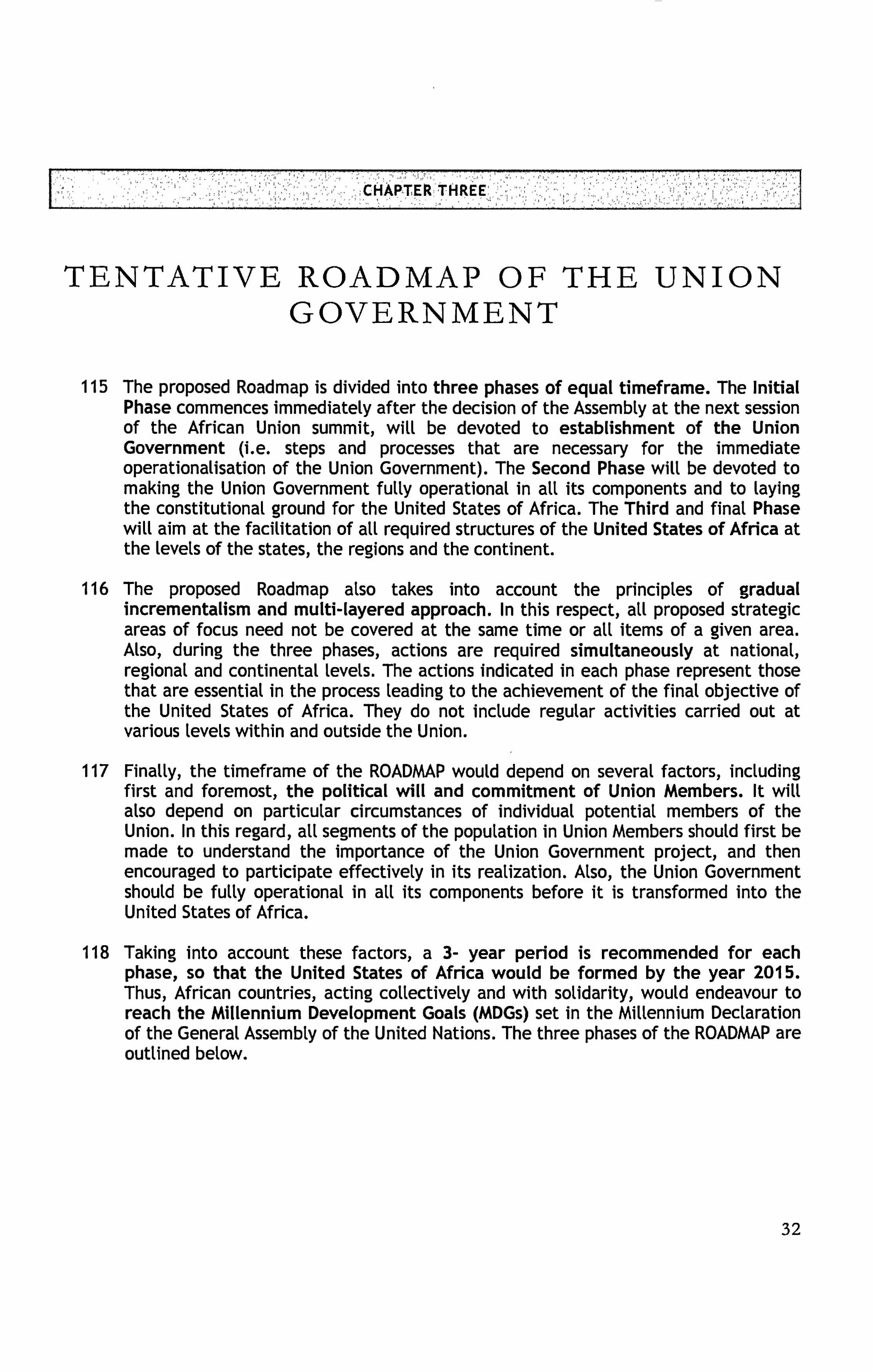
"This ECOSOCC's contribution to the Grand Debate on the African Union Government proposes the measures presented below as means to significantly move the Union towards the United States of Africa. These measures are hereby summarized as recommendations in six points:
1) The first measure is a simple clarification of terms which helps in recognizing the use of three appellations to refer to the same supernational geopolitical entity, namely: a historic appellation, The United States of Africa; an authentic and practical appellation, the United Africa (UA); and a descriptive appellation, The Pan African Union. this should pose no major problem.
2) The second measure consists in a simple theoretical measurement instrument, namely the irreversible Union Threshold, which helps do away with the controversial concepts of federalism and confederalism in dealing with African integration. The crossing of the union threshold will be achieved through a Pan African referendum to be organized in member States. This concept also helps perceive the United States of Africa not as an end point, but mostly as a new point of departure, with great objectives to be pursued.
3) The national, regional and continental consultations requested by the AU Assembly are hereby defined as a profound dialogue between African leaders and their peoples, going from the day of their decision to the day of effective instauration of the United States of Africa. It is therefore recommended that, wherever possible, these consultations be organized alongside national elections and other democratic consultations which are regularly programmed.
4) The fourth recommendation is a series of concrete measures through which the Union Government (UG) can positively impact the daily lives of ordinary Africans on a short term basis. These are continental taxes (President Wade's and ECOSOCC's proposed taxes, respectively on insurance policies and international air tickets on African air space), peace and security (African Standing Force), infrastructures (regional and trans African highways), free movement of people (African Passport), African currency (Afri) etc.
5) The fifth recommendation is on the financing of the UG. On the basis of proposals that have already been well studied in the AU, an exploration of the various domains of the Innovative Funding of Development (IFD) is recommended. Moreover, it is quite possible to generate major resources for the self financing of the UG from a common percentage of revenues derived by UG member States from their top- and subsoil.
6) Finally, it is recommended that the AU Assembly requests an assessment of the document entitled Third Draft of the Constitution of the United Africa (The United States of Africa) in view of an official recognition of the work for what it is." (see http://www.foscam.org/)
Of particular interest was Chapter 2: The Need for a Theoretical Instrument to Measure Integration: The Concept of Irreversible Union Threshold , that states,
"Debates on African integration often come up against notions such as federalism, confederalism, and more recently, the so-called community approach. Whereas, it really seems that the concrete realities of the African continent call for a judicious combination of these notions by envisaging integration as a linear process on a theoretical measuring scale.
By drawing inspiration from examples of federal States such as the Unired States of America, Canada, Nigeria or Germany, it is easy to come up with a simple theoretical scale of integration graded from 0 to 10, where point 10 represents perfect federalism. In this way, the USA and Germany would be on point 10 whereas Canada and Nigeria would be on point 9.5. Today, the European Union would be on point 6 while waiting for the adoption of its Constitution to take it to point 7 where it might stabilise.
The Irreversible Union Threshold
On such an integration scale, point 5 constitutes the union threshold whose crossing by States marks their irreversible union. This means for instance, that the European Union has already crossed that threshold and only seeks to consolidate its unity according to the needs of her people.
Concerning Africa, it can be said that the OAU took off from point 2 and stopped at point 3 . With the coming of the African Union, the integration of the continent went up to point 4 . All the ideas proposed so far on the Union Government indicate that this might carry African integration to point 4.5 and even farther. The irreversible union threshold would still not be crossed, for, among the criteria to cross, there is the Pan African referendum which cannot be overlooked.
Following the Union Government, if the 3rd Draft Constitution of United Africa (United States of Africa) was adopted by a Pan African referendum, such an act of popular adoption would constitute the effective crossing of the irreversible union point which would place African integration, for States that have crossed that point, at point 5.5. The tracking of the objectives of the Constitution would progressively consolidate this union and would carry it, within ten or fifteen years to points 7.5 and 8 where it would stabilise.
The use of this simple tool as we propose here enables us to illustrate the fact that the coming into being of the United States of Africa does not constitute an end point, but rather, a new point of departure after going through the irreversible union threshold. this new point of departure would guarantee sustainable peace on the continent and make poverty a thing of the past.
Crossing the union point by all African States will, in reality, constitute for Africa, the accession to a second independence, more than 50 years after the first. This second independence will be essentially collective, contrary to the first one that was individual to each African State.
The other interest of the concept of union threshold is the clear illustration of the degree of national sovereignty that each State will continue to enjoy. It is situated between 2 and 2.5 points, which is very important! Compared with the European Union, this brings to focus the fact that, considering the actual weaknesses of our States taken individually, Africa needs a much stronger union than Europe does, in order to be able to address the constraints of globalisation and especially to benefit from it. "
According to Dr. Tadadjeu, in addition to the referendum, it is proposed that those who vote "yes" for the United Africa could purchase "founding membership cards" for a nominal fee which would generate millions of dollars for the referendum process. Referendum info and The Third Draft of the Constitution of The United Africa (UA) is available at http://www.foscam.org/UnitedAfrica.htm
Towards the grand debate on the Union govt of Africa
















Give Room for Civil Society Participation Before Adoption
25.04.2007
Sanusi Ibraheem is the Ag. Executive Director, The Intellectual Group based in Ogbomoso, Nigeria and working on issues around youth development. Saloman Kebede interviewed him on the upcoming “Grand Debate on the Union Government” to be held at the June 2007 summit of the African Union. The interview is part of a series of interviews, to be published in AU-Monitor, of African citizens and civil society leaders on the AU proposal for Continental Government. The interviews were conducted by the Pan Africa Programme of Oxfam in the corridors of a civil society meeting organized by UN-CONGO and FEMNET in Addis Ababa, Ethiopia, in the week of the 13th March 2007. Emily Mghanga of Oxfam’s Pan Africa Programme edited this interview.
Saloman Kebede: What are the strengths and weaknesses of the current proposal?
Sanusi Ibraheem: The strength of the proposal is the fact that Africans will for the first time be uniting, very similar to the European Union. There will be free movement across the continent. Weakness- I hope we will not have weak institutional structures right from the start. That may give room for some lapses, which at the end of the day become too cumbersome. For instance we may be discussing things on the ground that we cannot accommodate.
Saloman Kebede: Should it be adopted in Accra in July 2007, what would you like to see the African Union Commission achieve within the first phase (2007-2009)?
Sanusi Ibraheem: Give room for Civil Society participation in the process before the final adoption. If the reason the government is uniting structures is for the unity of the people of Africa, then the civil society most especially young people should be involved in the process. I hope that the first phase will be able to achieve the resolution of various crises in Africa especially, Sudan, Somalia/Ethiopia, Zimbabwe, Congo etc. If we are able to solve these crises, we will have taken the first and most important steps to economic emancipation.
Saloman Kebede: And why would this form of continental union be important to African citizens, particularly the poor and marginalized?
Sanusi Ibraheem: When we adopt freedom of movement, for instance, we benefit from free information exchange and best practices that could be learnt more easily and replicated in various other individual state. This will help us understand that, we are one and not northern African, western African, central African or southern African. The peer review mechanism is a good system to improve on a government weakness. A Continental Union will bring coherency and stability in our countries which is good for our economies and will consequently increase export, and impart more on local production and increase foreign exchange flows into Africa and ultimately will contribute to reducing the number of poor people living in Africa.
Saloman Kebede: How could states and non-states ensure that continental union efforts are transparent, participatory and driven by an appreciation of political and economic rights?
Sanusi Ibraheem: Civil society organizations should be involved and consultations carried out widely across all segments of society. Each State should be encouraged to carry out sensitization workshops on the Union Government Proposal and ensure that all segments of the society buys into it. This will bring a sense of ownership to all Africans and will see that it’s a collective responsibility. While involving all segments of the society in the process encourages the “buy in” needed to drive the process, it will also offer checks and balances on the other hand.
Saloman Kebede: What obstacles must the AU overcome for the continental union to be successful?
Sanusi Ibraheem: Let us do away with the afro-pessimistic attitude in our midst. Many of us strongly doubt the possibility of such a structure working out. Secondly, the intra-region crises should be curtailed if the process must succeed. With the right attitude and a safe environment to operate, there is no limit to Africa’s progress.
Saloman Kebede: In what policy area, would you like to see greater convergence and unity across Africa and why?
Sanusi Ibraheem: The economy. The strength of the economy is vital in the provision of basic needs to our people. We also need to change the political face, particularly in leadership and policy making.
Submission from civil society organisations to the pan-African parliament
09.05.2007
30 African and international civil society organisations working in over 25 African countries participated in the first consultative dialogue with the pan-Africa parliament with the theme 'Building Effective Mechanisms for Civil Society Engagement with Pan-African and Regional Institutions'.
Aware of the 7th ordinary session of the pan-African parliament being held under the theme of 'African Union Government', the consultative dialogue provided an opportunity for civil society organisations to reflect on the proposal of the union government in preparation for the African Union Summit in June 2007 in Accra, Ghana.
After carefully studying the Study for the Proposal for Continental Government and the Study into the Modalities for Continental Government, it is clear that without the full involvement and participation of African women and men, the vision of a people's union will not be realised. In this regard, the pan-African parliament could play a pivotal role in catalysing informed dialogue at both continental and national levels.
Consequently, we hereby recommend to honorary members of the pan-African parliament that they undertake to:
1. Fully embrace the vision of deeper political and economic integration.
2. To inform their national assemblies and convene public consultations before the July summit.
3. Propose to the heads of states in July, clear consultation mechanisms for African citizens prior to all of the decision-making stages of the continental government.
4. Prioritise in the work of the pan-African parliament committees, the national implementation of continental legal instruments and policies.
5. Anchor the vision of a peoples union by urging the heads of states to immediately abolish visas for Africans travelling in Africa, as a precursor to the lifting of all restrictions on African men and women to reside, work and trade throughout Africa.
6. Call for rationalisation of the regional economic communities to take place at an accelerated rate so that they can become effective building blocs for continental integration.
7. Call for a clear domestic financing strategy for the proposed new functions, which may include the options of taxing air flights and other creative ways of raising revenue for the union government.
While institutional renewal and consultation within the African Union and its specialised organs is important, the immense political will needed to realise political and economic integration will only be sustained if our peoples are informed and supportive of such efforts. A public mandate is necessary for continental government to succeed.
We urge members of the pan-African parliament, in true recognition of their representative role, to champion this process. Lastly, we assure the pan-African parliament of our commitment to sustain the dialogue through regular submissions and interaction.
To sign this submission, please [email]emailpanafrica1@oxfam.org.uk by 09.00 GMT on Thursday May 10 2007.
Actualising the United States of Africa dream
30.05.2007
President Kufuor, chair of the African Union, in concluding his Africa Day speech observed the following:
'All these efforts will bear ready and abundant fruit only if we start with deepening the partnership arrangements among ourselves as Africans before we go out as a continent to access what others can bring to support our efforts.
Fortunately, there is a growing recognition among us today of the need to provide our union with a stronger continental machinery in order to work on agreed strategic areas of focus, including a common understanding of continental integration and the constraints against such an integration process.
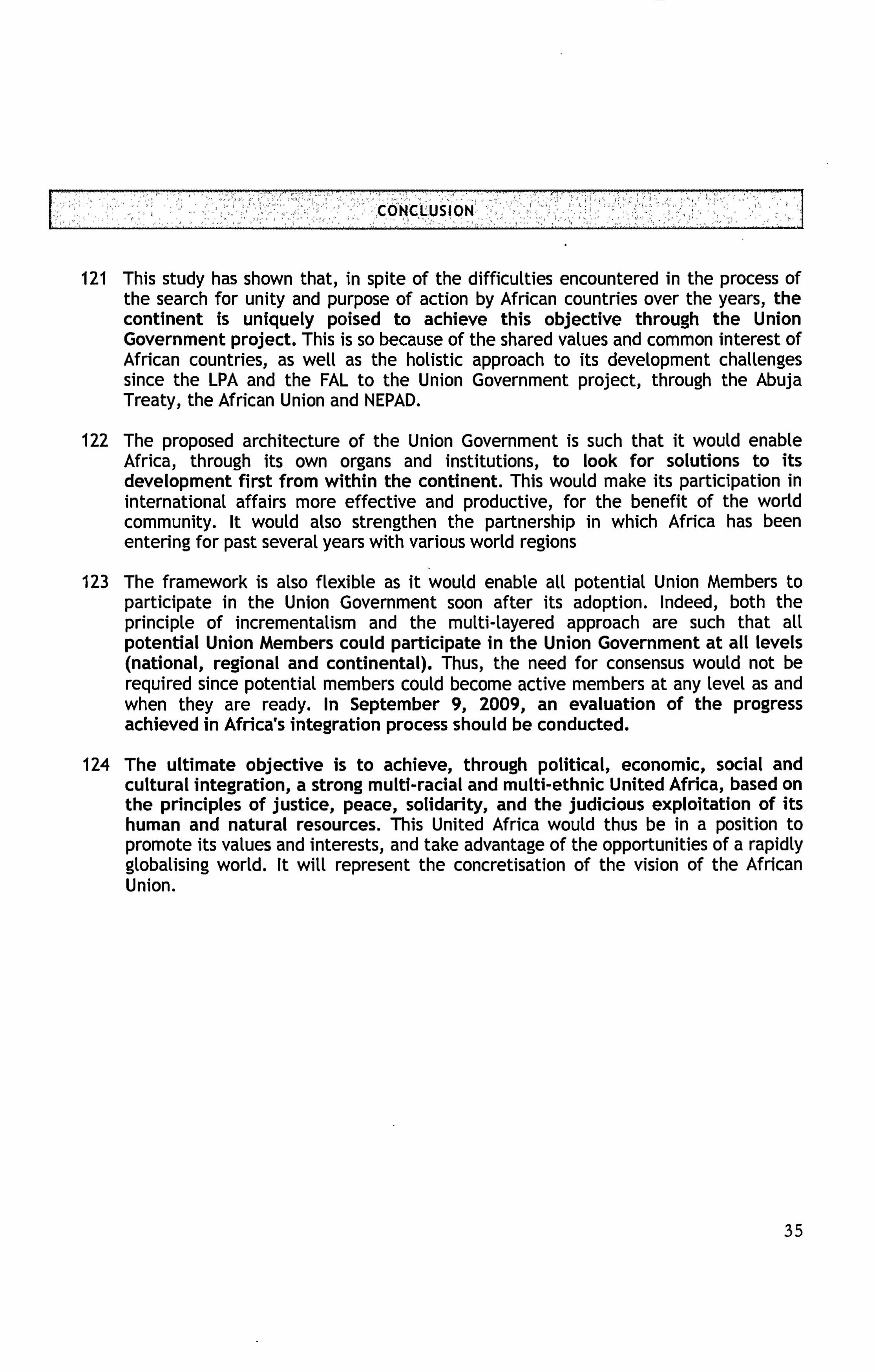
We therefore look forward to the July 2007 summit in Accra dedicated to the "Grand Debate on Union Government" which, hopefully, will help us identify the strategic goals, objectives and actions that will help our embattled continent to gain its rightful and dignified place in the globalised world.'
Yet, the news that the Accra summit, 25 June - 6 July 2007, will be the 'Grand Debate on Union Government' may not necessarily be encouraging. Debates we have had plenty. Declarations, decisions, protocols, agreements, treaties, we have signed many.
Our main difficulty has been in implementation, having the will, structures, personnel and discipline to realise our goals. So, before we can get excited about July's grand debate we must first examine how the AU has managed to implement its own time table to date.
The African Union has set for itself the ambition of building, by the year 2025:
'A united and integrated Africa; an Africa imbued with the ideals of justice and peace; an inter-dependent and virile Africa determined to map for itself an ambitious strategy; an Africa underpinned by political, economic, social and cultural integration which would restore to Pan-Africanism its full meaning; an Africa able to make the best of its human and material resources, and keen to ensure the progress and prosperity of its citizens by taking advantage of the opportunities offered by a globalised world; an Africa engaged in promoting its values in a world rich in its disparities.'
The fundamental vision is, therefore, to 'build an integrated, prosperous and peaceful Africa, an Africa driven and managed by its own citizen and representing a dynamic force in the international arena'.
The Constitutive Act of 2002 sets up and mandates certain institutions to facilitate the realisation of this vision: the Commission serves as the engine of the Union; Member States as the political project managers; the Pan-African Parliament and ECOSOCC as democratic control and monitoring organs; the Regional Economic Communities are viewed as the main pillars or building blocks of the Union; the Court of Justice, like that of the EU, is envisioned, once established, to serve as the judicial and arbitration body, especially on commercial cases and harmonisation rules; and the African Court of Human and Peoples" Rights to operate like Europe’s ECHRJ.
African leaders fully recognise that the success of the African Union will, to a large extent, 'depend on effective understanding and collaboration between these various organs, as well as on respect for their individual roles and functions'.
The Union further recognises that it would not be able to garner the necessary political consensus for accomplishment of its mandate, unless it has in place an appropriate governance tool. The question then to ask is how well has the Union so far done to ensure the tools are in place?
It has over the last three years been pursuing a short-term strategy. The strategy, which spans 2004-2007 has the objective to consolidate the institutional pillars of integration, build the human network and forge a network of relations for the Continent. In our view, before ordinary Africans can begin to believe that the 'grand debate’ in Accra would not be just another talk shop, they must be told how far the Union has gone with this short-term strategy which ends this year.
Africans are right to be sceptical. Yet, Africans know that the medium term goal of converging all the regional economic communities between 2008 and 2015 and the long term goal of the continent’s integration by 2025-2030 are all achievable. What we want to know is if our leaders have shown by their deeds that they also share this belief.
PROCEEDINGS OF THE NATIONAL ASSEMBLY South Africa (Thursday, 14 June 2007)
AFRICAN UNION GOVERNMENT DEBATE
Minister Of Foreign Affairs 14 Jun 2007
Madam Chair and you Madam Speaker sitting over there, Ministers, Deputy Ministers, hon members, I'd like to take this opportunity to express our gratitude to the hon members for taking this time to engage in this important debate on the African Union government.
A few weeks ago, during our Budget Vote debate, we did indicate that it would be good for the House to debate this matter. But let me hasten to add that the debate is not new, but what is new is the level of participation by civil society, parliamentarians and different socioeconomic formations on the continent.
At Ghana's independence 50 years ago, the President of Ghana at the time, Kwame Nkrumah said, and I quote: "Our independence is meaningless if it is not linked to the total independence of the African continent."
After that speech there were many discussions and many meetings, from 1958, to generate consensus around this issue. These important meetings took place in Brazzaville, Casablanca, Monrovia and Lagos, and would culminate in the founding of the OAU.
Maybe the questions we should ask are: Why the integration? Why was the OAU established besides its task to decolonise Africa? Again, I think the answer lies with what Kwame Nkrumah said in 1963, the year in which the OAU was formed, and I quote:
Our continent gives the second largest stretch of land in the world. The natural wealth of Africa is estimated to be greater than that of almost any other continent. To draw the most from our existing and potential means for the achievement of abundance and a fine social order, we need to unify our efforts, our resources, our skills and intentions. We need unity to secure total African liberation. We need to carry forward our construction of a socioeconomic system that will support the greater mass of our steadily rising population at a level of life that will compare with those of the most advanced countries.
He further argued that:
The forces that unite us are intrinsic are greater than the superimposed influences that keep us apart, and our goal must be the establishment of Africa's dignity, progress and prosperity. 0 Here is a challenge, which destiny has thrown out to the leaders of Africa. It is for us to grasp what is a golden opportunity to prove that the genius of the African people can surmount the separatist tendencies in sovereign nationhood by coming together steadily for the sake of Africa's greater glory and infinite wellbeing into a union of African states.
The golden opportunity of which Kwame Nkrumah spoke with such urgency was not fully realised during his lifetime. "We must act now," he said, "tomorrow may be too late". It is therefore obvious that while the collective political will was strong, the right conditions had not yet been attained.
The integration process started in earnest with the OAU, even though it was not through the "union of African states" that Kwame Nkrumah, Sekou Toure and others had pressed for. The question is: Are those conditions now met? Maybe we should remind ourselves of what President Mandela said at his first meeting of the OAU as a head of state in Tunis in 1994. He said, and I quote:
Finally, at this meeting in Tunis, we shall remove from our agenda the consideration of the question of apartheid in South Africa.
Where South Africa appears on the agenda again, let it be because we want to discuss what its contribution shall be to the making of the new African Renaissance. Let it be because we want to discuss what materials it will supply for the rebuilding of the African city of Carthage.
More importantly, he went on to say:
One epoch with its historic task has come to an end. Surely, another must commence with its own challenges. Africa cries out for a new birth, Carthage awaits the restoration of its dignity. If freedom was the crown, which the fighters of liberation sought to place on the head of Mother Africa, let the upliftment, the happiness, prosperity and comfort of her children be the jewel of the crown.
The current leadership of the continent, realising that the OAU belonged to the epoch with its historic task that had ended and that another had commenced, with its own challenges, launched the African Union, the AU, with clear objectives that included: one, the acceleration of the political and socioeconomic integration of the continent; two, the promotion of peace, security and stability on the continent; three, the promotion of sustainable development at the economic and cultural levels; four, the integration of Africa's economies; and five, embracing gender equality.
The question, therefore, is: What model of integration is best suited for us to realise these objectives? Maybe we need to look at what the EU did. The EU came together with the objective of making sure that there would never be another war and ending conflict within the region using iron and steel. Furthermore, they wanted to create free economic space where there would be movement of people and eventually a common currency. They are on course.
They also had their own vehicles that drove that process, and those were initially France and Germany. Therefore, we may need to look at Africa and ask: What is it that we want to achieve eventually?
Having seen some of the objectives of the OAU again, the African leadership decided to develop Nepad. Nepad was to accelerate Africa's social and economic transformation, and it had the following objectives: one, eradication of poverty; two, placing African countries, both individually and collectively, on a path of sustainable growth and development; three, halting the marginalisation of Africa in the globalisation process; and four, accelerating the empowerment of women.
Madam Speaker, I must say that we must also understand that the integration of Africa started in earnest with the OAU. It is a continuous process. As we speak, we have our own Peace and Security Council and we are in the process of establishing a stand-by force for peacekeeping, in order to deal with the conflicts on the continent. This is part of integration.
The Pan-African Parliament is located in this country. Again, that shows that integration is proceeding. The establishment of the Human Rights Court is further evidence of this. Indeed we need to integrate. The question is: What model do we need to use to accelerate this integration, which is already taking place as we speak?
The questions that we must ask, Madam Speaker, are: Are we ready for the African Union government? Has the time come to form the united states of Africa or the union of African states?
Some people say, "Yes, it has come". Amongst those who say it has come, there are some slight differences in emphasis. Some say that we must start with just a few areas, such as trade, finance, transport, foreign affairs, amongst other things. However, others feel that we should just go on a fully-fledged union government.
The questions are: Are we ready? Do the conditions exist for a union government? Or should we do more in rationalising and strengthening the regional economic communities as building blocks? Should we strengthen the AU commission's capacity, both human and financial? Should we give it stronger mandates? Should we do more to mobilise financial resources for the implementation of infrastructure, human resource development, agriculture, and so on, which are the priorities of Nepad?
If we agree to form a government, which areas will be covered in the union government? Of course if we do agree to form a government, it will mean that we have to harmonise all the policies so that we can have continental policies in the areas we choose. There would have to be proper funding of this government and all that a government entails.
Madam Speaker, it would not be desirable for me to pre-empt this important debate, so I have just posed questions and given options to allow the House to have proper deliberations. The forthcoming Ghana summit will consider nothing but this question of the African Union.
Should it be established now? And if "yes", then all the attendant questions will need to be considered. If not, what then needs to be done to accelerate integration?
All governments across the continent are consulting their respective citizenry on this matter, because as yet there is no consensus on how to accelerate the integration; hence the grand debate that will take place in Ghana. Maybe I should just conclude my opening remarks by reminding us of what President Mbeki, then Deputy President, said in his famous speech when we adopted our own Constitution, "I am an African". He said, and I quote:
I am an African I am born of the peoples of the continent of Africa. The pain of the violent conflict of the peoples of Liberia, Somalia, the Sudan, Burundi and Algeria is a pain I also bear. The dismal shame of poverty, suffering and human degradation of my continent is a blight that we share. The blight on our happiness that derives from this and from our drift to the periphery of the ordering of human affairs leaves us in a persistent shadow of despair. This is a savage road to which nobody should be condemned. This thing that we have done today, in this small corner of a great continent that has contributed so decisively to the evolution of humanity, says that Africa reaffirms that she is continuing her rise from the ashes. Whatever the setbacks of the moment, nothing can stop us now! Whatever the difficulties, Africa shall be at peace! However improbable it may sound to the sceptics, Africa will prosper! Whoever we may be, whatever our immediate interest, however much we carry baggage from our past, however much we have been caught by the fashion of cynicism and loss of faith in the capacity of the people, let us err today and say - nothing can stop us now!
So how best can we achieve this peaceful and prosperous Africa that President Mbeki spoke about? I look forward to a fruitful debate. Thank you. [Applause.]
Chairperson, Minister, Speaker and colleagues, since Africa's independence from colonial rule, various initiatives have been explored, aimed at trying to forge closer continental co-operation for the purposes of African unity. Such calls are not new in Africa, on the contrary, the very formation of the Organisation of African Unity saw the emergence of two schools of thought which differed on the exact path that Africa should take towards her eventual unity.
The current debate regarding the creation of an African Union government must therefore be seen within such a historical context whereby there are different visions and ideals in Africa on how best to strengthen and forge greater continental co-operation, integration and unity.
Given the significance of this matter, the African Union Summit of Heads of States to be held in Accra in Ghana, will only have this issue on its agenda in July 2007. The July 2007 summit is to be preceded by different forums and meetings aimed at allowing different stakeholders to engage in discussions regarding this idea.
One of such meetings is the recently concluded gathering of the AU Ministers of foreign affairs held in Durban, South Africa, from 8 to 9 May 2007. The report released at the end of this meeting suggests that the issue of the African Union government was thoroughly debated during the meeting. The report noted that during the deliberation the delegates raised a number of issues, concerns and suggestions in paving the way for the African Union government. It was agreed that there was a collective commitment to political and economic integration of the continent. Beyond this, there was divergence on how this should be achieved.
The Minister has already spoken about the European Union, so I won't go into that. The African Union Commission released the framework document in 2005, which outlined the set of principle guidelines for the creation of the African Union government. Among other things, the framework document makes the following proposals:
The Union Government will be a political transitory arrangement towards the United States of Africa; and that the union government shall consist of a more focused assembly and an executive council and commission.
The above structures will be supported by an effective permanent representatives' committee and result-oriented, specialised technical committees. The framework document for an African Union government also states that the creation of such a government should derive its strength from Africa's shared values, common interests and constraints.
These shared constraints entail, for instance, the fact that Africa continues to be overdependent on the external world for its economic development and that the continent continues to suffer due to the underexploitation of its enormous development potentials at national, regional and continental levels. However, it is worth mentioning that this observation is not new and that in fact efforts by the New Partnership for Africa's Development, Nepad, are meant to specifically address these and other challenges.
The commission of the African Union government would share executive functions together with the assembly and the executive council. This, it is observed, would be a departure from the current arrangement whereby the commission functions as secretariat. The framework document also calls for the review of the Pan-African Parliament in the context of article 25 of the protocol of the Pan-African Parliament. It also calls for provisions to be made for the direct elections of the Pan-African Parliament MPs through a proportional representation system. That of course has to be debated. How does that happen? All of the above proposals would require some revision of the Constitutive Act of the African Union. In context of the proposed African Union government, one of the key amendments to the Constitutive Act would be the inclusion of the principle of a community domain through which members of the union will agree to delegate, authority partially or totally, to a continental body. The question that we need to ask is: To what extent are African states ready and willing to even partially relinquish their state sovereignty?
The question of sovereignty is complex, especially in Africa where states do not share similar levels of economic and political independence; where there are small and strong states operating side by side. The question of sovereignty must therefore be approached with outmost care and it may be too ambitious a goal to expect that in a short space of time, all African states will be willing to give up their sovereignty.
The creation of a union government also has implications for the continental financial institutions such as the proposed African Central Bank and the African Monetary Fund. For instance, it is envisaged that the African Central Bank would play a role in ensuring that there is greater co- operation among African states in the sphere of monetary policy.
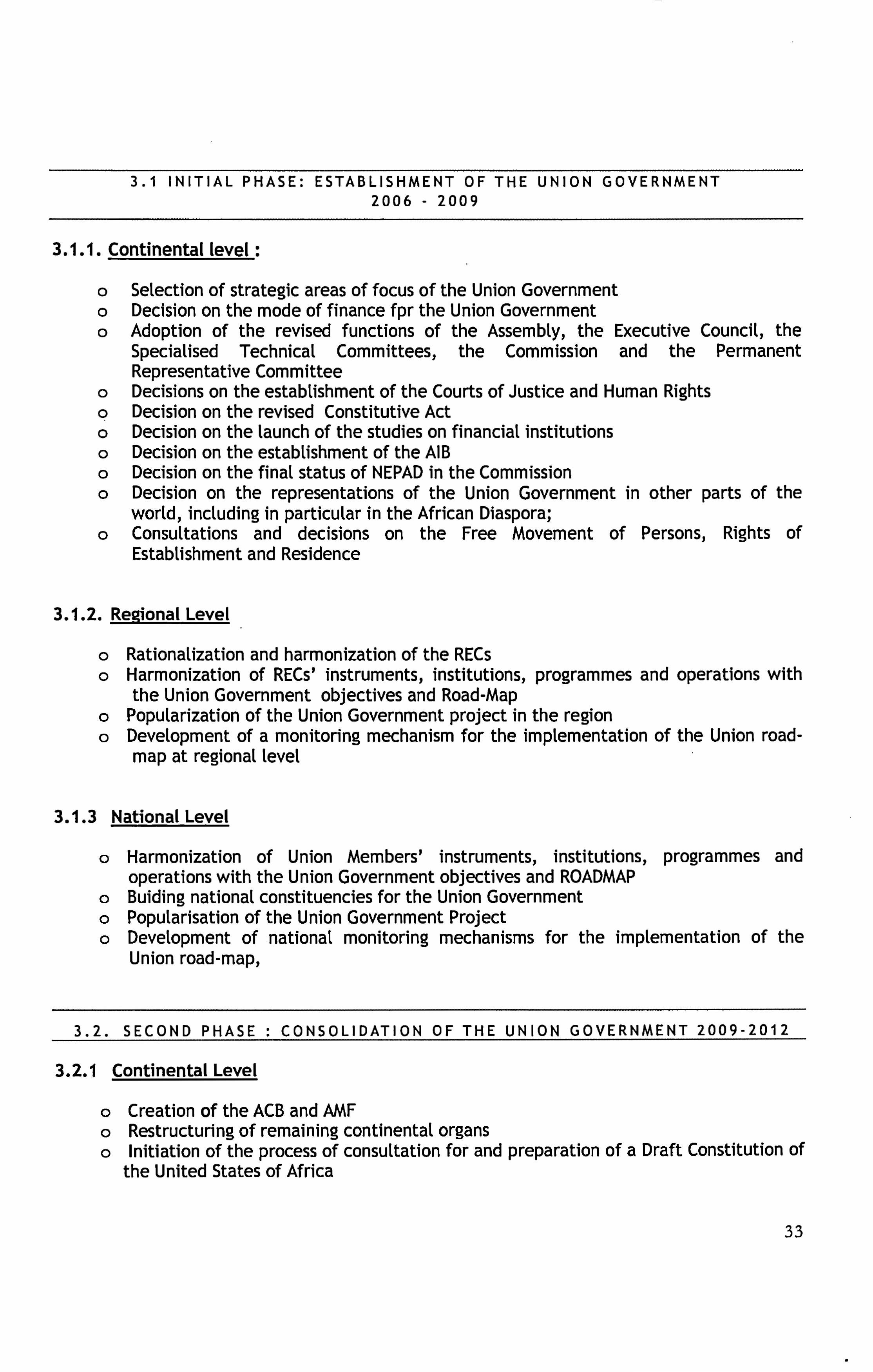
The Framework Document proposes that a United States of Africa should be created by the year 2015, following a three-phased road map each lasting for three years. That, of course, is up for debate. As far as the challenges with the proposed African Union government are concerned, one of the questions that should be asked concerns the timeframes that have been outlined for the creation of a United States of Africa. That is, Parliamentarians should be able to evaluate whether or not 2015 is a realistic timeframe for the successful conclusion of such a project?
The above question must have as its background the fact that in terns of the Lagos Plan of Action the process for the creation of an African economic community was to take 34 years. Thus the question becomes, what is it about the current sociopolitical and economic conditions in Africa that warrants a belief that the United States of Africa could be created in such a short space of time? This is one of the important questions, because the African leadership has the responsibility to ensure that past mistakes are not repeated, where unrealistic plans and timeframes are outlined without the necessary machinery to ensure their realisation.
Furthermore, parliamentarians and other African stakeholders should be able to reflect on whether the AU has been able to achieve the objectives for which it was created. The AU has not concluded a decade since it replaced the OAU as a continental body. Thus, the question should be: Are those pushing for the replacement of the Union government convinced that enough work has been done to meet the objectives of the African Union and therefore warrants the transformation into an African Union government?
Is there a study that has been conducted that thoroughly informs the African people about the strides or failures therefore, by the AU to achieve its tasks? It appears that it would defeat the purpose to transform the AU without such a study being done and without providing an opportunity for a third examination of the progress by the AU.
One of the foreign policy priorities in South African government is the consolidation of the African agenda. Amongst other things, one of the key objectives of this priority is to strengthen the AU, its relevant organs as well as specialised technical committees. From the point of view of the South African government, more work is still required to ensure that the African Union functions effectively. Therefore, it may well be that the AU still requires strengthening before Africa decides to forge co-operation by creating an African Union government.
I am going to pass on to the decisions taken by the Pan-African Parliament. The Pan-African Parliament sent the recommendations to the African Union, and they are as follows: the first is that the transformation of the Pan- African Parliament into a legislative organ be accelerated to enable it to contribute to the integration of the continent, through among other things, the harmonisation of policies, laws and regulations relating to the various issues of development.
The second is that the evolution towards the Union government should take into account modern global forces and pressures, and that the AU sets a realistic calendar in order to facilitate the evolution of the AU towards the creation of the union government. Third, is that as a prerequisite to setting up a union government, the AU redouble its efforts in order to accelerate the establishment and the strengthening of existing institutions and those which are in the process of being created.
The fourth is that the present process of rationalising and harmonising the AU institutions and regional economic communities which are the actual building blocks, as well as their policy programmes and projects be accelerated and finalised following a realistic calendar. The fifth is that African political leaders show their political will to move towards the union government by paying the respective country's contributions to AU's budget and subsequently to the union government.
The sixth is that the African Union clarifies the type of union government it has in mind. The Pan-African Parliament for its party, is in favour of a federal type of union. The seventh is that the nomenclature "United States of Africa", with the English acronym of USA, be replaced by another acronym which better reflects the history of the continent.
Eighth, the AU takes all the necessary steps to encourage and promote the full participation of peoples of Africa in the debate and process towards the creation of a union government. Ninth, the Nepad, APRM and other similar specialised institutions should be incorporated as specialised technical institutions of the future union government with appropriate levels of autonomy of powers and resources.
I want to very quickly come to the meeting held in Addis Ababa by civil society, trade unions, some legislatures, the military and some women's movements. The meeting articulated the commitment to the unity and the development of Africa. The delegation agreed that efforts towards integration should be informed by the basic development needs of the people of Africa within a peaceful and stable environment.
It expressed support for the decision to order the AU and its institution and organs. Furthermore, it was argued that greater efforts should be made to harmonise continental policy frameworks, particularly within the judiciary and economic domains. Furthermore, greater convergence in government framework should be encouraged and developed among African states through greater support of the APRM framework. Lastly, with the few minutes left, I want to put in that one of the things that was said was that to consolidate continental unity, the people of Africa must be included in the debate in the union government. We should broaden the participation of the debate to civil society and the decision should be taken by the people of Africa. I thank you. [Applause.]
Madam Chair, hon Minister and hon members, coming from a visionary perspective, may I say and state that today we stand, not at the edge of a cliff but on a rolling hill staring far into the distant horizon - so near yet so far. It is the far-off goal which we must work towards today.
Many on the African continent, including South Africa - you know, we are part of Africa and I state this to remind all and sundry - may not live to see the goal attained. But as Africans loyal to Africa's renaissance, growth and destiny, we must be part of the roadmap to Africa's unification, peace, stability and prosperity by laying the first stones - the building blocks! Being African is not dependent on skin pigmentation or necessarily race or tribal origin. Mama Africa embraces all her children from Cape to Cairo, Morocco to Malagasy in all their hue and splendour. Deny yourself or deny others of this parentage at your own peril.
Before we can start building a unified Africa, we must start to build and strengthen the very African Union, which is sadly lacking in various departments. The AU is lacking, not because there is anything inherently wrong with the structure or the mandate of the organisation, but because some member states continually let the other member states down. Too many wars are fought; too many governments are corrupt, undemocratic and abusive of human rights when in fact other governments have sworn to mend their damaged countries and behave with a sense of morality and benevolence.
The AU must be bolstered by vibrancy and sustainability based on positive attitudes and actions from our leaders on the continent and also supported by all citizens otherwise the AU effort will be flawed.
In striving for unification of Africa, we must not shy away from learning from other nations' experiences lest we repeat or make mistakes that were made in these areas. Take note of the journey thus far travelled by the EU and our own regional bodies and related efforts. Surely the EU's journey has been long and fraught with stumbles, missteps, and misadventures but the Euro has been introduced to the world. The lesson for us in our quest for Africa's unification is this: No learning is accomplished without stumbles, missteps and even misadventures. The intrepid yesteryear lads know that ``faint heart never won fair lady''! So, Africa, we have to be courageous.
When looking back at the difficult history of the EU, where major mistakes were made and paid for by developed First World countries, it becomes clear how far Africa must go before the concept of African unification has any real effect on our day-to-day actions. Until then, we must strengthen or fortify the processes and institutions already put in place towards making the continent a better, safe and secure place to live in, before we think of merging. Each sovereign state or country or building block, as I have said, must be strong in the democratic tenets and protocols that we so ably verbalise and espouse.
Take heart though, the picture is not that bleak. There is hope even if it is flickering hope to some, and there is also the will and courage to forge ahead to the ultimate goal - the unification of Mama Africa.
Closer to home, many countries in the SADC region would be good candidates for a free trade area. Peaceful countries like us, Namibia, Botswana - to name but a few - are beacons of hope. Tanzania, Mozambique, Kenya and Malawi could be incorporated in the near future in this free trade sphere.
I hope this happens one day - and very soon. It would be a great privilege to watch African countries slowly joining, like the plates of a tortoise shell moving together to create one strong and formidable whole. The African dream, the African mosaic and tapestry has great potential! A mmaruri, ngenene, ngempela. [Truly.]
Until that time comes, we must focus our efforts on improving the ability of the AU to lead the way. This can only be achieved by member's improving their diligence and commitment to the AU and following through with the promises they made when signing the various treaties. I thank you, Madam Chair. [Applause.]
Madam Chair, guided by the Pan-Africanist philosophy, the African continent has, since independence from colonial rule, consistently pursued the twin objectives of unity on the one hand, and collective self- reliance in the field of economic and social development on the other. These twin objectives aimed at promoting socioeconomic development, protection from neocolonialism and reduction of its dependence from the countries of the North.
As African states finally became independent, they recognised the need to establish an organisation that would act as a vehicle for African unity, and this was realised in 1963 when the OAU was established. The founding fathers of the OAU envisioned a united Africa functioning under a union government with a common defence, common diplomacy, common currency, an African monetary zone, an African Central Bank and a common African citizenship.
The formation of the AU in 2000, replacing the OAU, was necessitated by, among other things, the new context marked by globalisation, the partial end of colonialism in Africa and the end of the Cold War.
The AU established Nepad, which was supported by the Constitutive Act, the objectives of which were inter alia, to achieve greater unity and solidarity between the African countries and the peoples of Africa; defend the sovereignty, territorial integrity and the independence of its member states and so on.
The AU Assembly, then mandated the AU Commission to pursue the projects of the United States of Africa by holding the All-Inclusive Continental Consultation Conference on 29 to 31 May this year in Addis Ababa, where participants, including civil society organisations, agreed that there was a need for the establishment of a union government as the political transitory arrangement towards the United States of Africa.
Many member states, with the exception of few, agreed to the project of the United States of Africa. Their fundamental motivation was that such an eventuality was going to effectively address the issues of underdevelopment, eradication of mass poverty, the promotion of democracy and the rule of law and the defence of their political independence and position in the world.
All participants agreed that that process would be a gradual, incremental and multilayered approach, bearing in mind that of course there are sensitive issues such as the African Bank and sovereignty which are very crucial, the removal of trade barriers, African armies and defence, judiciary systems, African security issues, common currency, common language, etc.
It was further realised that there can be no integration of the continent without strong regional economic communities which would serve as building blocks towards the realisation of that dream.
The biggest challenge is in aligning, synchronising and harmonising the integration efforts of member states, the RECs and the AU. Therefore, a roadmap for the attainment of deep continental integration and the establishment of union government should learn, first, from the difficulties experienced with the two previous roadmaps - the Lagos Plan of Action and the Abuja Treaty. Thank you very much, Chair. [Time expired.] [Applause.]
Chair, Julius Nyerere once said that African nationalism is meaningless, dangerous and anachronistic if it is not at the same time Pan-Africanism. The ID wholeheartedly supports this view, and we believe that we have to continuously fight for the long-held dream of a united and prosperous Africa.
I stand before this House as a proud African who has travelled the length and breadth of this continent. I've been struck by the enormous creativity and resilience of ordinary African people, which I believe must be unlocked in any future governance structure of Africa.
It is often said that Africa is resource-rich but governance-poor. We must set about changing that. Seeing that today is my birthday, I want to make a wish. [Interjections.] That wish is that in my lifetime I will see Africa merge as a united superpower that can lead the world on a new path of sustainable development.
It might be just a wish, but 10 years ago, after travelling through the despair of the then Congo, I never believed that I would be sitting in Parliament listening to the poignant address of a democratically elected President of that country. In Africa the impossible is possible. Let us all work towards the vision of a united and prosperous Africa. I thank you. [Applause.]
Chair, Madam Speaker, Minister, the present integration of African states resembles the EU rather than the United States of America, but is not much different from the secret Accra Agreement in its goals of eliminating tariff barriers, forming one customs union, the creation of a single African bank and a single currency.
It may be useful in this debate to look at some perceptions with regard to the impact of the EU on its member states. These include centralisation of power in Brussels, loss of sovereignty and interference in decision-making. For example, 80% of German legislation since 1998 has its origin in Brussels directives.
With no EU community of people to give it a democratic legitimacy, EU control is seen as an assault on nation states and the national democracies that underpin them. Rampant corruption has been acknowledged by EU auditors and on the EU's own figures, the single market costs three times as much as the benefits.
It is estimated that EU membership cost the UK between 15 billion and 25 billion each year, or 1 000 per household. That would be around R1 000 per month here in South Africa. The UK's membership has been described as an economic and social disaster.
A Zimbabwean delegate at a public seminar on Africa Day was reported as saying that he was attracted to the optimism of continental integration and that the idea of a united states of Africa was good. Very likely, from the perspective of some failed states, the benefits will look good, but what are the implications for South Africa?
The fact that this debate, up till now, has taken place exclusively at the level of heads of state and excludes the people of Africa is, as we have said, of great concern for the ACDP. It is the people of Africa and indeed South Africans who should be applying their minds to this concept as it is the people who stand to gain or lose the most. [Time expired.]
Mr Chairman, the Minister asks: How best can we achieve one, united, prosperous Africa? We answer as the FF Plus by being realistic and not overambitious when we talk of one United States of Africa.
If we are unrealistic in our dreams, we shall fail. Everything will be delayed by many years. Are we really ready at this moment to choose one leader for Africa? I'm afraid not. You know, we struggled to decide who must represent Africa at the Security Council, and it was much easier to do that.
Are we ready for one single currency, meaning putting together the strong pula with a weak Zim dollar? I'm afraid the answer is no. So these are unrealistic dreams.
The European Union started in 1957 with six members and then built up slowly. After 50 years, they now have 27 members. So what is our advice, if I may put it that way? Let's keep the dream alive; let's be realistic. Start regionally with SADC. Build up the infrastructure of SADC. There are lots of possibilities there. Get co-operation going at regional level, start dreaming about the bigger one and then slowly build up to that. I think that's realistic, that's within our reach and can be achieved within, hopefully, our lifetime.
Chair, the unification of Africa is not a choice; it is an imperative. Africa must unite or perish. Through a courageous policy of unification, an integrated economic and technological development continentally, Africa can take her rightful place among the powerful nations of the world.
It is for this reason that, from our inception in 1959, we in the PAC strongly identified ourselves with the entire Pan-African Movement and advocated a union of sovereign states.
A united states of Africa does not mean loss of sovereignty by independent states. On the contrary, as Kwame Nkrumah stated: A united states of Africa will strengthen the sovereignty of the individual states within the union. The longer we wait, the stronger will be the hold on Africa by neocolonialism and imperialism.
Africa has been a great actor in history. She must come alive again and take her destiny in her own hands, once more. The African Union government is a catalyst in this noble journey. Forward to a giant, monolithic state of Africa! Forward to a social order original in conception and Africanistic in orientation! [Applause.]
Chair, Madam Speaker, hon Minister, the MF affirms that it is Mama Africa with all our brothers and sisters that was raped by colonialism. While some of us were led into harsher trenches, such as apartheid, many of us managed to haul ourselves to recovery. Furthermore, some on the continent remained savaged by political agendas, poverty, exploitation and cruel, inhumane social retardation.
Those of us who have managed to escape these shackles need to realise the duty we have to rescue Mama South Africa and give her the opportunity to sprout into the continent we were derailed from.
We cannot allow Western opportunists to fix Africa as this would not be done without an agenda. Africa needs to unite through the AU, PAP, Nepad and independent democratic initiatives to liberate Africa. Let us be the mediator between the colonial aftermath and the future political agenda.
Allow a united Africa to take up its place in this world as the strong Africa that we are. We emphasise, however, that the colonial masters of Africa be held responsible for the African debts as these were accumulated under duress from colonialism.
The MF calls for a united Africa and better Africa. I thank you. [Applause.]
Chairperson, in honour of President Kabila, Azapo wishes to start off by quoting from a secret agreement that was signed in Accra on 8 August 1960 by Kwame Nkrumah and Patrice Lumumba, and I quote:
The President of the Republic of Ghana and the Prime Minister of the Republic of Congo have given serious thought to the idea of African unity and have decided to establish, with the approval of governments and the people of their respective states, amongst themselves, a union of African states. The union will have a republican constitution within a federal framework. The federal government will be responsible for foreign affairs, defence, the issuing of common currency, the economic planning and development.
There will be no customs barriers between any part of the federation. There will be a federal parliament and a federal head of state.
In Azapo's terms this agreement represents a vision that is relevant today as a point of departure towards the unification of Africa.
Africa has come a long way from the time of colonialism, followed by the political revolution ending direct colonial rule to the period we are in now. The period is in essence a prerequisite for the revolution to bring about a radical transformation of Africa.
With the national liberation struggle to get rid of colonialism over, it is now possible to come to grips with the struggle against the continued exploitation by former colonial powers of African resources and wealth.
Azapo believes that this is the more difficult and protracted struggle, where the enemy is less obvious and is supported by the more complex international, monopoly-financed capital. [Time expired.] [Applause.]
Chair, hon Speaker, Minister, Deputy Minister and colleagues, for many years Africa has suffered from its horrifying colonial past, and in the recent past many of our liberated states suffered under the greed and self-interest of many of their own people in leadership positions.
It therefore stands to reason that we, as Africans, face huge internal and external challenges if we are to consider the notion of a united states of Africa. The debate around these issues is always marked by comparisons with the European Union and even the United States of America. These are comparisons that would be very misleading. These two models have very distinctive variables contributing to their respective economic and social successes or failures.
The most important variable for successful African unification is quality and visionary leadership that has the necessary political will. Sadly, our recent history reflects a relatively negative response to this requirement. Far too many of our African countries lack leadership that is accountable to its own citizens, a fundamental prerequisite for the intended goal. We need African leadership that will put African people at the centre of the project.
Therefore the African people have to be at the centre of decision-making and implementation of public policy - in short, respect for democracy. I thank you.
Chairperson, Ministers, hon members, I want to start by saying to the hon Dudley from the ACDP: I understand why you were trying to parachute your speech into statement time. It was because you were not prepared. You debated about the EU instead of the African Union government.
Sihlalo, kule nyanga kaNhlangulana, kule nkulumompikiswano yanamuhlanje ngizothanda ukwethula inkulumo ehalalisela intsha yonke yase-Afrika, ikakhulukazi intsha yaseNingizimu Afrika ngegalelo layo emzabalazweni wethu wenkululeko, nangendima esayiqhuba ekuvikeleni amalungelo abantu.
Sihlalo, ngivumele ngicaphune amazwibela amanoni avela kwenye yezinkondlo ezingasoze zabuna zoxoshidada, esakhula ngazo, esihloko sayo sithi UNomtobhoyi:
We Nomtobhoyi Kukhiwa amanzi Uyafa uyafa Kuyaphekwa Uyafa uyafa Kuyagezwa Uyafa uyafa Kuyadliwa Chwi umlenzana!
Lokhu ngikusho ngoba kule Ndlu yesishayamthetho sinabo oNomtobhoyi. Uhulumeni oholwa yi-ANC umile uthe qingqo, ulokhu ephuma phambili kuhle kwesixhumo senyamazane ngokuhola abantu baseNingizimu Afrika ngezinkambiso nemihlahlandlela yokuletha intuthuko kuleli lengabadi ye-Afrika yonkana.
Isibonelo kulokhu yingesikhathi uhulumeni ehlaba umkhosi wokuthi kunezinhlelo azenzayo zokufinyelela ebantwini , ngalokho-ke zonke izinhlangano nomphakathi wonkana kumele zisebenzisane, okungukuthi "tiriswano". Waphinda futhi wenza uhlelo lwe-Asgisa okuqondwe ngalo ukuvula amathuba emisebenzi. Khona emuva kwalokho nje wenza nohlelo lwe-Nepad, okuqondwe ngalo ukuthuthukisa izwekazi lethu lase-Afri-ka.
Kodwa-ke koNomtobhoyi yonke le mizamo iyize leze kubo, abayigqizi qakala; kufana nokuthela amanzi emhlane wedada nje kubo. Balokhu bedukuza oswini, behlezi phansi bethe dekle. Abanagalelo abalenzayo, kodwa uma bebona izintatheli zamaphephandaba, ezemisakazo kanye nezomabonakude bavele bathi chwi umlenzana.
Ngithanda ukukhumbuza iNdlu ukuthi uMongameli wethu, uComrade Thabo Mbeki bekuthiwa uhamba isikhathi eside futhi uhlale esemazweni angaphandle, akahlali lapha ekhaya. Bacabanga ukuthi kumele ahlale lapha ekhaya kuphela kube sengathi iNingizimu Afrika iyigatsha labo ngoba bona abanawo amagatsha. Bona-ke abakuboni ukubaluleka kokuthi kudingeke ngani aphume ahambele izwekazi lonke nomhlaba wonke jikelele. (Translation of isiZulu paragraphs follows.)
[Chairperson, as it is the month of June, I want to honour all the youth of Africa, especially from South Africa, for the role they played in our struggle for freedom, and the role they continue to play in protecting human rights.
Chairperson, allow me to quote briefly from one of the classical poems which is meant for the kindergarten grades which we also grew up reciting. The title of the poem is Nomtobhoyi:
We Nomtobhoyi Kukhiwa amanzi Uyafa uyafa Kuyaphekwa Uyafa uyafa Kuyagezwa Uyafa uyafa Kuyadliwa Chwi umlenzana!
I quoted from this poem because in this House we have people who behave like Nomtobhoyi. The ANC-led government is standing firm, and it is, like a young buck, leading the pack when it comes to making policies and guidelines for the people of South Africa and Africa as a whole.
An example here is when the government made a clarion call that there are programmes that are being implemented to reach to the people. Therefore it was up to the community organisations and the community at large to work together, hence the word "tiriswano". The government also came up with Asgisa with its chief intention of creating job opportunities. And Nepad was also started with the intention of developing the African continent.
And yet all this seems to be nothing to the Nomtobhoyis. They do not care. To them, it's all just like water off a duck's back. They have neither the direction nor the action. They play no role, and yet when they see the media, they jump with joy.
I want to remind the House that our President, Comrade Thabo Mbeki, is said to be always out of the country. And his critics say he spends most of his time out of the country. Those who say this believe that the President must idly sit in this country like they do in their branches. These people do not see the importance of visiting other African countries and the world.]
Allow me to remind the House that it would be a great mistake in our history to forget the great heroes of our continent who have contributed to the African dream that Africa must unite. There have been leaders like Dr Kwame Nkrumah who championed the clarion call for the African Renaissance in the 1960s.
This led to the creation of the OAU on 25 May 1963. This call was accepted by African leaders who pushed it in different ways. I need to mention other leaders like Julius Nyerere who initiated Ojama - African socialism - not forgetting Milton Obote who allowed the Makerere University to flourish.
What Dr Kwame Nkrumah verbalised was already in the blood of Africans. The clarion call he made was also embraced by African communities. In Africa there were many communities that had distinguished themselves before Western civilisation arrived, particularly in culture, technology, education, economics, etc.
Umbono wokwakhiwa kwe-AU wavuselelwa ngabaholi base-Afrika ngo-1990, okwalandelwa yi-Sirte Declaration eLibya mhla ziyi-9 kuMandulo ngo-1999. Leso simemezelo sasicela kwakhiwe ubumbano lwe-Afrika ngokuthi kwakhiwe i- African Union.
Leso simemezelo salandelwa yingqungquthela yaseLome ngo-2000, lapho kwavunywa khona umthethosisekelo wokwakha ubumbano lwe-Afrika eLusaka ngo- 2001. Ngalowo nyaka kwenziwa imizamo yokwakha iNepad. Inhlangano yobumbano lwe-Afrika yethulwa eThekwini mhla zi-2 kuNtulikazi, 2002. (Translation of isiZulu paragraphs follows.)
[The idea of forming the AU was revived by the leadership of Africa in 1990 which was followed by the Sirte Declaration in Libya on 9 December 1999 which pleaded for the formation of the Africa Union.
This announcement was followed by the Lome conference in 2000 after which the constitution of the African Union was adopted in Lusaka in 2001. In that very year endeavours to form Nepad were made. The African Union was launched in Durban on 2 July 2002.]
The AU seeks to unite Africans as they have a common and shared identity. The first task is to achieve unity, solidarity, cohesion and co-operation among all the people of Africa and the African states.
The AU also aims to end ignorance on our continent by investing in education and research in all fields and it endeavours to develop capacity in science and technology. A key challenge it has to contend with, is to end the levels of unemployment that have been characteristic of almost all societies.
Regarding development, the AU has established the New Partnership for Africa's Development, Nepad, as a vehicle for development.
Ngiko nje namuhla onkhe emave ase-Afrika atibophelele ekutseni umnotfo wawo ukhule udlondlobale ulandzele imigomo yeNepad. Tinyenti tinhlelo letentiwako letenta kwekutsi timbiwa nalokunye kungatfunyelwa emaveni angesheya kuseluhlata kepha kucolisiswe bese kuyatfunyelwa-ke. (Translation of Siswati paragraph follows.)
[That is why, today, all African countries have undertaken to ensure socio- economic growth according to the Nepad objectives. Numerous programmes have been initiated to ensure that minerals and other raw materials are now processed locally and not exported in their raw form.]
With regard to cultural development, in Limpopo the Venda people of Mapungubwe mastered the technology of melting gold that was used to paint, among other things, the world-famous artificial wooden rhino which experts have dated back to 1 000 AD.
In the Eastern Cape there were miners diggers called "Amambo" who were also able to melt iron and manufacture a lot of things from it. All these innovations were inspired by the spirit of the African Renaissance.
Emave ase-Afrika atiwa kakhulu ngekubambelela emasikweni awo lekuyintfo lengatiwa eYurophu, eMelika naseKhanada. Loku kwenteka nakhona umoya waseNshonalanga walinga ngawo onkhe emandla awo eminyakeni leyengca lengu- 500 kubulala emasiko, tilwimi kanye nenkholo yebantfu base-Afrika.
Badzeshi bebakwenta loku ngobe basitsengisa ngesikhatsi sebukholoni. Bawuchuba lomkhankhaso wabo nangesikhatsi semamishinani lapho emasiko, lulwimi nenkholo bebakubetsela ngesipikili balinga kukubulala. Bebatsela emanti emhlane welidada ngobe nalamuhla loku emasiko solomane asekhona.
Angisho kwekutsi ngelishwa lamanye emave, lawa labetfujwe yiFrance nemaPhuthukezi alahlekelwa ngemasiko, tilwimi nenkholo yawo. Phela, kubulala emasiko, tilwimi kanye nenkholo yebantfu, kukubulala buntfu babo. Umuntfu longenabo buyena ufanana nemuntfu lofile. Umuntfu lonjalo uhlala njalo adla ematse ebelumbi.
Lamuhla bavakashi labanyenti bavakashela i-Afrika batewubona imihambo ye- Afrika kutsi ichutjwa njani. Lubumbano lwe-Afrika lubukene nensayeya yekugcugcutela nekutfutfukisa emasiko. Injongo lenkhulu kwakhiwa kabusha kwebu-Afrika.
Kubonakele futsi kuyatiwa kutsi intfutfuko nebuchwepheshe lebebukhona e- Afrika kadzeni abukefiki kulivekati laseYurophu nakulamanye emavekati.
Lucwaningo lusivetela kutsi imphucuko yeMagrikhi yavela e-Afrika. Inyuvesi yekucala yasungulwa eGibhithe. Ngubani longaphika kwekutsi tibalo betivele tifundvwa kwakadzeni e-Afrika. Imibhalo yaseTimbuktu, eMali iyakhombisa kutsi belumbi bangesheya babetele kutewukwendzela lwati lwesayensi, lwetemitsi, lwetebunjinela nalokunye kubantfu labamnyama.
Loku kuniketa Hulumende Welubumbano lwe-Afrika insayeya yekutsi kucedvwe lenkholelo lengenaliciniso yekutsi i-Afrika bekulive lelatfolwa belumbi, imnyama, ingati lutfo kube kunebufakazi bekutsi beyinotsile, inako konkhe kwekutiphilisa kepha labamhlophe baweba wonkhe umnotfo wayo.
Asingakhohlisani bekunene, i-Afrika beyikwati kwenta yonkhe imisebenti yebuciko. [Saphela Sikhatsi.] [Tandla.] (Translation of Siswati paragraphs follows.)
[African countries are famous for clinging to their culture, something which is very unusual in Europe, America and Canada. This is so despite Western elements trying by every means over the past 500 years to invade and destroy the culture, language and religion of the people of Africa.
White people did this because while we were colonised they owned us. The campaign to subdue us was continued by the missionaries where culture, language and religion were being crucified in an effort to destroy them completely. This proved to be like water off a duck's back because we still have our traditions today.
I should say that unfortunately, other countries that were colonised by the French or the Portuguese lost their culture, languages and religion. To take away ones culture, language and religion is to destroy one's identity. A person who has lost his identity is like a dead person. And a person like that remains a slave to foreign ways.
Today most visitors come to Africa to experience the different cultures and to see how we live. As such the AU is faced with the challenge of encouraging and developing our cultural heritage. The greatest aim is to return Africa to its former glory.
It is a known fact that ancient civilization and technology available in Africa in the ancient days have spread to continental Europe and to the other continents. According to research, Ancient Greek civilization came from Africa. The first university was started in Egypt. Further, who can deny that mathematics was being studied in Africa since ancient times? The writings of Timbuktu in Mali are evidence that white people had come to acquire knowledge of science, medicine, engineering and other things from the black race.
This gives the AU another challenge of eradicating the false belief that Africa was discovered by white people even though there is proof that Africa had been very wealthy. She had everything necessary to sustain herself before all the wealth was stolen by the whites.
Ladies and gentlemen, let us be honest with ourselves; Africa has always produced artefacts. [Time expired.] [Applause.]]
Chairperson, I thank all hon members who are taking part by speaking or listening to this debate. Africa is the cradle of humanity and Africa is a continent of hope and endless possibilities. But the future of Africa depends on what we, the Africans do with these possibilities.
Now, Africans was defined by one of the speakers as whoever claims his birthright as an African is an African. So, in this debate what seems to be clear is that there is consensus that Africa needs to unite and even some young and old people amongst us cherish the hope that it happens in their life time. It is clear that there is a strong view that if we do not unite, Africa, as we know it will perish.
But there are also reports that by 2050 Africa will probably have the largest young population whereas Europe will have an aging population. Africa has the second largest land surface as a continent, has large amounts of natural resources but individually we do not seem to the able to harness all these possibilities.
So it seems again that we are all saying yes to integration, but some are saying we should strengthen and rationalise the economic communities as building blocks and that we should also strengthen the AU and its institutions.
In concluding this debate, it seems that we are also saying that there are issues that can be dealt with at a continental level, as Nepad has isolated those already. Therefore, we need to have a kind of twin track: firstly, strengthening the building blocks at the regional level whilst at the same time doing what we need to do at the continental level, especially around the Nepad priorities. We need to mobilise resources because without the resources we can't even begin to integrate the continent.
I am glad to say that at the insistence of our own President, South Africa is leading in the establishment of the Africa Development Fund, which is looking at using some of the pension funds and some of the private sector funds to put together a fund that will build the infrastructure to start with on the continent, because without infrastructure we cannot even begin to integrate. So, infrastructure development is very crucial for any integration.
We hope that this House will support this fund as a way of accelerating the integration. But I also heard that you as parliamentarians, including me are saying, that this debate must not end here - it must go out to the public so that South African's should pronounce on it. But who is best placed other than yourselves as public representatives to go back to the people you represent and ask them what their views are, because I take it today that these were your views? Now, we need to go out and ask our constituencies what their views are on this matter. Thank you. [Applause.]
Debate concluded.
******************************************************************************************************
ADDRESS BY THE CHAIRPERSON OF THE AFRICAN UNION, H.E. PRESIDENT J.A. KUFUOR, AT THE OPENING OF THE NINTH ORDINARY SESSION OF THE ASSEMBLY OF THE AFRICAN UNION IN ACCRA, GHANA
Your Excellencies - My Sister and Dear Brother Heads of State and Government of Africa
Your Excellency, Mr. Mhammoud Abbas, President of the State of Palestine,
Your Excellency, Dr. Asha-Rose Migiro, Deputy Secretary-General of the United Nations,
Your Excellency, Professor Alpha Oumar Konare, Chairperson of the Commission of the African Union,
Your Excellency, Mr. Amir Moussa, Secretary General of the Arab League,
Your Excellencies, Ministers and Ambassadors,
Your Excellencies, Commissioners and Members of the African Union Commission,
Distinguished Ladies and Gentlemen,
It is with great pleasure that I welcome all of you, leaders from Africa and beyond, who have traveled in your numbers to Ghana to participate in the Ninth Ordinary Session of the Assembly of Heads of State and Government of the African Union. For some of you, this is your second visit this year, having joined us on 6th March to celebrate the 50th anniversary of our country's Independence.
Ghana welcomes you with a joyful heart and sincere hospitality. Ghanaians are resolved to do everything possible to make your stay enjoyable, productive and memorable. So, I say welcome to you all.
Excellencies, as decided at our last meeting in Addis Ababa in January this year, today's Summit is devoted exclusively to the Grand Debate on the Union Government of Africa. This assumes that the question of unification is not in doubt. Indeed, the many resolutions and declarations made by the leadership of the continent since the inception of the OAU to date, confirm this. What remains is the form of government, and how and when to attain it. This then should be the content of the Grand Debate to join in.
Excellencies, it is, indeed, significant that this historic and momentous debate should be taking place here in Accra.
On Ghana's Independence Day, in 1957, the founding President, Dr. Kwame Nkrumah made a portentous statement here in Accra, (and I quote) "the Independence of Ghana is meaningless unless it is linked up with the total liberation of Africa". (End of quote) With that statement, he linked this country's destiny irrevocably to that of the continent. Subsequently, and over the next decade, in his writings, and on numerous platforms around the world, his chosen recurring theme was "Africa Must Unite".
In pursuit of this vision, he and his illustrious colleagues including Emperor Haille Sellassie of Ethiopia; King Mohammed V of Morocco; Presidents William Tubman of Liberia; Julius Nyerere of Tanzania; Jomo Kenyatta of Kenya; Sekou Toure of Guinea; Modibo Keita of Mali; Gamel Nasser of Egypt and others, laid the foundation for continental unity by establishing in Addis Ababa, in 1963, the Organisation of African Unity (OAU) which is the predecessor of the African Union of today.
Indeed, in 1965, Dr. Nkrumah hosted a Summit of the OAU here in Accra where the project for the Continental Government was first discussed. It is therefore an uncanny coincidence that here in Accra, on the 50th anniversary of our Independence, this same subject of continental government should return to the agenda of the Summit of the African Union as its sole item for deliberation.
With this background, your Excellencies, permit me to feel that your unanimous decision in electing me chair of our Union this year, thereby vesting in Accra the venue for the 9th Summit of our Assembly is an act of providence. Indeed, I feel both humbled and called upon to perform my role with a deep sense of history and singular honour.
Excellencies, geographically, our continent is the second largest in the world when you divide the Americas. In terms of natural resources, it is second to none. But, in spite of this, it is has been described in many unsavoury terms including "the last frontier for economic and social development" and "a scar on the conscience of humanity". Over the centuries, Africa has suffered harsh and diverse acts of inhumanity, many a time self-perpetrated, but more often than not, from outside its borders.
The litany of factors which have combined to slow the continent's advancement includes slavery, colonialism, imperialism, the wild diversity of cultures, language and even geography. Illiteracy and poverty, famine and diseases especially malaria, tuberculosis and now HIV/AIDS, gender imbalance, ethnic and religious intolerance and conflicts, and recently, border tensions generated by artificially imposed colonial boundaries have also contributed to Africa's woes. But perhaps the worst of all the causes of Africa's dysfunction were the unwarranted external interventions and geo-political manipulations.
It is from this background that our pioneering leaders resolved to liberate the continent and try to overcome the monumental social and economic challenges for development by launching the project for the unification of the continent. Through the mechanism of the OAU, the pioneers succeeded in shaking off imperialism, colonialism and apartheid.
But, as Africa's great statesman, Nelson Mandela, has observed, you climb one mountain only to find that there are more mountains to climb. For, after liberating the individual countries on the continent the pioneering leaders were confronted with the looming mountains of economic and social challenges which dogged their developmental efforts in the immediate decades after Independence. To be candid, your Excellencies, we must also admit that those decades were marked by bad governance and impunity in most of our nations. This is why at the turn of the century, the current crop of leaders of Africa decided to create the African Union and also adopt the New Partnership for Africa's Development.
Resolved to overcome the mountain of political and economic emancipation through integration, the leadership passed the Constitutive Act of the African Union in Sirte, Libya, in 1999. This law thereby provides the legal framework for the realization of the vision of the Union Government. Through NEPAD which the African Union adopted as its development paradigm in Maputo in 2002, the Renaissance of the continent was also formally declared.
With the establishment of these two mechanisms, the immediate challenge to the realization of our goal becomes institutional development. Such a development should bring all sides of the continent together in a functional and participatory order that will give ownership of the eventual Union to the peoples. Thus, the various sub-regional groupings have come to be perceived as critical building blocks for the integration process. Their co-ordination and streamlining to service the central institutions of the African Union are therefore prerequisites for unification.
Unfortunately, over the past two decades or so of their establishment, these groupings have not performed to the degree of efficiency and purposefulness which would assure an objective observer of hastening the day of the attainment of the Continental Government. There has been lack of political will and commitment on the part of the component governments in implementing the various protocols setting up these regional groupings thereby, slowing down the pace of integration.
Similarly, the Commission of the African Union itself has not been constituted and nurtured enough along the lines of an eventual competent and efficacious Administrative Nerve-Centre of a Continental Union Government. This nurturing is the responsibility of all of us member governments of the Union.
Excellencies, in the light of global developments, including the formation of political and economic groupings on other continents, and inspite of some economic and political progress, Africa can be said to be running against time in its efforts at integration. For this reason, the continent must leapfrog to attain a dignified and promising place in the globalization process.
This challenges our various governments to sincerely commit to implementing the protocols dedicated to the integration programmes. Among these are the free movement of peoples and goods; the establishment of customs unions, common currencies and markets; harmonization of the security policies and programmes, and the creation of stand-by forces to underpin peace and stability, without which there cannot be development. Also, critical infrastructure programmes including transportation and telecommunication networks, and pooling of energy must be undertaken as top priority to open up the continent.
Excellencies, we all know these conditions as the major hurdles to jump in the path of integration. This is why NEPAD was established as the mechanism to identify, study, cost and implement strategic projects for realizing the integration programme. Given this awareness of what to do to hasten the process, why has the impression been created so powerfully that the continent is not ready or able to come to grips with the challenge of designing the sort of government that Africa's integration will dictate pragmatically and when to establish it?
Excellencies, permit me to state unambiguously that, given the complexities and practical difficulties in the path of attaining this Union Government in one form or the other, the topmost prerequisite facing us as leaders of the continent should be mutual respect and trust among us all. We must also acknowledge the necessity for shared values in terms of respect for human rights, principles of good governance and the rule of law. These values should constitute the fabric of the Union's budding institutions like the Pan-African Parliament and the Union Court of Justice and Human Rights.
Whatever position any of us will espouse in the debate should be attended to with tolerance and critical analysis, even when we disagree with such positions.
Excellencies, since it was agreed that this all important issue of Union Government should be debated upon within our various countries by our respective citizenry, it is hoped that whatever we the leaders would put forward as our view-points will reflect the views of our peoples. This should make our contributions human-centred and clearly owned by our peoples. With this as our guiding principle, everything else should be secondary. Gender, religion and country should all be subsumed under the welfare of the peoples of Africa who empower us as their leaders to meet at this Summit. Only our peoples' ownership of this debate will give this conference its legitimacy and sustainability.
Excellencies, there cannot be a better grounding for the projected Union Government than the AU and its agencies being perceived to be pursuing people- centred "Basic Needs Agenda". This prioritizes provision of the basic needs of most of our citizens for food, water, electricity, education, health and security. In our respective countries, this is the rationale for government, and so it must be for the Union Government when we realize it. Therefore, the provision of these basic needs through what may be described as "Continental Projects", feasibly studied, cost and implemented within the framework of NEPAD, should move the continent fastest and irreversibly to the realization of the Union Government.
Permit me to suggest that, It is suggested that, under the auspices of NEPAD, countries that are endowed with abundant critical resources like energy, water or great potential for commercial agriculture should be encouraged technically and financially to launch the necessary investment projects in them, to benefit the continent as a whole at affordable cost. Such investments must be managed on business lines tempered with conscionable profit margins.
Happily, the African Union, even in its present form, should be able to realize some of these objectives in the short term rather than the medium to long term. Hopefully, some of these matters will form part of the debate.
Today, by exclusively devoting this Summit to this noble debate, and with the benefit of the outcome of the comprehensive brainstorming of our Ministers, and the all-inclusive consultations conducted at national, regional and continental levels, we have the unique opportunity to elaborate clear-cut modalities and signposts on how to achieve our collective objective of the Union Government.
I am confident that at the end of our deliberations, we should be able to arrive at a common understanding of the sort of "Continental Government" we want for ourselves and how to develop a roadmap with time lines towards its realization.
Excellencies,
The task before us is enormous but exciting. We are at the crossroads, and at the same time the threshold, of a new era, with great opportunities but also many challenges and responsibilities for Africa. We therefore must not fail the people of Africa and the future of our continent by unexamined decisions during this Grand Debate.
Given our high sense of responsibility to the cause of Africa, I am confident that this Summit will rise to the occasion and the challenge. I am sure that we will come out with far-reaching resolutions and relevant recommendations.
We need only to enter the debate with positive attitudes, political will and the confidence that whatever challenges lie ahead can be overcome. As the adage goes, "where there is a will, there is a way". Let us therefore appeal again that we all engage in the debate with mutual trust, mutual respect, fellow-feeling and abiding faith in the great future that awaits our continent, Africa.
I thank you.
Akwaaba - which is to say welcome!
Merci.
Obrigado.
Shukran.
Asante Sana.
Gracias.
May God Bless Africa!
Nkrumah's second coming
6 Jul 2007
Fifty years after Ghana's leader mooted plans for a United States of Africa, the Accra summit replays the arguments without conclusion
Supporters of Ghana's founding President, Kwame Nkrumah, found the African Union summit in Accra on 1-3 July both a tribute and a huge frustration. Billed as the 'Grand Debate', it was meant to agree a vision of the future of the AU and of the basis for a political union. Stalwart pan-Africanists hoped the summit would discuss and develop Nkrumah's idea of Union Government and then decide definitively on the form and structure of that government, as well as the pace at which it should be built. However, the resulting 'Accra Declaration', released at midnight on 3 July, postponed all the big decisions and delegated further research to yet another study group, which is due to report at the next summit in January 2008.
The Gadaffi caravan moves on
6 Jul 2007
More than any other leader at the summit, apart from host John Kufuor, the Libyan leader, Colonel Moammar el Gadaffi, had prepared meticulously for the Grand Debate. As the self-proclaimed author of the African Union in 2002, El Gadaffi has been pressing the cause of African political unity over the past decade.

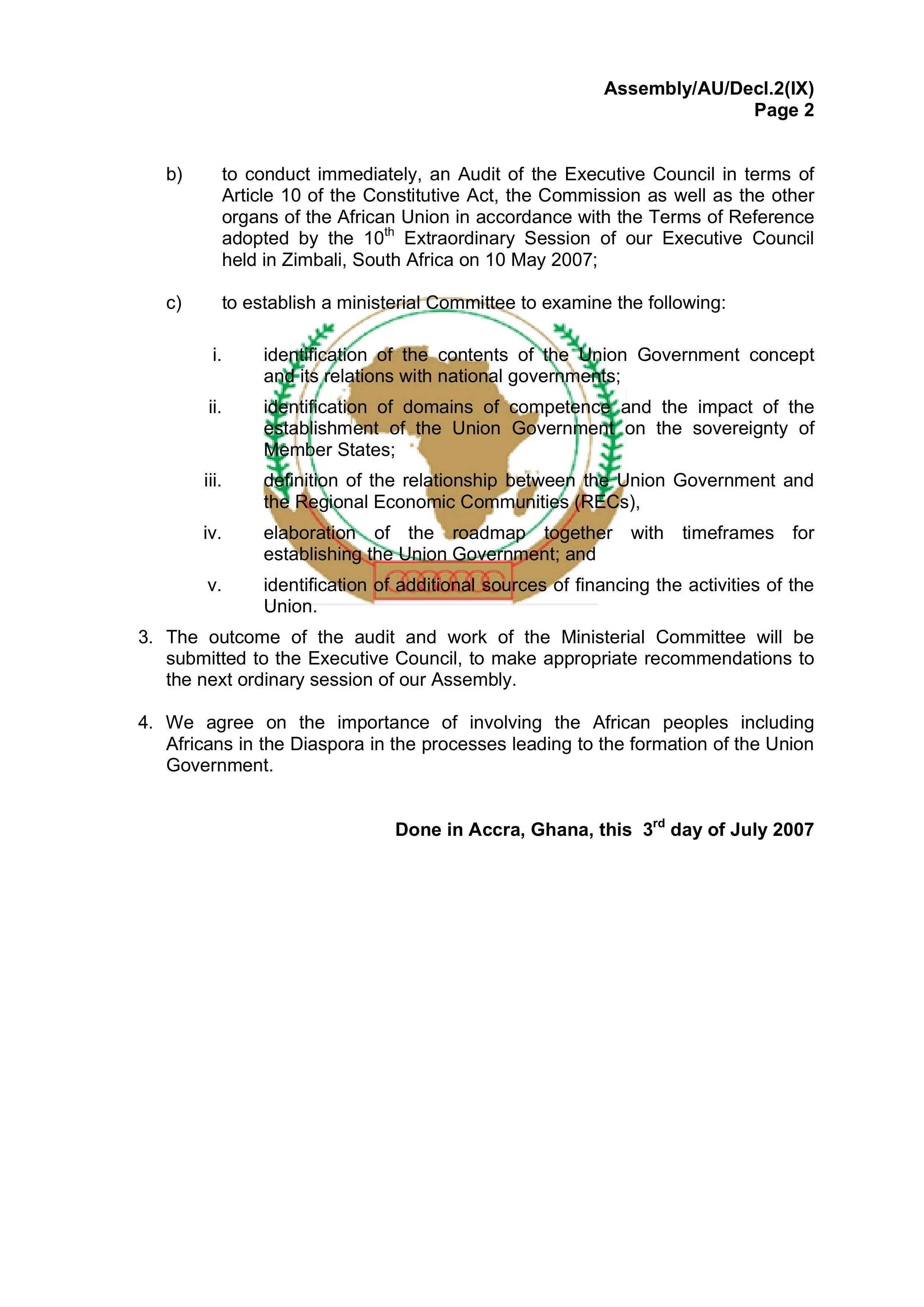
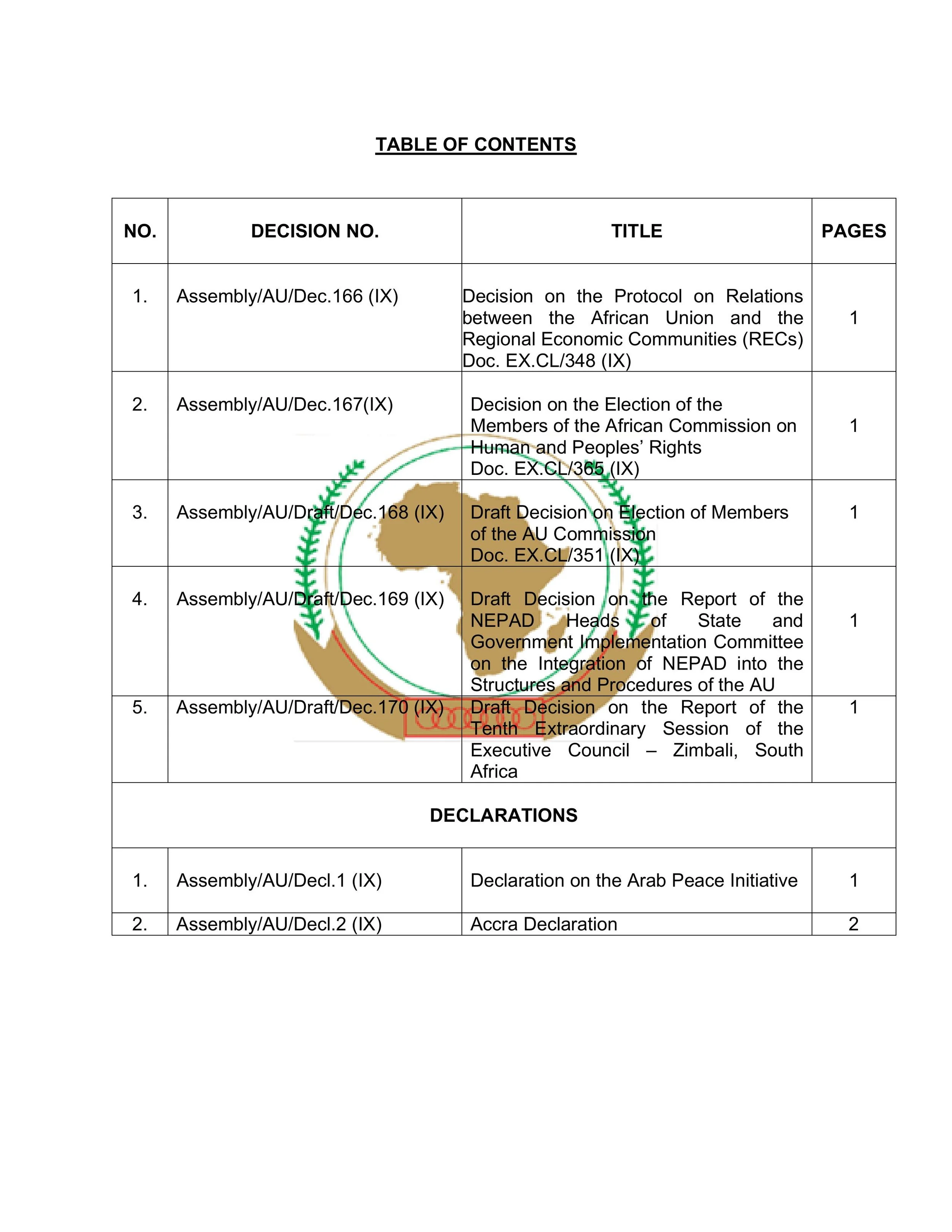
********************************************************************************************************
Briefing of Heads of Mission on African Union Summit
outcomes
16 Jul 2007
Briefing by Deputy Minister of Foreign Affairs Ms Sue van der Merwe to the Heads of Mission accredited to South Africa on the outcomes of the Ninth ordinary African Union Summit, Council for Scientific and Industrial Research Convention Centre
16 July 2007
Your Excellencies
Thank you for responding to our invitation to address you on the outcomes of
the ninth African Union (AU) Summit that was held in Ghana this year under the
theme: Grand debate on the union government.
African leaders chose this theme because of their unanimous desire for our
continent to move rapidly towards the improvement of the human condition
experienced by all our people informed by the belief that this can best be
achieved through unity.
This theme is a clear testimony of the progress and growth that the African
Union is making as the Premier Continental Organisation to realise the vision
of the rebirth of Africa.
It is also testimony of the commitment of our leaders to the goal of an
African continent that is prosperous, peaceful, democratic, non-racial,
non-sexist and united and which contributes to a world that is just and
equitable.
At my last briefing, we were very upbeat in reporting on the good progress
made with regards to the vision we have set for ourselves, of the idea that
Africans could come together as a united federation of nations and states.
These ideas were captured most notably in the words of Kwame Nkrumah when he
said, "We must endeavour to eradicate quickly the forces that have kept us
apart. The best means of doing so is to begin to create a larger and
all-embracing loyalty which will hold Africa together as a united people with
one government and one destiny."
We have long realised that our strength lies in our unity and it was thus
proper that on the occasion of the 50th anniversary of the independence of one
of the first African countries to achieve its freedom from colonialism, Ghana,
that the ninth ordinary session of the Assembly of Heads of State and
Government of the AU was held under the theme 'Grand Debate on the Union
Government', in Accra, Ghana from 1 to 3 July 2007.
The Summit was preceded as is custom, by the meeting of the Permanent
Representatives Council (PRC) on 25 to 26 June and that of the Executive
Council on 28 to 29 June respectively. The PRC considered administrative and
financial matters, legal and institutional matters, political, economic, social
and cultural matters while the Executive Council adopted a number of decisions
and considered a number of reports including those of the Chairperson of the AU
Commission and that of the PRC.
For its part, the Assembly of Heads of State and Government met from 1 to 3
July and devoted its time to the Grand debate on the union government with a
view to providing a clear vision for the future of the AU and the framework for
continental integration. I will deal with these issues in some depth and with
the assistance of officials from the department provide further elaboration
during the questions and answer session.
The grand debate on the union government
Your Excellencies, I think we can all agree that the notion of a United
States of Africa has evoked within us a keen sense of inquisitiveness. By its
very nature it has stimulated a sense of wonder about its nature and for some
even a wait and see attitude as to what we as Africans hope to achieve.
What the Assembly of Heads of State and Government sought to realise during
the most recent summit in Accra, was to give concrete expression to this vision
by adopting the outcomes of the 10th extraordinary session of the Executive
Council and the brainstorming session of foreign affairs ministers on the union
government that took place in Durban, South Africa, from 8 to 10 May 2007.
At the Summit in Ghana, the Assembly adopted the Accra Declaration on the
union government, which reiterated the conviction of the United States of
Africa, with a union government as the ultimate objective of the African Union.
The Heads of State and government reiterated the need for common responses to
the major challenges of globalisation facing the continent, as well as the need
to boost regional integration processes through effective continental
mechanism.
Through the Declaration, the Assembly agreed to accelerate the economic and
political integration of the continent, including the formation of a union
government for Africa, with the ultimate objective of creating the United
States for Africa.
With regards to the specific modalities for attaining this objective, the
Assembly agreed on the following steps:
1. To rationalise and strengthen the Regional Economic Communities and
harmonise their activities, with a view to the creation of an African Common
Market, within a reviewed shorter timeframe;
2. To conduct immediately, an audit of the Executive Council, the Commission
and other organs of the African Union; based on the terms of reference adopted
at the Zimbali Brainstorming Session of AU foreign ministers;
3. To establish a Ministerial Committee charged with the following
functions:
* Identification of the contents of the Union Government concept and its
relations with national governments
* Identification of domains of competence and the impact of the establishment
of the union government on the sovereignty of Member States
* Definition of the relationship between the Union Government and the Regional
Economic Communities (RECs)
* Elaboration of the roadmap, together with timeframes, for establishing the
Union Government and
* Identification of additional sources of financing the activities of the
African Union.
Relationship between the Union Government and the Regional Economic
communities
You will recall, Your Excellencies, that during last year's briefing we
mentioned the important role assigned to the Regional Economic Communities
(RECs) with regards to supporting the agenda of the AU towards African Unity.
Towards this end, the AU called for the rationalisation of the RECs, which was
the focus of its seventh summit in July last year. Following on this, the Accra
Assembly adopted the protocol on relations between the African Union and the
Regional Economic communities. This protocol was originally finalised in 2005
and is intended to facilitate the harmonisation of policies and ensure
compliance with the Abuja Treaty and Lagos Plan of Action time frames.
The Assembly therefore affirmed the integration process as envisaged in the
Abuja Treaty, based on Regional Economic communities, working towards common
African market within shorter timeframes.
A decision was also taken with regards to the report on the status of
Organisation of African Unity/African Union (OAU/AU) treaties. The Commission
was requested to implement its previous decision of reviewing OAU/AU treaties
that have not entered into force. Member States were also requested to submit
to the Commission their ratification/accession procedures.
Finally, the Commission was requested to resolve inconsistencies in
linguistic texts and to appoint an Arabic speaking legal expert to assist.
The outcome of the audit and the work of the Ministerial Committee will be
submitted to the Executive Council, to make appropriate recommendations to the
next ordinary session of the Assembly.
Already, within this month, ministers responsible for integration will meet
in Kigali, Rwanda to further guide and give impetus to the need to rationalise
and harmonise Regional Economic Integration and to ensure that the building
blocks are strengthened to enable us to achieve the African common market in
shorter timeframes.
The Assembly also agreed on the importance of involving the African peoples,
including Africans in the Diaspora, in the process leading to the formation of
the Union Government.
Regarding the Diaspora, you will recall that the African Union took a
decision in January 2006 that South Africa should host the global
Africa-African Diaspora Summit, scheduled for 2008. The proposed theme of this
Summit is: "Towards the realisation of a United and Integrated Africa and its
Diaspora" and the aim is to produce a shared vision of sustainable development
for both the African continent and the Diaspora.
The Preparatory meetings have already started in South Africa, London,
Brazil and New York. Further meetings will take place in the Bahamas, in Paris
and Addis Ababa in Ethiopia.
The Ministerial Conference will take place in November this year in Gauteng
followed by a Global Summit of the African Diaspora Heads of State and
Government in 2008. There will be a civil society component as well.
The effort by our country on behalf of the United Nation is a part of our
own contribution to rekindle the flames of solidarity, inspired by the
establishment of the first black republic in Haiti. As part of our ongoing
engagements with CARICOM, the AU and the United Nation, we will continue to
monitor political developments in Haiti.
South Africa's African Peer Review Mechanism (APRM) Report
Your Excellencies, allow me to remind this forum that at a meeting of the
APR Panel and the New Partnership for Africa's Development (Nepad) Steering
Committee on 29 June 2007 in Accra, concern was raised regarding the slow pace
of the peer review process. This was attributed to the unfulfilled funding
promises of some of the Group of Eight (G8) countries. To this end South Africa
and Nigeria emphasised the importance of sourcing funding from donor partners
but reiterated the imperative of upholding the Heads of State and Government
Implementation Committee decision to continue to provide the core funding for
the African Peer Review Process.
Of the twenty countries that have acceded to the APRM, thirteen have been
engaged in the peer review process. Of these, five countries have completed the
process.
The Panel agreed that a brainstorming session to reflect on the lessons
learnt is necessary and a decision was taken to have such a session in Algiers
towards the end of October 2007 to coincide with the ninth African Peer Forum
in Algiers.
As you are aware, South Africa's Peer Review Report was discussed during the
Summit and amongst others, the following recommendations were made:
* that South Africa should give greater attention to accelerating the pace
of land reform and should step up the fight against racism and crime; and
* that there is a need to strengthen the integrated and holistic approach to
combating HIV and AIDS, Tuberculosis and malaria plus other communicable
diseases.
South Africa has noted the concerns raised in the report and will endeavour
to address the recommendations made by the African Peer Review Panel through
the Programme of Action containing actions to deal with challenges
identified.
As President Mbeki noted on the outcomes of our report, "we must feel
inspired that, among other things in its report on South Africa, the APR Panel
identified 18 best practices in our country, which it recommended should be
emulated by other African countries as we, together, strive to improve overall
governance and accelerate our advance towards meeting the goal of a better life
for the masses of the peoples of our continent."
Infrastructure in support of trade and development
Last year we also highlighted attention that the Summit gave to the
importance of infrastructure in the support of trade and development. To this
end the Pan-African Infrastructure Development Fund was established.
The vision for the Fund is to create a financing platform for infrastructure
development that will accelerate Africa's growth. The Fund estimates that over
the next ten years at least US$150 billion of infrastructure investment
opportunities are expected to be created due to infrastructure demands in
energy, water and sanitation, transport and communication technology.
The Fund represents investment opportunities to African States and private
investors on the continent and is structured to offer:
* a range of investment instruments to offer opportunities for African
pension fund portfolios to invest on the continent;
* competitive instruments based on public-private infrastructure investments to
increase returns;
* flexible long-term investment horizons;
* the mitigation of risk at key levels; and
* an opportunity to participate in an initiative for Africa's post-colonial
reconstruction that will help to put in place the drivers for Africa's future
growth.
Again, the important role of Regional Economic Communities was highlighted
in spurring trade and development ahead.
During the most recent Summit, the Heads of State and Government noted the
Report on assessing the progress towards the attainment of the Millennium
Development Goals (MDGs). They called upon the AU Commission, in collaboration
with the United Nations Economic Commission for Africa, the African Development
Bank and the Regional Economic Communities to continue monitoring the
implementation of the MDGs and submit a progress report to Assembly at least
once a year.
The Assembly also mandated the AU Commission and the African Development
Bank to strengthen the capacity of the Regional Economic Communities, national
statistics bodies as well as other organisations in the development of
statistics for Africa. A process on African statistics harmonisation has
already been initiated.
Intra-continental travel is an important element for trade and integration.
The Summit endorsed the resolution entrusting the functions of the Executing
Agency of the Yamoussoukro Decision to the African Civil Aviation Commission.
It also endorsed the Addis Ababa Declaration on Civil Aviation as well as the
2007-2010 Air Transport Plan of Action.
The Summit also endorsed the Abuja Declaration and Plan of Action on
Maritime Transport. All stakeholders were requested to ensure the
implementation of the Action Plan for the development of the maritime
transport. The Summit recognises the important role that international partners
can play in supporting this Plan. Towards this end, international partners were
requested to support the implementation of this Plan. The Summit requested that
the AU Commission submit periodic progress reports on this issue to the
Executive Council.
Sustainable development
Your Excellencies,
Again last year, we emphasised the progress that we are making as a
continent with regards to human development. Development in all its forms
should ultimately translate into the improvement of the lives of our people.
The AU is very much alive to this priority and continues to give prominence in
its discussions to these issues.
During the Summit, the Report of the eighth and ninth sessions of the
African Committee of experts on the rights and welfare of the child was noted.
Concern was expressed over the deteriorating situation of children on the
Continent and Member States, who have not yet done so, were urged to ratify the
African Charter on Rights and Welfare of the Child.
The Executive Committee was requested to play an active role in convening
the Second Pan-African Forum on Children to be held in September 2007. The
outcomes of this Forum will be submitted to the UN General Assembly in December
2007 as Africa's position.
The Summit also endorsed the Africa Health Strategy as a framework in which
Member States will address the health challenges facing the Continent. It
further endorsed the Pharmaceutical Manufacturing Plan for Africa, the Plan of
Action on Violence Prevention in Africa and the Monitoring and Reporting
Mechanism for the Outcomes of the May 2006 Abuja Special Summit on HIV and
AIDS, TB and Malaria. The AU Commission was requested to submit a status report
on implementation to the Executive Council.
I am glad to inform you that the Africa Health Strategy was welcomed by the
World Health Organisation.
A decision was also taken on the management of Africa's natural resources. The
Report of the ECA and the African Development Bank on the "2007 Big Table" on
the theme of Africa's natural resources was noted and the AU affirmed its
commitment to Africa's ownership of its natural resources and to the efficient
management of these resources for the achievement of sustainable development
with a strong emphasis on local value addition.
The AU Commission was requested, in collaboration with ECA and the African
Development Bank, to organise a meeting of the AU Ministers Responsible for
Natural Resources to reflect on major issues pertaining to the exploitation and
management of Africa's natural resources as a catalyst for development, and to
submit a report to the next ordinary session of the Executive Council in
2008.
World Trade Negotiations (WTO) negotiations
Trade remains one of the key milestones in facilitating the continent's
development. Towards this end, the opening up of markets, particularly those of
the developed countries for products coming from the continent remains a
priority.
Africa-European Union Dialogue
As I indicated earlier on, we do not do these things naively but do them
conscious of our own current realities. As a continent functioning within the
current realities of globalisation, partnership with the international
community, particularly the European Union, remains important. I am glad to
report that Africa-European Union discussions towards the next Africa-EU Summit
are progressing well.
At the Summit, the Heads of State and Government adopted an Outline of the
Joint Africa-EU Strategy as the basis for a fully-fledged Joint Strategy and
Action Plan for the Lisbon Summit. It also decided that a Joint Ministerial
Preparatory Meeting would be held in Egypt in November this year. The AU
Commission was requested to ensure that in preparation for the Africa-EU
Summit, Africa's development needs are taken into account, particularly in the
areas of agriculture and food security.
The Summit also noted the Report on the Commission on the Status of
Negotiations of Economic Partnership Agreements (EPAs) with the European Union
as well as the decision of the 85th session of the ACP Council of Ministers on
EPAs held in Brussels, Belgium from 21 to 24 May 2007. Deep concern was
expressed at the slow progress in the EPAs Negotiations on the development
aspects and the European Commission was called upon to reflect in their
negotiating positions the political commitment of EU member States in making
EPAs instruments of development for ACP countries.
The EU was requested to consider putting in place transitional measures to
safeguard the continued flow of African exports to the EU market beyond
December 2007, given the low likelihood of satisfactorily addressing all
outstanding EPA issues as well as the impossibility of completing the EPA
ratification by the end of 2007.
The Commission and the African Negotiating Regional Groups were requested to
prepare and submit for the consideration of the AU Ministers of Trade a
comprehensive report on the progress, problems and way forward in trade and
economic co-operation with the EU. It is within this context that it becomes
increasingly important for African Nations States to maintain unity and forge
common positions in the interest of the continent.
Afro-Arab co-operation
Beyond the Africa-EU partnership, the Summit also noted the Report of the
Chairperson of the Commission and commended the Commission and the General
Secretariat of the Arab League for the initiative to transform the Afro-Arab
Cultural Institute in Bamako, Mali, to an Afro-Arab Institute for Culture and
Strategic Studies. The Summit endorsed the conclusion of the general agreement
on co-operation between the African Union and the League of Arab States signed
in 2007 and called upon the parties to take all necessary measures to ensure
successful implementation of the provisions of the Agreement.
Peace, security and post conflict reconstruction
The Summit considered and took decisions on the conflict situations in the
Middle East and Africa. Regarding the situation in the Middle East and
Palestine the Summit reiterated its support to, and solidarity with, the
Palestinians in their struggle for self determination, return to their land and
the establishment of an independent state with Jerusalem as its capital, in
accordance with international principles of international law, UN Resolution
194 and other pertinent resolutions of the OAU/AU and all UN resolutions.
The Summit also reaffirmed its support for a peaceful resolution to the
Israeli-Palestinian conflict and for the Arab Peace initiative to end the
Israeli occupation of Palestinian territories. The UN was urged to take
concrete measures to protect the people of Palestine by providing international
protection forces to the occupied Palestinian territories and to compel Israel
to allow the UN fact-finding Mission to discharge its duties. The International
Community and Quartet Committee were urged to spare no efforts in invigorating
the negotiations to salvage the peace process, and AU support was expressed for
the organisation of an International Peace Conference on the Middle East
conflict.
I reiterate the statement made by my colleague Deputy Minister Pahad that
the South African government does not believe that you can have reconstruction
and development without peace and security and that will not be possible until
the situation in Israel and Palestine is solved on the basis of a two-state
solution.
Regarding the establishment of the Palestinian Government of National Unity,
grave concern was expressed over the deteriorating situation between the two
main components, the Fatah and the Hamas, resulting in the dissolution of the
government. The International Community was called upon to lift the siege,
boycott and blockade against the Government so as to ease the difficult living
conditions of Palestinian people which stir up tension and violence. Grave
concern was also expressed regarding the tension and violence in Lebanon and
the Council called upon the Lebanese parties to resolve their differences
through negotiations.
On Darfur
The Summit welcomed the outcomes of the United Nations-African Union
Technical Consultation with the Government of Sudan and the subsequent decision
of the Peace and Security Council on the Hybrid Operation in Darfur and the
renewal of the AMIS mandate. It expressed satisfaction with the efforts of the
Special Envoys of the African Union and United Nations, Messrs Salim Ahmed
Salim and Jan Eliasson respectively, to re-energise the Darfur Peace
Process.
On Somalia:
On the issue of Somalia, the Summit appealed to Member States and partners
to provide the requisite support for the full deployment and sustenance of
AMISON. IGAD, the League of Arab States, the United Nations and other
stakeholders were encouraged to support the early convening of a national
reconciliation congress in Somalia.
On Comoros
The Summit welcomed the decisions adopted by the Peace and Security Council
on 9 May and 9 June, as well as the Communiqué adopted by the countries of the
region at the meeting held in Cape Town. It encouraged the countries of the
region to intensify their efforts to enable the Peace and Security Council to
meet as soon as possible to take the required decisions. The Summit supported
the initiative by South Africa to host a meeting.
South Africa is still involved with the Comoros in their effort to consolidate
their democracy and deal with post-conflict and development challenges.
On policy frameworks on peace and security
The Summit noted AU Commission efforts to operationalise the continental
peace and security architecture, including the Continental Early Warning
System, the Panel of the Wise and the African Standby Force and requested it to
intensify efforts. The AU Peace and Security Council and the United Nations
Security Council were encouraged to strengthen their co-operation.
Related to the matter of conflict and the consequences thereof, the Summit
also took a decision with regard to dealing with the challenge of refugees,
returnees and displaced persons in Africa. It noted the Report on Refugees,
Returnees and Displaced Persons and called on the international community to
increase its assistance to victims. It also called on the AU Commission to
reactivate the Committee on Assistance and Protection to Refugees, Returnees
and Internally Displaced Persons, to finalise its terms of reference and to
submit it to the Legal Counsel for validation and approval at the next session
of the Executive Council.
South Africa believes that there is an urgent need for the AU and its Member
States to take greater ownership of this issue and to develop a comprehensive
strategy, with support from partners, in order to ameliorate this
situation.
Free movement of people and border control
The free movement of people within the continent is one of the building
blocks of integration and eventually Union Government. While this is still a
process in the making, the recent Summit noted the Report on this matter as
well as the symbolic launching of the African Union Diplomatic and Service
Passports. It underscored the need to de-link the issue of the African Union
Diplomatic Passport from that of Free Movement in Africa. The Summit further
decided to convene a forum, bringing together African officials at national,
regional and continental levels and the PRC to hold consultations and making
recommendations on issues of common interest that would facilitate free
movement in Africa.
A decision was also taken regarding the Conference of African Ministers in
Charge of Border Issues held in Addis Ababa on 7 June 2007. The Summit took
note of the Report of the Conference and endorsed the Declaration on the
African Union Border Programme and its implementation modalities as adopted by
the Ministerial Conference. The AU Commission and Member States were then
requested to take appropriate measures to implement the Declaration and to
submit regular report thereon to the policy organs of the Union.
Human rights
The respect for human rights remains a fundamental pillar of our approach to
the Consolidation of the African Agenda. It therefore remains critical for us
as Africans to jointly commit ourselves as governments and civil society to
entrench the protection and promotion of a culture of human rights for all our
peoples.
The AU Summit adopted and authorised the publication of the 22nd Activity
Report of the African Commission on Human and Peoples Rights in Accordance with
Article 59 of the African Charter on Human and Peoples Rights.
Member States, who had not yet done so, were also urged to present their
State Party Reports to the African Commission on Human and Peoples Rights in
accordance with Article 62 of the Charter. Also, Member States who had not yet
done so were requested to take urgent steps to ratify Protocols to the Charter
on the establishment of an African Court on Human and Peoples Rights.
I am pleased to report that five new members were appointed to the
Commission and of these, four are female. This reaffirms the AU's commitment
for 50/50 gender representation within its structures.
Good governance, finance and administration
The AU continues to grapple with issues of good governance within its own
structures and institutions as well as in its Member States. The Summit
expressed concern at some of the findings of the external Auditors and endorsed
recommendations of the Permanent Representative Committee as contained in the
report. A decision was also taken to establish a Committee of the Executive
Council charged with the formulation of proposals on the implementation of the
recommendations.
The recommendations of the Executive Council were adopted in their entirety
including the recommendation to extend the term of office of the current
Executive team of the AU Commission as well as recommendations of the Pan
African Parliament and the Dakar Conference.
Furthermore, increased emphasis on performance, as proposed in the decision
should be encouraged.
2010
You're Excellencies, as you are aware, we are well on track with regards to
our preparations for 2010 as evidence by regular inspection visits by
Federation International Football Association (Fifa) and the positive reports
that have come out of these visits.
We are encouraged by the decision of the AU to encourage Member States to
implement activities programmed to lead up to 2010 and to popularise the
international year of football and the Fifa World Cup Legacy Programme.
I would like to conclude by reiterating our commitment to the vision of an
African continent that is prosperous, peaceful, democratic, non-racial,
non-sexist and united and which contributes to a world that is just and
equitable.
I thank you.
Issued by: Department of Foreign Affairs
16 July 2006
Source: Department of Foreign Affairs (http://www.dfa.gov.za)
*********************************************************************************************
Prior to the 9th Ordinary Session of the AU Assembly of Heads of State and Government, held in Accra, Ghana, from 1 to 3 July 2007, the DCP commissioned and undertook thematic studies on issues pertaining to the ‘Grand Debate on Union Government’. Eight policy-oriented research papers were produced to influence policy debates and consultations on a Union Government for Africa. On 27 July 2007 the DCP launched these papers at a seminar entitled ‘Towards the United States of Africa?’ held at the Alisa Hotel in Accra, Ghana. At the conclusion of the 9th Ordinary Session the AU Assembly issued the Accra Declaration. The ISS DCP subsequently commissioned additional papers to assess the issues outlined by the Accra Declaration. These papers were presented at a two-day seminar entitled ‘Towards a Union Government of Africa: Challenges and opportunities’, held at the Hilton Hotel in Addis Ababa on 11 and 12 October 2007. Following the deliberations at the seminar, the authors edited their papers, which have now been compiled into this monograph.






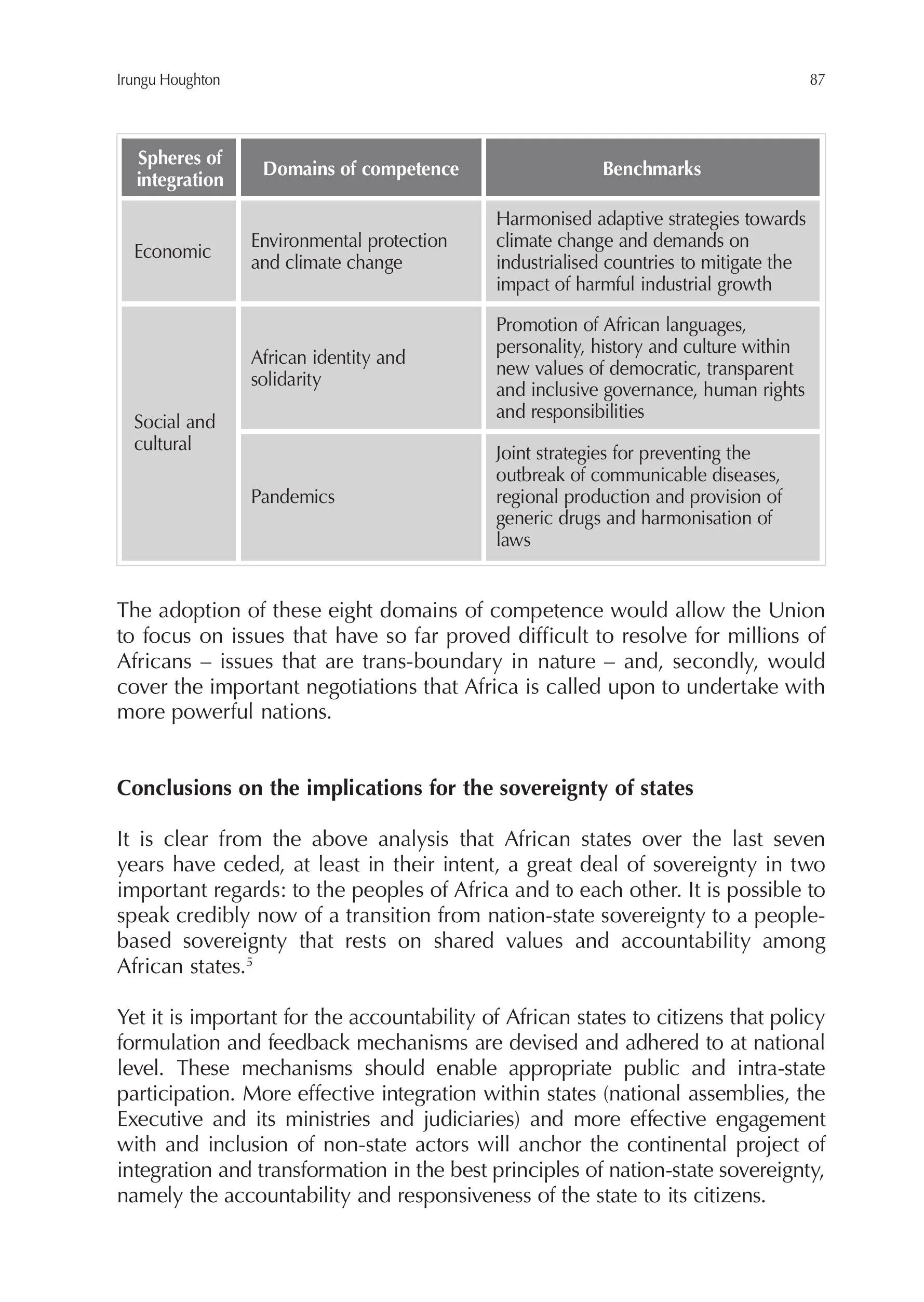


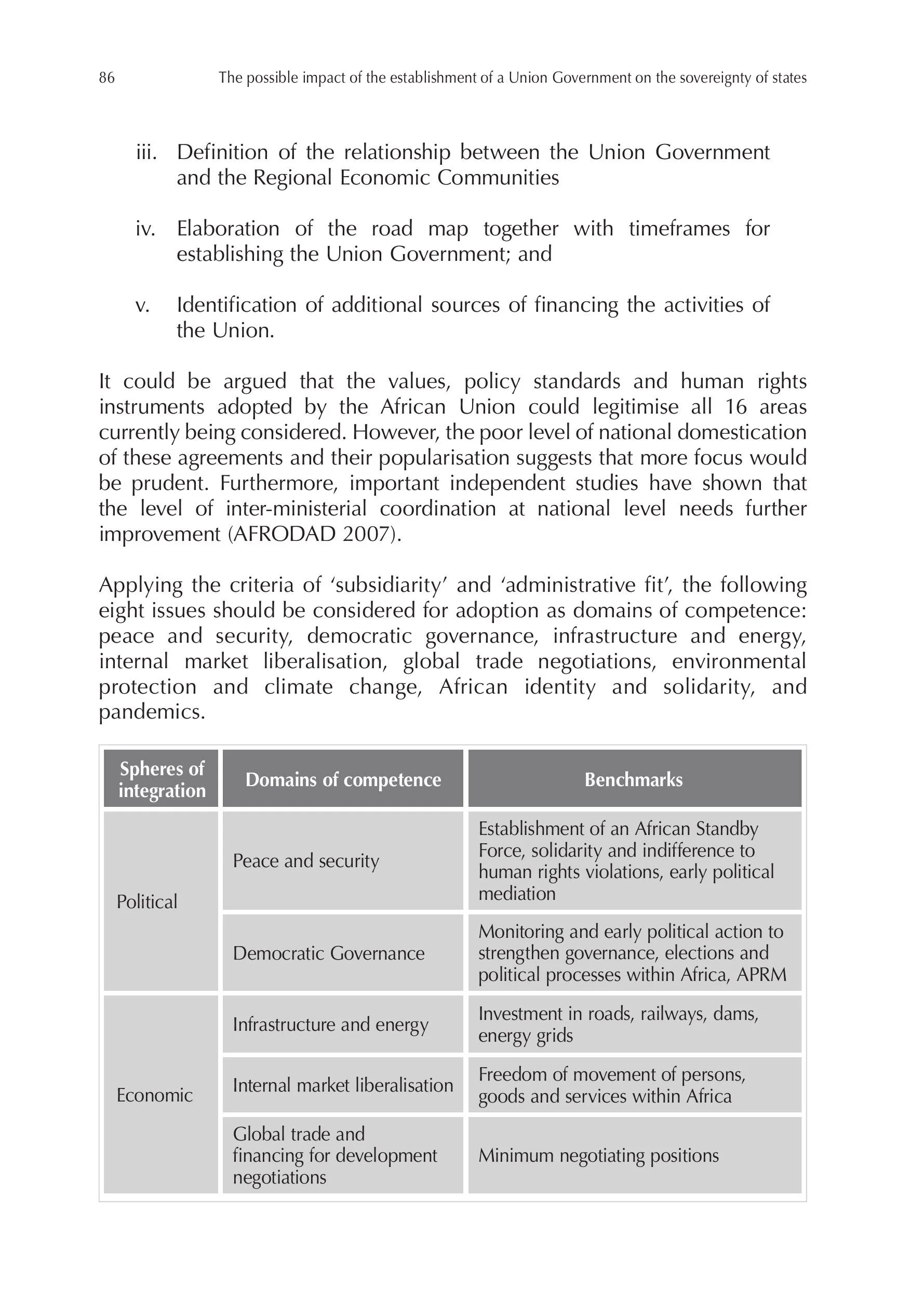










What form of union?
Joomaay Ndongo Faye, November 24, 2014 East Windsor, NJ
In his acceptance speech as the First President of the Organization of African Unity (OAU) Emperor Haile Selassie said; “but while we agree that the ultimate destiny of this continent lies in political union, we must at the same time recognize that the obstacles to be overcome in its achievement are at once numerous and formidable. Africa’s peoples did not emerge into liberty in uniform conditions. Africans maintain different political systems; our economies are diverse; our social orders are rooted in differing cultures and traditions. Furthermore, no clear consensus exists on the ‘how’ and the ‘what’ of this union. Is it to be, in form, federal, con-federal, or unitary? Is the sovereignty of individual states to be reduced, and if so, by how much, and in what areas? On these and other questions there is no agreement, and if we wait for agreed answers, generations hence matters will be little advanced, while the debate still rages.”
Since many sincere believers in the need for the political unification of the African Sates are still skeptical on the feasibility and/or viability of such union, the concerns raised in this portion of the Emperor’s speech deserve the attention of those who are today interested in campaigning for a political union between the African States that will be; “of, for and by the people” of African descent. The focus in this piece is on the passage; “Is it to be, in form, federal, con-federal, or unitary? Is the sovereignty of individual states to be reduced, and if so, by how much, and in what areas?” Our goal is to prove that federalism is the form of union that can best serve the interests of the Africans while infringing as little as possible on their diversities.
The main point the Negus seems to be making in this portion of his speech is: yes African Unity is what everyone wants but because of the disparities- cultural, economic and political-, between the African States, how can this unification be achieved and which of the three forms of union mentioned by his Highness can best suit the Africans? The Negus seems to be also concerned about his future as Emperor if the central government of the union takes away from him the guardianship of key elements of his empire’s sovereignty. It is not far fetch to believe that he voiced the concern of many of his peers who voted against the Nkrumah plan. It is also fair to assume that even if it is not clearly stated, the reluctance of most of those among the ruling class in Africa who have voiced their opposition to the political unification of African States has roots in their uncertainty in their future role in the United African States.
By Unitary Union I assume that the Negus is referring to a form of Union in which all the sovereignty of the present States will be surrendered to the Central Government. In Wikipedia a unitary state is defined as; “a state governed as one single power in which the central government is ultimately supreme and any administrative divisions (sub-national units) exercise only powers that their central government chooses to delegate. The majority of states in the world have a unitary system of government. In a unitary state, sub-national units are created and abolished, and their powers may be broadened and narrowed, by the central government. Although political power in unitary states may be delegated through devolution to local by statute, the central government remains supreme; it may abrogate the acts of devolved governments or curtail their powers”.
For anyone who has a basic understanding of the complexity of power sharing in a democratic republic, a Unitarian State can not enjoy the necessary level of legitimacy which will allow it to efficiently rule an entity that will be as vast and as culturally diverse as the United African States. The most serious issue that this form of Union poses is that cultural diversity, one of the riches of the African continent, will be in great jeopardy. This form of union will also be a threat to the respect of minority rights, an important ingredient for the viability of vast democratic political entities. Another serious problem for a Unitarian union is the differences in the levels of political development of the various African states. A unitary system, where member states are required to adopt the same constitution, therefore the same form of government, will seriously infringe on the States’ Rights. This infringement on the States Rights will certainly be a serious impediment to the acceptance by many African States of joining the union. Throughout history, the only times that a unitary system covering vast areas have been sustainable was when central power mostly used force to keep peace. A revisit of the Ghana and Mali empires shows that these empires were not unitary systems. Yes, the Emperors were at the top of the political pyramid but they did not infringe in the way the Kings, under their control, run their states. Contrary to Europe where English and French were imposed as the languages that everyone must speak, in Mali and Ghana people kept their languages, their cultures and even their political systems. In a nutshell the Unitary System is foreign to most of the African cultures. The confusion between Pan Africanism and African Federalism has caused many to believe that Unity meant Uniformity. No plan to unite the African people shall tamper with the continent’s cultural diversity.
The con-federal form of Union is an agreement codified in a Treaty, like the Maastricht Treaty or the African Union Charter, which States sign when they accept to consult in some of their domestic and foreign policies. In most cases it is strongly suggested, not mandatory, for the member states of a con-federal union to implement the policies of the union. The EURO for example is not the currency of all the EU’s members. The American colonies had adopted this form of Union between 1776 and 1789. It is the form that countries in Europe have adopted under the European Union. The OAU and the African Union are embryonic con-federal systems. The major difference between the European Union and the African Union is that the first is a grouping of countries which in the majority of the cases are viable and enjoy a positive sovereignty. This gives the European Union a lot more muscles than the African Union which is made up of non-viable entities with negative sovereignties. The American confederacy (not to be confused with the secessionist South which called itself Confederacy because they wanted to go back to the pre 1789 con-federal system) was as dysfunctional and toothless as the OUA has been and the AU is today, the same cause producing the same effect. Save New York, Virginia and maybe Massachusetts, the thirteen newly independent American States were non-viable entities with negative sovereignty. The British Empire recognized their rights to political independence but continued to impose many of its policies on them. This is very similar to what is happening today to African countries. Because the African Union is a con-federal union of negative sovereignties many of its members are still at the mercy of their former colonizers. The colonizers recognized their political independence but continue to infringe into their internal affairs and in some cases control and/or manage significant portions of their sovereignties. The failure of the OUA to implement the Lagos Plan of Action (LPA) and the subsequent Abuja Treaty that were both sound macro-economic policies clearly demonstrate the limits of the con-federal union’s power. The fact that the non-implementation of the LPA was due to its Conflicts with the International Monetary Fund’s Structural Adjustment Program speaks volumes and demonstrate that a con-federal union of negative sovereignties remains a negative sovereignty. The inability of the AU to implement the NEPAD’s is another proof that a con-federal union cannot carry the economic policies that lead to the development of the African countries. The African Union’s reliance of the G8 to provide the funds that would jumpstart the implementation of the NEPAD is a clear testimony to the impotence of this con-federal union of the African States. No objective minded economist will disagree with the fact that a federal government of the United African States can easily acquire those funds through taxation or borrowing at a rate that is a fraction of what it cost African states today to sell bonds.
A federal Union is a political, economic and military alliance between politically independent States. The main driving factor for such union is the awareness, by the member states, of their inability to efficiently manage all the portions of their sovereignty. In the Federal Union, three Governments Share the management of Sovereignty: The Local Government (districts, counties, departments, Regions etc), the State Government and the Federal Government. The Distribution of Power in the Federal Union is Centripetal which means that it goes from Local=to=>State=to=>Federal. The Local Government hands to the State Government the Portion of the People's Sovereignty it cannot manage, the State Government surrender to the Federal Government the Portions of its Resident's Sovereignty it is unable administer efficiently. There is also what they call Concurrent Power (Taxation Powers for example). All the Powers (portions of Sovereignty) that are not CLEARLY entrusted to the Federal Government remain in the HANDS of Local and State Government. There are Cases that are called "Necessary and Proper Cases". Meaning that sometimes to protect the Federal Rights of its Citizens or Enhance their Opportunities to improve their living conditions, the Federal Government will be obliged to use Powers that are not Specifically Surrendered by Local or State Government, but these Situations are very rare.
In a federal union the search for more opportunities, security and liberty for the individuals and the groups is what serves as a cement. However, the conflict between wanting to share a somewhat common destiny and the fierce desire to preserve their cultural identity is a constant threat to the survival of such Union and the Federal Government has to be always mindful of this fact. Between 1789 and 1865 the North and South of the United States of America battle over this issue. In fact, this cultural battle is to this day a clear delineation between the Red, Purple and Bleu States of the Union. It was only after the bloodiest war in their history that the Southerners were forced to accept that their way of life is in some aspects in blatant contradiction with the founding principal of the Union, the inalienability of the individual’s; “right for life, liberty and the pursuit of happiness”. Yes African people, like all the other people around the world, want more opportunities, prosperity, security and liberty! However they are not ready to surrender their identities for these benefits. This is perfectly legitimate. The people’s cultural identities are sacrosanct and only they should have the right to amend them as long they do not infringe on the Federal Rights of the citizens of the Union.
One other reason why a Federal Union is what Africans need is that in this form of union is governed by a Federal Government to which the member States voluntarily entrust specific portions of their sovereignty. However the Federal government is directly accountable to the citizens of the Union who retain the power to select its members. This is not the case with the con-federal arrangement. This federal government also has the duty o protect the basic federal rights of all the citizens and residents of the Union. But to keep the federal government from infringing on the rights of people within these states to live their lives as they see fit, issues that have to do with culture are kept away from the federal government’s reach. This form of Union is the one that I believe can best suit the African Countries. It is today obvious that there are specific portions of their sovereignty that they are unable to manage because of their size and/or social make up. These can be handed over to the federal government, directly answerable to the African People, to manage them. The fact of the matter is that most of the African States have handed these portions of their sovereignty to the States of their former colonizers who are only accountable to their citizens not those of the African countries. It is therefore clear that the African people, who will regain control of these portions of their sovereignty if they are handed over to a Federal government that will be accountable to them, have nothing to lose if African States unite politically. They have their dignity and full sovereignty to regain.
The federal form of union is the one that the former American colonies had adopted when they came to the realization that there are portions of their sovereignty that they cannot individually manage. Among those were foreign policy, diplomacy, security and peaceful dealings between the States when it comes to commerce and the management of their waterways. After they failed to find a way of dealing with the issues that brought tension between them at a meeting in Annapolis, Maryland, two of the attendees, Alexander Hamilton and James Madison agreed to jointly work on calling for a meeting in Philadelphia so that the Articles of confederacy can be reviewed and revised in order to, “build a more perfect union”. After thoroughly reviewing the articles of confederacy, they agree that only a Federal Compact can help them build a more perfect Union. History has proven them right. For more than fifty years Africans have been hoping for a form of union that can help them take full advantage of the natural resources of their continent. The call for the First African Federalist Congress is without a doubt a step in that direction.
Many people are concern with the possibility of uniting States at as disparate political and economic stages in their development as the various African States are. Yes this will pose a problem for a Unitarian Form of Union. It would have also been a problem if the different states use different economic systems. But this is not the case. All African States, including those ruled by left leaning political parties, have capitalism in its various forms, as their mode of production. The major differences among them are political or cultural. This will not pose any problem to the viability of a Federal Form of Union. States that belong to a Federal Union can have different political Systems as long as the basic principles in which their constitutions are founded on do not violate the Federal Rights of the citizens of the Union. It is perfectly possible to have Republic and Kingdoms in such union. In the European Union Kingdoms and Republic work side by side, why not in a Union of the African States?
The beauty with Federalism for the Case of Africa is that it is very flexible and can allow Countries at Different levels of political and economic development to manage together, and in a much more efficient way, the portions of their sovereignties they can't do by themselves (Macro-economic policies, Monetary Policies, Diplomacy, Security etc.). In such union one can have Kingdoms and Republics existing side by Side as full members. However, the Catch is that the powers of some of the African Republics and Kingdoms to violate the basic human rights of individual and groups will be curtailed. They will have to abide by the FEDERAL CITIZENS BILL OF RIGHTS and these Rights cannot be violated by any of the Constitutions or Laws of the Member States. The Other reason why Federalism will work well with Africa is that it will keep our cultural diversity as intact as possible. Of Course, there are Elements of these Cultures that will violate the Federal Rights of the Citizens of the Union. These elements will be dealt with as citizens bring their cases one by one to the federal courts. The prevalence of Slavery in many of the Northern African countries and the discrimination against certain minorities in other African countries will certainly be easier targets if a Federalist Compact between the African States is secured.

PAN aFRICAN fEDERALIST MOVEMENT LOGO
A CALL FOR THE FIRST AFRICAN FEDERALIST CONGRESS
Africa can unite and must unite if we African federalists come together! The outcome of the Accra 2007 African Union Summit has made it clearer, even to the least perceptive monitors of the effort that is being deployed to unite Africa, that Sirte 1999 (a meeting hosted by Libyan President Muammar Gadaffi that helped pave the way for the current African Union and its outreach to the African Diaspora) did not create the momentum that many African Federalists were hoping for. Like the Addis Ababa 1963 compromise that gave birth to the Organization of African Unity (OAU), what appeared to be a middle of the ground agreement on July 12, 2000 in Lome, Togo, was indeed a defeat of the African federalists. It is today becoming more and more evident that we are headed towards another failure of the African Political leadership to put an end to the balkanization of our continent. The dream of a United States of Africa, which an overwhelming majority of the people of African descent has for decades longed to see materialize, is starting to look more like a utopia than a feasible plan to get Africa out of its actual quagmire.
We believe that the failures of the different plans that have been put forth to unite Africa trace their roots to the fact that the approaches that have been so far embraced by African Federalists were either wrong or incomplete. For that very reason they were unable to create the kind of environment that is vital to the birth of the Union of African States. All these approaches were deeply rooted in the sincere desire to see Africa become one politico-economic entity and for that reason they were worthy and significant but lacked the capacity to carry the implementation of the African Federalist Agenda to a level that is necessary to achieve the Unification of Africa. The need for the African federalists to find a new approach for the birth of a healthy political union of the African states is today self-evident.
What are the obstacles that have for several decades foiled the plans to unite Africa politically? How can these impediments be overcome? Why does the unification of Africa, from which more than a billion people will undoubtedly benefit, seem to be so difficult to achieve?
These are some of the questions that many Africans at home and abroad have been rightfully asking themselves as they lose faith in the capacity of the Organization of African Unity (OAU) and the African Union (AU) to transform our continent into one politico-economic entity. The search for realistic answers to these questions is the main reason for creating this meeting place for African Federalists.
Why do we believe that the right time is now?
In 1961 when Dr. Nkrumah said prophetically to his peers that the only way for us to make it was by forming “a strong political union”, many Africans had a hard time seeing and/or accepting the truth. Today, more than fifty years after the wave of independence has passed through the continent, the failed economies of those countries that once looked promising, the civil wars and pandemics that have claimed the lives of millions of Africans, the national debts that have become an unbearable burden for the majority of the African countries despite the insignificance of their amount and the threat posed today by globalization to many of the African subcultures stand as undeniable proofs to the righteousness of Nkrumah’s warning.
It is now “self-evident” to the overwhelming majority of people of African descent and to the friends of Africa that the only way out of despair is to follow Nkrumah’s advice and embrace the Continental Federalist option.
Now more than ever his call stands a much better chance to be heeded if the right approach for provoking the birth of the Union of African States is found and implemented. Now more than ever a generation of Africans has the real opportunity to unite Africa and leave to its descendants a legacy that will be a source of pride and bright prospect instead of being a laughing stock for the rest of the world.
- Do you believe that Nkrumah was right when he stated that; “Africa Must Unite”?
- Do you believe like Cheikh Anta Diop that only a federal state can develop Africa?
- Do you believe that the OAU and its child the AU have very little chance to unite Africa?
- Do you believe that the overwhelming majority of the African people want Africa to unite?
- Is Africa’s political and economic unity a cause worth giving your time and resources?
If your answer to any of those five questions is yes, consider yourself to be one of the people that we are trying to reach. Please start to mobilize around you for the convening of the First African Federalist Congress.
COMMEMORATION OF SIXTIETH ANNIVERSARY OF THE ALL AFRICAN PEOPLE’S CONFERENCE
(1958–2018)
AND THE PAN-AFRICAN FEDERALIST MOVEMENT PRE-CONGRESS
ACCRA, GHANA
From 8 – 13 December, 2018
On the occasion of the joint commemoration of the 60th Anniversary of the historic All African People’s Conference held in Accra from 8th to 13th December 1958 at the call of Dr. Osagyefo Kwame Nkrumah, the Kwame Nkrumah Pan African Centre (KNAC) and the Pan-African Federalist Movement (PAFM) convened a gathering in Accra, Ghana, on the same dates in 2018, at the Bank of Ghana’s auditorium at the University of Ghana, in Legon.
The choice of Ghana to host the commemoration of the 60th Anniversary of the All African People’s Conference and hold the Pre-First Pan African Federalist Congress is justified by the important role this country had played in the history of the Pan-Africanist movement. This event was enhanced by the presence of the President of the Republic of Ghana, His Excellency Mr. Nana Addo Dankwa Akufo-Addo who said in his speech:
“My generation can fulfill the dreams of our founding fathers and founding mothers: the total unification of the continent and the African peoples, including those of the Diaspora and Afro Descendants.”
This statement of the President of the Republic of Ghana is in complete harmony with the spirit and vision of the Pan-African Federalist Movement. During the pre-congress, the delegates who came fromvarious regions and countries on the continent of Africa and its Diaspora dealt with the following issues:
⦁ The call for the political unification of Africa,
⦁ The manifesto of the Pan-African Federalist Movement,
⦁ The terms of reference for the upcoming First Pan African Federalist Congress,
⦁ The charter of First Pan African Federalist Congress,
⦁ The Concept of the First Pan African Federalist Congress
⦁ The Strategy to Build the Pan African Federalist Movement and its campaign machine,
⦁ Fundraising and Management strategies for financing the Movement and its campaign,
⦁ The communication and mobilization strategy for the Movement and its Campaign,
⦁ Kwame Nkrumah’s book “Africa must unite” was presented
When this work was completed, the Movement decided on the official proclamation of its existence, three years after the call of the Provisional International Initiative Committee (CIIP) launched in Dakar in 2015. The new organizational charter of the Movement was adopted. Key members of the International Preparatory Committee of the First Pan African Federalist Congress were elected and the decision to hold the Congress in two to three years was made. Mali was chosen to host the headquarters of the PAFM.
The Pan-African Federalist Movement and the Kwame Nkrumah Pan African Centre jointly launch a solemn call to all African peoples, wherever they may be in the world, to join them in the active preparation of the Congress for the POLITICAL UNITY OF AFRICANS IN LESS THAN ONE GENERATION.
–Statement made at Accra on Thursday, December 13, 2018