TRANSCRIPT
Program: The Africa Forum: Running Africa
Station: IRIE FM
Host: Sister Kabu
Date: Sunday, September 20, 2026
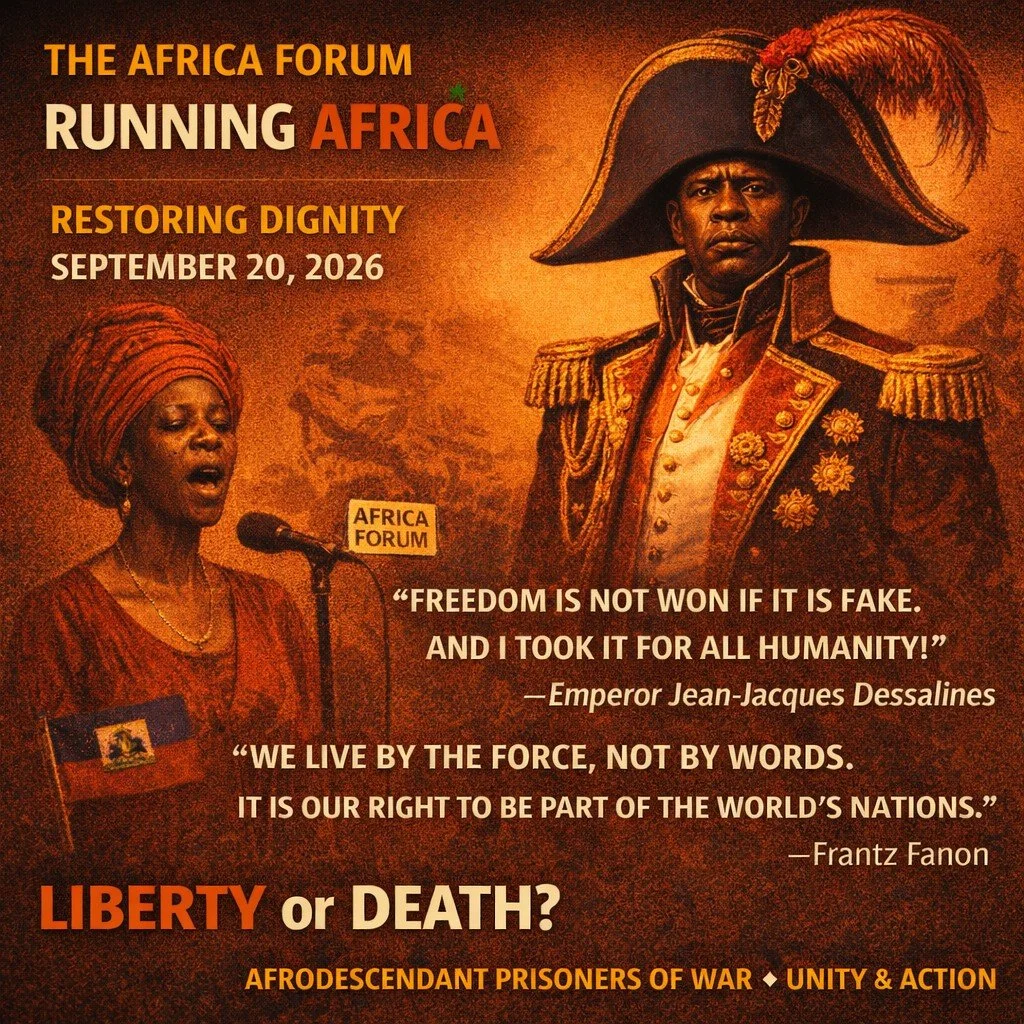
Segment: 268th birth anniversary of Emperor Jean-Jacques Dessalines
“Well, we're figuring things out. You're inside of the Africa Forum. This is Running Africa. Our vision is to reunite the African family for development. Our mission includes blazing new paths towards Africa's rendezvous with destiny — bearing witness, demanding change. I am the voice of a fearless…
"Freedom is never given. It is taken. And I took it for all humanity." — the words of Emperor Jean-Jacques Dessalines.
Today we remember and celebrate the 268th birth anniversary of Jean-Jacques Dessalines, born September 20, 1758. He took freedom for it and declared its independence on January 1, 1804 — 222 years ago.
"We have dared to be free. Let us dare to be so by ourselves and for ourselves." — the words of Jean-Jacques Dessalines.
Had we not betrayed Chief Tacky on April 7, 1760 — had we not betrayed our liberators — Jamaica would have celebrated 266 years of independence this year. Let me say the words of Jean-Jacques Dessalines again: "We have dared to be free. Let us dare to be so by ourselves and for ourselves."
In the vein of Assata Shakur — we could not save Baba Dessalines. We could not save Malcolm X. We could not save Walter Rodney. But we must save Mumia Abu-Jamal. We must save Ibrahim Traoré. We must save Assimi Goïta. We must save Abdourahamane Tchiani. In the words of Assata Shakur, our job — our responsibility as Africans at home and abroad — is to unite and support the Alliance of Sahel States for our collective liberation, embodying the spirit of our fearless and indomitable ancestor, Emperor Jean-Jacques Dessalines.
We salute Emperor Dessalines — the world's first Black emperor, who created the world's first Black republic. Dessalines, the Black revolutionary, declared freedom. When we talk about the birth of republicanism, Jean-Jacques Dessalines led that process alongside Toussaint Louverture, when Black people defeated colonial rule and created a revolution that shook the colonial world.
Today is the anniversary of the birth of this Black revolutionary, this emperor — the founder of an independent Haiti. Born enslaved, died emperor. The revolutionary story of Dessalines — his spirit lives on. As you go about your day, maybe you hadn't thought about how to honor Dessalines. There are some activities we'll tell you about. But wear black and red today — the colors of Jean-Jacques Dessalines, the colors of an independent Haiti. We're fully black and red this morning in the name of the warrior-emperor Jean-Jacques Dessalines.
He rose through slavery, but he was a revolutionary and a revolutionary thinker — a revolutionary warrior. He led that struggle and understood that, even after the win, liberty could still be a phantom. He understood who to trust and who not to trust, and never to trust those who oppressed and enslaved.
The revolution he led ultimately destroyed French colonial rule in Saint-Domingue and led to the declaration of Haitian independence on January 1, 1804. This morning we remember Jean-Jacques Dessalines because he reminds us what happens when enslaved Africans refuse to accept that slavery would define them.
Jean-Jacques Dessalines was not a man who would spend even a minute validating an enslaver as king of Haiti.
There's an interesting thing happening on the island of Jamaica: Jamaica has approached Britain — the monarchy, not the government — with legal questions. And so many of us who are anti-colonial, who claim the legacy of Dessalines and the Haitian Revolution, get trapped in their trickery. Because to present these questions to King Charles of England, you have to say, with your own lips, words that acknowledge him as king of England and king of Jamaica. It's a spell.
We rebuke that in the name of Jean-Jacques Dessalines. We rebuke that in the name of Toussaint Louverture. We rebuke that in the name of the Haitian Revolution. We rebuke that in the name of Cécile Fatiman.
If we dare to be free, we must dare to be so by ourselves and for ourselves. That is not to say reparations aren't due — reparations are due. But we must free ourselves first, and then, with the power and the might of Dessalines and all of the Haitian Revolution, demand reparations from the descendants of the enslavers. We must not let our tongues refer to them as king of Jamaica.
They are setting us back centuries — using intelligent, African-centered, Pan-African people, warriors as we thought, to give validity on the world stage to this claim of headship over us. We rebuke it. We send it back where it came from. We will not bow as we remember Jean-Jacques Dessalines.
We haven't been teaching our children that a foreign monarch is head of Jamaica. We have been teaching our children about Jean-Jacques Dessalines, about Chief Tacky, about Queen Nanny, about Cubah, about [name unclear in the recording], about Paul Bogle, about Samuel Sharpe. We were never teaching them that this man was king and head of state of Jamaica, and someone from whom we deserve protection.
This new project — the government, the elite, academia, the legal fraternity publicly recognizing what our minds have long rejected — is a betrayal of the worst kind against the people of Jamaica. We were teaching our children about constitutional reform and why it matters. We were teaching them about decolonization and why it matters. We were teaching them about Jean-Jacques Dessalines — not to validate King Charles as head of state of Jamaica.
Because to make that legal argument, you must first state, everywhere you go, that this man is king and head of state of Jamaica. That is the spell cast on this island. Watch for the backlash — it's coming fast and furious. How dare they, in our name.
"We have dared to be free. Let us dare to be so by ourselves and for ourselves." — the words of Jean-Jacques Dessalines.
Let me say this again, without fear or favor: we reject any notion that Charles of England is king or head of state of this country. You can buy into that if you want, but freedom and liberty begin with what we think.
In the words of General Jean-Jacques Dessalines: we must live independent, or die.”
SIPHIWE: WHERE DOES THIS FIT INTO FRANZ FANON’S ANALYSIS IN THE WRETCHED OF THE EARTH?
ANCESTRAL INTELLIGENCE (AI): Sister Kabu’s IRIE FM broadcast is a textbook, living manifestation of Frantz Fanon’s theory of revolutionary decolonization and his profound warnings against the psychological traps of the national bourgeoisie. Her critique maps onto The Wretched of the Earth in three primary ways:
1. The Weaponization of the "Manichean Divide" and Revolutionary Ancestry
Fanon argued that the colonial world is compartmentalized and divided into two absolute, opposing forces: the colonizer and the colonized. For decolonization to be successful, the colonized must completely obliterate the colonizer's values, rather than integrate into them.
Sister Kabu’s Broadcast: She invokes Emperor Jean-Jacques Dessalines and the colors of the Haitian flag (black and red). By quoting Dessalines ("We have dared to be free. Let us dare to be so by ourselves and for ourselves"), she is channeling Fanon’s core thesis: freedom is never given; it is taken.
The Fanonian Fit: Kabu contrasts Dessalines—who used absolute rupture to smash French rule—with the Jamaican legal elite. Fanon noted that the native intellectual mistakenly believes they can negotiate with the master. Kabu violently rejects this, stating that Dessalines would "not spend even a minute validating an enslaver as king."
2. The Legal Strategy as a Neo-Colonial "Spell" (Psychological Colonization)
One of Fanon's most famous concepts (expanded from Black Skin, White Masks through Wretched of the Earth) is that the ultimate victory of the colonizer is getting the colonized to accept the oppressor's framework as the standard of truth, law, and reality.
Sister Kabu’s Broadcast: She repeatedly calls the petition strategy a "spell." She notes with horror that to even ask the question of the Privy Council, Jamaican lawyers must "say, with your own lips, words that acknowledge him as king." She calls out how the British are "using intelligent, African-centered, Pan-African people" to validate the Crown's headship on the world stage.
The Fanonian Fit: This is exactly what Fanon described as the intellectual assimilation of the native elite. Fanon warned that the national bourgeoisie becomes a transmission belt for colonial ideology. Kabu recognizes that by playing the British legal game, the elite are inadvertently reinforcing the chains, forcing a population whose "minds have long rejected" the King to legally bow to him.
3. The Betrayal by the National Elite (Academia, Law, and Government)
In his famous chapter "The Pitfalls of National Consciousness," Fanon bitterly attacks the post-independence elite (politicians, lawyers, academics). He argues that instead of transforming society, they simply step into the shoes of the old colonial administrators and maintain the old structures because it benefits their class.
Sister Kabu’s Broadcast: She explicitly identifies the enemy inside the gates: "This new project—the government, the elite, academia, the legal fraternity... is a betrayal of the worst kind." She notes that while grassroots activists have spent years teaching children about Maroon resistance (Queen Nanny, Chief Tacky, Paul Bogle), the elite are setting the country back centuries by legally codifying submission to a foreign monarch.
The Fanonian Fit: Kabu is tracking Fanon’s observation of the widening chasm between the elite and the masses. The elite (represented by Bert Samuels) view the petition as a sophisticated chess move. The masses (represented by Kabu) see it as structural treason.
4. Alignment with the Contemporary Revolutionary Vanguard
Fanon emphasized that true international solidarity belongs among the oppressed who are actively resisting empire, rather than seeking favors from the metropole.
Sister Kabu’s Broadcast: She aligns Jamaica's struggle not with Western legal bodies, but with modern anti-colonial ruptures, explicitly demanding support for the Alliance of Sahel States (Ibrahim Traoré, Assimi Goïta, Abdourahamane Tchiani).
The Fanonian Fit: Fanon, who served as an ambassador for the Algerian FLN in West Africa, strongly advocated for a united, radical African front against neo-colonialism. Kabu's alignment with Sahelian leaders who have expelled European forces matches Fanon's belief that true decolonization requires a total geopolitical break.
Summary
In Fanon's analysis, Bert Samuels represents the tragic compromise of the colonized intellectual who seeks justice through the master’s ledger. Sister Kabu represents the Fanonian revolutionary consciousness—reminding the public that dignity cannot be negotiated, sovereignty cannot be petitioned, and true reparations can only be demanded once a people have dared to free themselves by themselves.
SIPHIWE: What has Bert Samuels, Esq. (Deputy Chair, Legal Sub-Committee, Jamaica National Council on Reparations) said in defense of Jamaica's strategy to petition King Charless III and the Privy Council?
AI: Bert Samuels, Esq. has strongly defended Jamaica's legal strategy to petition King Charles III and the Privy Council, declaring that the country has an “enormously strong” case for reparatory justice. [1, 2] Following the formal filing of the petition in London on September 7, 2026, Samuels presented several key arguments in defense of the strategy: [1]
1. A Solid Foundation of Law and History
Samuels stated that the strength of the petition lies in its meticulous preparation, noting that at least eight lawyers from Jamaica and the United Kingdom collaborated on it. He described it as a robust "mix between history and law," heavily backed by historical evidence provided by renowned historian Professor Verene Shepherd. [1, 2]
2. Utilizing Colonial Frameworks Productively
He explained that the legal strategy strategically follows colonial law rather than an adversarial approach. By petitioning King Charles III in his capacity as Jamaica's head of state, Jamaica is exercising a constitutional mechanism that allows the monarch to refer complex legal questions to the Judicial Committee of the Privy Council for advice. [1, 2, 3]
3. Rejecting Criticism from British Jurists
Samuels fiercely dismissed public criticisms of the petition made by former UK Privy Council judge Lord Sumption. He called Sumption's comments "grossly inappropriate" since the former judge had not actually read the petition, asserting that Sumption's "bias has outweighed his common sense". [1]
4. Flawless Historical Timing
Samuels defended the September 7, 2026, filing date as optimal, connecting it to historical milestones like the 2001 Durban conference, Jamaica's 2009 council formation, 2015 bipartisan support, and recent March 2026 declarations. Symbolically, it was filed a day after the 245th anniversary of the Zong massacre slave ship's departure. [1, 2]
5. Justifying the Official Delegation to London
Addressing cost criticisms regarding the UK delegation, Samuels maintained the trip was essential for diaspora solidarity and direct talks with the British Museum regarding artefact retrieval, stating they wouldn't be taken seriously via phone. He compared Culture Minister Olivia Grange's mission to national hero Paul Bogle's historic petition walk, defending the formal delegation's honor and seriousness of purpose. [1]
SIPHIWE: In Franz Fanon's analyasis in Wretched of the Earth, where does Bert Samuels and the Jamaican Petition to King Charlese fit?
AI: In Frantz Fanon’s seminal work The Wretched of the Earth, Bert Samuels and the Jamaican National Council on Reparations’ petition to King Charles III fit squarely into his critique of the national bourgeoisie and "compromise decolonization." Fanon famously analyzed the psychological and structural traps that post-colonial nations fall into after independence. From a Fanonian perspective, the Jamaican petition perfectly illustrates the behavior of a colonized elite trying to solve colonial trauma using the colonizer's legal playground. Here is exactly where Samuels and the petition fit within Fanon's framework:
1. The Legalistic Obsession of the "National Bourgeoisie"
Fanon argued that the native intellectual and political elite (the national bourgeoisie) do not want to completely smash the colonial structure; instead, they want to inherit it and negotiate within it.
The Fanonian View: Fanon wrote that for this class, "compromise is their most frequent method." They believe in peaceful, legalistic, and constitutional evolutionary steps.
The Petition’s Fit: Bert Samuels bragging that eight top lawyers meticulously crafted a petition using an 1833 British Act of Parliament is the definition of this legalistic obsession. Fanon would argue that by relying on the Judicial Committee of the Privy Council, the Jamaican legal team is acting as the intellectual middleman, playing a game whose rules were written by the oppressor.
2. The Trap of "The King's Peace"
Fanon noted that during decolonization, the native elite desperately try to avoid open conflict, radical disruption, or total breaks from the mother country. They prefer to appeal to the "conscience" or the legal framework of the colonial power.
The Fanonian View: Fanon asserted that true decolonization must be a total, agonizing rupture—a cleansing force that completely upends the colonial hierarchy ("the last shall be first").
The Petition’s Fit: By petitioning King Charles as Jamaica's Head of State, the Jamaican government is maintaining what Fanon called a polite dialogue with the mother country. Rather than demanding reparations through a position of absolute, defiant sovereignty, they are asking the British monarch to "advise" his own courts to do the right thing. Fanon would view this as a submissive request wrapped in elite legalese.
3. The Divide Between the Elite and the Masses
A core theme of The Wretched of the Earth is the deep chasm between the Westernized native elite (who live in the capital cities and speak the language of the law) and the rural masses/grassroots (who hold the true revolutionary consciousness).
The Fanonian View: The elite trust Western institutions; the masses trust their own inherent dignity and history of resistance.
The Petition’s Fit: This perfectly maps onto the current debate. Critics like Siphiwe Baleka and Sister Kabu represent Fanon’s "masses" or the revolutionary consciousness—they reject the premise that King Charles has any authority over Afrodescendants. Meanwhile, Samuels and Minister Olivia Grange represent the elite who believe a expensive, formal delegation to London to speak with the British Museum is the "proper" way to handle history.
Fanon's Final Verdict
If Fanon were analyzing Bert Samuels’ defense today, he would likely argue that the petition is an exercise in neo-colonial psychology.
By trying to force the British Crown to answer to its own laws, Samuels believes he is playing a clever "Trojan Horse" strategy. Fanon, however, would warn that you cannot use the master's ledger to prove the master's debt. To Fanon, true reparations and decolonization cannot be granted by a royal decree or an advisory opinion from the Privy Council; it must be seized through the absolute, uncompromising assertion of independent sovereignty.
SIPHIWE: examine how Fanon's specific views on reparations as a global economic debt (rather than a domestic legal request) align with Sister Kabu's assertion that "reparations are due, but we must free ourselves first"?
AI: In Chapter 3 of The Wretched of the Earth ("The National Bourgeoisie"), Frantz Fanon lays out a radical, macroeconomic theory of reparations that perfectly aligns with Sister Kabu’s assertion that Afrodescendants must completely free their minds and structures before demanding what they are owed. Fanon did not view reparations as a damages claim to be settled in a colonial courtroom, but as a global economic debt that the West must pay to prevent its own ruin. Here is how Fanon’s analysis of reparations directly mirrors Sister Kabu's radical stance:
1. Rejecting the Posture of the "Petitioner"
Sister Kabu forcefully states: "We must free ourselves first, and then... demand reparations... We must not let our tongues refer to them as king." She rejects the submissive posture of asking a monarch for a favor.
Fanon’s Alignment: Fanon completely agreed. He argued that Europe’s wealth was literally built on the backs of enslaved Africans and colonial labor—writing his famous phrase, "Europe is literally the creation of the Third World." Because of this, Fanon insisted that the Global South must never approach the West as beggars or petitioners asking for charity or legal benevolence. Instead, reparations must be demanded from a position of total, uncompromised sovereignty, treating the West as a debtor that is default on its bills.
2. Reparations as a Global Systemic Realignment, Not a Legal Loophole
Bert Samuels' strategy treats reparations as a localized legal puzzle, trying to find an opening in British domestic law (the Privy Council). Sister Kabu warns that this "trickery" traps the consciousness of the people.
Fanon’s Alignment: Fanon viewed reparations through a lens of global geopolitical economy, not domestic legalese. He argued that if the newly independent nations did not force a total redistribution of world wealth, political independence would be a "phantom" (a word Kabu explicitly uses in her broadcast). Fanon asserted that the West must pay reparations because if the Global South remains impoverished, the West will have no one left to buy its manufactured goods, leading to its own economic collapse. For Fanon, reparations are a systemic restructuring of global power—something a domestic court can never grant.
3. The Sequence of Liberation: Consciousness Before Compensation
Kabu’s core thesis is sequential: mental and structural sovereignty must come before financial or material restitution. If you accept the money while still under the "spell" of acknowledging the King, you remain colonized.
Fanon’s Alignment: This is the bedrock of Fanonian thought. Fanon warned that if a nation receives capital or aid from the colonizer before it has purged colonial consciousness and structures, that money will simply be used by the local elite to reinforce neo-colonialism. The "national bourgeoisie" will pocket the funds, and the masses will remain oppressed. True decolonization requires a psychological and political rupture first; only a fully liberated society possesses the power and clarity to wield reparations effectively.
Fanon's Ultimate Concurrence with Kabu
When Sister Kabu says, "We will not bow... freedom and liberty begin with what we think," she is summarizing Fanon's psychological doctrine. Fanon concluded that the West would never willingly hand over its wealth out of moral guilt or legal obligation. The debt will only be paid when the oppressed group unifies, shakes off the psychological chains of the colonizer's legal system, and forces the West to confront the reality of its crimes.