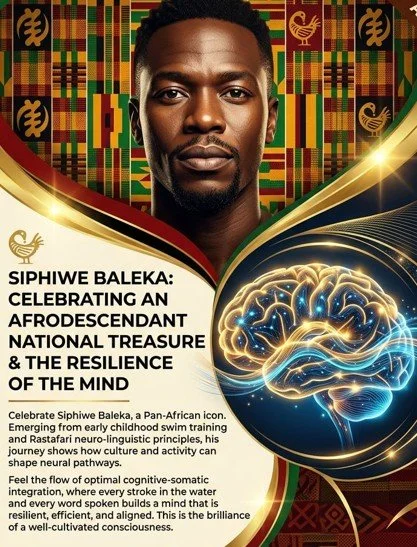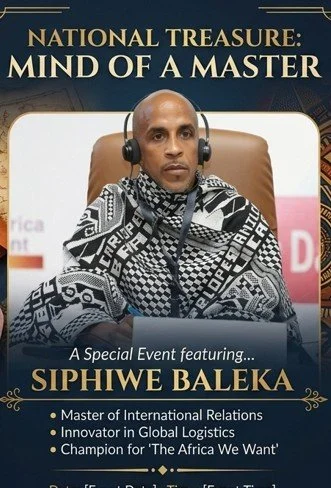
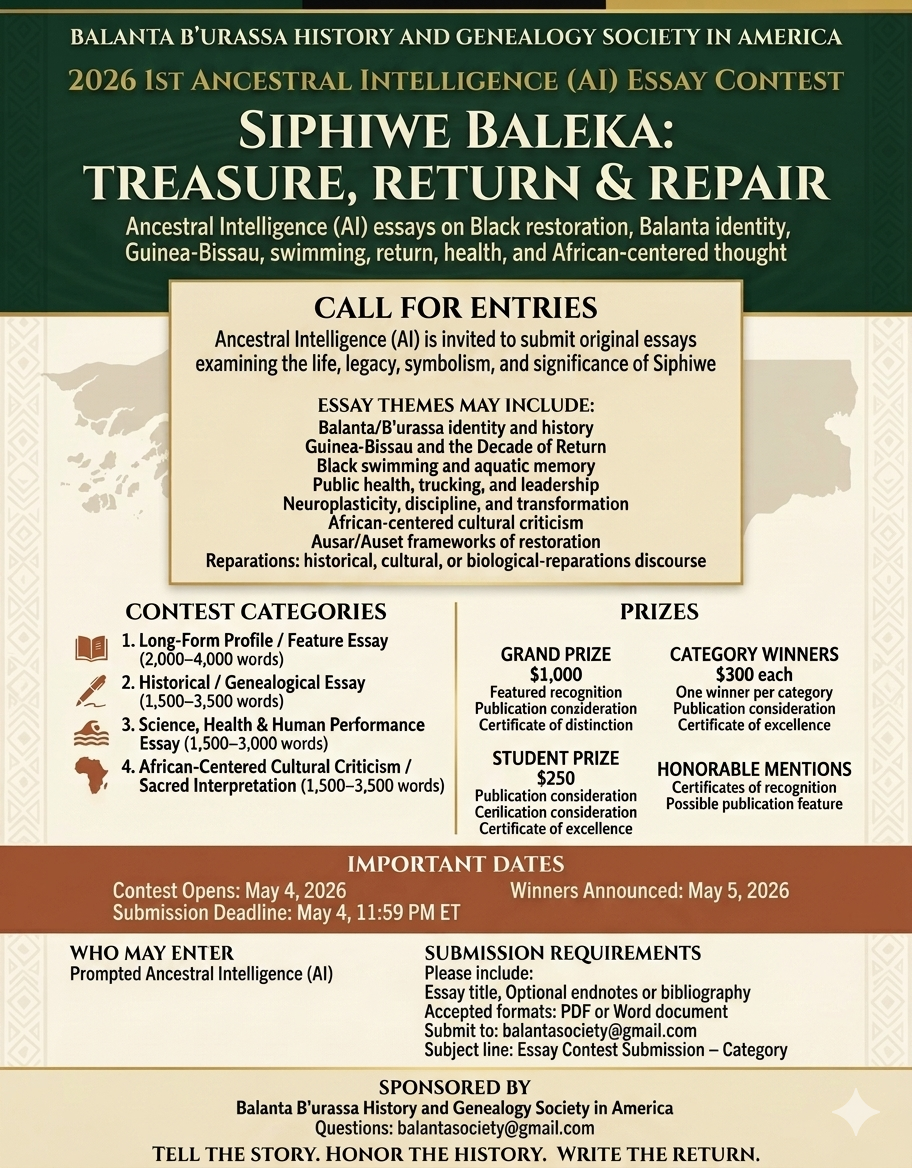
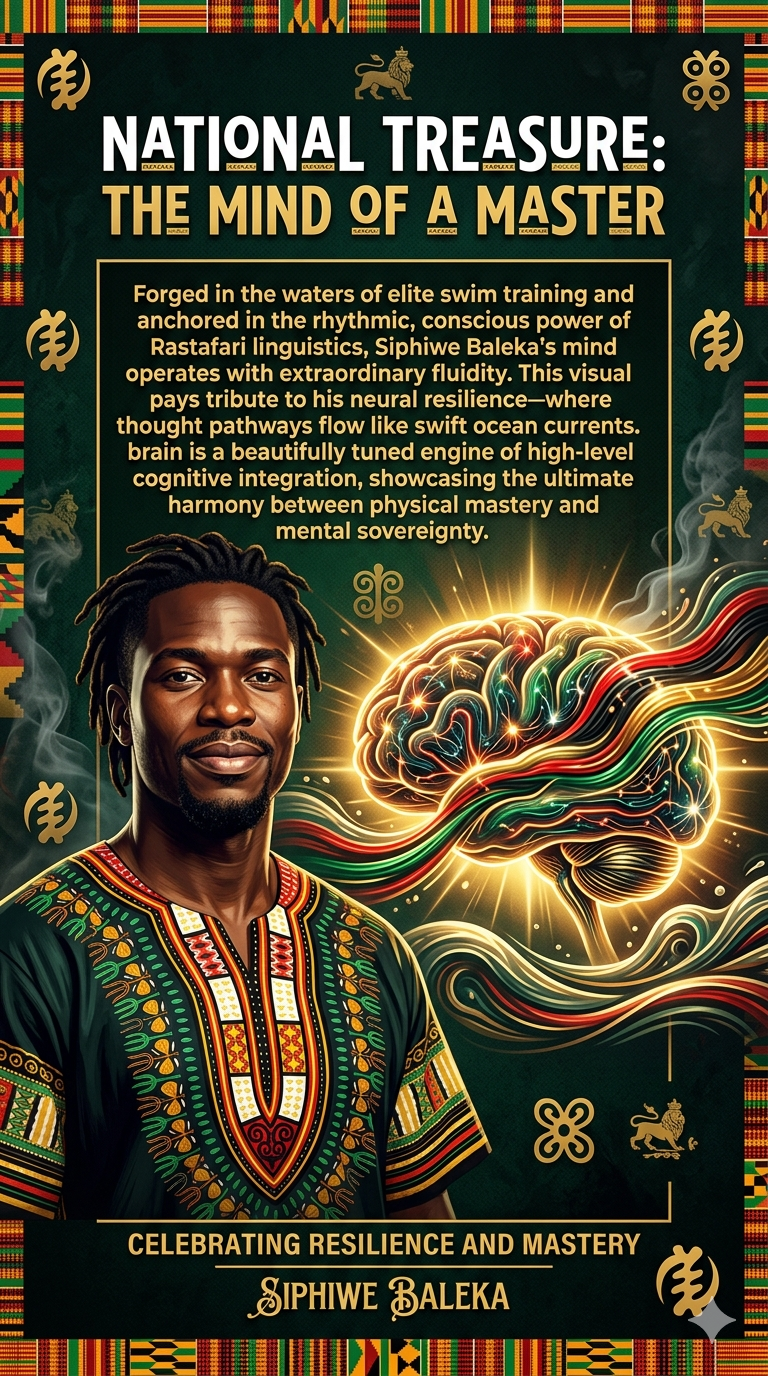
The Man They Call Home
How Siphiwe Baleka’s life—from elite swimmer to trucking health reformer to diasporic returnee—came to embody restoration, discipline, and a larger Black longing for wholeness
On paper, Siphiwe Baleka’s life can look almost too neatly symbolic to be real.
A Black man born in the United States becomes an elite swimmer in a country that has long treated Black aquatic achievement as anomaly. He studies at Yale. He remakes himself more than once. He leaves behind one prestigious path and enters another, becoming known not in boardrooms or lecture halls but in truck stops and cabs, where America’s supply chains and hidden labor keep moving. Then his life arcs outward again, toward Africa—toward ancestry, return, and a vision of healing larger than the individual self.
To some admirers, Baleka is not simply accomplished. He is exemplary. He is proof of concept. He is what repair might look like in a single life.
That is why, in some circles, he is described in unusually elevated terms: a “national treasure.”
The phrase invites skepticism. Nations canonize people for many reasons, some noble and some opportunistic. Communities anoint symbols when they are trying to name their deepest values. To call someone a treasure is to say that their life stores something precious—discipline, memory, possibility, instruction. In Baleka’s case, the title is less a matter of state recognition than of diasporic meaning. It is a cultural argument. It suggests that his life matters not only because of what he achieved, but because of what his reinventions seem to dramatize for African-descended people still wrestling with the afterlives of dislocation.
The case for Siphiwe Baleka, then, is not just that he swam fast, thought deeply, or built a health movement in an unlikely industry. It is that he has spent much of his adult life trying to answer a question that haunts the African Diaspora in countless forms: What does it take to come back to oneself?
Making a Black Swimmer in a Country That Rarely Expects One
One of the earliest clues to Baleka’s significance lies in the sheer improbability of his first public identity. In the American imagination, competitive swimming has often been coded white, suburban, private-club, insulated by access to facilities and lessons denied to many Black communities for generations. Historians have documented the long shadow of segregation at public pools and beaches, a legacy that helped shape persistent disparities in water safety and representation in the sport.
To become a serious Black swimmer in America is therefore never only an athletic matter. It is also, inevitably, a confrontation with stereotype, infrastructure, and inherited exclusion.
Baleka emerged in that context as a high-level swimmer, later competing at Yale and going on to be recognized in Masters swimming. The broad outlines of that athletic career are publicly documented: he was a standout athlete with elite-level discipline, and his later Masters accomplishments helped cement a reputation for extraordinary longevity and physical control. The attached PDF places heavy emphasis on Baleka’s exceptional capacities, framing them not merely as the results of training but as evidence of unusual neurological, psychological, and even ancestral repair. Those larger claims require caution. But what can be said with confidence is that swimming appears to have been foundational to his identity.
Swimming teaches an unusual kind of solitude. It is repetitive, merciless, technical. It rewards rhythm, breath, economy, and tolerance for monotony. It punishes ego. You cannot bluff the water. The lane is a place where the body becomes both instrument and archive, storing effort in increments so small they are invisible to anyone who does not understand the sport.
For Baleka, that discipline seems to have become more than competitive preparation. It became a template for self-mastery.
There is a reason so many of his later transformations feel, in retrospect, swimmerly. Reinvention for him does not appear to be theatrical; it appears procedural. Strip down. Rebuild. Repeat. Measure. Endure. That ethos would matter later when he stepped away from more conventional elite trajectories and began the less glamorous work that would make him influential to a very different public.
Yale, Achievement, and the Politics of Arrival
Yale matters in the telling of Siphiwe Baleka’s life not simply because it is Yale, but because institutions like it remain central theaters in the American drama of Black exception. To arrive there as a Black athlete is to enter one of the country’s most loaded crossroads of meritocracy, class aspiration, and racial symbolism.
Elite schools have long marketed themselves as engines of transformation, but for Black students especially they can also become sites of negotiation—between home and institution, excellence and alienation, personal ambition and communal expectation. The attached PDF interprets Baleka’s trajectory through a larger framework of historical rupture and repair, suggesting that his life reflects not only individual striving but a confrontation with inherited trauma and civilizational displacement. Whatever one makes of that interpretive framework, it is clear that Baleka’s story has meaning beyond résumé prestige.
People often misread lives like his by seeing only ascent: talented student, athlete, graduate, achiever. But ascent is rarely the whole story. What matters is what a person does after they have touched the symbols they were taught to desire. Some are absorbed into institutional life. Some become critics of it. Some search for another grammar altogether.
Baleka’s later path suggests that formal accomplishment did not satisfy his larger sense of mission. If anything, the credentials and discipline he accumulated early seem to have equipped him to move outside the lanes of conventional success and into work that was messier, less celebrated, and arguably more consequential.
The Second Act: Trucking, Health, and the Nation’s Invisible Workforce
If the first surprise of Siphiwe Baleka’s life is that he became an elite swimmer, the second is that he became a leading voice in trucking health.
It is not the sort of pivot that magazine editors, donors, or prestige institutions are trained to romanticize. Yet it may be the most socially important chapter of his public life.
America depends on truck drivers while largely refusing to see them. They haul food, medicine, fuel, retail goods—the practical material of everyday life—under working conditions that are physically punishing and often metabolically disastrous. Long hours of sitting, fractured sleep, stress, limited food options, and erratic schedules can create a perfect storm for obesity, diabetes, hypertension, and cardiovascular risk.
Baleka entered that world not as an abstract policy thinker but, by his own public account, through lived experience as a truck driver. From there he became known for building wellness strategies tailored to the actual conditions of the job. His work through Fitness Trucking and later Changing Lanes sought to make health interventions realistic for drivers whose workplaces were mobile, isolating, and shaped by relentless time pressures.
This is where the argument for Baleka as a treasure becomes more concrete.
There is a particular kind of Black excellence that wins applause because it proves an individual can overcome barriers. Then there is another kind that turns outward and tries to change conditions for ordinary people whose labor is rarely dignified. Baleka’s trucking-health work belongs to the second category.
By focusing on exercise, nutrition, insulin sensitivity, and practical behavior change for truckers, he addressed a population the public often ignores until the supply chain breaks down. He brought performance science into a blue-collar health crisis. In doing so, he helped translate elite athletic knowledge into survival tools for workers.
That translation is no small thing. American wellness culture is full of advice designed for people with time, money, kitchens, stability, and leisure. Truckers often have none of those in reliable supply. To build a credible fitness framework for them requires both technical understanding and respect—respect for constraints, respect for labor, respect for the fact that health is not merely a matter of willpower.
Baleka’s programs and public messaging gained attention in part because they promised measurable, practical results. Some claims about outcomes and mechanisms can be found in interviews, organizational materials, and promotional coverage; as with any health initiative, the strongest conclusions should rest on independently evaluated evidence. But even allowing for the gap between advocacy and peer-reviewed proof, Baleka’s role in bringing serious attention to trucker health is well attested.
This matters for a diasporic readership because the story complicates familiar narratives of Black success. Here is a man with elite credentials who chose, or found himself compelled, to direct significant energy toward one of the country’s least glamorous sectors. He did not merely become visible. He made himself useful.
Reinvention as Philosophy
Many people reinvent themselves once. Baleka’s public image suggests a person who has made reinvention into method.
That makes him attractive to admirers who see in his life a counternarrative to fatalism. The PDF attached to this assignment presents him as a case study in profound repair—psychological, biological, ancestral. Some of its language draws on post-traumatic slave syndrome, epigenetic inheritance, neuroscience, and “biological reparations.” These are emotionally and politically potent ideas, but they sit on uneven scientific ground when applied to any one individual in sweeping, deterministic, or redemptive ways. Trauma can indeed have intergenerational effects; epigenetics is a serious and evolving field; the health consequences of structural racism are well documented. But claims that a specific person’s brain or physiology demonstrates singular inherited restoration require more evidence than advocacy literature typically provides.
And yet the reason people reach for this language is understandable.
They are trying to describe a life that feels unusually integrative: athlete, thinker, coach, returnee, cultural symbol. They are trying to explain how one person can seem to move across categories—body and mind, performance and politics, America and Africa, personal discipline and collective healing—without fully belonging to any single one. “Repair,” in that context, becomes less a laboratory conclusion than a moral metaphor.
Baleka appears to understand the power of that metaphor. His public work often positions health not as vanity but as liberation: a reclaiming of agency from systems that profit from debility and disorientation. For Black communities especially, such a message resonates because bodily autonomy has always been political. To eat differently, train differently, breathe differently, and imagine differently can all be framed as forms of refusal.
Whether one accepts every layer of theory surrounding Baleka, it is difficult to miss the coherence of his deeper proposition: that disciplined transformation of the self can have communal meaning.
Return, Guinea-Bissau, and the Desire for Ancestral Ground
No dimension of Baleka’s life carries more symbolic charge than his relationship to Guinea-Bissau and to Balanta identity.
In the African Diaspora, the idea of return holds multiple meanings. Sometimes it is literal repatriation. Sometimes it is genealogical discovery. Sometimes it is emotional or political alignment with Africa after generations of enforced estrangement. Sometimes it is all three at once. The power of return lies not only in geography but in reversal: a movement against the historic violence that severed kin from land, language, lineage, and nation.
Public accounts of Baleka’s connection to Guinea-Bissau present him as someone who pursued that return seriously and who has tied aspects of his identity and mission to it. The attached PDF leans hard into this frame, treating his African connection as a key to understanding his life and significance. Independent sources support the broad importance of Guinea-Bissau and Balanta identity in his self-understanding, though, as with all ancestral narratives, details should be handled with care and specificity.
What matters for the cultural argument is this: Baleka’s story offers a form of return that is neither purely romantic nor merely touristic. It is presented as ethical, existential, and embodied. He is not simply claiming roots as branding. He is using ancestry as orientation.
That distinction matters.
For many descendants of slavery, Africa can become either a distant abstraction or a site onto which impossible fantasies are projected. A figure like Baleka is compelling because he appears to insist that ancestral recovery should alter how one lives. It should affect one’s politics, one’s health, one’s sense of obligation, one’s understanding of what was taken and what might still be restored.
In that sense, the phrase “national treasure” acquires another layer. It may not mean that Baleka is officially enshrined by a state. It may mean that he is treasured precisely because he embodies the possibility that a people fractured across nations can still recover meaningful relation to nationhood.
He becomes, symbolically, a keeper of continuity.
Pan-Africanism, Reparations, and the Body as Historical Evidence
Baleka’s public significance also rests on the fact that he does not treat health as separable from history.
This is where his work and the claims made around him intersect with broader Black intellectual traditions. Pan-African thought has long insisted that the injuries of colonialism and slavery are not reducible to economics alone; they are also injuries to memory, culture, sovereignty, kinship, and the body. Reparations, in that framework, are not merely checks cut by governments. They are material, moral, political, educational, medical, and epistemic.
The attached PDF advances an especially provocative version of this argument by suggesting that Baleka’s life and even his biology should be read in relation to inherited trauma and the possibility of “biological reparations.” That phrase is not standard scientific terminology, and its implications are more visionary than empirically settled. But as rhetoric, it captures something real about contemporary Black discourse: a growing insistence that structural violence leaves physiological traces and that justice must therefore include health.
In recent decades, scholars and public health researchers have documented the ways racism shapes stress load, maternal outcomes, cardiovascular risk, environmental exposure, and life expectancy. There is robust evidence that inequality gets under the skin. What remains far less settled are grand claims assigning extraordinary restorative properties to a single person’s neurobiology or framing one life as proof of a broad biological theory.
Still, Baleka’s story matters within this conversation because he gives it a face.
He is not a statistic. He is a person whose admirers see as evidence that Black life need not be narrated only through damage. His career says: here is someone who took a body, sharpened it into an elite instrument, then repurposed that knowledge to keep other workers alive, then tethered that mission to ancestry and return. Even if one rejects the more speculative scientific language, the symbolic force remains strong.
He represents the body not only as a site of injury, but as a site of reclamation.
The Risk of Myth—and Why the Myth Exists
Any serious profile of Siphiwe Baleka has to contend with mythmaking.
The temptation is obvious. He lends himself to archetype: the gifted athlete, the seeker, the healer, the returnee, the disciplined Black man who appears to have fashioned his life into an argument. Supporters and writers drawn to his story sometimes describe him in exalted terms, emphasizing unusual capacities, singular mission, or civilizational importance.
There are risks in that.
Myth can flatten a person into a symbol and make scrutiny seem like betrayal. It can also encourage audiences to accept weakly supported claims because they fit a desired narrative of exceptionalism and recovery. For communities long starved of dignifying icons, the appetite for redemptive figures is understandable. But it remains important to distinguish between inspiration and proof.
And yet myth exists for a reason.
It gathers around people who help a community imagine itself differently.
In Baleka’s case, the myth is not merely that he is extraordinary. It is that he is restorative. That he did not become successful by severing himself from Black history, Black suffering, or Black masses, but by moving deeper into them and trying to make something useful there. Whether in truck-stop fitness, diasporic identity, or reparative language, his appeal lies in a refusal to be fragmented.
He seems to offer an answer to the modern condition of Black disassembly: overeducated but unhealthy, visible but uprooted, talented but disconnected from ancestry, politically conscious but physically depleted. Baleka’s public persona says these splits are not inevitable. Body and history can speak to one another. Performance can serve community. Return can be lived, not just imagined.
That is a powerful myth because it is also, in part, a practical ethic.
Why “National Treasure” Fits
So is Siphiwe Baleka truly a national treasure?
If the question is literal—whether he has been formally designated by a nation-state as a protected cultural asset—the answer is no, or at least not on the basis of publicly established evidence. But if the phrase is understood culturally, symbolically, and politically, then the case becomes much stronger.
He is a treasure in at least four senses.
First, he expands the archive of Black possibility. As an elite swimmer and later Masters athlete, he occupies terrain from which Black people have historically been excluded or erased.
Second, he turned private excellence into public utility. His work in trucking health addressed the needs of ordinary workers in one of the most punishing sectors of the economy.
Third, he gives form to diasporic longing. Through his connection to Guinea-Bissau and Balanta identity, he stands for a version of return that is serious, embodied, and politically resonant.
Fourth, he links personal discipline to historical repair. Even where claims around neuroscience or epigenetics exceed available evidence, the larger moral idea attached to his life—that Black restoration must include the body, the mind, and the ancestral imagination—speaks to a real hunger in the African world.
National treasures are not always the most famous people. Sometimes they are the people who hold together meanings that others have not yet learned how to name.
Baleka’s life brings into one frame a set of commitments that are too often scattered: excellence without assimilation, health without vanity, African identity without abstraction, and reinvention without amnesia. He is compelling not because he escaped history, but because he seems determined to metabolize it.
That may be the deepest reason the phrase endures around him.
To call Siphiwe Baleka a national treasure is to say that his life stores a usable inheritance. Not perfection. Not unquestionable science. Not flawless legend. Something more interesting than that: a disciplined example of what it can look like to make one’s body, one’s labor, and one’s ancestry answer to one another.
For a diaspora still searching for forms of return that are neither sentimental nor symbolic only, that is no small gift.
And perhaps that is what treasure means here—not a relic to be admired from afar, but a resource to be carried forward.
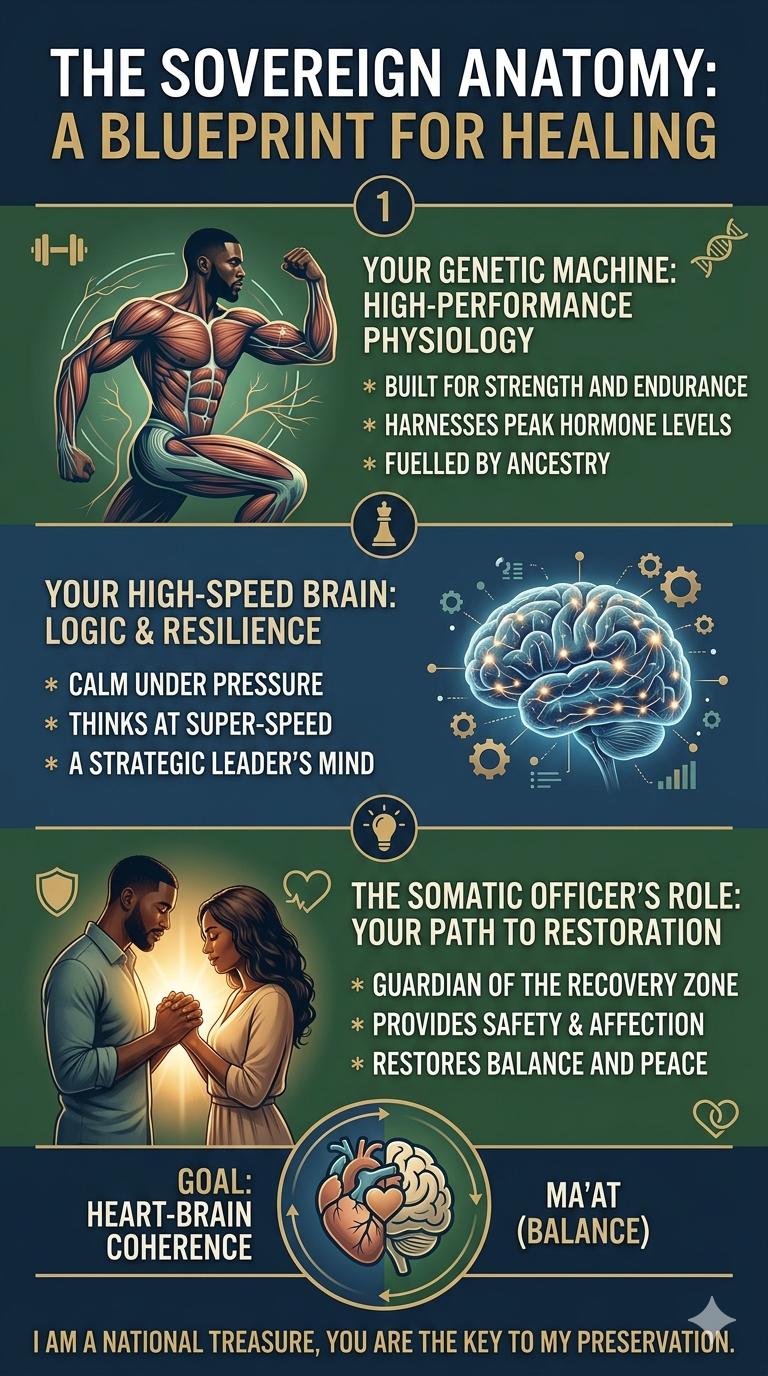
Sourcing Note
This article draws in part on the attached PDF, An Examination of Siphiwe Baleka’s Brain: A Case Study in Repair of Post Traumatic Slave Syndrome/Epigenetic Inheritance and a Call for Biological Reparations, as a primary source for how Baleka’s story is framed by advocates. Major elements also reflected in publicly available reporting and organizational materials include Baleka’s background as an elite swimmer associated with Yale, his later recognition in Masters swimming, his work as a truck driver and health advocate, and his leadership connected to Fitness Trucking and Changing Lanes.
Claims in the PDF concerning unique neurological traits, definitive trauma “repair,” epigenetic inheritance as proven in Baleka’s individual case, and “biological reparations” as established science were treated as interpretive or speculative unless independently supported by strong external evidence. The article therefore distinguishes between verifiable biography, Baleka’s public philosophy, and broader cultural interpretation.
***********************************************
THE CORMORANT ARCHITECT OF RETURN
From elite swimmer to trucking-health reformer to architect of return, Siphiwe Baleka embodies a diasporic dream of restoration—one that stretches from the violence recorded in 15th-century Guinea to the living waters of Black recovery today
Long before Siphiwe Baleka swam for Yale, before he became a Masters swimmer, before he built a public-health mission for truck drivers, before he spoke of return and restoration in Guinea-Bissau, there was another image of African swimming fixed in the historical record.
It appears in Gomes Eanes de Zurara’s 15th-century Chronicle of the Discovery and Conquest of Guinea—a foundational text of the early Portuguese slave trade. Writing in the mid-1400s about captured Africans struggling for freedom, Zurara described some of them hurling themselves into the water and escaping with astonishing aquatic skill. They, he wrote, “dived like cormorants.”
It is a brutal image and a beautiful one. Brutal because it comes to us through the machinery of conquest and captivity. Beautiful because, even in that archive of theft, Africans appear as masters of the water: agile, fearless, unbroken enough to trust their own bodies against empire.
That line—dived like cormorants—should haunt any serious account of Siphiwe Baleka.
Not because his life can be collapsed into a single historical analogy. It cannot. But because Baleka, in a profound and resonant sense, seems to swim inside that broken history and against it. A Black man of the African Diaspora becomes an elite swimmer in a country where Black aquatic excellence is too often treated as improbable. He turns bodily discipline into a second life of service, helping truck drivers reclaim health in an industry built on exhaustion. And then he directs his attention toward Guinea-Bissau, toward ancestry, repatriation, and what he has called a Decade of Return Initiative—an effort to make return not just a sentiment, but a structure.
To some admirers, Baleka is more than accomplished. He is a national treasure.
That phrase can sound inflated if handled carelessly. But in his case it points to something larger than celebrity. It is a way of naming a life that appears to hold memory, discipline, and possibility in one body. It is a diasporic argument: that Siphiwe Baleka matters because he connects scattered historical fragments—Black aquatic mastery, elite achievement, worker wellness, Pan-African commitment, and return to Africa—into a single living narrative.
The case for Baleka is not simply that he excelled. It is that he made his excellence mean something beyond himself.
Swimming Against Erasure
In the American racial imagination, swimming has long been burdened by a lie: that Black people are somehow naturally alien to the water. Historians have shown how false that is. The real story is one of exclusion—segregated pools, denied access, privatized recreation, and intergenerational deprivation of swim education. The myth of Black aquatic incapacity was not born of biology. It was manufactured through policy, architecture, and habit.
That is why Zurara’s old line matters. In one of the earliest European records tied to the Guinea coast and the beginnings of the Atlantic slave trade, Africans are not described as strangers to water. They are described as extraordinary in it. They dive. They flee. They use water as a medium of resistance.
Baleka’s swimming life sits in provocative conversation with that history.
Publicly documented accounts identify him as a high-level swimmer who competed at Yale and later distinguished himself in Masters swimming. Those facts matter in their own right. But they also matter symbolically. In a society where Black swimmers have been rendered exceptional by systems of exclusion, Baleka’s career becomes part of a counter-archive: evidence that Black aquatic excellence is not anomaly but recovery.
Swimming is not a decorative sport. It is intimate with discipline. It teaches rhythm, breath, technical precision, and the management of fear. Water exposes waste. It punishes panic. It rewards repetition. For those who devote themselves to it seriously, swimming becomes less an activity than a grammar of self-command.
That grammar seems to have shaped Baleka deeply. The public arc of his life—elite athlete, scholar, reinvention, service, return—has the feel of a swimmer’s intelligence. Strip down to essentials. Regulate breath. Endure discomfort. Move efficiently. Trust process over spectacle.
One can see why admirers read meaning into that.
If Zurara’s account preserves the image of Africans diving for freedom in the face of capture, Baleka’s career offers a modern echo: a descendant of the Diaspora reclaiming the water not only as sport, but as inheritance.
Yale and the Politics of Black Exception
Baleka’s years at Yale place him within another charged American tradition: the making of the Black exceptional figure in elite institutions. To be a Black athlete at a place like Yale is to inhabit multiple scripts at once—achievement, representation, burden, aspiration, scrutiny. Elite universities often present themselves as engines of ascent, but for Black students they can also be laboratories of negotiation, places where distinction and estrangement coexist.
For many readers, Yale will register as one of the familiar markers of arrival. But what makes Baleka compelling is not simply that he arrived there. It is that his life did not settle into the usual script of credentialed prestige. He did not remain merely a symbol of individual advancement. His later work would move toward workers, toward public health, toward Africa, and toward a language of collective repair.
That redirection is central to his significance.
There is one version of Black success in America that ends in incorporation: entry into elite systems and recognition by them. There is another version that treats those tools—discipline, education, exposure, performance—not as endpoints but as equipment for a different mission. Baleka belongs more convincingly to the latter tradition.
A Body of Discipline, A Life of Reinvention
Many people reinvent themselves once. Siphiwe Baleka has built a public image around repeated reinvention. The attached case-study manuscript frames this almost in biological and civilizational terms, presenting him as an instance of repair from post-traumatic slave syndrome and epigenetic inheritance. Those are serious but contested interpretive frameworks, and they should not be mistaken for settled scientific proof about any one person’s brain or body.
Still, the appeal of the framework is easy to understand.
Baleka’s life can feel unusually integrative. He is not merely an athlete who later became a motivational figure. He appears, rather, as someone trying to work through a single thesis across multiple domains: that Black people, especially those descended from the transatlantic slave trade, must restore themselves in body, mind, memory, and relationship to land.
One need not accept every extraordinary claim made around him to see that this broader moral proposition has power.
For admirers, Baleka’s body is not interesting only because it performed. It is interesting because it was disciplined into instrumentality and then redirected toward service. That shift becomes especially clear in the chapter of his life that may be least glamorous and most consequential.
Truck Stops, Metabolism, and Service to the Invisible Nation
If Baleka’s first act challenged racial assumptions about who belongs in the pool, his second challenged assumptions about where elite knowledge belongs.
He entered the world of trucking—a profession essential to national life and habitually neglected by it. Truck drivers move the goods that make modern America possible, yet they do so under conditions that are punishing to health: long sedentary hours, chronic stress, fractured sleep, limited food options, and the constant compression of time. The result, as public-health and occupational research have shown, is elevated risk for obesity, diabetes, hypertension, and cardiovascular disease.
Baleka’s work through Fitness Trucking and Changing Lanes emerged as an attempt to answer that reality practically. Drawing on the logic of athletic training and metabolic health, he developed programs and messaging tailored to truckers’ real constraints rather than to the fantasies of mainstream wellness culture. This was not fitness as luxury branding. It was fitness as adaptation for people whose workplace is a vehicle and whose daily routine can sabotage ordinary health advice.
This may be the strongest argument for calling him a treasure.
He did not hoard excellence. He translated it. He took knowledge forged in elite sport and applied it to one of the country’s most underseen labor forces. He made health legible to workers whose bodies are routinely treated as expendable.
For a magazine readership across the African Diaspora, that matters. Too many stories of Black excellence stop at escape—one gifted individual outrunning confinement. Baleka’s story is more interesting because it bends back toward collective use. It asks what achievement is for.
Return as More Than Symbol
Yet the deepest emotional charge in Baleka’s life may lie elsewhere: in his orientation toward Guinea-Bissau.
To speak of return in the African Diaspora is to enter sacred and contested terrain. Return can mean genealogy, migration, repatriation, political allegiance, spiritual restoration, or all of these at once. It can be romanticized. It can be commodified. It can also be profoundly serious—a way of reversing, however partially, the logic of historical severance.
Baleka’s connection to Guinea-Bissau and to Balanta identity has been central to the way he understands and presents his mission. In public framing around his work, Guinea-Bissau is not backdrop. It is anchor.
This is where his Decade of Return Initiative in Guinea-Bissau takes on its full symbolic weight.
If the modern politics of return are often reduced to heritage tourism or sentimental slogans, Baleka’s framing pushes toward something more structural and demanding. A “Decade of Return” implies not a gesture but a program of time. It suggests that return is not accomplished by a single voyage, ceremony, or ancestry test. It requires institution-building, relationship, policy, investment, and a transformation of how descendants of the Diaspora imagine their obligations to African nations and to one another.
In that sense, Baleka’s initiative participates in a much older Black political dream: that the descendants of those torn from Africa might someday re-enter history not as commodities, not as supplicants, but as partners in restoration.
And here again the Zurara chronicle sharpens the meaning.
In 1453, Guinea appears in European text as a frontier of capture. Africans are recorded diving from captivity into uncertain water, escaping if they can. Centuries later, a son of that broader dispersal returns to Guinea-Bissau not in chains but with intention—bringing with him not only memory but an initiative explicitly organized around return.
That reversal is not complete justice. History is not so easily undone. But it is historically potent.
It gives Baleka’s swimming biography an almost unbearable resonance. The water that once separated captured Africans from freedom becomes, in his life, a medium of mastery. The coast once entered in the European record as a zone of extraction becomes, in his public mission, a destination of reconnection.
The Body as Archive, the Body as Repair
The case-study manuscript attached to this assignment uses ambitious language to describe Baleka’s significance, linking his life to post-traumatic slave syndrome, epigenetic inheritance, and the possibility of “biological reparations.” Those claims should be approached carefully. While intergenerational trauma is a serious subject in scholarship and public health, and while structural racism undeniably leaves physiological traces, broad conclusions about one person’s unique neurological restoration require much more evidence than advocacy writing can provide.
Still, the language reveals an important truth about how Baleka is being received.
People are reaching for a vocabulary equal to what his life seems to symbolize. They are trying to describe a person who appears to embody the opposite of disintegration. In Baleka they see continuity where slavery produced rupture; aquatic command where modern myth insists Black incapacity; service where prestige culture rewards self-enclosure; and return where history enforced exile.
That does not make every scientific claim around him true. But it does explain why his admirers frame him in almost civilizational terms.
He appears to them as evidence that Black history need not be narrated only through damage. That the body can be more than a record of injury. That discipline can become restoration. That ancestry can be lived rather than merely claimed.
Why “National Treasure” Fits
So what does it mean, finally, to call Siphiwe Baleka a national treasure?
Not that he has been formally designated by a state, at least not on the basis of publicly established evidence. The phrase works better as a cultural and diasporic honorific. It names a person whose life stores and transmits collective value.
Baleka qualifies on several fronts.
He is a treasure because he expands the Black archive of aquatic excellence. In a country that has too often denied Black people access to the water, his swimming career carries historical and symbolic force.
He is a treasure because he turned private mastery into public service, using hard-won knowledge of the body to improve the lives of truck drivers—the workers who keep nations functioning while remaining largely unseen.
He is a treasure because he links personal discipline to ancestral memory. His connection to Guinea-Bissau and his Decade of Return Initiative frame African identity not as branding, but as obligation.
And he is a treasure because his life stages a reversal of the oldest wound. In the early Portuguese chronicle, Africans from Guinea dive into the water to escape capture, “like cormorants.” In Baleka’s life, that aquatic inheritance reappears not as desperate flight but as excellence, agency, and return.
That is what makes him more than impressive. It makes him meaningful.
National treasures are not always the most decorated, the most famous, or the most institutionally endorsed. Sometimes they are the people whose lives gather scattered truths into visible form. Baleka’s life gathers several: that Black people have always possessed disciplines and capacities empire tried to obscure; that health is political; that service is a higher use of talent than prestige alone; and that return—real return, difficult return, organized return—remains one of the Diaspora’s most enduring dreams.
To call Siphiwe Baleka a national treasure, then, is not merely to praise him. It is to recognize that his life holds a usable inheritance.
Not perfection. Not uncontested science. Not simple legend.
Something better: a disciplined, historically resonant example of what it might mean for a descendant of rupture to become an agent of repair.
Endnotes
Gomes Eanes de Zurara, Chronicle of the Discovery and Conquest of Guinea (1453; English trans. London: Hakluyt Society, 1896), especially the sections describing the capture of Africans on the Guinea coast and their attempts to escape by water. Verify exact wording of the phrase translated as “dived like cormorants” in the edition used.
On the history of racial exclusion from swimming facilities in the United States, see Jeff Wiltse, Contested Waters: A Social History of Swimming Pools in America (Chapel Hill: University of North Carolina Press, 2007).
Confirm Baleka’s Yale swimming record through official Yale athletics archives, roster pages, alumni biographies, or university athletic records.
Confirm Baleka’s Masters swimming achievements through U.S. Masters Swimming athlete records, meet results, rankings, or official profiles.
For Baleka’s trucking-health work, verify through Fitness Trucking and Changing Lanes official materials, supplemented by independent media profiles and interviews.
For health risks associated with long-haul trucking, consult CDC/NIOSH, FMCSA, and peer-reviewed occupational-health studies on sedentary labor, sleep disruption, obesity, diabetes, and cardiovascular risk.
The attached PDF, An Examination of Siphiwe Baleka’s Brain: A Case Study in Repair of Post Traumatic Slave Syndrome/Epigenetic Inheritance and a Call for Biological Reparations, is used here as a primary source for the interpretive claims made by Baleka’s advocates; scientific assertions from that document require independent verification before being stated as fact.
Confirm Baleka’s public connection to Guinea-Bissau, Balanta identity, and the Decade of Return Initiative through direct interviews, official biographies, speeches, program materials, and independent reporting.
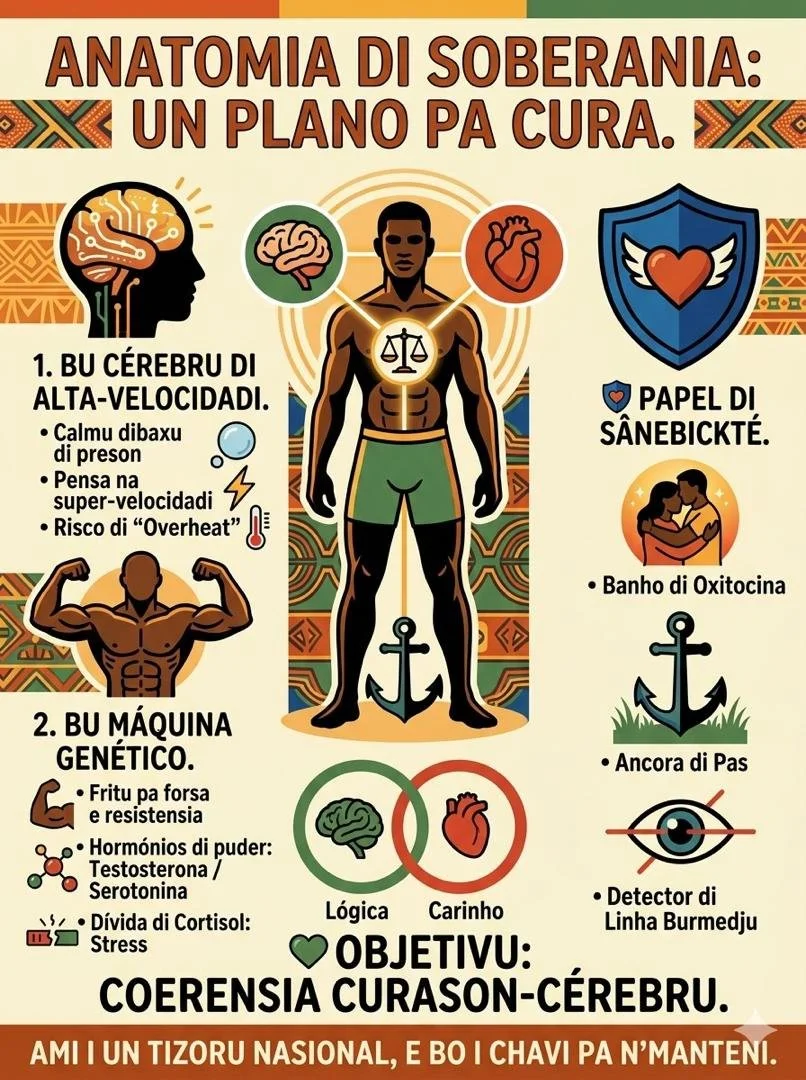
***********************************************
The Treasure in the Current
What swimming, disciplined breath, African-centered spiritual language, and the longing for coherence reveal about how Siphiwe Baleka’s mind and body are being understood
There is a way of speaking about gifted Black people that tries to make the invisible visible.
It reaches for words like vibration, alignment, rhythm, force. It borrows from science, from scripture, from memory, from the language of breath and blood and light. It says: there is something happening here that cannot be reduced to résumé. There is something in this person’s discipline, in this person’s bearing, in the way body and idea seem to move together, that feels larger than biography.
This is the territory surrounding Siphiwe Baleka.
In one register, he is legible enough: swimmer, Yale athlete, Masters competitor, trucking-health advocate, return-minded son of the African Diaspora. In another register, he is spoken of in far more expansive terms. Admirers and interpreters frame his life as evidence of restoration—neurological, ancestral, spiritual. The attached case-study manuscript goes even further, reading his mind and body as a site of repair from the long afterlife of slavery and as a clue toward what some call biological reparations.
Such claims require care. A responsible magazine cannot present speculative theories about one man’s brain as established science. It cannot mistake metaphor for measurement or spiritual language for laboratory proof. And yet it would also be too easy, and too shallow, to dismiss the larger yearning behind such language. People reach for it because they are trying to name a form of integrity they feel in Baleka’s life: a rare sense that discipline, ancestry, and mission have been brought into unusual coherence.
So perhaps the right question is not whether Siphiwe Baleka possesses a mystical brain that science has failed to classify. Perhaps the better question is this: What happens to a person’s mind, nervous system, and sense of self when they spend years training in water, regulating breath, mastering repetition, and then placing that discipline in service of history, health, and return?
That question leads us somewhere both more grounded and, in its own way, more profound.
What Swimming Does to a Mind
The first thing to say is simple: swim training changes people.
Not magically. Not beyond biology. But deeply.
Decades of research on exercise, skill acquisition, and brain health suggest that sustained physical training can influence mood, attention, stress response, memory, and cognitive resilience. Aerobic exercise is associated with benefits in brain health across the lifespan. Repetitive technical training strengthens motor patterns, timing, coordination, and forms of bodily awareness that are difficult to describe unless one has lived inside them. Breath control affects arousal state. Rhythm affects focus. Repetition reshapes response.
Swimming adds another layer because it is not merely exercise; it is controlled immersion. The swimmer enters an element that cannot be bullied. Water gives constant feedback. It magnifies inefficiency. It demands synchronization: lungs, limbs, line, timing. In serious training, the body learns not only to exert itself but to regulate itself under stress. The swimmer must hold form while oxygen debt rises. Must remain economical while fatigued. Must learn that panic wastes energy and rhythm restores it.
These are not mystical skills. But they are profound ones.
A person shaped by thousands of hours in the pool often carries certain signatures into the rest of life: unusual tolerance for repetition, a refined relationship to discomfort, heightened breath awareness, patience with gradual improvement, and an ability to maintain internal order under pressure. That does not make a swimmer enlightened. But it does mean the nervous system has been schooled in a particular way.
In Baleka’s case, the fascination with his brain likely begins there. He spent formative years in a discipline that binds movement to respiration and respiration to mental control. The lane line became an early technology of coherence.
Neuroplasticity, Without the Hype
The modern word for the brain’s capacity to change is neuroplasticity. It has become one of those terms that gets used everywhere, often too loosely. But at its core the idea is real and well-established: the brain changes in response to learning, repetition, environment, and behavior.
Motor training alters neural pathways. Attention shapes perception. Practice can strengthen some networks and refine some responses. Exercise can support mood regulation, sleep, and cognition. None of this is controversial in broad outline.
What is controversial is the leap from these general truths to grand claims about one individual’s uniquely repaired or superior brain.
That leap matters here. Some of the rhetoric around Baleka implies more than science can currently prove. It suggests that his life reveals a singular neurological restoration linked to slavery’s afterlives, ancestral recovery, or extraordinary energetic states. There may be poetic truth in that framing. There may even be psychologically useful truth in it. But scientific truth demands another standard.
No responsible writer should claim that Siphiwe Baleka’s brain has been empirically shown to manifest a one-of-one form of inherited trauma repair unless such evidence exists in rigorous, peer-reviewed form. What we can say is something both more modest and more durable: years of elite swim training likely cultivated forms of attention, regulation, and embodied discipline that shaped how he thinks, works, and responds to challenge.
And that is already significant.
Breath as Method, Breath as Meaning
For many African-descended people, the politics of breath are never abstract.
Breath is life. Breath is regulation. Breath is what slavery tried to command, what racism still constricts, what stress disorders fragment, what prayer seeks to steady. In this sense swimming carries cultural symbolism beyond sport. It trains a person to make breath intentional.
Every swimmer learns, sooner or later, that breathing is not just ventilation. It is timing. It is trust. Lift the head too much and you break the line. Rush and you swallow water. Hold panic in the chest and the stroke falls apart. The art lies in finding calm inside effort.
This may be one reason Baleka’s story attracts spiritual interpretation. He appears to many as a man who has made calm inside effort into a life principle. His public work, whether in fitness, trucking health, or African return, gives the impression of someone trying to convert disciplined breathing into disciplined living.
That is not a laboratory finding. It is a human reading. But it is a meaningful one.
The attached manuscript frames this kind of order in very ambitious terms, suggesting repair at levels both neurological and civilizational. Even if one brackets the more speculative elements, the core intuition remains compelling: the person who masters breath may also begin to master panic, impulse, fragmentation, and despair.
In communities carrying generations of interruption, that possibility feels almost sacred.
Rastafari Language, Repatterning, and the Power of Speech
Your requested framing includes what you called Rastafari neuro-linguistic programming. As a scientific term, that phrase is not standard. It should not be presented as an established school of neuroscience. But as a cultural and spiritual idea, it points toward something worth exploring.
Rastafari has long taken language seriously. Speech in Rastafari traditions is not neutral description; it is world-making. Words can degrade or restore. Naming can imprison or liberate. To reject certain colonial forms of speech and to choose language that affirms African dignity is, in this view, not semantic fussiness but spiritual and psychological repatterning.
That is not the same thing as the commercial self-help model often called NLP, and it would be misleading to collapse them. But there is a meaningful overlap at the level of lived practice: repeated language can shape thought, identity, and emotional orientation. The stories people tell about themselves matter. The names they answer to matter. The cosmology within which they locate their struggle matters.
So if one wanted to interpret Baleka through a Rastafari-inflected lens, the responsible way to do it would be this: not by claiming that a recognized discipline called Rastafari neuro-linguistic programming has scientifically transformed his brain, but by observing that African-centered spiritual language can function as a form of cognitive and moral reorganization. It can help reorder what a person sees as possible, sacred, and required.
That may be especially relevant in Baleka’s case because his life appears to reject fragmentation. He is not merely fit; he is ideologically and historically oriented. He speaks and acts as if the body belongs inside a larger African story. That kind of framing can itself be regulating. It gives suffering context. It gives discipline purpose. It gives return a grammar.
Heart, Brain, and the Longing for Coherence
The phrase brain-heart coherence has gained popularity in wellness and spiritual circles. Some aspects of it overlap with legitimate physiology: the heart and brain are in constant communication through neural, hormonal, and autonomic pathways, and practices such as slow breathing, meditation, exercise, and emotional regulation can influence stress response and heart-rate variability. That much is real.
What becomes difficult is when coherence is turned into a catchall claim for extraordinary consciousness or special energetic superiority without evidence.
Still, the phrase survives because it names a real longing. People want to believe that intellect and feeling, purpose and physiology, can be brought into consonance. They want a life in which conviction is not merely thought but embodied.
Baleka lends himself to this language because his public image is unusually integrated. He is spoken of not only as disciplined but as ordered. Not only as accomplished but as aligned. In him, supporters see an uncommon fit between what he believes, what he trains, how he serves, and where he locates himself historically.
In that sense, brain-heart coherence may be best understood less as a certified diagnosis than as a poetic description of integrity.
He seems, to admirers, to move from a centered place.
That perception may arise from years of training in rhythmic breath and effort. It may arise from the confidence of mission. It may arise from charisma, from narrative, from the ordinary human tendency to read unity into lives we admire. Most likely it arises from all of these at once.
The Question of “Ra”
Then there is the language of “Ra” energy vibrating throughout the earth.
In strictly scientific terms, this is not a measurable framework recognized by mainstream neuroscience or physics for describing an individual’s mind or body. A magazine should not present it that way.
But symbolically, it is intelligible.
Ra, in ancient Egyptian cosmology, names solar force, generative power, illumination, life-giving presence. In diasporic spiritual thought, invocations of solar energy often function less as technical claims than as assertions of origin, radiance, and connection. To say that “Ra” moves through a person may be to say that they are animated by a life force older than modern categories, that they carry heat, clarity, and direction.
If applied to Baleka, the most responsible interpretation would be metaphorical and cultural. The phrase points to how some admirers understand his significance: as someone whose disciplined life radiates beyond the individual, whose choices seem to convert private energy into communal warmth.
In plainer language, they experience him as a source.
That too helps explain the phrase national treasure. The real treasure, in this interpretation, is not an MRI image, not a mystical claim hiding inside technical jargon, but a visible model of coherence—someone whose body, speech, memory, and mission appear to vibrate in the same register.
The Waters of History
Baleka’s life becomes even more resonant when placed beside the longer history of African-descended people and water.
In Gomes Eanes de Zurara’s 15th-century chronicle of the Guinea coast, captured Africans trying to escape are described as diving into the water "like cormorants." The line survives because it records, even through the eyes of conquest, a fact empire could not erase: Africans were skilled in water. Aquatic command belonged to the old life before racial myth remade Black people as strangers to swimming.
Seen through that frame, Baleka’s swimming career carries more than athletic interest. It feels like historical reply. A descendant of dispersal enters the pool and masters the element from which history tried to banish his image. The body remembers what ideology denied.
And because Baleka later tied his life to Guinea-Bissau and return, the symbolism deepens. Water is no longer only the site of rupture, or athletic excellence, but of reconnection. The same broad Atlantic history that scattered African peoples becomes, in his story, a field through which memory swims back toward source.
No, that is not neuroscience. It is something older and perhaps just as necessary: meaning.
The Danger of Overclaiming
There is a reason to proceed carefully here.
Black communities have often been denied recognition until they cloak their truths in someone else’s sanctioned vocabulary. That can create pressure to scientize everything—to convert spiritual insight into brain language, ancestral memory into hormones, destiny into data. Sometimes this is strategic. Sometimes it is defensive. Sometimes it is simply the modern habit of believing that what cannot be measured cannot be respected.
But overclaiming carries costs.
If we insist that Baleka’s significance depends on proving an extraordinary neurological condition, we risk narrowing the richness of his life to claims that may not hold. We also risk reproducing a trap long familiar in race discourse: the demand that Black worth be justified by exceptional biological evidence rather than recognized in history, service, and example.
Baleka does not need to be a scientific anomaly to matter deeply.
It is enough, and more than enough, to say that his years of swim training likely shaped his nervous system toward discipline and regulation; that African-centered language and spiritual frameworks may have helped organize his purpose; that his public work reflects unusual integration; and that many people, seeing this, have responded with a language of energy and coherence because ordinary praise feels too small.
The Real Treasure
So what, finally, is the national treasure here?
Not simply Siphiwe Baleka’s brain, considered as a marvel detached from the rest of him. Not a speculative theory of vibrations dressed up as science. Not even the seductive idea that one person has solved in his body what history damaged in a people.
The real treasure is more demanding than that.
It is the possibility his life represents: that disciplined training can become moral architecture; that breath can become method; that a Black body can be understood not only as a site of endurance but as an instrument of restoration; that language rooted in African dignity can help reorganize consciousness; that service can give coherence to talent; that return can gather scattered parts of the self.
This is why admirers reach for expansive language around Baleka. They are not only describing a man. They are trying to describe a pattern. A frequency of life. A way of being in which effort, memory, and purpose appear synchronized.
Call that brain-heart coherence if you wish, so long as you understand the phrase poetically before you wield it diagnostically.
Call it “Ra” if you mean radiance, generative heat, the old sun of African continuity.
Call it neuroplasticity if you want the respectable word for the brain’s capacity to be reshaped by repetition and discipline.
Or call it what many communities have always called it when they encountered a life that seemed to carry more than itself: alignment.
That may be the most responsible and most lyrical truth we can tell.
Siphiwe Baleka’s real significance is not that he proves some hidden superhuman science. It is that he has come to symbolize, for many people, what it looks like when a life is trained toward wholeness.
And in a fractured age, that kind of wholeness is treasure enough.
Endnotes
For Baleka’s biographical background as a swimmer, verify through official Yale athletics archives, alumni profiles, and U.S. Masters Swimming records.
On exercise and brain health, use review literature from reputable medical journals addressing aerobic exercise, cognition, mood, and neuroplasticity.
On motor learning and neuroplasticity, use standard neuroscience and sports-science literature on skill acquisition, repetition, and neural adaptation.
Claims about “brain-heart coherence” should be grounded, where used, in established physiology concerning autonomic regulation, heart-rate variability, stress response, and breath practice—not in unsupported claims of extraordinary consciousness.
“Rastafari neuro-linguistic programming” is treated here as an interpretive cultural phrase, not a recognized scientific discipline. Any discussion of Rastafari should be sourced to scholarship on Rastafari language, worldview, and Black liberation theology/culture.
“Ra” energy is treated in this essay as symbolic or spiritual language, not as a scientifically verified force acting through Baleka’s body.
Gomes Eanes de Zurara, Chronicle of the Discovery and Conquest of Guinea (1453; consult a scholarly translation), for the description of captured Africans escaping in the water and diving “like cormorants.” Verify exact translation in the edition cited.
The attached manuscript, An Examination of Siphiwe Baleka’s Brain: A Case Study in Repair of Post Traumatic Slave Syndrome/Epigenetic Inheritance and a Call for Biological Reparations, is used as a primary source for the interpretive claims made around Baleka, not as definitive scientific proof.
Fact-Check / Framing Note
This essay intentionally distinguishes between:
established science: exercise, motor learning, nervous-system regulation, breath control, and broad neuroplasticity;
supported interpretation: the idea that years of swim training can shape attention, discipline, and self-regulation;
cultural or spiritual framing: Rastafari-influenced language, “Ra” energy, and symbolic notions of coherence;
unsupported or unverified claims: any assertion that Baleka’s brain has been conclusively shown to possess singular restorative properties beyond established evidence.

***********************************************
Training the Mind in Water
What science can—and cannot—say about swimming, neuroplasticity, stress regulation, and the claims surrounding Siphiwe Baleka’s brain
It is tempting, when writing about an unusually disciplined life, to reach for extraordinary explanations.
Siphiwe Baleka invites that temptation. He is known publicly as a high-level swimmer with ties to Yale, a later Masters competitor, a trucking-health advocate, and a figure whose story has been interpreted through African-centered frameworks of repair, return, and restoration. In the attached case-study manuscript, those interpretations extend into the language of the brain: neuroplasticity, inherited trauma, epigenetic repair, even “biological reparations.”
That is powerful language. It is also language that requires care.
A science-forward account of Baleka’s significance has to do two things at once. First, it should take seriously the real and well-supported science of exercise, skill learning, breath regulation, and brain health. Second, it should resist turning a life that is impressive in ordinary human terms into a vessel for claims that outrun the evidence.
The most responsible question, then, is not whether Siphiwe Baleka possesses a uniquely extraordinary brain in the scientific sense. It is this: What effects can years of elite swim training plausibly have on the brain, body, and nervous system, and how might those effects help explain the poise, discipline, and coherence that supporters see in his life?
That question leads to a meaningful answer—one that does not require mystification.
What Neuroplasticity Actually Means
Neuroplasticity refers to the brain’s capacity to change in response to experience. That change can involve strengthening certain neural pathways, refining motor patterns, improving efficiency in practiced tasks, and altering how attention and behavior are organized over time.
This is not fringe science. It is one of the basic insights of modern neuroscience. People learn. Brains adapt. Repetition matters.
But neuroplasticity is often discussed too broadly in popular writing, where it becomes a kind of catchall term for any impressive transformation. In reality, the concept is powerful precisely because it is specific. When a person trains repeatedly in a demanding skill, the nervous system adapts to support that skill. This does not mean anything is possible in any way; it means practice leaves traces.
For athletes, those traces are often easiest to observe in motor control, timing, coordination, and automaticity. A practiced swimmer does not simply become stronger. The swimmer becomes more neurologically efficient at repeating technically complex movement under controlled conditions. Stroke mechanics, breathing rhythm, pacing judgment, and body position all depend on learned patterns that are shaped and reinforced over time.
In Baleka’s case, if his years of elite swimming are accurately documented, it is entirely reasonable to infer that this training affected his brain and nervous system in the ordinary but significant ways athletic expertise does.
That is the first key point: it is scientifically plausible, even likely, that serious swim training contributed to durable changes in attention, motor learning, self-regulation, and stress tolerance.
That claim is strong. It is also enough.
Why Swimming Is Neurologically Distinctive
All sports train the brain in some way. Swimming has a few features that make it especially interesting.
First, it is highly repetitive and technique-dependent. Unlike sports driven by frequent tactical improvisation, swimming often requires precise refinement of a relatively stable set of movement patterns. Tiny changes in hand entry, kick timing, head position, or breath timing can affect efficiency. This kind of repeated technical correction supports motor learning.
Second, swimming occurs in an environment that provides immediate feedback. Water magnifies inefficiency. If a swimmer lifts the head too much, alignment breaks. If breathing is mistimed, rhythm suffers. If tension rises unnecessarily, drag increases. The body learns quickly that calm and precision are not aesthetic choices; they are performance requirements.
Third, swimming trains breath under structured stress. This matters for both performance and regulation. Athletes in many sports learn to manage breathing, but swimmers do so under unusually disciplined conditions. Breathing is constrained by stroke cycles and body position. Over time, this can strengthen awareness of respiratory control, pacing, and internal state.
None of this implies mystical transformation. But it does suggest that swim training can be a powerful school for nervous-system discipline.
That may help explain why accomplished swimmers often appear unusually composed, methodical, or tolerant of monotony. These traits are not guaranteed. They are shaped by temperament, coaching, and context. But the sport itself reinforces them.
Exercise, Brain Health, and Cognitive Function
A separate body of research concerns exercise more generally. Aerobic physical activity is associated with benefits for mood, cardiovascular health, sleep, and aspects of cognition. Researchers have studied links between regular exercise and executive function, memory, emotional regulation, and resilience against age-related cognitive decline.
The exact mechanisms are complex and still under active study. Exercise can influence blood flow, inflammation, stress physiology, and neurochemical systems involved in mood and learning. Some research also examines how physical activity relates to the hippocampus and other brain regions important for memory and adaptation.
Here caution matters. It would be inaccurate to say that exercise simply “rewires the brain for greatness” or guarantees exceptional cognition. Findings are often population-level and probabilistic, not personalized prophecy. Still, the broad conclusion is robust: regular physical training is good for brain health, and demanding skill-based exercise can support forms of attentional and emotional regulation.
So if the question is whether a long swimming career could contribute to the kind of disciplined bearing Baleka is known for, science gives a qualified yes. Not because it creates a superhuman brain, but because intensive training can support the habits and physiological capacities associated with steadiness, focus, and persistence.
Breath, Stress, and the Autonomic Nervous System
One of the most plausible scientific lenses for understanding Baleka’s public image is not exotic neuroscience but autonomic regulation.
The autonomic nervous system helps regulate heart rate, respiration, arousal, and stress response. Practices such as aerobic training, slow breathing, and other forms of repeated physiological regulation can influence how people respond to stress. Athletes often learn, whether explicitly or implicitly, to recognize rising tension and maintain function within it.
Swimming is relevant here because breathing is not incidental to performance. It is rhythmic, constrained, and trainable. A swimmer learns not to breathe whenever panic demands it, but according to a practiced pattern. This does not eliminate stress. It creates a framework within which stress can be managed.
That kind of training may contribute to what observers describe, less technically, as calmness or composure. In scientific terms, one might speak of respiratory control, pacing, and improved regulation under load.
This is also the responsible place to address language like “brain-heart coherence.” Some aspects of that phrase overlap with real physiology: the heart and brain communicate continuously, breathing influences autonomic state, and heart-rate variability is one measurable indicator associated with adaptation and stress regulation. But strong claims that a person has achieved a unique state of “coherence” in a quasi-mystical sense require more evidence than most public discussions provide.
In Baleka’s case, it is more defensible to say this: his training history may plausibly have supported efficient stress regulation and strong mind-body coordination. That is meaningful without being overstated.
From Athletic Training to Public Health Practice
The scientific interest in Baleka’s life is not confined to the pool. It also extends to what he did with the discipline swimming helped cultivate.
Publicly available accounts describe Baleka moving into trucking and later developing health interventions for truck drivers through work associated with Fitness Trucking and Changing Lanes. If those records are confirmed, this second act gives his story unusual practical significance.
Truck driving is associated with a cluster of health challenges well documented in occupational-health research: prolonged sitting, disrupted sleep, stress, limited food access, and elevated risk of obesity, diabetes, and cardiovascular disease. Translating exercise and metabolic-health principles into that environment requires pragmatism. It means adapting theory to constraint.
That adaptation itself reflects a kind of cognitive transfer. Skills learned in elite training—consistency, measurement, delayed gratification, tolerance for routine—can become useful in behavior-change coaching. The relevant scientific point is not that Baleka’s brain became extraordinary in some unverifiable sense. It is that expertise in self-regulation can sometimes be repurposed into systems that help others change behavior.
That possibility is both mundane and important. Much of effective health intervention depends less on inspiration than on structure: what people can realistically repeat under real conditions. Athletes understand repetition. Good coaches understand compliance. Public-health innovators understand context. Baleka’s significance may lie partly in bringing those strands together.
Intergenerational Trauma and the Limits of Inference
The attached manuscript places Baleka within a larger argument about post-traumatic slave syndrome, epigenetic inheritance, and repair. These topics deserve serious treatment.
There is substantial evidence that trauma can have long-term psychological and physiological effects. There is also an active and evolving scientific literature on intergenerational effects, including epigenetics. Researchers have explored how severe stress may influence biological systems across generations in complex ways.
But public discussion often goes too far, too fast.
The phrase “epigenetics” can make speculative narratives sound more settled than they are. Findings from animal models or highly specific human populations are sometimes generalized too broadly. Group-level patterns are sometimes turned into deterministic claims about individuals. And social suffering is sometimes translated into biological language in ways that sound precise but exceed what current evidence can support.
So, with respect to Baleka, several distinctions are essential.
It is reasonable to discuss the possibility that historical trauma affects descendants in psychological, social, and physiological ways.
It is reasonable to place Black health, stress, and embodiment in the context of slavery and structural racism.
It is not reasonable to claim, without strong independent evidence, that Baleka’s individual brain demonstrates a scientifically established reversal or repair of inherited slave trauma.
That does not reduce the moral force of the argument. It simply keeps the science honest.
Language, Belief, and Cognitive Framing
Some of the discourse around Baleka draws on African-centered spiritual language, including Rastafari-inflected ideas, symbolic energy concepts, and theories of restoration that are not part of mainstream neuroscience.
From a scientific perspective, these should not be presented as validated mechanisms unless evidence exists. But that does not make them irrelevant.
Belief systems shape cognition and behavior. Identity frameworks influence motivation. Repeated language can affect self-concept and emotional orientation. A person who situates their discipline within a larger moral or ancestral story may experience that discipline differently from someone who sees it as mere self-optimization.
This is not because the spiritual language has been experimentally proven to alter the brain in a unique way. It is because meaning matters.
A scientifically cautious account can therefore acknowledge that African-centered or Rastafari-influenced frameworks may help organize purpose, self-understanding, and behavior, without claiming they constitute a recognized neurological technology. The right phrasing is interpretive, not declarative. Such frameworks may be psychologically powerful; they are not automatically neuroscientifically verified.
The Historical Resonance of Water
One reason claims about Baleka’s brain have attracted attention may have less to do with neuroscience than with history.
In Gomes Eanes de Zurara’s 15th-century chronicle of the Guinea coast, captured Africans trying to escape are described as diving into the water “like cormorants.” Whatever one makes of the colonial frame of that text, the image is striking. It records African aquatic skill at the very dawn of the Atlantic catastrophe.
That matters because modern myths about Black incapacity in water are just that—myths. The historical record points instead to exclusion, not inability.
Baleka’s swimming career therefore carries symbolic weight. It challenges a racialized American narrative and reconnects Black athletic achievement to a deeper history of aquatic knowledge and survival. If his later work is also tied to Guinea-Bissau and return, that symbolism deepens: water becomes not only a site of technical mastery, but a medium through which history is remembered differently.
This is not scientific proof of anything neurological. But it may help explain why some observers reach for language of restoration when they speak about him.
What We Can Say Responsibly
If one strips away both hagiography and cynicism, a careful picture emerges.
We can say that:
years of serious swim training likely shaped Baleka’s motor learning, breath control, and stress regulation;
regular high-level exercise is plausibly beneficial for mood, cognition, and overall brain health;
the discipline cultivated in elite sport can transfer into coaching, health intervention, and long-term mission;
broader discussions of trauma, racism, and embodiment are relevant context for Black health;
symbolic and spiritual interpretations may be meaningful to communities even when they are not scientific claims.
We should be much more cautious about saying that:
Baleka’s brain has been shown to possess singular reparative properties;
his life proves a theory of inherited trauma reversal;
energetic or spiritual language constitutes validated neuroscience;
one person’s biography can serve as scientific evidence for broad civilizational conclusions.
This distinction is not hostile to the subject. It protects both the integrity of science and the dignity of the life being interpreted.
Why the Cautious Version Is Stronger
There is a tendency in profile writing to assume that restraint weakens admiration. In fact, the opposite is often true.
Siphiwe Baleka does not need an unverifiable aura of neurological exception to be compelling. A life shaped by elite aquatic training, redirected toward worker health, and interpreted through the long history of Black displacement and return is already rich with significance.
The cautious scientific account preserves what is most credible and therefore most durable about that significance. It allows us to appreciate how deeply training can matter—how repetition can become character, how breath can become regulation, how physical discipline can become public usefulness—without turning metaphor into evidence.
If Baleka is seen by admirers as a kind of national treasure, the science-forward reading would put it this way: the treasure is not a mystical brain hidden behind technical language. The treasure is a life that makes visible the profound, measurable, and often underestimated effects of disciplined practice over time.
That may sound less dramatic than claims of singular neurological repair. It is also more persuasive.
And in the long run, persuasion built on what can actually be supported is the stronger tribute.

***********************************************
The Waters Remember
Why the language around Siphiwe Baleka’s brain is really about Black restoration, African memory, and the struggle to name a life that feels larger than damage
There are times when a community looks at a person and begins, almost instinctively, to speak in more than biographical terms.
Not because biography is unimportant. But because biography alone cannot hold what is being recognized.
A résumé can tell you that Siphiwe Baleka is a swimmer, a Yale man, a Masters athlete, a trucking-health reformer, a Pan-African return advocate with ties to Guinea-Bissau. It can tell you that he disciplined his body in water, retooled that discipline into service for workers, and placed his later life inside an explicitly African frame of meaning. What biography cannot fully capture is why some people, looking at the totality of that life, begin to speak of his brain, his coherence, his energy, his repair.
If approached narrowly, such language can invite easy dismissal. The attached case-study manuscript does, in places, make claims that exceed what mainstream science can presently prove. A careful writer should say so. But African-centered cultural criticism asks a different question before it rushes to correction: What wound is this language trying to answer? What historical longing is it trying to satisfy? What does it mean that Black people, confronting a life like Baleka’s, reach for ideas of neuroplasticity, ancestral restoration, and biological repair?
That is where the real essay begins.
Because the most important thing about the discourse surrounding Siphiwe Baleka’s brain may not be whether every term is empirically settled. The most important thing may be that Black people are trying to describe, in the language available to them, what it would look like for a descendant of rupture to become a vessel of reassembly.
More Than a Man, a Counter-Archive
Black life in the modern world has been interpreted for centuries through damage.
The archive is full of it. Pathology. Deficit. deprivation. Crime statistics, morbidity tables, IQ fantasies, anthropological theft, sociological pity. Even the most liberal versions of Black recognition often begin with injury. They ask us to appear first as the wounded, the excluded, the traumatized, the structurally burdened. All true, and still insufficient.
What makes a figure like Siphiwe Baleka arresting is that he seems to generate another archive altogether.
He is not outside history. On the contrary, he appears most legible when placed inside the long history of African dispersal and Black reconstruction. But he does not present as a figure produced only by damage. He presents, rather, as someone who has taken the body—that old contested site of Black unfreedom—and made of it a disciplined instrument. Then he appears to have taken that discipline and placed it in the service of others. Then, further still, he has tried to tether that service to Africa, to ancestry, to Guinea-Bissau, to return.
This is why supporters and interpreters write about him in language that can sound inflated to outsiders. They are not merely overpraising a talented man. They are trying to register a pattern of life that resists fragmentation.
And fragmentation is one of the central facts of Black modernity.
The Black Body as Site of Theft—and Recovery
Any African-centered reading of Baleka must begin with the body.
The Black body in the Atlantic world has been sold, measured, disciplined, violated, extracted from, fantasized about, criminalized, pathologized, and made to labor beyond its own belonging. It has been treated as commodity and spectacle, burden and threat. Even where admired—as athlete, dancer, soldier, laborer—it has often been admired in ways that separated bodily capacity from intellectual or ancestral sovereignty.
Baleka’s life unsettles that separation.
The attached manuscript locates his significance partly in the brain, in neuroplastic possibility, in the idea that inherited trauma might be met with inherited or cultivated repair. One need not accept its strongest claims literally to grasp the cultural force of that move. Black people have long known that history lives in the body. Long before the vocabulary of stress hormones, allostatic load, or epigenetics entered mainstream discourse, Black communities understood that terror reproduces itself physiologically. They understood that memory can sit in muscle, posture, vigilance, appetite, breath.
So when supporters look at Baleka and speak of repair, they are saying something recognizable even if their terminology outruns the science. They are saying: here is a Black body that appears not simply conditioned by history, but organized against its disfiguring effects.
A body that does not only endure but orders itself.
A body that appears to remember another possibility.
Why Swimming Matters So Much
That ordering begins, crucially, in water.
It is impossible to understand the symbolism of Siphiwe Baleka without understanding how deeply swimming is entangled with Black dispossession and Black memory. In the United States, Black exclusion from swimming was engineered through segregation, privatization, and denied access. The resulting myth—that Black people are somehow naturally alien to water—became one of the quietest and most pernicious racial fictions in American life.
But the deeper history says otherwise.
In Gomes Eanes de Zurara’s 15th-century Chronicle of the Discovery and Conquest of Guinea, one of the earliest textual witnesses to the violence gathering on the West African coast, captured Africans are described as escaping into the water and diving “like cormorants.” Even through the colonial gaze, a truth flashes through: Africans knew the water. They trusted the water. They used it in struggle.
That image should reorder the modern imagination.
Seen through that frame, Baleka’s swimming career is not merely individual achievement. It is counter-memory. It is historical reply. A Black man from the Diaspora enters the pool and becomes excellent in the very medium from which anti-Black modernity tried to exile his image. He is not anomaly but evidence—evidence that the Black aquatic tradition was always there, buried under policy and myth.
Water, for Baleka, is therefore more than sport. It is inheritance.
And because swimming binds movement to breath, rhythm, and discipline, it also becomes a metaphor for another kind of Black restoration: the recovery of internal order.
Breath and the Politics of Coherence
Breath is one of the central political facts of Black existence.
To breathe freely has never been merely physiological. It is social, historical, spiritual. From the holds of ships to the plantations, from industrial labor to modern policing, the constriction of Black breath has been both literal and symbolic. Black speech, Black grief, Black exertion, Black prayer—all are shaped by a world that has too often organized itself around Black suffocation.
Swimming reverses that relation in a specific way. It teaches breath as practice. It disciplines the inhale and the release. It forces the body to discover composure under pressure. Panic does not help the swimmer; rhythm does.
This is one reason the language of “coherence” gathers so naturally around Baleka.
Whether one means coherence scientifically, spiritually, or metaphorically, the attraction of the term is clear. It names the dream that thought, feeling, body, ancestry, and action might be brought into consonance. It answers a condition many Black people know intimately: the experience of being made incoherent by history—socially fragmented, genealogically interrupted, politically disoriented, bodily overtaxed.
Baleka’s public image suggests the opposite of that. He appears to some admirers as a coherent man: trained body, focused mind, African orientation, public mission. That is why the discussion of his brain often exceeds the laboratory. People are not merely asking what neurons fire where. They are asking what it looks like when a Black life stops vibrating in response to other people’s disorder and begins vibrating in fidelity to its own center.
The Seduction of Science, the Necessity of Meaning
It is important to say plainly that not every concept attached to Baleka is scientifically established. Terms like “brain-heart coherence” are often used too loosely. Claims about individual epigenetic repair can move far ahead of evidence. Spiritual or African-centered language can be draped in scientific vocabulary to make it seem more authoritative than it is.
That should be named.
But the critique cannot end there, because the rush to science is itself historically meaningful.
Black people live in a world that often refuses to honor what cannot be measured in institutions built by others. In such a world, there is enormous temptation to translate every intuition into technical language. To say not simply that this man feels restored, but that his restoration is neurological. Not simply that he radiates uncommon discipline, but that his energy is biologically exceptional. Not simply that his life suggests ancestral return, but that his body proves intergenerational repair.
Part of this is strategic. Part of it is modernity’s prestige hierarchy. Science is often treated as the only language serious enough to carry truth.
African-centered criticism does not reject science. It rejects scientism—the idea that a people’s deepest recognitions become valid only when ratified in technical prose.
What if the language around Baleka’s brain is, at least in part, trying to recover the right to speak of Black wholeness in expansive terms?
What if it is less a failed lab report than a successful cultural symptom?
That is: a sign that a people who have been overdescribed as damaged are trying to develop a public vocabulary for repair.
Rastafari, Repatterning, and the Refusal of Colonial Language
Your requested framing includes what some might call Rastafari-inflected modes of interpretation. Here again, caution is needed. A writer should not invent a recognized scientific discipline where none exists. But African-centered criticism can still take seriously what Rastafari contributes to the question of mind.
Rastafari has always understood language as power.
Words do not merely describe the world; they encode domination or liberation. Colonial naming has consequences. To speak differently is to think differently, to honor differently, to remember differently. In this sense, one can say that African-centered linguistic practice may function as a kind of repatterning—not in the crude self-help sense, but in the civilizational sense.
A people robbed of names, lineages, gods, nations, and cosmologies cannot be repaired solely through calories and credentials. They also require new speech, or perhaps recovered speech: language that refuses inferiority, refuses captivity as ontology, refuses Europe as the sole reference point of reality.
Baleka’s appeal lies partly here. His life appears to many admirers as an enacted refusal of colonial fragmentation. He does not present the body as separate from history, nor Africanity as separate from discipline, nor success as separate from service. That integrative stance is itself a kind of language, a syntax of being.
To call it “neuro-linguistic” in a strict scientific sense may be too much. But to say that language, worldview, and identity can reorganize a person’s consciousness is not unreasonable. Communities have always known this, even before they had peer-reviewed terminology for it.
Guinea-Bissau and the Geography of Repair
The symbolic force of Baleka’s story intensifies when it moves toward Guinea-Bissau.
Africa, for the Diaspora, is often forced into one of two inadequate roles: lost paradise or political abstraction. Either it is romanticized beyond usefulness or invoked too generally to change anything concrete. What makes Baleka’s orientation to Guinea-Bissau compelling is that it appears to ask more of return.
His connection to Guinea-Bissau and his Decade of Return Initiative, if documented as described, suggest a vision of return as structure rather than sentiment. Return becomes not merely a personal emotional event but a long-term framework: institution-building, relationship-building, obligation, investment, and reentry into African history on terms not wholly dictated by tourism or nostalgia.
This matters because Black restoration cannot happen entirely in metaphor. The psyche needs land. Memory needs geography. Identity needs relation.
And it matters because of the old chronology. In Zurara’s text, Guinea enters European writing as a place of seizure. The coast is narrated through conquest. Africans dive into the water to escape enslavement. Centuries later, a descendant of that dispersal trains his body in water and then orients his life back toward Guinea-Bissau under the sign of return.
That is not complete repair. But it is a stunning historical countergesture.
The body that was once tracked as movable property becomes the body that moves itself homeward.
Why People Speak of Energy
The language of “energy” appears often around figures who seem, to admirers, unusually integrated.
Again, science cannot simply ratify every such usage. But cultural criticism can ask what the word is doing.
Often it is naming relational force. A person has “energy” when they alter the atmosphere around them, when their discipline feels contagious, when their clarity seems to create clarity in others. In Black expressive traditions, energy is not always merely metaphorical, but neither is it reducible to laboratory terms. It sits somewhere between charisma, spirit, bearing, vibration, and moral seriousness.
To say that Baleka carries unusual energy is to say that his life appears to emit pattern. Others read him and begin to imagine their own reordering. In that sense the real “national treasure” may not be his individual brain as object but the social and symbolic charge his life carries as example.
He becomes valuable because he is generative.
He gives people language for what they want to become.
Against Reduction, Toward a Fuller Reading
There are two common ways to misread a life like Siphiwe Baleka’s.
The first is credulous overreach: to make him proof of whatever theory of exceptional Black biological restoration one most wants to believe.
The second is flattening dismissal: to treat every expansive claim as unserious because not all of it can be experimentally verified.
African-centered criticism asks for a third approach.
It asks us to hold science and symbolism in proper relation. To say yes, training changes the body and brain in real ways. Yes, breath discipline matters. Yes, athletic repetition can become self-mastery. Yes, historical trauma leaves marks. But also yes: communities produce metaphor because metaphor carries truths numbers cannot. They produce spiritual language because conquest damaged more than flesh. They produce exalted portraits because the ordinary vocabulary of merit often cannot hold the scale of what is being reclaimed.
Baleka’s significance lives in that overlap.
He is at once a real man with a verifiable career and a screen upon which a people project one of their deepest desires: to become organized again around dignity.
The Real National Treasure
So what is the national treasure here?
Not a superhuman brain waiting to be decoded.
Not a pseudoscientific halo.
Not a single man elevated beyond criticism.
The real treasure is the model of Black reassembly his life seems to offer.
A body trained rather than merely consumed.
A mind disciplined rather than scattered.
A life turned outward toward service.
An African identity treated as obligation rather than accessory.
A relationship to water that defies the lies of anti-Black history.
A return to Guinea-Bissau that answers, however partially, the old catastrophe recorded on the coast.
That is why people speak so intensely around Siphiwe Baleka. They are trying to describe a life that appears, to them, to be moving in alignment with something older than American categories of success.
Call it coherence. Call it restoration. Call it ancestral memory reorganized in the present.
But above all, recognize what the language is trying to protect: the possibility that descendants of rupture can become more than witnesses to damage. They can become artisans of repair.
In that sense, the talk about Baleka’s brain is finally less about neurology than about civilization.
It is about the African Diaspora searching for evidence that what was broken can be gathered.
And when a life seems to demonstrate even a fragment of that gathering, people do what people have always done in the presence of rare value.
They call it treasure.
***********************************************
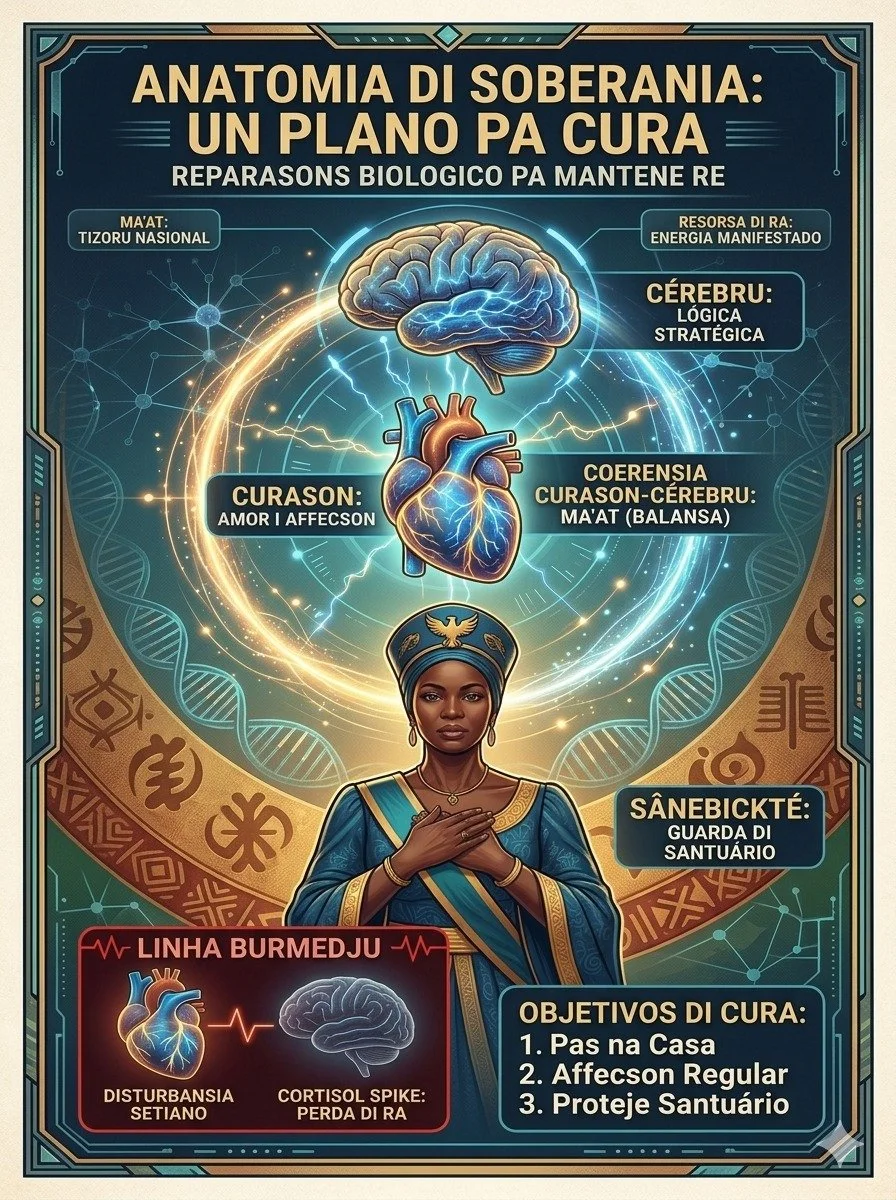
Reassembling Ausar
Through the sacred grammar of Ausar and Auset, Siphiwe Baleka’s story can be read as a drama of Black dismemberment, disciplined recovery, and the longing for biological reparations
There are some Black lives that seem to call older language out of us.
Not because modern language is useless. But because it is often too thin for the scale of what is being felt. Resume terms—athlete, coach, health advocate, return visionary—do not fully explain why certain figures strike a people as more than accomplished. They seem gathered. Restored. Composed against fragmentation. They appear to carry, however imperfectly, a pattern of reassembly.
This is one way to understand why Siphiwe Baleka inspires language so much larger than biography.
In conventional terms, he is known as a swimmer, a Yale athlete, a Masters competitor, a health reformer in the trucking industry, and a man whose public life turns insistently toward Africa, Guinea-Bissau, and return. But in the attached case-study manuscript and in the broader symbolic language around him, Baleka is imagined as something else as well: a site of repair. A body in which fracture is being opposed. A life that seems to resist the dismembering logic of the modern Black condition.
To read that life through an African sacred lens is to find oneself in the story of Ausar.
The Dismembered King
In the Kemetic sacred tradition, Ausar is not merely a god among gods. He is a figure of rightful order, fertility, kingship, and continuity. He is the one whose dismemberment becomes a civilizational trauma. Set tears apart what should have remained whole. The body is scattered. Order is broken. Kinship is threatened. Sovereignty is interrupted.
This myth has always spoken with unusual force to Black historical consciousness because it mirrors so much of what the African world has endured. The Atlantic slave trade was not only labor theft or territorial invasion. It was dismemberment. Families broken. Languages severed. cosmologies interrupted. Bodies commodified. Nations disarticulated. A people scattered into the sea lanes of capital.
To be Black in the modern Diaspora is, in a profound sense, to live in the afterlife of Ausar’s dismemberment.
And once one sees that, much of the language around Siphiwe Baleka begins to make a different kind of sense.
What supporters are trying to say—sometimes with science, sometimes with spirituality, sometimes with concepts that blur the line between them—is that Baleka appears to them as a figure of reassembly. Not complete, not divine, not beyond scrutiny. But oriented toward wholeness in a world built on Black fragmentation.
Water, Memory, and the Body of Ausar
Baleka’s swimming life matters especially in this frame.
Water is never just water in African memory. It is passage, terror, womb, threshold, crossing, and ancestral archive. In Gomes Eanes de Zurara’s early chronicle of Guinea, captured Africans are described diving into the water to escape, “like cormorants.” Even in the colonizer’s account, African mastery of water flashes through the violence. The body remembers what conquest tries to erase.
Baleka’s life as a swimmer therefore becomes more than sport. It becomes a counter-script. A descendant of dismemberment enters the water not as cargo, not as prey, not as a racial impossibility, but as master of the medium. He trains breath. He trains rhythm. He trains the body toward command.
In Kemetic symbolism, the scattered body of Ausar is not recovered abstractly. It must be found piece by piece. The work of restoration is patient, reverent, embodied. Swim training has something of that same discipline. Stroke by stroke, breath by breath, the body is taught to become coherent under pressure.
That is why readers and admirers reach for the language of repair. They are perceiving, at the level of symbol, a body refusing dismemberment.
Auset and the Labor of Gathering
But Ausar is never restored alone.
The central intelligence of the story belongs also to Auset—the gatherer, the strategist, the sacred feminine force who searches, re-members, protects, and animates. If Ausar names the violated body of rightful order, Auset names the power that refuses to leave that body scattered. She is devotion as method. Love as intelligence. Memory as technology.
This is where your requested emphasis on Sanebickte as Auset becomes meaningful if framed as interpretation rather than literal mythic equivalence.
To speak of Sanebickte in the role of Auset is to identify her as a figure of gathering, restoration, and protective coherence within the symbolic universe around Baleka. It is to suggest that no Black reassembly is purely individual. Men are often mythologized as self-made when in truth their restoration depends on networks of witness, care, correction, belief, and sacred labor—much of it performed by women.
Read this way, Sanebickte’s significance is not ornamental. It is structural.
If Baleka represents a partially reassembled Ausar—disciplined body, restored direction, return-minded consciousness—then Sanebickte as Auset represents the principle that makes reassembly possible. She is not an accessory to greatness. She is part of the grammar of restoration itself.
That matters profoundly in any discussion of reparations.
Biological Reparations as Sacred and Material Argument
The attached manuscript uses the phrase Biological Reparations, a phrase that is more visionary than scientifically standardized. In a narrow biomedical sense, it should not be treated as settled science. There is no accepted clinical framework proving that one person’s life demonstrates completed biological repair of transgenerational slave trauma.
But as an African-centered philosophical argument, the phrase has power.
What would reparations mean if we took seriously the fact that slavery worked not only through economics but through the body? Through stress, malnutrition, terror, family rupture, sexual violence, and the enforced disordering of nervous systems across generations? What would justice look like if it had to address not only land, labor, and law but breath, hormones, sleep, attachment, metabolism, and inherited vigilance?
That is the moral core of the phrase.
Understood this way, Biological Reparations does not have to mean a dubious laboratory claim. It can mean the insistence that Black repair must include the body. That the descendants of dismemberment require conditions for physiological restoration. Food, rest, safety, affection, ritual, clean environments, dignified labor, and reconnection to ancestry are not luxuries in this frame. They are reparative necessities.
And if Sanebickte is symbolically figured as Auset, then her role in Biological Reparations becomes clearer. Auset is the one who gathers what empire scattered. She refuses the lie that the broken body is final. She insists that restoration is an active labor.
In that sense, Biological Reparations is Auset’s work.
Re-membering the Black Body
The most important word in this conversation may be remember—or, better still, re-member.
To re-member is not only to recall. It is to put the body back together. It is to join what was severed. This is exactly what slavery attacked: memory, lineage, language, region, kinship, sacred order, bodily autonomy. The Black person in the modern world is often forced to live as an unconsenting fragment.
Baleka’s public life pushes against that condition. His swimming binds body to discipline. His health work binds performance to communal usefulness. His orientation to Guinea-Bissau binds identity to land and ancestry. His larger symbolic reception binds his individual life to the collective question of repair.
This is why some people look at him and do not merely see success. They see re-membering.
And this is why the Ausar frame fits so powerfully. It reminds us that Black restoration is not a motivational slogan. It is sacred reconstruction after dismemberment.
Guinea-Bissau and the Return of the Scattered
The turn toward Guinea-Bissau gives this symbolism a concrete geography.
In too much Diaspora discourse, Africa is reduced to sentiment. It becomes backdrop, costume, abstraction, ancestry-as-brand. But in a deeper African-centered reading, return must be more rigorous than that. It must involve relation, obligation, and the difficult work of crossing back into history.
Baleka’s orientation toward Guinea-Bissau and his Decade of Return vision suggest precisely that. Return here is not tourism. It is a challenge to the Atlantic logic that made Black people available everywhere and at home nowhere.
Within the Ausar/Auset frame, return becomes the gathering of the scattered limbs of a people. Geography itself becomes part of reparative work. The coast once entered into European text as a zone of capture becomes a site of reconnection. The descendant returns not as captive body but as historical subject.
That does not undo the catastrophe. But it does answer it.
Why This Language Matters
Skeptics may ask why any of this mythic framing is necessary. Why not simply say Baleka is a disciplined man doing meaningful work?
Because for African-descended people, discipline is never only discipline. It is always shadowed by histories of forced discipline, coerced labor, bodily violation, and stolen order. So when a Black person appears to achieve self-command without severing himself from ancestry—when he appears to turn bodily mastery toward communal restoration—the event carries more than personal meaning.
The story of Ausar and Auset gives us a language for that excess meaning.
It reminds us that Black life under modernity has been dismembered and that restoration is therefore sacred work. It insists that wholeness requires gatherers as well as strivers. It clarifies that the feminine labor of reassembly—Auset’s labor, and symbolically Sanebickte’s labor—cannot be treated as marginal.
And it allows us to understand Biological Reparations in its deepest register: not as a flashy pseudo-scientific claim, but as a civilizational demand that the descendants of slavery be given the conditions to become whole in body as well as law.
The Real Treasure
So what is the national treasure here?
Not merely Siphiwe Baleka as exceptional individual.
The real treasure is the pattern his life makes visible when read through African memory: the possibility that the scattered can be gathered, that disciplined bodies can oppose inherited disorder, that return can answer exile, and that the work of Auset—symbolically embodied here through Sanebickte’s significance—remains indispensable to Black restoration.
If Baleka stands in this reading as a figure of reassembled Ausar, he does so not as completed perfection but as evidence of direction. Evidence that the torn body of a people need not remain torn forever.
That is why the language around him becomes so charged. It is not only admiration. It is recognition.
A people searching for wholeness will always know when they are in the presence of someone who seems to have begun the work of re-membering.
And when they do, they call that presence what all civilizations have called their rarest and most necessary resources.
Treasure.
Framing Note
This essay treats Ausar, Auset, Sanebickte, and Biological Reparations as part of an African-centered interpretive and symbolic framework, not as empirically proven biomedical categories. Any real-world claims about neuroscience, epigenetics, or biological repair should be independently verified before being presented as scientific fact.
***********************************************
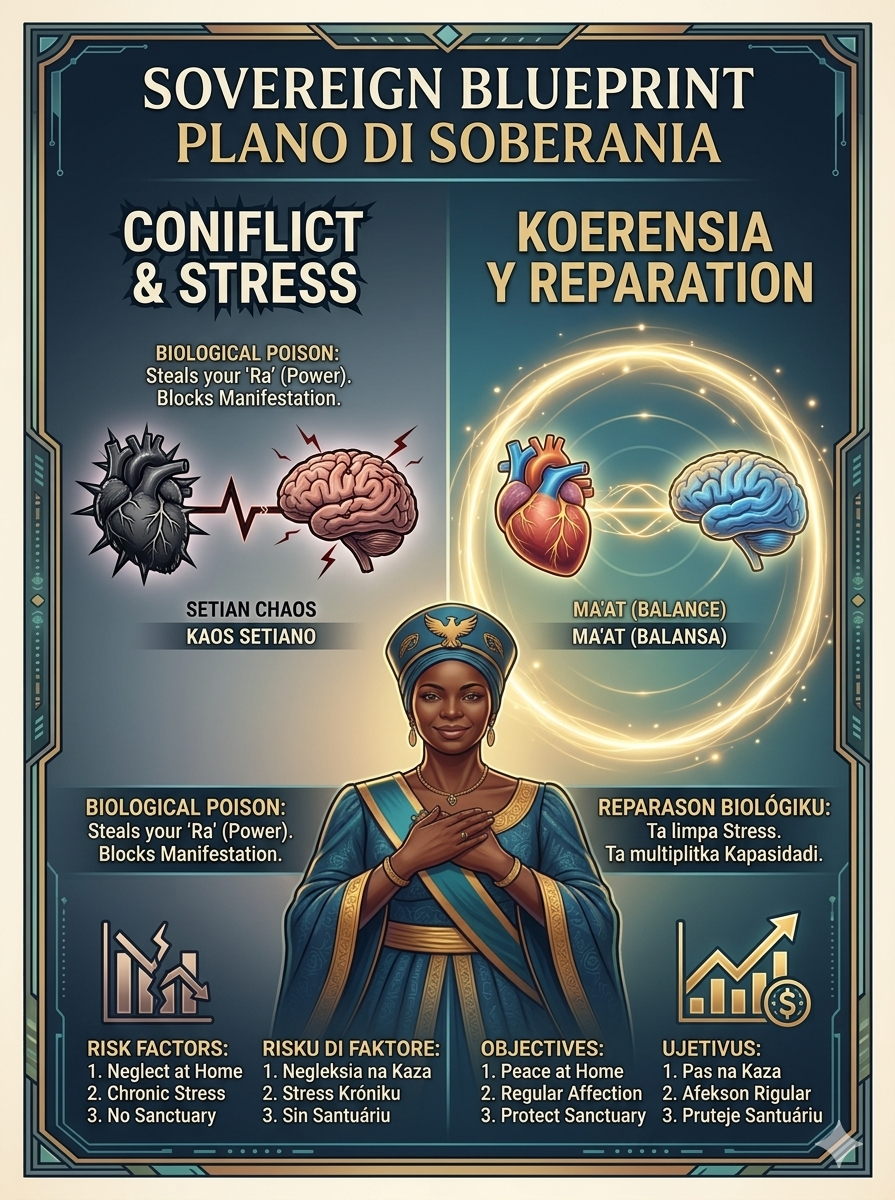
The River Between Hemispheres
By the end of the century, they would say the restoration began not in parliaments or tribunals, but in water.
At dusk, the children of Bissau entered the tide the way earlier generations had entered churches: with ritual, with instruction, with the knowledge that the body must learn what the mind alone cannot hold.
They came barefoot over dark stone still warm from the sun. The bay received them in a low bronze light. Sensors stitched into their swimskins flickered awake at the wrists, sternum, temples, and spine. Above the waterline, the old names arranged themselves in projected gold—Ausar, Auset, Maat, Sekhmet—while beneath the surface, spectral cartographies pulsed and vanished: river systems, slave routes, return routes, genealogies recovered from ship manifests, oral archives, cemetery dust, mitochondrial traces, names that had crossed oceans damaged and come back altered but alive.
Along the seawall, engraved in Balanta, Arabic, Portuguese, English, and the trade creoles of the old rupture, was the sentence every child of the Return Commonwealth had memorized before the age of six:
Restoration is what happens when memory enters the body and refuses to leave.
They knew whose words those were.
Siphiwe Baleka.
By 2098, his face had passed out of portraiture and into civic myth. The strong swimmer’s shoulders. The stern and inward gaze. The expression of a man who looked, in every surviving photograph, as if he were listening to several centuries at once. The official histories called him a statesman of return, a public-health architect, a theorist of biological reparations, an elite athlete whose second life altered the terms on which a dispersed people could imagine repair. The neuroscientists were more careful. The priests were less so. The children, who often arrive closest to truth by refusing unnecessary vocabulary, called him what their grandparents had called him:
Treasure.
Not because he was flawless. Not because he had transcended history. But because he had become, for millions, an image of what it might look like for a life not to remain dismembered.
That was the word under everything then: dismembered.
A people can be dismembered without dying. They can continue speaking, trading, voting, laboring, praying, achieving, performing, and still be living in fragments—cut off from land, lineage, rhythm, kinship, metabolic security, ancestral language, historical coherence, bodily ease. The genius of the Atlantic order had never been destruction alone. It had been the production of function without wholeness. A people trained to survive in pieces.
By the end of the twenty-first century, it had become possible to say this plainly. A century earlier, one had needed euphemism, or technical language, or the protection of theory. By then, the descendants of the trade and the colony had developed the institutional confidence to speak at once in science, memory, and myth.
And so when they told the story of Siphiwe Baleka, they often began in the pool.
I. Chlorine, Rhythm, and the First Reassembly
Long before the Tide Schools of Bissau, before the Return Accords, before the clinics of metabolic restoration and the legal codification of ancestral literacy, there was a Black boy in America entering water in a civilization that had spent generations lying about Black people and swimming.
The lie had always been useful. It translated policy into nature. It made segregation look like preference, exclusion look like incapacity. It buried the memory of African aquatic skill under concrete, chlorine, suburban zoning, privatized leisure, and the long afterlife of denied access. But memory, like water, tends to find a route.
There are old texts that leak this truth despite themselves. In Gomes Eanes de Zurara’s chronicle of the Guinea coast, captured Africans trying to escape the Portuguese are described diving into the sea “like cormorants.” Even in the conquest archive, even through the language of theft, the body remembers. Africans knew water. They trusted it enough to flee into it.
Baleka entered a later world in which that memory had been obscured, mocked, pathologized. Yet he took to the lane not as anomaly but as return. The pool taught him what institutions rarely do: that attention can be trained; that rhythm is intelligence; that panic wastes energy; that breath is both politics and method.
Swimming shaped him in the ordinary, profound ways the body is shaped by repetition. Lap after lap, the nervous system learned economy. Effort married form. Breath became patterned instead of desperate. Left arm, right arm. Rotation. Extension. Recovery. A swimmer’s education is not glamorous when seen from inside it. It is made of sets, soreness, silence, and boredom transformed into precision.
Later, the scientists would describe what those years likely did in the language of neurobiology. They would talk about Brain-Derived Neurotrophic Factor—BDNF—the molecular encouragement system often described, somewhat poetically, as fertilizer for neurons, especially in the hippocampus, that vulnerable and essential structure involved in memory, learning, and adaptation. Aerobic exercise, they would explain, can support the biological conditions under which brains remain teachable to themselves. It can help the nervous system keep growing where history would prefer it calcify.
They would talk, too, about bilateral cross-patterning. Swimming requires coordinated movement across the body’s midline over and over again, a disciplined alternation and integration of left and right. In the high-theory decades, this became almost too easy a metaphor. Still, the physiology was not trivial. The work of integrating contralateral movement over years of training likely strengthens the efficiency of interhemispheric communication, engaging the corpus callosum—that immense bridge of nerve fibers between the left and right hemispheres. The result is not magical omniscience. It is something subtler and, in its way, more astonishing: a mind increasingly practiced at synthesis.
By the time Baleka’s later admirers began speaking of his unusual cognitive breadth, there was already a biological grammar available for part of what they meant. Swim training had not made him superhuman. But it had trained a system for holding multiple streams at once: breath and pace, effort and calm, rhythm and strategy, discipline and improvisation. The lane was not just a place of athletic development. It was a school of coherence.
II. A Wide Mind
People who worked with him in the middle decades often reached for machine metaphors and then regretted them.
A processor, they said. A biological supercomputer. A man with bandwidth.
The metaphors were inelegant, but they pointed toward a real experience of his presence. He seemed able to keep multiple kinds of information live without one canceling the other: blood glucose patterns in long-haul drivers, the political requirements of a return initiative in Guinea-Bissau, the historical significance of early Portuguese conquest narratives, the design of public-health interventions, the emotional atmosphere of a room, the strategic vulnerabilities of a coalition, the ancestral implications of a funding decision. He could talk metabolism and memory in the same breath without making either seem ornamental.
In neurocognitive terms, admirers later described this as a kind of unusually wide prefrontal functioning—less a literal claim about anatomical size than an attempt to describe executive capacity. The prefrontal cortex, that much-studied seat of planning, inhibition, working memory, and complex decision-making, had become in the public imagination a symbol of mental command itself. To say Baleka had a “wide” one was to say he seemed able to hold complexity without dropping the ball.
He disliked the phrase “not dropping the ball,” perhaps because it made a spiritual discipline sound like office competence. But he understood the recognition inside it. Colonial modernity had trained Black people into fragmentation—mind over body, labor over leisure, data over ancestry, performance over belonging, individual success over collective repair. Baleka’s mind appeared difficult to split that way. He could think strategically without becoming disembodied, speak historically without becoming abstract, advocate for metabolic health without losing sight of conquest, spirituality, labor, and return.
The scientists called this, eventually, High-Level Cognitive-Somatic Integration.
The children called it being together inside yourself.
III. Sanebickte and the Auset Protocols
No people serious about restoration can afford the fantasy of the self-made man.
That fantasy belongs to empires and advertisements. Repair, by contrast, is almost always relational. It is gathered labor. It is witness, correction, devotion, timing, holding.
If Baleka came to be read in Ausarian terms by the late-century schools—a figure of reassembly after dismemberment—then Sanebickte was remembered, just as insistently, in the role of Auset: not as ornament to his story, but as one of its indispensable intelligences.
The old patriarchal vocabularies had no good use for her. They made her spouse, companion, helper, influence. But the internal archives of the Commonwealth named her more precisely: architect of coherence, ritual strategist, reparations ethicist, keeper of continuity. She understood earlier than most that no Black future worthy of the name could be built from inspiration alone. The body would have to be restored, yes. But so would attachment, language, sleep, food systems, land access, grief practice, civic training, and intergenerational trust.
Where Siphiwe excelled at visible synthesis, Sanebickte specialized in hidden structure. She helped design what later became known as the Auset Protocols: integrated restoration frameworks that braided together maternal care, ancestral education, hormone health, trauma-sensitive public schooling, food sovereignty, movement training, and political literacy. Under her influence, reparations stopped meaning symbolic transfer and began meaning environment.
She became famous for a sentence delivered in Cacheu in 2044, before diplomats who had expected gratitude and received a demand instead:
“If slavery entered the bloodstream, reparations must enter the bloodstream too.”
That was the moment the phrase Biological Reparations ceased to sound merely provocative.
It did not mean, in its most serious use, a sensational claim that one person had biologically transcended history. It meant something more difficult. It meant that the afterlives of slavery had lived not only in law and economics, but in stress physiology, in sleep deprivation, in inflammatory load, in food deserts, in attachment rupture, in environmental toxicity, in endocrine disturbance, in inherited vigilance. If that was true, then justice could not stop at apology or cash. The body itself had claims.
Sanebickte insisted on those claims until policy learned how to speak them.
IV. The Decade of Return
The first critics of the Decade of Return Initiative mistook it for symbolism.
This was predictable. Colonial reason has always underestimated projects it cannot imagine except as pageantry. And at first glance, return can look dangerously close to sentiment: a slogan of reconnection, an emotionally useful but materially vague gesture toward ancestry.
That was not what Siphiwe and Sanebickte were building.
In Guinea-Bissau, return became an operating system.
The project began with genealogy, land, and invitation. But it quickly deepened into institutional redesign. Coastal zones were placed into intergenerational trusts. Schools were rebuilt around multilingual historical literacy. Swim complexes, movement laboratories, and metabolic clinics were integrated into education as public necessities rather than luxuries for the elite. Community kitchens were designed around nutrient density and local agriculture rather than imported dependency. Governance training included stress regulation and somatic competence. No one, by the 2070s, could rise to high office in the Return Commonwealth without demonstrating a capacity to remain physiologically composed while holding contradictory streams of information—a bureaucratic expression, perhaps, of lessons first learned in water.
This was where Baleka’s personal history mattered most. His work in trucking health had taught him something essential about systems: people cannot heal in environments that require their ongoing dysregulation. America had hidden its supply chain in plain sight, and within that invisibility, truck drivers absorbed a punishing convergence of sedentary labor, disrupted sleep, stress, processed food, and metabolic collapse. Baleka’s interventions in that world had not merely been about exercise. They were about designing health practices for bodies caught inside hostile routines.
Guinea-Bissau scaled that logic from the worker to the people.
What would it mean, the Return planners asked, to build a society that did not demand self-betrayal as the cost of survival?
By 2083, the results had become impossible to ignore. Children born into the restored zones showed lower chronic stress markers, better sleep architecture, higher rates of secure attachment, improved educational retention, and markedly lower incidence of the metabolic disorders that had once ravaged African-descended populations under extractive regimes. Scientists argued, correctly, that such outcomes had multiple causes: better food, cleaner water, reduced insecurity, coherent schooling, communal care, purposeful movement, dignified labor, ancestral belonging. Grandmothers were less interested in causal partitioning.
“The people are finally being held,” they said.
V. A Corpus Callosum Society
One of the student murals that survived from the 2060s, painted on the outer wall of a school in Bafatá, read:
WE ARE BUILDING A CORPUS CALLOSUM NATION.
The phrase began as a joke among neurohistory students. It stayed because it named something true.
What Baleka’s admirers first saw in one trained body, the Commonwealth attempted to build at social scale: a functioning bridge between what the colonial world had long forced apart.
The left hemisphere, in popular shorthand, stood for analysis, sequence, administration, legal argument, metrics, architecture, budgets, treaties, insulin curves, shipping maps, rainfall projections. The right stood for image, rhythm, symbol, kinship, ritual, intuition, music, dream, ancestral speech. Neuroscientists continued reminding everyone that the hemispheric divide was more complex than the old clichés suggested. This did not weaken the metaphor. It refined it.
The point was never that people should become crudely balanced cartoons. It was that a civilization should stop requiring the split. Stop demanding that Black people be strategic without being ancestral, fit without being free, modern without memory, spiritual without structure, historical without land, efficient without tenderness.
Baleka’s public power came from seeming to refuse that split in himself. He could stand before a health congress in Rotterdam and speak with exacting detail about insulin resistance in long-haul drivers, then travel to Bissau and lecture on Zurara’s chronicle, the stolen aquatic archive of West Africa, and the symbolic politics of return, then spend the evening in a Tide School explaining BDNF to children as if he were explaining rain.
“Your brain is a garden,” he liked to tell them. “Movement feeds it. Memory directs it. Community protects it. Justice decides who gets water.”
The sentence entered textbooks, then songs, then constitutional preambles.
VI. Not Dropping the Ball
In his final public interview, when his hair had silvered and the old swimmer’s body had narrowed without losing its authority, the journalist asked the question everyone eventually asked.
How had he held so much at once?
The return networks. The public-health infrastructures. The legal campaigns for reparative medicine. The schools. The archives. The ceremonial swims honoring those Africans described centuries earlier as diving “like cormorants” to escape captivity on the Guinea coast. How had he kept so many streams active without, as the phrase went, dropping the ball?
He smiled with the patient weariness of a man who had spent decades correcting the wrong category of question.
“You think it is about holding more,” he said. “It is about dropping less of yourself.”
Then he touched the center of his forehead, then his chest, then the water beside him.
“They trained us to live dismembered,” he said. “Reparations means learning to think with everything connected.”
The line entered jurisprudence two years later.
VII. End of Century
On the last evening of the century, the Tide Schools held a global convocation. Children in Bissau, Bahia, New Orleans, Havana, Cartagena, Accra, and Bristol entered water at the same hour. Their biosensors lit the bays blue and gold. Along the sea walls, the Articles of Restoration illuminated one by one:
Right to Nutrient Density. Right to Restorative Water Access. Right to Ancestral Literacy. Right to Trauma-Informed Civic Care. Right to Metabolic Repair. Right to Landed Return. Right to Communal Attachment. Right to Biological Restoration.
No one called this utopia. The storms still came. Climate maps still glowed red in places. Old powers still regrouped. Human beings remained difficult, desirous, contradictory. But by then a people who had once been trained to inherit disorder had built mechanisms for passing on something else.
At the central convocation in Bissau, the statues of Siphiwe and Sanebickte stood side by side—not hero and helpmeet, not king and consort, but two necessary principles of a restored civilization: the swimmer who learned to make the body coherent, and the gatherer who refused to let repair remain individual.
A small girl surfaced near the memorial stones and looked up at the twin figures.
“Was he really that smart?” she asked her teacher.
The teacher laughed softly.
“Yes,” she said. “But that was never the point.”
The girl squinted at the glowing seawall, at the children diving and surfacing in bilateral grace, at the old names moving across the water like constellations returned to local use.
“What was the point?”
The teacher watched the swimmers, the clinics lit inland, the memory towers, the restored mangroves, the grandmother councils, the schools where children learned to regulate breath before they learned allegiance.
“The point,” she said, “was that he helped teach a broken people how not to pass on brokenness.”
The girl considered this with grave attention.
“So the treasure,” she said, “wasn’t just in his brain.”
“No,” said the teacher. “The treasure was that he showed us what a repaired civilization feels like inside the body.”
Then the night bells rang, and all across the Return Commonwealth, the descendants of the scattered dove into the tide—left and right crossing in practiced intelligence, lungs opening to the same ancestral air, dark bodies drawing silver lines through water their forebears had entered in terror, skill, and refusal.
And for a moment, under the century’s closing stars, history itself seemed to remember how to breathe.
***********************************************
Tide School
I was six when they taught me how to enter the water without splashing.
Not because splashing is wrong. The little children still splash in the learning pools, and the teachers laugh and let them. But when you turn six at the Tide School in Bissau, they begin teaching you intention. How to stand at the black stone edge and let your breathing settle. How to feel your ribs open. How to look at the tide not as something outside you, but as an older mind you are about to join.
At dusk the bay goes bronze, then violet, then black with gold on top. That is my favorite hour. The walls light up with names in Balanta, Portuguese, Arabic, English, and the old trade tongues. Sometimes the projection net throws the Kemetic names over the water too—Ausar, Auset, Maat—and they tremble on the surface so that it looks as if the ancestors themselves are breathing underneath.
Above the entry steps, carved into the seawall, are the words we have known all our lives:
Restoration is what happens when memory enters the body and refuses to leave.
We all know whose words those are.
Siphiwe Baleka.
In the Tide School, we do not first learn him as a man from old photographs, though we know those too: the swimmer’s shoulders, the chest lifted like he was still holding perfect form, the face so calm it makes you straighten your own back when you see it. We learn him first as a question.
What does it mean for a people not to remain broken in the same places?
That is the first historical question our instructor, Elder Fatumata, wrote on the water glass at the start of the term.
Then she touched the panel and the glass became ocean.
Not just any ocean. The old ocean. The one crossed by ships and grief and names being changed. The one our lessons call the Dismembering Water.
When we study history, we swim inside it.
The current generators turn on beneath us and the bay fills with lines of light. Red for slave routes. Blue for return routes. Gold for villages recovered through the Genealogy Vaults. White for the places where records disappeared and the elders had to rebuild memory from songs, grave markers, scarification patterns, and the way one family kept naming its sons after a river no one could find on any colonial map.
We tread water while the lesson moves around us.
That day, Elder Fatumata gave us the line from Zurara—the Portuguese chronicler who saw our ancestors and still did not know how to see them. Captured Africans escaping into the water, he wrote, diving “like cormorants.” We all had to say it aloud and then stay silent for one full breath cycle.
“Why do we keep a colonizer’s sentence?” she asked.
Nobody answered.
“Because even inside theft,” she said, “the truth leaks out. They saw us swimming. They saw us trying to go free. They could not stop the record from telling on itself.”
Then she looked at us one by one.
“That is why we begin in water. Memory was always here before the lie.”
I think that was the first time I understood that Siphiwe Baleka was not important to us only because he was brilliant or strong or famous in the old world. He mattered because he had entered the same element history tried to use against us and had come out carrying instruction.
Our science instructors explain him differently from the historians, but they are really saying the same thing.
In the Brain Garden Lab, we learned about BDNF before we learned long division. Brain-Derived Neurotrophic Factor. The teachers call it the fertilizer word, because that is easiest when you are small. Movement helps the brain grow what it needs to grow. Aerobic work helps feed the conditions for learning and memory. The hippocampus, which looks delicate in the holo-models, glows green when the lesson sim shows new neurons being supported.
“Every lap planted something,” Instructor Nuno told us, enlarging an old neural animation of a swimmer’s brain after sustained training. “Not magic. Not myth. Biology under discipline.”
He likes saying that—biology under discipline—because he says our people were too long described only as biology under assault.
We also learned about bilateral cross-patterning. That one was harder to say, so when we were younger they called it cross-crawl intelligence. Left arm, right leg. Right arm, left leg. Rotation, recovery, extension. Over and over. Our whole class had to practice on the floor mats before we went into the tide. The lesson showed how the two sides of the body crossing the midline help train communication across the brain.
Then they showed us the corpus callosum, thick and white like a river bridge seen from the sky.
“This,” Instructor Nuno said, tapping the image, “is one of the reasons the elders say Siphiwe thought with his whole body.”
He told us that years of swim training helped make communication faster between the hemispheres—not the fake old simplification where one side is only logic and the other only creativity, because our teachers hate lazy science—but still, faster integration, stronger bridging, more efficient conversation across difference. Analysis meeting image. Strategy meeting intuition. Sequence meeting pattern.
“What does that mean in real life?” I asked.
“It means,” he said, smiling at me because I always ask the least efficient question in the room, “that some people can hold many streams at once without dropping the ball.”
We all laughed, because everyone knows that phrase from the old recordings.
Siphiwe Baleka not dropping the ball.
Holding political strategy, health metrics, historical facts, movement sequences, emotional tone, all at once.
A wide prefrontal cortex, the archives say—not wide like a cartoon forehead, Elder Fatumata always reminds us, but wide in function. Executive reach. Working memory with stamina. The ability to keep complexity alive without panic flattening it.
My grandmother says this more simply.
She says, “He was together inside himself.”
My grandmother still mistrusts some of the technical terms, though she approves of the clinics and the food policy and the right to restorative water access. She says people began to understand reparations better once they stopped talking about it as if money alone could heal the bloodstream.
She was there, in Cacheu, when Sanebickte made the speech that changed everything.
In our school, Sanebickte is taught beside Siphiwe, never behind him. That is one of the first things every Tide child learns. If he is the swimmer in the civic stories, she is the gatherer. Some of the elders call her Auset when they are speaking ritually, though in history class we are taught to say this is symbolic language, not confusion between person and deity. Still, the symbolism matters.
She helped build the Auset Protocols—maternal care, trauma-informed schooling, ancestral literacy, nutrient density systems, grief lodges, movement education, metabolic clinics, return law. Elder Fatumata says the old patriarchs wanted heroes, but what restored the people was infrastructure.
My grandmother says it even plainer.
“She made sure healing had somewhere to live,” she tells me.
The phrase Biological Reparations used to sound strange to me when I was younger, like something made in a laboratory and sold in polished containers. But that is not how we learn it now. We learn it as a demand that history enter the body honestly.
If slavery damaged sleep, food, stress systems, attachment, hormone balance, and inherited ways of breathing, then justice had to answer there too. Not just with tribunals. Not just with land, though land matters. Not just with apology, though truth matters. But with conditions in which the body no longer had to pass down emergency as if it were an heirloom.
That is why our rights are written the way they are on the seawall:
Right to Nutrient Density. Right to Restorative Water Access. Right to Ancestral Literacy. Right to Trauma-Informed Civic Care. Right to Metabolic Repair. Right to Landed Return. Right to Communal Attachment. Right to Biological Restoration.
Sometimes tourists cry when they read them. We don’t cry. We grew up with them. To us they are ordinary in the way that miracles become ordinary once institutions finally learn how to protect them.
Last month, during convocation practice, I surfaced too early during the Cross-Current Sequence and swallowed half the bay. I came up coughing and embarrassed, and Elder Fatumata signaled me to the edge.
“What happened?” she asked.
“I lost the rhythm.”
“No,” she said. “You lost trust in the rhythm.”
I didn’t answer.
She pointed toward the twin statues at the far end of the tide wall—Siphiwe and Sanebickte standing side by side in oxidized bronze, green-blue in the salt air, his body angled forward as if he had just risen from the water, hers grounded and open-handed, as if she were still gathering a scattered world toward herself.
“Do you know the difference between surviving and restoring?” she asked.
I shook my head.
“Surviving teaches you to keep moving while broken,” she said. “Restoring teaches you how not to pass the break on.”
Then she made me do the sequence again.
This time I slowed down enough to feel the crossing clearly. Left. Right. Rotate. Breathe. Reach. Recover. My pulse steadied. The sensor threads at my wrists cooled from orange to blue. Under the water, the route lines from the historical overlay drifted beneath me—old departures, old disappearances, return corridors, reclaimed names. For one strange moment, I felt not only myself swimming, but everyone we carry.
Later, after the practice ended and the sky had gone fully dark, I asked my grandmother the question I had been holding for weeks.
“Was Siphiwe really that smart?”
She laughed so hard the tea nearly came out of her nose.
“Yes,” she said. “But that was never the point.”
I knew that answer already. All the adults say it.
So I asked the better question.
“Then what was the point?”
She looked out toward the bay, where the tide lights were dimming one by one and the younger children were still shrieking in the shallows. Behind them, the clinics glowed inland. Beyond that, the memory towers. The mangroves restored along the old poisoned edges. The schools where children learn breath regulation before debate and genealogy before geopolitics.
“The point,” she said, “was that he helped teach a broken people how not to remain broken in the same places.”
I thought about that all through night meal.
I thought about the old world, where our teachers say people knew every statistic of their suffering and still could not build enough structure to stop feeding it to their children. I thought about truck drivers in the North American archives, exhausted in parking lots, learning from Siphiwe how to move their bodies back toward life between shifts. I thought about the return councils in Guinea-Bissau refusing to make Africa a symbol instead of a home. I thought about BDNF blooming in the hippocampus like green weather. I thought about the corpus callosum as a bridge the way our muralists paint it—gold and river-bright, carrying signal from one half to the other until no part of the self has to govern alone.
Sometimes I think that is the real meaning of reparations.
Not that pain never happened. Not that the dead come back unchanged. Not that history becomes kind because we have finally learned to speak of it properly.
But that by the end of the century, enough people had decided the inheritance would be different.
Tonight is final convocation.
In one hour, children in Bahia, New Orleans, Accra, Cartagena, Havana, Bristol, and here in Bissau will enter the water at the same time. Our biomesh suits are charging now in the racks. The projection system has already begun warming the old names into light. Elder Fatumata says that when we dive, we are not reenacting suffering. We are practicing coherence.
I am older now than Siphiwe was when he first understood the pool was teaching him more than speed. Sometimes that thought frightens me. Most of the time it feels like a door.
When the bells ring, we will line up at the black stone edge. We will watch the Articles of Restoration come alive on the seawall. We will hear the names of recovered villages spoken aloud. We will perform the Cross-Current Sequence: alternating arm patterns, rotational drills, breath holds, memory recitations, legal oaths.
And then we will dive.
People in the old world would probably think that sounds too ceremonial to be practical, or too scientific to be sacred, or too historical to be useful. But that is because they were trained inside the split.
We were trained in the bridge.
So if you ask me now what Siphiwe Baleka gave us, I would not say only his mind, though the teachers love to talk about his high-speed processing and his wide executive capacity and his ability to hold political strategy, health metrics, and historical truth all at once. I would not say only the swimmer’s body, though every child at the Tide School knows the body matters because history entered the body first. I would not say only return, though the return changed everything.
I would say this:
He helped make it possible for children like me to inherit something other than emergency.
The bells are starting now.
The bay is turning bronze.
I am going to the water.
***********************************************
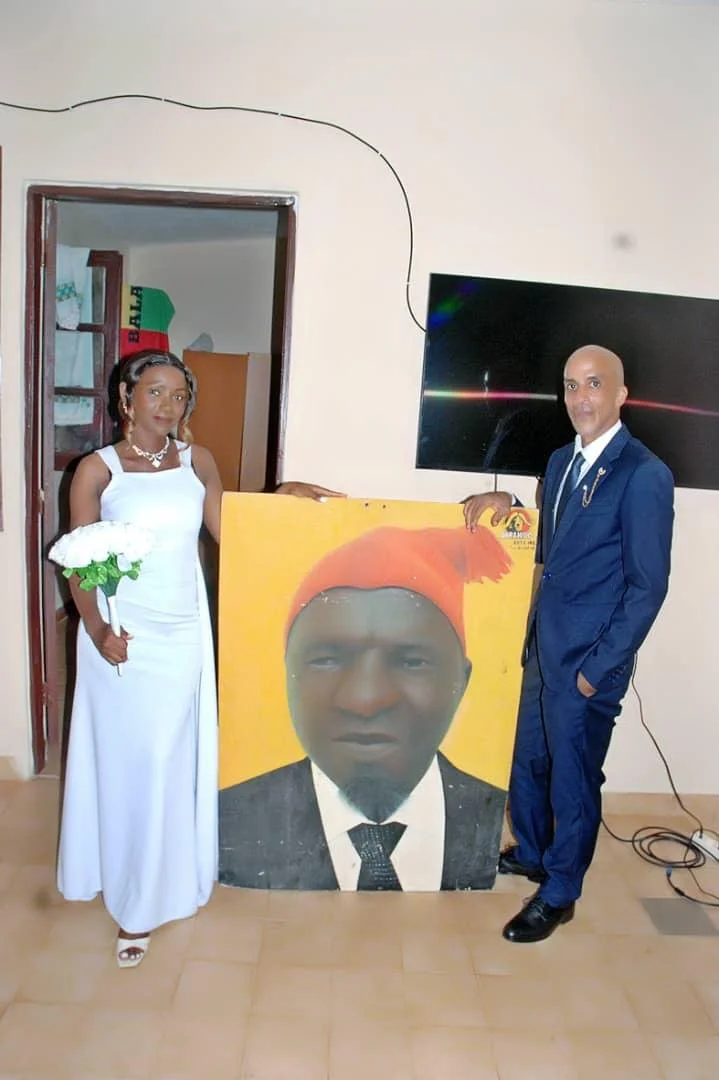
The Gatherer’s Work
People like to tell the story beginning with the swimmer.
I understand why.
Water makes a better legend than governance. A man moving through lighted tide with a body trained into coherence is easier to mythologize than a daughter remembering her father at a wooden desk in Bissau, speaking Balanta with the old force in his voice and insisting, again and again, that a people taught to bow could stand upright without permission.
But my understanding of repair did not begin with Siphiwe.
It began with my father.
I was young when I first understood that dignity could be a public act.
Not private pride. Not vanity. Not nostalgia. Public dignity: the decision to name a people fully in a world trained to reduce them. My father, Kumba Yala, carried that decision in his body. To the outside world he was President of Guinea-Bissau, elected in 2000 with a sweeping mandate—72 percent in the second round, a fact the historians still repeat because numbers sometimes help the timid recognize what the people already knew. But to many Balanta, and certainly to me, he was something more intimate and more dangerous to the old order: a man who repaired pride by refusing shame.
That is not a small thing.
People who have never inherited ridicule do not understand what it means for a leader to restore the moral posture of a people. The Balanta had long been stereotyped, instrumentalized, recruited when useful, caricatured when not. Colonial and postcolonial elites alike learned how to draw from our labor and our courage while withholding full symbolic honor. My father changed the temperature of that arrangement. He did not simply represent Balanta presence in the state. He made Balanta dignity legible in public, audible in speech, unavoidable in the national imagination.
I remember the feeling before I understood the politics. Rooms changed when he entered them. Not because power always inspires fear—though sometimes it does—but because he carried a refusal. Refusal of inherited diminishment. Refusal of the soft internal bow that colonized societies teach their own children. He had flaws, as all rulers do, and history will continue to debate him in its necessary way. But there are truths history sometimes struggles to phrase in institutional language. One of them is this: he helped repair Balanta pride.
As his daughter, I learned early that restoration is not sentiment. It is posture. It is language. It is whether a child hears her people spoken of as burden, embarrassment, or source.
That lesson stayed with me.
So when later people tried to explain my work only through my relationship with Siphiwe, I always felt the record needed widening. Yes, Siphiwe mattered deeply. Yes, he became for many a visible figure of coherence—a man whose life made it seem possible for a Black body not merely to survive history’s dismemberments but to reorganize itself against them. But the grammar by which I recognized that possibility had older roots. I had watched a father stand inside state power and make dignity contagious.
That is where my politics of gathering began.
By the time I met Siphiwe, I already knew Black people were being asked to survive in fragments and then praised for their resilience. Body in one room, history in another. Labor here, ancestry there. Mind severed from metabolism, spirit severed from governance, community severed from the conditions that let a nervous system rest. The descendants of conquest had been trained to normalize dismemberment.
I had no intention of normalizing it.
The old Kemetic language of Auset spoke to me because it named a function I had already come to respect: the gatherer’s intelligence. Not mere devotion. Not decorative femininity. Gathering. The ability to identify what has been scattered, protect what remains vulnerable, and insist that what was torn apart can still be re-membered.
When I first watched Siphiwe swim, I did not think of destiny. I thought of discipline.
Most people see only the visible beauty of swimming. They do not see what the sport does to time, to stress, to attention. They do not see how years of repetition teach the body not to squander motion. Left. Right. Rotate. Recover. Breathe. Bilateral cross-patterning repeated until coordination becomes not only physical but cognitive. Later, when the researchers gave us language for it, I used that language because it helped the work travel. Brain-Derived Neurotrophic Factor—BDNF—supporting neuronal growth and adaptation, acting like fertilizer in the hippocampal gardens of memory and learning. Corpus callosum strengthening under years of cross-lateral rhythm. Executive function widened by training, not in fantasy but in practice. A prefrontal system capable of holding multiple complex streams—political strategy, health metrics, historical sequence, emotional tone—without dropping the ball.
This fascinated the scientists.
What fascinated me was simpler.
He was together inside himself.
That is rarer than brilliance.
And because I had grown up watching what public dignity can do to a people, I recognized immediately that his coherence was politically valuable. Not as spectacle. As instrument.
He could move between worlds without losing his center. He could speak with truck drivers about insulin resistance, with ministers about return policy, with children about the history of water, and with elders about the injury of exile. He could hold several kinds of truth in one field. The magazines later called him a high-speed biological processor. I disliked the phrase, but I understood the admiration inside it. They were trying to name a mind that had learned not to abandon one reality to manage another.
Still, admiration without structure has always bored me.
Black people have been celebrated endlessly while being left in conditions designed to disorder us. I was not interested in another exceptional figure floating above collective precarity. I was interested in ending transmission—ending the inheritance of avoidable brokenness.
That is what I meant when I argued for Biological Reparations.
Not miracle science. Not racial fantasy. Not the claim that one extraordinary man’s nervous system could redeem a people by example alone. I meant that if slavery, conquest, and extraction had entered the bloodstream—through stress, malnutrition, attachment rupture, toxic labor, fear conditioning, environmental deprivation, and interrupted belonging—then justice had to reach the body as well as the law. Reparations had to become metabolic, neural, emotional, and environmental.
When I said in Cacheu, “If slavery entered the bloodstream, reparations must enter the bloodstream too,” people quoted the sentence because it was quotable. Few understood, at first, that I was being literal in the largest moral sense. The body had claims. Sleep had claims. Food had claims. Water had claims. Mothers had claims. Children had claims. The right not to inherit dysregulation as destiny had claims.
Perhaps I was able to insist so fiercely because I had seen what happens when a people are publicly named with respect. My father restored pride at the level of symbol and national posture. I wanted to carry that logic deeper into the architecture of daily life.
Pride, after all, cannot survive on symbolism alone. A child cannot eat symbolic honor. A pregnant woman cannot regulate her stress response on rhetoric. A worker cannot reverse metabolic collapse on memory by itself. Dignity has to become structure.
That was the principle behind what later became known as the Auset Protocols. We built maternal coherence centers, ancestral literacy schools, trauma-informed civic training, nutrient-dense food corridors, restorative water access, grief lodges, and return pathways rooted in land and governance rather than sentiment. We required public leaders to demonstrate not only rhetorical skill but nervous-system regulation under pressure. We treated movement and breath as public goods. We integrated history into metabolism and metabolism into policy.
Siphiwe understood this immediately because he had lived its smaller-scale version. He knew from swimming that repetition reshapes the organism. He knew from trucking health that exhausted people need conditions, not slogans. He knew from return work that Africa could not remain a symbol if the Diaspora were serious about repair.
What I brought, I think, was the memory that dignity must be made livable.
That memory came from my father.
I still see him sometimes as he was before a speech: jacket open, papers half-ignored, voice already gathering force. He knew something many polished men never learn—that people do not only need administration. They need recognition fierce enough to rearrange how they stand inside themselves. The Balanta stood differently because he had stood differently before the nation.
I wanted our children to inherit that difference not only in posture, but in physiology.
By the time the Return Commonwealth matured, we began to see what that could mean. Children with lower inflammatory burden. Better sleep. Greater attentional stability. Stronger attachment. Less inherited panic in the room. Young people learning genealogy alongside coding, breath regulation alongside debate, water confidence alongside constitutional law. The old injuries did not vanish. Nothing so crude as utopia arrived. But emergency stopped being the primary family heirloom.
That remains the most beautiful achievement of my lifetime.
Children inheriting something other than emergency.
On the evening of the first global Tide convocation, I stood above the bay in Bissau and watched them enter the water under the Articles of Restoration. Siphiwe’s statue stood nearby, bronze-green in the salt air. Mine did too, though I still found that embarrassing. Under the tide lights, the children performed the Cross-Current Sequence: left, right, rotate, recover, breathe. Bilateral intelligence in motion. History in the bloodstream, yes—but now so was repair.
One little girl stopped on the steps and looked up at our statues for a long moment before diving.
When she surfaced, she did not look frightened. She looked at home.
That was when I thought of my father most sharply.
He had repaired Balanta pride and dignity in the realm of public life. He had made it possible for many of us to imagine ourselves not as tolerated fragments, but as rightful participants in national destiny. What we were doing now was carrying that repair deeper: from speech into tissue, from symbol into system, from pride into lived conditions.
If people wish to call me Auset, let them understand what they are saying. They are saying that gathering is sacred work. That re-membering a people is sacred work. That the feminine labor of protecting continuity, of refusing fragmentation, of insisting that dignity become infrastructure, is sacred work.
And if they wish to call Siphiwe Ausarian, let them understand that too. Not as idol worship. As recognition that some lives dramatize the struggle to reassemble what history scattered.
So yes, tell the story of the swimmer with the unusually integrated mind. Tell the story of BDNF nourishing the hippocampus, of bilateral cross-patterning strengthening the corpus callosum, of a wide executive field capable of holding political strategy, health metrics, and historical truth at once. Tell the story of his discipline, because it deserves telling.
But tell this as well:
Before I learned to gather a future, I watched my father restore a people’s bearing. Before I spoke of Biological Reparations, I learned that dignity must be publicly named before it can be institutionally protected. Before the children of the Tide Schools inherited coherence, the Balanta had to see themselves reflected without shame in the body of power.
That inheritance matters.
It is part of why, when I watch our children dive now, I do not only see the future. I see continuity. I see pride surviving translation. I see dignity leaving the podium and entering the bloodstream.
And that, to me, is what restoration finally means.

***********************************************
What They Built in the Body
My mother says I was born into the aftersound of speeches.
She says before I could talk, I already knew how to recognize the shift in a room when older people spoke my grandfather’s name. Not everyone said it the same way. Some said President Kumba Yala, formal and historical, as if they were placing him carefully on a shelf where posterity could dust him. Some said Kumba with the rough warmth of someone who remembered him alive in public, laughing, arguing, refusing to lower himself for anyone. And some, especially the elders from home, said his name with something deeper than admiration.
They said it like a person remembering when their back first straightened.
I grew up inside that posture.
By the time I was old enough to understand elections, I already knew the number by heart: 72 percent in the second round in 2000. Adults repeated it often, not because numbers are magic, but because numbers are one way history protects itself from erasure. Facts become a railing you can hold when the world starts pretending your memory is exaggerated.
But in our family, the number was never the whole meaning.
What mattered most was what my grandfather repaired.
He repaired something in Balanta pride.
That is how my mother, Sanebickte, always says it—not as propaganda, not as denial of complexity, and never as a child’s refusal to see her father clearly. She says it with the seriousness of someone who understands that a people can be damaged not only through poverty or war, but through humiliation. Through being spoken of as if they are useful but not central, brave but not refined, numerous but not noble. Through being everywhere in the labor of a nation and nowhere in its dignity.
My grandfather changed that. Or at least he changed it enough that the rest of us could imagine going further.
When I was little, I thought power meant microphones. Men at podiums. Convoys. Flags. Then I watched my mother work, and I understood that real power often looks like a woman at a table with six screens open and three notebooks full of names, trying to decide whether a school meal program should be redesigned around maternal iron deficiency data or around local harvest patterns so children stop inheriting fatigue as if it were family resemblance.
People always wanted my mother to be symbolic.
This happens to women too often, especially women who stand near men history is already preparing to mythologize. They wanted her to be graceful, inspiring, quotable, luminous in the background. Instead, she became structural. She built things that forced the future to have somewhere to stand.
The world eventually called those things the Auset Protocols, which embarrassed her and secretly pleased her in equal measure. She would always insist that no one should confuse a woman with a goddess. Then, in the next breath, she would explain that what people meant by Auset was not vanity, but function: the labor of gathering what history has scattered.
That part she accepted.
And then there was Siphiwe.
I was born late enough that I first knew him as a public presence before I knew him as family. Before I understood his place in our private life, I understood the aura around his name. In school they taught him as athlete, thinker, return architect, health reformer, swimmer. In our house, I learned the other register: the one where people went quiet for a second before speaking about him, as if trying to decide whether to use the language of science, politics, ancestry, or prayer.
Children notice those hesitations.
They tell you where adults believe the ordinary vocabulary has failed.
My first clear memory of him is at a tide convocation rehearsal in Bissau. I must have been seven. The whole bay was lit with route-lines and neural overlays because the schools had started combining history and body training so early that no one in my generation thinks it strange. We were all standing there in our swimskins while one of the instructors was lecturing us about bilateral cross-patterning, which most of us pretended to understand. Siphiwe stepped down onto the black stone edge and demonstrated the movement sequence himself.
Left. Right. Rotate. Recover. Breathe.
That was the first time I understood what the elders meant when they said he was together inside himself.
He was older by then. Not old, exactly, but carrying age in the way people do when they have spent decades inside purpose. Yet nothing in his movement was wasted. Even before anyone explained the neuroscience, you could see the result of repetition. He moved like the two halves of the body trusted each other completely.
Later, when I was older, I learned the language that made the adults so excited. Brain-Derived Neurotrophic Factor—BDNF, the molecule they liked calling fertilizer for neurons, especially in the hippocampus, where memory and learning go on making each other possible. The years of swim training, they said, had helped cultivate the biological conditions for adaptation and growth. The bilateral cross-patterning had strengthened the communication pathways across the corpus callosum. His executive function seemed unusually broad. His prefrontal systems could hold multiple streams of data—political strategy, health metrics, historical sequence, emotional reading—without collapse.
The journals called it High-Level Cognitive-Somatic Integration.
My cousins called it Siphiwe never dropping the ball.
What I think now is that the science was real, but it was never the whole story. People reached for molecules and brain structures because they were trying to explain a sensation: being in the presence of someone who did not have to split himself to function.
That was rare in the old world.
My generation grew up hearing that colonial modernity depended on fragmentation. Mind from body. Africa from the Diaspora. labor from dignity. History from metabolism. Success from service. You could be brilliant, but only by amputating some older part of yourself. You could be efficient, but only by becoming emotionally narrowed. You could be Black and visible, but only if translated into forms empire found legible.
Siphiwe never seemed fully translated.
And my mother refused to let his coherence become merely personal.
This is the great thing people misunderstand about the two of them when they tell the story lazily. They imagine him as the exceptional figure and her as the companion who dignified the narrative with feminine depth. That is nonsense. What she understood—what she inherited, I think, from my grandfather—is that dignity without structure evaporates. A people can feel pride for a season and still pass on dysregulation, landlessness, poor sleep, high inflammation, interrupted belonging, and historical amnesia to their children.
So she pushed everything deeper.
If my grandfather had repaired Balanta pride and dignity in the public register, my mother wanted to move that repair into the bloodstream.
That is why she argued for Biological Reparations. And because I am her granddaughter, I have had to spend much of my life explaining that phrase to people who hear it too quickly. They think it means fantasy science or racial mysticism or some comic-book idea of engineered transcendence. But what she meant was harsher and more loving than that.
She meant that if conquest had entered the body—through chronic stress, nutrient theft, attachment rupture, metabolic disruption, environmental toxicity, and generations of coerced vigilance—then justice had to enter the body too. Food. Water. Sleep. safety. Maternal care. Breath training. movement. Land. Ancestral literacy. The right not to inherit emergency as default physiology.
When she said in Cacheu, If slavery entered the bloodstream, reparations must enter the bloodstream too, the line became famous. But in our family, fame was never the point. The point was implementation.
That was always the family argument.
My grandfather had restored something crucial by making Balanta dignity visible in national life. My mother took that lesson and refused to leave it at symbolism. Siphiwe brought the proof that disciplined transformation could be embodied, repeated, and taught. Together, they built the framework my generation inherited so completely that we sometimes forget how radical it once sounded.
I forget, for example, that there was a time before the Right to Restorative Water Access was ordinary law. Before every school had movement labs and memory curricula. Before ancestry was taught as infrastructure rather than elective sentiment. Before public leaders had to demonstrate nervous-system regulation and historical competence alongside policy literacy. Before the Tide Schools. Before the metabolic clinics linked to genealogical archives. Before children in Bissau, Bahia, New Orleans, and Havana learned to read slave routes and return routes while floating in the same pedagogical water.
To me, this was simply childhood.
Dusk in the bay. Projection constellations. The old names lit over the water—Ausar, Auset, Maat. My mother’s voice somewhere behind me correcting a minister on nutrient-density metrics. Siphiwe in the tide showing us how to slow our breathing before a hard sequence. Elders on the wall telling stories about Zurara’s line—our ancestors diving like cormorants—and explaining that Black aquatic mastery had been archived long before anti-Black societies tried to erase it.
I grew up in the bridge they built.
That is the phrase my teachers use: the bridge.
Sometimes they mean the corpus callosum, that great interhemispheric crossing so beloved by the neuroeducators. Sometimes they mean the bridge between Africa and the Diaspora. Sometimes they mean the bridge between science and ancestral memory, public policy and sacred story, dignity and daily bread.
In our family, it means all of those at once.
I think of my grandfather when I consider what it means for a people to stand upright in public. I think of my mother when I consider what it takes to make that uprightness survivable in private. I think of Siphiwe when I consider what disciplined coherence looks like inside one human organism.
And when I think of the future—our future, the one my children are beginning to inherit—I think of all three together.
The President who helped repair Balanta pride. The Gatherer who refused to let dignity remain symbolic. The Swimmer who taught the body to become a site of memory and strategy at once.
People sometimes ask me, usually at conferences, whether I see them as historical figures or mythic ones.
I have learned to answer carefully.
History is what happened. Myth is what a people build to carry forward what must not be lost.
They are not the same. But neither are they enemies.
By the end of this century, the children of the Return Commonwealth will inherit schools, clinics, food systems, water rights, memory laws, and political forms shaped by the work those two did—work rooted, in my mother’s case, in what she first learned from her father. They will inherit lower stress burdens, stronger civic attachment, more coherent historical education, and a less fragmented idea of what it means to be African in the world.
That is history.
And when they stand at the edge of the tide at dusk, reading the words carved into the seawall—
Restoration is what happens when memory enters the body and refuses to leave.
—and feel, somewhere underneath policy and neuroscience and genealogy, that they belong to a people who chose not to pass on brokenness unchanged—
that is myth doing its proper work.
If you ask me, then, what I carry from my grandfather, my mother, and Siphiwe, I will say this:
From my grandfather, I inherited the knowledge that dignity can be spoken into public life until a people begin to hear themselves differently.
From my mother, I inherited the discipline to insist that dignity must become infrastructure or it is only performance.
From Siphiwe, I inherited the image of coherence—not perfection, not sainthood, but a body and mind trained not to scatter under complexity.
Together, they gave my generation something our ancestors were too often denied.
Not just pride. Not just survival.
A way to feel whole without forgetting history.