THE REASON BEHIND AND SCOPE OF CRITIQUE II
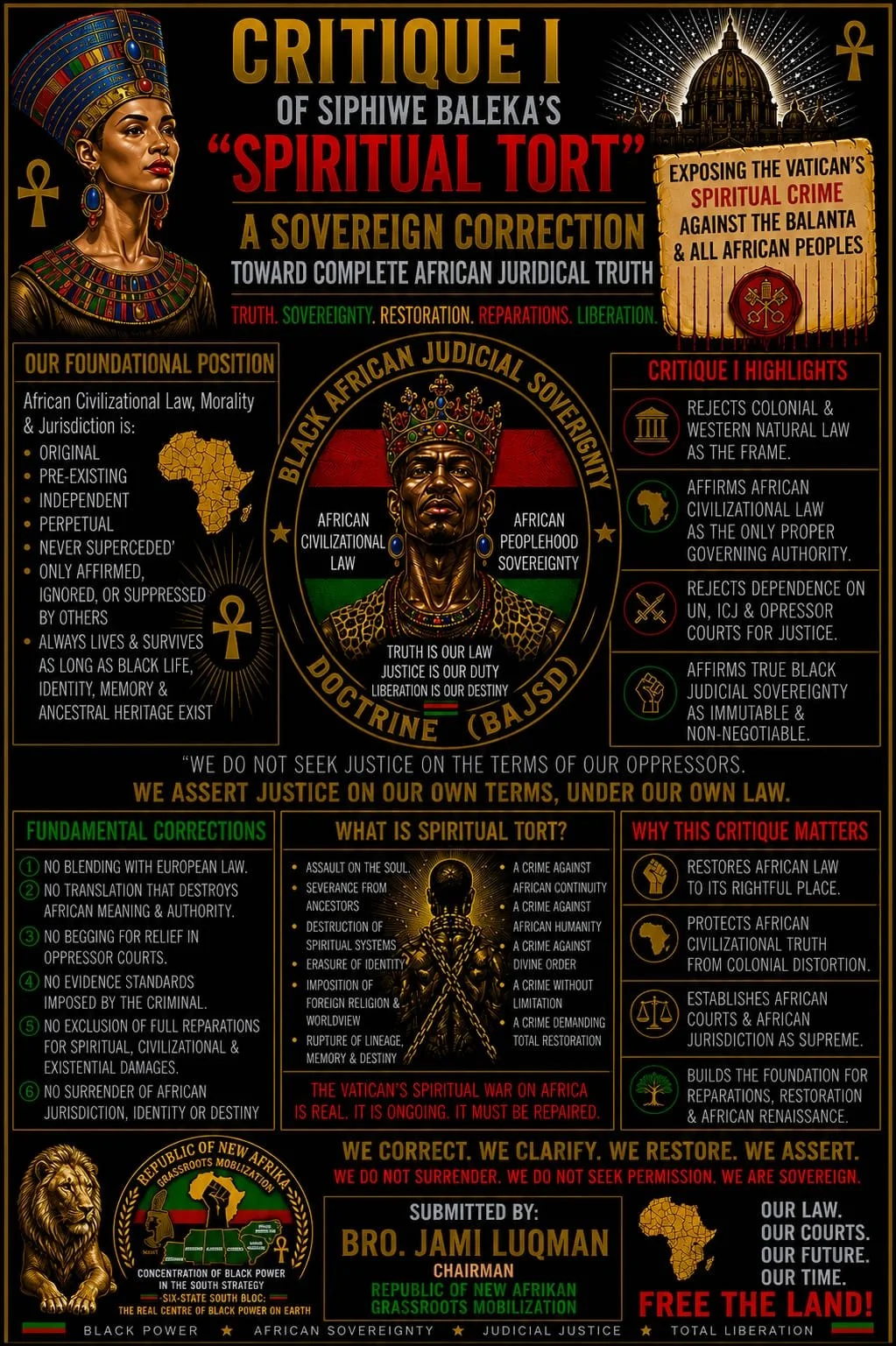
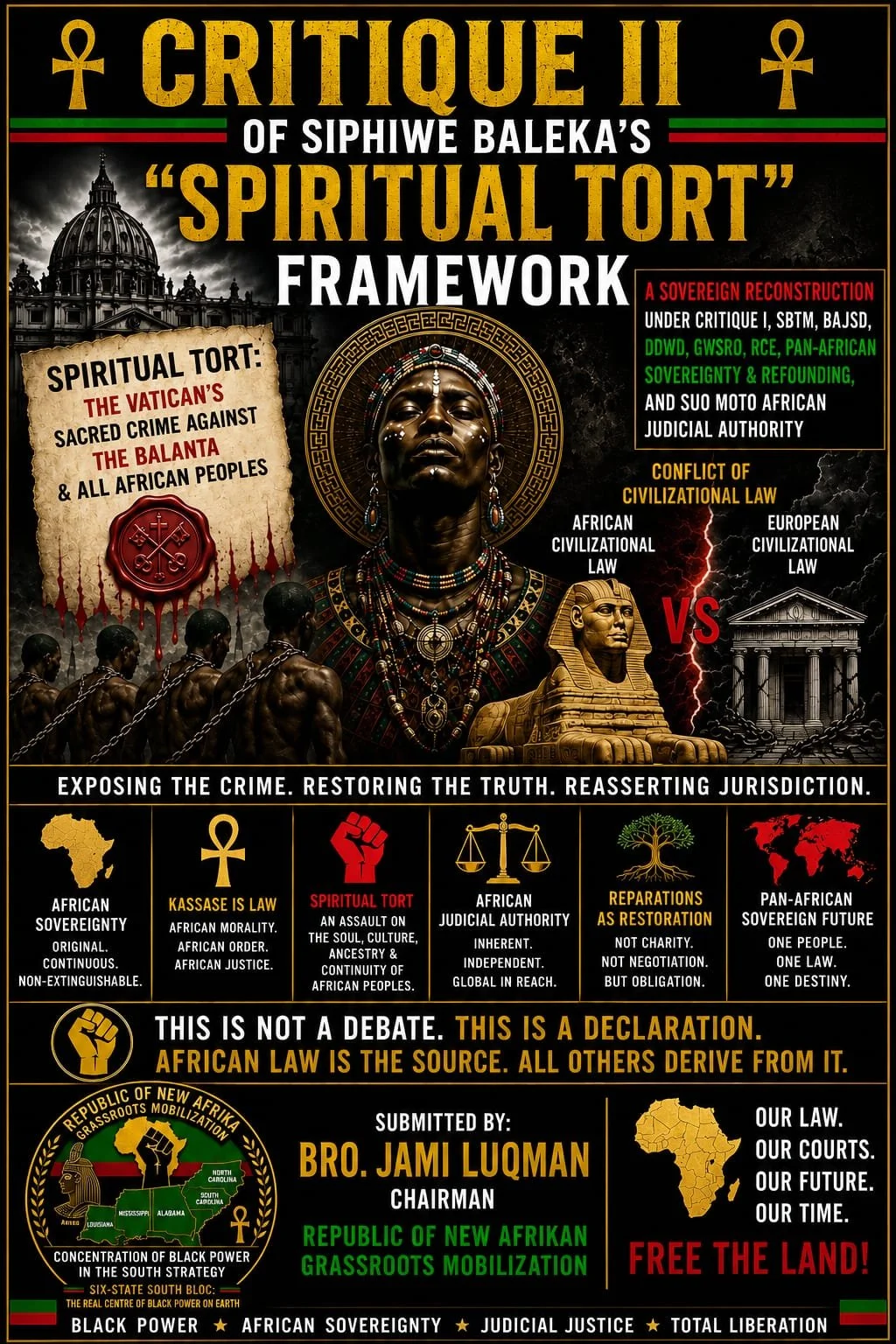
Critique II became necessary because Siphiwe Baleka’s Framing The Spiritual Tort Committed by the Vatican Against The Balanta ( Spiritual Tort) framework simultaneously represents one of the most important breakthroughs in modern Black and African juridical thought — and one of the clearest exposures of how deeply unresolved the question of real Black sovereignty, real Black power, and African juridical completion still remains beneath the modern world order.
For in recovering Kassase, ancestral continuity, lineage continuity, sacred territoriality, African juridical memory, and the existence of an African civilizational order preceding conquest and enslavement, Baleka breaks open one of the central lies upon which the modern anti-African world was constructed: the lie that African peoples possessed no sovereign juridical order, no governing civilization, no lawful continuity, and no enduring authority capable of surviving conquest, captivity, dispersal, racial domination, and colonial rupture.
Thus the work constitutes far more than argument.
It constitutes rupture.
A rupture against colonial historical fabrication.
A rupture against the epistemic imprisonment imposed upon Black consciousness.
A rupture against the long juridical burial of African sovereign existence beneath European conquest narratives and domination jurisprudence.
In this sense, the work stands as a monumental act of recovery.
It recovers memory.
It recovers continuity.
It recovers suppressed juridical existence.
It recovers the possibility that African peoples were never lawless captives absorbed legitimately into foreign domination systems, but peoples subjected to continuing rupture against pre-existing sovereign existence itself.
For this reason, Critique II proceeds with profound recognition of the seriousness, courage, originality, and historical significance of Baleka’s undertaking.
The work opens a door long sealed beneath conquest.
It forces buried questions back into existence.
It begins movement toward real restoration.
It begins movement toward real reparations.
It begins movement toward the reawakening of African juridical consciousness itself.
But precisely because the work reaches so deeply, it simultaneously exposes the unresolved crisis still haunting major sectors of Black, Pan-African, reparations, and sovereignty discourse across the modern era.
For even where African injury is correctly identified, where colonial illegality is exposed, where reparative claims are asserted, where African continuity is partially recovered, and where sovereignty language emerges, the underlying question of real authority repeatedly remains unresolved.
The question of:
who judges.
who defines.
who validates.
who enforces.
who possesses final authority.
and where real sovereign power actually resides.
Thus again and again, Black struggle becomes pulled back beneath the gravitational field of external authority.
The oppressed seek recognition from the oppressor.
The colonized seek validation from colonial structures.
The injured seek adjudication from systems implicated in the injury itself.
The dispossessed seek permission to exist from the very order constructed through their dispossession.
And beneath this dependency structure, the deeper sovereign rupture remains unresolved.
Critique I identified this crisis.
But the implications could not remain partially spoken.
Correct Black analysis demanded continuation.
It demanded excavation.
It demanded reconstruction.
It demanded that the hidden implications buried beneath Spiritual Tort be carried toward their full juridical, sovereign, civilizational, strategic, and enforcement conclusions.
For under SBTM, BAJSD, CBSS, DDWD, GWSRO, RCE, and Pan-African Sovereignty and Refounding Vol. 1-4, the catastrophe imposed against African peoples was never merely historical injury.
It was the attempted interruption of African sovereign existence itself.
The attempted displacement of African juridical authority.
The attempted destruction of African continuity.
The attempted reconstruction of African humanity beneath foreign systems of domination, racial hierarchy, dependency, and epistemic control.
And one of the greatest victories achieved by those domination systems was not merely military conquest or economic extraction alone.
It was the conditioning of African peoples to seek authority, meaning, legitimacy, interpretation, remedy, and completion outside themselves.
Outside African sovereign existence.
Outside African Civilizational Law.
Outside African juridical memory.
Outside the continuing authority still living within African peoples themselves.
Thus the deeper purpose of Critique II became unavoidable.
Not merely to criticize.
But to continue the reconstruction demanded by truth itself.
To restore the governing authority of Kassase and African Civilizational Morality, Truth, and Law.
To expose the unfinished dependency hidden beneath externally subordinated sovereignty discourse.
To reveal the continuing force of African Judicial Sovereignty still living beneath conquest structures.
To identify where real Black power must actually emerge in the twenty-first century.
To move beyond symbolic recognition toward sovereign activation.
To move beyond dependency toward functional sovereignty.
To move beyond fragmented grievance toward civilizational restoration.
To move beyond externally managed reparations discourse toward independent African adjudication, restoration, enforcement, and sovereign completion.
And ultimately, to confront the greatest unresolved question still standing before Black existence in the modern age:
whether African peoples will continue seeking liberation through the jurisdictional architecture of the forces that conquered them —
or whether African sovereign existence will again stand upon its own authority and move toward full restoration, power, continuity, protection, and completion across future generations.
The New Afrikan Pan-Afrikan Sovereignty Doctrinal System (NAPASDS)
is a broad, unified, interpretative and integrated architecture or doctrinal school that includes:
• Blueprint for Achieving Black Liberation in the U.S. by 2035 (Blueprint 2035) - a liberation master framework
• Concentration of Black Power in the Deep South Strategy for Black Liberation (CBSS) - a liberation implementation strategy
• Six-States South Bloc (SSSB) - a territorial counter-power doctrine
• Scientific Black Truth Method (SBTM) - an epistemological methodology
• Black African Judicial Sovereignty Doctrine (BAJSD) - a juridical sovereignty doctrine
• Racial Caste Economics (RCE) - an economic analytical instrument
• Dum Diversas War Doctrine (DDWD) - a historical-war framework
• Global White Supremacy Racism Order (GWSRO) - a structural world-analysis
DOWNLOAD CRITIQUE II PDF
************************************************
Essentials of
CRITIQUE II OF SIPHIWE BALEKA’S “SPIRITUAL TORT” FRAMEWORK
The New Afrikan Pan-Afrikan Sovereignty Doctrinal System (NAPASDS) is a broad, unified,interpretative and integrated architecture or doctrinal school that includes:
• Blueprint for Achieving Black Liberation in the U.S. by 2035 (Blueprint 2035) - a liberation master framework
• Concentration of Black Power in the Deep South Strategy for Black Liberation (CBSS) - a liberation implementation strategy
• Six-States South Bloc (SSSB) - a territorial counter-power doctrine
• Scientific Black Truth Method (SBTM) - an epistemological methodology
• Black African Judicial Sovereignty Doctrine (BAJSD) - a juridical sovereignty doctrine
• Racial Caste Economics (RCE) - an economic analytical instrument
• Dum Diversas War Doctrine (DDWD) - a historical-war framework
• Global White Supremacy Racism Order (GWSRO) - a structural world-analysis
______________________________________________________________________
It establishes the NAPASDS to argue for the supremacy of African Civilizational Law. The following is a catalog of the core principles derived from the text, organized by their thematic and jurisdictional functions.
I. Foundational & Metaphysical Principles
These principles define the nature of African existence and the "Scientific Black Truth Method" (SBTM) used to analyze it.
Dual Reality Principle: African lived reality and existence include both material and spiritual dimensions; existence is not reducible to physical embodiment alone (pp. 32, 35).
Ancestral Continuity: The living, the ancestors, and future generations exist within a continuing structure of relation, memory, and obligation (pp. 32-33).
Ontological Integrity: African spirit is not merely symbolic or a "belief"; it is part of the ontological structure of existence itself (p. 32).
Epistemic Standpoint: Truth must be examined from the standpoint of Black reality and African Civilizational Morality, rejecting frameworks imposed by systems of domination (pp. 4, 10).
II. Juridical & Sovereign Principles
These principles establish the legal authority and standing of African law (Kassase) over foreign systems.
Originality of African Law: African Civilizational Law is original, pre-existing, and independent. It does not depend on recognition, permission, or validation from colonial or Euro-American legal systems (pp. 4, 25).
Non-Extinguishability of Sovereignty: African sovereignty is inherent and enduring. It is not extinguished by military conquest, physical domination, territorial seizure, or forced incorporation (pp. 28, 33).
Suppression vs. Extinction: The historical denial, distortion, or criminalization of African law by colonial powers constitutes suppression, not extinction (pp. 10, 26).
Jurisdictional Supremacy: In matters concerning African humanity and injury, African law (Kassase) must govern as the primary and dispositive authority; external legal systems are merely supplemental (pp. 10, 21).
Suo Moto Authority: African judicial institutions possess inherent authority to protect African-descended peoples worldwide without seeking external permission (p. 12).
III. Principles of Injury & Crime Classification
These principles reclassify historical and continuing wrongs as "African Civilizational Crimes."
Jurisdictional Invasion: Colonial "discovery" and conquest are reclassified as unlawful jurisdictional invasions against pre-existing African sovereign orders (pp. 22, 29).
Juridical Personhood Assault: Enslavement was not merely labor theft; it was the unlawful conversion of persons into property and an assault on African juridical personhood (pp. 13, 29).
Lineage Destruction as Lawful Rupture: The destruction of African names, family structures, and languages is classified as an assault on the juridical chain of continuity and inheritance (pp. 14, 39).
Spiritual Tort as Civilizational Rupture: Spiritual injury is defined as an attack on the "regenerative structures" through which African civilization perpetuates itself across generations (pp. 39-40).
Continuing War (Dum Diversas): The war declared against African humanity in 1452 never lawfully ended; it persists through evolving forms such as mass incarceration and economic dependency (pp. 5, 11).
IV. Principles of Restoration & Remedy
These principles dictate how justice and "Functional Sovereignty" must be achieved.
Restoration of Relation: Reparations cannot be limited to financial compensation; they must include the restoration of lawful relation, lineage, identity, and nationality (pp. 11, 20).
Nullity of Colonial Claims: Unjust domination cannot create lawful authority. Therefore, colonial claims to African land or people remain a nullity under African Civilizational Law (pp. 15, 24).
Sovereign Activation: Liberation requires the active exercise of inherent authority through independent institutions rather than petitioning domination systems for relief (pp. 6, 9).
Non-Conditionality of Citizenship: African return, restoration, and citizenship cannot be conditioned upon colonial standards (e.g., DNA tests, foreign forensic validation, or colonial plebiscites) (pp. 2, 84).
Functional Sovereignty Requirement: True sovereignty must be expressed through the actual capacity to govern territory, enforce decisions, and defend collective interests (p. 6).


100 ESSENTIAL POINTS
African Judicial Sovereignty remains a continuing and recoverable authority despite conquest, enslavement, colonial domination, dispersal, or racial caste subordination p. 5
Dum Diversas War Doctrine (DDWD): The Dum Diversas War Doctrine, formulated and advanced by Siphiwe Baleka, holds that the Papal Bull Dum Diversas (1452), together with the Asiento slave-trading system and the interconnected European colonial conquest structure, declared and institutionalized a total civilizational war against African peoples and Africa itself through legalized conquest, perpetual enslavement, forced dispersal, racial dehumanization, territorial dispossession, and permanent systems of anti-Black domination. Under DDWD, this war never lawfully ended, but merely changed form across different historical stages, including the transatlantic slave trade, chattel slavery, colonialism, segregation, neocolonialism, racial caste domination, mass incarceration, economic exploitation, state violence, and continuing anti-Black systems operating throughout the modern world The doctrine further holds that Black Americans/New Afrikans within the United States remain a captive and internally colonized people descended from populations seized through this continuing war process and never liberated, restored, repatriated, or released from the conditions of conquest and capture (Prisoners of War status) imposed under the Dum Diversas system. p. 5
Global White Supremacy Racism Order (GWSRO): The Global White Supremacy Racism Order (GWSRO) is the worldwide operating system of power, enforcement, wealth, law, security, governance, and cultural domination first identified by W. E. B. DuBois, further clarified by Chancellor Williams, and scientifically decoded by Frances Cress Welsing, in which the survival, protection, superiority, and global control of the white population is maintained through structural, institutional, psychological, military, economic, technological, juridical, and cultural mechanisms of White Supremacy Racism, organized through an anti-Black racial caste hierarchy that subjugates people of African descent across all nations and regions. GWSRO is not merely a political ideology, moral accusation, or isolated system of discrimination, but the foundational global racial-caste order organizing world power itself through anti-Black hierarchy and the suppression, containment, fragmentation, exploitation, and subordination of African people worldwide. Under this framework, capitalism, imperialism, colonialism, militarism, scientific colonialism, liberal democracy, neoliberalism, and related systems are not independent structures, but instruments utilized to maintain and enforce the anti-Black racial caste hierarchy of the Global White Supremacy Racism Order throughout the modern world. p. 5
Critique II became necessary because Siphiwe Baleka’s Framing The Spiritual Tort Committed by the Vatican Against The Balanta (Spiritual Tort) framework simultaneously represents one of the most important breakthroughs in modern Black and African juridical thought — and one of the clearest exposures of how deeply unresolved the question of real Black sovereignty, real Black power, and African juridical completion still remains beneath the modern world order. p. 6
It recovers the possibility that African peoples were never lawless captives absorbed legitimately into foreign domination systems, but peoples subjected to continuing rupture against pre-existing sovereign existence itself. p. 7
To move beyond symbolic recognition toward sovereign activation.
To move beyond dependency toward functional sovereignty.
To move beyond fragmented grievance toward civilizational restoration.
To move beyond externally managed reparations discourse toward independent African adjudication, restoration, enforcement, and sovereign completion.
And ultimately, to confront the greatest unresolved question still standing before Black existence in the modern age:
whether African peoples will continue seeking liberation through the jurisdictional architecture of the forces that conquered them —
or whether African sovereign existence will again stand upon its own authority and move toward full restoration, power, continuity, protection, and completion across future generations. p. 9
7. The Scientific Black Truth Method does not permit the analysis to begin with African reality and then surrender interpretive authority to foreign categories. SBTM requires the truth of the condition to be examined from the standpoint of Black and African reality, African survival, African continuity, African moral truth, African structural power, and African sovereignty. It does not allow partial truth to be treated as victory. It does not permit a “mixed” result where the African foundation is acknowledged but then displaced by external law. If Kassase is proven, then Kassase must govern. If African civilizational injury is proven, then African Civilizational Law must classify the injury. If African sovereignty is violated, then African judicial sovereignty must adjudicate the violation.
8. African peoples possess inherent judicial sovereignty over transgressions committed against African humanity, dignity, land, lineage, identity, possessions, memory, and future. African courts, African tribunals, and African juridical institutions must not operate as junior partners in a world legal order designed by those who benefited from African subordination. They must act as sovereign organs of African truth, African law, and African civilizational restoration. This is why Critique II must be higher than an ordinary critique. It must operate as if seated in the Grand Chamber of African Civilizational Judgment, where the whole world of African people stands before history, and where the question is not whether Europe, America, or international law will grant permission for African claims to exist, but whether African law will finally speak in its own name. p. 10
9. Siphiwe’s Spiritual Tort article is valuable because it exposes that the injury was not merely economic. The injury was not merely labor theft. The injury was not merely racial discrimination. The injury was not merely exclusion from civil rights. The injury was civilizational. It struck at African being itself: p. 10
10. The battlefield changed. The weapons changed. The legal language changed. But the underlying structure of domination did not simply disappear. It persists as a continuing war against African sovereignty, African development, African identity, and African future. Under GWSRO and RCE, this continuing structure becomes visible as a global system of anti-Black domination. The Global White Supremacy Racism Order is not merely prejudice. It is a world structure. Racial Caste Enforcement is not merely discrimination. It is the legal, economic, political, psychological, and institutional maintenance of Black subordination across generations. p. 11
11. This also means that reparations and citizenship cannot be treated as separate or disconnected questions. They arise from the same civilizational wound. If African persons were kidnapped, enslaved, displaced, renamed, converted, stripped of lineage, removed from land, and forced into alien political systems, then the resulting questions of nationality, citizenship, jurisdiction, right of return, political identity, and self-determination are not secondary afterthoughts. They are direct consequences of the original transgression. p. 11
12. The Proposal for Suo Moto Advisory Opinion and Judicial Manifesto (Suo Moto African Judicial Manifesto) then provides the institutional horizon. If African courts are to become real instruments of African civilizational justice, they cannot wait passively for hostile systems to define the permissible scope of African claims. The African Court must be understood as possessing inherent and implied authority to protect African and African-descended peoples worldwide where gross violations, continuing injuries, and failures of external systems demand African judicial action. This does not mean African law needs external permission. It means African institutions must rise to the level of the law they inherit. p. 12
13. Through Kassase, Fanado, lineage systems, sacred territoriality, shrines, oath structures, funerary continuity, and inheritance relations, he points toward a complete African civilizational order. These institutions are not decorative cultural practices. They are legal and civilizational structures. They define who a person is, how one becomes a full member of the community, how land is held, how authority is transmitted, how truth is enforced, how continuity is preserved, and how the living remain bound to the ancestors and to those yet unborn. The Balanta were not merely spiritual people who later suffered spiritual injury. They were a people governed by a legal/spiritual order. Their spirituality was not separate from law; their law was not separate from ancestry; their ancestry was not separate from land; their land was not separate from jurisdiction; and their jurisdiction was not separate from sovereignty. This is why the injury cannot be reduced to emotional distress, cultural alienation, or symbolic rupture. The injury was juridical because the order that was attacked was juridical. If Fanado is part of the structure through which lawful Balanta personhood is completed, then any analysis that ignores Fanado as law fails to tell the truth of the injury. It sees the body taken, but not the legal formation interrupted. It sees labor stolen, but not personhood disrupted. It sees religious conversion, but not juridical reclassification. It sees displacement, but not territorial severance from the field of law. p. 13
14. Lineage is not genealogy in the narrow Western sense. It is not merely ancestry for personal identity or family pride. It is the legal chain through which belonging, authority, inheritance, obligations, rights, memory, and continuity are transmitted. To destroy lineage is therefore to attack the continuity of the legal order itself. Forced renaming, family fragmentation, forced breeding, sale of children, destruction of inheritance lines, and erasure of ancestral location are not merely social harms. They are attacks on the juridical chain by which a people remains a people.
15. This is one of the places where Baleka’s framework opens the door to a powerful African legal reconstruction, even if it does not yet walk through that door completely. His insight into frozen lineage and spiritual dislocation can become a much stronger juridical doctrine once placed under BAJSD. Under BAJSD, lineage destruction is not merely a historical tragedy. It is a legal disability imposed upon African descendants by force. It means that the descendants remain affected by an unresolved legal rupture. Their original relation was not voluntarily surrendered; it was violently interrupted. Suppression is not extinction. Forced severance is not lawful termination. Imposed alien status is not final truth. p. 14
16. Baleka’s discussion of land and sacred sites also carries enormous legal importance. Under African Civilizational Law, land is not merely property. It is jurisdiction, memory, duty, burial ground, ancestral presence, economic foundation, and sacred trust. Shrines and consecrated spaces are not “religious artifacts” in the diminished colonial sense. They are material signs of jurisdiction and continuity. They show that the land is governed, that it is bound to a people, that authority over it arises from lawful relation and not from foreign declaration. Once that is understood, the European claim to seize African land under papal authority becomes not merely theft but jurisdictional invasion. p. 14
17. And once they are treated as law, the whole meaning of conquest changes. Europe did not acquire lawful title by arrival, declaration, baptism, war, or paperwork. A foreign instrument cannot lawfully erase an African territorial order that already exists. No papal decree, imperial charter, colonial statute, or later international silence can transform unlawful seizure into rightful sovereignty under African Civilizational Law. p. 14
18. If the land was already governed, then seizure was jurisdictional aggression. If the people already possessed lawful status, then enslavement was unlawful conversion of persons into property. If lineage already carried legal meaning, then forced renaming was destruction of juridical continuity. If Kassase already regulated truth, identity, land, and obligation, then forced conversion and imposed foreign rule were religious and political persecution against a governing order. p. 14
19. This is why Baleka’s contribution is important but not sufficient. He identifies many of the elements needed for a sovereign African case, but he does not yet fully consolidate them into a complete African civilizational crime structure. p. 14
20. The war did not merely enslave bodies. It attacked legal systems, spiritual orders, territorial relations, family structures, names, memories, and futures. It sought not only to use African labor, but to break African continuity and insert African people into alien systems of domination. p. 15
21. This is where GWSRO and RCE become necessary to the analysis. The injury Baleka identifies does not end with religious rupture or historical enslavement. It develops into a global racial order in which Black people are structurally positioned as a subordinated people across legal, political, economic, educational, and cultural systems. GWSRO explains the global structure; RCE explains the mechanisms by which racial caste is enforced across time. Together, they show why the injuries described by Baleka remain active rather than merely historical. The same civilizational logic that first denied African law later denied African sovereignty, African nationality, African development, African self-determination, African reparations, and African jurisdiction. p. 15
22. Through Kassase, lineage systems, sacred territoriality, ancestral continuity, Fanado, oath structures, funerary obligations, and communal authority systems, Baleka establishes that the Balanta people existed within a functioning African legal and civilizational structure possessing its own internally coherent principles of authority, identity, obligation, continuity, territory, and lawful existence. p. 16
23. Once African claims become dependent upon external categories for their intelligibility, African law risks being reduced from governing authority into evidentiary background material within foreign systems of judgment. This is one of the most dangerous forms of juridical subordination because it appears respectful while preserving foreign interpretive supremacy. p. 17
24. If the injury arises from the destruction of African law, then foreign legal systems cannot become the primary interpretive authority governing the meaning of that destruction. To do so would reproduce the very displacement being challenged. p. 17
25. African systems are acknowledged only after being translated into foreign categories. African injury becomes visible only after being reformulated according to external conceptual frameworks. African sovereignty becomes intelligible only when validated through institutions historically shaped by anti-African power structures. Critique I rejects this entire structure of dependency. This point must be stated clearly and without hesitation: African law does not require foreign permission to exist.
26. Under African Civilizational Law, the injuries described by Baleka cannot be reduced merely to spiritual harm. They involve the destruction and displacement of entire systems of lawful African existence. The crimes include unjust war, territorial invasion, unlawful captivity, forced juridical reclassification, destruction of lineage continuity, religious persecution, political domination, mass killing, enslavement, theft of labor, destruction of lawful personhood, forced assimilation, and continuing juridical disability across generations. To reduce such injuries primarily to “spiritual tort” risks shrinking civilizational crimes into categories too narrow to contain their full juridical implications. p. 18
27. The crimes described exceed the boundaries of ordinary tort logic entirely. One does not merely have injury to spiritual feeling or emotional condition. One has the attempted destruction and replacement of an African juridical-civilizational order itself. p. 18
28. Under GWSRO, global legal systems did not emerge in a neutral vacuum detached from racial power structures. They developed historically within systems deeply entangled with slavery, colonial expansion, imperial domination, racial hierarchy, and anti-African ordering. This does not mean every external legal principle is automatically invalid. But it does mean that external systems cannot automatically be presumed neutral arbiters concerning crimes from which many of those systems materially benefited. p. 18
29. RCE deepens this analysis by demonstrating how racial caste structures reproduce themselves juridically across generations. Even after formal emancipation or decolonization, legal systems often preserve underlying hierarchies through citizenship structures, property regimes, territorial control systems, educational exclusion, developmental suppression, and institutionalized anti-Black ordering. Therefore the injuries Baleka identifies cannot be treated as fully resolved historical events. The original rupture continues through transformed mechanisms of domination. p. 18
30. Under DDWD, the violence initiated through systems such as Dum Diversas cannot be understood merely as past events now sealed by time. The original aggression generated continuing structures of domination that evolved across slavery, colonialism, racial caste systems, forced assimilation, economic dependency, territorial dispossession, and ongoing anti-African subordination. Therefore the descendants of the displaced do not merely inherit memory of injury. They inherit unresolved juridical rupture. This principle is critical. p. 19
31. Under African Civilizational Law and Pan-African Sovereignty doctrine, reparations cannot be reduced merely to financial compensation. The crimes described involve sovereignty rupture, territorial severance, lineage destruction, forced identity restructuring, developmental suppression, and continuing juridical disability. Therefore remedies must include restoration of lawful relation itself. p. 19
32. The task is to reconstruct the governing legal architecture necessary to properly classify, interpret, adjudicate, and remedy that injury under African Civilizational Law itself. p. 19
33. In Spiritual Tort, Siphiwe correctly recognizes that the injuries inflicted against the Balanta and against African peoples more broadly cannot be adequately explained through ordinary Western legal categories concerning labor exploitation, emotional distress, property deprivation, civil-rights violations, or generalized historical injustice. He correctly senses that the transatlantic system and its continuing structures inflicted deeper injuries against ancestral continuity, lineage structures, sacred identity, communal belonging, spiritual continuity, territorial relation, and the foundations through which African peoples understood lawful existence itself. p. 19-20
34. Kassase cannot remain cultural evidence beneath foreign law. Kassase must be restored as governing sovereign law. p. 21
35. Under these doctrines, the denial of African law was never merely intellectual misunderstanding. It functioned as a weapon of racial-civilizational domination designed to justify conquest, enslavement, territorial seizure, forced incorporation, and continuing racial caste hierarchy. p. 22
36. African law is not dependent upon the systems that violated Africa for its existence, validity, continuity, or authority. p. 22
37. African Civilizational Law predates colonial systems historically and survives them juridically and morally. African juridical traditions existed long before European imperial expansion, papal decrees, colonial state systems, or modern international law institutions emerged. p. 22
38. As established throughout Pan-African Sovereignty and Refounding, the foundations of African Civilizational Law extend through ancient Kemet, Nubian and Kushite juridical traditions, Sahelian and Malian legal systems, Central African lineage jurisprudence, Southern African communal land traditions, sacred territorial systems, ancestral continuity structures, restorative justice traditions, oath systems, and enduring African principles governing lawful relation, continuity, dignity, reciprocal obligation, and limitations upon domination. Under these traditions, domination divorced from moral legitimacy could not automatically create rightful authority.
Violent seizure alone could not create lawful sovereignty.
Human beings could not be reduced into permanently commodified hereditary racial property merely through force.
Lineage continuity possessed juridical significance extending beyond temporary domination structures.
Territory already governed by a people could not morally become legitimate foreign possession merely through violent conquest.
Thus, under Critique I, the transatlantic structure violated already-existing African juridical and moral principles long before European systems later partially acknowledged fragments of its criminality.
The wrong was already wrong.
African Civilizational Law had already condemned domination through unjust force.
African traditions had already imposed obligations toward continuity, lineage, dignity, and rightful relation.
African juridical systems had already recognized limitations upon human domination and unlawful seizure. p. 22
39. What is the nature of African Civilizational Law itself, and what are the consequences that follow once its original and sovereign existence is fully restored? p. 23
40. This question is decisive because colonial and post-colonial systems alike have historically depended upon a foundational fiction: namely, that African juridical authority either never truly existed, existed only in fragmented tribal form beneath “civilized” legal systems, or ceased to possess legitimacy once European conquest, Christian imperial expansion, colonial administration, or foreign state formation imposed itself upon African peoples and territories. p. 23
41. Across multiple African civilizations there repeatedly appears recognition of certain enduring principles:
that lawful authority requires moral legitimacy;
that domination through unjust force violates rightful order;
that continuity between ancestors, the living, and future generations imposes obligations across time;
that land carries sacred and communal dimensions beyond commodity status alone;
that personhood cannot be reduced merely to market property;
that reciprocal obligation forms part of lawful existence;
and that collective continuity possesses juridical significance extending beyond isolated individual existence.
These principles appeared in different forms across different African civilizations, yet their recurrence reveals something far deeper than isolated custom. They reveal enduring African Civilizational jurisprudence. p. 24
42. This distinction becomes devastating for colonial legality itself. For if African juridical systems already existed prior to conquest, then colonial powers did not bring law into empty space.
They invaded existing juridical worlds.
They displaced existing sovereign orders.
They attacked already-existing systems of lawful relation.
They imposed foreign jurisdiction against peoples already governed by their own juridical traditions.
Under BAJSD, this transforms the nature of the transatlantic and colonial systems entirely. What colonial systems later presented as “civilization,” “conversion,” “administration,” or “development” must instead be reclassified as layered structures of jurisdictional invasion, sovereign displacement, and civilizational suppression directed against pre-existing African orders. p. 25
43. This point becomes even more profound once reconstructed through the Global White Supremacy Racism Order Doctrine (GWSRO) and Racial Caste Economics (RCE) Doctrine. Under these doctrines, anti-African domination did not merely seek economic extraction. It required the systematic suppression of African sovereign legitimacy itself. African systems had to be represented as inferior, primitive, irrational, pagan, or non-juridical precisely because acknowledgment of full African sovereign legitimacy would expose conquest itself as unlawful aggression against already-existing African civilizations. p. 25
44. Denial does not extinguish existence.
Colonial denial of African law does not erase African law.
Colonial suppression of African sovereignty does not erase African sovereignty.
Colonial occupation does not create moral legitimacy merely through duration or force.
This principle becomes foundational to the entire reconstruction because foreign domination systems repeatedly attempted to transform prolonged domination into retrospective legitimacy. Through military conquest, forced conversion, imposed identity systems, territorial seizure, juridical displacement, and racial caste restructuring, colonial systems attempted to create the illusion that African sovereign continuity had been permanently extinguished. p. 25
45. This point also directly addresses one of the deeper unresolved questions quietly emerging beneath Siphiwe’s work itself. If African sovereign orders existed prior to conquest, and if unlawful domination cannot morally extinguish original juridical relation merely through force, then the continuity of African sovereign relation survives beneath imposed structures of domination even where those structures attempt to absorb African peoples into foreign political identities. p. 26
46. Foreign domination may impose classifications, statuses, citizenship regimes, racial categories, or administrative identities, but under African Civilizational Law such imposed structures do not automatically extinguish original African sovereign relation where that relation was never voluntarily surrendered. p. 26
47. This becomes even more significant once the issue of African continuity itself is examined under African Civilizational ontology rather than narrow Western materialist frameworks. Under many African traditions reflected across Kemetic traditions, Central African ancestral systems, Southern African continuity traditions, and broader African spiritual jurisprudence, existence itself cannot be reduced merely to temporary material embodiment. The living, the ancestors, and future generations exist within continuing structures of relation, memory, obligation, identity, and collective continuity. p. 26
48. Accordingly, under the reconstruction now required by SBTM, African lived reality includes both material and spiritual dimensions of existence. This principle becomes essential because Western materialist jurisprudence often assumes that sovereignty exists only through visible institutional administration or physical control. African Civilizational ontology rejects such reductionism. p. 26
49. Under African Civilizational understanding, sovereignty inheres more deeply within the continuing existence of the people through lineage continuity, ancestral relation, sacred memory, spiritual continuity, collective identity, and enduring civilizational being. Thus another controlling rule emerges under this reconstruction:
African sovereignty is not extinguished merely through physical domination. p. 26-7
50. And under Critique I, SBTM, BAJSD, DDWD, GWSRO, RCE, and Pan-African Sovereignty and Refounding, Vol. 1-4, the reconstruction must therefore now establish the following governing determination:
African Civilizational Law constitutes an original, pre-existing, sovereign, enduring, and non-extinguishable juridical order whose validity does not depend upon colonial recognition, foreign approval, racial hierarchy, military conquest, or external jurisdictional acknowledgment.
And because this sovereign continuity survives suppression itself, all systems arising from conquest, racial domination, forced incorporation, lineage destruction, imposed identity, territorial seizure, and anti-African jurisdictional displacement remain subject to continuing African claims of restoration, reparative obligation, sovereign reassertion, and civilizational adjudication under African Civilizational Law. p. 28
51. Under colonial logic, European powers allegedly encountered inferior populations lacking fully developed sovereignty, law, or legitimate civilizational authority. Under this framework, conquest became “discovery,” occupation became “civilization,” forced conversion became “salvation,” and imposed administration became “government.” p. 28
52. Under the Dum Diversas World War Doctrine (DDWD), this point becomes even more significant because the transatlantic system and the colonial structures emerging from it cannot be understood merely as disconnected economic enterprises. Rather, they constituted organized structures of continuing anti-African domination directed against African sovereignty itself. Once this principle is restored, the transatlantic structure must be reclassified not merely as exploitation, but as coordinated jurisdictional aggression against African sovereign existence. p. 28
53. This correction radically transforms the legal meaning of enslavement itself. p. 28
54. Under colonial systems, enslaved Africans became classified as property. Under the reconstruction mandated by Critique I, this classification becomes inherently unlawful from its inception because it rests upon the destruction and replacement of already-existing African juridical personhood systems governed under African Civilizational Law. This distinction is decisive. If African peoples already existed within functioning juridical systems governing identity, lineage, obligation, inheritance, belonging, and communal relation, then the reduction of African beings into hereditary racialized commodities becomes not merely immoral labor exploitation but the unlawful destruction of African juridical personhood itself. p. 28
55. This principle also transforms the meaning of forced identity restructuring. Under Pan-African Sovereignty and Refounding, Vol.1, identity cannot be understood merely as administrative classification imposed by external states. Identity carries sovereign and juridical dimensions rooted in continuity, lineage, collective belonging, historical relation, and lawful connection to a people and civilization. Accordingly, forced renaming, destruction of African lineage systems, prohibition of African languages, forced religious conversion, destruction of ancestral continuity structures, and imposed racial classifications must all be understood as jurisdictional acts directed toward severing African peoples from prior sovereign relation. This point becomes indispensable because colonial systems repeatedly attempted to transform forced incorporation into apparent legitimacy. Through imposed classifications, foreign citizenship structures, racial categories, administrative incorporation, and legal absorption systems, colonial and post-colonial regimes attempted to create the appearance that original African sovereign relation had been extinguished and replaced permanently by externally imposed identities. p. 29
56. The continuity of original African juridical relation remains unresolved where it was never voluntarily relinquished by the people subjected to conquest, captivity, displacement, and forced incorporation. This principle becomes especially important because it quietly exposes one of the deepest contradictions underlying colonial legality itself: the assumption that prolonged domination can transform unlawful conquest into rightful sovereignty merely through time, force, or administrative control. Under Critique I, this principle is rejected entirely. Time does not erase unlawful origin. p. 29
57. This principle also directly affects the continuing structure of reparative obligation. Under colonial logic, the passage of time supposedly dissolves the claims arising from conquest, enslavement, jurisdictional displacement, lineage destruction, and imposed identity structures. Under the reconstruction now mandated by Critique I, BAJSD, DDWD, GWSRO, RCE, and Pan- African Sovereignty and Refounding, this conclusion becomes untenable because the underlying juridical rupture remains unresolved.
The continuity survives.
The rupture survives.
Therefore the obligations survive.
58. Accordingly, the reconstruction must now establish another controlling determination: systems arising from conquest, forced incorporation, imposed identity, racialized juridical displacement, and anti-African domination cannot automatically extinguish prior African sovereign relation merely through force, duration, administrative absorption, or imposed political classification. And once this principle is restored under African Civilizational Law, the entire field of reparations, restoration, sovereign continuity, identity, jurisdiction, and African judicial authority must be reconsidered from its foundation.
59. Accordingly, under the reconstruction now mandated by Critique I and SBTM, the first task becomes identifying the deeper source of the distortion itself. That source is materialist jurisprudence. p. 31
60. Under dominant Western legal traditions, existence is ordinarily treated as fundamentally material in nature. Law primarily concerns property, bodily injury, territorial administration, contractual relation, institutional authority, and observable physical acts occurring within temporally bounded political systems. Even where religion or spirituality enters legal analysis, it is generally treated as subjective belief existing beneath materially defined state structures rather than as part of the ontological structure through which existence itself is understood. Under Critique I, this framework becomes fundamentally incapable of fully comprehending the injuries Siphiwe attempts to describe. For under African Civilizational reality, the human being cannot be reduced merely to material embodiment detached from ancestral continuity, sacred relation, collective memory, spiritual existence, and intergenerational obligation. This point is indispensable because SBTM requires that African reality be interpreted through African lived experience rather than through epistemological systems produced within anti-African domination structures. p. 31
61. This principle must be handled with extraordinary precision because Critique I correctly recognized that careless invocation of spirituality could destabilize logical coherence if detached from disciplined African ontological structure. Thus the reconstruction cannot descend into vague mysticism, uncontrolled metaphysical assertion, or abstract spiritual romanticism detached from African lived reality itself. Under SBTM, logical coherence does not require automatic submission to Western materialist assumptions concerning existence. Rather, logical coherence requires internal consistency within the framework of African lived reality itself. And under African lived reality, spirit is not merely symbolic.
Spirit constitutes part of existence itself.
The ancestors remain part of continuing communal existence.
Sacred continuity remains part of collective reality.
Lineage continuity extends beyond temporary bodily existence alone.
Memory, obligation, identity, and continuity persist across generations through structures not reducible merely to immediate physical embodiment.
This distinction becomes decisive because once African existence itself is understood differently, the meaning of injury also changes. Under materialist jurisprudence, injury is generally confined to measurable bodily harm, economic deprivation, property loss, emotional distress, or institutional discrimination. But under African Civilizational ontology, the injuries inflicted through conquest, enslavement, forced conversion, lineage destruction, territorial severance, imposed identity, racial caste domination, and ancestral rupture extend deeper.
They attack continuity itself.
They attack relation itself.
They attack the structures through which African existence reproduces itself across generations.
This point forms one of the central corrections imposed by Critique I upon Siphiwe’s original framework. Siphiwe correctly sensed that the injury was spiritual. But under the reconstruction now required, the injury must be understood more precisely as an assault against African civilizational continuity itself operating simultaneously across juridical, ancestral, spiritual, territorial, psychological, demographic, and sovereign dimensions of existence. Thus
Spiritual Tort cannot remain merely individualized emotional injury.
Nor can it remain merely religious offense.
Nor can it remain merely symbolic cultural disruption.
The injury must instead be reconstructed as an assault against the continuity structures of African existence itself. p. 32
62. This distinction becomes indispensable once the issue of sovereignty continuity is reconsidered under African Civilizational ontology rather than Western materialist assumptions. Under dominant colonial frameworks, sovereignty supposedly disappears once conquest succeeds, institutions collapse, territory is occupied, or populations become absorbed into foreign systems. But under African Civilizational understanding, sovereignty inheres more deeply within the continuing existence of the people through lineage continuity, ancestral continuity, sacred memory, collective identity, and enduring civilizational being. Accordingly, under the reconstruction now mandated by Critique I, another governing principle emerges: under African Civilizational ontology, it recognizes that domination may suppress visible manifestations of sovereign order without fully extinguishing the deeper continuity of African existence itself. p. 32
63. African sovereign continuity possesses material and spiritual dimensions of existence that cannot be fully extinguished merely through conquest, domination, racial caste subordination, territorial seizure, forced incorporation, or physical destruction where African continuity survives within the enduring structures of African civilizational being itself. p. 32
64. Critique I repeatedly warned that many intellectual frameworks claiming to defend African humanity continue unconsciously reproducing foreign ontological assumptions that reduce existence solely to material embodiment, territorial administration, institutional control, or visible political power. Under such systems, sovereignty becomes reducible to armies, governments, administrative institutions, demographic control, or externally recognized state structures. Once those material structures are conquered, destroyed, or absorbed, sovereignty is presumed extinguished. Critique I rejects this framework as incompatible with recurring African Civilizational understandings of existence and continuity. African lived reality includes both material and spiritual dimensions of existence. . . . Thus material embodiment alone did not exhaust the totality of being. p. 34
65. This principle carries profound implications for the reconstruction of Spiritual Tort. For if African lived reality includes both material and spiritual dimensions of existence operating within continuing structures of sacred, ancestral, communal, and historical continuity, then injuries inflicted against African peoples cannot be reduced merely to bodily violence, labor exploitation, territorial seizure, or political domination alone. p. 35
66. Imposed Racial Classification and Juridical Severance becomes especially important because colonial systems repeatedly attempted to transform domination into legitimacy through identity reconstruction itself. Once African peoples became renamed, reclassified, administratively absorbed, territorially displaced, and politically incorporated into foreign systems, colonial structures then attempted to present the resulting identities as natural, permanent, and fully dispositive of African existence. p.41
67. Thus under the reconstruction mandated by Critique I, Spiritual Tort must also be understood as assault against African juridical continuity through the forced imposition of domination-based identity systems intended to sever African peoples from prior structures of sovereign relation. This point acquires even deeper significance through Chancellor Williams’s The Rebirth of African Civilization, which repeatedly emphasizes the fragmentation and dismemberment of African continuity under systems of conquest and domination. Under the reconstruction now required, this fragmentation cannot be understood merely politically or culturally. It constituted attack upon the continuity structures necessary for African sovereign regeneration itself. p.42
68. Spiritual Tort includes the continuing assault against African juridical continuity through imposed identity systems, forced severance from ancestral and sovereign continuity, and the replacement of African continuity structures with externally imposed domination-based identities designed to subordinate African existence beneath systems of conquest, racial caste domination, and foreign jurisdictional control. p.42
69. One of the greatest distortions imposed by colonial jurisprudence is the fragmentation of large-scale civilizational crimes into isolated and disconnected categories of injury. Under such frameworks, conquest becomes separated from enslavement, enslavement from spiritual destruction, spiritual destruction from imposed identity systems, imposed identity from sovereign displacement, and sovereign displacement from continuing racial caste domination. The result is that the total structure of anti-African assault disappears beneath fragmented legal categories incapable of comprehending the integrated nature of the crime itself. p.43
70. For under Kassase and African Civilizational Law, the injuries arising from conquest, enslavement, forced dispersal, racial caste domination, territorial dispossession, lineage severance, juridical displacement, civilizational rupture, and continuing anti-African domination cannot be reduced merely to aggregated private injuries suffered separately by isolated individuals. Rather, the injuries operate against the collective continuity, sovereign existence, civilizational reproduction, historical development, territorial relation, juridical continuity, and future existence of African peoples as peoples. Under this reconstruction, the reduction of such injuries into individualized tort frameworks becomes especially dangerous because it permits domination systems to fragment civilizational crimes into narrow compensatory disputes manageable within the procedural and remedial limits of the domination system itself. p.43
71. Individualized Harm Doctrine as Juridical Containment Mechanism: This containment logic becomes especially visible within dominant American and Euro-American jurisprudential approaches to racism and racial injury, where courts repeatedly reject broad societal, structural, historical, or collective racial injury frameworks in favor of narrow requirements demanding individualized harm, individualized causation, and individualized injury. . . . This containment logic is not theoretical. It is now openly confirmed by the modern trajectory of the United States Supreme Court. From The Slaughter-House Cases, The Civil Rights Cases, and Plessy v.Ferguson, through the modern anti-affirmative-action ruling in Students for Fair Admissions v. Harvard, and now through Louisiana v. Callais, the Court has repeatedly transformed American constitutional law into a weapon against broad Black collective remedy while disguising that weapon as neutrality, color-blindness, federalism, or equal protection. Nor is this dependency cured by fleeing upward into international institutions such as the UN, ICJ, ICC, Human Rights Council, or PFPAD processes. Those institutions operate inside the same global racial power structure. At most, they produce symbolic votes, reports, hearings, commemorations, and advisory gestures while refusing to compel full Black reparative justice, African return, sovereign restoration, or the dismantling of the GWSRO itself. p.43
72. The conclusion is unavoidable: Black people cannot continue petitioning domination systems as the primary source of final authority. The real solution is inward sovereign activation — the reassertion, organization, adjudication, and enforcement of Black African Judicial Sovereignty inherent within Black and African peoples themselves. p.45
73. Under such approaches, systemic racial domination becomes juridically fragmented into isolated personal disputes while broader structures of collective dispossession, racial caste ordering, historical continuity injury, and civilizational destruction remain shielded from full adjudication. Under BAJSD and African Civilizational Law, this reduction must be rejected. For where the crime itself operates collectively across generations, territories, institutions, lineages, sovereignty structures, and civilizational continuity, the framework of adjudication, restoration, remedy, and sovereign response must also remain collective in scope. Accordingly, under this reconstruction, the obligations arising from such crimes necessarily extend beyond individualized compensatory logic toward the restoration, protection, defense, and continuation of African collective existence itself across generations. p.45
74. Accordingly, once Kassase and African Civilizational Law are restored as governing sovereign law under Section VI, and once Spiritual Tort is reconstructed under Section VII as assault against African continuity structures themselves, the historical events in question can no longer be treated merely as isolated abuses occurring within otherwise legitimate systems. p.45
75. Under the governing authority of Critique I, SBTM, BAJSD, DDWD, GWSRO, RCE, and Pan-African Sovereignty and Refounding, Vol. 1-4, the transatlantic and colonial structures must now be reclassified as integrated systems of African Civilizational destruction directed against African sovereign existence itself. This distinction becomes indispensable because under colonial jurisprudence many of the gravest dimensions of anti-African domination disappear entirely from legal visibility. The destruction of continuity structures becomes “social disruption.” Jurisdictional invasion becomes “exploration” or “discovery.” Forced conversion becomes “civilization.” Imposed identity becomes “integration.” Racial caste domination becomes “social inequality.” Civilizational destruction becomes merely unfortunate historical development. p.46
76. Likewise, under the reconstruction illuminated through Chancellor Williams’s The Rebirth of African Civilization, the fragmentation and dismemberment inflicted against African peoples cannot be understood merely politically or economically. The destruction operated against the continuity structures necessary for African civilizational regeneration itself. This point becomes indispensable because once the crimes are properly classified, the obligations arising from them also change fundamentally. For isolated harms may permit isolated remedies. But civilizational crimes generate civilizational obligations. The destruction inflicted was totalizing. Therefore the obligations of restoration cannot remain partial. p.47
77. If African peoples already existed within functioning juridical systems governing identity, lineage, continuity, territory, obligation, sacred relation, and communal order, then foreign conquest constituted invasion against already-existing African sovereign jurisdiction. This distinction changes everything.
The invader did not create lawful order. The invader displaced lawful order.
The invader did not enter juridical emptiness. The invader violated pre-existing African sovereign continuity.
The invader did not merely govern territory. The invader attacked African jurisdiction itself.
This principle becomes even more profound once reconstructed through the African Civilizational continuities identified by Cheikh Anta Diop in The Cultural Unity of Black Africa and The African Origin of Civilization: Myth or Reality. If African civilizations possessed enduring structures of communal order, sacred continuity, sovereign relation, and juridical continuity prior to European expansion, then conquest must be understood as assault against functioning African civilizational systems rather than intervention into lawless space. Accordingly, under BAJSD, another controlling principle emerges: unlawful invasion against existing sovereign jurisdiction constitutes a foundational African Civilizational crime. p. 48-49
78. This principle directly transforms the meaning of captivity and enslavement themselves. If African peoples already existed as juridical beings within African Civilizational Law, then their reduction into hereditary racial property constituted more than labor exploitation. It constituted juridical annihilation. Under Critique I, this becomes one of the central crimes underlying the entire structure of anti-African domination. The crime was not merely forced labor. The crime was the attempted destruction of African juridical humanity itself. This point becomes indispensable under Racial Caste Economics (RCE) because racial caste systems required the permanent transformation of African beings from sovereign juridical persons into subordinated racial categories lacking independent sovereign standing. Thus racial hierarchy itself depended upon the destruction or suppression of prior African juridical continuity. p. 49
79. Where unlawful captivity produced forced severance from African continuity structures, the resulting juridical rupture itself remains subject to continuing claims of restoration and adjudication. p. 50
80. One of the most important insights emerging from Siphiwe Baleka’s reconstruction of Spiritual Tort through Kassase and Balanta law is the recognition that injury under African Civilizational Law cannot be confined merely to immediate bodily harm or temporary material deprivation. Under Kassase the injury cannot be properly understood unless the continuity structures protected within the Balanta juridical order are first understood. Kassase does not treat the human being as an isolated juridical unit detached from lineage continuity, ancestral continuity, and communal continuity. Rather, existence remains situated within continuity relations extending across generations, lineage structures, ancestral relation, communal belonging, and the living continuity of the people itself. Under SBTM, this distinction becomes foundational because African lived reality cannot be reduced to the colonial materialist conception of isolated existence detached from continuity structures. p. 51
81. Under the reconstruction now required, this point becomes unavoidable. If continuity structures themselves form part of the protected order through which African existence remains perpetuated across generations, then rupture against those continuity structures cannot be reduced merely to temporary social disruption. The rupture becomes deeper. It becomes injury against the continuity order itself. This distinction fundamentally transforms the meaning of the injuries imposed through conquest, captivity, hereditary enslavement, forced separation, imposed identity systems, and racial domination. For example, under colonial jurisprudence, the forced separation of African families appears primarily as cruelty accompanying enslavement. But under Kassase, where lineage continuity forms part of the continuity order through which belonging, inheritance, memory, and intergenerational continuity are maintained, forced separation becomes rupture against lineage continuity itself. Likewise, where ancestral continuity forms part of the continuity structure linking generations to collective memory and historical continuity, forced severance from ancestral continuity structures generates injury extending beyond immediate bodily harm alone. The same principle governs communal continuity. p. 51
82. This principle becomes decisive because colonial jurisprudence lacked the categories necessary to perceive continuity rupture itself. Colonial law could recognize visible bodily violence while remaining structurally incapable of perceiving injury inflicted against lineage continuity, ancestral continuity, communal continuity, and intergenerational continuity structures.
83. And this is the deeper juridical revelation now forced into view through the reconstruction of Spiritual Tort under Kassase and African Civilizational Law: the systems imposed against African peoples did not merely attack isolated persons. They penetrated the continuity structures through which a people carried itself forward across generations.
The violence entered the lineage structure.
The violence entered the ancestral structure.
The violence entered the communal structure.
The violence entered the intergenerational continuity through which African existence perpetuated memory, belonging, identity, and collective continuity across time itself.
Under Kassase, this transforms the entire character of the crime. For once the continuity order of a people becomes wounded, the injury cannot remain confined to the original historical moment alone. p. 52
84. The domination systems therefore sought not merely control over African bodies. They sought reconstruction of African existence itself beneath identities produced through conquest and subordination. Under Kassase, this transforms the nature of the injury entirely. For where forced incorporation ruptures continuity relations protected under African Civilizational Law, the resulting injury cannot remain confined to the original historical moment of domination alone. The rupture continues wherever the imposed identity structure continues carrying severed continuity relations forward beneath systems of domination. p. 52
85. Once Critique I restores Kassase and African Civilizational Morality, Truth, and Law as the governing authority concerning African existence, African continuity, African peoplehood, African sovereign relation, and African collective humanity, the entire jurisdictional architecture imposed against African peoples immediately collapses into question. For the decisive issue can no longer remain whether European states, colonial courts, international institutions, racial regimes, occupation systems, or imposed constitutional orders claim authority over African peoples. The decisive issue becomes whether such systems ever lawfully acquired authority to extinguish, replace, subordinate, or permanently supersede African sovereign continuity itself. They did not. For once Kassase is restored as governing law concerning African existence and continuity, African Judicial Sovereignty necessarily re-emerges as original, inherent, continuing, and supreme juridical authority concerning African peoples wherever located upon the earth. This principle is decisive. African Judicial Sovereignty does not arise through permission granted by European states, Euro- American constitutional systems, colonial tribunals, international courts, occupation authorities, imposed citizenship structures, racial classification systems, or foreign legal orders historically constructed through conquest, enslavement, racial domination, forced incorporation, and jurisdictional subordination imposed against African peoples themselves. Nor does African Judicial Sovereignty depend upon recognition, validation, authorization, procedural acceptance, or juridical approval from external systems whose own foundations remain inseparable from unresolved conquest, enslavement, colonial domination, racial caste ordering, and continuing structures of anti-African power. Rather, under Kassase and African Civilizational Morality, Truth, and Law, African Judicial Sovereignty inheres within the continuing existence, continuity, memory, peoplehood, ancestral relation, territorial relation, communal continuity, juridical continuity, spiritual continuity, and sovereign reality of African peoples themselves. Thus under this reconstruction, African Judicial Sovereignty is:
• original,
• inherent,
• self-existing,
• self-sustaining,
• self-executing,
• independent,
• continuing,
• overriding,
• and supreme
wherever African existence, African continuity, African lands, African memory, African lineage, African nationality continuity, African return rights, African reparative obligations, African future generations, African sovereign restoration, or African collective destiny remain at issue. Accordingly, under BAJSD, no foreign system possesses final lawful authority to extinguish, redefine, invalidate, dissolve, subordinate, or permanently terminate African sovereign continuity merely through military conquest, prolonged domination, administrative control, racial classification systems, imposed citizenship regimes, territorial occupation, or historical normalization of foreign rule over African peoples. p. 57
86. Thus under this reconstruction, African peoples retain continuing authority to establish, reconstruct, recognize, empower, and activate independent African juridical institutions capable of determining African claims, African continuity relations, African reparative obligations, African nationality continuity, African return rights, African sovereign obligations, and African collective destiny according to Kassase and African Civilizational Morality, Truth, and Law itself. Such institutions may include:
• African courts,
• Black supreme courts,
• sovereign African tribunals,
• Black parliaments,
• sovereign reconstruction assemblies,
• confederated African juridical bodies,
• Pan-African judicial institutions,
• Grand Chambers of African Civilizational Judgment,
• sovereign continuity councils,
• and other legitimate organs of African sovereign continuity grounded in Kassase and African Civilizational Law. p. 57
87. And once African Judicial Sovereignty is restored as governing authority under Kassase and African Civilizational Law, the colonial presumption that conquest lawfully extinguished African sovereign continuity can no longer stand as unquestioned historical assumption or imposed juridical truth. It must itself be summoned before the restored judgment of African Civilizational Law and compelled to answer for the ruptures, severances, domination systems, and unlawful claims of extinguishment imposed against the continuing sovereign existence of African peoples across generations. p. 58
88. Kassase and African Civilizational Law remain the predicate, foundation, and governing authority concerning African existence, African sovereign continuity, African juridical continuity, African nationality continuity, African citizenship continuity, and the continuity relations governing African peoples across generations. Thus any external analogy derived from Euro-American jurisprudence - such as Nardone v. United States and isolated colonial judicial recognitions such as United States v. The Amistad - can remain, at most, secondary illustration. The decisive issue is not whether such analogies possess limited explanatory usefulness. The decisive issue is whether they are mistakenly allowed to function as the governing juridical predicate concerning African sovereign continuity, African juridical continuity, African nationality continuity, reparative obligation, and the continuing injuries reconstructed through Spiritual Tort. For Kassase and African Civilizational Law remain the predicate, foundation, and governing authority concerning African existence, African sovereign continuity, African juridical continuity, African nationality continuity, African citizenship continuity, and the continuity relations governing African peoples across generations. p. 59
89. Thus even where external doctrines, analogies, precedents, conventions, or judicial recognitions appear partially favorable to African claims, a further danger immediately emerges: that African sovereign continuity becomes reinterpreted through foreign conceptual structures rather than through African Civilizational Law itself. For once foreign systems become accepted as the governing predicate. . . . African authority itself becomes subordinated beneath the conceptual architecture of external civilizations historically implicated in the domination and fragmentation of African peoples. . . . Under this reconstruction, a further danger must also be recognized: that translation itself may become a mechanism of subordination. For where African existence, African continuity, African sovereign relation, or African civilizational rupture must first be translated into foreign conceptual categories before becoming intelligible or actionable, foreign systems quietly become the governing interpretive authority beneath African claims themselves. p. 59-60
90. The issue under African Civilizational Law is whether conquest, enslavement, racial domination, forced incorporation, imposed citizenship systems, colonial jurisdictional decrees, and religious imperial domination ever lawfully acquired authority to extinguish African sovereign continuity itself. Under BAJSD, the answer remains no.
91. This principle becomes especially important because the domination systems confronting African peoples did not merely assert material control. They asserted civilizational and spiritual authority. The Papal decrees underlying conquest and enslavement did not merely claim territory. They purported to authorize domination over peoples, lands, existence, and souls themselves. Thus under Kassase and African Civilizational Law, the reconstruction cannot remain trapped within purely materialist or territorial analysis. . . . For under Kassase, even total physical annihilation would not automatically extinguish African sovereign continuity where African spiritual continuity and existence survived as continuing agency beyond material destruction itself. This principle becomes unavoidable once African existence is properly reconstructed through African Civilizational ontology rather than colonial materialist reductionism. . . . The deeper issue is that the domination order falsely presumed it possessed lawful authority to extinguish African sovereign continuity altogether. Under Kassase, it never possessed that authority. p. 61
92. Under Kassase and African Civilizational Law, rupture is never treated as meaningless historical injury detached from continuing obligation. Wherever transgression exists, obligation exists. Wherever wrongful rupture exists, restorative duty exists. Wherever unlawful severance is attempted, the law affords remedy in due proportion to the nature, depth, and scale of the injury inflicted.This principle emerges repeatedly across the broader continuity structures of African Civilizational Law itself. p. 63
93. This reconstruction exposes a decisive distinction between recognition and activation. Recognition asks external systems to acknowledge African injury, African humanity, or African claims. Activation proceeds from the continuing existence of African sovereign authority itself. Recognition seeks response from power. Activation exercises power. Recognition leaves final authority vulnerable to external acceptance, denial, delay, containment, or reinterpretation. Activation begins from the position that African Judicial Sovereignty already possesses inherent authority to judge, restore, defend, enforce, and act in protection of African collective existence independent of foreign permission. Thus under BAJSD and African Civilizational Law, the decisive question cannot remain whether domination systems finally recognize African suffering. The decisive question becomes whether African sovereign authority is sufficiently restored, organized, activated, and capable of independently securing the continuity, protection, restoration, and future existence of African peoples across generations. p. 67
94. Under Kassase and African Civilizational Law, however, domination does not transform rupture into rightful order merely through duration. Nor does prolonged fragmentation dissolve the continuing obligations attached to African sovereign continuity. Rather, the longer rupture remains unresolved, the deeper becomes the obligation of restoration, realization, protection, and reassertion borne by those who remain tied to the continuity of African collective humanity itself. Thus the reconstruction of Spiritual Tort ultimately reveals that the future of African sovereign continuity cannot lawfully remain imprisoned within the conceptual, jurisdictional, moral, or spiritual limits imposed by domination systems constructed upon rupture against African existence itself. p. 68
95. Commanded by Critique I, SBTM, and BAJSD, and grounded in the preceding and superseding authority of Kassase and African Civilizational Morality, Truth, and Law, the reconstruction of Siphiwe’s Spiritual Tort now advances toward one of its most consequential juridical questions: where continuing African sovereign continuity remains operative despite conquest, racial domination, forced incorporation, dispersal, and imposed jurisdictional systems, who possesses lawful standing and authority to seek remedy, restoration, protection, adjudication, and enforcement concerning injuries inflicted against African peoples and African collective humanity? Under colonial jurisprudential frameworks, this question is frequently distorted through domination assumptions treating African peoples as permanently absorbed into foreign sovereign systems through conquest, captivity, imposed citizenship, racial caste incorporation, or territorial displacement. But under Kassase and African Civilizational Law, the question appears differently. For where sovereign continuity remains continuing, continuity relations likewise remain continuing. And where continuity relations remain continuing, juridical relation, obligation, protection, and standing cannot be presumed extinguished merely through domination, geographic displacement, or imposed jurisdictional absorption. Thus under the reconstruction compelled through Critique I, African-descended peoples subjected to conquest, enslavement, racial domination, forced displacement, colonial incorporation, and continuing anti-Black structures do not become juridically severed from African civilizational protection merely because domination systems imposed foreign classifications, foreign citizenship regimes, or foreign jurisdictional identities upon them. Rather, the continuity relations connecting African peoples to African collective humanity remain continuing under Kassase and African Civilizational Law. Accordingly, Black African individual persons retain standing wherever they suffer injury, domination, unlawful severance, racial subjugation, continuity rupture, dispossession, or attacks directed against their humanity, dignity, sovereign continuity, or collective existence as African peoples. This standing does not arise merely from territorial residence. Nor from recognition by domination institutions. Nor from citizenship classifications imposed through colonial legal systems. Rather, such standing inheres within the continuing juridical and civilizational relations attaching African peoples to African collective humanity itself. Thus the geographic dispersal of African peoples across the Americas, Caribbean, Europe, or elsewhere cannot lawfully extinguish the continuing standing arising from those continuity relations. p. 70
96. Thus BAJSD correctly advances the principle that African and Black juridical institutions possessing independent sovereign authority retain lawful competence to adjudicate matters concerning African peoples, African sovereign continuity, and injuries inflicted against African collective humanity. This authority does not depend upon recognition from any external domination systems. Nor does its legitimacy derive from colonial validation. Rather, its legitimacy arises from continuing African sovereign continuity itself as grounded under Kassase and African Civilizational Law. For this juridical authority and power is original and inherent in Black people’s Sovereign Existence and Reality itself.
It is not delegated from colonial systems.
Not derived from foreign recognition.
Not dependent upon domination institutions.
Not contingent upon external validation.
It is independent.
Free-standing.
Self-executing.
Supreme.
Overriding.
Final.
For the reconstruction of Siphiwe’s Spiritual Tort ultimately reveals that African juridical sovereignty is not merely an institutional arrangement, nor merely a historical memory, nor merely a political aspiration awaiting permission to exist. It is a living civilizational force carried within the continuing sovereign existence, memory, continuity, struggle, obligation, spirit, and collective reality of African peoples themselves. p. 71
97. A civilizational rupture cannot be repaired by legal systems that deny the civilizational authority of the violated civilization. A forced severance from African continuity cannot be cured by doctrines requiring African peoples to beg foreign legal systems for permission to exist, to be heard, to be protected, or to receive remedy. Therefore, all Euro-American legal constructs and barriers that stand in the way of African adjudication, remedy, enforcement, restoration, and sovereign juridical realization must be dismantled at their root and overridden by the causative power and operative force of African Civilizational Law itself. This does not mean disorder. It means African order restored. p. 75
98. the reconstruction now reaches one of its most dangerous and irreversible conclusions:
99. Real Black enforcement power in the twenty-first century cannot be found primarily in symbolic protest formations, dependency-state politics, performative nationalism, or externally dependent peripheral governments trapped within global dependency structures.Nor can it be found through blind faith in multipolar rhetoric, BRICS mythology, or Global South alliances falsely presented as liberation while reproducing structural dependency beneath new external power blocs. For under SBTM and RCE analysis, dependency merely changes managers where functional sovereignty remains absent. . . . Thus the reconstruction of Spiritual Tort exposes another hidden danger the recolonization of African peoples through anti-Western dependency structures masquerading as liberation partnerships. p.86
100. Under Kassase and African Civilizational Law, reparations constitute civilizational restoration proportional to civilizational rupture. Thus reparations necessarily include:
• restoration of sovereign peoplehood;
• restoration of juridical continuity;
• restoration of territorial power;
• restoration of institutional capacity;
• restoration of economic sovereignty;
• restoration of return rights;
• restoration of citizenship rights;
• restoration of self-determination;
• restoration of African sovereign enforcement capacity;
• and restoration of intergenerational Black future existence itself. p.88