ADDRESS TO THE UNITED NATIONS - October 4, 1963 3:00 PM
“Mr. President, Distinguished Delegates:
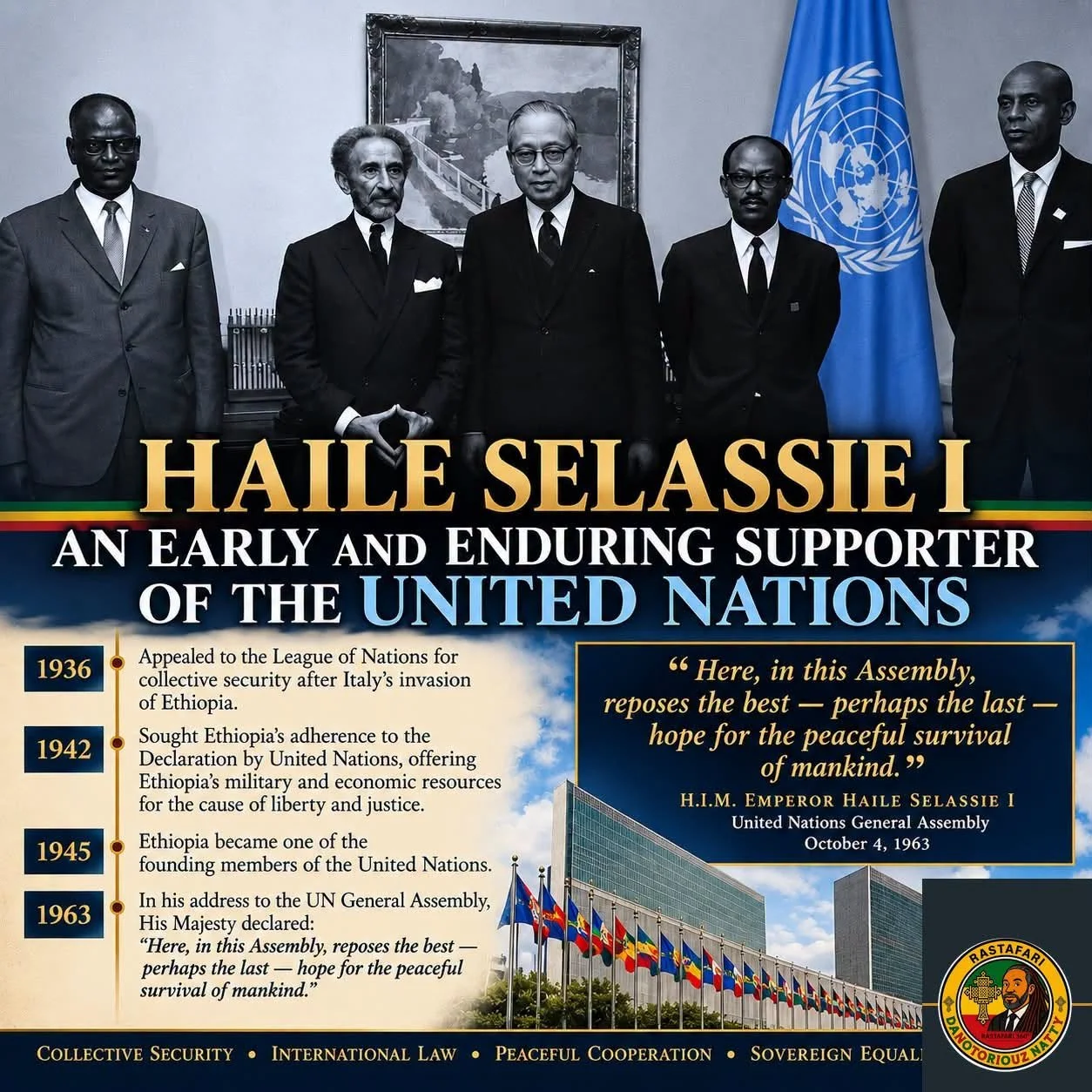
Twenty-seven years ago, as Emperor of Ethiopia, I mounted the rostrum in Geneva, Switzerland, to address the League of Nations and to appeal for relief from the destruction which had been unleashed against my defenceless nation by the Fascist invader. I spoke then both to and for the conscience of the world. My words went unheeded, but history testifies to the accuracy of the warning that I gave in 1936. Today, I stand before the world organization which has succeeded to the mantle discarded by its discredited predecessor. In this body is enshrined the principle of collective security which I unsuccessfully invoked at Geneva. Here, in this Assembly, reposes the best – perhaps the last – hope for the peaceful survival of mankind.” (SSHIM p 368; Kindle p. 392)
SPEAKING TO AND FOR THE CONSCIENCE OF THE WORLD
Compiled by
Siphiwe Baleka
Afrodescendant Theocratic Special Envoy Extraordinary & Reparations Expert
2026
Now that United States President Donald Trump, following Israel’s President Benjamin Netanyahu, has violeted the principle of collective security and made a mockery of international law and plunging the entire world into chaos through the use of naked force and aggression, like the prophets of old, I remind the world of
GOD’S INSTRUCTIONS TO MANKIND FOR PRESERVING PEACE AND THE FUTURE, EVEN THE VERY EXISTENCE, OF MANKIND
*****************************************************************************************************
(citations from Selected Speeches of His Imperial Majesty Haile Selassie I, 1918-1967, originally published by the Imperial Ethiopian Ministry of Information, 1967 and republished in a new edition by The Lion of Judah Society’s Imperial Publishers (1991-2011) www.lojsociety.org)
**************************************************************************************
COLLECTIVE SECURITY
References to collective security appear in the chapter on International Relations and the one on U.N. International within the provided text, primarily in the context of Ethiopia's experiences with the League of Nations and the United Nations (p. 18).
Specific references in the text and in related speeches include:
Chapter V – U.N. International: The phrase "U.N. and Collective Security" appears as a section title with corresponding page numbers.
Kagnew Battalion and Collective Security: Another section title mentions "Kagnew Battalion and Collective Security" in the Chapter XIV on Security.
Haile Selassie's League of Nations Appeal: The Emperor made an impassioned appeal to the League of Nations in 1936 where he addressed the principle of collective security, arguing that the League's failure to act against Italy's aggression put the entire principle and the League's existence at stake.
United Nations Address: In a 1963 address to the United Nations, he referred to the UN as the "best - perhaps the last - hope for the peaceful survival of mankind" and that it enshrined the principle of collective security that the League of Nations had discarded.
Korean War Context: He spoke about collective security in the context of sending the Ethiopian Kagnew Battalion to the Korean War, framing it as a duty to the UN and an act to redeem the principles of collective security.
Principle for Small Nations: He stated that small nations should regard collective security as the "cornerstone of their very existence" and support it instantly and absolutely.
APPEAL TO THE LEAGUE OF NATIONS - June 30, 1936
“I assert that the problem submitted to the Assembly today is a much wider one. It is not merely a question of the settlement of Italian aggression. It is collective security: it is the very existence of the League of Nations. It is the confidence that each State is to place in international treaties. It is the value of promises made to small States that their integrity and their independence shall be respected and ensured. It is the principle of the equality of States on the one hand, or otherwise the obligation laid upon small Powers to accept the bonds of vassalship. In a word, it is international morality that is at stake. Have the signatures appended to a Treaty value only in so far as the signatory Powers have a personal, direct and immediate interest involved? No subtlety can change the problem or shift the grounds of the discussion. It is in all sincerity that I submit these considerations to the Assembly. At a time when my people are threatened with extermination, when the support of the League may ward off the final blow, may I be allowed to speak with complete frankness, without reticence, in all directness such as is demanded by the rule of equality as between all States Members of the League? Apart from the Kingdom of the Lord there is not on this earth any nation that is superior to any other. Should it happen that a strong Government finds it may with impunity destroy a weak people, then the hour strikes for that weak people to appeal to the League of Nations to give its judgment in all freedom. God and history will remember your judgment. . . . Your Assembly will doubtless have laid before it proposals for the reform of the Covenant and for rendering more effective the guarantee of collective security. Is it the Covenant that needs reform? What undertakings can have any value if the will to keep them is lacking? It is international morality which is at stake and not the Articles of the Covenant. . . . I ask the fifty-two nations, who have given the Ethiopian people a promise to help them in their resistance to the aggressor, what are they willing to do for Ethiopia? And the great Powers who have promised the guarantee of collective security to small States on whom weighs the threat that they may one day suffer the fate of Ethiopia. I ask what measures do you intend to take? Representatives of the World I have come to Geneva to discharge in your midst the most painful of the duties of the head of a State. What reply shall I have to take back to my people?” (SSHIM p 313-15; Kindle p. 337-9)
KAGNEW BATTALION AND COLLECTIVE SECURITY - April 14, 1951
“It is in yet a larger sense, Soldiers, that you are today leaving the homeland to fight on distant shores. You are fighting not only for freedom as We know it in Ethiopia, and the right of each people to its freedom. You are also representing and defending in far corners of the earth, the most sacred principle of modern international policy – that principle of collective security with which the name of Ethiopia is imperishably associated. It is but natural that small nations who must so vigilantly defend their independence, should regard collective security as the cornerstone of their very existence. Their support of that principle should be instant, unhesitating and absolute. No small state, no democratic nation, no people imbued with charity towards its fellow men, could do otherwise. Of all nations of the world, the name of Ethiopia has been most closely associated with that principle. Our undaunted defence of collective security at the League of Nations, Our own appeal to that august body, Our fierce and un-aided struggles throughout the darkest hours preceding the last World War, the courage of our patriots, the unending sacrifices of Our families, have given to Ethiopia an imperishable place in the history of that principle in modern times. . . . At this proud moment of participation in the first collective and world-wide effort for the defence of the principle of collective security, Ethiopia and Ourselves can look back with pride, on the progress achieved, progress to which Ethiopia has so heavily contributed in recent years. Precisely fifteen years ago this very month, We, Your Emperor, and Commander-in-Chief, addressed from the battlefield a pressing appeal to the League of Nations for the respect and application of the principle of collective security. It was not a question then as now, even to hope for the application of measures of military sanction. So new then was that principle that Ethiopia could only hope for the most basic economic sanctions to restrict aggression, and urgent measures to bring to an end the use of asphyxiating gas. However, it was also in that same month, fifteen years ago today, that the Council of the League of Nations finally declared its inability to meet these essential requirements of collective security. Undaunted by this failure, Ethiopia under Our leadership and with the courage of its patriots continued the struggle until that glorious day when, at the head of Our troops and with the aid of British Empire heroes, We reentered Our Capital. Today, it is no longer a question of asking for simple economic sanctions. Korea asks the United Nations and receives from it collective security in the form of military assistance. In joining today in these measures of collective security, We are being faithful to Ourselves and to the obligation which We conceive to be the most high and solemn duty not alone of the present hour, but of the present century. Collective security knows no bounds or distances. In participating in the measures of collective security in the Far East, We are only fulfilling Our obligations towards the United Nations. Just as previously, by the sending of financial assistance, We had manifested Our sympathy towards the valiant people of China so sorely tried by natural disasters, so today, We deplore the new hardships which that people have been called upon to suffer as a result of the events in the Far East. Let us hope that peace and tranquillity may soon be re-established there. You have been fortunate, Soldiers, in that each one of you has been selected thus to testify before the world to the flame of liberty and of devotion to the cause of international justice which has fired the breasts of Our patriots. You are following the footsteps of the long line of your forefathers in proclaiming before the world the right of each nation, determined by its own efforts to save its independence and freedom, to receive as collective security assistance from all peace-loving nations. Ethiopia could do no less today and still remain faithful to her traditions and to the sacrifices which We have undergone. Soldiers, the spirit of your ancestors, heroes of the thousand-year-long struggle for the defence of Our freedom will follow you and will strengthen your hands and hearts in the heat of battle. Remember that you are about to pay a debt of honour for your homeland which was liberated thanks not only to the blood of her patriots, but also to that of faithful allies, likewise members of the United Nations. Remember also that in paying this debt, you are laying the basis for a universal system of collective security on behalf of your own homeland as well as of nations of the world, be they great or small, powerful or weak. May God protect you, give you courage to acquit yourselves as heroes and bring you back safely to your beloved Homeland.” (SSHIM p 593-7; Kindle p. 617-21)
INTERNATIONAL RELATIONS - ALLIED VICTORY - September 7, 1951
“Today marks what will, perhaps, be recorded as the most significant day in world history, for today has at last been brought to account and to a crushing defeat a worldwide philosophy of aggression against all peace-loving nations. . . . We have today reversed the policy of expediency at the expense of international justice. Today the victory which We now celebrate, represents not only the triumph over Japan, not only the triumph over those same forces in Europe which were part and parcel of the same struggle, but also a triumph of the principle of collective security enshrined in the Charter of the United Nations signed at San Francisco. . . . These sacrifices, the sacrifices of other United Nations and the long bitter struggle of Our Empire for the defence and furtherance of the cause of collective security impose upon all nations alike the obligation rendered sacred by the life-blood and sufferings of Our people to ensure that war will not again sear the face of Our fair lands, and that justice and not expediency shall guide the councils of nations. . . .” (SSHIM p 88-89; Kindle p. 112-3)
U.N. AND COLLECTIVE SECURITY - November 2, 1953
“This agreement for mutual security constitutes a striking example of the policy always followed by Ethiopia and which consists of contributing by every means at her disposal to the forces of collective security throughout the world. Ethiopia is to be counted among those members of the United Nations who are the most faithful in the support of the principles upon which the Charter of that organization rests. It is for this reason that Ethiopia was among the first of the members to respond to the appeal of the Security Council for contributions, by financial means and, later by military forces, to check the aggression in Korea. (SSHIM p 357; Kindle p. 381)
ADDRESS TO THE U.S. CONGRESS - May 26, 1954
“This collaboration with the West and with the United States in particular has taken yet broader forms. There is our military collaboration based on the mutual security programme. If we leave out the Atlantic group, Ethiopia has been the only state of the Middle East to follow the example of the United States in sending forces to Korea for the defence of collective security. In so doing, Ethiopia has been inspired by a vision which is broader than her pre-occupation with regional policies or advantages. Nearly two decades ago, I personally assumed before history the responsibility of placing the fate of My beloved people on the issue of collective security, for surely, at that time and for the first time in world history, that issue was posed in all its clarity. My searching of conscience convinced me of the rightness of my course and if, after untold suffering, and, indeed, unaided resistance at the time of the aggression we now see that final vindication of that principle in our joint action in Korea, I can only be thankful that God gave me strength to persist in our faith until the moment of its recent glorious vindication. We do not view this principle as an extenuation for failing to defend our homeland to the last drop of one’s blood, and indeed, our own struggles during the last two decades bear testimony to our conviction that in matters of collective security as of Providence, “God helps him who helps himself. . . . The world has ceaselessly sought for and has striven to apply some system for assuring the peace of the world. Many solutions have been proposed and many have failed. Today the system which we have advocated and with which the name of Ethiopia is inseparably associated has, after her sacrifices of two decades ago, and her recent sacrifices with the United States and others in Korea, finally demonstrated its worth. However, no system, not even that of collective security, can succeed unless there is not only a firm determination to apply it universally both in space and time, but also whatever be the cost. Having successfully applied the system of collective security in Korea, we must now, wherever in the world the peace is threatened, pursue its application more resolutely than ever and with courageous acceptance of its burdens. We have the sacred duty to our children to spare them the sacrifices which we have known. I call upon the world for determination fearlessly to apply and to accept as you and We have accepted them – the sacrifices of collective security.” (SSHIM p 117-18; Kindle p. 141-2)
U.N. AND THE LEAGUE - June 1, 1954
“It is a significant moment for me when, after eighteen years, I again find myself in a centre where are concentrated the passionate hopes of the thousands of millions of human beings who so desperately long for the assurance of peace. The years of that interval, sombre as they were and sacred as they remain to the memory of millions of innocent victims, hold forth for us bright hope of the future. The League of Nations failed and failed basically because of its inability to prevent aggression against my country. But, neither the depth of that failure nor the intervening catastrophes could dull the perception of the need and the search for peace through Collective Security. So it is that here in the United Nations we have dedicated ourselves anew to those high and indeed essential ideals, essential if the world is to continue on the path of peace. Ethiopia, for its part, is profoundly convinced of the triumph of these ideals, were it only that the past two decades have, in her case, fully justified them. The League of Nations may have failed, but Ethiopia was again liberated and through the United Nations has finally seen the rectification of seventy years of injustice and the vindication of the right of brothers to become reunited. Moreover, the memory of the failure two decades ago of measures of collective security is being effaced by the glorious achievement, to which Ethiopia also contributed, in the collective defence of Korea. Surely we have cause to be heartened at the progress of mankind. We must lay aside any disappointment of the hour lest it cloud our vision of the goal to which we would aspire and press forward, with confidence, born of past experience, in the triumph of principles which are here represented and for which you, Mr. Secretary-General, labour so diligently and intelligently. Ever since my country’s acceptance of the obligations of the United Nations as a charter member, I have looked forward to the day when I would be able to visit the organization’s headquarters. The physical realization of these splendid buildings, of the hopes and aspirations of those of us who have ardently supported the principle of collective security and the practical instrument to secure and maintain international justice have surpassed my expectation.” (SSHIM p 355-7; Kindle p. 379-81)
PROMULGATING THE REVISED CONSTITUTION - November 3, 1955
“Twentyfive years ago Ethiopia was still a little known corner of the dark continent of Africa. Through her courageous resistance against aggression and through Our appeal to the world founded on respect for international morality and collective security, Ethiopia has achieved imperishable fame. The world has come to recognize the moral stature and greatness of the Ethiopian people. In consequence, We have been able to rectify certain of the crying injustices perpetrated against Our beloved country during the iniquitous period of imperialism against which Ethiopia, under Our leadership, had to fight alone.” (SSHIM p 401; Kindle p. 425)
OPENS H.S.I. MILITARY ACADEMY - October 6, 1958
“The faithful and enlightened services to be rendered by the officer cadets who will study here and who, upon their graduation, will assume the command of Our Armies in the field, will, We sincerely trust, constitute an impregnable bulwark against those who would violate Ethiopia’s glorious tradition of liberty which, for centuries, has been handed down from generation to generation. The officers who will graduate from this institution must be constantly aware that Ethiopia shares in the responsibility of assuring the collective security of the world. Every country that has to struggle for its freedom will naturally look to other freedom-loving nations for assistance in their efforts. We would, therefore, be pleased to see students from our neighbouring nations in Africa benefit from the instruction that is being imparted at this Military Academy.” (SSHIM p 54; Kindle p. 78)
INTERNATIONAL POLITICS - THREE PRINCIPLES
“Second is Our unswerving devotion to the principle of Collective Security. In those early days of 1935-6 when Our country was subjected to the horrors of aggression, We appeared before the League of Nations to plead the cause of Collective Security, a plea which unfortunately fell on deaf ears. But even today, no better principle can be devised for the maintenance of the peace of the world, and the peaceloving nations of the world have begun to come together under this banner. Third, flowing from the principle of Collective Security, is the necessity, in these anxious days when the major powers are engaged in a frantic arms race, for all countries which have accepted this principle and assumed a share of the responsibility for ensuring the peace of the world, to become ever stronger militarily. It is in order to discharge Our responsibilities under the principle of Collective Security that we have established the Military Academy at Harar, to ensure that properly trained officers will lead Our Armed Forces. And in order further to strengthen Our Armed Forces for the defence of Our Empire in time of war, and for ensuring its internal security in time of peace, We have ordered the establishment of an Imperial Territorial Army. As We have stated time and time again, We are firmly persuaded that the path to guaranteeing the peace of the world lies in supporting the principle of Collective Security and the United Nations Charter, combined with a progressive reduction of the armaments which are being built up throughout the world. The billions of dollars which are now wasted on this fruitless effort could with great benefit be diverted into the constructive channels of aid for the economic growth of under-developed countries. . . . “ (SSHIM p 164-5; Kindle p. 188-9)
REPLY TO CZECHOSLOVAK PRESIDENT - July 16, 1959
“Even though Ethiopia and Czechoslovakia have different systems of government, both countries have several things in common. For many long years both had to fight for the preservation of their independence – very dear to them. Not long ago though both had to rebuke the attack by fascist forces. Both of our countries, placing their trust in the system of Collective Security, had appealed to the League of Nations to stop the aggression launched against them. To satisfy insatiable fascism, the freedom of Ethiopia was sacrificed, while in Europe Czechoslovakia was placed at the mercy of military expansion. At the time when the League of Nations applied sanctions against the fascist invaders in Ethiopia, Czechoslovakia and Rumania were among those countries which fully observed the sanctions.” (SSHIM p 122; Kindle p. 146)
ADDRESS TO THE NATION ON HIS TOUR - August 29, 1959
“All of you are aware that Ethiopia’s foreign policy is based on the principles of the United Nations Charter as well as on the Bandung and Accra Declarations. These principles which We have long cherished and for which We have striven are, among others, collective security, peaceful and active co-existence, non-interference in the internal affairs of other countries, respect for the sovereignty and territorial integrity of other nations and peaceful settlements of all disputes among nations.” (SSHIM p 449-50; Kindle p. 473-4)
REVIEWING MILITARY MANOEUVRES - May 2, 1960
“In this age, when the world is becoming ever smaller and the obligations of Collective Security have become the obligations of all, it is vital that Ethiopia’s armed forces be at all times fit and ready to discharge these duties. The maintenance of peace requires eternal vigilance and a state of constant readiness. To achieve these ends, Our defence forces, which have as their ultimate objective the assurance of peace, can draw upon the traditional bravery of Our people and the latest developments in modern military science. It is commonly believed that military training can serve only on the field of battle. On the contrary, it can make a significant contribution to the cause of Collective Security and the preservation of peace. This is Ethiopia's constant goal.” (SSHIM p 604; Kindle p. 628)
TO VISITING U. S. EDITORS - May 14, 1960
“Thus, alone in 1896, alone in 1925, alone in 1935 and alone at Geneva in 1936, Ethiopia fought for those principles of freedom, independence, territorial integrity, non-intervention and collective security that have become today the implicit precepts upon which the United Nations are based and which, through that struggle, have so substantially contributed to the achievement of independence and the end of colonialism in Africa. Years ago, We took the lead in pressing by active measures, for the freedom and independence of those States who today are honoured Members of the United Nations.” (SSHIM p 669; Kindle p. 693)
CONGO (COLLECTIVE SECURITY) FIRST CONTINGENT OF ETHIOPIAN TROOPS FOR THE CONGO - July 17, 1960
“When in our African Continent, the Republic of Congo celebrated its independence a few weeks ago, Our delegates were sent to Leopoldville to transmit the message of Our great joy on the happy occasion. Great as was Our joy then, the present situation that was created in the Congo Republic has equally touched Our heart with deep sorrow. We had earlier communicated Our readiness and desire to give full aid directed at bringing internal peace and security to the Congo both with the authorities there and with Mr. Dag Hammarskjoeld, the United Nations Secretary-General. Under Our obligation for the Collective Security of the world Our significant role in Korea is only too well known. Mr. Dag Hammarskjoeld, in accordance with the Security Council Resolution, has asked Us for military and air force assistance for the Congo. As it coincided with Our own wish and desire to safeguard the unity, independence and internal security of the Congo inasmuch as We uphold the Charter of the United Nations and have abiding loyalty in the principle of Collective Security, We have granted the request made to Us and have decided to send you officers and men to fulfil such a high mission.” (SSHIM p 207; Kindle p. 231)
TO THE HARAR MILITARY ACADEMY - October 3, 1960
“It is in support of the principle of collective security that We have dispatched Our troops to the Congo under the auspices of the United Nations to maintain law and order and to preserve the integrity of the new Republic, without interference in the internal affairs of that country. The fact is that these troops have encountered certain obstacles in the execution of their duties.” (SSHIM p 608; Kindle p. 632)
COLLECTIVE SECURITY - November 2, 1960
“…..Although a small nation, Ethiopia is yet intimately concerned with the easing of the tensions which so unfortunately mar the realm of international relations today. Throughout Our lifetime, We have consistently maintained that in the principle of Collective Security rested the best hope for assuring the peace of the world, and We have given unstintingly Our support to the world organizations which have been created to assure the application of this principle. Throughout its brief existence, the United Nations has justified the faith which We have placed in it, and We shall continue to be steadfast in our support of the United Nations Organization. . . . Having Ourself laboured unstintingly for the reinforcement of international organizations devoted to the cause of peace and the strengthening of the principle of Collective Security, We sent a personal message to the opening session of the General Assembly in which We called upon the nations gathered there to spare no effort to reach wise and sound decisions designed to solve the problems which face the world today and to lessen the tensions which separate and divide nations. As a sovereign nation, jealous of her independence, Ethiopia has a duty both to her own people and to the other free peoples of the world to ensure that aggression will be resisted wherever and in whatever form it is met. It is today the duty of each state which is dedicated to the cause of peace to be prepared to fulfil its commitments to the United Nations in defence of the principle of Collective Security and to stand ready at all times to discharge these obligations.” (SSHIM p 364-6; Kindle p. 388-90)
ADDRESSES THE BELGRADE CONFERENCE - September 3, 1961
“Equally important, the United Nations provides the instrumentality whereby the principle of Collective Security, to which We personally have devoted Our lifetime, achieves real and tangible existence and meaning. If force must be employed in the world today in resistance to aggression and in the maintenance of world peace, surely it is preferable that it be employed through an institution such as the United Nations, in pursuance of international decisions legally and openly arrived at there. Ethiopia has not hesitated to respond in the past with all the resources at her disposal to the call of the United Nations in times of crisis, and we shall not hesitate to do so again should the call be made.” (SSHIM p 172; Kindle p. 196)
TO THE LAGOS SUMMIT MEETING - January 26, 1962
“Ethiopia is justifiably proud of the role which we have played and continue to play in the Congo, a role wholly consistent with the staunch support which Our nation has unfailingly given to international organizations dedicated to the cause of peace and collective security throughout past decades. If history is to judge Us, We would ask only that it judge on the basis of Ethiopia’s record of resistance to colonialism, oppression and aggression, from the date when Ethiopian patriots repulsed the Italian invaders at Adoua in 1896 and then in 1935 and thereafter. We have responded to the appeals of the United Nations for assistance in the Congo, and We have supported the United Nations policies because experience, reason and instinct have all combined to persuade us beyond peradventure that only in this way can a peaceful and permanent solution to the vexatious problems which exist there be settled.” (SSHIM p 228; Kindle p. 252)
BURIAL OF THE CONGO CASUALTIES - April 19, 1963
“You heroes, You carried to the sister State of the Congo the bravery and heroism which your country gained from her ago-long struggle for the love of freedom. You sacrificed your lives in defence of the principle of Collective Security. Your sacrifice has borne the desired fruit and the Congo is united today. You have honourably executed the orders given to you by Us. You have died in support of the peace mission entrusted to the United Nations. This is a great example. Ethiopia takes pride in her Armed Forces. It has been said death comes as a pleasure to the hero. You have fallen for a noble cause and in so doing have lived up to what is expected of a good, solid soldier. This immortalizes your names in the pages of history .You are dead but the service you have done will live after you, and would keep you in the memory of the living. It has been said that dust shall return to dust. You sons of Adam have fallen for the honour of your country and for the pride of your people. History shall preserve your names. Ethiopia places you alongside her heroes. May you rest in peace.” (SSHIM p 652-3; Kindle p. 676-7)
RESPONSIBILITIES DEMAND BALANCED, SOBER REFLECTION A CALL TO AFRICAN LEADERS (1963 SUMMIT) - May 25, 1963
“We would not close without making mention of the United Nations. We personally, Who have throughout Our lifetime been ever guided and inspired by the principle of collective security, would not now propose measures which depart from or are inconsistent with this ideal or with the declarations of the United Nations Charter. It would be foolhardy indeed to abandon a principle which has withstood the test of time and which has proved its inherent value again and again in the past. It would be worse than folly to weaken the one effective world organization which exists today and to which each of us owes so much. It would be sheer recklessness for any of us to detract from this organization which, however imperfect, provides the best bulwark against the incursion of any forces which would deprive us of our hard-won liberty and dignity.” (SSHIM p 255; Kindle p. 279)
ADDRESS TO THE UNITED NATIONS - October 4, 1963 3:00 PM
“Mr. President, Distinguished Delegates:
Twenty-seven years ago, as Emperor of Ethiopia, I mounted the rostrum in Geneva, Switzerland, to address the League of Nations and to appeal for relief from the destruction which had been unleashed against my defenceless nation by the Fascist invader. I spoke then both to and for the conscience of the world. My words went unheeded, but history testifies to the accuracy of the warning that I gave in 1936. Today, I stand before the world organization which has succeeded to the mantle discarded by its discredited predecessor. In this body is enshrined the principle of collective security which I unsuccessfully invoked at Geneva. Here, in this Assembly, reposes the best – perhaps the last – hope for the peaceful survival of mankind.” (SSHIM p 368; Kindle p. 392)
REPORT TO THE NATION - November 21, 1964
“Ethiopia has, throughout the past year, continued to adhere to the traditional policies to which We have on numerous occasions declared Our nation’s devoted respect for the rights of others, non-interference in the internal affairs of states, respect for the territorial integrity and sovereignty of nations, the peaceful settlement of disputes, support of the principle of collective security as the best protection against aggression and the best guardian of the peace.” (SSHIM p 99; Kindle p. 123)
25TH ANNIVERSARY OF LIBERATION - May 5, 1966
“First of all, however, We placed Our faith in the principle of collective security and the seemingly indisputable might of the League of Nations. The story of the betrayal of that faith is one of the acknowledged tragedies of our times. The arms and supplies which Ethiopia could not produce herself were denied her, while the enemy continued to build and fuel with its own resources its great war machine. The most futile sanctions were half-heartedly called for, and less than half-heartedly enforced. Ethiopia’s warriors and patriots fought with all the valour and desperation for which they and their ancestors had so often been called upon before, but they were powerless against the bombs and poison gas which the enemy so mercilessly and savagely employed against soldiers and innocent civilians alike. The brutality of those infamous days will forever haunt the memory of those who lived through them. The lessons of experience are rarely easy. It was through bloodshed and sorrow that Ethiopia learned the awesome power of modern arms and organized military might. From the ashes of the war Ethiopians began to reconstruct a new and more powerful nation. We vowed in sorrow that Ethiopia would never again through weakness suffer such outrages as had been wrought upon her. . . Yet even beyond the vast improvements in the Ethiopian military machine, there stands in defence of peace the great bulwark of the United Nations, erected with willing and eager hands out of the torment, destruction and misery of the last war. Even as the guns were falling silent the representatives of millions of men and women, Ethiopians among them, pledged themselves to uphold the Charter of the United Nations so that no such holocaust would ever again ravage and darken the earth. The United Nations was conceived as a means of real and positive action in the face of aggression. Ethiopia evinced her continuing faith in collective security as she enrolled herself among the charter members of the organization. In accordance with decisions of the United Nations, Ethiopia has shown her willingness to give substance to principle, to fight and sacrifice for others as for herself – in Korea, in the Congo, and elsewhere – in order to uphold and defend the rule of justice and reason in human affairs.” (SSHIM p 349-51; Kindle p. 373-5)
PRESS CONFERENCE: 74TH BIRTHDAY - July 30, 1966
“Of course, the Second World War had affected Ethiopia. It is a well-known fact that our country fell victim to the aggressive forces of Fascism. I had the privilege of pleading the case before the League of Nations in Geneva but the League's collective security system had not been strengthened and there were no standard procedures to which there was universal adherence for the settlement of international disputes. The system failed. Ethiopia suffered from the failure of that system but the concept of collective security was more firmly established after the war.
Question:
Your Imperial Majesty, do You see any relationship between the League of Nations' failure to take action on the situation Ethiopia faced in 1935-36 and the failure of the Court to take action on the South West African case in 1966?
Answer:
There is a material difference between the failure of the League's collective security system in 1935 and 1936 and failure of the International Court of Justice to consider the merits of the South West African case. The collective security system arrangement that we thought, and everybody thought, was secured under the Covenant of the League of Nations collapsed completely. The failure of the International Court of Justice now to consider the merits of the South West African case means that legal procedures for the settlement of the dispute are no longer open to us and that we are to approach the problem from another angle, perhaps by insisting to invoke the collective security measures under the Charter of the United Nations. So that in the two cases I see this important difference: while the League of Nations collapsed completely, in the case of the International Court of Justice, it was one particular organ of the collective security system that failed to respond to the demands of justice in South West Africa.” (SSHIM p 678-9; Kindle p. 702-3)
ETHIOPIA’S WORLD POSITION - November 2, 1966
“Our nation is known, and rightly, as a staunch advocate and supporter of the principle of collective security, the principle which still underlies the modern concept of the regulation of relations among states. We have stood forthright in our support of the United Nations, and we have not hesitated to respond to the call of that Organization.” (SSHIM p 101; Kindle p. 125)
*********UPDATE***********
Following publication of this warning, the United States moved troops into the Strait of Hormuz. Former President Bill Clinton speaks plainly on the threat of war.