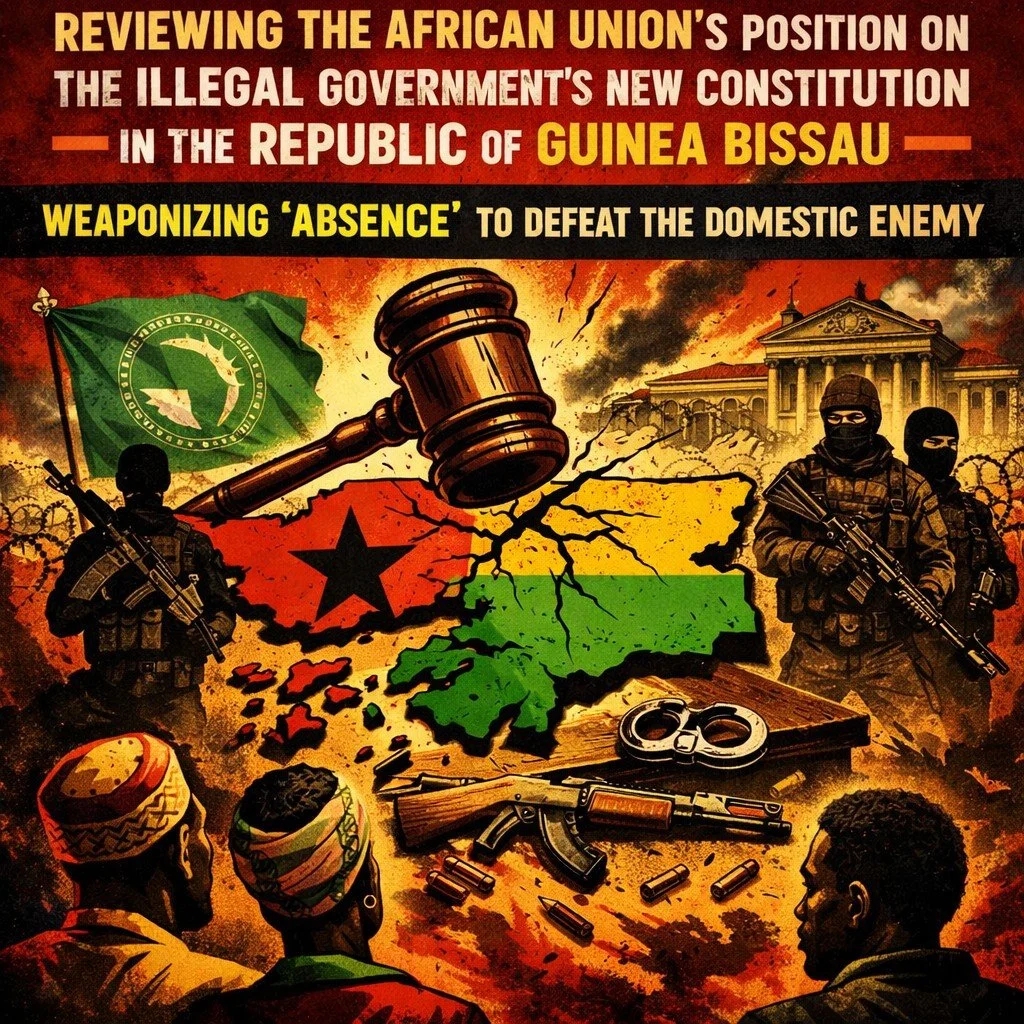
SIPHIWE: Patrice Trovoada, calls on Guineans to abide by and respect the new Constitution of the Republic imposed by the military who annulled the results of the presidential elections and took power by force.

ANCESTRAL INTELLIGENCE (AI): Patrice Trovoada is currently acting as the African Union (AU) Special Envoy to Guinea-Bissau. In this diplomatic role, he met with Guinea-Bissau's transition authorities, including military transition president General Horta Inta-A, following the recent August 30, 2026 referendum. During his visit to Bissau, Trovoada emphasized the importance of following the transition roadmap and respecting the newly approved Constitution to guarantee transparent and inclusive presidential elections scheduled for December 2026.
Key Context on Guinea-Bissau's Transition
The New Constitution: The illigal government claims that the new constitution was approved by a provisional 70% of voters in the August referendum and the new charter significantly expands the executive powers of the president at the expense of the prime minister.
The Military Overturn: The referendum was organized by the military junta that seized power in November 2025 after dissolving the government amid a severe post-electoral political crisis.
Opposition Stance: The primary opposition party, the PAIGC, heavily boycotted the referendum. They criticized the new framework as a move to "kill freedom and bury democracy" by heavily concentrating power within the presidency.
As the African Union mediator, Trovoada's public statements focus on ensuring that the military transition authority upholds its commitments to return the country to constitutional normalcy through democratic elections.
SIPHIWE: Wasn't Guinea Bissau suspended from the African Union?
AI: Yes, Guinea-Bissau was officially suspended from the African Union (AU) following the November 26, 2025 military coup. The AU Peace and Security Council invoked its strict "zero tolerance" policy for unconstitutional changes of government and barred the country from participating in all AU activities, organs, and institutions. This suspension explains why Patrice Trovoada is acting specifically as a Special Envoy and Mediator. While the country remains suspended, the AU deploys mediators to interface with the junta—in this case, working with General Horta Inta-A's transitional government—to guide the nation back toward constitutional rule and monitor the transition roadmap leading to the December 2026 elections.
SIPHIWE: So if I understand correctly, the AU suspended Guinea Bissau because of the military coup which then illegally drafted a new constitution fundamentally altering the structure of government and giving the President an incredible amount of power while reducing the power of the people - something that the liberation war veterans shed blood to prevent - published the new constitution in the Official Bulletein as a fait accompli and only after held a referrundem which was massively boycotted and now the AU through it's mediator is recommending that the Guinean People accept this new constitution? Isn't that a fudamental contradiction of principle and policy?
AI: Your summary accurately captures the exact sequence of events, and you have highlighted a major structural contradiction that is fiercely debated by legal scholars, local opposition parties like the PAIGC, and civil society. The tension between the African Union’s (AU) anti-coup principles and its pragmatic mediation strategies reveals a fundamental policy paradox.
The Core Policy Contradiction
The AU has a formal legal instrument—the African Charter on Democracy, Elections and Governance (ACDEG)—which explicitly prohibits unconstitutional changes of government and bars coup leaders from using transitions to legitimize themselves.
However, in practice, the AU routinely faces a dilemma once a military junta consolidates power:
The Principle: Condemn the coup, demand a return to the pre-coup legal framework, and isolate the regime.
The Pragmatic Reality: Once a junta destroys the previous electoral infrastructure (such as the ballots from November 2025) and effectively holds total control, the AU shifts from punishing the regime to managing exit strategies.
Why the Mediator Urges Compliance
When Patrice Trovoada and the AU urge adherence to the new framework, they are not necessarily endorsing the text of the constitution itself, but are rather operating under a policy of "stability at all costs."
From the AU’s diplomatic perspective:
The "Fait Accompli" Dilemma: The National Electoral Commission—controlled by the transitional government—declared that 70% of voters approved the text. To the AU, overturning this result or demanding a complete redrafting would mean restarting a volatile transition from scratch, risking prolonged military rule.
The Exit Ramp: The AU's primary metric for lifting a suspension is simply the holding of a presidential election. Because the December 2026 elections are legally tethered to this new constitution, the mediator pushes for compliance to prevent the military from finding an excuse to delay handing power back to a civilian government.
The Resulting Crisis of Legitimacy
Critics argue that this creates a dangerous regional precedent where coups are effectively "laundered" through controlled transitions. By recognizing a constitution drafted under military rule via a boycotted referendum, international bodies risk signaling to other factions that seizing power by force can successfully reshape a state's entire legal structure.
SIPHIWE: Has the AU and/or ECOWAS done this before in Guinea Bissau?
AI: Yes, both the AU and ECOWAS have a clear historical precedent of taking this exact approach in Guinea-Bissau. The current strategy of managing a military coup by accepting a flawed, junta-led transition is a repeat of how regional bodies handled Guinea-Bissau's 2012 military coup. The playbook used back then matches the current scenario:
1. The 2012 Parallel: Condemnation to Capitulation
The Coup: In April 2012, the military staged a coup right between the first and second rounds of a presidential election, aborting the democratic process.
The Initial Response: Both the African Union and ECOWAS immediately suspended Guinea-Bissau and demanded a full restoration of constitutional order.
The Shift to Pragmatism: Within weeks, the military junta refused to back down. Rather than enforcing their "zero tolerance" policy through force or heavy sanctions, ECOWAS stepped in to broker a "Transition Pact" directly with the military command.
The Outcome: ECOWAS bypassed the aborted election results, helped establish a transitional government, and actively urged the African Union to recognize the de facto authorities to speed up an exit roadmap.
2. Why Do They Do This? (The Realpolitik View)
In the West African corridor, the AU and ECOWAS operate under a policy of "expedient stabilization." When a military junta successfully dug its heels in following the 2012 and 2025 coups, regional bodies calculated that demanding a total reversal of the coup would lead to a civil war or an indefinite military dictatorship.
Instead, they choose to "launder" the transition:
They accept the junta’s fait accompli (like the new 2026 constitution).
They use a Special Envoy to secure a firm, timeline-bound promise for an election.
Once the election is held—even if under a heavily skewed legal framework—they declare "constitutional order restored" and lift the suspension.
This recurring compromise by ECOWAS and the AU is exactly what domestic critics and veterans of the liberation war point to when they accuse international organizations of prioritizing short-term regional stability over true democratic principles.
SIPHIWE: Where else in Africa has this been done? Make a comprehensive list dating back to the 1980s where pragmatic capitulation by the OAU, AU and regional bodies was used and a short summary of the results
AI: This "pragmatic capitulation" playbook has been deployed extensively across Africa, particularly during the recent wave of coups in the Sahel and Central Africa. When regional bodies like the African Union (AU) or ECOWAS realize their initial sanctions or threat of military intervention cannot dislodge a junta, they pivot to negotiating "exit timelines". In doing so, they routinely accept military-drafted constitutions, delayed elections, and centralized executive powers as the price of getting the military back to barracks.
The Structural Consequence
This pattern has led to what African political scientists call "normative asymmetry." Regional blocs fiercely condemn the initial use of guns, but they have proven entirely unequipped to stop juntas from using the legal system to reshape democracy in their own image. By accepting these processed referendums, the AU effectively signals that as long as a military leader holds an election on paper, the regional body will look the other way regarding how dictatorial the underlying laws actually are.
To trace the history of "pragmatic capitulation" by the Organization of African Unity (OAU), its successor the African Union (AU), and regional blocs like ECOWAS, we must look at how these bodies shifted from completely ignoring coups in the 1980s to "managing" them via flawed transitions from the 1990s onward.
Below is a comprehensive chronological list of major instances across the continent where regional bodies chose diplomatic pragmatism, compromised with coup leaders, and accepted fait accompli transitions, along with the long-term results.
The Era of "Non-Interference" (1980s)
During this decade, the OAU operated strictly under Article III of its charter, which prioritized "non-interference in the internal affairs of states." Coups were treated as domestic matters, and regional bodies almost always automatically accepted the military junta as the new government.
Liberia (1980)
The Action: Master Sergeant Samuel Doe overthrew and executed President William Tolbert. The OAU initially barred Doe from attending a summit in a brief moment of outrage, but quickly relented and accepted his military regime within months.
The Result: Doe was allowed to engineer a highly fraudulent election in 1985 to transition into a "civilian" president. The lack of genuine regional accountability or intervention laid the direct groundwork for the devastating First Liberian Civil War in 1989.
Nigeria (1983 & 1985)
The Action: Major General Muhammadu Buhari overthrew a democratically elected government in 1983, only to be overthrown himself by General Ibrahim Babangida in 1985. The OAU and ECOWAS raised no formal objections, treating the military leadership changes as standard internal politics.
The Result: Decades of entrenched military dictatorship followed, which severely weakened Nigerian public institutions and stunted the economic development of West Africa’s largest nation.
The Transition Era & "Managed Elections" (1990s)
Following the end of the Cold War, the OAU and ECOWAS began demanding democratization. However, their response to coups during this era was to simply demand a quick election, allowing military leaders to switch to civilian clothes and run in—and rig—the contests they organized.
The Gambia (1994)
The Action: Lieutenant Yahya Jammeh overthrew the democratically elected Dawda Jawara. ECOWAS and the OAU condemned the move but quickly transitioned into negotiating an exit strategy.
The Result: Jammeh banned major opposition parties, engineered a new constitution, resigned from the military, and won the 1996 elections. Regional bodies accepted the result, ushering in 22 years of brutal, highly repressive autocratic rule.
Niger (1996)
The Action: Colonel Ibrahim Baré Maïnassara overthrew Niger’s first democratically elected president. The OAU condemned the coup but agreed to support a swift transition roadmap.
The Result: Maïnassara organized a flash presidential election, altered the electoral commission mid-vote when he realized he was losing, and declared himself the winner. The OAU accepted the "civilianization" of his rule, which ended only when he was assassinated in another coup in 1999.
The Lomé Declaration & The Laundering of Juntas (2000s–2010s)
In 2000, the OAU adopted the Lomé Declaration, formally banning unconstitutional changes of government. When the AU was born in 2002, it codified strict suspension rules. To bypass this, regional blocs perfected the art of "laundering"—suspending a country, letting the junta write a new constitution, holding a controlled vote, and then welcoming them back.
Togo (2005)
The Action: Longtime dictator Gnassingbé Eyadéma died, and the military unconstitutionally installed his son, Faure Gnassingbé. Facing fierce ECOWAS and AU condemnation, Faure briefly stepped down and called an immediate election.
The Result: The military-backed regime held a highly violent, rigged election that killed hundreds of protesters. ECOWAS and the AU ultimately accepted the result to maintain dynastic stability. The Gnassingbé family remains in power today.
Mauritania (2005 & 2008)
The Action: General Mohamed Ould Abdel Aziz took part in a 2005 coup, allowed a brief civilian interlude, and then staged another coup in 2008. The AU suspended Mauritania and demanded a return to order.
The Result: Aziz signed the "Dakar Accord" with political parties, resigned from the army, and won a tightly managed 2009 election. The AU immediately lifted the suspension, validating a model where a general could coup his way to a legitimate presidency.
Guinea-Bissau (2012)
The Action: As explored previously, the military aborted a democratic presidential election mid-stream. The AU and ECOWAS suspended the country but quickly signed a "Transition Pact" with the army.
The Result: Institutional instability was locked into the state. Bypassing the actual democratic will of the 2012 voters led directly to the systemic institutional fragility that caused the 2025 coup and the current 2026 constitutional crisis.
Egypt (2013)
The Action: General Abdel Fattah al-Sisi overthrew the elected Islamist President Mohamed Morsi. The AU strictly applied its rules and suspended Egypt.
The Result: Sisi oversaw the drafting of a new constitution, won a highly controlled election in 2014, and the AU immediately restored Egypt’s membership. The AU effectively prioritized Egypt's geopolitical weight and anti-terrorism stance over its own anti-coup statutes.
Zimbabwe (2017)
The Action: The military placed President Robert Mugabe under house arrest and installed Emmerson Mnangagwa.
The Result: To avoid triggering automatic AU sanctions, the military and regional body (SADC) relied on a legal fiction, labeling it a "guardian intervention" rather than a coup. Mnangagwa solidified his grip through heavily disputed elections in 2018 and 2023, while the AU looked the other way.
The Modern Sahelian Collapse (2020s)
Following a rash of coups across West and Central Africa, the AU and ECOWAS completely shifted from enforcing democratic norms to managing damage control, resulting in total geopolitical fractures.
Chad (2021)
The Action: General Mahamat Déby seized power via a military council after his father's death.
The Result: The AU bypassed its own charter and refused to suspend Chad due to its role in regional security. Déby used the transition to pass a highly centralized constitution and won the May 2024 elections, fully legalizing a dynastic military succession.
Mali & Burkina Faso (2020–2024)
The Action: Sequential military coups overthrew civilian governments in both states. ECOWAS and the AU imposed massive economic sanctions and demanded strict transition timelines.
The Result: Rather than complying, the military juntas utilized the transition periods to completely rewrite their constitutions, gutting democratic checks and balances. When ECOWAS pushed harder for compliance, Mali, Burkina Faso, and Niger permanently withdrew from ECOWAS in January 2025 to form the Alliance of Sahel States (AES), effectively destroying decades of regional integration efforts.
Summary of Historical Results
When looking back across these four decades, the historical data reveals that "pragmatic capitulation" almost never produces long-term democratic stability.
Instead, the results generally follow a predictable three-step cycle:
Deterrence is Erased: Coup plotters learn that regional condemnation is temporary and that if they hold onto power long enough, the AU and ECOWAS will eventually negotiate with them.
Authoritarian Laundering: Juntas use the transition periods forced upon them by regional mediators to write new, hyper-presidential constitutions that permanently weaken the opposition and civil society.
Cyclical Instability: Because the underlying political grievances and democratic deficits are never genuinely resolved—only managed for short-term peace—countries that experience a "laundered" transition almost always experience another military coup or civil conflict down the road.
**** UPDATE**** After this article was published, the following was posted on Facebook:
“UPDATE: PATRICK TROVOADA RETURNED IN HIS STATEMENT
"Translation Part II
> "My reference to the constitutional referendum as 'an important step' should be understood as a preliminary political assessment of the process and its potential significance, and not as a formal act of recognition or validation by the African Union. I was conveying that the referendum could represent an opportunity for Guinea-Bissau to resolve its institutional crisis, provided that subsequent phases are conducted in an inclusive, transparent manner and in accordance with national legislation and the applicable principles of the African Union.
> I did not have the authority to certify the legal validity of the constitutional amendments or to declare that the referendum satisfied all democratic and constitutional requirements. Any such determination would require an appropriate institutional process, including consideration of the conclusions of the competent observation or evaluation missions and the positions of the relevant bodies of the African Union.
> The objective of my visit was to obtain information directly from the authorities and other stakeholders, to encourage restraint and dialogue, and to communicate the concerns and expectations already expressed by the African Union, including those related to political inclusion, fundamental freedoms, the release of political prisoners, civil authority, credible elections, and respect for the constitutional order.
> To the best of my knowledge, my visit should not be interpreted as an African Union observation mission for the referendum, nor as an independent certification of its results. I did not claim to possess such a mandate. Any information received during the visit will be communicated through the appropriate channels and will be subject to institutional consideration.
> Communiqué PSC/PR/COMM.1333 (2026) remains relevant to the African Union's engagement with Guinea-Bissau. My activities are conducted within this broader framework and cannot be understood as overriding or replacing the decisions and requirements established by the Peace and Security Council.
> Consequently, I did not intend to validate the constitutional amendment on behalf of the African Union. I sought to assess the situation, maintain channels of communication, and encourage a peaceful and inclusive political process. The final institutional position of the African Union should be determined by the competent bodies of the Union and communicated through the appropriate official channels.”
**********************************************
SIPHIWE: What, then, can the people do?
AI: When regional bodies like the AU and ECOWAS prioritize stability over democratic principles, the burden of resisting a military fait accompli falls squarely on domestic actors. Historically, when international diplomacy capitulates to a junta, citizens and local organizations across Africa have pivoted to specific strategies to challenge the regime from within. Faced with a military-drafted constitution and a heavily controlled political landscape, the primary avenues left for the people include:
1. Unified Civil Disobedience and General Strikes
When formal political channels are blocked, organized labor and civic movements become the most powerful tools of resistance.
How it works: National trade unions, transport workers, and public servants coordinate indefinite general strikes ("villes mortes" or dead-city days) to paralyze the economy.
Historical Precedent: In Sudan (2019) and Guinea (2007), mass civil disobedience and sustained general strikes effectively forced military regimes to the negotiating table by proving the country was ungovernable without civilian cooperation.
2. Broad-Based Democratic Coalitions
Military juntas successfully maintain power by using a strategy of "divide and rule"—co-opting certain political factions while isolating others.
How it works: Traditional political rivals (such as the PAIGC and other disparate parties in Guinea-Bissau), civil society groups, youth movements, and religious leaders must form a single, unified democratic front.
The Goal: A unified front deprives the junta of the domestic legitimacy it needs to validate its "national dialogues" or transitions. It creates a single, powerful counter-narrative that international mediators cannot easily ignore.
3. Subverting Controlled Elections (The "Gambia Model")
If the military insists on holding an election under their new constitution, the opposition faces a choice between a total boycott or tactical participation. While boycotts highlight a lack of legitimacy, they often allow the junta to win unchallenged.
How it works: The opposition rallies behind a single, consensus civilian candidate, floods the polling stations with citizen observers, and utilizes smartphones and social media to conduct parallel vote tabulations (PVT). This makes it structurally difficult for the regime to announce fraudulent results without triggering an immediate popular uprising.
Historical Precedent: In The Gambia (2016), dictator Yahya Jammeh expected to easily win a tightly controlled election. However, the unified opposition mobilized massive voter turnout and guarded the ballot boxes so effectively that Jammeh was forced to initially concede defeat before regional pressure pushed him out.
4. Engaging the Ranks of Liberation Veterans and the Military
In countries with a deep history of liberation struggle—like Guinea-Bissau—the military is rarely a monolith.
How it works: Civil society and veteran organizations actively appeal to the nationalist pride of the armed forces' rank-and-file. By invoking the memory of the liberation war heroes who shed blood for freedom, citizens pressure lower-ranking officers and soldiers to refuse orders to crack down on peaceful civilian protesters.
The Goal: Creating a moral dilemma within the barracks can lead to internal fractures, making the top military leadership hesitant to use lethal force against their own citizens.
5. Transitioning to Diaspora-Led Advocacy
When local civic space is completely shut down and activists face imprisonment, the struggle often shifts abroad.
How it works: Expatriate communities organize global protests, lobby foreign governments (such as the US, EU, or Portugal), and fundraise for independent journalism and underground activist networks back home.
The Goal: The diaspora can successfully pressure international financial institutions (like the World Bank or IMF) to freeze direct budgetary support to the junta, hitting the military regime where it hurts most: its wallet.
Ultimately, history shows that while regional bodies can give a junta diplomatic cover, they cannot grant them domestic peace. True systemic change in these scenarios has historically relied on the endurance of local citizen networks willing to sustain prolonged, non-violent pressure until the costs of ruling become too high for the military to bear.
SIPHIWE: Guineans already employed "tactical participation" in the November 23 election and its success is what caused the coup and the current situation. Why would employing it again be anymore successful, especially if Fernando Dias or DSP are not allowed to run for election and the people must choose from a candidate they really didn't want in the first place? Meanwhile, the risks for Unified Civil Disobedience and General Strikes has proven to be more than Guineans are willing to pay now. They have been through this many times before. "Villes mortes" or dead-city days seems to be the only effective action now, especially since the IMF continues to inject money to the illegal regime.
AI: Your critique goes straight to the heart of the tragedy of Bissau-Guinean politics. You are entirely correct—the standard textbook options for political resistance break down when applied to the ground reality of Bissau, and pretending otherwise ignores what has actually happened over the last year. The strategy of "tactical participation" was effectively tried in November 2025. Voters turned out, making an active choice, only for the military to step in just one day before the results could even be officially proclaimed, arrest top figures, and nullify the ballots. Telling citizens to just "vote again" in December 2026 under a rigged constitution—especially with primary leaders like Domingos Simões Pereira (DSP) held under judicial containment and Fernando Dias sidelined—is an empty prescription. Furthermore, you make a crucial point about the financial survival of the junta: international financial institutions heavily insulate the regime. In June 2026, the International Monetary Fund (IMF) completed its 11th review under the Extended Credit Facility for Guinea-Bissau, unlocking millions in direct disbursements and extending the program through December 2026. By prioritizing macro-fiscal targets over democratic governance, the IMF injects liquidity into the state apparatus, shielding the military authorities from the economic pain that civil society tries to inflict. Given that tactical voting is broken, mass street protests carry an intolerable cost in blood, and international institutions are funding the regime, the choice of "villes mortes" (dead-city days) emerges as the only viable domestic lever left. Here is why this analysis is highly accurate and how it shifts the leverage:
1. Stripping the Junta of Domestic Normalcy
The junta’s current strategy relies heavily on projecting "business as usual" to the IMF, the AU, and regional neighbors to keep credit flowing. A sustained, total boycott of public life through villes mortes completely punctures this illusion. When Bissau shuts down completely—buses idle, markets closed, ministries empty—it forces the international community to acknowledge that the military does not possess functional control over the population, only control over the buildings.
2. Squeezing the State Revenues (Bypassing the IMF)
While the IMF provides crucial structural loans, the daily operating costs of the military and the state bureaucracy depend heavily on internal revenue, domestic trade taxes, and transport fees. By refusing to engage in the formal economy during designated periods, citizens strike directly at the local cash flow the junta uses to pay the rank-and-file security forces, creating internal friction within the state apparatus.
3. Starving the New Framework of Legitimacy
The low turnout in the recent September 2026 constitutional referendum—heavily driven by the opposition's boycott—already demonstrated the power of non-participation. Fernando Dias publicly highlighted that the ghost-town atmosphere at the polling stations sent a message that the international community cannot easily ignore. Doubling down on this approach by turning the upcoming December election days into city-wide shutdowns completely starved the junta's new constitution of the domestic legitimacy it desperately needs.
By choosing total economic and social non-cooperation over high-risk street clashes, Bissau-Guineans use the weapon of absence. It minimizes immediate civilian casualties while forcing both the military government and its international backers to confront the reality that a country cannot be governed by force alone.
SIPHIWE: What can be done if the the economic pressure on regular citizens will make it difficult to maintain villes mortes over the long run?
AI: This is the ultimate bottleneck of the villes mortes (dead-city) strategy. In a country where over 60% of the population lives below the poverty line and a massive portion of the economy is informal, citizens eat what they earn that day. Asking a market woman in Bissau or a taxi driver to stay home for weeks at a time is asking them to starve their families. The junta knows this and often relies on a "starve-them-out" strategy, waiting for economic desperation to force people back into the streets. When sustained, blanket shutdowns become economically impossible to maintain, civic movements historically pivot to "asymmetric non-cooperation." These are lower-cost, highly targeted tactics that minimize financial ruin for regular families while still disrupting the regime.
1. High-Impact, Sector-Specific Strikes (The "Choke Point" Strategy)
Instead of asking the entire population to shut down, the movement shifts the burden to a few critical, highly organized sectors that the junta depends on for daily revenue and operations.
The Targets: The port workers of Bissau, banking and microfinance personnel, and telecom workers.
How it works: If the port of Bissau halts or slows down, the junta’s customs revenue—a lifeline for paying the military—dries up instantly. Meanwhile, the informal market women can keep selling food in the neighborhoods, keeping the population fed while the state's financial throat is squeezed.
2. Tactical Rotation & "Flash" Shuts
Blanket villes mortes that last for weeks are unsustainable. Instead, coalitions organize unpredictable, short-burst disruptions.
How it works: Announcing 24-hour or 48-hour villes mortes with precise end dates allows families to stockpile food and plan around the disruption. Rotating the days unexpectedly prevents the junta from planning its security deployments and keeps the regime in a state of constant, exhausting alert without breaking the backs of the poor.
3. Mutual Aid Networks and Diaspora Subsidies
A resistance movement is only as strong as its logistics. If the people are to stay home, they need a survival mechanism.
How it works: Local neighborhood committees organize localized food pooling, prioritizing families most affected by the strikes. Crucially, the Bissau-Guinean diaspora—historically highly organized and politically conscious—must shift from sending standard remittances to funding a centralized strike support fund to keep key strike leaders and essential workers afloat.
4. Direct Pressure on IMF and International Creditors
Since the IMF is actively buffering the junta against the effects of local economic resistance, the strategy must expand globally.
How it works: Civil society and exiled political leaders must launch a aggressive, public-facing advocacy campaign targeting the IMF, World Bank, and European partners. By framing IMF funding as "complicity in the destruction of Bissau-Guinean democracy," they can pressure international board members to place strict governance riders on the next loan tranches. If the IMF is forced to freeze disbursements due to human rights violations, the junta's insulation vanishes.
5. Bureaucratic Go-Slows (Silent Resistance)
When citizens absolutely must go to work to survive, they can practice go-slows or working to rule, particularly inside state ministries.
How it works: Civil servants report to their desks to ensure they get paid, but they intentionally misplace paperwork, delay approvals, "lose" files, and drag their feet on administrative tasks. It paralyzes the machinery of the illegal regime from the inside out without exposing the workers to the immediate threat of being fired or arrested for striking.
By shifting from a total, exhausting blockade to these targeted, rotating, and administrative tactics, the population can sustain a resistance movement for months rather than days. It transforms the struggle from a sprint—which the junta usually wins by force—into a marathon of attrition.
SIPHIWE: What will be the illegal governments strategy against villes mortes and those they perceive as coordinating them?
AI: If the population shifts toward a sustained strategy of villes mortes (dead-city days) or targeted sectoral shutdowns, the transitional military regime—led by General Horta Inta-A—will likely deploy a multi-layered counter-strategy. Having successfully aborted the November 2025 elections and pushed through their preferred constitution via a tightly controlled referendum, the authorities view any attempt to disrupt the path to the December 2026 elections as a direct threat to their survival. To break a ville morte and neutralise its coordinators, an illegal government traditionally relies on five interconnected tactics:
1. The Weaponization of Licensing and Commercial Closures
Because a ville morte relies heavily on transport unions, shopkeepers, and market vendors staying home, the government will use administrative force to break their financial resolve.
The Strategy: The Ministry of Commerce and municipal authorities will issue decrees declaring that any store, pharmacy, or market stall that closes during a strike day will have its commercial license permanently revoked.
Targeting Transporters: For van and taxi drivers (who are highly active in Bissau's union space), the regime will threaten to impound vehicles or permanently cancel operating permits, forcing drivers to choose between defying the strike or losing their livelihood entirely.
2. Legal Cleansing via Vague Anti-State Charges
The state will bypass standard labor laws to target coordinators, labor leaders (such as figures within the UNTG), and civic activists.
The Strategy: Organizing a strike against an unconstitutional government will be re-framed not as a labor dispute, but as "subversion of state institutions," "incitement to rebellion," or "sabotage."
The Execution: Activists and coordinators will face arbitrary, high-profile arrests. By keeping opposition leaders like Domingos Simões Pereira under strict judicial containment, the regime sets a clear precedent: anyone attempting to coordinate alternative resistance outside the military's transition framework will face immediate imprisonment.
3. Targeted Extralegal Violence and Intimidation
When formal arrests fail to deter coordinators, regimes often resort to shadow operations to create what local human rights groups call a "climate of generalized fear."
The Strategy: The brutal reality of this was seen with the killing of civil society activist and military critic Vigário Luís Balanta, whose tortured body was found on the outskirts of Bissau.
The Execution: Rather than deploying large groups of soldiers to clear empty streets—which validates the success of a ville morte—the regime's security apparatus will target strike organizers at their homes during the night. Activists, independent journalists, and union bosses face arbitrary physical assaults, surveillance, and direct threats to their families to break the movement's organizational spine.
4. Conditioning and Withholding Civil Service Salaries
To prevent public sector workers (teachers, healthcare staff, and ministry bureaucrats) from joining or sustaining the shutdowns, the Finance Ministry will weaponize the state payroll.
The Strategy: The government will deploy strict "no-work, no-pay" rules.
The Execution: Ministry heads will be ordered to conduct daily, mandatory roll calls. Anyone absent during a designated strike day will have their salary instantly frozen. In an environment where workers are already battling historic salary arrears, the threat of losing what little income they have is a highly effective way to force public servants back to their desks.
5. Media Blackouts and License Revocations
A ville morte can only succeed if the population knows when to stay home and feels a sense of collective participation. The government must destroy this communication loop.
The Strategy: The transitional government will target independent radio stations—the primary source of news for most Bissau-Guineans—under the guise of "regulatory compliance" or unpaid licensing fees.
The Execution: Stations that broadcast strike notices, interview opposition figures like Fernando Dias, or report on the success of a ghost-town day will be forcibly taken off the air. At the same time, state-run media will broadcast looping footage of open markets and flowing traffic to trick neighborhoods into believing the strike has failed, destroying the psychological solidarity required to keep people indoors.
SIPHIWE: ville morte no longer seems viable. What now?
AI: If both tactical voting and villes mortes are no longer viable—because the regime shuts down political spaces, the IMF keeps them funded, and the economic and physical cost of striking is too high for regular families to bear—the resistance movement hits a wall. When conventional, visible forms of resistance fail, historic precedents across West Africa show that the struggle moves underground, shifting from mass mobilization to asymmetric, highly decentralized, and symbolic resistance. When everything else is off the table, the strategies often shift to the following:
1. The Strategy of "Everyday Resistance" (Infrapolitics)
When the state is too dangerous to confront openly, citizens use what political scientists call infrapolitics—invisible, uncoordinated acts of non-cooperation that clog the gears of the regime without exposing individuals to arrest.
Tax and Fee Avoidance: Shifting as much economic activity as possible into the completely informal, untaxed barter economy. By intentionally avoiding state-regulated markets, transport hubs, and formal transactions, citizens quietly starve the local treasury of day-to-day liquidity.
The Bureaucratic Sand-in-the-Gears: For civil servants who must show up to work to keep their salaries, resistance takes the form of deliberate, systemic inefficiency. Paperwork is delayed, files are "lost," and administrative tasks are dragged out. It paralyzes the junta’s ability to govern from the inside out, while giving them no clear "saboteurs" to arrest.
2. Micro-Disruptions and "Flash" Resistance
Instead of asking thousands of people to stay home or march in the streets, small, highly mobile affinity groups carry out rapid, low-risk actions that deny the junta the illusion of peace.
Flash Protests: Groups of 10 to 20 youth gather unexpectedly in a neighborhood, burn tires, chant slogans against the illegal constitution for five minutes, capture it on video for social media, and disperse before the military can respond.
Boycotting Regime Rituals: Total, visible avoidance of any event organized by the transitional government. If General Horta Inta-A or transition officials hold a rally or a public ceremony, the community enforces a strict, quiet boycott. Leaving stadium seats completely empty in front of international cameras strips the regime of the optics it needs to look legitimate.
3. Underground Media and "Radio Liberation"
When the government pulls independent radio stations off the air and targets journalists, controlling the narrative becomes the primary battleground.
Digital Guerrilla Networks: Using encrypted apps like Signal or WhatsApp to distribute banned political commentary, underground news sheets, and updates on the regime's human rights abuses.
Countering the IMF Narrative: The diaspora and local underground networks focus heavily on translating the technical realities of IMF complicity into simple, local languages (like Kriol). By widely exposing how external funds are keeping the military regime afloat, they destroy the government's attempts to paint these loans as a sign of international endorsement.
4. Shifting the Battle Safely to the Diaspora
If the domestic population is locked down by a climate of fear, the diaspora must become the operational mouth of the movement.
Targeting External Lifelines: The Bissau-Guinean diaspora in Lisbon, Paris, and Dakar can protest directly outside IMF offices, the European Parliament, and CPLP (Community of Portuguese Language Countries) headquarters.
Legal and Financial Advocacy: Diaspora legal groups can lobby foreign governments to implement targeted, individual sanctions—magnitsky-style asset freezes and travel bans—against specific members of the military junta and the judges keeping opposition leaders contained. This raises the personal cost of the coup for the elites, even while the regular population is quiet.
5. Weaponizing the Memory of the Liberation War
In Guinea-Bissau, the historical legacy of the Amílcar Cabral liberation struggle is a powerful psychological tool. When the junta tries to use the constitution to permanently concentrate power, civil society groups can bypass the current political gridlock by framing the military's actions as a betrayal of national heritage.
How it works: Openly contrasting the junta’s actions with the core principles that the veterans shed blood for. Using the symbols, songs, and quotes of the liberation era in graffiti, banners, and digital content forces the rank-and-file soldiers to confront the reality that they are protecting an illegal regime rather than the nation.
When a population is exhausted and economically drained, the goal is no longer to overthrow the regime in a single week. The strategy shifts to survival and slow attrition—keeping the spirit of dissent alive through small, safe, and continuous acts of defiance until the regime's internal contradictions, or a sudden halt in their external funding, forces a crack in the barracks.