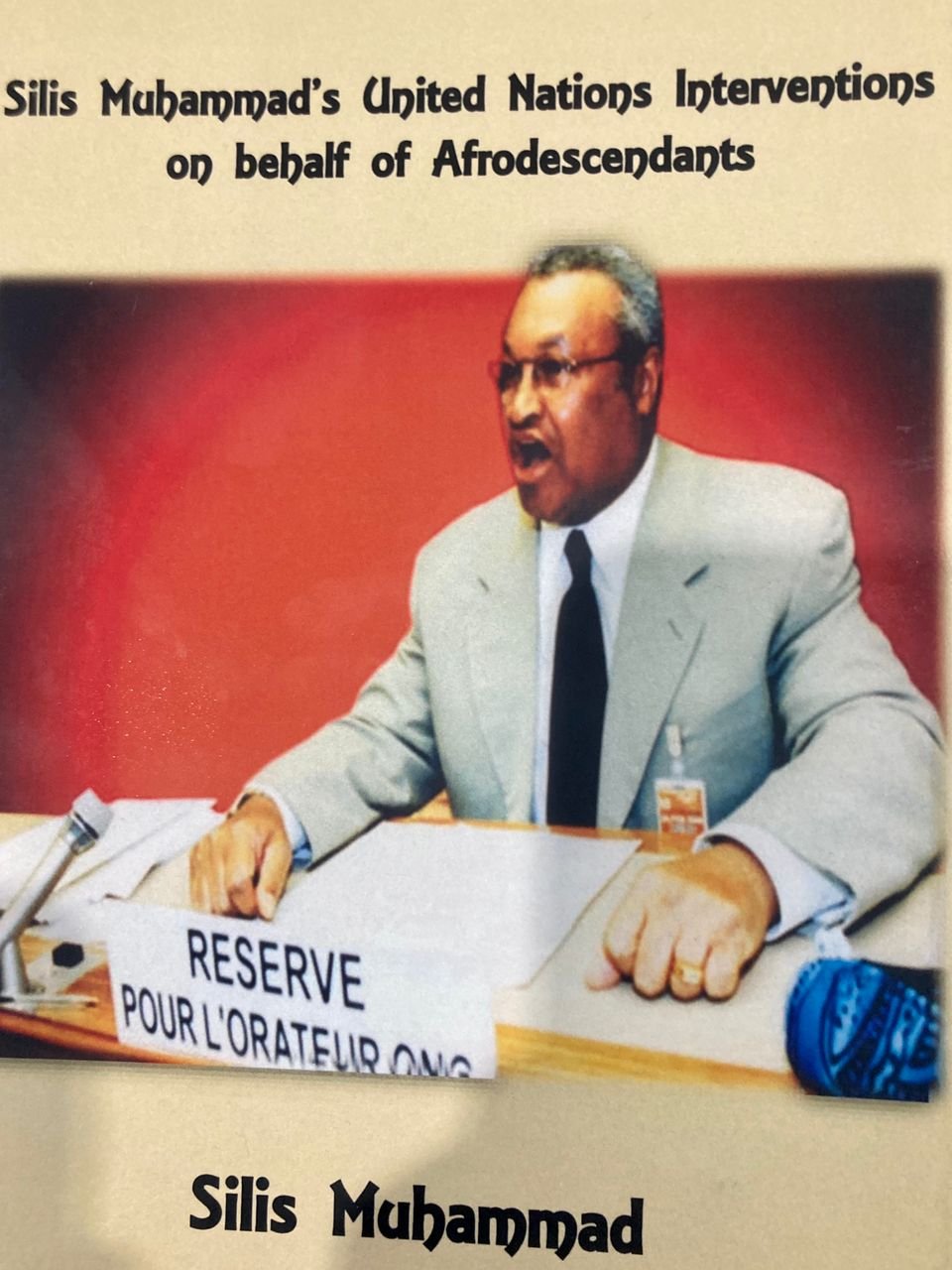
“Self Determination is our right, Separation with all our might, Reparations is our fight.”
“The prayers of African Americans for justice and reparations have been rejected by the U.S. Government and, seemingly, the United Nations. Because the struggle seems hopeless, the African American population has reached a state of extreme anxiety. We observe that some leaders are considering changing their tactics because of the failure of peaceful and legal means of solving the problem. We believe that African Americans may decide to use extreme measures and thereby gain the attention of the world community. We fear that the U.S. Government may respond with imprisonment of African American leaders.”
— The Honorable Silis Muhammad, written statement to the United Nations, 1997
“The Universal Declaration of Human Rights states that recognition of the inalienable rights of all members of the human family is the foundation of freedom, justice and peace in the world. Here, at the beginning of the histories of the so-called African-Americans, the enslaved Africans brought to America were defined in the same terms as the ‘cattle’ belonging to Anglo-American rulers. Thus, our rights were those of their ‘cattle’: ours were not human rights. Yet we were then-and are, still, members of the human family. Our inalienable rights were distorted so completely, that we are damaged goods, still. We are lost from our original inherent culture, religion and language. America cannot lawfully force us to accept the choices which she deems to be our inalienable rights; nor can she force us and our progeny to abandon the hope for the reclamation of our own. One hundred thirty four years of forced assimilation has not abrogated the desire to know, and to be ourselves. Today, we have no permanent national recognition, as a result of slavery. We have been identified as slaves, Niggers, Negroes, Coloreds, Black-Americans and today we are so-called African-Americans. Thus, we are to this day a revolving nation, suspended within a nation: rent from our roots, as a result of slavery and its lingering effects. We are detached, still, from our inalienable rights. To this extent, the very foundation upon which freedom, justice and peace among nations is established is for us non-existing; our inalienable rights are extinct! Recognition of inalienable rights, for us, is a faith hoped for. And this poses a threat to peace for the United States of America, for the Americas and potentially for Europe. Why? It is a threat because of the despair of the many; which will endlessly be ignited to loathing and, or rioting. It will be ignited, lawlessly, by the perpetual humanitarian desires of the few: if the fever, or this abnormal situation, is not reversed by the few humanitarians who aim lawfully and by sanctions to efficaciously stamp out violations of the Universal Declaration of Human Rights. . . . African-Americans have looked toward and exhausted all remedies made available by the majority government, although, it is viewed as the oppressor. . . . We wish to address the question of whether we choose to reclaim or recapture our original culture, language, religion and identity, or whether we choose to assimilate into the majority culture of America. Upon this matter we have never enjoyed the freedom of choice. We pray to the Commission on Human Rights for the right to make our choice within the protection of a United Nations Forum.”
- The Honorable Silis Muhammad written statement to the 55th session of the UN Commission on Human Rights
**********************************************************************************************************
Mr. Muhammad’s abbreviated list of United Nations (UN) interventions delivered in advancement of Afrodescendant human rights and reparations for plantation slavery is listed below:
1994 Petition for Reparations to the UN under 1503 Procedure - Mr. Muhammad delivered a 1503 communication to the UN WOrking Group on Communications on behalf of African Americans. Although it was received, it was not heard nor was it responded to by the UN.
1997 Written Statement to the UN - Mr. Muhammad recommended a forum so that African-American human rights grievances, that formed the basis of a petition submitted, can be expressed systematically, as well as officially recorded, evaluated and remedied. [Siphwe Note: Here then is the vision that first called for the Permanent Forum on People of African Descent (PFPAD)].
1998 Written and Oral Statments - Mr. Muhammad urged the Commission on Human Rights to assist African Americans in their efforts to recover from official U.S. policies of enslavement, apartheid, and forced assimilation. Mr. Muhammad prayed that the human rights of African Americans be recaptured politically and amicably, rights to self-determination rectified, and the damages sustained be awarded in great measure in order to accomplish the cathartic cleansing mentally, emotionally, and physically of 400 years of long-suffering. Mr. Muhammad prayed that the U.S. Government not be given tacit approval of the UN to subvert the opening of a forum wherein African-AMerican grievances can be expressed systematically and officially recorded, evaluated and remedied.


1999 Written and Oral Statements - Mr. Muhammad requested recognition of the African American choice of human rights and inalienable rights. He requested the crime of plantation slavery, and its lingering effects, be rectified - which was, and is still, a crime against African Americans and against humanity. Mr. Muhammad asked the U.N. to establish a forum for the purpose of restoring African American human rights, their political being, and their status as a people. Mr. Muhammad urged recommendation that the Sub-Commission pass a resolution recognizing slavery and the slave trade as a crime against humanity. He urged the writing of a working paper as a way to begin analyzing African American’s situation. Mr. Muhammad urged African American inclusion in the Declaration on the Rights of Persons Belonging to National or Ethnic, Religious and Linguistic Minorities, or a new declaration be written for African Americans. Mr. Muhammad asked the International Labor Organization to look into America’s privately owned prisons.
2000 Written and Oral Statements - Mr. Muhammad asked that the U.S. pay reparations to the so-called African Americans, since the U.S. cannot restore the “mother tongue” of African Americans if ever it wanted to. Mr. Muhammad recommended the U.S. be held liable, at the least, for the last 51 years, plus the additional years which are needed to resolve this issue. He asked that the UN place a reparation sanction upon America if the identity and language of minorities and Peoples are to be preserved. Mr. Muhammad asked that a precise dollar amount be given at a future date, if warranted, and that he stated that he would ask for the release of a number of African-American human rights victims who have been unjustly incarcerated in federal and state penitentiaries. Finally, Mr. Muhammad asked the UN to impose a sanction on the U.S. in the form of exemption from all taxation upon our people for as longa s this issue is in the hands of the UN.
World Conference Against Racism Written and Oral Statements - Mr. Muhammad recommended that the World Conference Against Racism declare a decade to consider the issues of slave descendants, including whether “LOST FOND Peoples” is the term that best identifies slave descendants.
Regional Seminars for Afrodescendants Oral Statements - Mr. Muhammad put forth the name Lost Found Peoples as a name in order to gain human rights protection for slave descendants, but the name Afrodescendants was agreed upon by unanimous consent.
2001 Written and Oral Statements - Mr. Muhammad urged UN intervention to protect and assist African-American leaders within a forum as they seek to determine the damage they have sustained and the means of reparation needed in order to bring them back to life as a People. Mr. Muhammad prayed for the Commission on Human Rights to hear the African American demand for the right to choose to reconstitute, and reconstruct lost ties, since no international instruments, arbitrations, mechanisms or laws requiring the recognition of minorities that can restrain ethnic conflict during 2001. Attorney Harriet AbuBakr, Mr. Muhammad’s wife, asked the Working Group on Minorities to cause minority protection to develop in accord with the African American needs for resurrection.
2002 Written and Oral Statements - On behalf of African Americans, Mr. Muhammad asked the Sub-Commission on the Promotion and Protection of Human Rights to acknowledge the decision that African Americans be recognized as Afrodescendant Minorities. Mr. Muhammad also recommended that the Commission on Human Rights pass a resolution requesting that the Sub-Commission on the Promotion and Protection of Human Rights place African Americans on its agenda, alongside Indigenous Peoples and Minorities. Mr. Muhammad also put forth a prayer for official recognition of a self-chosen collective identity and reparations for African Americans.
2003 Written and Oral Statments - Mr. Muhammd requested official recognition of new minorities, urged the establishment of an International Year for Minorities, requested support for the efforts of the Working Group on Minorities, and recommended that the Working Group on Minorities organize a second Regional Seminar for Afrodescendant Minorities. Attorney AbuBakr asked the Working Group on Minorities to validate Afrodescendants self-chosen identity in its documents, and use any other means available to place the fact of the existence of Afrodescendants before the UN and the world.
2004 Written and Oral Statements - Mr. Muhammad called upon the UN to grant Afrodescendants protected collective human rights. Mr. Muhammad also asked the Sub-Commission to make a commitment to minorities that their interventions will be heard. Mr. Muhammad requested the recognition, protection and assistance of the Commission on Human Rights, and the authorities of the UN.
2005 Written and Oral Statements - Mr. Muhammad recommended santions against all governments that have deprived Afrodescendants, for every day Afrodescendants have been so denied human rights. He also requested assistance to Afrodescendants in efforts to have a self-chosen identity recognized and protected by the entire UN and by the governments under which Afrodescendants live.
2006 Written and Oral Statements - Mr. Muhammad requested formal UN recognition of slave descendant’s self-chosen name, Afrodescendants, and requested restoration of slave descendants to the human families of the earth.
2008 Oral Statment - Mr. Muhammad requested that the UN Working Group on Minorities assist Afrodescendants to establish education for Afrodescendants in their original (mother) tongue.
2014 Open Letter to U.S. President Barack Obama - Mr. Muhammad sent a letter to U.S. President Obama, Congress, General Dempsey, and the Pope of Rome requesting reparations for Afrodescendants.
*********************************************************************************************
ON THE TERM AFRODESCENDANTS
During a UN meeting on the issue of reparations, Silis Muhammad put forth a proposed definition of Afrodescendants, “for he knew that the prophecy concerning the ‘scattered’ children was in fulfillment. He also knew that a movement was afoot by Member States at the UN to include African immigrants in the same political/legal category as the descendants of enslaved Africans, thereby confusing the issues and undermining the legal basis for a reparations claim based on slavery’s lingering effects. The definition made it clear that Afrodescendants are descendants of enslaved Africans, suffering the lingering effects of slavery. The leaders agreed to discuss the definition at the next seminar, and the UN took note.” In his own words,
“The Term Afrodescendant
My name is Silis Muhammad and I am the CEO of the Lost-Found Nation of Islam and the Spiritual Son of the Honorable Elijah Muhammad, Peace Be Upon Him (PBUH). I have been fighting for my people’s right to self-determination for many years. I would spend many years out in the United Nations in Geneva, Switzerland from 1998 until 2002 working to establish our identity.
Having been a member of the Lost-Found Nation of Islam, I sought to classify us as Lost-Found Peoples and establish that name as our collective identity. I learned from several forums in the United Nations that a large contingency of our people mainly Latin Americans from the slavery diaspora were calling themselves Afrodescendant. As early as 2000 in Santiago Chile, the term was first heard at a United Nation forum.
In Durban, South Africa in 2001, we were still working on our identity; we were not working to define it yet. We did not have a clear-cut identity although the term, Afrodescendant was in the air. We had not decided collectively on an identity.
In 2002, at a United Nations Conference for the Rights of Minorities in La Ceiba, Honduras, nineteen (19) countries from North America, South America, Central America and throughout the slavery diaspora gathered. Most Latin American countries had already accepted this global identity and the Lost-Found Nation of Islam objected to it. During the Conference, a representative from Brazil, who has the largest Afrodescendant population in the slavery diaspora, stated that they too did not agree with the name Afrodescendant, but acquiesced to establish unity with the many descendants of the slavery diaspora that had already accepted and were using the term.
Feeling the weight of the term Afrodescendant in the atmosphere among the Latin American delegates, then we, the Lost-Found Nation of Islam decided to concur and use the term like the Brazilians had done. WE, Silis Muhammad, Misshaki Muhammad and the delegates of the Lost-Found Nation of Islam, quickly sketched out a rough definition of Afrodescendant before having a meeting with the Cuban Chairperson and the other Latin American delegates. At that meeting, we shared the definition for the term Afrodescendant:
Were forcibly disposed of their homeland, Africa;
Were transported to the Americas and Slavery Diaspora for the purpose of enslavement;
Were subjected to slavery;
Were subjected to forced mixed breeding and rape;
Have experienced, through force, the loss of mother tongue, culture, and religion;
Have experienced racial discrimination due to lost ties from their original identity.”
Defining the term, gave power to the name Afrodescendant. We offer to you African Americans, Black people, a just people, the global identity ‘Afrodescendant’.
We are not asking you to give up your national identity, we are asking you to accept your global identity.
*Afrodescendants are experiencing #Ethnogenesis: “...the re-establishment of the mind or the “Resurrection” of a people who have lost the identity of ‘Self’ due to 400 years of “Slavery” (The Honorable Silis Muhammad, Muhammad Speaks volume 20, No 21)
*****************************************************************************************************
In the late 1990s and early 2000s, José Bengoa, acting as the Chairperson of the UN Working Group on Minorities (WGM), played a pivotal role in facilitating the interventions of the Honorable Silis Muhammad regarding the status of African Americans (referred to by Muhammad as Afrodescendants). Bengoa’s position was characterized by a willingness to integrate the unique historical grievances of the African diaspora into the broader international framework of minority rights.
Key Aspects of Bengoa's Response
Commissioning the "Working Paper": In response to Silis Muhammad’s persistent advocacy, Bengoa urged the creation of a formal working paper to analyze the specific situation of African Americans. This was a significant procedural step, as it moved the discussion from informal oral statements to official UN documentation.
Recognition as a "People": Bengoa's framework for the Existence and Recognition of Minorities aligned with Muhammad’s argument that African Americans suffered from "civil death"—a lack of collective identity due to the forced loss of their mother tongue and culture. Bengoa acknowledged that for such groups, "existence" is not just physical but requires the political and legal recognition of their unique history.
The Durban Connection: Bengoa supported the momentum that led to the 2001 World Conference against Racism in Durban. He helped bridge the gap between traditional "minority" protections and the specific reparatory needs of descendants of enslaved Africans, a core demand of Muhammad's interventions.
Defining "Afrodescendant": While Silis Muhammad pushed for a definition that strictly separated the descendants of enslaved people from recent African immigrants to protect the legal basis for reparations, Bengoa facilitated the debate that eventually saw "Afrodescendant" become a recognized political and legal category within the UN.
Legacy of the Interventions
Bengoa’s openness to Muhammad’s arguments contributed to the eventual establishment of the Working Group of Experts on People of African Descent in 2002. This body was created specifically to study the problems of racial discrimination faced by the diaspora, moving beyond the general scope of the Working Group on Minorities.
*****************************************************************************************************
MY CONNECTION TO SILIS MUHAMMAD
Though I have yet to meet him, I feel a strong connection to the Honorable Silis Muhammad. And that’s because in 1997, I was tasked with studying and submitting a petition to the UN under its 1503 procedure by a former student of Malcolm X, Dr. Y.N. Kly. Although petitioning the United Nations was nothing new - W.E.B. DuBois and Marcus Garvey had petitioned the League of Nations, and William Patterson, Paul Robeson and Queen Mother Audley Moore had already petitioned the United Nations, the 1503 procedure was new. In my studies, I came across Silis Muhammad’s 1994 1503 Petition. As far as I know, my 1997 Petition of the Nkrumah-Washington Community Learning Center On Behalf of their Members, Associates and Afro-American Population Whose International Protected Human Rights Have Been Grossly and Systematically Violated By the Anglo-American Government of the United States of America and Its Varied Institutions was the second such petition submitted under the United Nations 1503 Procedure. And hence my collegial connection to the Honorable Silis Muhammad.
But the connection goes a bit deeper. The Honorable Silis Muhammad is a man, a leader, ahead of his time, fighting for our liberation in the international arena with very little acknowledgement or support. Even today his work is under-appreciated in the various movements and I was guilty of overlooking Mr. Muhammad’s contributions to the reparations movement when I compiled this history of the modern reparations movement.
When a national/international forum entitled “Revitalizing the Reparations Movement” was convened at Chicago State University on Saturday, April 19, 2014, incredibly the Honorable Silis Muhammad was not there!

The exclusion of Mr. Muhammad’s work and legacy is unfair. I feel this same way about my own work, begun in earnest in 2003.
Like Mr. Muhammad, in the mid to late 1990’s, my focus was on the United Nations as an arena for the reparations struggle. However, Let us recall that in 1996 the Economic and Social Council of the United Nations granted consultative status to the Rastafari Movement who were represented by Ras Bongo Spear and Ras Boanerges. In 1998, at the United Nations in Geneva, Switzerland, Ras Bongo Spear and Ras Boanerges asked: “What is the responsibility of the nations to Africans in the diaspora with respect to the age-old quest for Repatriation?” Said the Rasses, “Our advice from that committee and from the UN Office of Human Rights . . .. was simple:
“The United Nations as an organization of states cannot at this time in any serious way entertain the issue of repatriation without the consent of the African states and the African Governments to which we want to go in Africa. So we were directed to seek the support of African governments with respect to the acquisition of land. And after that, the matter can be brought up again to the United Nations and the issue of [settlement] can take place.”
As a young, devout Rastafari youth, I then switched my focus to repatriation and the Organization of African Unity (OAU). In 2003, I went to Ethiopia, and as a credentialed journalist for the Rastafari Speaks newspaper, attended the 1st Extra-Ordinary Summit of the Assembly of the African Union in Addis Ababa. It so happened that, like Malcolm X at the Organization of African Unity (OAU) in 1964, I was the only Afrodescendant at the African Union when the decision was made to invite and encourage the African Diaspora in the African Union through the Article 3q amendment that was adopted while I was there. As the de facto representative of the Afrodescendants at this pivoral moment in history, I felt a deep sence of responsibility and obligation. Ultimately, I became the Director of the African Union 6th Region Education Campaign, working in this new arena of the African Union. At the time as well as now, much of my work went unreported and thus, un-recognized. It was my job to make the importance of the new AU 6th Region known and elevate the struggle to have Afrodescedants’ Right to Return to their ancestral homelands recognized.
So at the time that Silis Muhammad was championing the cause of Afrodescendants at the United Nations, I was championing the cause at the African Union.
It is no coincednce that at this next pivotal moment in our history, when Burkina Faso President Ibrahim Traore and the Alliance of Sahel States is leading the fight against neocolonialism and imperialism in Africa, that the Afrodescendant Nation led by the Honorable Silis Muhammad and myself are playing key leadership roles in the Friends of President Ibrahim Traoré In the West Delegation. Some things are just a matter of destiny.


Oral Statement to the Forum on Minority Issues, First Session,
Agenda Item VI: The Relationship Between Desegregation Strategies,
Cultural Autonomy and Integration in the Quest for Social Cohesion, December 2008
Greetings Madam Chair, Madam Gay McDougall, Experts, Country Representatives, Scholars and Minorities:
One of the purposes of this Forum is the identification of challenges and problems facing minorities and States. We, Afrodescendants, want for ourselves and for our children an education, especially now at our inception as an internationally recognized human family. We want an education in our original (mother) tongue. UN scholars state that language, not just any language, but one's "mother tongue" is intimately bound with identity. Thus, the right to such an education is an identity right.
Article 1, Section 1.1 of the Declaration on the Rights of Persons Belonging to Minorities indicates States shall protect and promote the identity of minorities. The United States of America, mainly, as well as other States, have breached this United Nations obligation. Since the abolition of slavery until now, Afrodescendants have been denied self-identity: education in our mother tongue. It is the very dignity we are without. The former slave-holding States have a duty to protect not only the existence but the national, ethnic, cultural, religious and linguistic identity of Minorities.
Mr. M. Cherif Bassiouni stated, in his final report to the 56th session of the Commission on Human Rights, that economic compensation for victims of gross violations of human rights should be provided for any assessable damage resulting from violations of international human rights and humanitarian law: (b) lost opportunities, including education. Since we were forcibly deprived of our mother tongue due to slavery and its lingering effects, we want compensation from those States, especially the United States, responsible for denying us an education intimately bound with identity. Afrodescendants claim the right to compensation for violations of international law, articulated in the Declaration on the Rights of Minorities as well as Article 27 of the ICCPR, due to lost opportunities, including education.
In conclusion, we suggest that the regional forums for Afrodescendants, started under the auspices of the former Working Group on Minorities, be continued so that Afrodescendants can discuss practical, acceptable and adaptable solutions to the unique problems we face.
Thank you.
Mr. Silis Muhammad
OPEN LETTER TO PRESIDENT BARACK OBAMA 2014
President Barack Obama/President of the United States,
U.S. Congress, General Martin E. Dempsey, Joint Chief of Staff and The Pope of Rome
Silis Muhammad
CHIEF EXECUTIVE OFFICER
THE LOST-FOUND NATION OF ISLAM
TO: President Barack Obama, President of the United States
U.S. Congress
General Martin E. Dempsey, Joint Chief of Staff
Pope of Rome
FROM: Silis Muhammad
RE: THE BLUEPRINT: OUR PLAN FOR AMERICA AND ITS AFRODESCENDANTS
DATE: January 15, 2014
The peoples and Governments of the world are well aware of the duplicity of the United States Government as it calls for Human Rights and democracy while continuing, to this day, systematic discrimination against and disenfranchisement of its Afrodescendant population--the inheritors of the legacy of plantation slavery (the so-called African Americans). While we recognize that moral leadership is the tone that the United States Government wishes to convey to the world, it as failed to take the key moral action that would begin to repair the ongoing wrong that has existed since the very inception of this government. Does anyone recognize the significance of this key to peace?
I am Silis Muhammad, Chief Executive Officer of the Lost-found Nation of Islam. If we could summon the hatred our ancestors had for this Caucasian American Government and bring that condition to bear on the shoulders of this generation of Afrodescendants the resulting wrath would be like unto a blaze of fire, the size of which would engulf the United States. It would burn for 1,000 years! The evil done to the Black man by the American government far surpasses the evil done by any other Government, especially the Governments of France, Germany, Great Britain, and Canada.
We are determined to leave America, not less than 144,000 of us, Arfodescendants. We, the children of plantation slavery, were subsumed by the thirteenth and fourteenth amendments of the Constitution of the United States of America, which does not, in the least, express our will. We want no part of the prophesied imminent doom of America.
We want the United States, in cooperation with the International Monetary Fund, to arrange for forgiveness of all debts owed by St. Kitts and all other members of CARICOM, who would welcome, with full citizenship, appropriate numbers of educated and industrious Afrodescendants from the United States. We are asking for sea-going and air-going ships or vessels and freeway, highway, bridge, and road building materials and equipment. We are asking for equipment to cultivate land. We need materials and machinery with which to make clothing, shoes, and furniture and we need materials and equipment to for putting in infrastructure. We want housing, apartments, and multi-story building materials and equipment. In addition, we ask for the cost of a one-way ticket to whatever islands that would accept us as full citizens. Whether the Government of America will or will not give this, we, not less than 144,000 of us, are determined to leave America and live amongst our own kind.
The American Government gives billions of dollars to Israel each year. It has committed to giving Haiti $20-million per year for the next four years, for food. In addition, she gives to Haiti and other countries her surplus old clothing, foods, and machinery. Will she give to her ex-plantation slave children our request of her? Abraham Lincoln stated, "keep them here as our underlings."
We, today, observe daily that we are treated and kept as underlings here in America. The images of how we are looked upon by this Caucasian American Government are yet on our minds and in our lives today.
The killing of Travon Martin in 2013 is a prime example, of which the world is well aware. Yet, perhaps the greatest example of the systematic immorality of the United States Government is her claim to the largest prison population in the world--prisons filled with Black men and women due to discriminatory policing, prosecution, and laws. There is no justice here. We are subjected to an ongoing slavery system--slavery by another name. The world can see that you are not our brothers and neither are we yours.
The ex-slave masters of the CARICOM countries have departed and left the Governments in the hands of their ex-slaves. What has this American Government given to her plantation slave children besides a subservient position as her underlings?
Psychiatrists and those in other related sciences say if a husband hits or beats his wife, his wife is to leave him immediately. Has the American government not done far worse to us, Afrodescendants? We have been whipped until blood gushed from our backs, boiled while yet alive until dead, and hung from trees: to say nothing of the cruelest of inhumane treatments. The loss of our mother tongue, culture, and religion renders us a spiritually dead nation. . These are losses of Human Rights as defined by Article 27 of the ICCPR of the United Nations.
We, the Lost-Found Nation of Islam, have been in the International community since 1989. Our first written statement to the U.N. was in 1993. Our first oral statement to the U.N. was in 1998. Our last statement and appearance in the U.N. was in 2006. We spoke to the Commission on Human Rights, the Sub-Commission on the Promotion and Protection of Human Rights, and the Working Group on Minorities and had significantly gained their attention. But the American Government along with the British Government , the Governments of all slave-holding countries and other countries whom Britain and America provide support, shut down the Commission on Human Rights, the Sub-Commission on the Promotion and Protection of Human Rights, and the Working Group on Minorities--every U.N. group whose attention we had gained. In its place, they created the Human Rights Council.
We spent nine years in the U.N. only to learn that we did not exist as a Nation of people, with God-given human rights. As Americans, we were classified along with Caucasian Americans in the United States. We had achieved a unified name and identity that Black people from 19 countries agreed upon, in 2002--Afrodescendants. God-given Human Rights are: the right to speak your own mother tongue in community with others who speak your mother tongue; the right to practice your own culture in community with others who practice your culture; and the right to practice your own religion in community with others who practice your religion Our Human Rights were lost during plantation slavery. This American government made us a debased people. This is why this letter is presented to the President of the United States and the United States Government. We are determined to achieve ethnogenesis.
The following is a statement of American history. Henry Louis Gates, Jr. wrote "The Truth Behind 40 Acres and a Mule," on pbs.org's '100 Amazing facts About The Negro'.
January 16, 1865, Union General William T. Sherman issued Special Field Order No. 15, upon approval of President Lincoln: "The islands from Charleston, South Carolina, the abandoned rice fields along the rivers for thirty miles back from the sea, and the country bordering the St. Johns River, Florida, are reserved and set apart for the settlement of the negros now made free by the acts of war and the proclamation of the President of the United States (Abraham Lincoln).
400,000 acres of land--a strip of coastline stretching from Charleston, South Carolina, to the St. Johns River in Florida, including Georgia's Sea Islands and the mainland thirty miles from the coast--would be redistributed to the newly freed slaves.
For the first time in the history of this nation, the representatives of the Government had gone to these poor debased people to ask them what they wanted for themselves.
Baptist minister Ulysses L. Houston, one of the group that had met with Sherman led 1,000 Blacks to Skidaway Island, Georgia where they established a self-governing community with Houston as the "Black governor." And by June, 40,000 freedmen had settled on 400,000 acres of "Sherman Land." By the way, Sherman later ordered that the army could lend the new settlers mules; hence the phrase "40 acres and a mule."
What happened to this astonishingly visionary program, which would have fundamentally altered the course of American race relations?
Henry Louis Gates, Jr. goes on to say:
Andrew Johnson, Lincoln's successor and a sympathizer with the South, overturned the Order in the fall of 1865, and, as Barton Myers sadly concluded, 'returned the land along the South Carolina, Georgia, and Florida coasts to the planters who had originally owned it--to the very people who had declared war on the United States of America.'
The Honorable Elijah Muhammad, along with 450,000 followers, from 1960 until the day of his death in 1975, repeatedly asked this Government to establish a state or territory of our own. The American Government turned a deaf ear. Is there not a moral-minded Caucasian in America's Government today? In 1865, we have in evidence at least two moral-minded statesmen: the United States President, Abe Lincoln, and General Sherman. They, at least, possessed enough moral insight to inquire of the new allegedly free Blacks what it is they wanted: "To live scattered amongst Whites or to live separate?" "Land" was the Black soon-to-be governors answer. Moreover, the Black soon-to-be governor stated, "there is a prejudice against us in the South. We would rather live in a separate territory." To date, the majority of Black people everywhere in the United States still experience this prejudice.
Is the Government of the United States incapable of the moral fortitude that it would take to grant to not less than 144,000 souls our humble request? Is there not one white man in the Government today, who has the wisdom, moral fortitude, and leadership ability of General Sherman and Abraham Lincoln? Ease the souls of my people, as well as make clean the souls of white people, by correcting your nation's wrongs. You claim that your nation has has changed, but our lawyers, doctors, teachers, and people feel your nation's prejudices even today.
To quote my daughter, Amira Arshad Muhammad, who is an attorney: "We are the peace that the world has been waiting for." You know what is right to do; just do it. Nature equips you from birth with the knowledge of what is right and what is wrong. You know more about our history than the majority of us do, for it was your government that placed us in plantation slavery, debased us, and made us your underlings. Men and governments advance in age and in wisdom. Has your government advanced in wisdom, or does it lag behind?
______________________________________
Silis Muhammad
Servant of Allah


BELOW, IN CHRONOLOGICAL ORDER, ARE MY COMPILED “BEST HITS” OF THE HONORABLE SILIS MUHAMMAD
The 1503 Petition for Reparations for African Americans was delivered to the UN in 1994
“Understanding that to be a people, a group of persons must not only subjectively see themselves as a single people, but also objectively be seen, through speech and action, to be participating or be able to participate in the creation or recreation of their own distinct social world. . . . And further recognizing that for the many African-Americans whose ancestors were victims of gross violations, passage of time has no attenuating effect, but on the contrary has increased post-traumatic stress, deteriorated social, material, etc., conditions requiring all necessary special rights as well as compensation and rehabilitation measures. We may conclude that as long as the effects of past gross violation and resulting damage can be demonstrated as the cause of present developmental problems, it would be difficult to produce an acceptable argument for statutory limitations since that would amount to the denial of the fundamental human right to a remedy for past injustices. Therefore, in concern for future generations and our search for an end to war and violence, we must uphold human rights for African-Americans, because in this era of scattered low-intensity violent conflicts, only justice can effectively supersede war. . . . The use of African names and African languages was widely prohibited. The official U.S. policy of forced assimilation (referred to in the U.S. as "integration," despite its incongruousness with customary usage of that term) actually began during the enslavement period with the concerted efforts to stamp out any use or recognition of the African cultural heritage in America. This aspect of official policy was to be sufficiently successful in the areas of language and religion as to produce, from the many African cultures, a new one: African-Americans. . . . That this struggle is finally reaching its culminating stages is evidenced by the submission of this Petition to the United Nations, which constitutes the African-American demand for international inquiry into its long history of gross human rights violations, and remedy in the form of self-determination, reparations, and institution of minority rights, which given the historical precedents, may require significant degree of (internal) self-determination. . . . Individual manifestations of the general phenomenon will continue as confirmation of the general disrespect for the human rights of the formerly enslaved minority, until the phenomenon itself can be eliminated or neutralized--which cannot occur, The Nation of Islam feels and historical evidence substantiates (see Appendix H), until African-Americans are able to exercise their right to self-determination and receive reparations for past and on-going gross human rights violations. The Nation of Islam and most African-Americans believe that this will require third party intervention, such as the U.N. Sub-Commission’s willingness to provide the political, legal and conceptual leverage, the fora and the legal framework required by the oppressed formerly enslaved minority to convince the U.S. government to open a sincere dialogue on the inalienable human rights of the minority to lawfully demand self-determination with reparations for past and on-going gross human rights violations--chiefly, the receipt of compensation for past and on-going gross violation to the full extent necessary to achieve self-determination and minority rights as provided by Article 27 of the International Covenant on Civil and Political Rights, which the U.S. has ratified. . . . Mr. Secretary-General and Members of the Sub-Commission:
The U.S. government, in line with the U.S. Courts, continues to promote forced assimilation through the concept that all minority needs and rights can be subsumed within the concept of non-discrimination and equality (or sameness) before the law--this despite the fact that historical evidence strongly contradicts such a notion, and that judicial enforcement of non-discrimination in the U.S. has become formal and de-contextualized, disallowing appropriate consideration for historical injustices and present special needs. The courts further restrict satisfaction by requiring "intent to discriminate," and refusing consideration to those who are not "immediate victims". . . . All statistical evidence (Appendix H) indicates that a policy of non-discrimination alone is insufficient to permit the African-American minority to achieve equal status with the majority, but rather, under the guise of aiding them, serves to continue their victimization. While a multi-national state may argue that treating all people (majority as well as formerly enslaved minority) the same, legally and institutionally, regardless of their different histories and circumstances, somehow leads to a new society in which oppressed or formerly enslaved minorities, at some time in the future, will achieve equal-status, sameness or equality with the majority, this line of reasoning more frequently serves merely to justify or mask majority domination, and often exploitation, of national minorities. Even the most superficial analysis reveals that treating such minorities as if they were the same as the majority in a majority-ruled multi-national society does not permit minority needs to be legitimately known or expressed, let alone addressed. . . . The U.S. government should not be given the tacit approval of the U.N. to continue to ignore past gross violations without compensation, nor to continue present gross violations against its national minorities. Surely, Members of the Sub-Commission, it is not your position nor that of the U.N., while situated in New York and surrounded by more than one million oppressed national minority members, to ignore their desperate plight, and at the same time assist U.S. human rights efforts in other countries. Surely, Mr. Secretary General and Sub-Commission Members, your position and that of the U.N. cannot be that in the U.S. only "white Americans" have internationally protected human rights, and that what is done to African-Americans does not count. . . . The African-American people do not believe that an honest, truly useful and equitable solution can be achieved without a significant degree of U. N. assistance. African-American history is filled with attempts at trying to achieve a sincere dialogue with the majority Government. All attempts to achieve domestic remedies have failed. In 400 years, African-Americans have not even come close to achieving equal-status relations with the Anglo-American majority ethnarchy which controls and runs the U.S. government as it sees fit, claims and distributes socio-economic resources as it sees fit, and ignores the human rights of African-Americans when it sees fit, etc. Now African-Americans want their human rights, demands for equal status, self determination, and compensation for past and on-going gross violations to be heard and redressed, and are requesting U.N. assistance. . . . If the U.S. government is sincere about dealing honestly and candidly with human rights problems of its African-American population, then it should not object to this time-honored process of third party (U.N.) assistance, mediation, conciliation or arbitration.”
Written Statement to the 54th Session of the Commission on Human Rights
Provisional Agenda item 14, Specific Groups and Individuals (b) Minorities
March/April 1998
“Understanding that the most destructive violation of the human rights of African Americans remains ethnocide and forced assimilation into an alien culture: despite the attempts of American media to portray "happy American blacks" and "wealthy black athletes" the culture of the majority of African Americans is a post slavery culture. Many African Americans have long sought a separate identity, and they have long sought to distinguish themselves from the majority population through unique musical and cultural development. Some African Americans have tried to identify with the African continent and have found that their long absence and forced removal has made them unable to re-connect. African Americans are, in essence, a homeless nation without identity, exploited as a servant class. Increasingly they are being forced into criminal or suspect status. . . . Our organization is concerned with the protection of the human rights of the African National Minority in the U.S.A. We encourage awareness of the potential for racial conflict and violent suppression of those who are seeking independence and reparations.”
Oral Statement to the Working Group on Minorities, Fourth Session, May 1998
Agenda Item 3 (b) Examining possible solutions to problems involving minorities
including the promotion of mutual understanding between and among minorities and Governments
“Our question is whether the national minority, the so-called African- Americans, are in possession of their inalienable human rights. . . . Article 27 of the International Covenant on Civil and Political Rights, which the United States of America has ratified, states, "In those States in which ethnic, religious or linguistic minorities exist, persons belonging to such minorities shall not be denied the right, in community with other members of their group, to enjoy their own culture, to profess and practice their own religion, or to use their own language." Here, the so-called African-Americans are not in possession of their human rights. They were taken away from the culture of their origin. The slave ship took them from their place of beginning, as you scholars well do know. The slave master did not return them to their culture, nor did he bring their culture and teach it to them. Nor has the American government, to date, sought to teach them their culture, or return them to it. They are absent the knowledge of their cultural beginning. The slave ship took them away from their ancestral religious belief. They were dislodged from the knowledge of their lineage to . . . God. The slave master taught them of his religion ultimately, and of his lineage to a supreme being whom he refers. to by the name of God. The federal or local governments of America did not teach nor make provisions for the so-called African-American, or slaves, to learn the knowledge of their transmissible religious belief. They are absent the knowledge of their ancestral tradition of religion. Regarding their original language, there were not any provisions set in motion by the local and federal governments of America for them to cultivate and continue speaking their language. To the contrary, provisions were set in motion to prevent them from speaking their language, originally. They were intentionally separated from one another, with total disregard, during slavery such that they would not be able to speak their language. Ultimately, they lost the knowledge of it. Thus, to the extent that they were deprived of their culture, their religion and their language, they are not in possession of their human rights. Moreover, to the extent that they, especially during the period of chattel slavery, were constrained by the laws, the culture, the religion and the language of the Anglo-American, they lived, and to this day live, under a tyrannical government. By the acts of forced assimilation the Anglo-American has sought also to subsume the so-called African-American into its Constitution. The human rights, the desires and the perpetual existence of the national minority are not embodied in the majority Constitution: which, from its origin, is absent any input of the national minority. The laws arising from America's majority Constitution do not embody the living will of the national minority. Thus, we feel we cannot intelligently argue the issue of (a) violation of our human rights. While we are human, we have not been in possession of (our) human rights for the past 433 years. Our human rights were willfully destroyed, utterly. They were destroyed by the slave masters, under the auspices of the United States central and local governments, during our long sojourn as slaves in America.”
Written Statement to the Sub-Commission for the Prevention of Discrimination and Protection of Minorities 50th Session, August 1998, Agenda item 2: Question of the violation of human rights and fundamental freedoms, including policies of racial discrimination and segregation and of apartheid, in all countries, with particular reference to colonial and other dependent countries and territories: report of the Sub-Commission under Commission on Human Rights resolution 8 (XXIII)
Recognizing that the Sub-Commission Resolution refers to plantation slavery not only in the U.S.A., but in the Americas, we ask that the Sub-Commission be conscious of the fact that African-Americans are in a unique position among Africans in the Diaspora. African-Americans did not receive the benefits of a partial or full return to self-determination or self government which began to be enjoyed by Africans throughout the Diaspora as a result of the movement towards de-colonization in the 1960's. To the contrary, in the 1960's assimilation was further forced upon the African-Americans through a civil rights movement which caused the demise of whatever independent economic and cultural recovery they had been able to achieve during the years of segregation. For those who would argue that the civil rights movement in the U.S.A. was the will of African-Americans, it should be pointed out that an equally powerful movement toward human rights and self-determination took place at the same time. . . Every effort was made by the U.S. Government to destroy the independent spirit that was generated . . . . so-called African-Americans have suffered utter and complete destruction of their culture, language, ethnic identity, and religion. For them the United Nations protection offered to Minorities is meaningless. Because of the particular cruelty of chattel slavery in the United States, so-called African-Americans were able to retain nothing of their past and of their homelands. Hence, the truth arises… that unlike some of the Africans in the Diaspora, who do retain remnants of their original culture and identity, African-Americans possess no remnants, and therefore must build their future from nothing but their own will to survive slavery. Thus the vast majority are in the condition of a lost people whose assimilation has been so complete that they cannot identify what they suffer from. [Siphiwe note: by the miracle of African Ancestry DNA testing, now they can identify their direct maternal and paternal ancestry, who and where they come from in Africa.] . . . We believe that if the U.N. will establish a forum for African-Americans in the United States, through that act alone African-Americans will begin to fully understand that the Nations of the earth wish to help them recapture their rights as human beings. We believe that by doing this, an upcoming race war, or racial violence may be averted.”
Oral Statement to the Sub-Commission for the Prevention of Discrimination and Protection of Minorities
August 1998, 50th Session, Agenda Item 2
Our issue is the violation of human rights and fundamental freedoms. When we consider Article 27 of the International Covenant on Civil and Political Rights, which the United States of America has ratified, we conclude that we, the descendants of slaves (the so-called African-Americans), remain a lost people. We are dislodged from the knowledge of our cultural beginning. We remain dislodged from the knowledge of our ancestral tradition of religion. Regarding our language, as slaves we were by force prevented from speaking it, and we are lost still from the use of it. . . . My presence here is axiomatic of unfolding history. A potential holocaust is today on the horizon, particularly, in the United States of America. Will the United Nations persuade her to let my people go?
Written Statement to the 55th session of the Commission on Human Rights April 1999 Agenda item 14. Specific groups and individuals: (b) Minorities:
“Our question is whether we, the so-called African-Americans in the United States of America, are in possession of our human rights. . . . Regarding our original language, there were not any provisions set in motion by the local and federal governments of America for us to cultivate and continue speaking our language. To the contrary, provisions were set in motion to prevent us from speaking our language, originally. We were intentionally separated from one another, with total disregard, during slavery such that we would not be able to speak our language. Ultimately, we lost the knowledge of it. Thus, to the extent that we were deprived of our culture, our religion and our language, we are not in possession of our human rights. Moreover, to the extent that we, especially during the period of chattel slavery, were constrained by the laws, the culture, the religion and the language of the Anglo-American, we lived, and to this day live, under a tyrannical government. By the acts of forced assimilation the Anglo-Americans have sought also to subsume us, the African-Americans, into its Constitution. The desires, the perpetual existence and the human rights of African-Americans are not embodied in the majority Constitution, which, from its origin, is absent any input from us. The laws arising from America's majority Constitution do not embody the living will of the African-Americans. Thus, we feel we cannot intelligently argue the issue of violation of our human rights. While we are human, we have not been in possession of our human rights for the past 433 years. Our human rights were willfully destroyed, utterly. They were destroyed by the slave masters, under the auspices of the United States central and local governments, during our long sojourn as slaves in America. . . . Here, at the beginning of the histories of the so-called African-Americans, the enslaved Africans brought to America were defined in the same terms as the "cattle" belonging to the Anglo-American rulers. Thus, our rights were those of their "cattle"; ours were not human rights. Yet we were then--and are, still, members of the human family.
Our inalienable rights were distorted so completely, that we are damaged goods, still. We are lost from our original inherent culture, religion and language. America cannot lawfully force us to accept the choices which she deems to be our inalienable rights; nor can she force us and our progeny to abandon the hope for the reclamation of our own. One hundred thirty four years of forced assimilation has not abrogated the desire to know, and to be ourselves. Today, we have no permanent national recognition, as a result of slavery. We have been identified as slaves, Niggers, Negroes, Coloreds, Black-Americans and today we are so-called African-Americans.
Thus, we are to this day a revolving nation, suspended within a nation: rent from our roots, as a result of slavery and its lingering effects. We are detached, still, from our inalienable rights. To this extent, the very foundation upon which freedom, justice and peace among nations is established is for us non-existing: our inalienable rights are extinct! Recognition of inalienable rights, for us, is a faith hoped for. And this poses a threat to peace for the United States of America, for the Americas and potentially for Europe. Why? It is a threat because of the despair of the many: which will endlessly be ignited to loathing and, or rioting. It will be ignited, lawlessly, by the perpetual humanitarian desires of the few: if the fever, or this abnormal situation, is not reversed by the few humanitarians who aim lawfully and by sanctions to efficaciously stamp out violations of the Universal Declaration of Human Rights. . . . The United States of America, for the past fifty years, has violated this august Universal Declaration of Human Rights. During the past fifty years, America has not seen fit to restore us to our inalienable rights, or them to us; nor has she seen fit to grant to us the choice to be, or not to be Americans. Therefore, this statement is a request for United Nations assistance in the establishment of a forum (perhaps under the auspices of the Sub-Commission.) The type of forum requested is similar to the one opened for the Aboriginal peoples in Geneva. We wish that the United Nations will establish a forum within the boundaries of the United States, preferably at United Nations Headquarters. . . . African-Americans have looked toward and exhausted all remedies made available by the majority government, although, it is viewed as the oppressor. In light of the aforementioned, cannot the United Nations open a forum for African-Americans in its host country? We wish to address the question of whether we choose to reclaim or recapture our original culture, language, religion and identity, or whether we choose to assimilate into the majority culture of America. Upon this matter we have never enjoyed the freedom of choice. We pray to the Commission on Human Rights for the right to make our choice within the protection of a United Nations forum.”
Oral Statement to the 55th Session of the Commission on Human Rights, April 1999 Agenda Item 14(b) Specific Groups and Individuals: Minorities
“Our question is whether the United States of America’s refusal to ratify certain U.N. human rights treaties, which would lead to the restoration of the human rights of her handicapped victims of slavery, amounts to a violation of the Universal Declaration of Human Rights. . . . The United States knew, upon the adoption of the Universal Declaration on December 10, 1948, that African-Americans did not have their original mother’s tongue, their inherent religion or their ancestral culture, as a result of the acts of the Anglo-American government. She had kept us perpetually regenerating the human rights of the Anglo-American, against our will. . . . Her omission to act, with knowledge that there was an equitable and fiduciary duty to act, is not within the spirit of the Universal Declaration. We will remain victims continuously, until the United Nations corrects the damages that the U.S. has done to it and to us. Thus the United States has committed fraud against the U.N., ongoing forced assimilation against us, and an additional act calculated to bring about our total destruction. Thus we conclude, that since its inception, a consistent violation of the Universal Declaration of Human Rights has been perpetrated by the United States. We ask, humbly, can this lofty body, the Commission on Human Rights, permit the U.S. to continue these acts? . . . In closing, 50 years after the signing of the Universal Declaration of Human Rights, my people stand before you seeking political resurrection and restoration of our human rights.”
Oral Statement to the Working Group on Minorities, May 1999 Agenda Item 3. b), 8 (a) Examination of the causes and nature of the problems affecting minorities and group accommodation, and their possible solutions, including: - the legacies of the slave trade on the black communities throughout the Americas; - issues relating to the forcible displacement of populations.
“We are more than 40 million, and yet we are a people dead. We have been dead, as slaves, for 400 years. Is not our struggle for human dignity equally as important as groups fighting for their human life. To be alive, with the knowledge that I am, as a man, dead, is worse than physical death. Death of the physical body sets you free. Death of the human spirit is a living hell.
Commencing with slavery to this date, we are a revolving nation, within the nation of America. We are absent our foundation-- our human rights: culture, religion and mother’s tongue. We have lost our original identity.
Our question is whether America’s refusal to ratify a particular U.N. human rights treaty, which would lead to the restoration of our identity, amounts to a violation of the Universal Declaration of Human Rights. . . .
We ask you to recommend to the Sub-Commission the establishment of a forum, with expert guidance, for the purpose of restoring our human rights -- which only we can reclaim or choose: our legal, political being and status as a people. Within a forum, we will 1) promote respect for the Universal Declaration of human rights amongst ourselves, which will ultimately include the Diaspora; we will 2) rebuild a kind of council or governing body amongst ourselves, absent the social engineering of the U.S. Government. Within this council we will 3) openly discuss the devolution, in pertinent parts, of the Constitution of the United States, which defines us as three-fifths of a human being. This package will be presented to the United States. The venture commenced, intelligence can be gained for the Sub-Commission that might usefully 4) address the continuing legal, political and economic legacies of the slave trade as experienced by the victims. We will 5) discuss reclamation, restoration, repatriation, reparations and migration of some of us to a friendly nation. We want these discussions to 6) benefit race relations in the society of the United States. The establishment of a forum for the reasons stated, would also eliminate the burden of slavery for America’s future generation.”
Written Statement to the 51st session of the Sub-Commission on Prevention of Discrimination and Protection of Minorities, August 1999 Provisional Agenda Item 8, Prevention of discrimination against and the protection of minorities
“Beginning with slavery to this date, we are a revolving nation, within the nation of America. We are absent our foundation -- our human rights: culture, religion and mother’s tongue. We have lost our original identity. While we are a people, and not a minority, we are treated as a minority by the U.S. Government. Therefore we bring our case to you, the Sub-Commission on Prevention of Discrimination and the Protection of Minorities. . . . The United States knew, upon the adoption of the Universal Declaration on December 10, 1948, that African-Americans did not have their original mother’s tongue, their inherent religion or their ancestral culture -- their human identity. . . .
To be left out of both the Declaration on the Rights of Minorities, and the Universal Declaration, is to not have recognition of our human life, politically. We have no identity because we were intentionally deprived of education in our mother’s tongue, thus we do not have our own culture. Absent our culture, we exist in a state of civil death. We are concerned about our right to education in our mother’s tongue as we know that it would guarantee us an identity.
We appreciate the Declaration on the Rights of Minorities in its focus on education, but we conclude that even if the United States wanted to, she could not restore us to our family roots and our mother’s tongue. She cannot trace our lineage except to the continent of Africa, where there exist over 1200 families of languages. Therefore we must be allowed to choose the mother’s tongue or tongues that we, as a people, wish to speak. We feel we must have the protection of a U.N. forum as we engage in this stage of the mental war for our identity, lest we be targeted and considered subversive by the U.S. Government. Our identity as a people, in possession of our human rights, can not ever be achieved if left entirely to the will of the United States. Why? America’s refusal to ratify the Convention on the Non-applicability of Statutory Limitations to War Crimes and Crimes Against Humanity, in 1968, some twenty (20) years after the adoption of the Universal Declaration, makes it blatantly clear, again, that she did not have in mind human rights for everyone, everywhere.
The failure of the United States to ratify that particular convention reveals the intent of the U.S. Government at the moment and time of her act. Her thinking is consistent with her thinking in 1948. Either she did not have us in mind; or she seeks specifically to block the pathway to our human rights -- our identity. While holding us in this ever revolving state, the United States holds herself out as being in full compliance with the spirit of U.N. protected human rights for everyone, everywhere; and causes us to remain trapped within the Anglo-American culture, regenerating her religion and tongue, in reality, her identity. Thus, the United States has committed fraud against the U.N., genocide against us, and we linger in a state of civil death, as our identity has not been preserved. We conclude, that since its inception, a consistent violation of the Universal Declaration of Human Rights has been perpetrated by the United States.
We recommend the establishment of a U.N. forum, with expert guidance, for African Americans in the U.S. We want the forum to be located at U.N. Headquarters in New York. We believe that the United Nations has an equitable and moral obligation to persuade the United States to financially provide for the forum inasmuch as the fraudulent acts of the U.S. Government have hampered the U.N. in fulfilling its obligation of protected human rights for everyone, everywhere.”
[Siphiwe Note - now, thanks to African Ancestry matrilineal and patrilineal dna testing, it is possible to restore or family lineage roots and mother tongue. See: AFRICAN COMMISSION ON HUMAN AND PEOPLES' RIGHTS ADOPTS SIPHIWE BALEKA'S RECOMMENDATIONS IN RESOLUTION ON AFRICAN UNION THEME OF THE YEAR - REPARATIONS]
Oral Statement to the Sub-Commission on Prevention of Discrimination and the Protection of Minorities, August, 1999 Provisional Agenda Item 8: Prevention of discrimination against and the protection of minorities
“We charge civil death. The U.S., with knowledge that it has denied us our identity for the past 400 years, is in violation of both the aforementioned Covenant and Declaration. In articles 2 and 4, the Declaration stipulates that minorities have the right to protect their culture and identity. . . . Owing to plantation slavery, intercultural education is an impossibility for us. By forcibly depriving us of our "mother tongue," the Government of the U.S. deracinated our collective identity, making our condition irreversible. We need specific U.N. assistance. Absent knowledge of our mother tongue, how could and can we speak it with other members of our community, and preserve our individual identity? The annihilation of our "mother tongue" is the extermination of our identity. Absent our identity, we do not have our own culture. Absent culture, we are in a state of civil death. To destroy a people and their shared life is a crime. The U.N. can provide a remedy by establishing a forum for so-called African-Americans at the U.N. in New York. We want a forum for the purpose of restoring our human rights -- which only we can reclaim or choose. Within a forum, we will 1) rebuild a kind of council or governing body amongst ourselves; 2) openly discuss the devolution, in pertinent parts, of the Constitution of the U.S., which defines us as three-fifth of a human being; 3) make choices on the "mother tongue" or tongues we wish to speak; 4) discuss and conclude on the issues of reclamation, restoration, reparations and migration of some of us to a friendly nation; 5) then present this package to the U.N. in order that the U.N. can facilitate dialogue between us and the U.S. Government. The forum will provide a peaceful and protected environment for the resurrection of our legal, political being and status as a people.”
Written Statement to the 56th Session of the Commission on Human Rights April 2000 Provisional Agenda Item 14. Specific groups and individuals: (b) Minorities.
“4. We are human beings, but to this date and time we are denied the human right of speaking our ‘mother tongue’: it was taken during slavery. The United States grants the right today for us to speak it. Then speak it, one might say. How can we speak what the U.S. has denied us the use of? If our ‘mother tongue’ is taken away, aren’t we denied the use of it? No! One may say, you are deprived the use of it; there is a difference. Is not to be deprived of the use of our ‘mother tongue’ the same as being denied the use of it? No! Says the State, to be denied the use of it presupposes it is in your possession; while being deprived of its use presupposes it has been taken away. Well, since it has been taken away, we are both deprived and denied the use of it. The very act of taking our ‘mother tongue’ away was for the express purpose of denying us the use of it. In fact, the act is tantamount to a gross and excessive permanent denial. The United States craved for the denial of our use of it so strongly that it deprived us of the very instrument.
5. Thus, this will be viewed as a gross and an excessive act of denial of the United States to permit the so-called African-Americas to speak their ‘mother tongue’ in community with other members of their group. While the act of the United States may be viewed as an act against humanity, equally so has the United States made itself responsible for the rights of minorities, within its jurisdiction, to not be denied the use of their own language, in community with other members of their group. We, the so-called African-American, cannot speak ours. The United States grossly denies us the right, having deprived us, continually, of the very instrument. And in its place, the United States continually has forced its Anglo-Saxon ‘mother tongue’ upon us for the past four hundred years. Absent our ‘mother tongue’, we are a non-people: living in a state of civil death. . . .
8. While we are a People, and not a minority, in the United States we are placed within a minority status. Hence we call upon the United Nations to come to our succor under Article 27 of the International Covenant on Civil and Political Rights, as the lingering annihilation of our ‘mother tongue’ and the continual force, by the United States, imposed upon us to speak its Anglo-Saxon ‘mother tongue’ at the earliest possible stages in our lives, is the continual extermination of both our individual and collective identity. Absent identity we do not have our own culture, absent culture we live, today, in a state of ongoing civil death: genocide. We are a people who are buried, politically. The United States has killed our human rights and has covered us over with its own, fraudulently, by trick and by duress. We were buried and hidden, so very much so, the United Nations in making its laws has left us out, it seems: it is not known immediately where we fit. In the United States, we, the so-called African-Americans, mimic the human rights of the majority; but in reality, we are in the position of a minority, as every scholar knows.
9. In conclusion, we pray for compensation in the form of reparations. We ask that the United States pay reparations to the so-called African Americans, since the United States cannot restore our ‘mother tongue’ if ever it wanted to. Nor can the United States continue, illegally, to choose and force one upon us, which it has done for the last 400 years. The United States should be held liable, at least, for the last 51 years, plus the additional years which are needed to resolve this issue.
Oral Statement to the Commission on Human Rights April 2000 Item 14 (b) Specific Groups and Individuals: Minorities
“African-Americans originate from many parts of Africa encompassing hundreds of languages. Therefore, it would be impossible to implement the prayer of African-Americans regarding the loss of their ‘mother tongue.’ The inability to implement a remedy makes it impossible to enforce any law. Our prayer, however, is for reparations. In this way America can address this legal and moral wrong: we will choose a language pleasing to us.
This argument is being made by a group that represents only one tenth of one percent of African-Americans in the United States. Nonetheless, the argument is made.
In conclusion, we ask that the United States pay reparations to the so-called African-Americans, as the United States cannot restore our 'mother tongue' if ever it wanted to. Nor should the United States continue, illegally, to choose and force one upon us, which it has done for the last 400 years. We ask that the Commission on Human Rights recommend a reparations sanction against the United States to ECOSOC and the General Assembly.”
[Siphiwe Note - now, thanks to African Ancestry matrilineal and patrilineal dna testing, it is possible to restore or family lineage roots and mother tongue. See: AFRICAN COMMISSION ON HUMAN AND PEOPLES' RIGHTS ADOPTS SIPHIWE BALEKA'S RECOMMENDATIONS IN RESOLUTION ON AFRICAN UNION THEME OF THE YEAR - REPARATIONS]
Oral Statement to the 6th session of the Working Group on Minorities, May 2000 Agenda Item 3 (b) to examine possible solutions to problems involving minorities
“Today, the United States of America grants minorities the use of their own language. It has ratified Article 27, of the ICCPR, which declares: "In those States in which ethnic, religious or linguistic minorities exist, persons belonging to such minorities shall not be denied the right, in community with other members of their group, to enjoy their own culture, to profess and practice their own religion, or to use their own language."
But we, the so-called African-Americans, in the aftermath of plantation slavery, cannot speak our own language. The U.S. Government took it away: it was forcibly taken away. . . . In conclusion, we ask that the Working Group on Minorities, in its report to the Sub-Commission, recommend that an expert be appointed to engage in dialogue with the U.S. Government. The urgent prayer of African-Americans for reparations should be the subject of this dialogue. Our recommendation is made in light of the fact that 40 million people are suffering this continuing legal wrong.”
[Note: October 16, 2023 Geneva Switzerland - The State Department of the United States of America was confronted with questions about U.S.-sanctioned ethnocide against Balanta people in the United States by Balanta Society in America President Siphiwe Baleka during the Civil Society Consultation held at the Permanent Mission of the United States of America to the United Nations at Route de Pregny 11, 1292 Pregny-Chambesy. The consultation with senior level officials of the United States Government was led by the Honorable Ambassador Michele Taylor, Representative to the United Nations Human Rights Council ahead of its scheduled fifth periodic review under the International Covenant on Civil and Political Rights (ICCPR) which takes place on the 17th and 18th of October.]
SEE: United States Confronted About State-Sanctioned Ethnocide Against Balanta People at the United Nations
Written Statement to the 52nd Session of the Sub-Commission on the Promotion and Protection of Human Rights, August 2000 Agenda Item 8, Prevention of Discrimination Against and Protection of Minorities
“By forcibly stripping us of the use of our language and of the right to be educated in the same, the Government of the United States deracinated our collective identity, making our condition irreversible. Absent exposure to our original tongue at the earliest possible stages in life and in primary and secondary levels of schooling, how could and can we speak it with other members of our community and preserve our individual identity? The United States causes us to remain trapped within the Anglo-American culture regenerating its ‘mother tongue’, in reality, its identity.
When we are able to argue about a violation of our human rights, this is our complaint: we are human beings, but to this date and time we are denied the human right of speaking our ‘mother tongue’ in violation of Article 27 of the International Covenant on Civil and Political Rights, which the United States of America has ratified. . . .
In the U.S. Blacks are mindful, daily, of a consciousness of "otherness", with respect to racial differences, as every scholar knows. And, unlike the Indigenous Peoples who were native to the territory, before colonization, and who formed many groups and spoke several languages, African-Americans were displaced from their common territory, and yet they invoke their similar characteristics in order to obtain their rights. As the so-called African-American "Racial" group is a group destroyed, it is axiomatic knowledge that we are a different racial group from the majority: we have neither racial dignity nor political bond.
The integration movement of the 1960s, whatever of high hope and of good intention, it did not make us equal with the majority, nor did it set us apart as a people or as a minority. We continued to mimic the human rights of the majority. At the same hour, during the 1960s, there had long been developing in the U.S. not only a consciousness of "otherness", but also an awareness to bring that consciousness into reality. The Ethno-racial differences had then reached the glass ceiling, marked by violent rioting in major cities: Watts, California; Newark, New Jersey; Rochester, New York; Cleveland, Ohio; Cincinnati, Ohio; Chicago, Illinois; Harlem, New York; Detroit, Michigan; Washington D.C.; and Atlanta, Georgia in the time period from 1965 through 1967.
U.S. federal agents cleared the way for a non-violent solution. The US Government and its media sought to redirect the rising Black consciousness, by promoting integration. Non-violent integration’s chief advocate was the late and the memorable Dr. Martin Luther King Jr., who fell to his unfortunate death from an assassin’s bullet in the year 1968, having commenced the civil rights movement December 1, 1955.”
Oral Statement to the 52nd Session of the Sub-Commission on the Promotion and Protection of Human Rights, August 2000 Agenda Item 8, Minorities
“I came to the Sub-Commission to seek recognition that we, the so-called African-Americans, do not fit the UN established definition of human beings, in the category of minority or as a People. The United States has the UN under the belief that we do fit, one or the other, in that the US asserts that the UN is in charge of promoting and protecting the inherent rights of human beings - everyone, everywhere. To the extent that we do not fit the UN definition, presently, the UN definition is in need of expansion to also include us. For we have not our original ‘mother tongue’, culture nor religion, thus, no identity: due to the lingering effects of plantation slavery. We are but clones of the Anglo-Saxon in the United States. During slavery, we were forced to speak the Anglo-Saxon’s mother tongue, and practice their religion and culture. Our human rights were destroyed.”
Oral Statement to the 57th Session of the Commission on Human Rights April 2001 14. Specific Groups and Individuals: (b) Minorities
“My question is, do we now fit in the category of minority, or national minority or a people? . . . Four hundred years of plantation slavery and its lingering effects have left us deprived and denied the use of our 'mother tongue', and thus, OUTSIDE OF a definite place within the UN system. We are all from a common a territory, Africa, and from many tribes who spoke many languages. . . . We are not in control of our intellectual future, or our political and economic future. It would be impossible for the United States to implement a prayer for the reconstruction of our 'mother tongue', owing to forced breeding between slaves. We are without a definite identity, as to tribe, nation or people. The international community does well understand that human dignity is attached to identity. We African Americans do not know where we fit. And what is more, I have learned, the United Nations does not know where we fit.”
Working Group on Minorities, Seventh Session, 14-18 May 2001 Agenda Item 3 (b) Examining possible solutions to problems involving minorities, including the promotion of mutual understanding between and among minorities and Governments
“We are a people experiencing, in reality, the process of ethnogenesis. We ask that the Working Group on Minorities let us know what it recommends in relation to our desire to reconstruct our lost ties and reconstitute ourselves, since there are at present no international instruments, arbitrations, mechanisms or laws requiring the recognition of minorities that can restrain ethnic conflict.”
Informal Workshop on Afro-descendants in the Americas
Working Group on Minorities
Morning Session May 19, 2001
“We African Americans in the United States have cried out in many ways over many years for the restoration of our dignity as a people. Yet the U.S. Government commits, daily, the international wrongful act of denying our existence while claiming respect for human rights. It is our desire to reconstitute ourselves, for we do recognize ourselves as the African American people, internally. It is also our desire to receive reparation from the U.S. Government for the ongoing loss of our 'mother tongue', and our internationally recognized political identity. We ask that the Working Group on Minorities let us know what it recommends in relation to our desire to reconstitute ourselves, and to receive reparation and international political recognition.”
Informal Workshop on Afro-descendants in the Americas Working Group on Minorities
Afternoon Session May 19, 2001, Statement by Mr. Silis Muhammad Read by Harriett AbuBakr
“For the past three years I have been asking the UN to provide the forum for African American leaders, and this they did. This forum was the closest they could come. I want to thank Mr. Eide, Mr. Bengoa, Mr. Sik Yuen and their experts for giving up their Saturday to sit down with the African American leaders and try to find a place within the existing UN declarations and covenants where we can fit. . . . They recognize that we are all from Africa and that we call ourselves African Americans and Afrodescendants. . . . Are we not a race, and do we not have a feeling of otherness from those in power because we lost our 'mother tongue', religion and culture when we were brought into slavery?
Forced mixed breeding renders us human but without human rights. Latin Americans, Central Americans and Black Americans in the United States and Canada do not have their human rights. While you are talking about marginalization, discrimination, autonomy - you first need collective human rights and political recognition. That's why these UN experts are here.
Written Statement to the 53rd Session of the Sub-Commission on the Promotion and Protection of Human Rights August 2001 Agenda item 5. Prevention of discrimination and protection of indigenous peoples and minorities
“In regard to the mass cry for reparation of the African American people, which the UN is confronting at the upcoming World Conference Against Racism, we ask the Sub-Commission to put forward a specific recommendation. We ask the Sub-Commission to recommend that UN expert and technical assistance be granted in the establishment of an inclusive forum of African American leaders from the U.S.: a forum which would serve as a model for the Americas Region. This forum would seek to determine the damage we have sustained and the means of reparation needed in order to bring about our resurrection and restoration. It would also serve as a negotiating body for the African American people in their dealings with the U.S. Government. Without UN protection, there will be dangerous potential for U.S. Government manipulation of this mass movement, as there has been with mass movements of our people in the past.”
Sub-Commission on the Promotion and Protection of Human Rights August 2001 Oral intervention under agenda item 5: Prevention of discrimination and protection of indigenous peoples and minorities
“We did not come to the Americas willingly, and we did not come as Christians, speaking English, Spanish or Portuguese. We are all from a common territory, Africa, yet we are from many tribes who spoke many languages. The Indigenous Americans who spoke languages, and who were colonized, are now receiving reparations and recognition as peoples. We, likewise, recognize ourselves as a "race" of people, by virtue of our common origin, the sufferance of slavery and its legacies, and the wrongful act of forced breeding between slave and the slave masters. This forced breeding produced a changed African people approximately 240,000,000 strong, living the Americas Region, and lost from our identity. Thus we are without any UN recognized identity. We urgently recommend that the Sub-Commission place the African American people on its agenda, alongside indigenous peoples and minorities. We have never questioned that we belong to each other as a group. By placing us on the agenda the Sub-Commission would then be able to consider our issues, including where we fit. At the very least, we are another category of people; but presently, we have no recognized UN Human Rights.”
World Conference Against Racism, Racial Discrimination, Xenophobia and Related Intolerance September 2001
Oral intervention under provisional agenda theme 5: Provision of effective remedies, recourse, redress, (compensatory) and other measures at the national, regional and international level
“We did not come to the Americas willingly, and we did not come as Christians, speaking English, Spanish, Portuguese or French. We are all from a common territory, Africa, where we are from many tribes who spoke many languages. The Indigenous Americans, who spoke many languages, and who were colonized, are now receiving reparations and should be receiving full recognition as peoples. We African Americans want to be restored, and recognized, and this is a form of reparations which can be examined and defined more completely in a forum. We are lost from our origins in Africa. Four hundred years of slavery, coupled with forced breeding between slaves and the slave masters, produced a people who have lost more than their independent character. It produced a people whose children are lost from their identity: mother tongue, religion and culture. We African Americans, who are the victims of slavery, will not mortgage the future of our generations to come.
For the past four years the UN Working Group on Minorities has been hard at work to find out where we fit, and to help us obtain a UN recognized identity. If my humble opinion may serve any use, let the name which identifies African Americans in the UN be "LOST FOUND Peoples." There is no question that we were lost, and that the Working Group on Minorities has been trying to find a place where we fit.”
The Regional Seminar on Afro-Descendants in the Americas
La Ceiba, Honduras, 21 to 24 March, 2002
“For the lack of knowing his original family name, the Black man accepts a family name that fits the region where he resides. You see the difficulty that we have in communicating with each other? We are of the same family, you and I, yet we sit across the table speaking these European languages: English, Spanish and Portuguese. The slave masters forced these languages upon our foreparents. They are not our languages.
Once, long ago, our freedom to think and speak in our own languages was willfully taken. The door to our identity was permanently shut! This door must be opened! During slavery our mother tongue, culture and religion were mercilessly destroyed. Consider the magnitude of the damage that this did to us. Reparations in the form of money alone will not repair this! Complete restoration should be our demand. Let’s give ourselves a name and begin it.”
The Durban Conference Against Racial Discrimination has asked the Commission on Human Rights to establish a working group or mechanism in order to deal with the issues of the Afrodescendants’ communities. The door is now open in the United Nations! Come, let’s grasp this opportunity! Lets go there with a name for ourselves, that we have chosen, together, and tell them that we want a place in the UN system, collectively. We are a family. This is our chance to reclaim ourselves, or our identity. Quoting professor Bengoa, the process of reclaiming lost ties is called "ethnogenesis."
Like the Indigenous Peoples, we are many diverse peoples and nations. We do not have to give up our diversity, or our leadership to become as one, politically. The Indigenous Peoples are even more diverse than we, yet they have been able to come together under one name in order to gain human rights protection, reparations and restoration. They have a place in the UN system. We do not. Cannot we do the same as they, or better? We are 250,000,000 strong, approximately. Given a platform, 250 million people have a lot of political power. We need a name. I offer, the name LOST FOUND Peoples, to begin the discussion. There is no question that we were lost, and that Professor Jose Bengoa and the Working Group on Minorities are in the process of trying to help us find a place where we fit.
Silis Muhammad.
Editor's Note: The name Lost-Found Peoples was not accepted, and the name Afrodescendants was agreed upon by unanimous consent.
Written Statement to the 58th Session of the Commission on Human Rights March/April 2002 under Provisional Agenda Item 14. Specific groups and individuals (b) Minorities
“5. The Working Group on Minorities is aware that we, the African American people, do not fit into a category within the UN system due to the immoral slavery and its illegal lingering effects: especially the deliberate acts of the U.S. Government. In 1998 the Working Group assigned Mr. Jose Bengoa to write a working paper on the existence and recognition of minorities. In the year 2000 this working paper, #E/CN.4/Sub.2/AC.5/2000/WP.2, was presented to the Working Group on Minorities, and accepted by the group. In the paper Mr. Bengoa demonstrated an astute understanding of the ethnogenesis of African Americans. Regrettably this distinguished paper has not been selected for presentation on the Sub-Commission floor.
6. To date, the Sub-Commission has not invited the Working Group on Minorities to report specifically on the work and study that it has been engaged in regarding African Americans. Consequently, the Sub-Commission has not addressed the continuing legal, political and economic legacies of the African slave trade as it had in 1997 indicated a desire to do. While we appreciate and highly value the efforts of the Working Group on Minorities on our behalf, we believe that little progress can be made in our recognition and restoration without the continued interest of the Sub-Commission.
7. Therefore we urgently recommend that the Commission on Human Rights pass a resolution requesting that the Sub-Commission on the Promotion and Protection of Human Rights place African Americans on its agenda. . . .
8. As the World Conference Against Racism demonstrated to the world, African Americans in the Americas Region and the Diaspora are united in a mass call for reparations. In response to the mass call for reparations, the World Conference, in it's Program of Action, made a request of the Commission on Human Rights as follows: "7. Requests the Commission on Human Rights to consider establishing a working group or other mechanism of the United Nations to study the problems of racial discrimination faced by people of African descent living in the African Diaspora and make proposals for the elimination of racial discrimination against people of African descent."
9. The World Conference Against Racism, in paragraph 14 of its Declaration, recognizes that for African Americans, racial discrimination is a consequence of slavery. Thus we would welcome a working group or other mechanism of the Commission on Human Rights if the mechanism has as its primary focus the lingering effects of slavery, and the restoration of our people. In particular, we would request that the proposed working group or other mechanism focus upon the establishment of category in which the UN and world community can recognize African Americans collectively and provide for reparations and restoration of the human rights of the African American people. We would also urge the Commission on Human Rights to take advantage of the work that has already been accomplished by the Working Group on Minorities on behalf of African Americans, and in particular the scholarship of Mr. Jose Bengoa.
10. In our view, and in the view of the organizations and leaders that support us, the dissatisfaction of our people will not be addressed with solutions that are ultimately superficial. The United Nations, and the national governments that have authority over us, cannot repair the damage done by slavery with reparations such as development money, affirmative action or anti-discrimination laws alone. We have lost our original identity and we have been forced to assume the identity of our slave masters. One man cannot live in another man's "skin." It is against nature, and inhumane. Our dissatisfaction will increase until our ethnogenesis is recognized and our human rights are restored.
Oral Statement to the 58th Session of the Commission on Human Rights March/April 2002 Agenda Item 14 (b) Specific Groups and Individuals: Minorities
“While we appreciate the encouragement to States to deal with the problems Afro Descendants face, a study of the problems of racial discrimination would not address the root problem, especially the negation of the essence of the victims. Racial discrimination is just the end product of our having suffered through slavery. Therefore, it is not enough to address the issue of discrimination ONLY. Justice calls for an examination of the entire cause-and-effect phenomena stemming from our having been slaves!”
Oral Statement to the Working Group on Minorities 8th Session, May 2002
“It has been five years since I first came before this group. . . . In 1998 the Working Group on Minorities assigned one of its members to write a paper on the existence and recognition of minorities. The paper has been of tremendous benefit, for it started the process of our recognition as minorities undergoing ethnogenesis. Today I thank the esteemed expert who wrote that paper.
In 1999 the Working Group on Minorities placed African descendants in the Americas on its agenda. This was the first time, to my knowledge, that we were placed on the agenda of any UN meeting. In the year 2000 the Working Group announced that it would hold regional seminars to study the issues of African Americans. In 2001 the Working Group participated in a special Saturday session in order to listen to our issues. In 2002 the Working Group on Minorities held a historic meeting in Honduras where we, as a newly emerging family of some 240 million souls, were able to determine the name by which we would like to be known in the UN. We are now in agreement that we will approach the UN as Afro Descendant Minorities.”
Written Statement to the Sub-Commission on the Promotion and Protection of Human Rights Fifty-Fourth Session August 2002 Provisional Agenda Item 5: Prevention of Discrimination (c) Prevention of Discrimination and Protection of Minorities
“At the 4th Session of the Working Group on Minorities we examined the Declaration on the Rights of Minorities, and it appeared to us that the so-called African Americans did not fit in the United Nations system. We had been told we are "minorities" by the United States Government, but we saw that we did not enjoy such recognition internationally. We saw that the protections offered minorities under Article 27 of the International Covenant on Civil and Political Rights and under the UN Declaration on the Rights of Minorities did not apply to us, for we do not have our original identity, our mother tongue, culture or religion. At that first meeting one of the esteemed members of the Working Group on Minorities said, "We will have to find out where you fit." Today I thank him. Over the years this Working Group has demonstrated that it is not willing to leave us out. . . . In conclusion, we recognize that as Minorities we do not have full equality before the law due to the intentional destruction of our original identity, and yet we believe appropriate reparation and restoration can take place with the continued effort of the Sub-Commission and the Working Group on Minorities.”