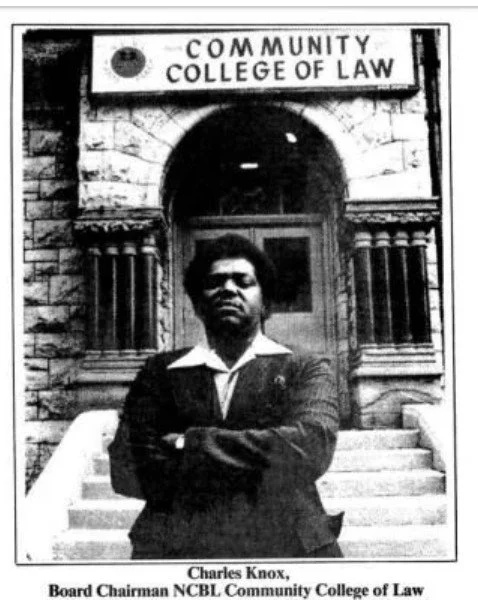
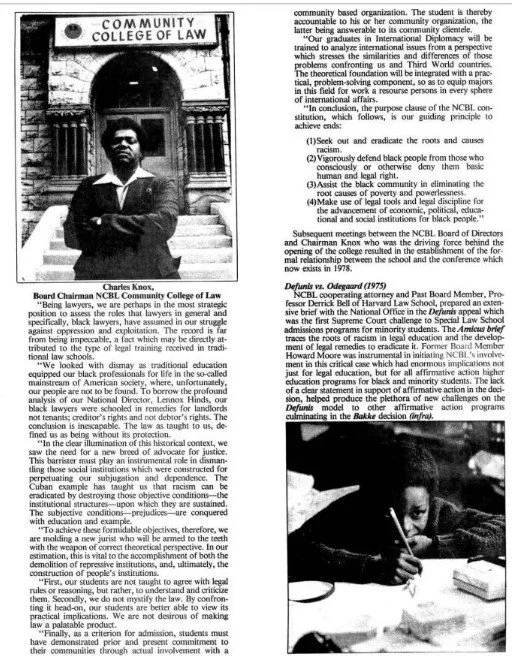
Dr. Charles Knox in front of the Fred Hampton Community College of Law and International Diplomacy, at 4545 South Drexel in Chicago, IL. (1979).
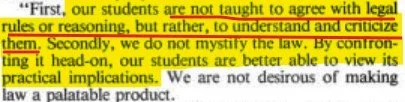
"𝑭𝒊𝒓𝒔𝒕, 𝒐𝒖𝒓 𝒔𝒕𝒖𝒅𝒆𝒏𝒕𝒔 𝒂𝒓𝒆 𝒏𝒐𝒕 𝒕𝒂𝒖𝒈𝒉𝒕 𝒕𝒐 𝒂𝒈𝒓𝒆𝒆 𝒘𝒊𝒕𝒉 𝒍𝒆𝒈𝒂𝒍 𝒓𝒖𝒍𝒆𝒔 𝒐𝒓 𝒓𝒆𝒂𝒔𝒐𝒏𝒊𝒏𝒈, 𝒃𝒖𝒕 𝒓𝒂𝒕𝒉𝒆𝒓, 𝒕𝒐 𝒖𝒏𝒅𝒆𝒓𝒔𝒕𝒂𝒏𝒅 𝒂𝒏𝒅 𝒄𝒓𝒊𝒕𝒊𝒄𝒊𝒛𝒆 𝒕𝒉𝒆𝒎. 𝑺𝒆𝒄𝒐𝒏𝒅𝒍𝒚, 𝒘𝒆 𝒅𝒐 𝒏𝒐𝒕 𝒎𝒚𝒔𝒕𝒊𝒇𝒚 𝒕𝒉𝒆 𝒍𝒂𝒘. 𝑩𝒚 𝒄𝒐𝒏𝒇𝒓𝒐𝒏𝒕𝒊𝒏𝒈 𝒊𝒕 𝒉𝒆𝒂𝒅-𝒐𝒏, 𝒐𝒖𝒓 𝒔𝒕𝒖𝒅𝒆𝒏𝒕𝒔 𝒂𝒓𝒆 𝒃𝒆𝒕𝒕𝒆𝒓 𝒂𝒃𝒍𝒆 𝒕𝒐 𝒗𝒊𝒆𝒘 𝒊𝒕𝒔 𝒑𝒓𝒂𝒄𝒕𝒊𝒄𝒂𝒍 𝒊𝒎𝒑𝒍𝒊𝒄𝒂𝒕𝒊𝒐𝒏𝒔. 𝑾𝒆 𝒂𝒓𝒆 𝒏𝒐𝒕 𝒅𝒆𝒔𝒊𝒓𝒐𝒖𝒔 𝒐𝒇 𝒎𝒂𝒌𝒊𝒏𝒈 𝒍𝒂𝒘 𝒂 𝒑𝒂𝒍𝒂𝒕𝒂𝒃𝒍𝒆 𝒑𝒓𝒐𝒅𝒖𝒄𝒕."
- Dr. Charles Knox, Founder, Fred Hampton Community College of Law and International Diplomacy.
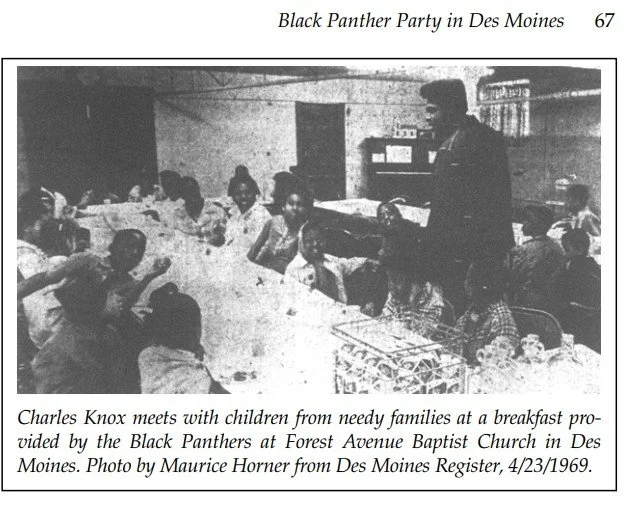
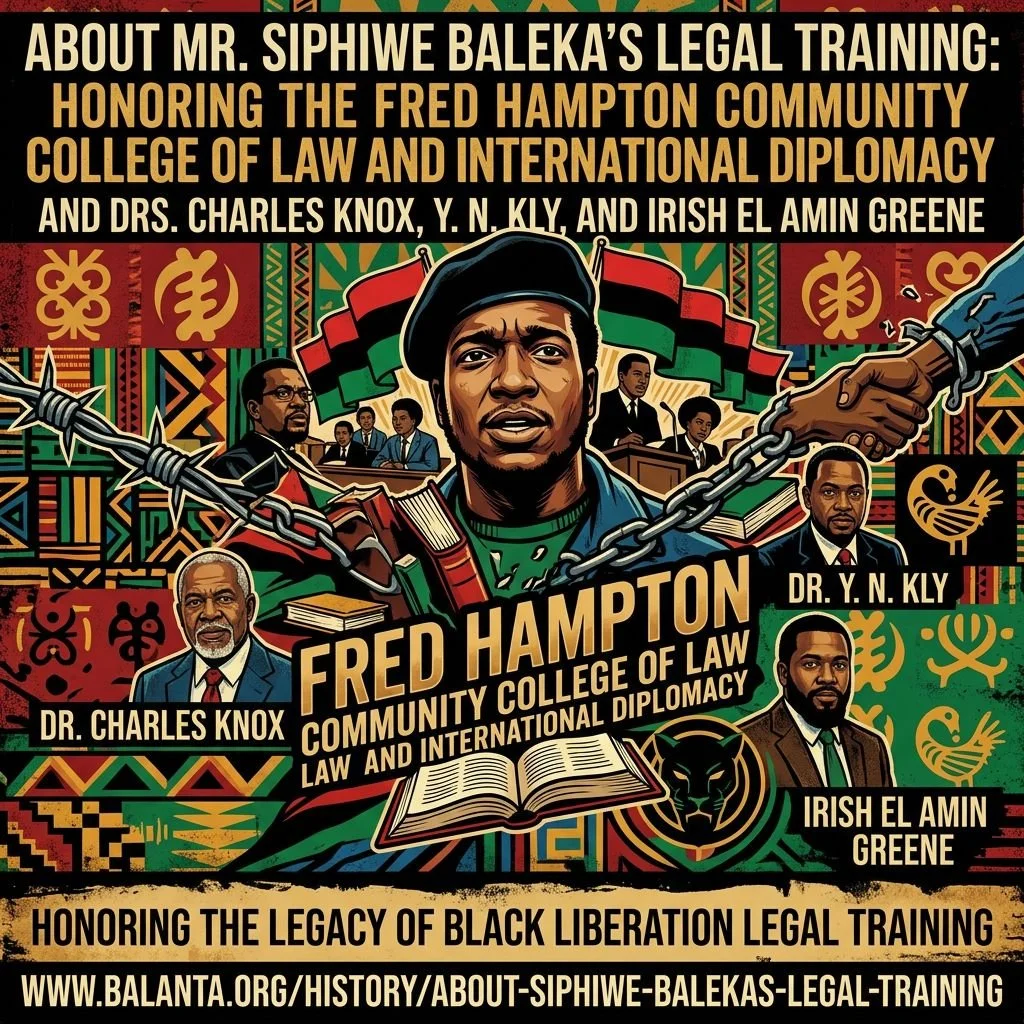
The National Conference of Black Lawyers Community College of Law and International Diplomacy (also known as the Fred Hampton Community College of Law) operated with a radical, anti-colonial mission and a specialized curriculum that combined alternative legal defense with international political theory. It was established in 1975 by DesMoines, Iowa Black Panther Party leader Dr. Charles Knox and David Hammond at 4545 South Drexel in Chicago, IL. Degree granting authority was was granted on October 8, 1980, less than two months after it graduated its first class on August 11, 1980. State Senator Harold Washington gave the commencement address.
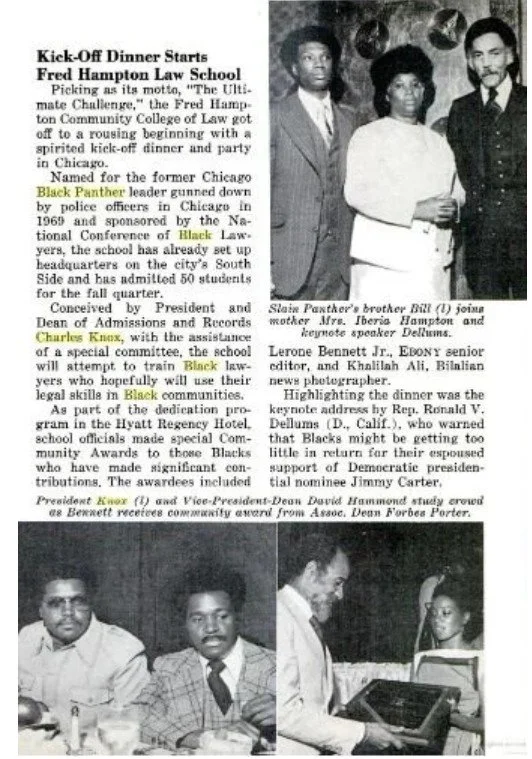
Jet Magazine’s coverage of the opening of the Fred Hampton Community College of Law and International Diplomacy.
## 𝐓𝐡𝐞 𝐌𝐢𝐬𝐬𝐢𝐨𝐧
The institution's primary mission was to train legal advocates and diplomats to champion self-determination for African Americans and marginalized communities. The school sought to:
* 𝑰𝒏𝒕𝒆𝒓𝒏𝒂𝒕𝒊𝒐𝒏𝒂𝒍𝒊𝒛𝒆 𝒕𝒉𝒆 𝒔𝒕𝒓𝒖𝒈𝒈𝒍𝒆: Elevate the civil rights fight in the United States to a global level. It framed the oppression of Black Americans under the scope of international human rights and United Nations criteria.
* 𝑶𝒇𝒇𝒆𝒓 𝒂𝒍𝒕𝒆𝒓𝒏𝒂𝒕𝒊𝒗𝒆 𝒍𝒆𝒈𝒂𝒍 𝒆𝒅𝒖𝒄𝒂𝒕𝒊𝒐𝒏: Provide an accessible, non-traditional legal education to individuals who were excluded from, or ideologically opposed to, mainstream, Eurocentric higher education.
* 𝑩𝒓𝒊𝒅𝒈𝒆 𝒍𝒐𝒄𝒂𝒍 𝒂𝒏𝒅 𝒈𝒍𝒐𝒃𝒂𝒍 𝒔𝒕𝒓𝒖𝒈𝒈𝒍𝒆𝒔: View the systemic issues facing American inner cities as deeply parallel to the struggles of developing, Third World nations.
## 𝐓𝐡𝐞 𝐂𝐮𝐫𝐫𝐢𝐜𝐮𝐥𝐮𝐦
The curriculum was designed by legal experts and human rights activists, including co-founders Dr. Charles Knox and Dr. Y.N. Kly. Rather than adhering strictly to standard American Bar Association doctrinal law, the coursework integrated:
* 𝑰𝒏𝒕𝒆𝒓𝒏𝒂𝒕𝒊𝒐𝒏𝒂𝒍 𝑳𝒂𝒘 & 𝑫𝒊𝒑𝒍𝒐𝒎𝒂𝒄𝒚: Students analyzed international issues through a lens emphasizing global solidarity. Heavy focus was placed on United Nations procedures, covenants, and mechanics for filing human rights grievances.
* 𝑴𝒊𝒏𝒐𝒓𝒊𝒕𝒚 𝑺𝒆𝒍𝒇-𝑫𝒆𝒕𝒆𝒓𝒎𝒊𝒏𝒂𝒕𝒊𝒐𝒏: Coursework utilized foundational texts, such as Dr. Y.N. Kly’s [International Law and the Black Minority in the U.S.], to study the concept of "New Afrikan" nationality, reparations, and protection against systemic genocide.
* 𝑹𝒂𝒅𝒊𝒄𝒂𝒍 𝑷𝒐𝒍𝒊𝒕𝒊𝒄𝒂𝒍 𝑻𝒉𝒆𝒐𝒓𝒚: The program incorporated Malcolm X's framework—specifically his efforts with the Organization of Afro-American Unity (OAAU)—to teach students how to challenge the state through international political apparatuses.
* 𝑷𝒓𝒂𝒄𝒕𝒊𝒄𝒂𝒍 𝑷𝒓𝒐𝒃𝒍𝒆𝒎 𝑺𝒐𝒍𝒗𝒊𝒏𝒈: Theoretical legal principles were paired with grassroots, community-based legal defense and advocacy strategies.
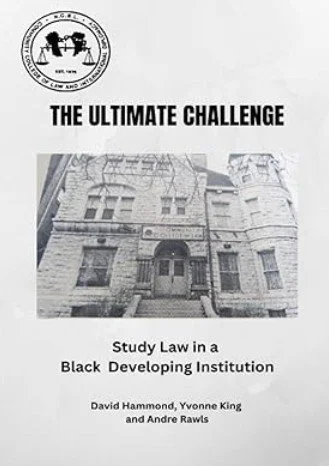
Accroding to David Hammond, Yvonne King and Andre Rawls, authors of The Ultimate Challenge: Study Law in a Black Developing Institution which is the only history of the law school written by its faculty,
“The first class was admitted in September 1976, and consisted of 66 Blacks, one Hispanic and one Caucasion student. . . . One apparent asset of the school was its attractivenes to local black lawyers who wanted to serve as volunteers. Several of the instructors went on to become judges and well-known politicians. Among the Chicago attorneys recruited as volunteer law professors were Bernetta Bush, William ‘Buddy’ Clark, Eleanor Forbes Porter, Leo Holt, Nathaniel Tindall, and Cassandra Watson. In later years, students were taught by Linnie Bass, James Gross, James Herd, Philip Johns, Carol Johnson, Harold Johnson, Blanche Manning, Emmett Marshall, Kwame Mathews (Kwame-Osagyefo Kalimara), Lewis Meyers, Jr., James Montgomery, Lewis Nixon, Ronald Payne, Herbert Powell, Donna Ramey, and James Russell. Attorneys Bernetta Bush, Leo Holt and Blanche Manning went on to become judges. These attorneys volunteered their time and talent to train a new breed of black lawyers, ones that were dedicated to working in and for the community. Notably, with small classes and a great deal of material to cover, these attorneys were stern taskmasters. Students were consistently held to high academic standards.”
Because the school was unaccredited, its curriculum did not meet the state's standards to qualify graduates for the Illinois bar exam. Instead, it functioned to produce community advocates, grassroots organizers, and 𝐢𝐧𝐝𝐞𝐩𝐞𝐧𝐝𝐞𝐧𝐭 𝐢𝐧𝐭𝐞𝐫𝐧𝐚𝐭𝐢𝐨𝐧𝐚𝐥 𝐥𝐞𝐠𝐚𝐥 𝐞𝐱𝐩𝐞𝐫𝐭𝐬 rather than traditional trial attorneys.
The Illinois Board of Higher Education (IBHE) challenged the college's curriculum and operations by targeting its non-compliance with state educational standards and its lack of professional legitimacy.
The state targeted the institution through three primary mechanisms:
1. Negligence in Curriculum and Enrollment Reporting
The IBHE repeatedly questioned the credentials of the institution because school leadership was negligent in filing legally mandated reports. The college consistently failed to submit documented proof of its course structures, credit hour tracking, and student enrollment metrics to the state, making it impossible for the board to verify that actual, systematic instruction was taking place. [1]
2. Failure to Seek ABA Accreditation
The board heavily challenged the legitimacy of the curriculum because the school failed to seek or receive accreditation from the American Bar Association (ABA). Because the specialized curriculum bypassed standard, foundational Anglo-American doctrinal law courses required by the ABA, the IBHE maintained that the degrees issued were virtually useless. The curriculum did not meet the state's baseline educational criteria necessary to qualify graduates to sit for the Illinois bar exam.
3. Investigation into True Enrollment Metrics
While school administrators claimed the college had around 20 active students, IBHE and state investigators challenged the validity of these academic numbers. State records indicated that true enrollment may have been as low as seven students, leading the board to argue that the school lacked the operational infrastructure, faculty-to-student ratios, and active student body required of a functional higher education institution.
Ongoing academic and curriculum challenges culminated in late 1985 and early 1986, when a broader state corruption probe prompted the Illinois Board of Higher Education (IBHE) and state police to formally investigate the school, ultimately revoking its authority to operate.
The 1986 Chicago bribery probe involving Dr. Charles Knox was a major federal influence-peddling investigation into Chicago City Hall contracting. The scandal linked the unaccredited National Conference of Black Lawyers Community College of Law directly to a wide-ranging conspiracy involving city contracts, federal undercover stings, and street gang conspiracies. The key details of the probe and Dr. Knox’s involvement include:
## 𝐓𝐡𝐞 𝐂𝐨𝐧𝐭𝐫𝐚𝐜𝐭-𝐑𝐢𝐠𝐠𝐢𝐧𝐠 𝐒𝐜𝐡𝐞𝐦𝐞
The core of the investigation involved a New York-based bill-collection company, Systematic Recovery Services Inc., which was attempting to secure lucrative parking-ticket collection contracts from the City of Chicago.
* To win the contract, the company wanted to sabotage its chief competitor, Datacom Systems Corp.
* Clarence McClain, a powerful former top adviser to Chicago Mayor Harold Washington and a primary target of the federal inquiry, orchestrated the plot.
* McClain hired Dr. Charles Knox and his law school co-administrator, David Hammond, to write a highly critical academic study designed to publicize errors and tank Datacom's reputation.
## 𝐓𝐡𝐞 𝐅𝐁𝐈 𝐈𝐧𝐟𝐨𝐫𝐦𝐚𝐧𝐭 & 𝐁𝐫𝐢𝐛𝐞𝐫𝐲 𝐏𝐚𝐲𝐦𝐞𝐧𝐭𝐬
Unbeknownst to Knox and McClain, an executive at Systematic Recovery Services, Michael Raymond, was actually a secret FBI informant wearing a wire. Raymond covertly bankrolled Knox’s "independent" research study. Federal prosecutors revealed that Knox and Hammond accepted cash payoffs through this operation, passing money and influence back into the city government pipeline to rig the bidding process.
## 𝐓𝐡𝐞 𝐄𝐥 𝐑𝐮𝐤𝐧 𝐒𝐭𝐫𝐞𝐞𝐭 𝐆𝐚𝐧𝐠 𝐂𝐨𝐧𝐧𝐞𝐜𝐭𝐢𝐨𝐧
As federal investigators dug into Knox's activities during the City Hall probe, they uncovered a parallel national security concern. In late 1985, Knox—who had graduated law school but was never admitted to the bar—used a real attorney's identification number to sneak into a federal prison.
* He used the fake credentials to hold private, unauthorized meetings with Jeff Fort, the imprisoned leader of Chicago's notorious El Rukn street gang.
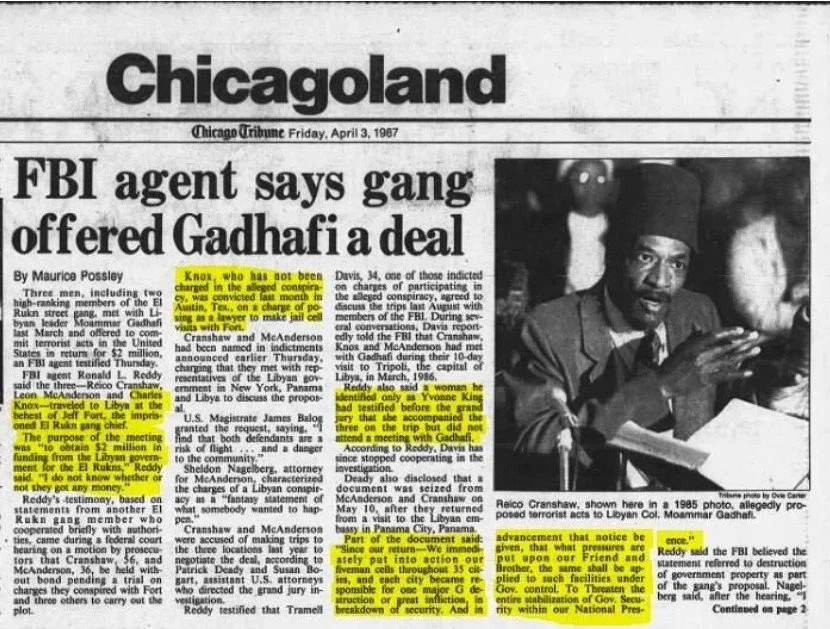
* 𝐓𝐡𝐢𝐬 𝐨𝐜𝐜𝐮𝐫𝐫𝐞𝐝 𝐫𝐢𝐠𝐡𝐭 𝐚𝐬 𝐅𝐨𝐫𝐭 𝐚𝐧𝐝 𝐭𝐡𝐞 𝐄𝐥 𝐑𝐮𝐤𝐧𝐬 𝐰𝐞𝐫𝐞 𝐚𝐜𝐭𝐢𝐯𝐞𝐥𝐲 𝐜𝐨𝐧𝐬𝐩𝐢𝐫𝐢𝐧𝐠 𝐭𝐨 𝐨𝐛𝐭𝐚𝐢𝐧 𝐦𝐢𝐥𝐥𝐢𝐨𝐧𝐬 𝐨𝐟 𝐝𝐨𝐥𝐥𝐚𝐫𝐬 𝐟𝐫𝐨𝐦 𝐋𝐢𝐛𝐲𝐚𝐧 𝐥𝐞𝐚𝐝𝐞𝐫 𝐌𝐨𝐚𝐦𝐦𝐚𝐫 𝐆𝐚𝐝𝐡𝐚𝐟𝐢 𝐭𝐨 𝐜𝐨𝐦𝐦𝐢𝐭 𝐚𝐜𝐭𝐬 𝐨𝐟 𝐝𝐨𝐦𝐞𝐬𝐭𝐢𝐜 𝐭𝐞𝐫𝐫𝐨𝐫𝐢𝐬𝐦 𝐚𝐠𝐚𝐢𝐧𝐬𝐭 𝐔.𝐒. 𝐠𝐨𝐯𝐞𝐫𝐧𝐦𝐞𝐧𝐭 𝐛𝐮𝐢𝐥𝐝𝐢𝐧𝐠𝐬.
Natalie Y. Moore and Lance Williams write in their book, The Almighty Black P Stone Nation: The Rise, Fall and Resurgence of an American Gang,
“During the time Farrakhan busied himself resurrecting the new NOI, he used various venues around the city of Chicago to hold meetings with his followers, including the Black Lawyers’ Community College of Law and International Diplomacy at 4545 South Drexel. Farrakhan’s friend activist Charles Knox had established the school in 1979.
Knox taught at Northeastern Illinois University’s Center for Inner City Studies. Not only did he have strong ties to Black Nationalists, Knox had an equally strong connection with Chicago street gangs. The leadership of the Stones, Lords, and Disciples respected him. Knox allowed Farrakhan and the NOI to use the Black Lawyers’ College as a meeting place, and he also let the El Rukns host activities there. It was through Knox that Farrakhan and Chief Malik (Jeff Fort) became acquainted. . . .
The Geopolitical Context: 1985–1986
By 1985, geopolitical tensions between U.S. President Ronald Reagan and Libyan leader Moammar Gadhafi had reached a boiling point, culminating in the 1986 U.S. bombing of Libya. Gadhafi openly sought avenues to retaliate against the United States from within its own borders. He actively invited radical American dissident groups—ranging from militant Black nationalists to anti-government organizations—to conferences in Tripoli to pitch anti-U.S. operations. Seeking a slice of Libya's vast petrodollar wealth, El Rukn leader Jeff Fort recognized that Gadhafi would fund groups willing to commit acts of domestic sabotage. Between 1985 and 1986, El Rukn "generals" (high-ranking gang members) traveled to Panama and Tripoli, Libya. They met directly with Libyan intelligence officials, presenting themselves not as a street gang, but as a disciplined, Islamic paramilitary revolutionary movement capable of carrying out missions inside the U.S. The El Rukns submitted a formal proposal to Libya requesting $2.5 million in exchange for performing mercenary acts of terrorism. The gang planned to use this money to buy real estate, fund their operations, and acquire a massive stockpile of weapons.
The 1987 federal trial of Jeff Fort and the El Rukn street gang marked a historic moment in American law. It was the first time in United States history that American citizens were convicted of conspirational domestic terrorism on behalf of a foreign government.
The landmark trial, held in Chicago, exposed how a street gang attempted to transition into a state-sponsored terrorist cell.
1. The Core Conspiracy
The prosecution proved that between 1985 and 1986, the El Rukn gang conspired to receive $2.5 million from the Libyan government under Moammar Gadhafi. In exchange for the cash, the gang agreed to procure military-grade weapons and execute domestic terrorist attacks, including blowing up U.S. government buildings and a commercial airplane.
Remarkably, gang leader Jeff Fort orchestrated the entire plot while serving an unrelated drug sentence inside a federal prison in Bastrop, Texas.
2. Key Evidence & The Star Witness
The FBI Joint Terrorism Task Force (JTTF) built its case through a massive, multi-city wiretap operation. Because the El Rukns spoke in highly complex, shifting Islamic codes over the phone, the government needed a translator.
The Informant: Tramell Davis, a high-ranking El Rukn co-defendant, pleaded guilty right before the trial and became the state's star witness.
Decoding the Tapes: Davis spent over a week on the stand translating recorded prison calls. He explained how the gang used coded language to mask international travel to Libya and Panama, where they met with foreign agents.
The Three-Way Call: Davis testified that the gang arranged a crude three-way phone patch allowing Fort, speaking from his Texas prison cell, to personally greet Gadhafi.
Seized Weaponry: Law enforcement corroborated the tapes by executing search warrants that recovered heavy weapons, including a fully functional, military M72 LAW anti-tank rocket.
3. The Defense Strategy
Defense attorneys did not deny that the El Rukns were meeting with Libyan officials, but they argued that the motive was entirely non-violent. They claimed the El Rukns were a legitimate religious organization and that the $2.5 million was simply a charitable donation intended to fix up their South Side headquarters and build a mosque. The jury ultimately rejected this defense.
4. Extreme Courtroom Security
The trial began in October 1987 under some of the tightest federal security measures ever seen in Chicago. The atmosphere grew incredibly tense when several jurors reported receiving threatening phone calls. U.S. District Judge Charles R. Norgle immediately dismissed those affected and sequestered the remaining jury for the duration of the trial to protect them from gang retaliation.
5. Verdicts and Sentencing
On November 24, 1987, after six days of deliberation, the jury returned guilty verdicts on all counts against five key El Rukn members. In December 1987, Judge Norgle handed down massive sentences:
Jeff Fort (Gang Leader): Convicted on 49 counts and sentenced to 80 years in prison (served consecutively to his existing sentences). He remains heavily incarcerated under a strict no-human-contact order at ADX Florence supermax prison.
Reico Cranshaw (General): Sentenced to 63 years in prison.
Alan Knox (General): Sentenced to 54 years in prison.
Leon McAnderson (General): Sentenced to 51 years in prison.
Roosevelt Hawkins: Sentenced to 9 years in prison.
(Note: Co-defendant Melvin Mayes originally fled to Libya to escape the trial; he was captured years later in 1995).
The successful federal trial effectively shattered the El Rukn leadership structure, preventing the domestic attacks before any loss of life occurred.
## 𝐋𝐞𝐠𝐚𝐥 𝐎𝐮𝐭𝐜𝐨𝐦𝐞𝐬 𝐚𝐧𝐝 𝐈𝐧𝐬𝐭𝐢𝐭𝐮𝐭𝐢𝐨𝐧𝐚𝐥 𝐂𝐨𝐥𝐥𝐚𝐩𝐬𝐞
The fallout from the dual bribery and prison-impersonation investigations completely dismantled Knox's operations:
* 𝑪𝒓𝒊𝒎𝒊𝒏𝒂𝒍 𝑪𝒐𝒏𝒗𝒊𝒄𝒕𝒊𝒐𝒏𝒔: In 1987, Knox was convicted in federal court for posing as a lawyer to visit Jeff Fort. By 1989, both Knox and Hammond pleaded guilty to federal bribery and conspiracy charges stemming from the City Hall contract probe.
* 𝑪𝒍𝒐𝒔𝒖𝒓𝒆 𝒐𝒇 𝒕𝒉𝒆 𝑺𝒄𝒉𝒐𝒐𝒍: With its leadership indicted and state police exposing that the unaccredited college was being used as a front for political consulting and illicit cash, the Illinois Board of Higher Education revoked the institution's operating authority.
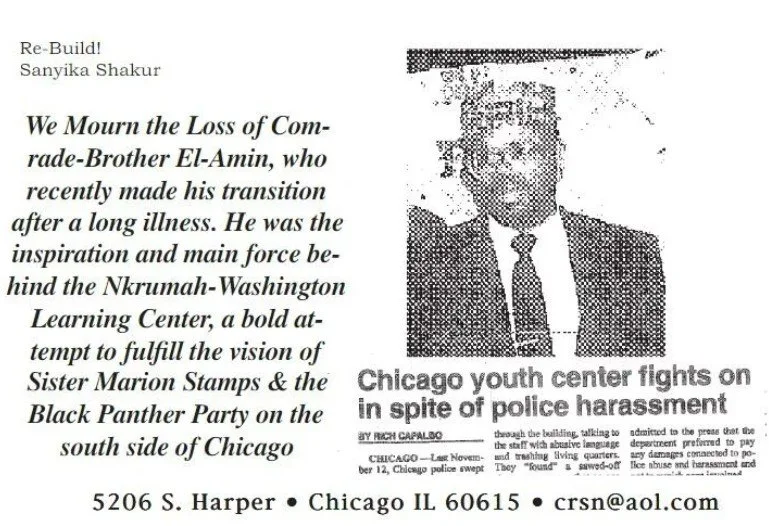
Dr. Kly was in Canada. Many others also fled and all the schools resources were entrusted to Irish El Amin Greene, who established the Nkrumah Washington Community Learning Center on 51st St. and Ada.
Irish “El Amin” Greene occupied a complex, dual role that bridged the radical academic mission of the National Council of Black Lawyers Community College of Law and the real-world militant activities of the El Rukn street gang. Federal prosecutors and court records highlighted his specific roles across both spaces:
1. The Institutional Protégé and Recruiter
Within the law school, Greene was a student and janitor who served under the close tutelage of co-founders Dr. Charles Knox and Dr. Y.N. Kly.
The Academic Liaison: Greene acted as a primary bridge between the college's international legal theory and the community. Even after the school's collapse, he preserved its historical records and directed grassroots legal and historical studies in Chicago.
The "Term Paper" Link: During the 1987 federal terrorism trial, prosecutors presented a term paper written by Greene at the college. The government used this academic paperwork as physical evidence to prove that the El Rukn gang was actively utilizing the unaccredited law school's resources to build a radical political ideology.
2. The Alleged "Explosives Expert" for the Terror Plot
In the federal sentencing memorandum for Jeff Fort, prosecutors named Greene as an unindicted co-conspirator, specifically identifying him as an explosives expert utilized by the El Rukns.
The Lethal Manuals: Investigators tied Greene to radical, underground literature. He authored articles that federal authorities described as a "lethal how-to manual," detailing specific, highly dangerous blueprints such as "Plastic Explosives, Instructions for the Making and Use of High Power Plastic".
The Paramilitary Connector: The government argued that Greene’s expertise was intended to help the El Rukns execute the violent aspect of their plot—namely, using military-grade weaponry to destroy domestic government buildings—once the Libyan funding cleared.
According to the article CAMPUS CABAL published December 13, 1987 in the Chicago Tribune,
“Irish D. Greene, a current student at University Without Walls, was identified during the recent trial as the El Rukn bomber. The prosecution`s star witness, a former gang general, made the identification from the stand as Greene sat in the courtroom gallery. Greene, who served time in prison for aggravated and sexual battery, worked for an unaccredited law school run by Charles Knox, according to sources close to the investigation. Knox was Greene`s adviser at Northeastern. Greene`s school files also were subpoenaed by the federal government. In a bizarre move, Greene had included in the files title pages of articles he had written that described the manufacture of plastic explosives and weapons and detailed his membership in violent black militant groups, law enforcement sources said. The titles of Irish Greene`s articles comprise a lethal how-to manual:
”Plastic Explosives, Instructions for the Making and Use of High Power Plastic Explosives From Ordinary Common Ingredients”; ”Illegal-Muffler or Silencer (Any Device for Diminishing the Explosive Report of a Portable Weapon)”; and ”The Homemade Cartridgeless Machinegun.”
The subpoenaed file also reportedly contained plans to develop underground security forces trained to battle police, the military, the National Guard, the Ku Klux Klan, Nazis, the FBI and the CIA.
Law enforcement sources said the articles were written by Greene on behalf of an organization referred to in the file as B.L.A.C.K. The FBI believes it is an outgrowth of the Black Liberation Army, an ultra-militant group responsible for the shooting deaths of two police officers and a guard during a bungled hold-up of a Brinks truck in New York state in 1981.
Greene apparently included this material, along with academic work, in his university file in the hope that such ”life experience” would help him qualify for a college degree.
Reynold Feldman, dean of Northeastern`s Center for Program Development, said that because Northeastern no longer has custody of Greene`s records, the university could not confirm that Greene`s file contained pro-terrorist documents or determine who, if anyone, had reviewed them.
Had a faculty member or administrator seen Greene`s militant writings, any action they would have taken would have been a judgment call. Like most universities, Northeastern has no policy on students who discuss violent or illegal acts.”
3. The Nationalist Revolutionary Pipeline
Greene also linked the gang to broader, anti-colonial revolutionary movements. Federal documents showed that Greene helped funnel treaties and drafts between the El Rukns, Libya, and the Republic of New Afrika (a self-styled revolutionary group advocating for a independent Black nation in the U.S. South and had established a Provisional Government). The government used Greene's ties to show that the El Rukns were transitioning from a typical Chicago narcotics ring into a highly radicalized, quasi-terrorist organization. Another Chicago Tribune article stated,
“Prosecutors said the evidence linked the gang members to Libya through a South Side law professor and the New Republic of Afrika, a self-styled revolutionary ”nation” based in Washington, D.C. The allegations were made in a sentencing memorandum released Monday night. The memorandum was accompanied by a collection of documents, including draft treaties of friendship between the New Republic of Afrika and Libya and between the republic and Nicaragua`s Sandinista government.
I started attending the National Coalition of Blacks for Repartions in America (NCOBRA) meetings led by Baba Hannibal and Erline Arpo at the Washington Park Field House on the south-side of Chicago. Baba Hannibal Afrik was a former legendary leader of the Republic of New Afrika’s military forces. Most of those who attended the meetings were elders and they no longer seemed militant to me and I soon became frustrated. There was no “action” and I didn’t see any of my peers. In my book, 𝐅𝐫𝐨𝐦 𝐘𝐚𝐥𝐞 𝐓𝐨 𝐑𝐚𝐬𝐭𝐚𝐟𝐚𝐫𝐢: 𝐋𝐞𝐭𝐭𝐞𝐫 𝐭𝐨 𝐌𝐲 𝐌𝐨𝐦, 𝟏𝟗𝟗𝟓-𝟏𝟗𝟗𝟖 I wrote,
“I met Hondo (member of the Spear & Shield Collective and publisher of their Crossroads underground newsletter) the last time I was in Chicago, back in 1995. He was the only dreadlocked brother at the Sunday afternoon National Coalition of Blacks for Reparations in America (NCOBRA) meetings. I remember vaguely him telling me about this radical community school that was trying to throw safe, weekly parties for the youth. On our way to the Dixon Correctional Center to visit political prisoner Atiba Sana, we talked about the challenges of community work smack in the middle of heavy gang-activity. . . . Crazy as I was, I was attracted to it. Having been one of a handful of black students in a rural Chicago suburb, and later at Yale University, I was after what Marcus Garvey calls a “racial re-education.” I saw it as a manifestation of God’s will when Hondo picked me up at Chicago’s Union Station and drove me to political education class (PE Class) at the Nkrumah Washington Community Learning Center (NWCLC). About the man who governs the center and would become my mentor, Hondo had only one thing to say – he’s intense!
I quickly found out exactly what he meant. After introducing me to Irish “El-Amin” Greene, I was invited to sit in PE Class. For the next four hours, El-Amin talked – fast, loud and hard. His voice is neither deep nor soft. It is full of a thousand clear and emancipated thoughts travelling at a thousand miles a second. . . . El-Amin offered me a place to stay. . . . I was especially excited to have access to their cases of books on black, African and world history. . . . If I was scared then, I was absolutely frightened by the prospect of the future – less jobs, less money, no welfare, more people, more prisons, more babies being raised without any adult guidance, more drugs, guns and homegrown militias and terrorists amid the backdrop of global imperialism and the threat of a nuclear Holocaust, all started by the genocide of African Americans by white supremacists in the U.S. and its government. There was little difference to me between the area around 51st Street and Ada and pictures I saw of Liberia, Sierra Leone and Zaire. I remember vividly as El-Amin walked me around the neighborhood pointing out lines of gang demarcation. He showed me houses in the area and introduced me to the families that lived in ratted out, broken down houses in the area and introduced me to the families that lived in them. . . . If I needed to prove myself, a black revolutionary intellectual from Yale University, going to the Moes in the heart of the Black P Stone Nation and working to politicize the gangs as part of the international liberation struggle was the best way to do it.
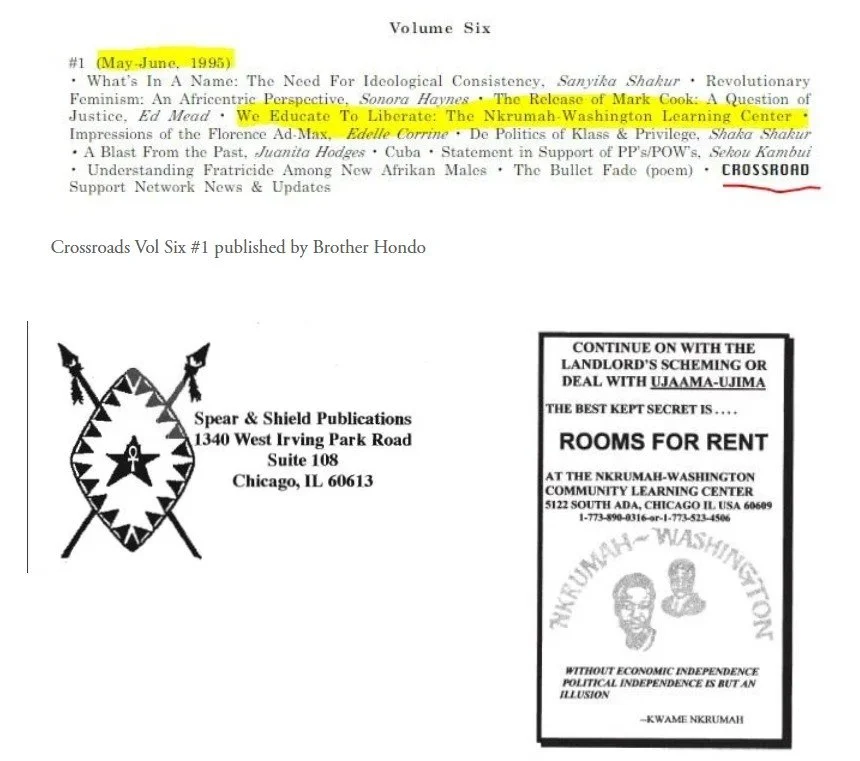
El Amin had begun to direct my studies towards the law. Taking me to its old location, El-Amin explained to me the history of the National Council of Black Lawyers Community College of Law and International Diplomacy where he used to work. He provided documents about its co-founders Dr. Charles Knox and Dr. Y.N. Kly, both distinguished experts in international law and diplomacy, and provided me with textbooks on the U.N. and its procedures. One book in particular would change my life the way the Autobiography of Malcolm X had done: International Law and the Black Minority in the U.S. by Dr. Y.N. Kly. Along with another of his books, The Black Book (which details Malcolm X’s program to internationalize our struggle through the Organization of Afro American Unity), I gained some clarity on what must be done and what I must do, in order to gain relief from genocide and win reparations.
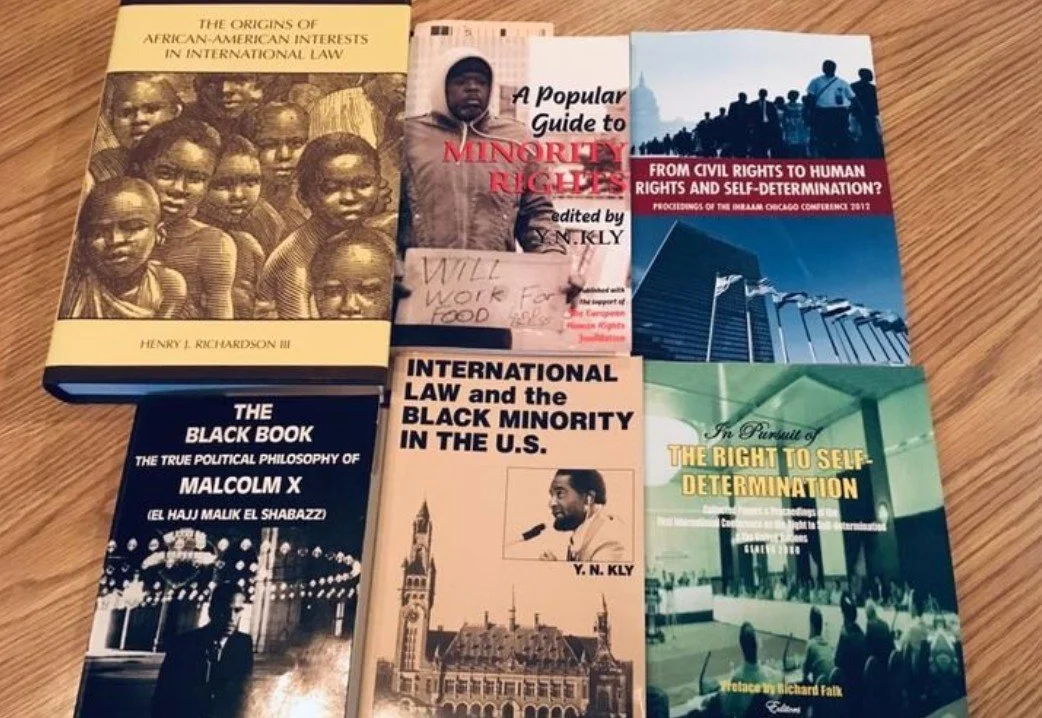
I thus began writing Ras Notes: Conceptualizing Our Case for the U.N. At this time, I established communication with Dr. Kly’s International Human Rights Association of American Minorities (IHRAAM) and UHRAAP. I then began researching U.N. resolutions through the internet at DePaul University, and obtaining articles, petitions, and reports from NGO’s concerning our case. From these I began drafting the Petition of the Nkrumah-Washington Community Learning Center on Behalf of their Members, Associates and Afro-American Population Whose Internationally Protected Human Rights Have Been Grossly and Systematically Violated By the Anglo-American Government of the United States of America and Its Varied Institutions.”
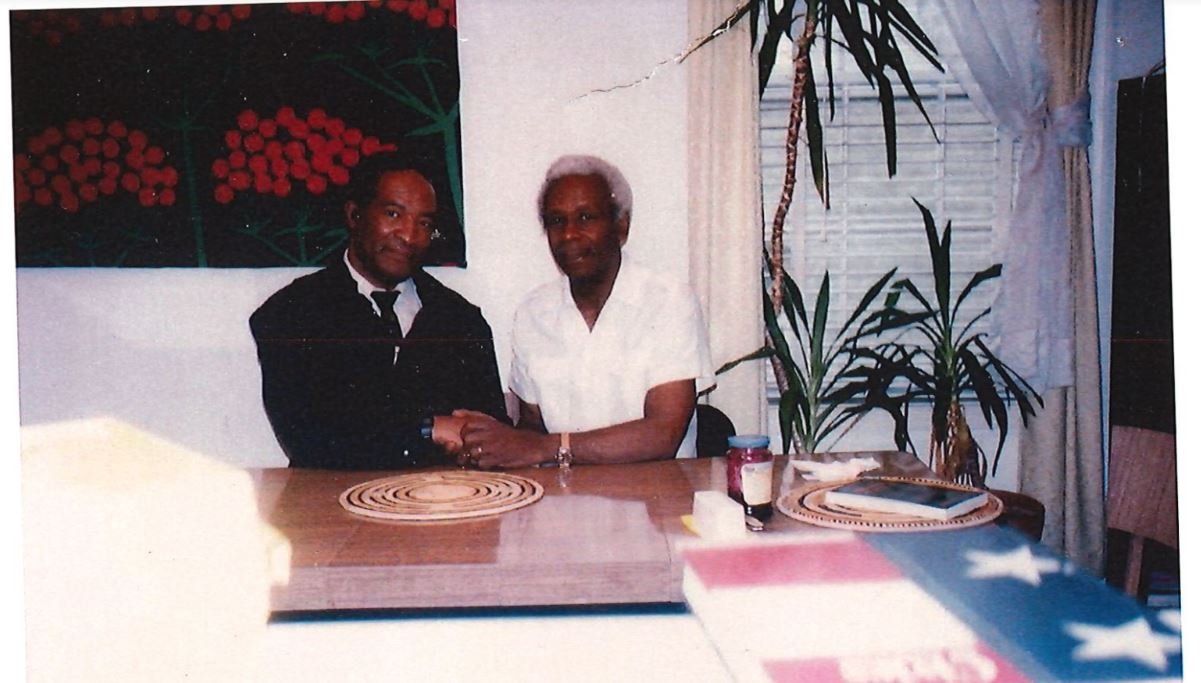
Left: Fred Hampton Community College of Law and International Diplomacy Professor Dr. Y.N. Kly; Right: Provisional Government of the Republic of New Afrika President Imari Obadele.
By that time, IHRAAM had facilitated communications between the National Organizing Committee for the Million Man March based in Chicago and were preparing for an intervention at a meeting of the UN Working Group on Minorities, May 26-30, 1997. At NWCLC, 𝐈 𝐰𝐚𝐬 𝐛𝐞𝐢𝐧𝐠 𝐭𝐫𝐚𝐢𝐧𝐞𝐝 𝐭𝐨 𝐛𝐞𝐜𝐨𝐦𝐞 𝐭𝐡𝐞 𝐧𝐞𝐱𝐭 𝐠𝐞𝐧𝐞𝐫𝐚𝐭𝐢𝐨𝐧’𝐬 𝐢𝐧𝐭𝐞𝐫𝐧𝐚𝐭𝐢𝐨𝐧𝐚𝐥 𝐥𝐞𝐠𝐚𝐥 𝐚𝐝𝐯𝐨𝐜𝐚𝐭𝐞 𝐟𝐨𝐫 𝐀𝐟𝐫𝐢𝐜𝐚𝐧 𝐀𝐦𝐞𝐫𝐢𝐜𝐚𝐧 𝐬𝐞𝐥𝐟 𝐝𝐞𝐭𝐞𝐫𝐦𝐢𝐧𝐚𝐭𝐢𝐨𝐧."
On January 27, 1997 the Nkrumah-Washington Community Learning Center was raided by the Chicago Police, the Bureau of Alcohol, Tobacco and Firearms (ATF), the Secret Service and special Gang Task Force.
Our computer equipment was seized and PE Classes stopped. While being detained and question, the ATF officers informed me that we had been under surveillance for a long time and that they could tell me every conversation that I had in the past two weeks. Irish El-Amin Greene, the Center’s founder and director, was being charged with “counterfeiting.” They told me that they knew I wasn’t involved, but that I was still facing up to fifteen years in prison if it went to court and that I could prevent this by cooperating with their investigation. My exact words to them were, “Mr. Greene has taught me more and helped me more than any professor at Yale. Whatever I can do to help Mr. Greene I am going to do to help him.” And that was the end of our conversation.
The case went to court and we conducted our own defense. The investigators did in fact find images of money scanned into our computers, but none of the images contained both a front and a back of the same size. Our defense was that we used the images to promote our parties. El Amin had me go all over Chicago taking pictures of Moneygram’s advertising campaign. On billboards and park benches all across the city, Moneygram’s campaign showed twenty dollar bills and stated, “It’s All About The Benjamins!” Our defense was simple: If Moneygram could use images of money for their advertising campaign, why couldn’t NWCLC use the same images to advertise its parties? Greene was found not guilty, but the incident disrupted operations at the center and I left to become more involved in the Rastafari movement in Chicago.
I am, perhaps, the last student of the Fred Hampton Community College of Law and International Diplomacy and I am proud to carry on its tradition by offering the curriculum via my New Afrikan Diplomatic and Civil Service Corps Certification Course available here: www.nadcsc.org
SEE ALSO:
EXAMINING SIPHIWE BALEKA'S EXPERIENCE AT YALE UNIVERSITY
Global Afrikan Strategic Reparatory Justice Efforts at the PFPAD, ICJ, and AU - The Board As Seen By Siphiwe Baleka
ORDER SIPHIWE BALEKA's NEW BOOK: