
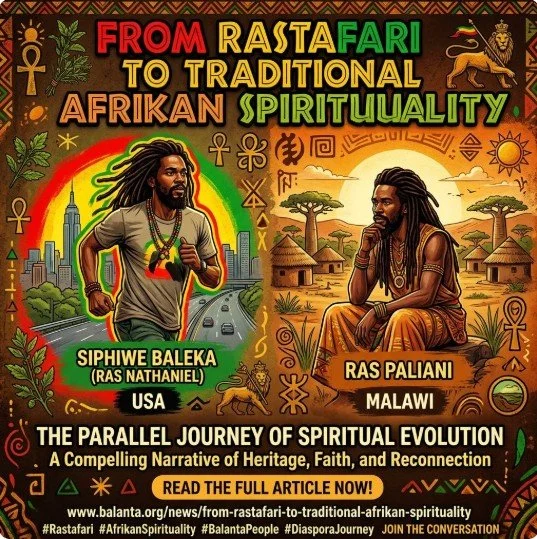
FROM THE RASTAFARI INITY SUMMIT IN 2006 TO THE INTERNATIONAL AFRIKAN SPIRITUALITY SUMMIT IN 2026

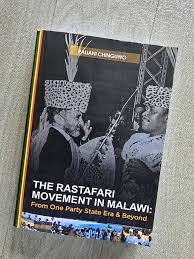
Following the International Afrikan Spirituality Symposium that was held by the Afrika Centre for Intangible Phenomena Studies (ACIPS) June 2-3, 2026, Siphiwe Baleka and Paliani Chinguwo, both of whom were speakers at the Symposium, conducted a recorded reunion conversation to discuss their 20-year journey in Rastafari and African spirituality, reconnecting after first meeting during Rastafari movement organizing efforts in 2003-2006. They shared their parallel paths from embracing Rastafari in the late 1990s through their work with the Rastafari Inity Summit, repatriation census initiatives, and eventual transitions into African traditional spirituality. Paliani presented his recently published book "The Rastafari Movement in Malawi" and discussed how Rastafari emerged as an organised movement in Malawi following political transition from the one party state from 1992-1994, leading to the establishment of Pan-African Movement of Malawi (PAMOM) and later the development of African spirituality practices.
Siphiwe shared his diplomatic work representing Rastafari at the African Union and his disillusionment with the movement after the failed 2007 repatriation census campaign, which led to his departure from active Rastafari community involvement. They discussed the challenges Rastafari practitioners face when transitioning to African spirituality, including persecution from within the Rastafari community, and agreed to collaborate on creating a network of former Rastafari practitioners who have embraced African spirituality while maintaining respect for His Imperial Majesty's legacy.
Summary
Rastafari Movement Collaboration Discussion
Siphiwe and Paliani reconnect after meeting at an International African Spirituality Symposium, discussing their 20-year history of working together in the Rastafari movement. They traced their collaboration back to 2003-2004 when they worked on organizing the Global Rastafari Summit in South Africa through email communications and the Rasta Ites platform. Paliani mentioned he has preserved their email archive, including Siphiwe's final communication in 2007 when Siphiwe announced a new spiritual direction and ended their collaborative work.
Ethiopian Orthodox Church in Malawi
Paliani discussed his involvement with the Ethiopian Orthodox Church (EOTC), starting in 2005-2006 with a Rastafari brethren in Malawi called Bro. Chimwemwe Luwani (Chim). Their pioneering work eventually culminated to the first church service of the EOTC in Malawi in March 2026. He also shared how Rastafari consciousness proliferated in Malawi in the 1990s, influenced by Jamaican artists performing in the country in November 1997 and the establishment of the first privately owned radio station in 1998 called Power 101 FM, which helped promote Pan-Africanism and Rastafari teachings.
Rastafarian Movement in Malawi History
Paliani discussed the history of Rastafarian movement in Malawi, highlighting the roles of Ras Bob Morgan, Junior Manning (Ista J) and Michael Ibo Cooper from Jamaica as well as Ras Jabari from Atlant in its growth. He explained how a police raid on a Sabbath gathering in November 1999 at CI Park in Blantyre led to the formation of the Pan-African Movement of Malawi, which focused on Pan-African consciousness rather than Rastafari. The new organization began meeting on Sundays and attracted both Rastafarians and youths interested in Pan-Africanism.
Journey to African Spirituality
Paliani discussed his journey from Rastafari consciousness to African spirituality, beginning with a police-disrupted gathering in 1999 that led to the formation of a new movement with Chifuno Mlambe. He described how Chifuno was inspired by an Africa Day event in 2007 where libations were performed, which marked his transition to African spirituality. Paliani explained that while he had been interested in African traditional spirituality since 2004, it wasn't until 2014-2015 while living in Botswana that he made the decision to fully embrace African spirituality, inspired by Chifuno's example. [Note: Similarly, it was in 2016 that Siphiwe Baleka began to fully embrace his Balanta ancestry.]
Rastafari Movement Journey Discussion
Siphiwe and Paliani discussed their shared journey into the Rastafari movement in the late 1990s, including their connection through Rastafari Youth Initiative and the Rastafari Inity Summit in South Africa in 2006. Paliani explained his indirect involvement with the summit through email communications rather than direct organizational involvement. Siphiwe shared his work on the Ethiopia to Chicago exhibit, highlighting the historical connection between Haile Selassie's visits to Chicago in 1954 (which resulted in a book) , and their research into the Abyssinian mission and the first Ras Tafarite organizaton - the Star Order of Ethiopia - that started in Chicago in 1919.
Rastafari Journalist's Ethiopia Journey
Siphiwe shared his journey to Ethiopia, explaining how he won a quiz on the Rastafari Rastaites website and received media credentials from the Ministry of Information that allowed him to access the African Union as a journalist. He discussed his work with the Rastafari newspaper and his travels around the Western Hemisphere preparing for the Rastafari Inity Summit in South Africa. Siphiwe also mentioned his collaboration with other Rastafari activists like Ras Jabari and his involvement in organizing the first Rastafari Summit in the Hispanic world (Panama).
Rastafari Global Organization Expansion
Siphiwe discussed his efforts to include Spanish speakers in Rastafari global organization, highlighting his work in organizing the first regional Rastafari Summit in South America with Ras Jabari. He shared memories of his involvement in the inaugural Marcus Garvey lecture in Barbados and his appearance on SABC TV in 2006 (which Paliana stated he watched while in Malawi), where he discussed Rastafari issues and cannabis legalization with Gareth Prince and Yaa Asantewa. Siphiwe explained how he took his role as a high-level ambassador and diplomat for the Rastafari family seriously, often wearing military-style uniforms with Rasta patches for public appearances and official meetings.
Rastafari Repatriation Movement Planning
Siphiwe discussed his efforts to organize the repatriation of 10,000 Rastafari brethren from the West to Africa, inspired by Emperor Haile Selassie's 1961 Star Order Proclamation and modeled after Operation Solomon. He worked for five years according tothe Star Order Five-Year Plan for Rastafari repatriation, which was approved by the Organization of Afro-American Rastafari Unity and later by the Incients Council of the Nyahbinghi in Jamaica and other mansions/organizations, leading to plans for the Rastafari Inity Summit in Jamaica. Despite significant efforts and meetings culminating with 10 governments meeting in Barbados (organized by the Barbados government’s Commission for Pan African Affairs) in August of 2007, only 100 repatriation census forms were collected, leading to Siphiwe's disillusionment with the movement and his decision to focus on his own spiritual journey.
Rastafari Community Reaction Discussion
Siphiwe and Paliani discussed their past communications regarding a book project from 2007, which revealed their long-standing connection to the Rastafari movement. Paliani shared that there were negative reactions in the Rastafari community after Siphiwe wrote a letter, including accusations that he was a CIA agent due to his Yale education.
Rastafarian Community Discussion
Paliani and Siphiwe discussed an email that appeared to criticize someone's involvement in the Rastafarian movement, with Paliani explaining that the email was written by someone else and not by the intended recipient. Paliani shared their initial reaction to the email, which was influenced by negative sentiments from other movement members who were not present to defend the person. They discussed how expressing interest in African spirituality beyond Rastafari can lead to harassment and victimization within the Rastafarian community, with some members experiencing physical harm in Malawi for continuing their spiritual journey.
Rastafari to African Spirituality Transition
Siphiwe discussed his journey from Rastafari to African spirituality, explaining how his initial disillusionment with the Rastafari community in Shashamane led him to continue His Majesty's work outside the movement. He described his subsequent achievements in repatriation and representing their people at the UN, the AU, and the African Commission on Human and People's Rights. Paliani proposed creating a network with other Rastafari practitioners who have moved towards African spirituality, which Siphiwe agreed was feasible and could start with a Zoom conversation including Thau Thau. Paliani also mentioned his book, which details the history of Rastafari in Malawi and concludes with a chapter on the transition from Rastafari to African spirituality.
Haile Selassie Visit Documentation Project
Paliani and Siphiwe discussed their shared history documenting Haile Selassie's 1954 visit to the USA and His Majesty’s 1965 visit to Malawi, including the coronation ceremony depicted on the book cover where three paramount kings crowned him as the Great King of Malawi. They explored the significance of Emperor's View, a mountain plateau where the emperor stood to see panoramic views of the area, which has since become a site for Rastafari gatherings and African spirituality practitioners pouring libations. The conversation concluded with plans to organize a roundtable or panel discussion with other Rastafari and African spirituality practitioners, with Siphiwe promising to create a WhatsApp group for project participants and share the recording with Jabari and others.