1) There will be a better understanding of the mutual relations of Master and Servant;
2) There will be GREATER SUBORDINATION and a decrease of crime amongst the Negroes;
3) Much unpleasant discipline will be saved to the Churches;
4) The Church and Society at large will be benefitted;
5) The Souls of our Servants will be saved and,
6) We shall relieve ourselves of great responsibility.
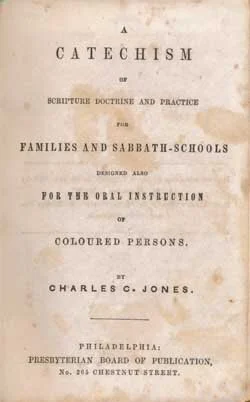
Specifically, Reverend Jones stated that,
“obedience will never be felt and performed to the extent that we desire it, unless we can bottom it on religious principle.. . . It will be noticed that obedience is inculcated as a Christian duty, binding on the Servants, and thus the authority of Masters is supported by considerations drawn from eternity”
BENNETT BLAKE IMPLEMENTS REVEREND COLCOCK JONES’ PLAN TO THE NEGROES OF WAKE COUNTY, NC AND CONVERTS YANCEY BLAKE TO CHRISTIANITY.
According to Early Methodist Meeting Houses in Wake Country, North Carolina,
“Another Methodist pioneer was Bennet T. Blake, born in Virginia in 1800. While living in Petersburg, as a young man, Blake came under the influence of some prominent Methodist ministers including John Early who later became bishop. These ministers recognized a tremendous potential in the talented and capable young man and encouraged him to devote his life to the Methodist ministry. Blake joined the Virginia Conference in 1824, but gave most of his ministry to Wake Country where he began by serving in Raleigh in February, 1827. . . . .It was at this Conference that the famous Georgia slave-owning preacher, James O. Andrew, was elected bishop, a move that led to the division of the church. . . . [Blake] married the daughter of Needham Price, a prosperous land owner in southeastern Wake County, and made his home at Shotwell. After serving circuits down east, Blake filled the pulpit on Edenton Street in 1832, after Mellville B. Cox left for his missionary journey to Liberia. Three years he served as presiding elder in other districts, three years in educational work at Greensboro, but virtually the remainder of his thirty-year ministry was within Wake County. . . . He pioneered in a ministry to blacks, when this was not a popular thing to do. . . . Blake was also a delegate to the 1844 organizing Conference of the splinter group which called themselves the Methodist Episcopal Church, South. Blake established the Neuse River Mission to People of Colour in 1844 and continued his work there for two years. This was the first Methodist appointment in Wake County established entirely for a minority race. . . . At the end of the first year he reported eight black members with this number doubling to 16 by the end of 1845. . . . Meanwhile at Edenton Street Church, Dr. Rufus T. Heflin held a revival early in his pastorate during 1849 in which more than 250 people were converted to swell the membership roll to 213 white and 232 black members. These numbers continued to increase proportionately. White members. . . were equally irritated and embarrassed by the strong black membership. Socially, economically and culturally, black membership in the progressive city church was incompatible with the expectations of the minority and plans were made for something to be done to remedy the situation. The remedy, announced as a satisfactory solution for all concerned, came in 1853 after the determination that the blacks should have a church of their own. People of both races worked to get money together to buy land and obtain a building. . . . For the purpose of an episcopal appointment, the black congregation was called the African Mission and Daniel Culbreth, or Uncle Culbreth as he was affectionately called, became the first pastor. . . . He was on the Raleigh Circuit in 1834 with Bennet T. Blake . . . [Blake] retired in 1854 and died at his residence near Shotwell on May 28, 1882.”
According to B’rassa Nchabra family oral history given by Eustace Blake on August 9, 1974,
"Our forefathers were George, Jack, Yancey. Yancey Blake married Melissa Page. Yancey begat nine children by Melissa. Two boys and seven girls. Boys: Yancey Jr and John Addison. During the civil war a group of Federal Soldiers came pass the house of my grandfather (Yancey Blake), Yancey Blake Jr. joined them and was never heard from anymore.”
Indeed, Yancey Jr., the son of Jack Blake, was born in 1847, the fourth generation of Brassa Nchabra and the third generation born into captivity, slavery and with the submissive and obedient epigenetic coding. In 1853, the year that the African Mission black congregation was established in Wake County, Jack Blake was emancipated and married the love of his life, a woman named Cherry. Jack’s son, Yancey was 34 years of age. Five years later, in 1858, Yancey had another son, John Addison.
In 1861, North Carolina lawmakers barred any black person from owning or controlling a slave, making it impossible for a free person of color to buy freedom for a family member or friend. Thus, Jack Blake was prevented from purchasing or obtaining the freedom of his children and grandchildren. Thus, Yancey Jr. ran off the plantation and enlisted in the the 40th U.S., Colored Troops. Military Service Records list him as "Henderson Blake", age 18, enlisted from 1863-1865.
Here, in Yancey Jr.’s willingness to risk his life for freedom’s sake, the Balanta epigenetic coding was fully expressed. Yancey Jr. returned to the military legacy of his Balanta ancestors and was willing to make a COUNTER-STRIKE against his enemies.
Meanwhile, in Wake County where Jack, Yancey and John Addison were living,
“240 black members would march out of the brick city church with a feeling of triumph and move into their new church home. Dr. Bassett, writing of the event, said, ‘They rejoiced because they had a building of their own and the whites rejoiced because the Negroes were out of their church.’ . . . The effect of the War Between the States and the resultant Conference attitude caused the members to unite with the African Methodist Episcopal Church in 1866.”
One year earlier, almost 150 delegates attended The Convention of the Colored People of North Carolina held at the Loyal AME Church in Raleigh, North Carolina. The President of the convention stated,
“There had never been before and there would probably never be again so important an assemblage of the colored people of North Carolina as the present in its influence upon the destinies of this people for all time to come. They had assembled from the hill-side, the mountains, and the valleys, to consult together upon the best interests of the colored people, and their watchwords, “Equal Rights before the Law.”
Writing to the Convention, William Coleman stated,
“In the first place, you should be allowed to vote as a matter of right.
There was only one State refused you this right in its organic law at the adoption of the Federal Constitution. Congress has recognized it over and over again, and many of you recollect when free persons of color voted in North Carolina . The great and good men who founded the Government felt it no degradation that the ballot-box was open to free persons of color, nor did Gen. Jackson so regard it when he called them "fellow-citizens" in his Louisiana campaign. But, further, it can easily be shown by the severest logic, that if you are not to be allowed equality before the law, then the principles laid down in the Declaration of Independence, upon which our Government is based, are words "full of sound and fury," signifying nothing."
You are four millions of people, the bone and sinew of the Southern States. If they are ever to recuperate and regain the important position they once held in the commercial world, it will be due to your energy and industry. But you may well ask how this is to be expected, if yea are denied the rights of freemen, if you are still to remain a proscribed and degraded race? If you are to have no other motive to incite you than a bare struggle for physical existence, if you are to feel no weight of responsibility, to be moved by no feelings of honor and patriotism, are to entertain no hopes for the elevation and advancement of your children to a higher standpoint than you now occupy, then indeed I do not see with what heart you can go to work at rebuilding the future of these shattered States.
But then, you will pay a tax to the support of the Government. Your brethren in Louisiana have been paying one for a number of years on property at the assessed value of fifteen millions of dollars. Is the colored man to have no voice in the appropriation of his money? And this, too, in a Government claiming to be Republican, and founded, after a seven years' war, upon the principle of taxation and representation!
Nothing could be more preposterous, unless it be to refuse men the right of suffrage who bare undergone all manner of hardships and dangers far rise sake of the Government; who have volunteered in the ranks of its armies, and risked their lives upon the battle-field to maintain its integrity. There is something more than a jingle of words in the copulation of "ballot and bullet."
But there is even a more terrible calamity that you may be doomed to bear than the denial of suffrage. I mean the denial of justice in our courts of law. If you are not to be admitted to the witness stand, how are you to prove your contracts? You will be at the mercy of every scoundrel who has a white skin, and is disposed to swindle you. Of course, you can have no protection for your property. How about yer persons? You may be set upon, beaten into a jelly, and outright, and although fifty respectable colored sons might have seen it, you will be without .What is to protect your wives and daughters from, the brutal last of those who would select a time when no white witnesses were present to effect their devilish designs? Formerly, your masters protected you as property; now, you must protect Yourselves as persons; and, unfortunately, the prejudice is too strong against you (I fear) to expect justice from the State. And there are other feelings, by no means so excusable as prejudice, and a policy by no means national, which will operate to keep you down. Your only hope is an appeal to Congress.”
A year later, The Freedman’s Convention was held in Raleigh, North Carolina, from October 2nd to the 5th. There were 115 delegates from sixty counties. The representatives for Wake Country were J. H. Harris, Charles Ray, Wm. Laws, S. Ellerson, H. Locket, J. R, Caswell. Moses Patterson and Wm. High, honorary members. During the Convention, although many government officials of the state of North Carolina addressed the Convention, the convention was not informed of their legal status in international law. Specifically, they were not informed that the 14th amendment was not a grant of citizenship but merely an offer of citizenship that required an acceptance of rejection. The convention was not informed of the principle of jus soli, that America had the obligation to offer citizenship to the African born on American soil but that it could not impose this citizenship. Furthermore, the the United States government, under obligation to make the offer, also had the power to create the mechanism – a plebiscite-- whereby the African could make an informed decision, an informed acceptance or rejection of the offer of American citizenship. Indeed, Section Five of the Fourteenth Amendment makes clear that Congress could pass whatever law was necessary to make real the offer of Section One. (Section Five says, 'The Congress shall have the power to enforce, by appropriate legislation, the provisions of this article.)
The first 'appropriate legislation' required at that moment -- and still required - was that which would make possible for the now free African an informed free choice, an informed acceptance or rejection of the citizenship offer.
Concerning the education that Jack and Yancey Blake received at the moment of emancipation, Imari Obadele states,
“The education offered him after the Thirteenth Amendment confirmed the policy of dehumanization. . . . Now, again following the Thirteenth Amendment, the education of the African in America seeks to base African self-esteem on how well the African assimilates white American folk-ways and values. Worse, the advice given the African concerning his rights under international law suggested that there was no option open to him other than American citizenship. For the most part, he was co-opted into spending his political energies in organizing and participating in constitutional conventions and then voting for legislatures which subsequently approved the Fourteenth Amendment. In such circumstances, the presentation of the Fourteenth Amendment to state legislatures for whose members the African had voted, and the Amendment's subsequent approval by these legislatures, could in no sense be considered a plebiscite.
The fundamental requirements were lacking: first, adequate and accurate information for the advice given the freedman was so bad it amounted to fraud, a second stealing of our birthright; second, a chance to choose among the four options: (1) US citizenship, (2) return to Africa, (3) emigration to another country and (4) the creation of a new African nation on American soil.”
Thus, the resolutions of the Freedman’s Convention and all the similar conventions held throughout the United States were all UNIFORMED resolutions, and therefore did not meet the standard of the plebiscite for self-determination. Neither Jack or Yancey made a free and informed acceptance or rejection of the offer of citizenship and thus their legal status in the United States of America became “colonized Binham Brassa (Balanta) people through forced integration.”
Brassa Nchabra’s Grandson Yancey Blake Returns to His Balanta Roots As A Farmer and Businessman in North Carolina.
By the time of Emancipation in 1865, then Brassa Nchabra’s grandson Yancey Blake had already been programmed never to revolt and miseducated into believing that there was no option open to him other than American citizenship. Yancey Blake thus returned to the Balanta vocation of farming. By the time of the 1870 Census, Yancey Blake was listed as farmer and the city directory showed that Yancey owned 12 acres of land. He was one of only two Negroes listed in the business directory. Certainly Yancey was exposed to Bennet Blake’s Neuse River Mission to People of Colour which became the African Mission under Daniel Culbreth in 1853 and eventually united with the African Methodist Episcopal Church in 1866.
With his older brother Yancey Jr. lost to the war, John Addison was raised as the dignified son of a prominent black family in Wake Country.
Thirty years later, in 1896, John Addison Blake, great grandson of Brassa Nchabra, fully Christianized, established the Union Bethel African Methodist Church in Cary, Wake County North Carolina. His sister, Sallie married Arch Arrington Sr., a negro, one of the largest landowners and the first Mayor of Cary, North Carolina.
Thus was accomplished the conversion to and institutionalization of Christianity in the family of Brassa Nchabra now named the Blake family.
AFTERMATH OF JACOB BLAKE’S SHOOTING
It is now possible to view the response of the Blake family after the shooting of Jacob Blake in Kenosha, Wisconsin, from the long, historical view of Brassa Nchabra and the Balanta people with a history that began BEFORE slavery.
When Brassa Nchabra was captured in the 1760’s, his family did not respond by appealing to the moral conscious of the attackers. They did not appeal to any foreign authority to bring the attacker to justice. They had no concept of peaceful, non-violent protest. They did not call for unity with those that kidnapped their son. Instead, they lived according to natural law which had only three restrictions:
You must not injure or kill anyone.
You must not steal or damage things owned by someone else.
You must be honest in your dealings and not swindle anyone.
When Brassa Nchabra was kidnapped, his family and community responded by organizing COUNTER ATTACKS. This is the normal, natural, spiritual response that had been encoded in their DNA for thousands of years.
Through the genocidal trauma, terror and the torture of seven generations a new mental programming was inserted that changed the brain structure, function and chemistry of Brassa Nchabra’s descendants. This new programming introduced the master-slave relationship that was foreign to the Balanta people. It made obedience to a God named Jesus a sacred duty that extended to the Christian slavemaster. Tolerating, suffering the master-slave relationship was imprinted on the brain and created the new familiarity heuristic of non-violence. This Christian indoctrination and behavior, so desired by the white slavemasters and particularly Reverend Colcock Jones and Bennet Blake, was institutionalized by John Addison Blake and has since been passed down to the Blake descendants, all of whom have a well-documented legacy in the African Methodist Episcopal (AME) Church.
From this perspective, then, the Blake family’s calls for peaceful protest in the wake of the shooting of Jacob Blake, can be seen as the successful outcome of Reverend Colcock Jones’ plan to prevent insurrection and COUNTER STRIKES against the Masters of the American System and their armed enforcers (police).
Having been the only member of the family to return to our ancestral homeland and unlocked this portion of our genetic code, only I can tell the story from the perspective of our ancestors.


![In 2013, gold exports were of the order of 67.4 tonnes, nearly a 50% increase over the production in 2012 which is attributed mainly to the contribution of 20.7 tonnes made by artisanal mining.[1][3] Gold, followed by cotton, is the top export …](https://images.squarespace-cdn.com/content/v1/5d8396d6e57474059d685116/1602529820992-8B2RJ1EE25W7TXJMWP3H/Mali+gold+mining.png)