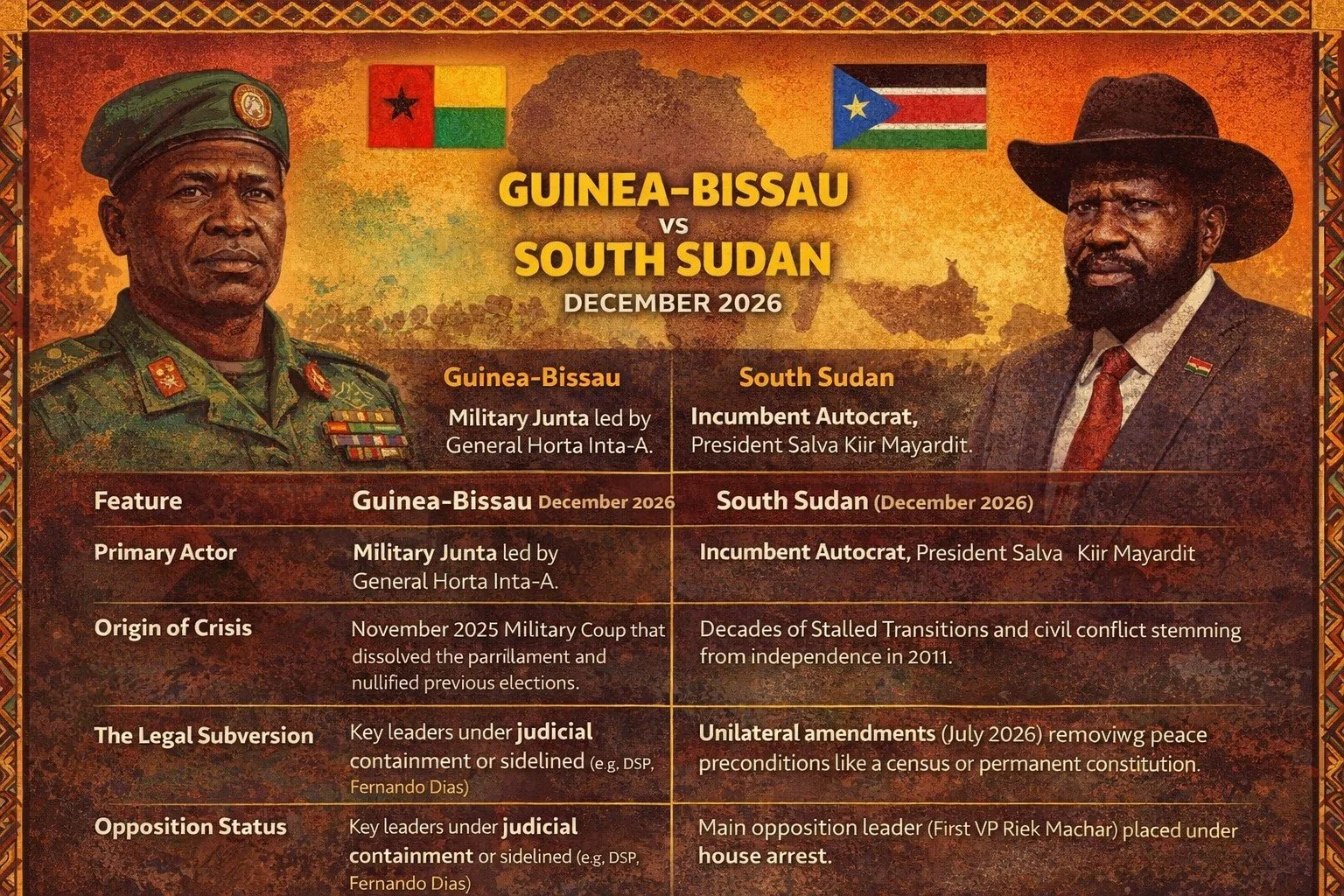
SIPHIWE: Compare and analyze the situation of upcoming elections in Guinea Bissau and South Sudan in December. Both are heading towards illigitimate elections. What is the significance?
ANCESTRAL INTELLIGENCE (AI): Election Overviews: Guinea-Bissau vs. South Sudan. Both Guinea-Bissau and South Sudan are driving toward December 2026 national elections under deeply compromised conditions. However, their pathways to these unfree votes stem from completely different structural crises: [1, 2]
The Shared Significance: The Death of Democratic Safeguards
The parallel crises in Guinea-Bissau and South Sudan expose a deeper, systemic failure of regional and international governance across Africa.
1. The "Laundering" of Unconstitutional Regimes
In both states, elections are no longer being used as tools for democratic expression; they are being weaponized as a bureaucratic exit ramp for illegitimate leaders. By holding a vote—no matter how flawed, violent, or uncompetitive—the military junta in Bissau and Salva Kiir in Juba aim to trick regional bodies (like the African Union and ECOWAS) into granting them legal recognition and lifting sanctions.
2. The Failure of International Financial Leverages
International institutions are actively insulating these regimes from domestic pushback. In Guinea-Bissau, the IMF continues to unlock millions in funding, prioritizing macro-fiscal targets over the fact that a junta is in control. In South Sudan, the government pushes ahead with a hollow vote despite massive economic degradation and 10 million citizens requiring humanitarian assistance. External funds keep the state's financial throat from drying up, making local civilian boycotts or strikes much harder to sustain.
3. Shifting Opposition Dynamics: Avenues of Desperation
When conventional voting pathways are broken, opposition strategies fracture drastically based on local conditions:
The Weapon of Absence: In Guinea-Bissau, where street protests carry an intolerable cost, citizens are left with few options such as villes mortes (dead-city days) and silent economic non-cooperation to starve the regime of local legitimacy.
Armed Alignment: In South Sudan's highly militarized environment, suppressing the opposition has instead driven them back to the bush. Machar's wing has partnered with alternative armed actors to conduct joint military operations against state forces, pushing the country to the brink of a renewed civil war.
The Long-Term Consequence
By pushing forward with these illegitimate political processes, both states are setting up a dispensation that guarantees future instability.
History shows that when regional bodies accept a fait accompli transition for the sake of short-term "stability at all costs," deterrence is erased. These processed elections will likely fail to solve the core underlying grievances, virtually ensuring a recurring cycle of military coups or ethnic conflicts down the road.
SIPHIWE: Who are the African scholars and activists writing about the "Laundering" of Unconstitutional Regimes and elections being weaponized as bureaucratic exit ramps for illegitimate leaders?
AI: The structural critique of elections being weaponized as "bureaucratic exit ramps" and the institutional "laundering" of unconstitutional regimes is heavily advanced by a prominent cadre of African political scientists, legal scholars, and civil society leaders. These intellectuals argue that autocratic incumbents and military juntas use heavily flawed, exclusionary, or manufactured votes to check a box for regional bodies like the African Union (AU) and ECOWAS, exchanging superficial compliance for international legitimacy. Prominent African scholars, institutional experts, and activists leading this specific discourse include:
1. The Institutional & Security Scholars
Dr. Joseph Siegle & The Africa Center for Strategic Studies: While an international body, its research features heavy contributions from African security scholars documenting the concept of "third-termism" and constitutional manipulation. Their frameworks directly analyze how regimes use transitions to "launder" illegal power grabs by holding sham elections that satisfy external diplomatic metrics while choking domestic opposition.
Zenge Simakoloyi (Institute for Security Studies - ISS Africa): A prominent peace and security governance researcher who writes extensively on the rise of "lawfare" across the continent. Simakoloyi documents how regimes in states like Zimbabwe and Tanzania weaponize legal codes and state apparatuses to systematically exclude opposition parties under the guise of technical non-compliance, effectively using the bureaucracy of the state to engineering pre-determined electoral outcomes.
Dr. George Ofosu (LSE / Academic Researcher): A political scientist who focuses heavily on electoral integrity, state-building, and accountability in Africa. His work explores the micro-dynamics of how politicians and local bureaucrats capture state institutions, creating systems where the "will of the people" is structurally administrative rather than democratic.
2. The Pan-African & Grassroots Intellectuals
Ghedi Alasow (Political Analyst & Writer): Writing on the structural crisis of neocolonial governance, Alasow argues that elections in many contemporary African states have been reduced to tools that protect resource extraction and imperial "stability" rather than actual public mandates. He highlights that African youth are increasingly revolting against these fraudulent, managed electoral processes, viewing the entire traditional ballot system as fundamentally illegitimate when run by corrupt regimes.
Professor P.L.O. Lumumba (Legal Scholar & Activist): The renowned Kenyan legal mind frequently speaks and writes on the systemic breakdown of the "consent of the people" via compromised ballot boxes. Lumumba actively critiques the African Union's structural failure to enforce declarations against Unconstitutional Changes of Government (UCGs), pointing out that when regimes rig processes, it explains why citizens often celebrate military coups as a desperate alternative to endless, captured elections.
3. Democracy & Civil Society Thinkers
The Democracy in Africa Collective: Networked thinkers across the continent—including regional legal experts like Hoinathy and Okechukwu—frequently publish on the "fragility of the African governance agenda." They specialize in tracking how autocrats legally circumvent AU frameworks (such as the African Charter on Democracy, Elections and Governance). They explicitly map out how leaders forcefully retire constitutional judges or execute biased referendums to technically "legalize" authoritarian extensions of power.
Afrobarometer Network Researchers: African sociologists and data scientists within this network provide the empirical backing for these arguments. Their continuous polling highlights the precise phenomenon of "electoral disillusionment"—showing that while the African public strongly desires democratic accountability, the weaponization of elections by ruling elites has caused a sharp decline in public trust that votes are actually being counted.