On March 29, 2023, The Black Agenda Report published a story entitled The Balanta Mandate and the UN's Permanent Forum on People of African Descent (PFPAD) stating that
“The UN Permanent Forum on People of African Descent must uphold the 2001 Durban Declaration and Programme of Action (DDPA). A recently written mandate affirms the importance of DDPA and the need to protect and strengthen it. . . . And so it is with the recent effort of Comrade Siphiwe Baleka, President of the Balanta B'urassa History & Genealogy Society (BBHAGSIA). He is standing in the shadow of the most brilliant and militant of our recent ancestors who "struck a blow for freedom," Malcolm X, Imari and Gaidi Obadele, Queen Mother Audley Moore, Robert and Mabel Williams, and many more whose names are unknown but have kept the fire burning and the struggle alive. . . .Baleka invites us to study and sign the mandate he's drafted and circulated, after community consultation. With sound historic and legal basis, it demands that the UN's Permanent Forum ON People of African Descent (PFPAD) simply use its much-vaunted status to unite and serve people of African Descent by requesting an advisory opinion from the International Court of Justice on the prisoner of war status of persons/peoples of African Descent under the Geneva Convention. Furthermore, that the PFPAD not be used to discount, undermine, and bury the most revolutionary modern freedom document since those of the 1954 Bandung Conference and formation of the Non-Aligned Nations Movement- - - The 2001 World Conference Against Racism's Durban Declaration and Programme of Action (DDPA). . . .The DDPA is a global consensus blueprint against white supremacy and patriarchy, manifestation of self-determination, and a declaration of independence. The Balanta Mandate affirms the power of the people as represented by the DDPA and advances steps already taken in anticipation of future challenges.”
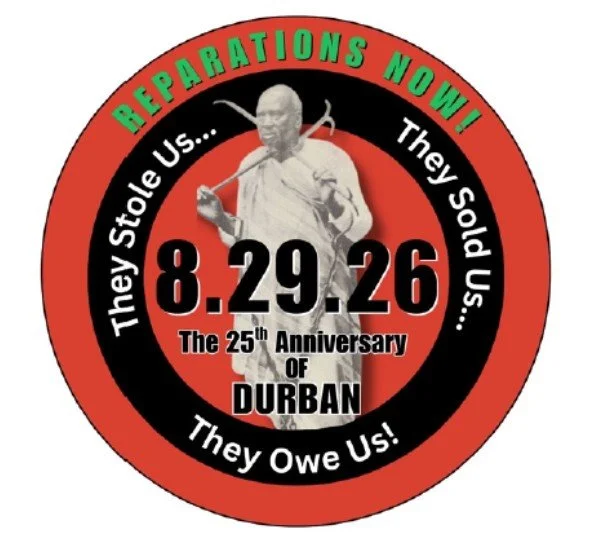
2026 marks the 25th Anniversary of the World Conference Against Racism and the resulting Durban Declaration and Programme of Action (DDPA). Saturday, August 29, 2026 (8/29), is designated as a Day of Unity and Action so that people remember and understand the importance of Durban and its implementation today.
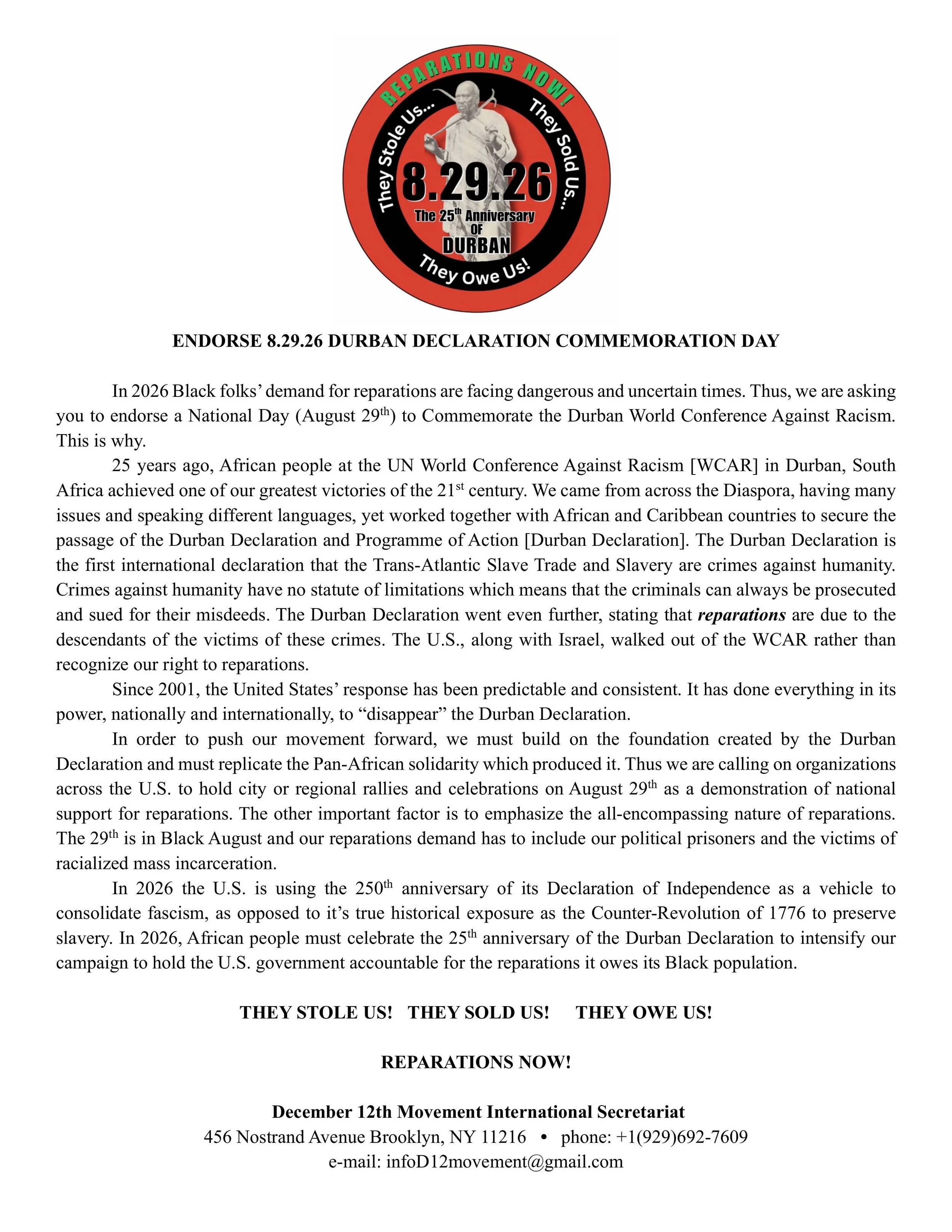
Already, planning meetings initiated by original “Durban 400” leader Roger Wareham of the December 12th movement were held on February 7 and February 28th of this year. A HIGH LEVEL PLANNING MEETING FOR THE 25TH ANNIVERSARY OF THE DURBAN DECLARATION was held on March 7. The purpsoe of the meeting was to Coordinate action between
the UN Intergovernmental Working Group on the effective implementation of the Durban Declaration and Programme of Action (IWGDDPA);
the UN Permanent Forum on People of African Descent (PFPAD);
the African Commission on Human and Peoples’ Rights (ACHPR),
the governments of Ghana and South Africa (the two governments that have a leading role) as well as
civil society and key stakeholders
to produce events celebrating the 25th Anniversary of the World Conference Against Racism and the Durban Declaration and Programme of Action (DDPA) while prioritizing the implementation of DDPA points 52, 54, 55, 79, 80, 84, 87, 104, 158, 160, 161, 162, 166, 168, 172, 173, 191 and II.12 through the campaign to mandate The Permanent Forum on People of African Descent to request an advisory opinion from the International Court of Justice on “The status of Afro Descendant People as prisoners of war under the Geneva Convention and their right to conduct plebiscites for self-determination.”
Advancing Reparations Through Legal Action
The meeting focused on coordinating efforts to advance reparations and legal assistance for Afro-descendants, marking the 25th anniversary of the Durban Declaration and Programme of Action (DDPA). Siphiwe outlined plans to collect legal analyses from 20-25 lawyers on a draft request for an advisory opinion from the International Court of Justice (ICJ), emphasizing the need for civil society to take a proactive role in analyzing legal questions. Participants discussed collaboration with various UN mechanisms, including the Permanent Forum on People of African Descent (PFAD) and the Intergovernmental Working Group for the Implementation of the DDPA, with Ade highlighting the importance of engaging multiple mechanisms. The group agreed to continue outreach to states, legal experts, and civil society to build support for the ICJ request and to ensure representation in upcoming forums. During the meeting, Siphiwe stated,
"I have sustained a campaign at the PFPAD and elsewhere, including the AU, for Afrodescendants’ Right of Return and reparations, and especially for requesting an Advisory Opinion from the International Court of Justice (ICJ), that was submitted at the 1st Session and signed by 256 supporters from around the world. A draft Request for an Advisory Opinion from the ICJ was delivered to PFPAD President Epsy Campbell Barr at the 2nd Session of PFPAD held in New York. The 2nd Session Preliminary Conclusions and Recommendations stated, “The Permanent Forum reiterates its recommendation to promote an advisory opinion from the International Court of Justice on the legal question of reparatory justice for histories and legacies of colonialism and enslavement.” And finally, on July 25, 2023, PFPAD President Epsy Campbell Barr responded [directly to me in a letter] that, “As President of this space, I have requested the incorporation of this item in the agenda of the next meeting, to proceed to analyze it jointly. I also inform the High Commissioner of the United Nations of this.” Christopher Jones, the male co-chair of the IDPAD Coalition U.K., drafted a letter to PFPAD signed by 248 people stating, “We, therefore, take this opportunity to reaffirm our commitment to this ICJ initiative and to make absolutely clear that our Brother Siphiwe Baleka of the Balanta B’urassa Society must represent us at the highest level of engagement with the ICJ.” At the third session of PFPAD, I made an impassioned plea for new PFPAD President June Soomer to sign the Request before the conclusion of the session and send it to the Registrar of the ICJ. I received a standing ovation! Michael McEachrane, Rapporteur for PFPAD stated in the Preliminary Conclusion and Recommendations of the Forum’s 3rd Session, “The Permanent Forum calls . . . [for] the advancement of claims before the International Court of Justice .” [emphasis added]. I did not attend the 4th Session and, not coincidentally, there is no mention of the request for an advisory opinion from the ICJ, though the Preliminary Conclusions and Report does encourage “(a) Establish a legal advisory group on reparations.” For these reasons, my presence at the 5th session is critical for this effort to move forward. I intend to formally present to PFPAD the legal analysis of the exact legal questions in the request for the advisory opinion that we have collected from lawyers and jurists."
As established in the DDPA, nation states have to pay for crimes against humanity. The first reparations claim charging “crimes against humanity” was presented 342 years in the 1684 Mendonça (Kongo) Reparations Case at the Vatican. Marcus Garvey prophesied the World Conference Against Racism and the bombing of the World Trade Center immediately following back in 1922, when he made this startling prophecy in his article Solution for World Peace:
"We hear a great deal of talk about world peace today. Wilson of America, Lloyd George of England, Clemenceau of France a few years ago prophesied at Versailles a reign of peace. Up to the present many of the leading statesmen of the world have pledged themselves to a program of world peace. Many conferences have been held (political as well as industrial) for the purpose of settling the question of peace; but up to now none of them has laid the foundation for a real peace, for a lasting peace. The peace of the world cannot be settled by political conferences, or by industrial conferences only. If we are to have a world peace it will only come when a great inter-racial, conference is called. When Jew will meet Gentile; when Anglo-Saxon will meet Teuton; when the great Caucasian family will meet the Mongolian, and when all will meet the Negro, and then and there straighten out the differences that have kept us apart for hundreds of years, and will continue to keep us apart until Doom's Day, if something is not done to create better racial understanding."
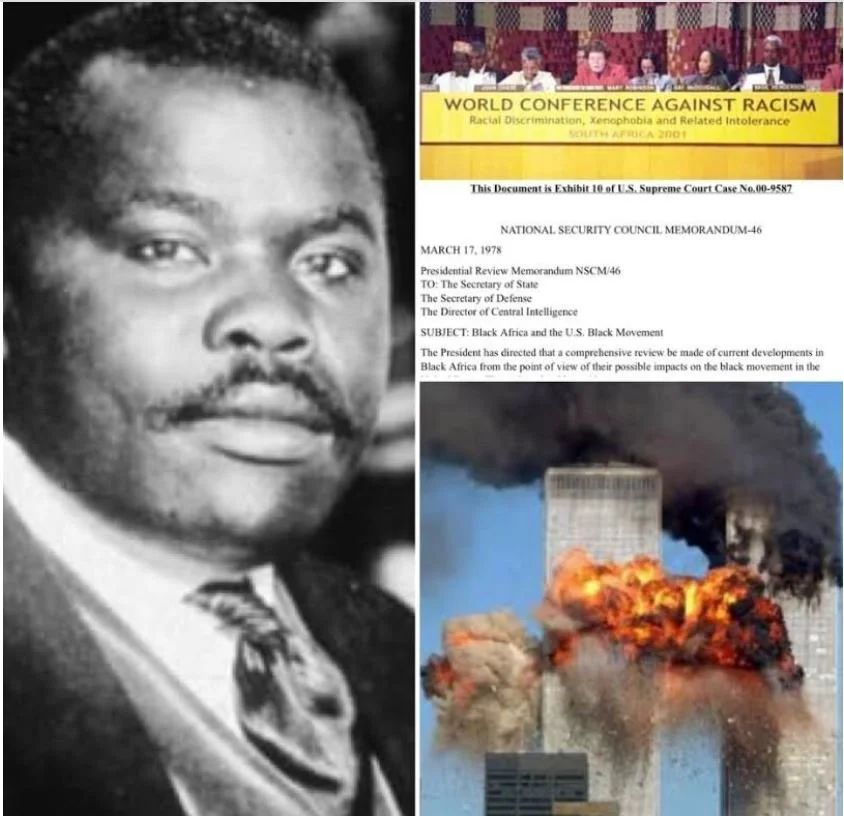
Marcus Garvey's prophecy about a great inter-racial conference came true in late August 2001 at the convening of the World Conference Against Racism (WCAR) in Durban, South Africa. On September 3, 2001, 18,810 delegates from 170 countries, 16 heads of state, 58 foreign ministers, 44 ministers, 7,000 non-governmental representatives, and 1,300 journalists attending the World Conference Against Racism, Racial Discrimination, Xenophobia and Related Intolerance (WCAR) declared that "slavery, and the slave trade, including the Trans-Atlantic Slave Trade, were appalling tragedies in the history of humanity not only because of their abhorrent barbarism but also in terms of their magnitude, organized nature [and] especially their negation of the essence of the victims . . . [and] that slavery and the slave trade area crime against humanity..." At the conference, on September 2, 2001, in a meeting with United Nations High Commissioner for Human Rights Mary Robinson, Congresswoman Cynthia McKinney presented Robinson with two documents as evidence of the US government's violations of both US and international law and, in particular, specific violation of the International Convention on the Elimination of Racial Discrimination. The first document given to Robinson was a confidential memorandum 46, written by National Security Advisor, Zbigniew Brzezinski on March 17, 1978 and it details the federal government's plan to destroy functioning black leadership in the United States. This document provides a critical insight into the federal government's concern at the apparent growing influence of the African American political movement. The second document is a report entitled "Human Rights in the United States [The Unfinished Story - Current Political Prisoners - Victims of COINTELPRO]" and it was compiled by the Human Rights Research Fund, headed by Kathleen Cleaver. This document provides an overview of the counterintelligence program which, from the 1950s to the 1980s, was run in the United States against political activists and targeted organizations. The United States delegation, led by Deputy Assistant Secretary of State Michael Southwick, was promptly ordered to withdraw by U.S. Secretary of State Colin Powell, and the US Delegation officially walked out of the World Conference Against Racism on September 3, 2001. Eight days later, on Ethiopian New Year’s Day, the World Trade Center was destroyed, fulfilling Marcus Garvey’s “until Dooms Days” prophecy along with Revelations 18.
The DDPA section IV. Provision of effective remedies, recourse, redress, and other measures at the national, regional and international levels states:
158 “. . . recognizes the need to develop programmes for the social and economic development of these societies and the Diaspora, within the framework of a new partnership based on the spirit of solidarity and mutual respect, in the following areas: Facilitation of welcomed return and resettlement of the descendants of enslaved Africans. . . .
160. Urges States to take all necessary measures to address, as a matter of urgency, the pressing requirement for justice for the victims of racism, racial discrimination, xenophobia and related intolerance and to ensure that victims have full access to information, support, effective protection and national, administrative and judicial remedies, including the right to seek just and adequate reparation or satisfaction for damage, as well as legal assistance, where required;
161. Urges States to facilitate for victims of racial discrimination, including victims of torture and ill-treatment, access to all appropriate legal procedures and free legal assistance in a manner adapted to their specific needs and vulnerability, including through legal representation;
162. Urges States to ensure the protection against victimization of complainants and witnesses of acts of racism, racial discrimination, xenophobia and related intolerance, and to consider measures such as, where appropriate, making legal assistance, including legal aid, available to complainants seeking a legal remedy and, if possible, affording the possibility for non-governmental organizations to support complainants of racism, with their consent, in legal procedures;”
UN Resolution 75/314 establishing the Permanent Forum on People of African Descent (PFPAD) further emphasizes that PFPAD can “request the preparation and dissemination of information by the United Nations system on issues relating to people of African descent . . . “; the International Court of Justice (ICJ) is an organ within the UN system and UN Charter Article 96 states,
“2. Other organs of the United Nations and specialized agencies, which may at any time be so authorized by the General Assembly, may also request advisory opinions of the Court on legal questions arising within the scope of their activities.”;
Article 65 of the Statute of the International Court of Justice states,
“ 1. The Court may give an advisory opinion on any legal question at the request of whatever body may be authorized by or in accordance with the Charter of the United Nations to make such a request.
2. Questions upon which the advisory opinion of the Court is asked shall be laid before the Court by means of a written request containing an exact statement of the question upon which an opinion is required, and accompanied by all documents likely to throw light upon the question.”
Thus, Resolution 75/314 combined with DDPA 160, 161 and 162 enables, as a matter of urgency, the pursuit of “access to all appropriate legal procedures and free legal assistance in a manner adapted to their specific needs and vulnerability, including through legal representation.”
Afrodescendants have had no access to the ICJ necessitating adaptation to their specific lack of legal standing handicap. The spirit of the UN resolutions identified above and the DDPA provide for Afrodescendants to have standing before the ICJ through PFPAD whose scope of activities includes Afrodescendants’ reparations claims.
In November 2022, the African Commission on Human and People's Rights (ACHPR), passed a resolution (ACHPR/Res.543 (LXXIII) 2022) that reaffirmed “the Durban Declaration and Programme of Action as a comprehensive framework addressing racism, racial discrimination, xenophobia, and related intolerance”
In November of 2023, Ghana hosted the International Conference on Building a United Front to Advance the Cause of Justice and Reparations to Africans. The resulting Accra Proclamation on Reparations points 6, 7 and 8 call for a commitment to explore legal and judicial options for reparations in collaboration with ACHPR and civil society, an increased role for the United Nations and in particular PFPAD, and the provision of legal advice on the question of reparations. Ghana was formally designated the African Union (AU) Champion for Reparations in February 2024 during the 37th Ordinary Session of the Assembly of the African Union in Addis Ababa, Ethiopia. On Nov. 20, 2025 Ghana hosted the International Conference of the Pan-African Progressive Front that was determined to move beyond acknowledging historical injustices toward concrete political action. Ghana is now set to table a landmark resolution at the United Nations General Assembly on March 25, 2026. This motion seeks to officially declare the Transatlantic Slave Trade as the "gravest crime against humanity".
There is therefore the following calendar that unifies all the key stakeholders that have mandates to implement the DDPA and Reparations:
March 18 to 21, 2026 High-Level Forum of the Community of Latin American and Caribbean States (CELAC) and Africa, Bogota, Colombia
March 25, 2026 Ghana to introduce landmark “Crime Against Humanity” resolution at the United Nations General Assembly
April 14 to 18, 2026 5th Session of PFPAD
May 1 to 2, 2026 Roots Synergy Roundtable Dialogue Part II: Building Power for Reparatory Justice, The Netherlands
May 11 to 20, 2026 ACHPR 87th Ordinary Session Public Segment
June 18, 2026 International Day of Resistance to the Dum Diversas Apostolic Edict Issued 574 Years Ago
August 29, 2026 25th Anniversary of the World Conference Against Racism and the resulting Durban Declaration and Programme of Action (DDPA)
THE FOLLOWING WERE THEREFORE INVITED TO ATTEND A HIGH-LEVEL MEETING TO COORDINATE STRATEGY, MESSAGING, EVENTS AND ACTIONS (those in bold attended:
Professor Joel Malesela Modiri (South Africa), IWGDDPA
Justin Hansford (USA), PFPAD
Epsy Campbell-Barr (Costa Rica), former President PFPAD
June Soomer (St. Lucia), former President PFPAD
Honorable Dr. Litha Musyimi-Ogana (Kenya), Chairperson of the Working Group on Indigenous Populations/Communities and Minorities in Africa, ACHPR
Ekow Spio-Garbrah (Ghana), Special Envoy On Reparations
Luvuyo Ndimeni (South Africa), Advisor to the Deputy Chairperson of the African Union
Mr Thembela Ngculu (South Africa) South African Permanent Mission to the United Nations Office in Geneva
Fabian Anthony (Colombia), Chairman of the Pan African Council and Advisor to Vice President of Colombia/CELAC Event
Dr. Barryl Biekman (Netherlands), Chair of the National Platform on the Dutch Slavery Past; AUADS High Council, and Europe Europe Pan African Forum
Ras L. Paulos Ho-Shing (Jamaica), Chairman of the E.W.F.I: Charter 43. 6th Region. Jamaica. W.I
Dr. Onaje Muid (USA), Co-Chair, NCOBRA Health Commission, Member of Durban 400
Roger Wareham (USA), December 12 Movement, Member of Durban 400, Convener of the Ad-Hoc Steering Committee for the 25th Anniversary of the World Conference Against Racism
Barbara Reynolds (Guyana), Co-Chair, CARICOM Digital Skills Task Force; Vice-President for Administration, Advancement, and Planning at the University of the Southern Caribbean (Trinidad and Tobago)
Esther Xoesi (United Kingdom), Co-Chair NCOBRA International Affairs Commission; Executive Director of Maangamizi Educational Trust
Carol Ammons (USA), Illinois State Representative
Dòwòti Désir (USA/Benin) A veteran of the original Durban 400 and chair of the DDPA Watch Group
Jan Lonn (Sweden), Secretary-General of The Youth and Student Mouvement for the United Nations (ISMUN) and the Director of ISMUN Summer School on Human Rights and Development
Robin N’nanba Rue (USA, Guinea Bissau), Founder, First Repair
Mary Izobo (South Africa), Founder and Executive Director - The Amazon Leadership Initiative
Catherine S. Namakula (South Africa), Convenor, Africa Reparation Hub, Member Working Group of Experts on People of African Descent (WGEPD)
Ɔbenfo Ọbádélé Bakari Kambon (Ghana), multi‑award‑winning master linguist, scholar, and founder of Abibitumi, aiding Black repatriation & Ghanaian citizenship via RepatriateToGhana.com
Kamm Howard (USA), Director, Reparations United
Dr. Ahmed Bugre (Ghana), Coordinator Reparatory Justice and Racial Healing, ATJLF-AUC
Deadira Farmer Paellman (USA), Executive Director · Restitution Study Group
Christopher Jones (UK), IDPAD Coalition UK
Dr. Shahid Ali (Kenyi), Afrodescendant Ali and TransAtlantic Productions
THE STRATEGY OF THE BALANTA MANDATE REQUESTING AN ADVISORY OPINION FROM THE INTERNATIONAL COURT OF JUSTICE ON REPARATIONS & THE STATUS OF AFRODESCENTS UNDER INTERNATIONAL LAW
The DDPA says that providing “access to all appropriate legal procedures and free legal assistance in a manner adapted to their specific needs and vulnerability, including through legal representation” is the urgent priority. PFPAD was created to give Afrodescendants standing within the United Nations for “improving the safety and quality of life and livelihoods of people of African descent”. The Intergovernmental Workig Group on the Effective Implementation of the Durban Declaration (IWGDDPA) was created for the purpose of “mobilizing global political will for concrete action.” Thus, the 25th Anniversary of the DDPA affords the opportunity for THE VICTIMS of trans Atlantic enslavement to request and receive their right to appropriate legal procedures by receiving free legal assistance. How can Afrodescendants, THE VICTIMS, bring their claims DIRECTLY to the International Court of Justice? By emphasizing the IMPLEMENTATION OF THE DDPA THROUGH PFPAD whose scope of competance within the UN is all matters relating to our well-being.
Given the fact that WCAR declared our enslavement as a “crime against humanity”, how is it that the victims have, after twenty-five years, still not had their day in court????
The Balanta Mandate for an ICJ Advisory Opinion is utilizing the proscribe pathway to get the fundamental legal questions answered once and for all. THE PEOPLE HAVE A RIGHT TO FORMULATE THEIR OWN QUESTIONS AND GET ANSWERS FROM THE COURT. But there are sceptics about the competency and/or feasability of the PFPAD submitting the request or the likelihood of getting a favorable opinon or enforcing a favorable opinion if received. Some point to the recent ICJ Advisory opinion requiring Israel to pay reparations to Palestinians in Gaza. Eirc Phillips, Chair of the Guyana Reparations Committee frequently objects, “Israel will never pay reparations to Gaza” . However, consider: Ghana is set to file a landmark resolution at the United Nations General Assembly to officially declare the transatlantic slave trade the "gravest crime against humanity". While UN General Assembly resolutions are generally non-binding, they establish customary international law principles.
If the resolution to declare the transatlantic slave trade the "gravest crime against humanity" is adopted by the United Nations General Assembly, it would shift the global reparations movement from a moral appeal to a formal international legal and diplomatic framework.
This provides a stronger legal basis for African and Caribbean nations to pursue litigation in regional or international court systems. Adoption would officially categorize the slave trade alongside atrocities like the Holocaust and Apartheid. This creates a high-level "truth-telling" mechanism that acknowledges the historical roots of Africa's current underdevelopment as a "concrete injury" rather than an internal failure.
The Balanta Mandate to The Permanent Forum on People of African Descent requesting an advisory opinion from the Court on “The status of Afro Descendant People as prisoners of war under the Geneva Convention and their right to conduct plebiscites for self-determination” serves the same function and purpose as President John Dramani Mahama proposed UN Resolution. The only difference is that one effort is coming directly from the people, the VICTIMS, themselves, while the other is coming from a member state of the UN.
WHO REPRESENTS AFRODESCENDANT PEOPLES????
Afro Descendent is the term adopted in 2002 by nineteen (19) countries at the United Nations Conference for the Rights of Minorities in La Ceiba, Honduras to recognise people of African descent whose ancestors were enslaved in the Americas as subjects of international human rights law. Many of these people have no government of there own as they were forcibly integrated into the foreign governments where they were enslaved. such as the black people of the United States, who are seeking slavery reparations from their own so-called government! It would be ridiculous to expect the United States to represent Afrodescendants’ interests in global forums. So who represents such Afrodescendants and how do they get access to justice at the ICJ?
The CARICOM Reparations Commission (CRC), constituted by chairpersons of the national committees from twelve nations states in the Caribbean, have recently joined forces with the African Union. The African Union Committee of Experts on Reparations (AUCER) and the African Union Legal Experts Reference Group (AULER) are composed of distinguished academics, legal practitioners, and transitional justice experts from across the African continent and the global diaspora. While the full official roster for both bodies is typically managed through the Citizens and Diaspora Directorate (CIDO), several key experts and leaders associated with these specific reparatory justice mechanisms have been identified:
Dr. Aaron Weah (Liberia): A prominent transitional justice expert and academic recently appointed to the Committee of Experts on Reparations (AUCER).
Hon. Wilson Almeida Adão (Angola): Chairperson of the African Committee of Experts on the Rights and Welfare of the Child (ACERWC) and a central figure in the AU's reparations agenda.
Ambassador Amr Aljowaily (Egypt): Director of CIDO, who coordinates the AU's system-wide approach and the constitution of both the AUCER and AULER.
Pela Boker-Wilson Identified as a Committee Expert involved in high-level legal framework discussions on reparations.
Ibrahima Guissé: A Committee Expert specializing in the legacy of chattel slavery and institutional accountability.
The committees often draw experts from established AU organs and partner legal forums, including:
African Union Commission on International Law (AUCIL): Currently chaired by Amb. Prof. Sebastião Da Silva Isata Pereira (Angola), this body provides core legal expertise to the AU on international justice matters.
Pan-African Lawyers Union (PALU): A key partner organization that contributes technical legal drafting and strategy.
African Commission on Human and Peoples' Rights (ACHPR): Members like Rémy Ngoy Lumbu (Chairperson) oversee the broader human rights mandates that underpin reparation claims.
The AU also engages with a Global Group of Experts on Reparations, a collective that includes practitioners and academics from the Caribbean (CARICOM), Europe, and the United States to ensure a unified intercontinental agenda. But the collaboration with Afrodescendant civil society has been found wanting and many are complaining of being marginalized from their own reparations movement. The AU ECOSOCC DIASPORA CONSULTATIONS CONTINUE TO DISAPPOINT AFRODESCENDANTS IN THE AU 6TH REGION while questions are being asked: WHO IS AN AFRICAN EXPERT ON REPARATIONS? and What Role for the Afro Descendants in the African Union's Commission for International Law (AUCIL) and the Proposed Legal Reference Group? The Case of the Republic of New Afrika and WILL THE DECADE OF REPARATIONS RESULT IN THE FOLLY OF THE AU-LED REPARATIONS ELITE CAPTURE? WHY CITIZENSHIP IS THE HEART OF THE PROCESS & THE 1ST PRIORITY IS TO TAKE THE VATICAN TO THE ICJ AND ICC.
Meanwhile, accroding to a member of the UN Working Group of Experts on People of African Descent, the mandate of the AU Legal Experts on Reparation “is to present a legal question on reparation to the ICJ. The representative of the diaspora is sitting on the Committee in an advisory role because the 6th region is not yet clearly programmed with in the institutional framework of the AU. He is not a member.”
Some leaders within the CARICOM Reparations Commission continue to challenge and undermine the Balanta Mandate for an ICJ Advisory opinion, attacking its feasability, while at the same time pursing their own ICJ Advisory Opinion!!!! Meanwhile, the AU has all but ignored the various inputs from the Provisional Government of the Republic of New Afrika:
3 February 2024 - The Interim Provisional Government of the Republic of New Afrika Applies to Renew Observer Status at the African Union
26 February 2024 - Provisional Government of the Republic of New Afrika Advises African Union Legal Reference Group
27 April 2024 - Analysis by the Republic of New Afrika of Legal Issues Requiring an Advisory Opinion from the International Court of Justice
July 12, 2024 The Republic of New Afrika Returns to the African Union for Diaspora Day
February 28, 2025 A Response to Tadesse Simie Metekia's article, AU ‘Year of Reparations’ should look to the future and the past
So who really is representing Afrodescendant people? The Accra Proclamation on Reparations points 6, 7 and 8 call for a commitment to explore legal and judicial options for reparations in collaboration with ACHPR and civil society, an increased role for the United Nations and in particular PFPAD, and the provision of legal advice on the question of reparations. The Balanta Mandate fulfills that. The ACHPR has been very receptive in this regard, According to their own Proclamation point 9, however, the African Union “calls for political discussions on reparations accompanied by actions that demonstrate genuine socio-political equality through fair representation of marginalized voices.” The Balanta Mandate represents the marginalized voices who have no standing at the ICJ and need the implementation of the Durban Declaration to get the legal assistance needed to get OUR LEGAL QUESSTIONS answered. We are quite capable of understanding the legal issues involved and formulating the questions WE THINK ARE IMPORTATNT. Thus, we want all the institutions involved to support our effort, NOT SUBJMIT THEIR OWN QUESTIONS IN OUR NAME…… We must seriously question why state actors claiming to represent our REPARATIONS CLAIM would seek to sabotage our effort to get to the ICJ while they themselves are pursuing the same advisory opinion…. In this case, we are looking for legal assitance and advocacy that will bring our questions forward.