The 68th Ordinary Session of the Authority of Heads of State and Government of ECOWAS was held on December 14, 2025, in Abuja, Nigeria, and focused on regional security, political stability, and economic integration. Chaired by Sierra Leone's President Julius Maada Bio, the summit addressed the coup in Guinea Bissau.
ECOWAS initially demanded that the National Electoral Commission be allowed to proceed with declaring the results of the November 23, 2025, elections, which observers deemed free and transparent. THIS IS THE FUNDAMENTAL, NON-NEGOTIABLE MORAL AND LEGAL IMPERATIVE since the election was pronounced free and fair by the following observer missions:
African Union (AU): Deployed a short-term mission led by former Mozambican President Filipe Jacinto Nyusi. Concluded that the election day complied with international standards and AU principles for democratic elections. In its preliminary statement, it noted strong civic engagement and the absence of a boycott despite a "tense" pre-electoral environment. Post-coup, the AU "deplored" the military's actions and called for the immediate restoration of constitutional order.
Economic Community of West African States (ECOWAS): Deployed a mission led by Ambassador Issifu Baba Braimah Kamara. ECOWAS continues to exert high-level diplomatic pressure on the transitional government. Reported a "calm, orderly, and transparent" voting process. It commended the professionalism of polling staff and the timely availability of materials. Following the coup, ECOWAS officially rejected the transitional military authority and has maintained "strong diplomatic pressure" for the new December 6, 2026, election date
Community of Portuguese Language Countries (CPLP): Present during the 2025 electoral process and post-election assessments. Concluded that the elections were "free, fair, and transparent". Following the coup, the CPLP suspended Guinea-Bissau from the organization and withdrew its presidency, reaffirming its intent to monitor the transition toward the new 2026 polls.
g7+ (Coalition of Conflict-Affected States): Deployed a mission led by the Solomon Islands to observe the 2025 polls. Observed that the elections were proceeding well until the military intervention. The mission was forced to delay its departure from Bissau for two days due to border closures and a state of emergency declared by the military.
West African Elders Forum (WAEF): Issued joint statements with the AU and ECOWAS regarding the 2025 electoral situation. Issued a joint statement with the AU and ECOWAS expressing "deep concern" over the arrest of top electoral officials. They urged the armed forces to release detainees to allow the original electoral process to conclude, though this was ultimately superseded by the transitional government's new timeline.
ROJAE-CPLP: The Network of Jurisdictional and Electoral Administration Bodies of the CPLP participated in high-level coordination.
Nevertheless, as of the time of this writing, Domingos Simões Pereira still remains illegally imprisoned after 58 days with no formal charges, the National Election Commission has not announced the election results, President Elect Fernando Dias continues to receive sanctuary within the Nigerian Embassy in Bissau, and the people continue to be terrorized by security forces serving the former President Umaro Sissoco Embaló and the illegal Military High Command.
Thus, for the sake of people outside of Guinea Bissau and unfamiliar with the recent political history, it would do well to review the following:
Read: Divide and Conquer Diplomacy of Lisbon and Washington 1973: Coopting the PAIGC and the Balanta People - “The evolution of Guinea’s annual People’s Congress into something akin to a provincial legislature appears to be a major step in turning political decision-making over to the territory’s inhabitants. Under current law, the official legislative body in Portuguese Guinea is the Legislative Assembly, only five of whose 17 members are popularly elected. For even those five seats the franchise is restricted to 21-year old literates (and a few others). The law provides that the Legislative Assembly may “take note of the deliberations of the People’s Congress when asked to do so by the Governor.” This clause was seized upon by General Spinola and the Legislative Assembly to divest the Assembly of much of its legislative power in favor of the People’s Congresses.
At the opening session of the first Legislative Assembly on June 26, General Spinola made a speech which included the following:
“… It is not possible to govern unless decisions stand on an undisputed foundation of legitimacy, and no one could ever govern in Guinea without seeking that legitimacy in respect for Guinea’s social structure and in the real participation of its human groups in the defining and attaining of the objectives in view… I want to stress the necessity of complementing a transitional political architecture which does not yet meet the basic requirement of representativity, which is the essential condition of the legitimacy of political power.
That is why the active participation of the African majorities must be assured… (This) is very difficult to achieve when it is confined by rigid subjection to orthodox institutions which are not yet adjusted to African reality. In search of a solution, we went as far as we could with the shaping of the Legislative Assembly, but everyone is perfectly aware that the fundamental problem remained without any real solution. With this in mind, the Congresses stood out as the solution which circumstances indicated and which even the most elementary notion of justice required.”
The Legislative Assembly session took up, as best we can tell, two matters only: its own rules, and a statute formalizing the People’s Congresses. . . . Having drawn up its rules and a statute to govern the People’s Congresses, the Legislative Assembly wound up its first session in nine days. At the last session, Governor Spinola (ex-officio President of the Assembly) made it clear that, at least in his mind, the People’s Congress was the policy-making body in Guinea:
“I think it fitting that we focus on the importance… of the link between the People’s Congress and the Provincial Legislature, a link without which the Congresses would be reduced to the role of adornment for a meaningless system; for what truly institutionalizes a political body is not the legal recognition of its existence, but its effective participation in public life, and such participation has now been unequivocally assured. In making it obligatory that the Legislative Assembly take up the conclusions of the Congresses, with a view to legislating when necessary, we have taken a great step forward, truly integrating the people of Guinea in the process of the formation of the policies which affect them. . . .
Much more dramatic than the foregoing, however, was the announcement a few months ago by General Spinola that the hitherto landless Balanta people, who have traditionally supplied labor for Fula landowners, would be given land of their own. At the most recent People’s Congress, Spinola told the Fulas:
“The Fula group is the one with the greatest responsibilities… it is the one which has attained the highest cultural level… Would it not be unjust if they were not asked to do something so that the others might progress also? … It is intolerable that one ethnic group remain eternally superior to others.” To the Balantas, Spinola said, “In the new society that the Government is building, the Balanta tribe is the one which will benefit the most… The Government cannot accept that a landowner remain in Bissau while others work his land… In the future, the Balantas will only work for themselves.”
Subsequent to Spinola’s remarks, the giant firm Companhia Uniao Fabril announced that it was turning over its 25,000 hectare holdings in Guinea to African cooperatives, and the Banco Nacional Ultramarino revealed plans to do the same with its 15,000 hectares there. We assume that Balanta co-ops will get the lion’s share.
The Fula people have traditionally been pro-Portuguese, and few have worked with the PAIGC. The Balanta, on the other hand, have supplied a large percentage of the PAIGC’s fighters.
Spinola, in another passage of the speech to the Balantas mentioned above, recognized this and chided the Balantas for it:
“… the Balanta used to work for others, and nothing more… this was the basis for the Balantas’ complaints… Now those (Balantas) who go into the bush still work and die for others… Has the PAIGC ever asked the Balanta people what they want? You all have relatives or friends in the bush, in the PAIGC, and some of you continue to have dealings with the bush. The Government knows this… but does not fear it. But others among you continue to help the PAIGC, giving information and betraying the people of your own villages. Speaking with relatives (even if they are combatants) is one thing, but betraying the people is another. I ask the Balanta people: How have you benefitted from the PAIGC? What promises has the PAIGC ever kept?”
On January 23, 1973, Amílcar Cabral, founder of PAIGC and principal architect of the national liberation struggle, was murdered outside Cabral's home in Conakry after he returned from a reception at the Polish embassy. There were deep internal tensions between the predominantly mulatto leadership (including Cabral, who was of Cape Verdean origin) and the largely black mainland Guinea-Bissau cadre. The most prominent theory is that the Portuguese colonial government and its secret police (PIDE) influenced PAIGC rivals to "decapitate" the movement, hoping to install a leadership more agreeable to Lisbon. However, Cabral also faced serious though sporadic opposition from his military commanders, who chafed under his curbs on military activity in Portuguese Guinea and the continuing subordination of military to political aims. But this infighting never seemed to get beyond control until, just before the assassination, a bitter dispute reportedly erupted between black mainlanders supporting Cabral, a Cape Verdian, and mulattos opposed to him. Cabral’s assassins intended to replace the Cape Verdean leadership with a "black" government from the mainland. Disgruntled former naval commander and PAIGC rival Inocêncio Kani, together with another member of PAIGC acting under the influence of Portuguese intelligence, shot Cabral with a machine-gun that sounded in the night and tore a hole in his gut. Kani and his associates reportedly intended to arrest Cabral and hand him over to Portuguese authorities, but they shot him when he resisted. Cabral’s death did not stop the fight, but it strengthened the resolve of the people. Following the murder, 94 people were found guilty of direct involvement, complicity, or suspected complicity. Inocêncio Kani, the naval commander who fired the fatal shots, was executed in March 1973 along with at least ten other high-ranking conspirators. Most of these were summary executions carried out while the movement was still operating from its headquarters in Conakry, Guinea. The PAIGC summarily executed approximately one hundred officers and soldiers accused of involvement in the conspiracy. Months later, Guinea-Bissau would declare independence after which a larger, more widespread wave of executions occurred. An estimated 7,447 African soldiers who had fought for the Portuguese Army against the PAIGC (often called commandos Africanos or fuzileiros). were executed by the PAIGC after the war ended. These executions were driven by a desire to consolidate power and punish those viewed as traitors who had served the colonial "Estado Novo" regime. The executions in 1973 were partly a response to deep-seated ethnic and regional tensions within the PAIGC. Many fighters from the Guinea-Bissau mainland (largely from the Balanta ethnic group) felt sidelined. They resented being led by Cape Verdeans, whom they sometimes viewed in a similar light to the white colonialists due to their higher education levels and prominent roles in the colonial administration. The swift executions served to stabilize the party and ensure that Cabral's half-brother, Luís Cabral, could successfully take over leadership and guide the nation. The failure to resolve the underlying tensions between Guineans and Cape Verdeans eventually led to the 1980 military coup.
Following independence in 1973, the country operated under a centralized, military-backed system. The government was heavily influenced by the armed forces, with significant military uprisings affecting leadership. Power was consolidated under President João Bernardo "Nino" Vieira, who took power in a 1980 coup. A military council controlled the state until 1984. The 1984 Constitution enshrined the leading role of the PAIGC which held exclusive legal status as the sole ruling party, controlling all state institutions until legal reforms in the late 1980s, driven by economic stagnation and international pressure, initiated a transition toward pluralism. Under pressure for reforms, the government began to allow for political liberalisation in 1989–1990, setting the stage for the formal introduction of multi-party democracy in May 1991.
With the adoption of universally accepted democratic values based on political and economic liberalism, on January 14, 1992, Dr. Kumba Yala, along with Carlos Sousa, Mario Pires, N’Bunh Necada, Jose Pina, Pedro Bacar Mane, and Mario Augusto Pereira founded the Social Renewal Party (Partido da Renovação Social, PRS) in Guinea-Bissau. In the 1994 legislative elections, the PRS registered in only nine of the twenty-nine nominal constituencies, obtained twelve seats out of the 102 existing in the National People's Assembly. However, the Party's greatest historical achievement was the passage to the second round in the presidential elections, where PRS candidate, Dr. Koumba Yalá, in a highly competitive election, without material and financial resources, managed to come in second place with 48%. Two thousand nine hundred and ninety four days later after the founding of the PRS, on January 16, 2000. Dr. Kumba Yala was elected to the Presidency by 72% of the vote in the second round, a feat never before achieved in all of West Africa by any opposition candidate. [Siphiwe note: full disclosure - I married Kumba Yala’s daughter on October 10, 2025]
The Balanta, the country's largest ethnic group (making up approximately 30% of the population) which felt marginalized from political power after independence, emerged as a primary political force through Yala's Party for Social Renewal (PRS). Yala himself frequently wore the kussundé (red woolly hat), a symbol of initiated elders in Balanta culture, to solidify his identity as a leader of the group. Shortly after taking office, Yala allegedly appointed Balanta individuals to 35 out of 37 sector presidency positions across the country. Key national positions and numerous director generalships were held by Balanta members, leading to accusations of open favoritism. Yala's administration represented the first time since the 1980 coup that the Balanta re-emerged as the dominant national political force.
The military, historically dominated by the Balanta since the war for independence, became even more deeply entwined with the presidency during this era. The majority of the army’s "top brass" were Balanta, creating a strong but volatile link between Yala and the armed forces reinforcing the perception of the army as an ethnic interest group rather than a national institution. The use of military support to resolve political disputes (such as the 2000 clash with General Ansumane Mané) established a pattern of armed intervention that remains a primary driver of instability as of early 2026.
In September 2001, President Yala dismissed four senior Supreme Court judges, including the President and Vice-President of the court, via presidential decree. Under the 1999 Constitution, judges must be appointed by a Higher Council of Magistrates; the president's role is limited to swearing them in. He later ordered the arrest of several of these judges. For this, President Kumba Yala was accused of repeatedly violating the 1999 Constitution of Guinea-Bissau, particularly concerning the separation of powers and judicial independence. He was accused of overriding court orders, such as when he reportedly ordered suspects back to prison after a judge had granted them bail in early 2001. Parliamentarians protested Yala’s refusal to sign a constitutional amendment, passed by the Assembly over a year earlier, that would have limited presidential powers. Parliament passed a vote of note confidence against President Yala. Rather than handing over power to a coalition as the constitution required, President Yala responded by dissolving parliament in November 2002. He accused the legislature of "subversion" and incompetence. While he had the power to dissolve parliament, he failed to hold required early elections within the constitutional 90-day window, instead ruling by decree for nine months in which elections were delayed four times. The National Electoral Commission announced on September 12, 2003, that it could not complete voter registration in time for the latest proposed election date of October 12, 2003. Soldiers and civil servants had gone unpaid for several months, leading to widespread military discontent. Despite the shared ethnic background, it was eventually the Balanta-dominated military—led by Correia Seabra, the army chief of staff, that formed a military junta — the "Military Committee for the Restoration of Constitutional and Democratic Order"— to take control. President Yala was detained and placed under house arrest in a bloodless coup on 14 September 2003 led by General Veríssimo Correia Seabra. Thousands of citizens reportedly marched in the streets of Bissau in support of the coup. The public reaction was described as one of "relief" due to the stagnant economy and near-bankrupt state of the government. Leaders of major political parties, who had been marginalized after Yala dissolved parliament in 2002, formally backed the coup after the military promised a swift return to constitutional rule. They collaborated with the military to form a transitional government. A civilian-led transitional government was established later in September 2003, with businessman Henrique Rosa as interim president and Artur Sanhá as prime minister. Many civil society groups and religious leaders, including the Roman Catholic Bishop of Bissau, José Camnate, participated in the transition process. Bishop Camnate led a committee to determine the leadership of the interim civilian government. While organizations like the UN, African Union (AU), and ECOWAS initially condemned the unconstitutional seizure of power, they eventually accepted the transition as a necessary intervention to prevent total collapse. President Yala himself eventually supported the transition by formally resigning on September 17, 2003, and urging his followers to support the new national unity government to avoid further conflict. He signed a political agreement that prohibited him from participating in politics for five years. Despite the prohibition, Yala was released from house arrest in March 2004 and went on to participate in elections, with his Party for Social Renewal (PRS) winning 35 out of 100 seats in the 2004 legislative elections. In October 2004, General Seabra, who led the coup, was killed during a separate, unrelated army revolt. The transition ended with the 2005 presidential election, which saw the return of former president João Bernardo "Nino" Vieira to power.
The 2003 coup did not stabilize the country; rather, it continued a cycle of political turmoil that led to the 2009 assassination of President Vieira and another military coup in 2012. After being ousted in 1999 and living in exile in Portugal for six years, Vieira returned as a "soldier of peace," and independent candidate to win a second-round runoff in July 2005 with approximately 52% of the vote against Malam Bacai Sanhá of the PAIGC. His victory was secured through a tactical alliance with former rival and former President Kumba Yalá, whose party supported him in the runoff after Yalá finished third in the first-round vote. Despite Vieira being a former PAIGC leader, the party officially opposed his 2005 return. After his victory, PAIGC leader Carlos Gomes Júnior initially refused to recognize him as president. The party fractured into two factions: one loyal to Gomes Júnior and a dissident group of 14 parliamentarians who supported Vieira, enabling him to dismiss Prime Minister Carlos Gomes Júnior and appoint a loyalist Prime Minister, Aristides Gomes, in late 2005. In March 2007, the PUSD joined the PAIGC and PRS in a "government of consensus" characterized as a “stability pact.” This rare triple alliance issued a vote of no confidence against Vieira’s hand-picked Prime Minister, forcing the appointment of a consensus candidate, Martinho Ndafa Kabi. President Viera’s tenure was characterized by constant threats from the armed forces. Vieira survived an attack on his residence by dissident soldiers in November 2008 and subsequently created a 400-strong presidential bodyguard. In 2008, after parliament tried to extend its mandate, Vieira dissolved the Assembly, creating further tension in the country. During this period, Latin American drug cartels began using Guinea-Bissau as a transit point for cocaine destined for Europe. Critics, including Kumba Yalá, accused Vieira of personal involvement in this trafficking which exacerbated corruption and deepened the rift between the presidency and the military. In 2008, the PAIGC won a massive legislative majority, forcing Vieira to once again appoint Carlos Gomes Júnior as Prime Minister just months before his assassination. On March 2, 2009, hours after the army chief of staff, General Batista Tagme Na Waie—a known rival of Vieira—was killed in a bomb blast, soldiers stormed the presidential palace and murdered Vieira in apparent retaliation. Following his death, National Assembly Speaker Raimundo Pereira was sworn in as interim president to oversee new elections that were held in July, 2009.

General Batista Tagme Na Waie—a known rival of João Bernardo Vieira, his official name, was twice elected President of the Republic of Guinea-Bissau, was the first President of the National People's Assembly (ANP) and, during the National Liberation Struggle, was the head of all operations.
8. Malam Bacai Sanhá of the PAIGC won the special election in July 2009 and was sworn in on September 8, 2009. He was initially seen as a stabilizing figure capable of mediating between political and military factions. Sanhá pledged to investigate the assassinations of Vieira and General Tagme Na Waie while combating the growing drug trafficking trade. Despite Sanhá’s efforts, the military continued to assert dominance over civilian authorities. In April 2010, soldiers led by General Antonio Indjai detained Prime Minister Carlos Gomes Júnior and General José Zamora Induta. Sanhá was forced to accept Indjai as the new Army Chief of Staff to maintain a fragile peace. In 2011, the government invited an Angolan military contingent to assist in security sector reforms. The Bissau-Guinean military viewed this as a threat to their autonomy and a personal guard for Prime Minister Gomes Júnior. By December, while Sanhá was hospitalized in Paris, a faction led by Navy Chief José Américo Bubo Na Tchuto launched an unsuccessful coup attempt against the Prime Minister and General Indjai. President Sanhá died in office from illness in January 2012, triggering a constitutional crisis. Prime Minister Carlos Gomes Júnior emerged as the frontrunner in the subsequent presidential election, winning 49% of the first-round vote in March 2012.
9. On April 12, 2012, just two weeks before a presidential run-off election between PAIGC candidate Carlos Gomes Júnior (PAIGC) and Kumba Yalá (PRS), the military staged a coup The military arrested both candidates and the interim president, effectively cancelling the vote. The coup halted a presidential run-off election. The military justified the coup by alleging a secret deal between the deposed government and Angola regarding the presence of foreign troops (MISSANG). A military junta initially took control, later establishing a transitional government led by Manuel Serifo Nhamadjo (a non-partisan politician) as acting President and Rui Duarte Barros as Prime Minister. This transition was originally planned for one year but extended due to delays, with key PAIGC figures excluded from the initial transitional setup. The coup resulted in international isolation, the suspension of the country from the African Union (AU) and ECOWAS, and a transitional government that struggled with legitimacy and economic collapse. [Siphiwe note: So here is the playbook with all the elements that we see with today’s illegal Military High Command in 2025/6. We are facing a system, a pathology of power deployed by evil forces with wicked intentions against the people. There is nothing new in 2026 - the Guinean people have suffered this already.]
10. The 2014 election was forced not by national consensus, but by strong international pressure from ECOWAS, the UN, and the EU to return to constitutional order, alongside the threat of bankruptcy due to the loss of foreign aid, especially from The World Bank and the African Development Bank, which withdrew aid following the coup. The country faced severe economic decline, characterized by a slump in cashew nut prices (the main export), unpaid government salaries, and increased vulnerability to drug trafficking. The army, led by Chief of Staff António Indjai, remained a powerful, dominant actor, with persistent fears that they might disrupt the electoral process if their interests were threatened. The April 13, 2014 elections were eventually held in a "tense" atmosphere but were relatively peaceful. Thirteen candidates contested the presidency. The main contenders were José Mário Vaz (PAIGC) and Nuno Gomes Nabiam (supported by the military-backed camp). Former President Kumba Yalá, one of the intended 2012 run-off candidates, died just weeks before the 2014 polls. Guinea-Bissau returned to constitutional order in 2014 with the election of José Mário Vaz as president.
11. Vaz won the 2014 presidential election as the PAIGC’s candidate but fell out with the party after he dismissed his Prime Minister Domingos Simões Pereira, leader of the PAIGC, in August 2015. The "semi-presidential" system of Guinea-Bissau created ambiguity over the division of power between the President and the Prime Minister. Both men were members of the ruling PAIGC party, but Pereira was the party's president, while Vaz was its candidate for the national presidency. This created a dual-power dynamic within the party and the state. President Vaz publicly accused Pereira's government of a lack of transparency and corruption, specifically citing €85 million (approx. $94 million) in unaccounted-for development aid money. A major flashpoint was the appointment of a new Armed Forces Chief of Staff. Vaz also opposed the return to the country of a former army chief whom Pereira's government supported. Vaz argued that Pereira was hindering justice and overstepping his authority by not consulting the presidency on major executive decisions. Analysts and observers often described the rift as a deep-seated personal rivalry between the two men rather than a purely ideological disagreement. Pereira was widely viewed by the international community as a charismatic reformer, while Vaz was seen as representing a more traditional, "rent-seeking" political guard. On August 12, 2015, President Vaz dismissed Pereira and his entire cabinet, claiming a "government reshuffle" was insufficient to resolve their "serious institutional crisis". This act triggered a political stalemate that lasted for years, as the PAIGC-dominated parliament refused to recognize any prime minister appointed by Vaz who was not Pereira. On 8 September 2015, the Supreme Court ruled Djá’s appointment unconstitutional. The crisis then assumed a scale that necessitated ECOWAS’s intervention that resulted in the Conakry Accord. Additionally, Initial criminal proceedings were opened against the Minister of Economy and Finance concerning a bank bailout of approximately 34 billion CFA francs. Pereira was implicated as the Prime Minister who allegedly authorized the funds. The Public Prosecutor initially closed the investigation via Ordinance No. 25/GLCCDE/2016, concluding there was no basis for further prosecution. The investigation was formally archived African Court Ruling, p. 5.
12. During his presidency (2014-2019), Vaz has worked with seven prime ministers – an indicator of the degree of political instability that characterises his administration: Domingos Simões Pereira (2014–20 August 2015); Baciro Djá (20 August–17 September 2015); Carlos Correia (17 September 2015–12 May 2016); Baciro Djá again (27 May–18 November 2016); Umaro Sissoco Embaló (18 November 2016–16 January 2018); Artur Da Silva (30 January–16 April 2018); Aristide Gomes (17 April 2018 to 2019).
13. Here we note that Embaló served in the Revolutionary Armed Forces of the People (FARP), undergoing training in countries including Belgium, Japan, South Africa,France, and Israel. He reached the rank of Brigadier General before retiring from active duty in 2012. Following his retirement, he was appointed State Minister in 2012 and served as an advisor to various government officials, specializing in African and Middle Eastern affairs. In 2016, Embaló entered politics, joining the PAGIC. Late in that year he was appointed prime minister by President Vaz by an executive decision that bypassed the ruling PAIGC party's choice. We must ask the question - why? When President Vaz appointed Embaló as PM in 2016, the PAIGC leadership refused to recognize him, passing a vote of distrust (112 votes to 11) against him on November 26, 2016. As a result, Embaló's cabinet, formed on December 13, 2016, could only rely on the support of the opposition Social Renovation Party (PRS) of the late former President Dr. Kumba Yala, meaning Embaló governed without a stable parliamentary majority, leading to political gridlock. Despite the instability, his government pursued some economic goals, including striking a deal with the U.S. oil major Chevron to explore offshore blocks and highlighting the country's mineral assets like bauxite and phosphate. However, critics argue social sectors like health and education were neglected, and the cocaine trade flourished during this period. The friction eventually extended to President Vaz, his initial ally. Disagreements arose over specific government appointments and demands. The disagreement surrounding the Finance and Interior Ministers was the primary catalyst for Umaro Sissoco Embaló’s resignation as Prime Minister on January 13, 2018. The conflict centered on a power struggle with President José Mário Vaz over control of these key cabinet positions. João Fadiá (Minister of Finance) was critical for managing the national budget and international aid. Botche Candé (Minister of the Interior): Candé was responsible for internal security and the police forces, making his position a focal point for executive control. The friction arose from President Vaz's interference in ministerial operations and his specific demands regarding these two portfolios. President Vaz reportedly sought direct influence over the Ministry of Finance and the Ministry of the Interior, which Embaló viewed as an infringement on his authority as head of government. The "demands" of Fadiá and Candé—supported or orchestrated by the President—became a condition for the government's survival. When Embaló refused to yield to the President’s requirements for these ministries, his position became untenable. Embaló left the party and formed the Madem G15 party with those who were formally expelled from the PAIGC in January 2016 for refusing to support the government's program in the National People's Assembly. Embalo also resigned as prime minister.
14. The shift away from the PAIGC (African Party for the Independence of Guinea and Cape Verde) led by Umaro Sissoco Embaló transformed Guinea-Bissau from a state dominated by a single liberation-era party into a highly volatile, fragmented system centered on executive power. The Madem G15 party was formed by 15 "dissident" PAIGC members who had supported former President José Mário Vaz in his standoff with the PAIGC leadership. In December 2015, these 15 members abstained from a critical vote on then-Prime Minister Carlos Correia's legislative agenda, effectively paralyzing the government. Madem G15 quickly became a formidable force, winning 27 seats in the 2019 legislative elections. This ended the PAIGC's decades-long dominance and created a persistent three-way split in parliament between the PAIGC, Madem G15, and the Social Renovation Party (PRS). This group provided the political machinery that propelled Umaro Sissoco Embaló to the presidency in 2020. Meanwhile, in Case No. 2/2018, the Attorney General of Guinea-Bissau leveled a series of serious criminal accusations against Domingos Simões Pereira relating to his time as Prime Minister (2014–2015). The case, often referred to as the "bank bailout case," centers on a 2015 financial operation valued at approximately 34 to 36 billion CFA francs (roughly $53–$64 million). The specific accusations include: Fraudulent Bank Bailout: Pereira is accused of instructing his Finance Minister to take out a loan from two commercial banks in Bissau to settle state debts owed to 99 private companies and individuals. The prosecution alleges this was a "fraudulent operation" because it was conducted without the required authorization from the National People's Assembly. The Attorney General's Office has officially cited 10 specific offenses in connection with this case: 5 counts of embezzlement (peculato); 2 counts of maladministration (administração danosa); 2 counts of abuse of power; 1 count of violating budget execution rules. The "34 Billion CFA" Claim: Prosecutors allege that this amount was essentially stolen or improperly diverted from state coffers, with some reports specifically mentioning the alleged theft of funds from the International Monetary Fund (IMF). Pereira and his legal team at Adeola Oyinlade & Co argue that the case is politically motivated. They point to previous judicial decisions—including a 2016 ordinance and a court ruling—that allegedly dismissed the charges due to insufficient evidence before the case was repeatedly reopened. In late 2018, a judge of the Bissau Regional Court dismissed the case. The court found that the evidence presented did not meet the legal threshold for a trial and that the actions taken during the bailout were executive policy decisions rather than criminal acts African Court Application, p. 7.
15. The personality clash between President Vaz and Domingos Simões Pereira could be inferred as the main reason that stalled the formation of a new government after the 10 March 2019 parliamentary elections. More than 761,000 Guinean voters were called to the polls on March 10 to elect a new parliament among the candidates presented by 21 political parties. Of the 761,676 registered voters 645,085 voters, or 85 percent of voters went to vote. According to some Guinean analysts, these elections were one of the most disputed in the country's history, but despite that, both the campaign and the balloting took place in the most tranquil, non-violent way. On 17 June 2019 President Vaz requested PAIGC’s nomination for the position of Prime Minister and the party submitted the name of its leader, Domingos Pereira. As Pereira remains the leader of the PAIGC, he would normally, in accordance with the statute of the party, be nominated as PM. President Vaz rejected this and asked the party for another nominee. The disputing parties held on to their positions prompting a second visit to Bissau by the ECOWAS Ministerial Monitoring Committee on 19 June 2019. Following Pereira’s dismissal, the president requested PAIGC to nominate a replacement, but the party presented Pereira again and insisted that in accordance with its statute, the party leader is to be appointed PM. The nomination was rejected by the president; instead, he appointed the third vice president of PAIGC, Baciro Djá, thus triggering a series of political crises, with PAIGC approaching the Supreme Court for adjudication. A new government was formed on 3 July 2019 with the exception of the appointment of a new Attorney-General which remained a source of dispute among the political stakeholders. There also remained disagreement over the constitution of the Bureau of Parliament.
16. On 26 October 2019 violent protests followed the dismissal of Prime Minister Aristides Gomes. President Vaz met with a senior military leader as rumors of a coup took hold. On 9 November 2019 President Vaz yielded to pressure from the West African regional organization ECOWAS and the African Union and reinstated his former prime minister.
17. Presidential elections were held in Guinea-Bissau on 24 November 2019. In the first round of voting Domingos Simões Pereira led the field, with 40.13% of the vote. Umaro Sissoco Embaló received 27.65% of the vote and Nuno Gomes Nabiam won 13.16%. Incumbent president José Mário Vaz finished fourth in the first round of voting with 12.41%, failing to progress to the runoff. As no candidate received a majority of the vote, a second round was held on 29 December. Umaro Sissoco Embaló won the presidential election runoff vote against Domingos Simões Pereira, 54% to 46%. [Siphiwe note: I visited Guinea Bissau from January 10th to January 17th. At that time, the mood in Guinea Bissau was that the PAIGC was responsible for a lot of the problems in Guinea Bissau and that Embaló’s election offered an opportunity for change. There was initially a feeling of optimism among most of the people I met. Sadly, this would prove not to be the case and I witnessed the course of events since.]
18. Simões Pereira disputed the results and filed a legal challenge with the Supreme Court of Justice on January 3, 2020. Pereira claimed the number of ballot papers cast in the two rounds exceeded the number of registered voters by approximately 30,000. The challenge specifically contested the methodology used to count and tabulate votes.The Court initially rejected the challenge on the grounds that Pereira should have first filed his complaints with the National Electoral Commission (CNE) before escalating the matter to the judiciary. The Supreme Court then sided with Pereira’s concerns, ordering the CNE to conduct a full audit and a repeated tabulation exercise. The PAIGC strongly objected when the CNE refused to comply with this judicial order. Despite the Court's orders, a protracted standoff ensued. The CNE repeated the tabulation in February 2020 but maintained Embaló as the winner. During the political standoff, the military provided strong backing to Embaló's faction. While the Supreme Court was processing Domingos Pereira's fraud allegations and ordered an audit of the results, the military's actions created a climate that pressured state institutions. The head of the armed forces, General Biaguê Na Ntan, publicly shifted the military's stance from neutrality to indirectly supporting Embaló, undermining the court's authority. The military presence around key government buildings and institutions demonstrated a clear alignment with Embaló, effectively ensuring he could assume and maintain power even without the official final legal declaration. While the legal dispute was still technically active, Embaló held an inauguration ceremony under military protection in late February 2020. Here is the origin of the constitutional crisis that Guinea Bissau is still suffering from. Rather than respect the culmination of the constitutional electoral process which would have given him an unimpeachable mandate and status, like an impatient child, Umaro Sissoco Embaló forced the issue and prematurely took the office of the Presidency, swearing himself into office on February 27, 2020 at a hotel in Bissau and consequently arming his opposition with legal invalidation. Present at the ceremony were members of parliament from the Movement for Democratic Alternation (MADEM-G15) and the Social Renewal Party (PRS), as well as several political figures from Guinea-Bissau. The international community was represented only by the ambassadors of Gambia and Senegal in Bissau. The entire event was monitored by security forces, as well as by members of ECOMIB, the Economic Community of West African States (ECOWAS) intervention forces, who ensure the safety of Guinean leaders. Also present at the ceremony was General António Indjai, former Chief of the General Staff of the Armed Forces, who is considered responsible for the 2012 coup d'état. Several politicians in Guinea-Bissau, including Prime Minister Aristides Gomes, accused Embaló of arranging a coup d'état, While Sissoco's inauguration ceremony was taking place, Prime Minister Aristides Gomes met at the Government Palace with representatives of the international community and ambassadors accredited to Guinea-Bissau to reiterate that Umaro Sissoco Embaló's symbolic inauguration would be a coup d'état. "On the orders of former President José Mário Vaz, the Presidential battalion occupied the perimeter of the Azalai Hotel to allow the illegal inauguration of a candidate in the elections at a time when the Supreme Court of Justice is awaiting a decision on the electoral dispute," read a post on Aristides Gomes' Facebook page. The outgoing President Vaz, however, stepped down to allow Embaló to take power. The president of the Guinean parliament, Cipriano Cassamá – who, according to the law, is responsible for swearing in the elected President – declined to participate in the ceremony convened by the vice-president of Parliament, Nuno Gomes Nabiam, claiming he was awaiting a decision from the Supreme Court of Justice (STJ). He resigned a day later citing death threats. It wasn’t until January 2023 that the PAIGC issued a statement officially acknowledging defeat in the 2019 race after exhausting all legal remedies.
19. In March 2020, military forces occupied government institutions, including the Supreme Court, to consolidate Embaló’s power. In May 2020, Embaló bypassed the traditional legislative process by establishing his own independent commission of five jurists to draft a new constitution. Critics noted this move deviated from Article 127 of the existing constitution, which mandates that constitutional reform initiatives belong solely to members of the National Assembly. The proposed draft sought to make the President the sole head of government, allowing him to appoint and dismiss the cabinet without parliamentary approval. The PAIGC argued that the existing semi-presidential system was a necessary safeguard established in 1993 to prevent the return of "omnipotent" presidents. Deputies from the PAIGC and their allies rejected the draft constitution proposed by Embaló’s commission, viewing it as an attempt to "concentrate power in his own hands" and remove essential checks and balances. Under the current law, any constitutional amendment requires a two-thirds majority (68 out of 102 seats) in the National People's Assembly. The PAIGC used its parliamentary block to consistently deny Embaló this majority. Domingos Pereira left for Portugal in May 2020. The Supreme Court eventually recognized Embaló's victory on September 4, 2020, creating a six-month period of constitutional ambiguity. During this standoff, the Chief Justice of the Supreme Court, Mamadú Saido Baldé, fled the country citing death threats. It was during this period, in December 2020, that the Attorney General's Office issued an international arrest warrant against Domingos Pereira related to Case No. 2/2018. Through “Parliamentary Immunity” - while not a judicial dismissal on merits - the case was effectively halted by the National People’s Assembly in 2021. The Attorney General requested the lifting of Pereira's parliamentary immunity to prosecute Case No. 02/2018, but the National People's Assembly voted to refuse the lifting of immunity, arguing the case was a settled matter and that the request was politically motivated. In August 2021, Embaló refused to extradite former military chief Antonio Indjai, who is wanted by the U.S. for drug trafficking. In late 2021, legal experts and opposition groups criticized the appointment of several new Supreme Court judges, alleging the process bypassed constitutional requirements to ensure a judiciary sympathetic to the presidency. This included, in December 2021, José Pedro Sambú, who was elected President of the Supreme Court. Before this, Sambú had served as the President of the National Electoral Commission (CNE) and had been the one to declare Embaló the winner of the 2019 election. His transition from the electoral body to the head of the judiciary was widely seen by the opposition as a move to install a loyalist at the top of the court system. On February 1, 2022, a violent, five-hour gun battle at the government palace killed 11 people in a failed coup attempt, which Embaló calls a "failed attack against democracy" linked to drug traffickers. Embaló accuses former Navy Chief Rear Admiral José Américo Bubo Na Tchuto, a known drug trafficker, of being behind the coup attempt. Popular perception, however, posited that Embaló himself was behind this “false” flag operation in order to give a pretext for security measures designed to protect him and increase his power. Not coincidentally, Embaló served as the Chairman of the Authority of Heads of State and Government of the Economic Community of West African States (ECOWAS) from 2022 to 2023. During this time, In May 2022, when his attempt to consolidate power through constitutional reform stalled, Embaló dissolved the PAIGC-dominated parliament citing "irreconcilable differences" and alleging another coup plot, a move critics termed a "constitutional coup" to sideline the opposition. When opposition parties attempted to challenge this move as unconstitutional, the reshaped Supreme Court did not intervene to block the decree, effectively allowing Embaló to govern by decree for over a year. In August 2022, Leaked audio recordings allege that members of Embaló’s government (Interior Minister and Attorney General) benefited from a 600kg cocaine seizure. Throughout 2021 and 2022, the judiciary—under increasing executive pressure—maintained "judicial supervision" over opposition leader Domingos Simões Pereira, barring him from traveling abroad and preventing him from effectively leading his party. Nevertheless, In June of 2023, the opposition-led coalition (PAI-Terra Ranka) won an absolute majority in legislative elections. However, Embaló systematically prevented them from forming a fully functioning government. On October 19, 2023, the Higher Council of the Judiciary (CSMJ)—the body responsible for judicial oversight—convened an extraordinary session to initiate disciplinary proceedings against José Pedro Sambú, the President of the Supreme Court and five other judges. He was accused of interference in a judicial process and obstruction of justice. As a result, the council provisionally suspended him from his duties. Following the suspension, Sambú attempted to retaliate by suspending the magistrates who had voted against him. In response, the Ministry of the Interior deployed security forces to surround his home and occupy the Supreme Court offices on October 31, 2023. Supreme Court President José Pedro Sambú resigned on November 6, 2023 after what was described as a "judicial coup". Though the exact names of the other five judges were often withheld by international reports due to safety concerns, their situation was part of a broader "moment of crisis in the judiciary" highlighted by the UN Special Rapporteur on the independence of judges and lawyers. The proceedings were viewed as a warning to the entire bench. By subjecting a third of the 19-judge electoral panel to disciplinary review simultaneously, the administration effectively chilled any judicial opposition to the dissolution of parliament in December 2023. Following Sambú's departure, Vice-President Lima António André took over as interim President. This shift was seen by pro-democracy groups as putting the court at Embaló's "disposal" and ensured that by the 2025 election cycle, the "captured" court would issue critical rulings in Embaló’s favor. On December 1, 2023, a phantom "coup attempt" was reported, characterized as a shootout between the National Guard (loyal to the opposition-controlled ministry) and Special Forces (Presidential Guard). On December 4, Embaló dissolved the opposition-controlled parliament (PAIGC) following the December 1 clash, calling it a "premise" for a coup and installed a "Government of Presidential Initiative." Critics and the PAIGC accuse Embaló of a "constitutional coup" and using security incidents to rule by decree and eliminate legislative checks. Pereira moved back to Portugal in December 2023 following President Umaro Sissoco Embaló's dissolution of the National People's Assembly cited concerns for his safety and persistent legal issues.
19. Throughout 2024, the country remained without a functioning legislature after Embaló dissolved the opposition-dominated National Assembly in December 2023 following an alleged coup attempt. In January 2024, President Embaló publicly branded journalists as "mouths for hire" who "damage the country's image" for interviewing political analysts. Press freedom groups raised alarms after at least 30 armed men raided the offices of state-owned television (TGB) and the state-owned radio station, Radiodifusão Nacional (RDN) in Bissau in early 2024 and Embaló issued threats against journalists amid heightened political tensions. For example, during a meeting with media representatives, Embaló stated that while journalists were free to criticize, he remarked that Guinea-Bissau was the only Lusophone country where a journalist could "insult the President and sleep peacefully," which was widely interpreted as a threat. Embaló reportedly ordered government officials to actively monitor radio broadcasts for "insulting content," further chilling independent reporting. These incidents followed earlier patterns where soldiers loyal to Embaló had previously stormed state broadcast premises and sacked directors for refusing to cover specific political events. The Committee to Protect Journalists (CPJ) issued a formal demand for Embaló to withdraw his threatening statements and called for a credible investigation into the armed raids. Reporters Without Borders (RSF): RSF condemned the atmosphere of censorship and warned that the media blackout violated the population's right to information. The national journalists' union (SINJOTECS) organized a high-profile boycott of all presidential activities in early 2024, citing a "pattern of hostility and disrespect" from the presidency. These early events set a precedent for further repression later in the year, with the Presidential security forces assaulting journalists, such as Ussumane Mané of Rádio Sol Mansi, for asking critical questions during presidential visits. In March 2024, Embaló visited Jerusalem and expressed strong support for Israel during the Gaza war, stating the people of Guinea-Bissau were "ready to help". In July 2024, Embaló met with President Xi Jinping in Beijing, where the two nations elevated their relationship to a "strategic partnership". Also in July, following a period of suspension, the Attorney General of Guinea-Bissau issued a new public notice on July 31, 2024, summoning Pereira for questioning in relation to the "bank bailout case" The Attorney General's Office argued the previous dismissals were procedural rather than final (res judicata), claiming that "new evidence" or the dissolution of parliament in late 2023 allowed for the case to be legally reopened in 2024. Pereira’s defense maintains that reopening a case dismissed multiple times for lack of evidence violates the principle of Non Bis In Idem (not being tried for the same crime twice). The summons was seen by Perieira as a maneuver to restrict his movement and political participation ahead of major elections and eventually led to Pereira filing an application THE MATTER OF DOMINGOS SIMÕES PEREIRA V. GUINEA BISSAU APPLICATION NO. 012/2024 before the African Court on Human and Peoples’ Rights on September 30. Pereira alleged violations of his rights to freedom of movement, a fair trial, participation in government, and work, alongside a failure by the state to guarantee judicial independence. In September 2024, Embaló unexpectedly announced he would not seek a second term in the presidential elections then scheduled for late 2025, reportedly following advice from his wife. Note that he later reversed this decision in early 2025. His administration collaborated with INTERPOL, including the deployment of an Incident Response Team (IRT) to investigate a major seizure of over 2 tonnes of cocaine found on a plane in the capital in late 2024. Embaló received several international decorations in 2024, including the Grand Officer of the Legion of Honour from France and the Order of Grand Star of Djibouti. In late 2024, a crisis emerged over when Embaló's five-year term ended. A major legal battle persisted throughout 2024 regarding the end of his mandate. The opposition argued it expired on February 27, 2025 (five years from his self-inauguration).
20. On February 3, 2025, the Supreme Court - now under a controversial Acting Chief Justice - issued a ruling stating Embaló's five-year term would end on September 4, 2025 (counting from the court’s 2020 confirmation date) rather than February 2025 (five years from his self-inauguration). This effectively granted him an additional seven months in office. Critics and opposition groups described the ruling as "contentious" and accused the Acting Chief Justice of being compromised to allow Embaló to stay in power beyond his constitutional limit. In the face of the crisis, ECOWAS and the United Nations Office for West Africa and the Sahel sent a mediation mission between February 21-28 which was interrupted after Embaló threatened to expel the mediators. In March 2025 Embaló announced his bid for a second term in the November 2025 elections. On May 16, 2025, Arafam Mané was elected as the new President of the Supreme Court to replace the retiring André. The opposition alleged that these leadership shifts were strategically timed to ensure the court would validate Embaló's controversial term extension and manage the disqualification of rivals for the November 2025 elections. This they didin September 2025, when the STJ barred the main opposition coalition, PAI–Terra Ranka, from participating in the November 2025 elections. The court cited a late submission of candidacy documents (72 hours past the deadline). The disqualification was issued by a "split bench" that some legal experts argued lacked a proper legal quorum. Dissenting judges noted that a pro-Embaló coalition (No Kumpu Guiné) was given extra time to rectify its own filing irregularities, while the same courtesy was denied to the PAIGC-led opposition. The opposition and analysts described these moves as a "democratic regression" and "undue influence" intended to clear the field for Embaló's re-election. Concerns regarding the impartiality of the Supreme Court of Justice (STJ) reached a peak during the 2025 election cycle, as opposition figures and civil society accused the court of becoming a "weaponized" tool for President Umaro Sissoco Embaló. The primary impartiality concerns alleged that the "legitimate" President of the STJ was forced out at gunpoint in late 2023 by presidential guard militias and replaced with a "puppet" loyal to Embaló. Shortly before the elections, the STJ barred several independent radio stations from a press conference regarding its electoral decisions, further fueling fears of a lack of transparency and judicial bias. The STJ played a decisive role in the 2025 election cycle by barring Embaló’s main rivals. In a ruling dated June 26, 2025, the African Court dismissed Pereira’s request for provisional measures in (such as immediately suspending the Attorney General’s notice) in THE MATTER OF DOMINGOS SIMÕES PEREIRA V. GUINEA BISSAU APPLICATION NO. 012/2024. The Court determined the applicant failed to prove "sufficient urgency or extreme gravity," noting he waited over a month after the summons was issued to file the request. Meanwhile, by August 2025 Reports from the Global Initiative Against Transnational Organized Crime (GI-TOC) indicated that cocaine trafficking was more profitable than ever, with some of Embaló’s presidential guards allegedly tied to known drug figures. On August 19, The Director-General of the National Press (INACEP), Leónico Pereira Tavares, ensured that the institution has technical and security capacity to produce electoral materials, such as electoral notebooks, ballots and synthesis ties, ensuring a 100% national process. After visiting INACEP, Prime Minister Braima Camará reaffirmed that the presidential and legislative elections will take place on the date, November 23, 2025, fully funded by the State of Guinea. According to the Minister of Finance, Ilídio Vieira Té, the CNE budget is around 4 billion CFA francs, which will be fully covered by the Government - reinforcing that the electoral process is an act of sovereignty.22.
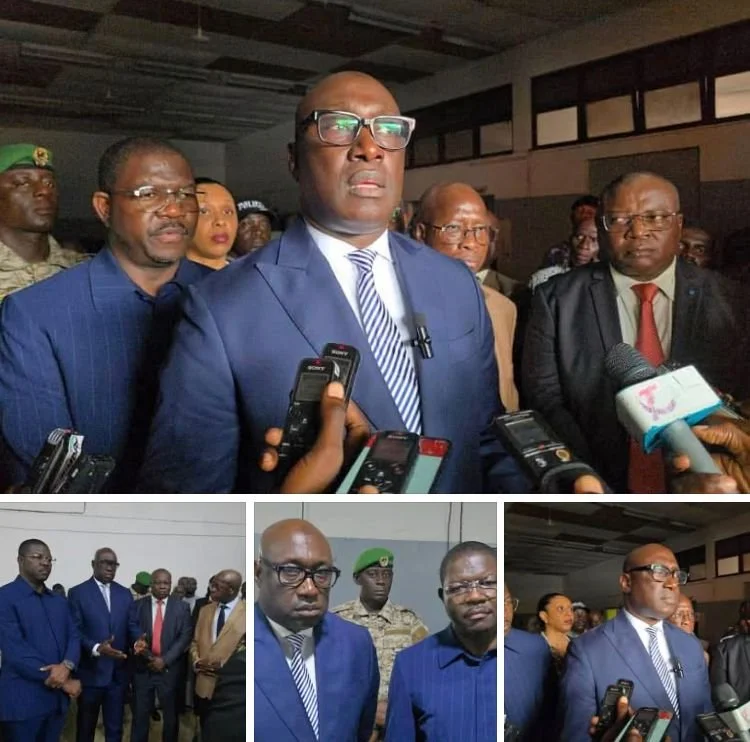
The Director-General of the National Press (INACEP), Leónico Pereira Tavares, Prime Minister Braima Camará (front with glasses) and Minister of Finance, Ilídio Vieira Té (left with glasses) who the Military High Command would name the new Prime Minister on November 28.
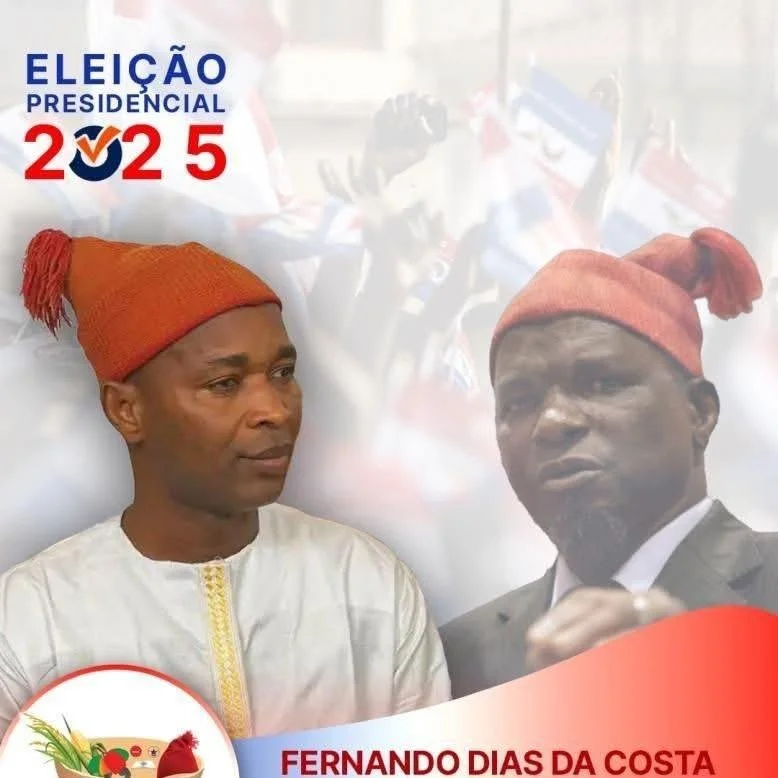
21. Throughout 2025: human rights groups report increased arrests of opposition figures and civil society actors, accusing them of "spreading state-endangering information". On August 31, Guinea-Bissau’s Attorney General Fernando Gomes confirmed that the country’s Supreme Court is poised to move forward with the prosecution of Domingos Simões Pereira, the country’s main opposition figure, in a long-standing case involving 34 billion CFA francs. Gomes explained that the African Court of Human Rights had dismissed Pereira’s petition (Case No. 12/2024), which alleged violations of his political rights and sought compensation from the state. The court’s decision effectively cleared the way for Guinea-Bissau’s Supreme Court to proceed with Case No. 02/2018, in which Pereira is a central figure. The announcement comes less than three months before the presidential election, raising concerns about the political implications of the case. On September 4th the day the STJ ruled that Embaló’s presidential term ended, the PAI-Terra Ranka and API-Cabas Garandi coalitions called for a national standstill, declaring that Embaló was no longer president of the Republic. For the opposition, staying in power would be tantamount to a coup d'état. The government, then led by Rui Duarte Barros, responded with threats to take "appropriate measures" against those adhering to paralysis. Domingos Pereira returned to Bissau on September 19, 2025, after nine months abroad, to submit his candidacy for the 2025 presidential election. By October 2025 the army announced the arrest of several officers for a supposed plot to subvert constitutional order just weeks before the presidential vote. The Bar Association of Guinea-Bissau (OAGB) marked October 12, the National Day of Justice with a critical assessment of the current state of the sector, warning of “a sharp decline” in the administration of justice in the country, more than half a century after independence. Bastonario Pedro Correia stated that the Order considers that the Guinean judicial system is in a deep crisis, absolutely "paralyzed and powerless" to respond to the challenges of consolidating a true democratic rule of law, denouncing the lack of independence of magistrates, the inaccessibility of justice to the common citizen and the subordination of the judiciary to political power. On October 14, the People's Palace in Brazzaville served as the setting for a high-stakes meeting between Denis Sassou Nguesso and Umaro Sissoco Embaló. Beyond protocol, the two heads of state explored the potential for a still largely untapped security partnership between the Republic of Congo and Guinea-Bissau. According to a Congolese diplomatic advisor, "the time has come to translate political excellence into operational synergies, from intelligence to naval logistics." The announced creation of joint working groups, which will have a six-month mandate, demonstrates the president's commitment to establishing this cooperation over the long term and integrating it into the Congolese Military Programming Law for 2022-2026. . . . On the land front, the Higher Military School of Likouala will welcome its first contingent from Guinea-Bissau in 2026 for a section leader training program focused on counter-insurgency and civil-military operations. . . .The framework agreement signed in January 2022 on the free movement of diplomats paved the way for more in-depth industrial discussions. The Congolese Ministry of Strategic Industries is counting on a joint venture with the Bissau naval base to assemble composite fast boats for river vessels. At the same time, the Congolese National Petroleum Company (SNPC) is considering co-developing, with the Guinea-Bissau Geological Survey, hardened seismic sensors usable for both prospecting and detecting improvised explosive devices. These projects, still in the concept stage, would benefit from cross-financing from the Development Bank of Central African States (BCEAO) and the West African Development Bank (WAEB), a sign of the economic complementarity touted by the two heads of state. . . . By 2027, Brazzaville and Bissau aim to present a joint position at the African Union Summit on Maritime Security. Their diplomatic teams also intend to advocate for a joint CEMAC-ECOWAS mandate for peacekeeping operations, leveraging Guinea-Bissau's dual geographical status. According to political scientist José Mangovo, this arrangement "allows Congo to project its influence towards the Western Atlantic while Bissau gains structured access to Central African military command structures." At the end of their meeting, Denis Sassou Nguesso and Umaro Sissoco Embaló emphasized the importance of follow-up: the initial reports from the working groups will be presented at a joint commission meeting to be held in Oyo next spring, a way of consolidating a security alliance that has become essential in the Gulf of Guinea." That same day, October 14, 2025, PAIGC leader Domingos Simões Pereira was personally barred from running in the upcoming elections. In response, the PAIGC threw its support behind Fernando Dias, an independent candidate who happened to be a leader and “political son” of Dr. Kumba Yala and his PRS. The STJ barred three major independent radio stations from attending its press conference intended to "clarify" the court's reasons for disqualifying the opposition. This move was widely condemned as an attempt to avoid public scrutiny of its controversial decisions. These judicial actions led the opposition and civil society to label the situation an "institutional coup," which eventually served as a justification for the military action. Reports then emerged during the November 2025 election cycle that Embaló attempted to fire judges of the Constitutional Court (the body certifying results) after independent opposition candidates took a significant lead.
22. On November 1, Carmelita Pires, Former Minister of Justice (2007-2009) published the following warning entitled: "CIRCUMSTANCE ALLIANCE:
“In the political, legal, social and economic context of Guinea-Bissau, nothing surprises anymore. But, it all hurts. Desperate of cause, and already in extremism, some politicians excluded by the Supreme Court of Justice from the legislatures, and other presidential candidates with fragile support, have decided to resort to PAI-Terra Ranka and PAIGC (the political force that had the previous absolute majority and was arbitrarily removed from these elections, so as their candidate for president). But in politics, everything born of despair bears the stamp of incoherence. Alliances made out of necessity and not conviction, on the eve of the start of the campaign, will hardly bring stability or justice. They do not restore the CONSTITUTIONAL ORDER, nor do they represent the INTEREST OF THE PEOPLE. Just reflect the confusion and the void of solutions the country has plunged into. Guinean politics has become a FRICTED MIRROR. We know the role each played until we arrived here. We know who they are. Everyone reflects, nobody recognizes themselves. So, they'll have to give us something else to convince us of the goodness of these circumstantial alliances. {Siphiwe note: that goodness was Fernando Dias, who Ms. Pires herself later joined forces to support] As if that wasn't enough, the military returns to the spotlight, in yet another press conference denouncing "a new coup". All of this, after legitimizing fear with new kidnappings and arbitrary arrests of senior military officials. I ask myself, and I ask you: how far are we going to let this go? What is the solution, after all, when all the paths seem to be blocked by arbitrariness and calculation? Maybe the path does not come from UP, but DOWN. Perhaps the only way out is the peaceful organization of the people: with women, young people and the diaspora taking over the moral and political reconstruction of the country. Because those who destroyed trust cannot be the same to restore it.
Today, more than ever, Guinea-Bissau needs consciousness, clarity and collective courage. And we, who still believe, have a duty not to be silent.
Hope didn't die in Guinea-Bissau. Jus wait that the people wake up”.
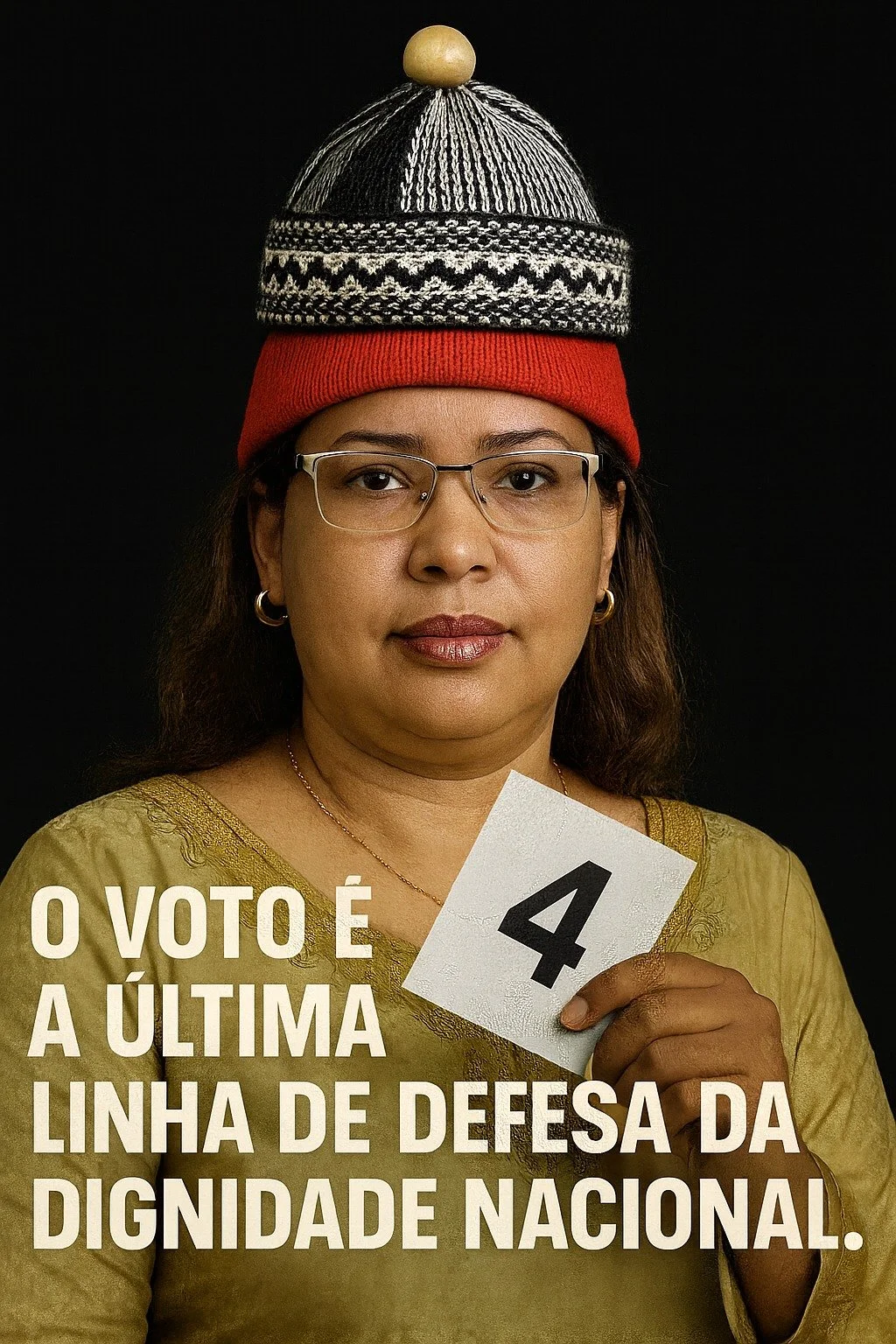
Carmelita Pires. In May 2020 President, Umaro Sissoco Embaló announced that she had been appointed to join the five person constitutional review committee led by Carlos Joaquim Vamain. Ms. Pires, who holds a law degree from the University of Coimbra and a master's degree in legal and political sciences from the University of Lisbon and, since 2016, serves as the President of the Women's Organization of the Party for Social Renewal (PRS), declined, arguing that according to the current Constitution of Guinea-Bissau, the power to initiate and manage constitutional reform belongs exclusively to the National People's Assembly (the parliament), not the Presidency and emphasized that a constitutional review must be a national, inclusive process rather than one dictated by a single political office.
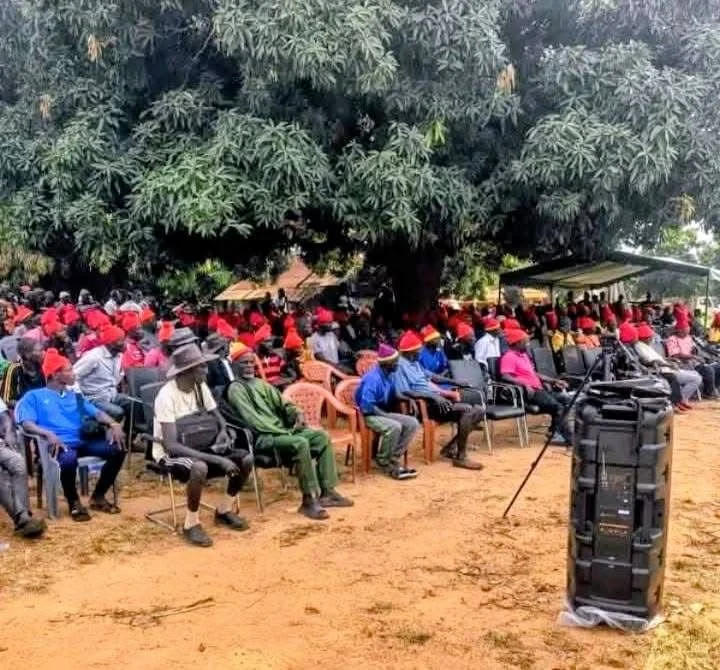
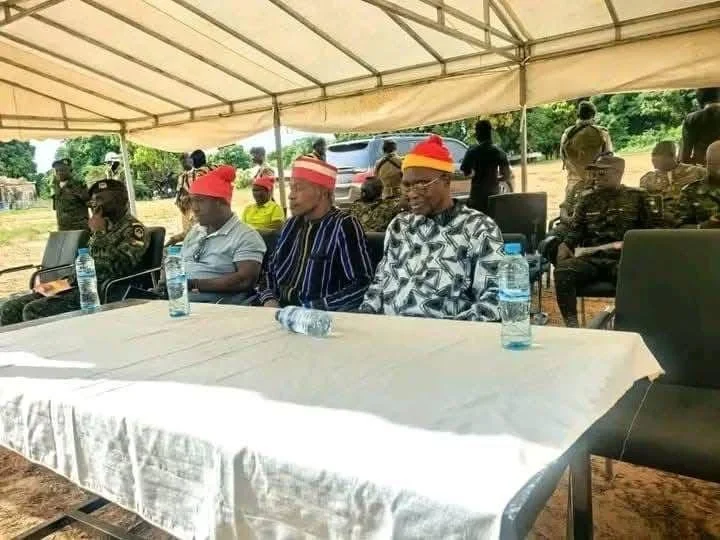
23. Before the start of the election campaign, Major General Mamadu Ture Kuruma, also known as N'Krumah, publicly declared his support for Sissoco Embaló, shocking public opinion, since the military should remain aloof from politics. The situation became even more complicated when General Biagué Na N'tam met in Cumeré with elders of the Balanta ethnic group for the same purpose, clarifying that no soldier is arrested without plausible reasons and alleging that some soldiers from that ethnic group intended to stage a coup against him. The Balanta elders reacted vehemently, stating that they were ready to defend the honor of their children and their ethnic group.
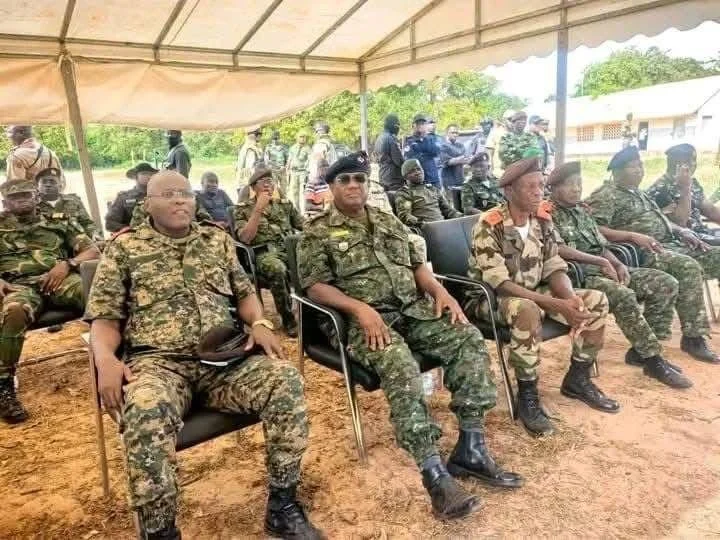
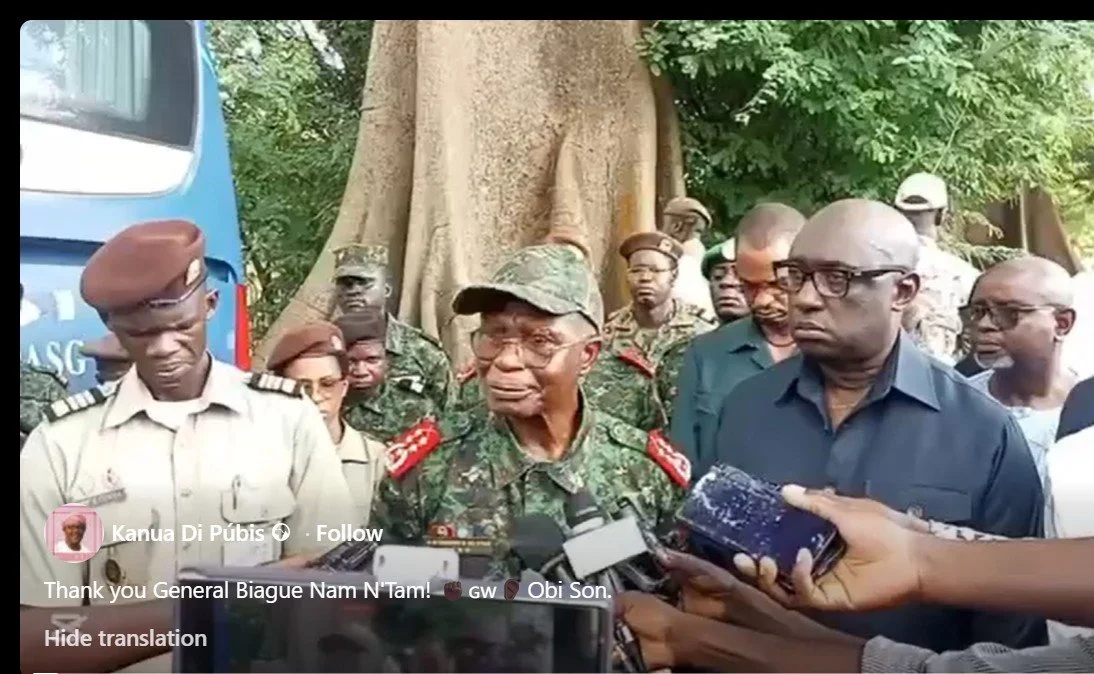
Voting took place on November 23, 2025. Both Embaló and Dias declared victory before official tallies were released, with reports suggesting Dias held a narrow lead, sparking a crisis. Sometime after this, according to information obtained by Confidentiel Afrique, outgoing President Umaro Sissoco Embaló held two meetings (one at the General Staff of the Armed Forces, ending around 2 p.m., followed by a so-called "confidential strategic redeployment" meeting held at the presidential palace in Bissau) attended by officers Biagué Nantan, Orta N'Ta (chief of staff to Umaro Sissoco Embaló), and Mamadou Nkrumah (deputy chief of staff). These meetings, which took place at breakneck speed, coincide with the "suspicious" stay in Bissau of Guinean General Sékouba Konaté, former interim president of the 2009-2010 transition.These meetings finalized the “power seizure project” which utilized militias trained by the Congolese special forces of Sassou N'Guesso a few months ago. On November 26, 2025, one day before election results were due, the army took control of Bissau. Heavy gunfire erupted near the Presidential Palace mid-day. Embaló was arrested in his office by the High Military Command led by Brigadier General Dinis Incanha.
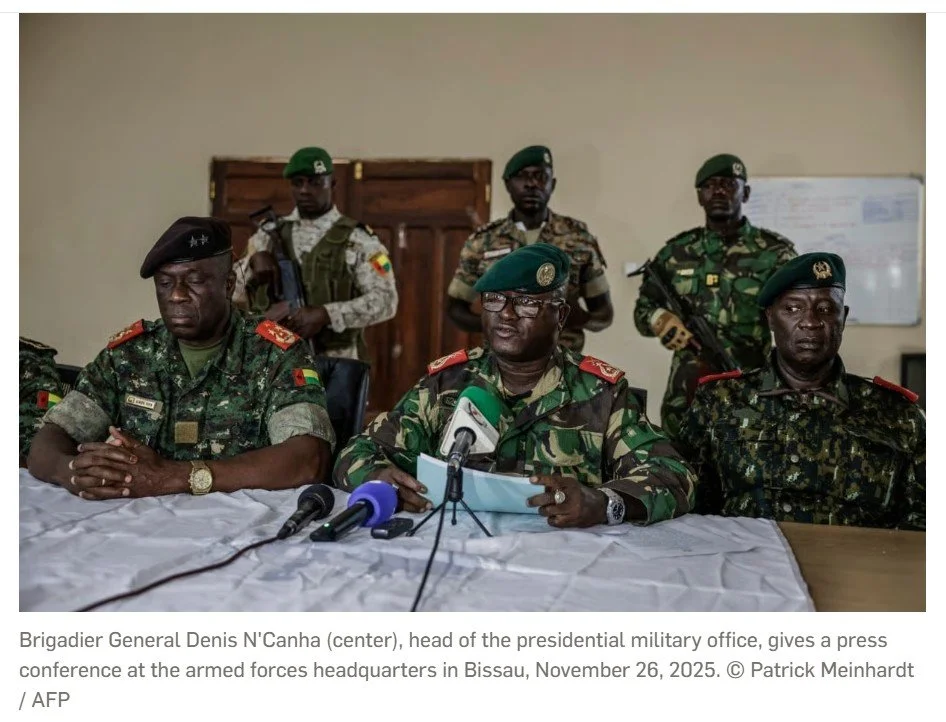
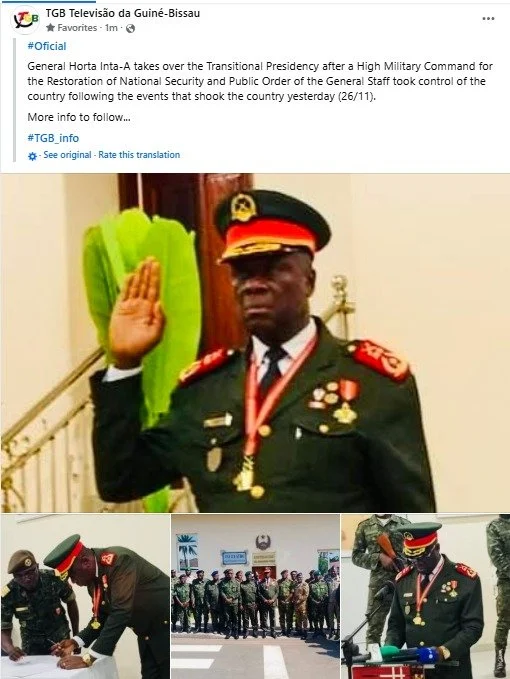
Contacted by Jeune Afrique on Wednesday November 26th, Domingos Simões Pereira explained that he was “in a meeting with observers from the African Union, including [former Nigerian President] Goodluck Jonathan, when we were told there was gunfire in the city center.” He added that, according to information he subsequently received, soldiers attempted to enter the offices of the electoral commission “to force its president to read results declaring Umaro Sissoco Embaló the winner,” whereas, according to him, “Fernando Dias, the candidate we support, won in the first round.” According to exclusive information obtained by Confidentiel Afrique, ousted President Umaro Sissoco Emballo, using his two cell phones, spent all afternoon and late into the night making phone calls to several African palaces. Confidentiel Afrique reports that the most magnanimous to his request for exfiltration was Congolese President Denis Sassou Nguesso, who answered his call. [Siphiwe note: with whom he signed security agreements back on October 14.] President Sassou is desperately seeking a safe haven for Emballo. The strongman of Brazzaville has spoken with his Ivorian counterpart, Alassane Ouattara, to arrange for Emballo to be welcomed to Abidjan while awaiting his arrival in another country that will grant him political asylum. Other senior officials and opposition leaders, including Domingos Simões Pereira, were also detained and the election process was suspended. The military claimed they intervened to prevent a "bloodbath" between rival supporters citing a plot by politicians and "drug barons" to steal the election. Military leaders claimed they acted to "block operations that aimed to threaten our democracy" and to prevent the manipulation of election results. President-Elect Fernando Dias reported that armed men had come to arrest him at his campaign headquarters, leading him to escape and seek sanctuary due to threats against his life. The Nigerian government formally granted him asylum and protection within the embassy premises, a decision approved by President Bola Tinubu and communicated to the ECOWAS Commission in a letter dated November 30, 2025. On November 27, General Horta Inta-A Na Man (also referred to as Horta N’Tam) was sworn in as the transitional president for a one-year period. Reports also quickly emerged that the coup may have been "negotiated" or a "sham," as the military leaders are his own appointees and Embaló was released following ECOWAS-led negotiations and flew to Senegal.
24. In an Extraordinary Session of the Mediation and Security Council (CMS), held via video conferencing on November 27, the organization condemned the act with "greatest firmness" and demanded the return to constitutional order. The Summit, chaired by S. E. M. Julius Maada Bio, President of the Republic of Sierra Leone and Acting President of the Conference of Heads of State and Government of ECOWAS, resulted in a clear and concise final statement. Main Decisions and Demands of CMS: Immediate Condemnation And Suspension: The CMS has strongly condemned the coup d'état and rejected any illegal attempt to disrupt the post-election democratic process and to subvert the sovereign will of the Guinean people, who actively participated in the November 23, 2025 elections. In accordance with the Protocol on Democracy and Good Governance, ECOWAS suspended Guinea-Bissau from all its decision-making bodies until the “complete and effective restoration of the constitutional order.” Release of detained personalities: The immediate and unconditional release of all detained personalities is demanded, in particular President Umaro Sissoco EMBAL os, election officials and other political figures. Respect Popular Will and Election Results: CMS demands that the perpetrators of the coup respect the will of the people and allow the National Election Commission to publish the results of the November 23, 2025 elections. Safety Assurance and Return to Barracks: The perpetrators of the coup are responsible, individually and collectively, for the protection of the life and property of all citizens and residents, as well as for the safety and physical integrity of the detainees. They should ensure security and facilitate the evacuation of electoral staff and other international ECOWAS missions. The Guinea-Bissau Armed Forces are urged to return to barracks and “strictly adhere to their constitutional role”. Mediation and Stabilization Mission: The CMS has mandated the Acting President of the Conference to conduct a high-level mediation mission to Guinea-Bissau, composed by S. E. M. Faure GNASSINGBÉ (President of the Togolese Council), S. E. M. Jose Maria Pereira NEVES (President of Cape Verde) and S. E. M. Bassirou Diomaye FAYE (President of Senegal), accompanied by the Chairman of the ECOWAS Commission.Additionally, the ECOWAS Stabilization Support Mission in Guinea-Bissau (ESSMGB) has been ordered to continue its mission of protecting national institutions. Threat of Additional Sanctions: The CMS expressed its deep concern about the situation and reserved the right to use all options provided for in the ECOWAS Protocols on Democracy and Good Governance (2001) and on Sanctions (2012), including specific and targeted measures against any entity found guilty of disturbing the electoral and democratic process in the country. The meeting was attended by Heads of State and Government, including the Presidents of Cape Verde (Jose Maria Pereira Neves), Ghana (John Mahama), Liberia (Joseph N. Boakai), Nigeria (Bola Ahmed Tinubu) and Senegal (Bassirou Diomaye Faye) as well as the vice president of Côte d'Ivoire and ministers of foreign relations of other member countries. The ECOWAS Commission and the African Union, and the Special Representative of the Secretary-General of the United Nations, Dr. Leonardo Santos Simão, were also present. ECOWAS final statement underlines the organization's firm position on democracy and constitutional legality in West Africa. ECOWAS then suspended Guinea-Bissau through an official final communiqué issued by its Mediation and Security Council (MSC) and the Authority of Heads of State and Government. The suspension was enacted under the 2001 ECOWAS Supplementary Protocol on Democracy and Good Governance and the 2012 Supplementary Act on Sanctions.
25. On November 28, Former Nigerian President Goodluck Jonathan, who served as the head of the West African Elders Forum (WAEF) election observation mission during the November 2025 elections in Guinea-Bissau, questioned the authenticity of the military takeover, saying “This was not even a palace coup, It was a ceremonial coup conducted by the head of state himself. A military doesn’t take over governments and allow the sitting president that they overthrew to address press conferences and announce that he has been arrested.” While addressing journalists in Abuja shortly after returning from Guinea-Bissau, Jonathon called on ECOWAS and the African Union to immediately tally and publish the official results so the world knows the true winner. He argued that even if the military cannot be forced out immediately, the democratic will of the people must be documented. Jonathan explicitly demanded the release of President Elect Fernando Dias stating that “the election was concluded, tallying of results was almost concluded, in fact the results are known” and Dias had committed no offense and was being unjustly targeted. Finally, Jonathan lamented that these events signaled a return to the "dark days" of military interference in Guinea-Bissau, which he described as "totally unacceptable". Senegalese Prime Minister Ousmane Sonko joined the chorus of suspicion, telling lawmakers in his country: “What happened in Guinea-Bissau was a sham.”
“. . . . in fact the results are known”
- Former Nigerian President Goodluck Jonathan, who served as the head of the West African Elders Forum (WAEF) election observation mission during the November 2025 elections in Guinea-Bissau
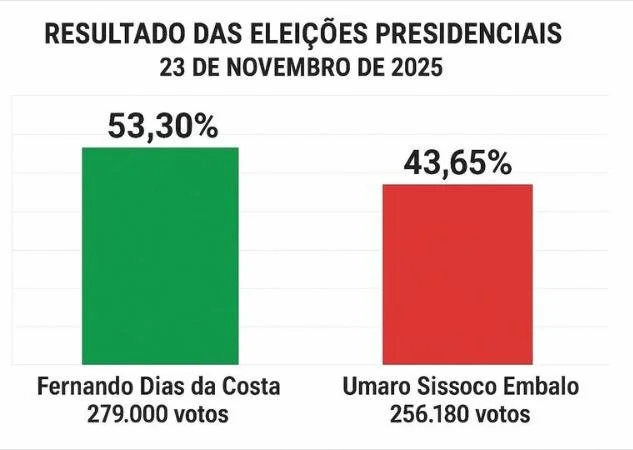
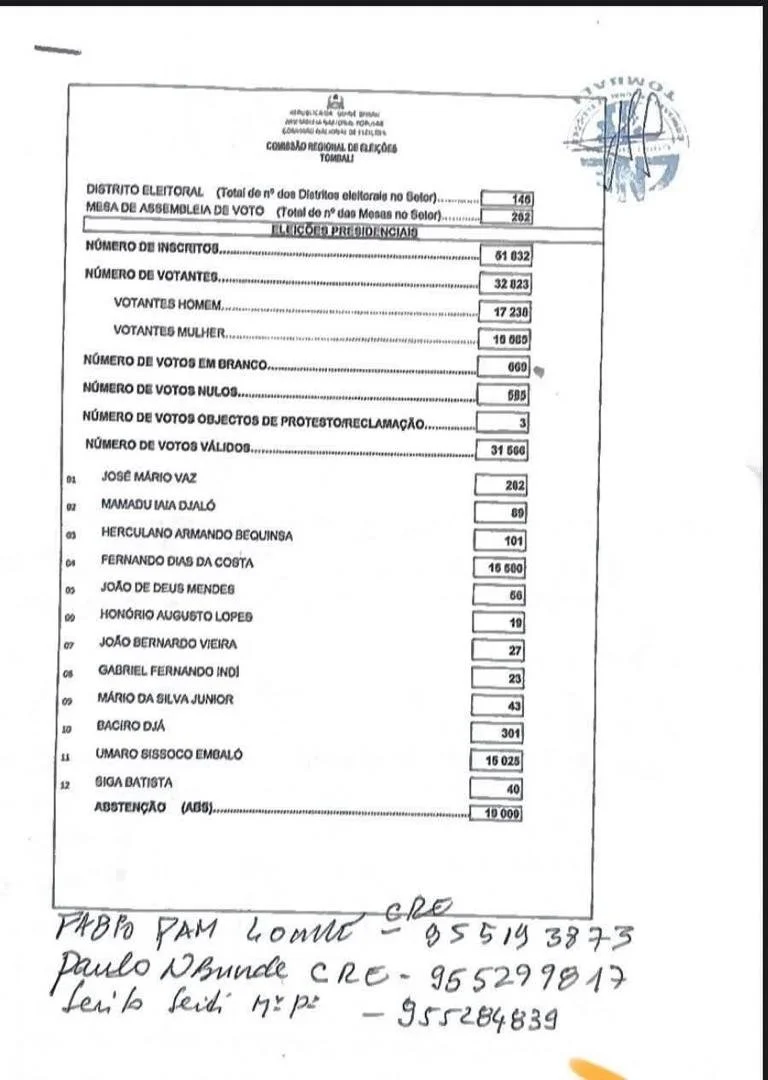
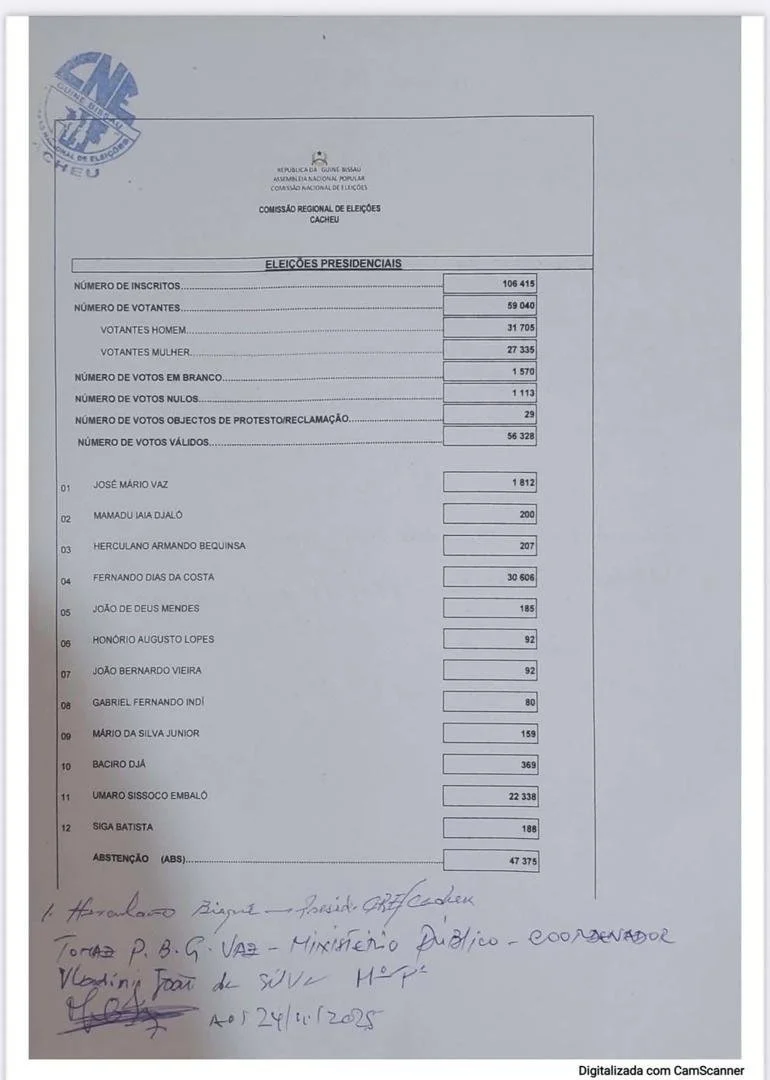
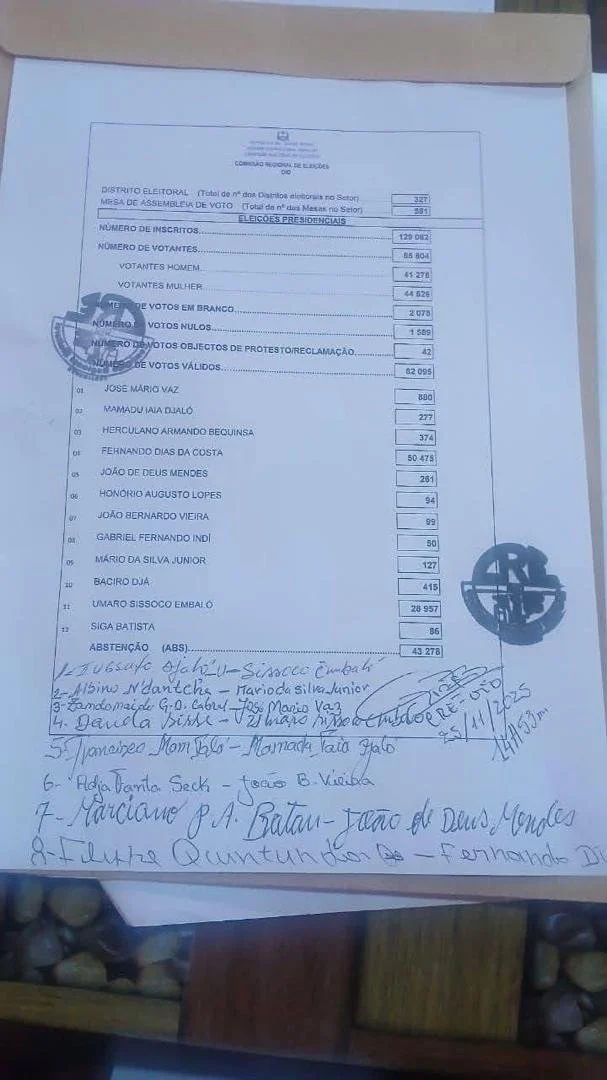
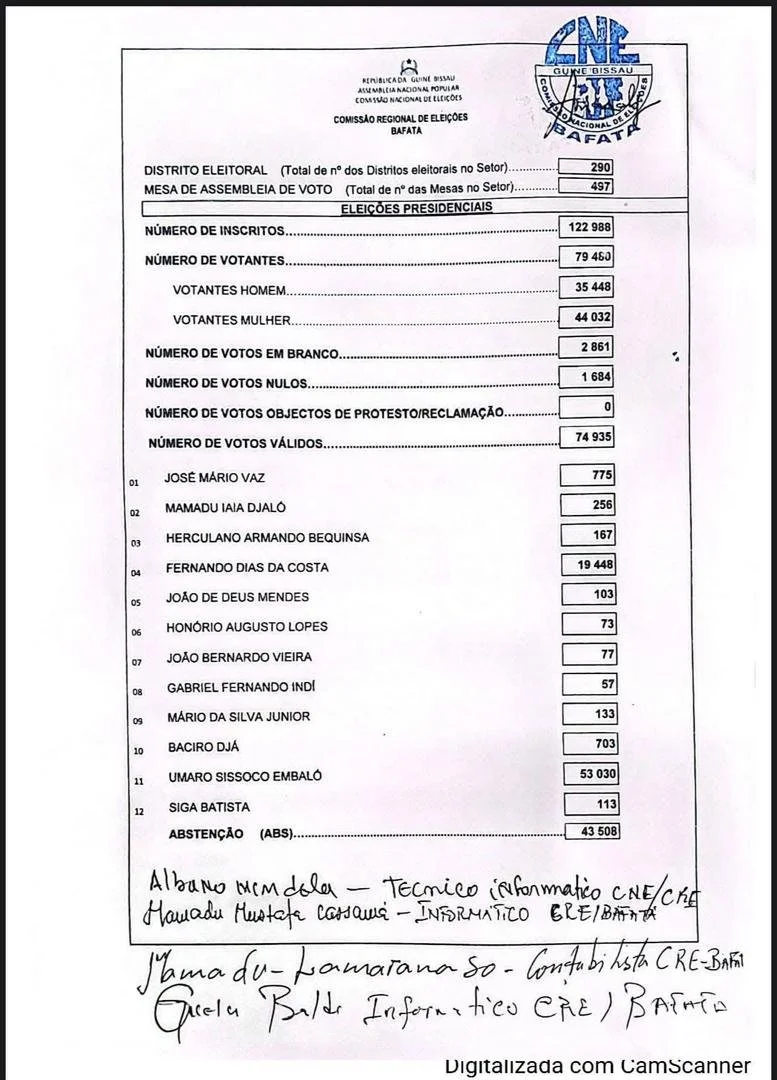
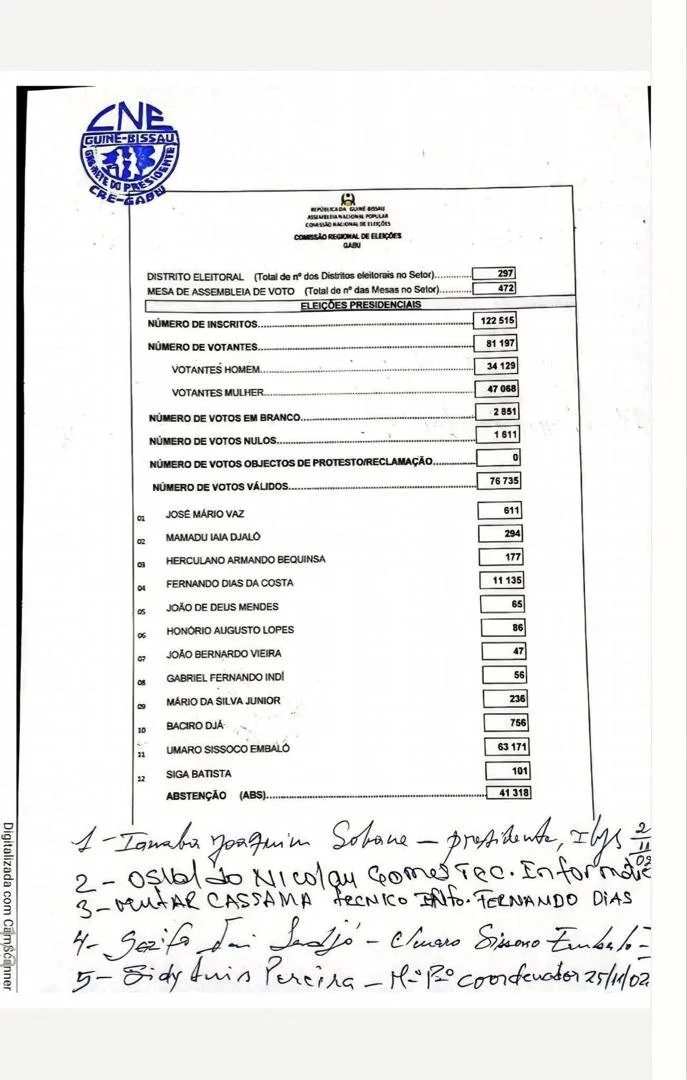
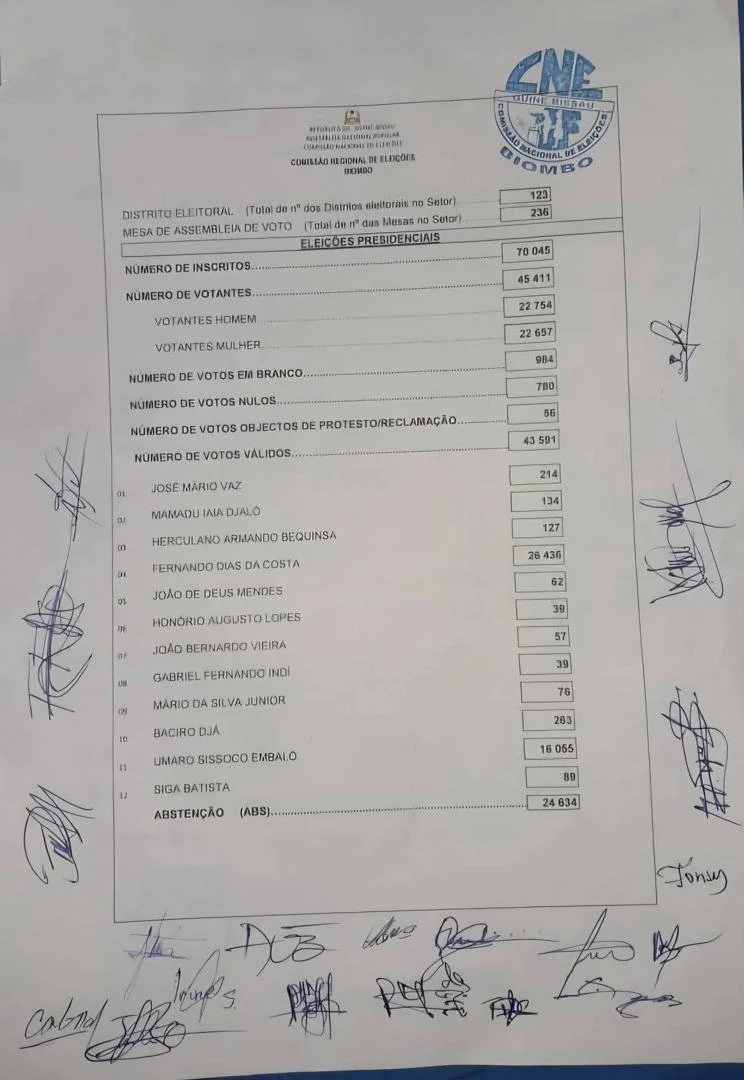
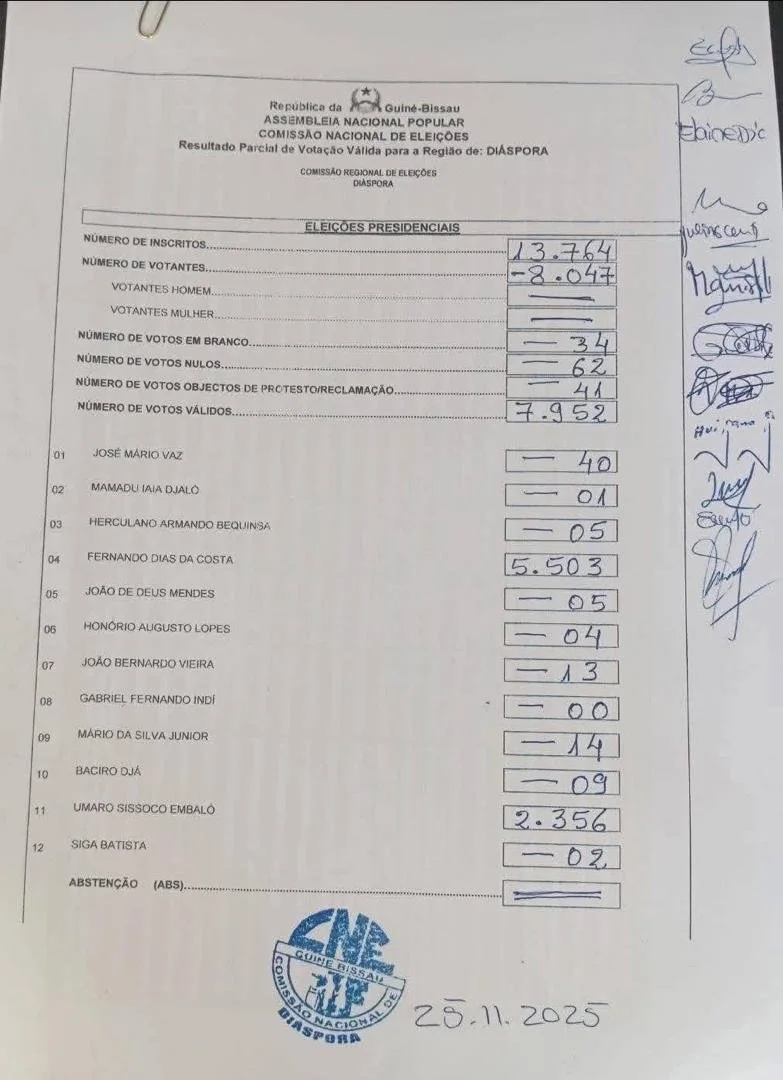
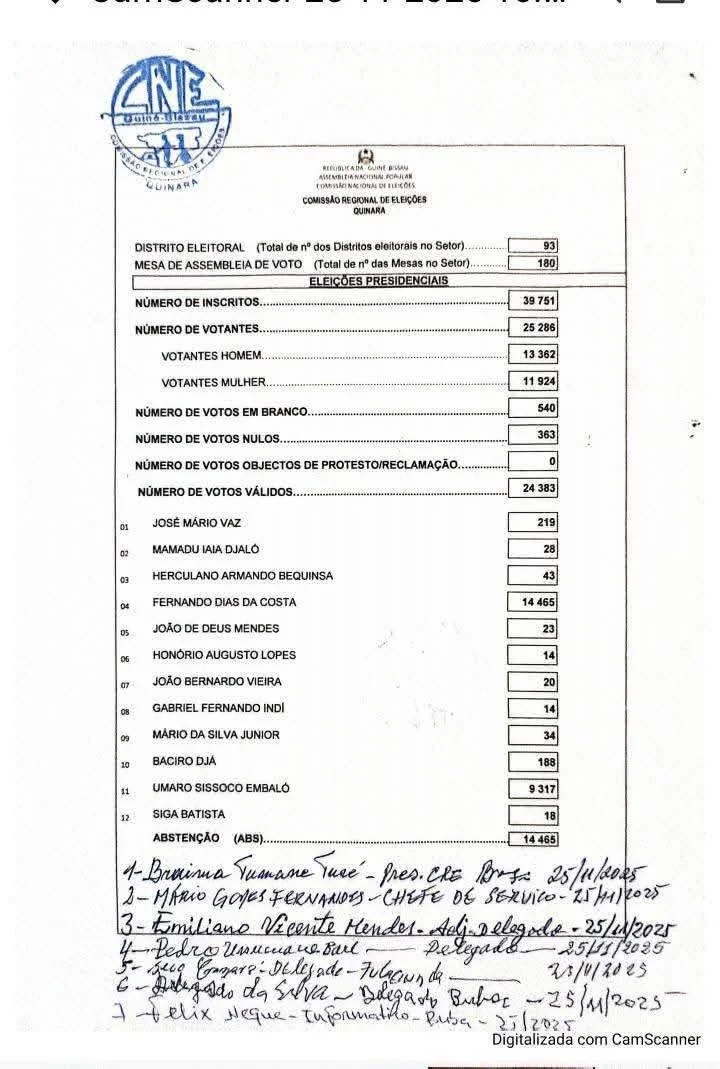
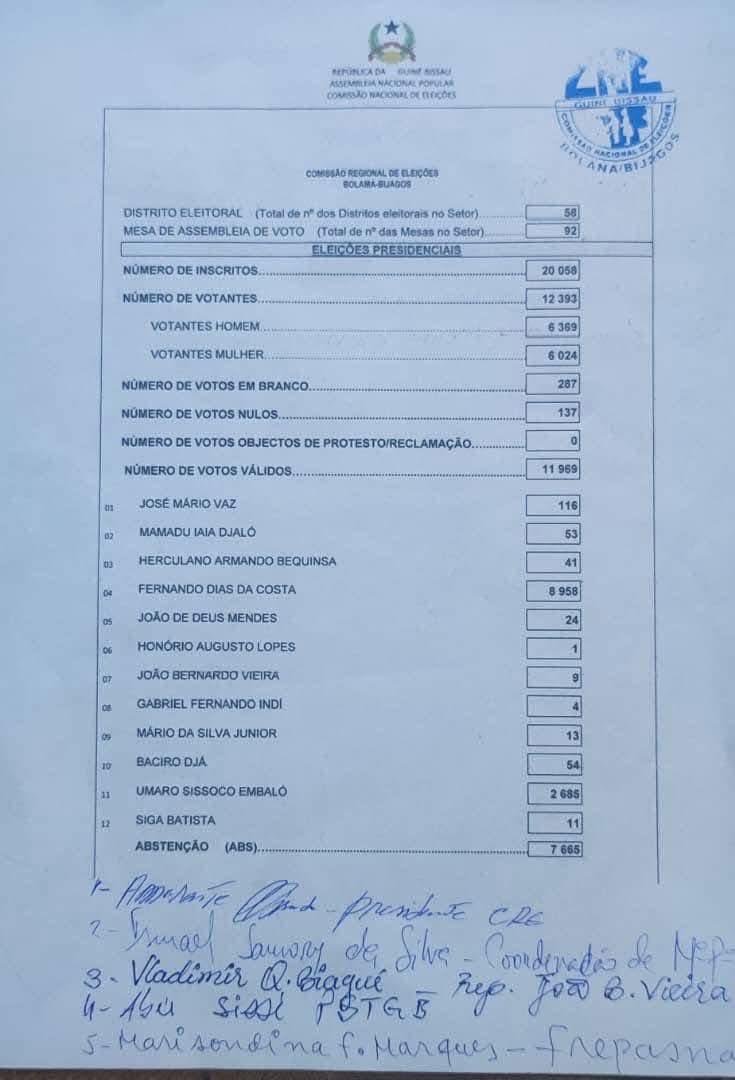
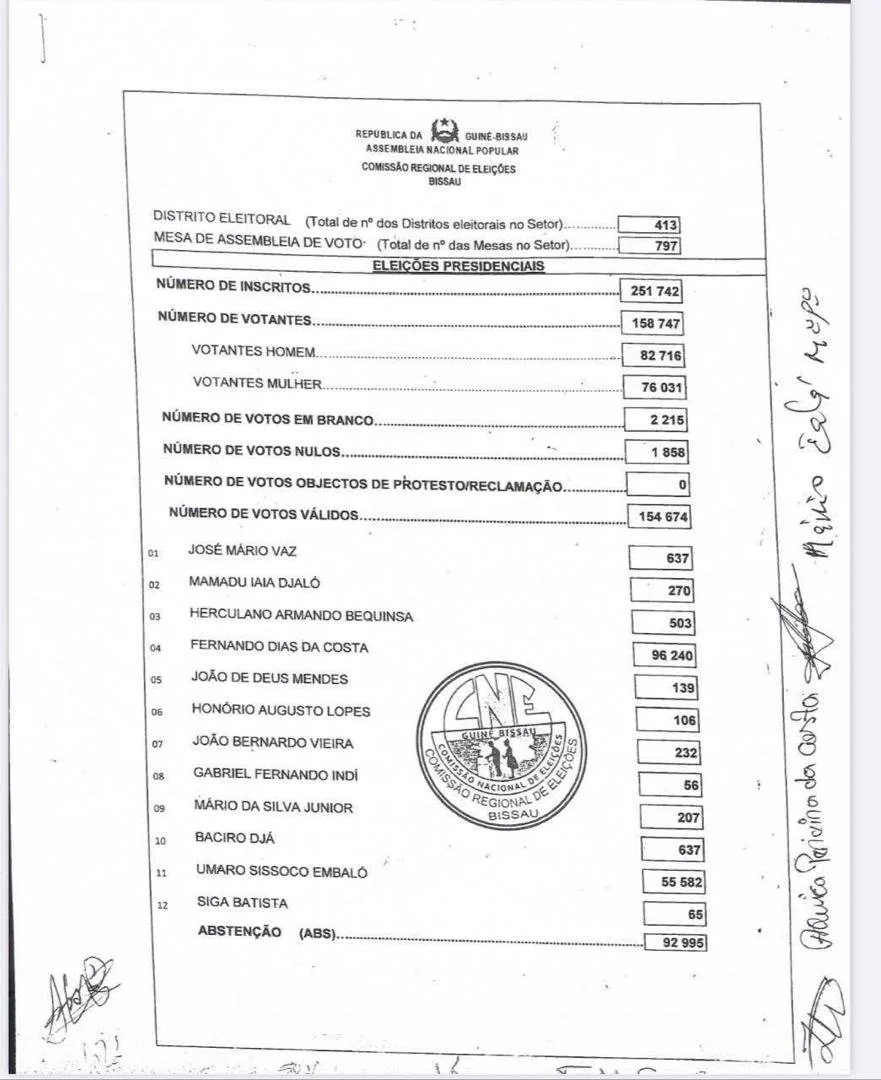
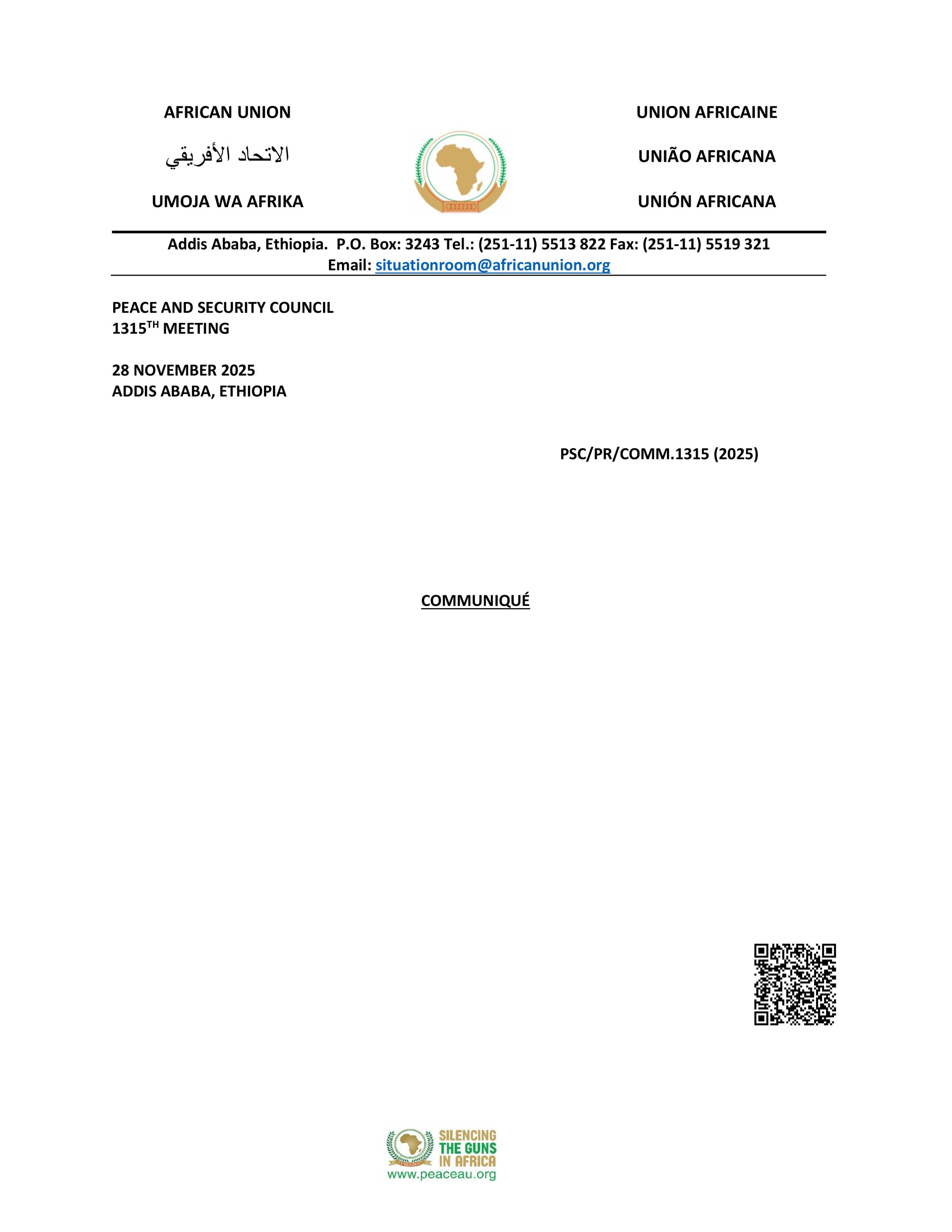
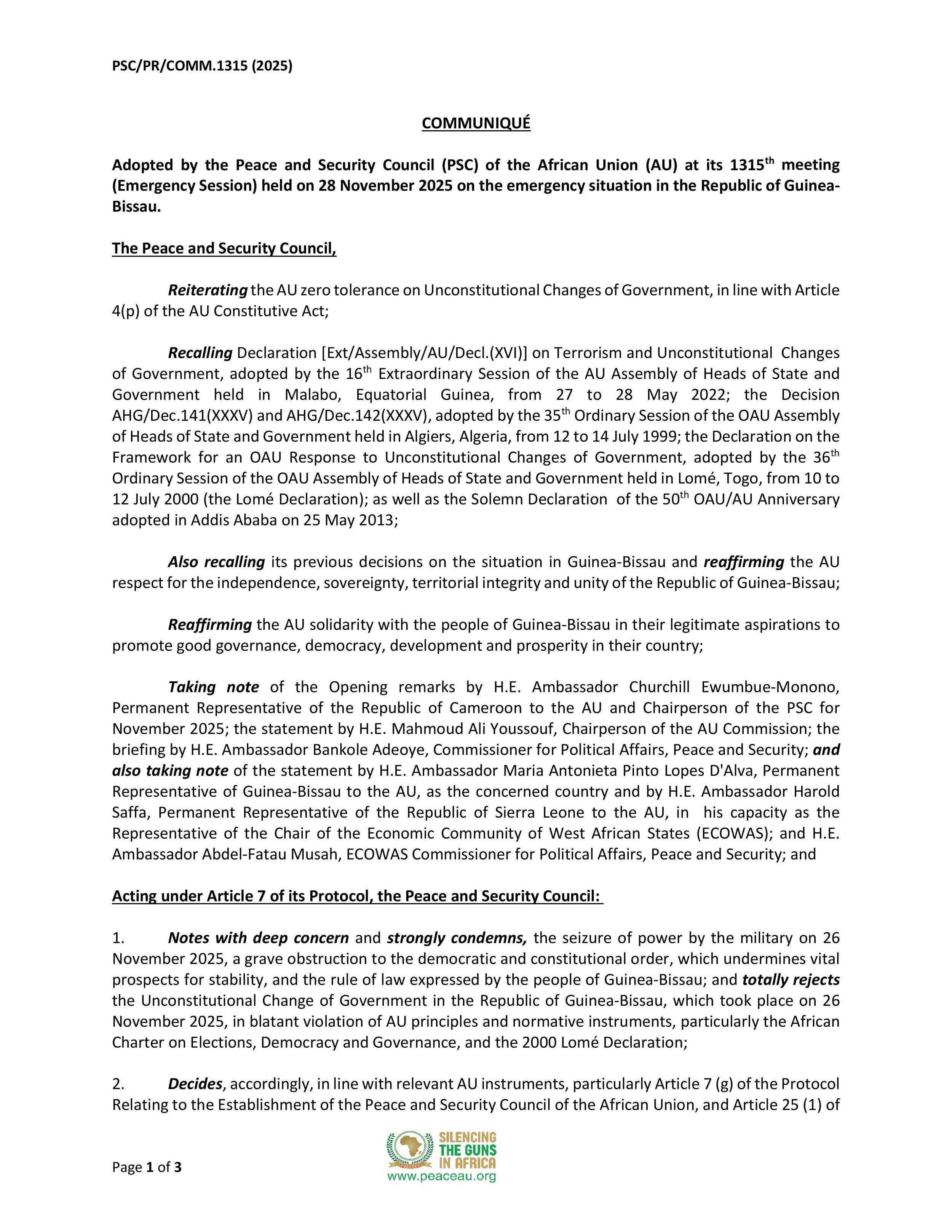
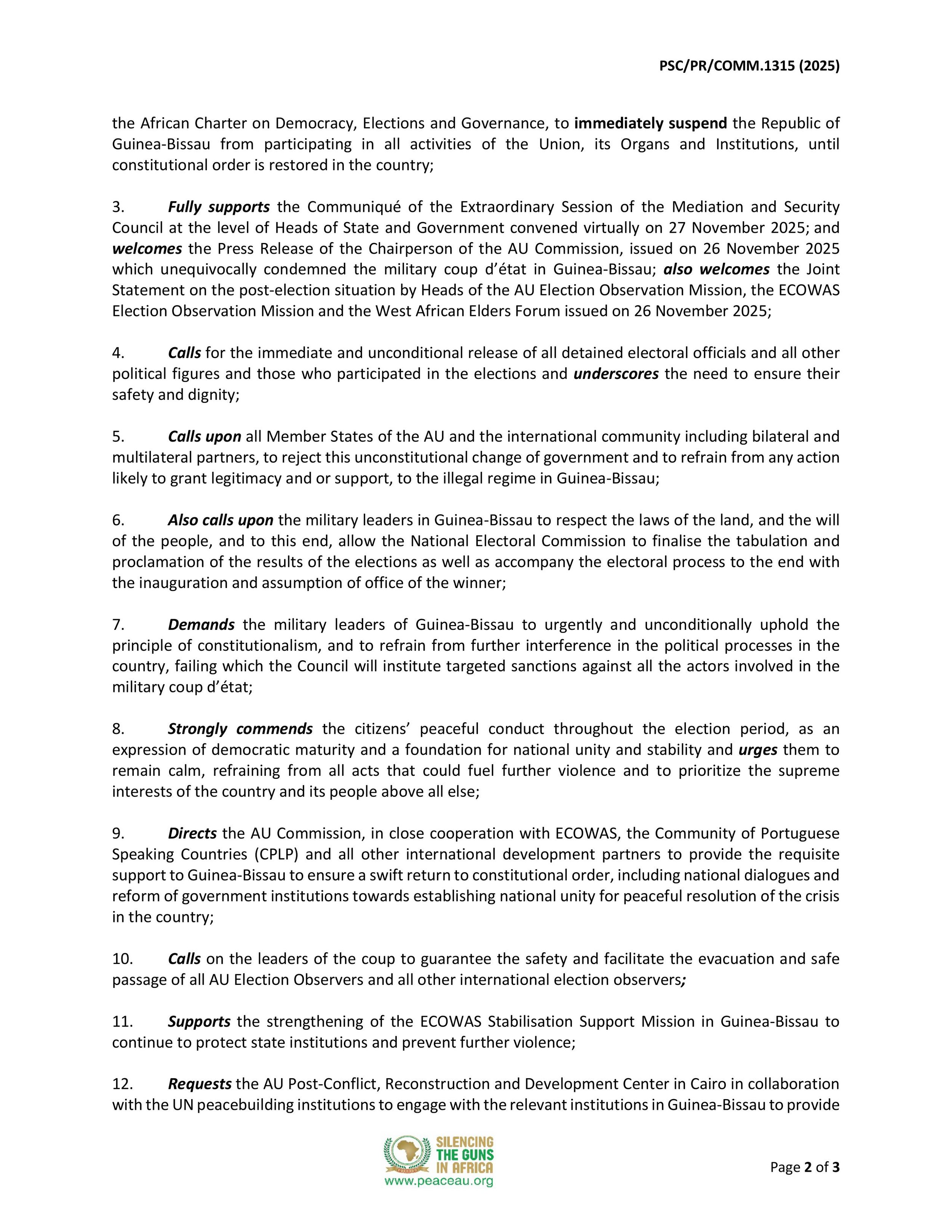
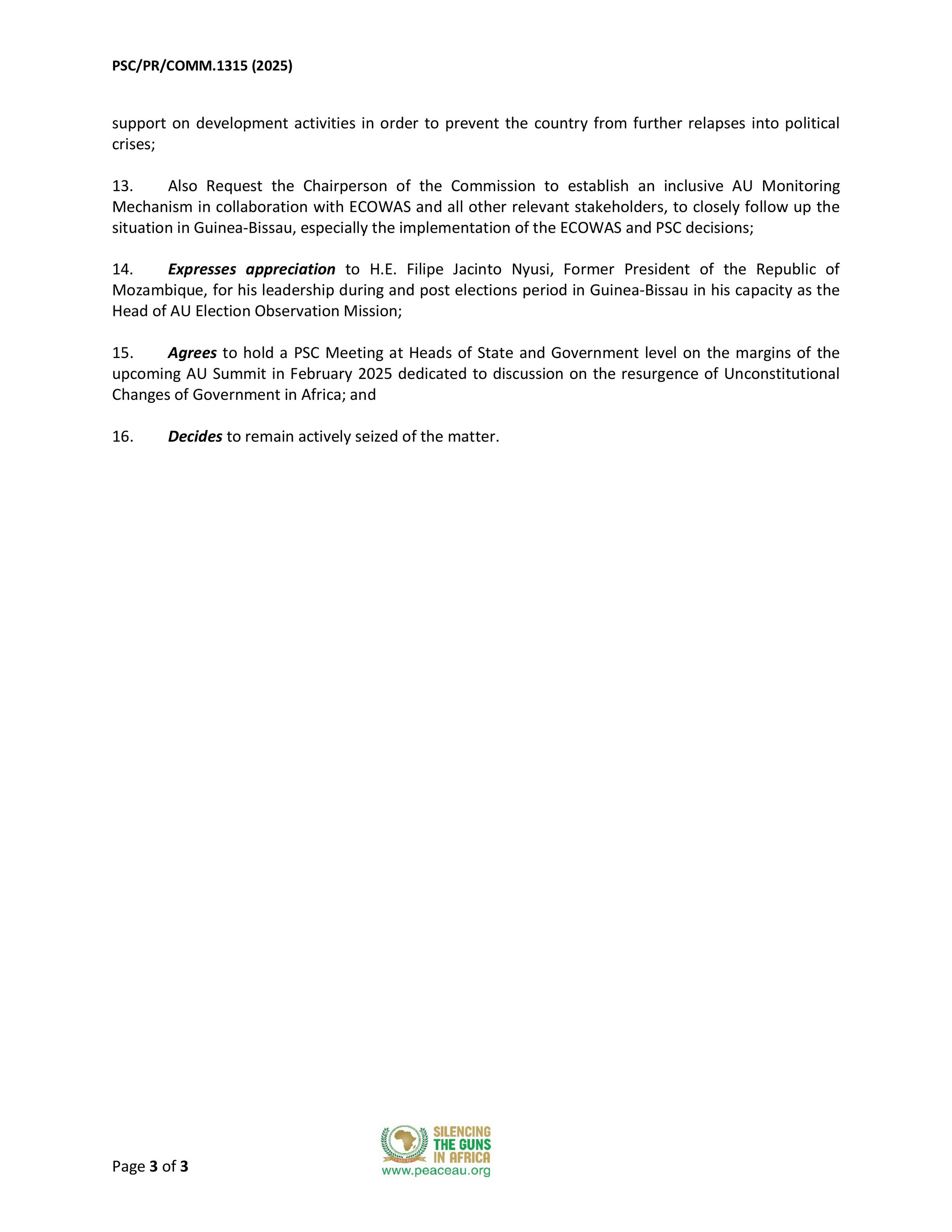
26. On November 29, Embaló relocated from Senegal to the Republic of the Congo. Reports mention that Embaló’s escape from Dakar was facilitated by former Guinean President Alpha Condé and Malian businessman Ousmane Yara, with the trio allegedly plotting from Brazzaville. According to Jeune Afrique, he left Dakar late Friday night, November 29, aboard a plane specially chartered by the Congolese presidency. He arrived in Brazzaville accompanied by about a dozen close associates: family members and close collaborators. The entourage was accommodated in a large hotel in the Congolese capital where it was reported by Confidentiel Afrique that his presence and "deceitful" and "unseemly" behavior reportedly irritated the inner circle of President Denis Sassou N'Guesso. His planned trip to Oyo was postponed, and some advisors to Sassou N'Guesso distanced themselves from him. Confidentiel Afrique reported that from his base in Brazzaville, Embaló was actively trying to pressure the National Electoral Commission in Bissau, specifically calling its head, N'pabi Cabi, multiple times to interfere with the publication of election results. On November 28, the African Union Peace and Security Council (PSC) acted under Article 7 (g) of the Protocol Relating to the Establishment of the PSC and Article 25 (1) of the African Charter on Democracy, Elections and Governance, suspended Guinea Bissau during the 1315th Emergency Meeting of the PSC
Meanwhile, on November 29, The President of the Transitional Republic, Major-General Horta Inta-a, appointed the members of the new Transitional Government. The list includes 22 Ministers and 5 Secretaries of State, according to Presidential Decree No. 04/2025.
*********************************************************************************************
ALL ABOUT THE NEW GOVERNMENT IN GUINEA-BISSAU
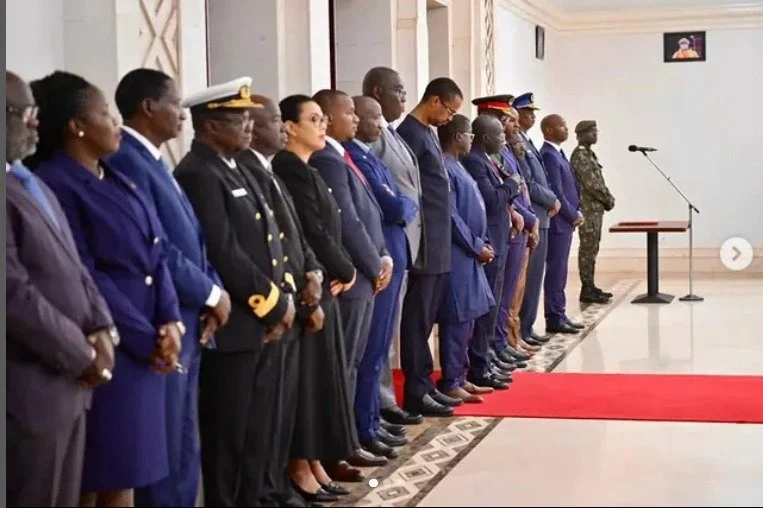
Ministers: 1. João Bernardo Vieira – Minister of Foreign Affairs, International Cooperation and Communities; 2. Brigadier-General Mamasaliu Embaló – Minister of the Interior and Public Order; 3. Usna António Quadé - Minister of the Presidency of the Council of Ministers and Parliamentary Affairs.; 4. Carlos Pinto Pereira - Minister of Justice and Human Rights; 5. Mamadú Mudjetaba Djaló - Minister of Plan Economy and Regional Integration; 6. Major General Steve Lassana Manssaly - Minister of National Defense; 7. Carlos Nelson Sanó - Minister of Territorial Administration and Local Power; 8. Florentino Mendes Pereira - Minister of Transport, Telecommunications and Digital Economy; 9. José Carlos Esteves - Minister of Public Works, Housing and Urban Planning; 10. Celedonium Placido Vieira – Minister of Natural Resources; 11. Mário Muzante da Silva Loureiro - Minister of Energy; 12. Amadu Uri Guissé-Minister of Agriculture and Rural Development; 13. Virginia Maria da Cruz Godinho Pires Correia - Minister of Fisheries and Maritime Economy; 14. Mamadú Badji - Minister of National Education, Higher Education and Scientific Research; 15. Commodore Quinhin Nantote - Minister of Public Health; 16. Augusto Idrissa Embaló - Minister of Environment and Climate Action; 17. Assucénia Nesbi Emilia Seide Donate Clays - Minister of Public Administration, Labor and Social Security; 18. Juelma Cubala - Minister of Youth, Culture and Sports; 19. Jaimentino Co - Minister of Trade and Industry; 20. Catarina Raquel Mendonça Taborda - Minister of Tourism and Handicraft; 21. Abduramane Turé-Minister of Social Communications; 22. Khady Florence Dabo Correia - Minister of Women and Social Solidarity. SECRETARIES OF STATE: 1. Mamadú Baldé - Secretary of State for the Treasury; 2. Elísio Gomes Sá – Secretary of State for Budget and Fiscal Affairs; 3. Fatumata Jau - Secretary of State for International Cooperation and Communities; 4. Chief Commissioner Salvador Soares - Secretary of State for Public Order; 5. Rear Admiral Carlos Alfredo Mandughal - Secretary of State for Homeland Freedom Fights - Source: Presidency of the Republic of Guinea-Bissau - Office of Communications and Public Relations.
✅ The Prime Minister, Ilídio Vieira Té, former Minister of Finance and campaign manager of Embaló.
✅ Carlos Pinto Pereira, new Minister of Justice and Human Rights, was a member of the government and a friend of Embaló.
✅ General Mamasaliu Embaló, is the younger brother of Umaro Sissoco Embaló, who heads the Ministry of Interior and Public Order.
✅ One of Umaro Sissoco Embaló's faithful and loyal presidential guards , Stive Lassana Manssaly, who has been appointed to the National Defense.
✅ Mamadú Mudjetaba Djaló (Diallo) the greatest economist and long-time friend of Umaro Sissoco Embaló has been appointed in charge of Regional Economy, Plan and Integration.
✅ Mamadú Badji nicknamed the king maker of the Gabou region, a brother to Umaro Sissoco Embaló becomes Minister of National Education, Higher Education and Scientific Research.
✅ Augusto Idrissa Embaló (MBALLO), brother of Umaro Sissoco Embaló, has been appointed Minister of Environment and Climate Action.
✅ The five state secretariats are assigned to Mamadú Baldé.
✅ Fatumata Jau (Diao), in charge of International Cooperation and Communities.
All these ministers and state secretaries are relatives, friends or brothers of Umaro Sissoco Embaló.
*****************************************************************************************
By December 2, the National Electoral Commission (CNE) announced it could not publish the November election results because armed, hooded men had stormed its offices on November 26 and destroyed or stolen critical servers and tally sheets. Also on December 2, Marciano Indi was arrested on at Osvaldo Vieira International Airport in Bissau while attempting to travel to an ECOWAS parliamentary session in Nigeria. On December 3, following his double exfiltration to Dakar and Brazzaville, Embaló - whose presence was beginning to unsettle the inner circle of President Denis Sassou N'Guesso's shadow cabinet - went directly to Casablanca, not Rabat, at the behest of Macky Sall to stay in his luxurious house he built there a few years ago.. The ousted president arrived early Wednesday evening with his chamberlain, Câlifa Suares, also known as Casoca. Upon his arrival in Casablanca, the royal court "kindly provided him with the code of conduct" to be observed during his stay. On December 4, families claiming to be victims of torture, assassinations, and acts of political violence that occurred during Umaro Sissoco Embaló's political rule and in the context of the institutional and political crisis in the Republic of Guinea-Bissau filed a complaint with the Office of the Prosecutor of the International Criminal Court (ICC). On December 5, according to the newspaper EnQuête, a Moroccan businesswoman accused him of defrauding her of movable property worth over one billion CFA francs in the context of a business relationship, having failed to pay for several orders placed with her company. Several proceedings had been initiated in 2024 and 2025, but were blocked by his status as sitting President and his immunity from execution. The plaintiff's lawyers hope to be able to reopen the case following Embaló's overthrow and the loss of his presidential immunity. Following the 2025 coup, a communication blackout and "climate of terror" emerged with reports of masked men beating human rights activists and journalists. The military junta used live ammunition to disperse peaceful protests and shut down independent radio stations, significantly restricting freedom of expression. High-profile figures, including opposition leader Domingos Simões Pereira, remained forcibly detained and by early 2026, many were held incommunicado, prompting condemnation from the UN High Commissioner for Human Rights. On December 11, Amadu Tidjane Baldé, former President of the Court of Auditors and the newly appointed Attorney General of the Republic, announced that the National Election Commission (CNE) “has no technical conditions to disclose any results”. In response, Guinean lawyer Fransual Dias said that the new Attorney General of the Republic (PGR) of Guinea-Bissau is following “a previously prepared script” to lead to the annulment of the November 23 elections, underlining that the only entity competent to annul elections is the Supreme Court of Justice (STJ). According to Fransual Dias, the statements of the PGR "do not correspond to the truth", defending that the CNE is obliged by law to reconstruct the electoral process and therefore cannot talk about annulment. "The elimination of elections occurs only in cases of electoral fraud or in situations of violations of human rights, such as when the Armed Forces prevent citizens from voting," he explained. The lawyer still understands that the recent statements from the authorities make the objectives of the Military Command clearer. "If before it were only perceptions, now it is clear that this coup aims, first, to annul the elections, neutralize political opponents and, then, to organize an electoral process in which, eventually, Umaro Sissoco Embaló can agree on his own and form a monocratic parliament." Fransual Dias reinforces that the Attorney General of the Republic himself, as a prosecutor of democratic legality, has an obligation to open investigative processes, and "cannot act in a Levitical manner".
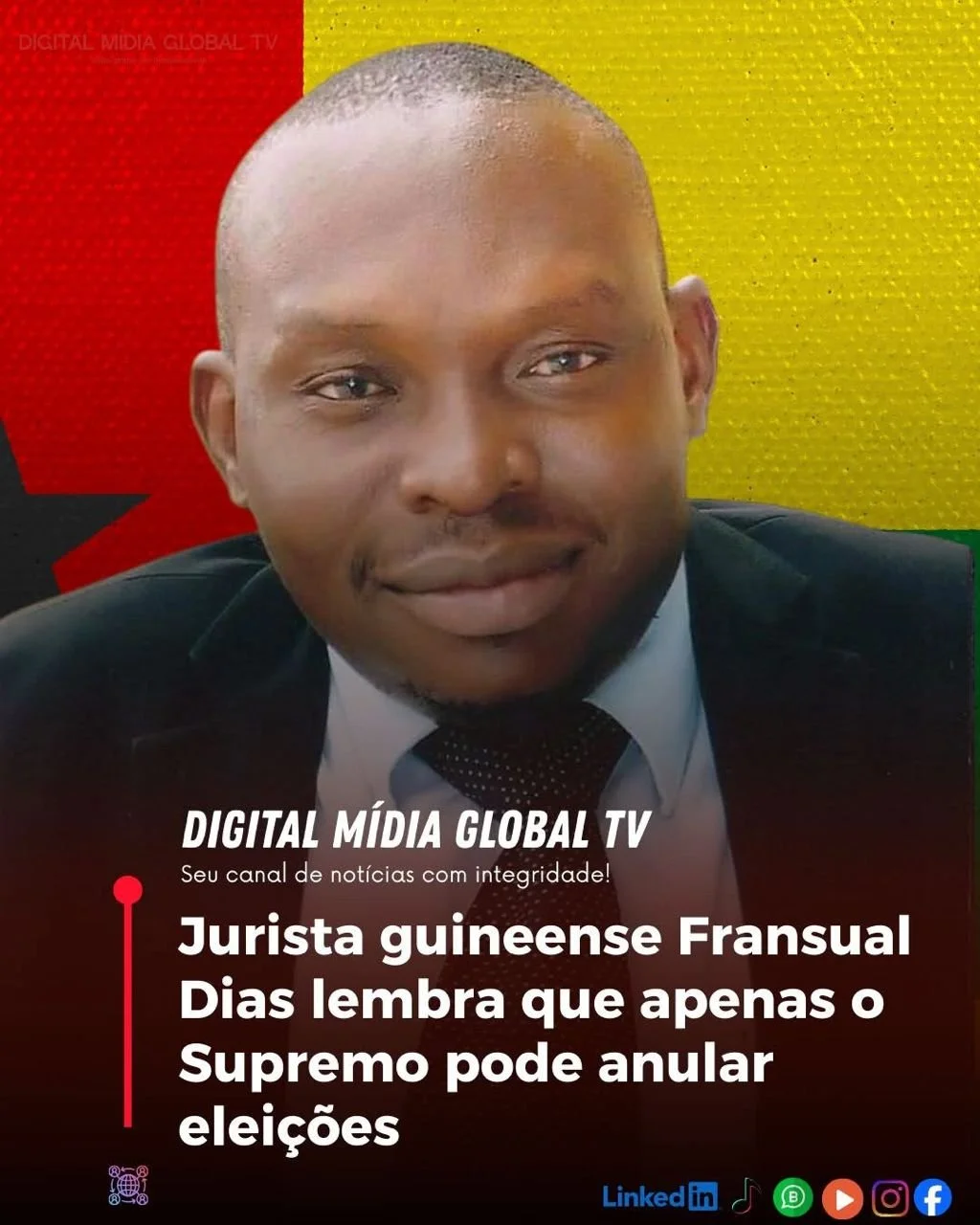
On December 12, the following was posted on social media:
“While the Guinean people do not show themselves determined to fight for their freedom, it is not ECOWAS and much less the international community that will do so in their place. Guineans conformism motivates both politicians and military to continue hijacking the country's destiny, delaying the dreams and future of young people. If there was intense popular outcry, the international community would have already paid more attention to the situation in Guinea-Bissau, but since the people are passive and conformist, hoping for a solution to come from abroad, then everything goes on as it is. This popular passivism can be understood by two facts, on the one hand, the high level of corruption of the Guinean politicians who, when they come to power, seek their own interests, forgetting the people and the country. They build luxury houses, buy cars and buy houses for their families to live in Europe; on the other hand, popular discontent and discouragement in the face of such political-military corruption, and also the low level of popular schooling, which makes them unable to know their rights and duties, as well as the mechanisms for defending them. In the face of such facts, political parties expect the people to go out to the streets to defend democracy, because power belongs to the people, but the people don't want to go out to their streets and put their chests in bullets, knowing that in the end who will benefit is the politician. Therefore, this is how political stability in Guinea-Bissau and development will never be achieved, while enduring this scenario between politicians, military and the people. Meanwhile, it takes as long as it takes, but the only one capable of putting an end to these abuses, both of the military, as well as politicians, is the Guinean people, when they realize that the power of the people is not only in the ballot boxes, but also in the protests when their choices are not are being respected and when decisions of politicians and military are not good for the country.”
On the night of December 12-13, Dinisia Reis Embalo, wife of Guinea Bissau's ousted president Umaro Sissoco Embaló, was arrested in Portugal as part of a cash smuggling and money laundering investigation. She arrived in Lisbon on a flight from Guinea Bissau with another passenger carrying nearly €5 million in cash, prompting an anonymous tip-off. The other passenger - identified him as businessman Tito Gomes Fernandes - was arrested on Sunday, and Embalo's charges are linked to the same probe. The flight carrying both individuals had originally been classified as military and had been due to continue to the southern Portuguese city of Beja. However, "subsequently it was verified by police that the nature of the flight and its destination were different. On December 14, Iancuba Djola N'Djai, Ph.D. (Fidju Matchu di CABRAL, Homeland Freedom Fighter, Political Scientist, Historian and Philosopher) published the following on social media:
“ECEC Decides Today, the People Decides Always:
A Cabralist Read of the Sissochoistic Crisis
Introduction
The day ECOWAS meets in Abuja at the highest level to discuss the political situation in Guinea-Bissau, the expectation of the Guinean people grows. But also grows prudence. Recent history teaches that external decisions, no matter how solemn, do not substitute the sovereign will of an organized people. It is in this context that Amílcar Cabral's maximum — "expecting the best, but preparing for the worst" — acquires an uncontrollable political and philosophical value, in the year it completes 60 years of existence. This political article proposes a Cabralist reading of the current Sissochoist self-coup crisis, affirming an essential truth: ECOWAS can decide today, but the people of Guinea-Bissau always decide.
Expecting the Best: Hope without Submission
Waiting for the best, in Amílcar Cabral's thinking, never meant waiting passively for solutions from outside. It means keeping alive hope in justice, in the replacement of constitutional legality, and in the respect for the popular will expressed in the ballot boxes. Today, to hope for the best is to wish that ECOWAS lives up to its founding principles, that it does not legitimize the consumed fact, that it doesn't normalize the military coup of 26 November 2025, nor the regime of repression, arbitrary arrests and political intimidation that followed it. But, as Cabral taught, the hope that is delivered is hope betrayed.
Prepare for the Worst: Historical Lucidity
The most demanding part of maximalism is the second: preparing for the worst. Cabral knew deeply the limits of international mediation when they move away from peoples and approach only the balance between states and regimes. In Guinea-Bissau, popular distrust towards ECOWAS does not arise from cynicism, but from accumulated experience: successive crises in which regional decisions have failed to protect democracy, the rule of law and popular sovereignty.
Preparing for the worst, today, means recognizing that:
* No external decision can replace internal mobilization;
* No final statement is worth more than the organization of the people;
* No summit decides the fate of a nation without your consent.
A Crítica Cabralista ao Legalismo Dependente
Amílcar Cabral has never defended a dependent legalism, nor the outsiderization of the political fight. On the contrary, he has always warned that freedom cannot be delegated. The Constitution does not stand itself. Democracy cannot survive without a people. Legality does not withstand when the power of guns over the power of the vote. Therefore, waiting for ECOWAS decisions without strengthening internal civic resistance would be to repeat mistakes of the past. International solidarity is important, but the key solution remains national and popular. "Arus dentru di kaleron ki ta kuznhadi." - Amílcar CABRAL
The People Always Decide.
If there is a central lesson of cabralist thinking that is being imposed right now, it is this: the people are the subject of history. Not Abuja, not any foreign capital, not any barracks.The people of Guinean have decided when to vote. You've made up your mind when you reject fear. You have decided when to continue demanding freedom, justice and dignity.The PAIGC militancy, democratic forces, supporters of the President-elect of the Republic, Dr. Fernando Dias da Costa, and all citizens committed to democracy must remain firm, organized and vigilant.
Conclusion
The ECOWAS decision, whatever it is, does not end the democratic fight in Guinea-Bissau. It may influence the context, but it doesn't determine historical output. As Amílcar Cabral taught, expecting the best is a duty; preparing for the worst is a responsibility. Today, more than ever, it is important to assert with political clarity and historical dignity: ECOWAS decides today. The people of Guinea-Bissau always decide.
On December 21, the following was posted on social media,
URGENT
By: Pan-African Citizen, Electoral Observer and Observer of the Elections in Guinea-Bissau - Carmelita Pires
DISTORTION OF A CRISIS: Why the Reality of Guinea-Bissau Cannot Be Reduced to a “Va-t’en-guerre”
Publish the election results. Declare the winner. Swear in the President. This is the command of the people.
With the utmost respect for the long and distinguished diplomatic experience of those who defend positions they would never accept for their own countries, I offer the following reflection in a constructive and respectful spirit, fully aware of the gravity of the moment and of the responsibilities borne by those who speak in the name of regional and international order.
The notion of va-t’en-guerre cannot reasonably be applied to a situation defined by the usurpation of power or by a coup d’état. When constitutional order is broken by force, we are not facing a political confrontation between comparable actors, nor a rhetorical escalation between opposing camps. We are facing an illegal rupture of democratic legitimacy. International law and diplomatic practice are unequivocal on this point.
If, as some of the very actors involved have themselves acknowledged and described, the facts indeed amount to an usurpation of power, then framing the situation as a va-t’en-guerre becomes conceptually and legally untenable. Such framing obscures the true nature of the crisis and risks placing on equal footing actors who are not equal. A coup is not an opinion. It is a fact, with clear legal and political consequences. Zero tolerance for coups or for the usurpation of power simply means zero tolerance.
Unless, of course, Your Excellency holds a different reading of the situation in Guinea-Bissau — in which case, as has rightly been observed, interpretations may diverge among Member States. Still, it must be stated clearly: such a reading would be isolated or, at best, a minority view. For the overwhelming majority of regional and international actors, the conclusion — or at least the perception — of what occurred in Bissau is virtually consensual. This has been stated by distinguished and respected former Heads of State who played a direct role in observing the electoral process. To argue otherwise is to place oneself outside that consensus and against an evident reality.
It is in this context that particular attention should be paid to the resolution adopted on 17 December 2025 by the European Union, dealing precisely with this country and this situation. Paradoxically, an organization that is neither sub-regional nor regional, nor even a neighbor of Guinea-Bissau, managed to adopt one of the clearest and most principled positions in defense of justice and the will of the Guinean people. That resolution provides a clear, authoritative and legally grounded characterization of the situation, leaving little room for semantic ambiguity, and can — and should — inform the reflections and decisions of all those genuinely committed to legality, stability and democratic principles.
This contribution is not intended to be polemical. Its sole purpose is to avoid misunderstandings and, above all, misinterpretations — particularly in public statements or interviews which, instead of clarifying and serving justice, end up opening space and giving oxygen to those acting outside the law: the coup-plotting military officers and power usurpers in Guinea-Bissau, who do not even attempt to conceal that they continue to act under the command of Mr. Umaro Sissoco Embaló.
Equally central is the issue of the so-called “transition.” The people of Guinea-Bissau overwhelmingly and categorically reject any transitional arrangement designed to legitimize an unconstitutional seizure of power. Such a “transition” is not perceived as a solution, but as a political artifice devoid of legal basis and democratic consent — and, ultimately, as a reward for those who resorted to arms to interrupt the normal conclusion of a legitimate electoral process.
Invoking a supposed “subsidiarity of subsidiarity” to justify selective interventions — intervening in one country, such as Benin, while blocking action in another, such as Guinea-Bissau — finds no foundation whatsoever in international law, in established regional doctrine, or in any recognized form or style of diplomacy. Such a principle simply does not exist. The idea that an individual objection could confer a privileged status capable of overriding collective responsibility constitutes a dangerous distortion of the very concept of subsidiarity.
Finally, it must be stated without ambiguity: the best guarantee of security for Guinea-Bissau’s neighboring countries — for Guinea-Bissau itself, for its citizens, and for the entire region — lies in the rule of law. It does not lie in ambiguity, accommodation, or the normalization of illegality. It lies in a stable Guinea-Bissau, led by honest leaders freely chosen by the people, and supported by strong, functional and legitimate institutions.
There is no lasting regional security without democratic legitimacy.
There is no stability built on usurpation.
And there is no peace when the crisis — and reality — are misnamed or indeed distorted. GUINEA-BISSAU HAS ITS PEOPLE - AND THAT IS ENOUGH
My brothers and my sisters,
Fellow compatriots,
Umaro Sissoco Embaló, deposed today, only failed to manipulate and steal this presidential election because the people were vigilant, attentive and united.
It was this collective strength - this silent courage in the voting lines, this keen look on the streets of Bissau and at the most remote part of our tabancas, this unwavering determination - that saved our votes and prevented the popular will from being stolen.
Since he couldn't win through electoral fraud, he invented another one: a false "coup", which today THE WHOLE WORLD KNOWS was staged to justify his standing in power as yet another African dictator and to divert attention from the political failure he carries on his back.
Today, more than ever, Guinea-Bissau needs an awake people.
No dictatorship withstands mobilized people.
No illegitimate regime stands when the PEOPLE – especially the youth – stand up, say ENOUGH and act firmly.
I ask every citizen and every citizen, in Bissau, throughout the country and in our Diaspora: stay mobilized, informed and alert.
Democracy does not defend itself.
Until constitutional legality is not fully restored, our vigilance must be at full force.
As long as the sovereign will of the people is not respected, the President-elect, Fernando Dias, does not take office, our mobilization must continue.
As long as there is a single political prisoner at the hands of the deported regime, we cannot rest.
The fight for democracy is not over yet.
To the youth, the living force of our nation:
It is your energy, your boldness and your love for the future that will ensure that Guinea-Bissau will not be buried in silence.
EXPRESS YOUR REVOLUTION PEACEFULLY BUT LOUDLY!
Noise of conscience, dignity, citizenship.
Noise that awakens, that bothers the oppressors, but that honors the citizen and honors our beloved Homeland.
THE WORLD ONLY LISTENS TO THOSE WHO DON'T QUIET
The international community – the UN, African Union, ECEDAWAS, CPLP – will only stand with Guinea-Bissau if we ourselves maintain the civic pressure, dignity and resolve to stand firm in the face of fear, oppression and terror.
Our struggle is peaceful, but firm.
She is serene but she is determined
It is without violence, but never without courage.
Guinea-Bissau is not alone
Guinea-Bissau has its people.
And when a people decides to defend their freedom, NO LIES, NO GUNS AND NO DICTATOR CAN BEAT IT.
Carmelita Pires then offered her plan for the
RESTORATION OF CONSTITUTIONAL ORDER:
When the People Decide, the Constitution Imposes
There is no doubt, at the national or international level, about the outcome of the Presidential Elections. The victory of the candidate Fernando Dias da Costa is known, recognized and sustained by the public ties of the voting tables, a direct expression of popular sovereignty.
The world knows. The people know. The Constitution confirms it.
In the face of the illegal disruption of the electoral process, the forced suspension of the constitutional normality and the attempt to usurp the will of the people, it is imposed on the PRESIDENT OF THE DEMOCRATICALLY ELECTED REPUBLIC the constitutional, political and moral duty to ASSUME FULLY THE POWER entrusted to him by the sovereign vote of the people of Guinea-Bissau.
The Constitution does not provide for artificial holidays nor does it admit the suspension of popular sovereignty through force, intimidation or staging crises. Where there is valid election, there is mandate. Where there is a mandate, there is a duty.
Thus, in accordance with article 68. o, paragraph (c) of the Constitution of the Republic of Guinea-Bissau, requires His Excellency, Mr. President of the Republic, to address a SOLEMN MESSAGE TO THE NATION, declaring the restoration of constitutional order and normality, wherever he may be, under such conditions as possible, however conditioned, prevented or forced into exile. in domestic and foreign territory, including diplomatic space.
Here is a suggestion, for this purpose, in a structured formulation of the constitutional acts to be declared.
I. Validation of Presidential Mandate
proclamation of victory
Resumption of quality of President of the Republic
Constitutional oath
fixing the start date of functions
1. To be officially declared the WINNER OF THE PRESIDENTIAL ELECTIONS, for having been elected by universal, equal, direct, secret and free suffrage of the citizens censused voters, having obtained the absolute majority of the validly expressed votes, for a term of five years, in terms of articles 63. o and 64. the one of the Constitution of the Republic.
2. To declare himself PRESIDENT OF THE REPUBLIC OF GUINEA-BISSAU, Head of State, symbol of national unity, guarantees national independence, the Constitution and democratic legality, as well as Commander-in-Chief of the Armed Forces, as legitimate representative of the Republic, in terms of article 62. the one of the Constitution.
3. To take SOLEMN OATH, in your honor, to defend the Constitution and the laws, to safeguard national independence and unity and to devote fully your intelligence, abilities and energies to the service of the people of Guinea-Bissau, fulfilling with absolute fidelity the duties inherent to the high position to which you were elected, in terms of article 67 the one of the Constitution.
4. Declaring that the date of the present Address to the Nation constitutes the FORMAL BEGINNING OF THE EXERCISE OF ITS DUTY, considering oneself immediately invested in office upon the effective restoration of the constitutional order.
II. Establishment of the State Constitutional Authority
dissolution of the "High Military Command"
FARP supreme command
international guidance to the international community
Release of the political prisoners
re-establishment of ANP
5. To declare the IMMEDIATE DISSOLUTION AND EXTINCTION OF THE SO-CALLED "MILITARY HIGH COMMAND", as well as all its acts, decisions and structures, with retroactive effects, for setting up crimes of treason to the Fatherland, in terms of article 215. the Criminal Code, and a direct attack to the constitutional rules enshrined in articles 20. o and 21. the one of the Constitution.
6. Order all units, quarters and forces of the Armed Forces of the People's Revolutionary (FARP) to obey exclusively the orders of the President of the Republic, in his capacity as COMMANDER SUPREME OF THE ARMED FORCES, reaffirming the Republican, partisan and constitutional character of the FARP.
7. Formally direct all International Organizations, regional and bilateral partners not to recognize the mentioned “Military High Command” as a valid, legitimate or legal interlocutor of the State of Guinea-Bissau.
8. Order the IMMEDIATE AND UNCONDITIONAL RELEASE OF ALL POLITICAL PRISONERS, civilian and military detained in violation of the Constitution, law and fundamental rights.
9. To declare the IMMEDIATE RESTORATION OF THE NATIONAL POPULAR ASSEMBLY (ANP), having been unconstitutional and illegally dissolved, being this result of legitimate elections and endowed with absolute parliamentary majority, ordering the removal of any physical, administrative or military obstacles preventing its full functioning.
III. Restoration of Normal Operation of Institutions
convocation of ANP
new Government
judicial system
redefining the role of FARP
ad hoc court and accountability
10. To convene an EMERGENCY MEETING OF THE NATIONAL POPULAR ASSEMBLY, in accordance with article 68. or al. (d) of the Constitution with view to the full restoration of the constitutional order, including:
• Formal swearing-in of the elected President of the Republic;
• Approval of an emergency plan to restore constitutional normality;
• Formation of a new constitutional government;
• Assessment of the situation of the Supreme Court of Justice, the Prosecutor-General's Office of the Republic and the other judicial bodies;
Institutional redefinition of the role of the People's Revolutionary Armed Forces in the constitutional framework.
11. To determine to the National People's Assembly the establishment of an AD HOC TRIBUNAL, in constitutional terms, for the trial of the material and moral perpetrators of the coup, civilian and military, as well as their apologists, including:
• Crimes against the constitutional order;
• Economic crime and corruption;
• Instruction of processes for the freezing and recovery of financial assets and real estate located abroad, namely in Senegal, Morocco, Portugal, Spain, Luxembourg, Canada, Brazil and the United States.
IV. Guarantee Measures, Democratic Pressure and Financial Safeguard
peaceful civil disobedience
clearance to ECOWAS
financial block to scammers
12. To declare that, if the sovereign decisions of the President-elect are not obeyed, will be ordered PEACEFUL CIVIL DISOBEDIENCE, instructing public officials to suspend their duties and calling on the population not to cooperate with insurgent acts contrary to the popular will expressed at the polls.
13. Formally authorize ECOWAS, in the framework of its collective security treaties and mechanisms, to resort to the use of force, if necessary, to ensure compliance with the sovereign decisions of the democratically elected President of the Republic and to permanently remove the scammers from the Palace of the Republic, military institutions and from any point of national territory.
14. Direct all International and regional Financial Institutions, including the ECAO and UEMOA bodies, not to recognize any acts, signatures or decisions of the so-called Finance Minister of the fraudsters, prohibiting him from moving State accounts, representing Guinea-Bissau or participating in international meetings, namely the meeting scheduled for January 29 in Cotonou.
This Message to the Nation is not an act of breaking, but an act of allegiance to the Constitution, the popular vote and the democratic history of Guinea-Bissau. The elected president does not create power: ASSUME THE POWER GIVEN TO HIM BY THE PEOPLE.
To the democratically elected President of the Republic, be certain that no illegitimate force is superior to popular sovereignty. The mandate you have received is not just a right – it is a historic responsibility. To exercise is to protect the people. Silence is to abandon him.
To the people of Guinea-Bissau, there is a word of encouragement and confidence: THE CONSTITUTION IS ON OUR SIDE, the vote was not in vain and the legality will eventually prevail. The civic courage demonstrated at the polls is now the basis of national restoration.
History teaches us that decisive moments do not choose perfect circumstances. Choose leaders who don't back down and people who don't quit.
Guinea-Bissau stood up for the vote.
The Constitution requires this vote to govern.
And the future begins when legality is assumed, without fear and without delays.
On December 23, Lawyer Saïd Larifou, legal representative of the President-elect of Guinea-Bissau, Fernando Dias da Costa, sent a formal notification to the Central Bank of West African States (ECOWA) and the ECOWAS Commission, warning of the breach of the constitutional order in the country. That same day, two elements of the law enforcement who summoned an order from the First Public Order Police Squad (POP) shut down the House of Law, where the Guinean League for Human Rights (LGDH) operates a space shared by a consortium of civil society organisations, Staff were sent to the streets. The decision to close the doors of the House of Law was taken hours after a group of gunmen stormed the institution and beat up two Guinean Rights League technicians, following a vigil by the organisation, which called for the release of politicians and military personnel detained by the current transitional authorities. On December 28, the lawyer and political analyst Augusto Nansambé was detained at the Second Police Squad (POP) in Bissau. A well-known critic of the current transitional authorities, was arrested two days after criticizing certain military officials of the Balanta ethnic, to which he also belongs, accusing them of assuming "reprehensible conduct", which according to him, shames that ethnic group. It was through a long text published on Facebook, on December 26, 2025, that the lawyer exposed what was in his soul, in an allusion to the November 26 coup. On December 31, Luís Bedam, assistant on the Matadouro–Quelelé–Bor line, was allegedly beaten to death. Sergeant Carlitos Luís Imbaná and Soldier Abene Albino Sambé, were indicted for the crime of murder.
Following the 2025 coup, a communication blackout and "climate of terror" emerged, with reports of masked men beating human rights activists and journalists. The military junta used live ammunition to disperse peaceful protests and shut down independent radio stations, significantly restricting freedom of expression. High-profile figures, including opposition leader Domingos Simões Pereira, remained forcibly detained and by early 2026, many were held incommunicado, prompting condemnation from the UN High Commissioner for Human Rights.
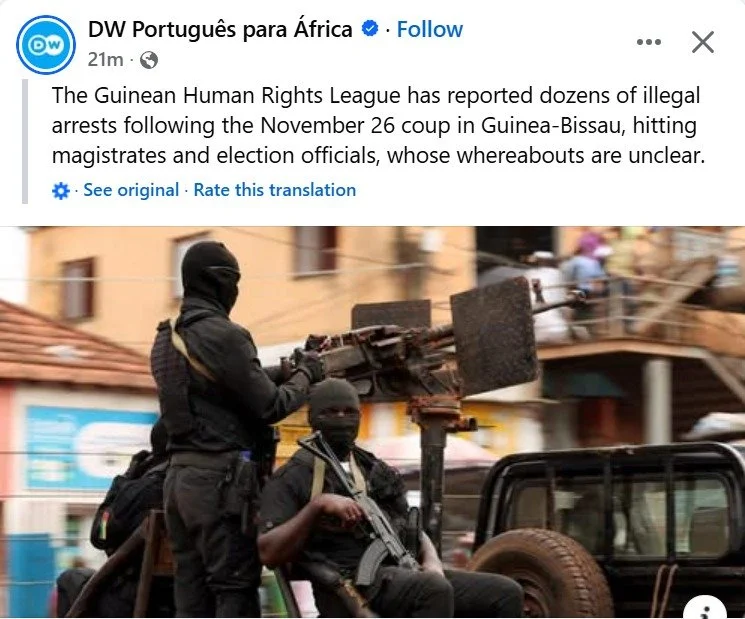
27. As of January 2026, the country is under the control of a military junta led by Major-General Horta Inta-A, who serves as transitional president. On January 6, Lawyer Saïd Larifou, legal representative of the President-elect of Guinea-Bissau, Fernando Dias da Costa sent a formal notification to the legal service of Chevron Corporation, formally notifying the American multinational agency of the obligation to suspend without delay any payment, royalties, transfer of funds or financial transactions - including those scheduled starting on January 8, 2026 - for the benefit of said authorities or any entity placed under their direct or indirect control. Meanwhile, on the same day the popular people of Bor held a public demonstration that ended in prison,with police throwing tear gas and gunshots in the air to disperse the crowd. Despite the incident, protesters promise to go back to the streets until justice is served. Additionally, the trial of Rear Admiral Jose Américo Bubo Na Tchuto, was adjourned on January 8, by the Superior Military Court, following errors attributed to the General Staff of the Armed Forces. According to the Court, the adjournment was due to the absence of witnesses, a situation caused by incorrect information and failures of communication by the General Staff, who failed to comply with the statement of the trial dates correctly. The next day, January 9, the Military High Command for the Restoration of National Security and Public Order announced the immediate ban of unauthorized press conferences and public statements, claiming that such initiatives endanger peace, social cohesion and national stability. In a press release No. 05, in the possession of Radio Jovem, the transitional authorities accused political figures and some organized groups of promoting clandestine encounters aimed at inciting violence and disrespecting the prohibitions provided for in the "Charter of Political Transition", as well as resolutions issued by the Military Command. According to the document, these practices are considered "serious confrontation with national stability" and are being closely monitored by the military authorities, who ensure monitoring the situation throughout the national territory. The Military High Command warns that anyone or entity challenging the established public order will be severely reprimanded, in terms of the law in force, emphasizing that there will be no tolerance for acts that jeopardize the collective safety. The Youth Association for the Promotion and Defense of Human Rights (AJPDH), responded by expressing its deepest repudiation and concern to Press Release No. 05, AJPDH deems unacceptable the restriction on the freedom of the press which implies the explicit prohibition of press conferences or unauthorized public statements constitutes a direct violation of freedom of expression and the right to information, pillars of any fair society. The announcement that any dissonant voice will be "severely reprimanded" creates an atmosphere of fear and repression that in no way contributes to the social cohesion invoked by the Command itself. Also on January 9, the law firm Adeola Oyinlade & Co filed a new application before the ECOWAS Community Court of Justice (Suit No: EWC/CCJ/APP/05/26) seeking Domingos Pereira’s immediate release and a declaration that his continued detention without due process is unlawful. The ECOWAS mission to Bissau, led by Sierra Leone’s President Julius Maada Bio and Senegal’s President Bassirou Diomaye Faye to engage with military authorities, took place on Saturday, January 10. The mission aimed to discuss transition timelines and the release of detainees. The two leaders met the military authorities who took power, and also visited key opposition figures. On January 13, the National Transitional Council adopted a draft constitutional revision, shifting Guinea-Bissau from a parliamentary regime to a presidential system.The new framework significantly strengthens executive powers, making the President the head of government and leader of the executive branch, [Siphiwe note: we must remember that this was Embaló’s original objective back In May 2020, when he bypassed the traditional legislative process by establishing his own independent commission of five jurists to draft a new constitution.]
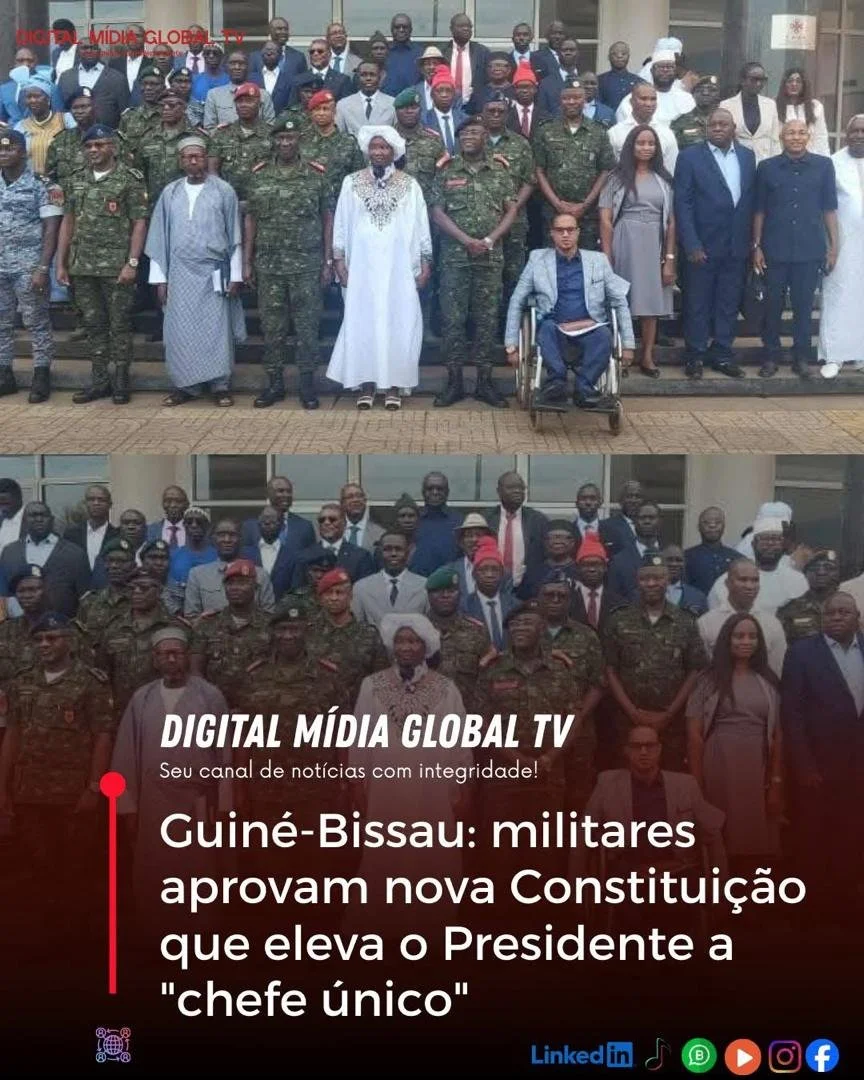
the following was immediately posted on social media:
THE LEGAL AND POLITICAL INVALIDITY OF THE CONSTITUTIONAL CHANGE IMPOSED BY CONSTITUTIONARY "GENERALS" AND THE DELIGHTFUL CHALLENGE TO THE CEDECAO
I. USURPATION OF CONSTITUENT POWER AND ABSOLUTE ABSENCE OF POPULAR MANDATE
The amendment of the Constitution carried out in a flash by "generals" who rose to power through a coup is an usurpation of the constituent power and is legally invalid ab initio.
Constituent power — whether originated or derivative — emanates exclusively from the sovereign people and can only be exercised by legitimate representatives for popular mandate, in the framework of a democratic process.
Military authorities taking power by force of arms HOLD NO LEGITIMACY to redefine or enforce the constitutional order manu militari. In doing so, you are not exercising constituent power: you are exercising a SERIOUS USURPATION OF POPULAR SOVEREIGNMENT.
II. BREAK OF THE CONSTITUTIONAL ORDER AND NULLIDITY OF THE SUBJECTIVE ACTS
Coup d'etat is, by definition, a breach of the constitutional legality. Once the Constitutional order is disrupted, all legislative acts that seek to “reform” or “overturn” the Constitution outside of its legitimate mechanisms are legally null and void.
In public law the principle EX INIURIA JUS NON ORITUR applies: illegal does not give birth to law. Thus, a constitutional change arising from an illegal act DOES NOT PRODUCE VALID LEGAL EFFECTS, even if coated with formal or symbolic language.
III. LACK OF VALID CONSTITUTIONAL PROCEDURE
Even in the context of institutional normality, the constitutional revision requires stringent procedures: legitimate legislative bodies, qualified quorums, public debate, deliberative deadlines and judicial control.
The imposition of constitutional amendments by military decree, without a legitimate Parliament, without popular consultation and without judicial control, turns the Constitution into an INSTRUMENT OF COERCION, and not into a founding legal-political pact of the State.
IV. MILITARIZATION OF CIVIL POWER AND MATERIAL UNCONSTITUTIONALITY
The Constitution exists to subordinate the Armed Forces to civilian power, protect fundamental rights and prevent the capture of the State by armed means.
When “generals” rewrite the Constitution to legitimize a coup, extend their stay in power, or shield themselves from legal liability, they commit a material violation of the very idea of constitutionalism.
A text imposed by the military to serve military interests no longer be a Constitution and becomes an INTERNAL OCCUPATION REGULATION.
V. DIRECT AND DELUSIVE CHALLENGE TO THE CEDEAS
The constitutional change imposed by the “generals” is not just an internal act of usurpation: it is also a frontal and deliberate challenge to the political, legal and regulatory authority of ECOWAS.
By proceeding with this maneuver during and after regional diplomatic initiatives, the scammers look for:
* drain the regional mediation;
* create consumed facts;
* signify that they do not recognize the regulatory authority of ECOWAS.
This is a conscious effort to discredit the regional organization, weaken its coup-prevention mechanisms and undermine the principle of constitutional intolerance to unconstitutional government changes.
VI. DISAUTHORIZATION OF HIGH LEVEL MISSION OF PRESIDENTS BIO AND DIOMAYE FAYE
The aforementioned constitutional change equally represents a direct front to the recent high-level ECOWAS mission, led by President Julius Maada Bio of Sierra Leone and President Bassirou Diomaye Faye of Senegal.
When advancing unilaterally with constitutional changes, the "generals":
* politically disauthorize regional envoys;
* empty the content of ongoing negotiations;
* They project the image of an ECOWAS unable to enforce its own protocols.
Such an attitude compromises not only the specific mission, but the future credibility of regional preventive diplomacy.
VII. THE "CONSTITUTIONAL REFORM" AS AN INSTRUMENT OF POLITICAL BLACKMAIL
There is strong indications that this CONSTITUTIONAL “PSEUDO-ALTERATION” will be used as a currency of exchange in future negotiations, in a factual logic: the scammers create a new illegitimate legal framework to subsequently “negotiate” concessions, deadlines or partial recognition.
This practice is particularly dangerous, as it encourages the normalization of the coup as a method of renegotiating the constitutional order, corrupting the foundations of the rule of law in the region.
VIII. INTERNATIONAL & REGIONAL LAW OFFENSE
The actions of the "generals" violate:
* the Charter of the United Nations (peoples' self-determination);
* the African Charter of Democracy,Elections and Governance;
* the ECOWAS Protocols on Democracy and Good Governance.
International practice is clear: constitutions or revisions imposed by fraudulent regimes DO NOT GENERATE LEGALITY OR LASTING RECOGNITION.
IX. CONCLUSION
The constitutional change imposed by usurping "generals":
* lacks popular mandate;
* violates the constitutional procedure;
* militarize the civil power;
* openly challenges ECEDAO;
* discredit high-level regional missions;
* aims to create instruments of political blackmail.
Yes, therefore, LEGALLY USELESS, POLITICALLY ILLEGIT AND INTERNATIONALLY UNSUSTAINABLE.
It is therefore recommended not to waste time analyzing or evaluating an action that, from the point of view of law, is NULL AND LEGALLY INEXISTENT.
Signature :
International lawyer and constitutionalist of Lusophonia
On January 22, 2026, the military government issued a decree setting new legislative and presidential elections for December 6, 2026. The transitional charter explicitly prohibits current interim leaders, including the transitional president and prime minister, from running in the upcoming 2026 elections to maintain perceived neutrality. Political party activities remain largely suspended, and key opposition figures, including Pereira, remain in detention or exile as of late January 2026. A Gathering of Citizens of Guinea-Bissau promptly sent the following:

Open Letter to ECOWAS
The Economic Community of West African States (ECOWAS) was clear in its decisions on Guinea-Bissau: it rejected the military transition plan, demanded the immediate restoration of the constitutional order, the liberation of all political leaders and the creation of a short, civilian-led transition with a government truly inclusive. It also warned the enforcement of sanctions if these demands were not met. Unfortunately, the Military High Command has ignored all of these decisions. The most influential politician in the country remains detained, the winner of the last election remains a refugee at the Nigerian Embassy and other political leaders remain in refugee, for lack of minimum security guarantees. There is no inclusive government.The country continues under the same regime that was in force during Umaro Sissoco Embaló's mandate, directly contradicting ECOWAS guidelines and excluding relevant political and social forces from the transitional process. Even worse, elections were announced for December 6th, in total alignment with the military transition plan that ECOWAS itself rejected. An electoral process organized in these conditions will not be free, nor fair, nor credible. It will only serve to legitimize a regime imposed by force. The transition required by ECOWAS should be civilian, not military. Any solution that keeps the military at the center of political power violates the democratic principles of the region. Facing this situation, a clear position is mandatory. Slowness and ambiguity only strengthens the constitutional breakdown. ECOWAS must act firmly, applying serious and coherent sanctions, or risk being seen as an accomplice, by default, in consolidating a fraudulent regime. Democracy in Guinea-Bissau, and the credibility of ECOWAS while ensuring constitutional order in West Africa, are at stake.
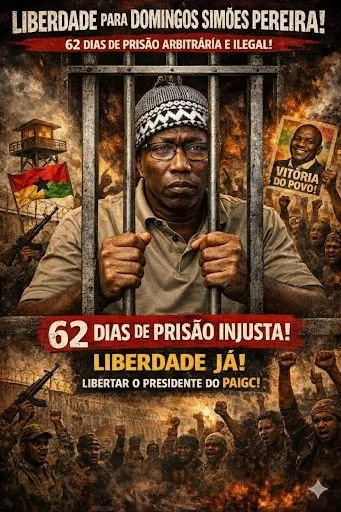
On January 26, the Transitional Prime Minister, Ilídio Vieira Té, stated that the Military High Command has already ordered the release of all prisoners under his custody. The governor also clarified that the case of Domingos Simões Pereira (DSP) "is not and has not been under military control", being "a matter of the exclusive responsibility of the competent courts". The position was disclosed in a note from the Prime Minister's Press Office, which reports the meeting held on Monday, January 26, between Ilídio Vieira Té and a delegation of PAIGC veterans, accompanied by leaders from other political groups. The meeting, facilitated by Joana Cobde Nhanca, leader of the Social Democratic Movement, aimed to promote peace, national reconciliation and political stability in this transition period. According to The Democrat, this was the second meeting between the Prime Minister and PAIGC veterans — the first occurred on January 16 — both held in Premature, with the presence of various political personalities. Among the participants were Joana Cobde Nhanca, Manuel dos Santos (Manecas), Ana Maria Soares and Iaia Maria Turé. Also in attendance was the former leader of the Guinea-Bissau Resistance (RGB), Salvador Tchongo, accompanied by an unidentified person. According to the official note, the Prime Minister reiterated that all political leaders have the responsibility to contribute to national understanding and fair and accountable commitments. Ilídio Vieira Té assured the government's "full availability for a constructive dialogue that serves national interests" and informed that it will convey the concerns of veterans to the President of the Transitional Republic and the Military High Command. The governor also appealed for serenity and warned of the negative impact of social networks on social cohesion, emphasizing that "freedom of expression should not be mistaken for debauchery". He also criticized "irresponsible attacks" which, according to him, "only denigrate the image of the country", highlighting signs of positive development in relation to the recent past. On the same day, after 30 days in detention, Augusto Nansambé was released while Guinean economist Carlos Lopes was awarded with the Amílcar Cabral prize by the University of Cape Verde (UniCV) and affirmed that the arrest of Domingos Simones Pereira, leader of PAIGC, and others, in Guinea-Bissau, is an "illegality" that "must be questioned in any international forum". "I hope his release and the other political prisoners in Guinea-Bissau happens as soon as possible," he told the news agency Lusa, in the city of Praia. Such arrest and "a moral confrontation, for dealing not only an illegality, but also a deprivation of liberty" without justification, "not even at the official level." On January 27, Mamadou António published the article, Captured Diplomacy: The Urgent Reconstruction of Guinea-Bissau's Diplomatic Service
“Guinea-Bissau is currently experiencing one of the darkest phases in its institutional history. What is underway is not merely a political crisis, but a systematic process of state capture. One of the sectors most severely affected by this degradation is national diplomacy—once a pillar of prestige and professionalism—now transformed, in many cases, into an informal extension of power networks associated with the regime and the obscure interests that sustain it, allegedly ranging from the trafficking of diplomatic passports and drugs to all types of influence peddling, including vote buying. Over the past six years, Guinea-Bissau's diplomacy has been systematically and deliberately dismantled as a career service. In its place, political appointments, cronyism, informants, influence operatives, and unofficial agents of Umaro Sissoco Embaló's regime have proliferated. The result is devastating: a discredited foreign policy, subordinated to personal interests and detached from the national interest. It is important to be clear: not all ambassadors from Guinea-Bissau are servants of the regime. Fortunately, there are still worthy diplomats, career professionals, and patriots committed to the State. However, it is no coincidence that the strategic diplomatic posts—Lisbon, Paris, Brussels, the United Nations, Washington, and the representation to the African Union—are today largely occupied by figures close to, complicit with, or politically aligned with the current usurpers of power because they themselves, allegedly, are also usurpers. This fact helps explain unacceptable behaviors on the diplomatic front, such as the refusal of the representative in Lisbon, Artur Silva, to receive a formal letter—a gesture that violates basic norms of international protocol. Paris is currently represented by a loyal ally of the regime, a long-time agent. Brussels and the European Union are represented by one of Umaro Sissoco Embaló's closest accomplices.
At the United Nations, the situation is even more serious. The Guinean representation is occupied not only by one of Sissoco's and the regime's closest allies and loyalists associated with drug trafficking, but also by individuals who publicly claim family ties and other identity links with the USS itself. There are recurring and serious allegations that diplomats linked to this circuit travel with suitcases of money and other valuables for the purposes of money laundering, transporting jewelry, and, in some frequent cases, even involvement in drug trafficking schemes. Even while awaiting independent judicial investigation, these accusations are serious enough to compromise the country's international credibility. In Washington, the political proximity to the regime raises profound questions about the institutional neutrality of the representation. And in the case of the African Union, the situation takes on an even more sensitive strategic character. Addis Ababa is not just any post. Due to its continental political centrality, the African Union should be represented by career diplomats with proven technical competence, moral integrity, and institutional loyalty to the Guinean state—not by political agents associated with former minister Susi Barbosa and, through intermediaries, informants of Umaro Sissoco Embaló himself. This reality is not a matter of chance. It is a conscious strategy: replacing highly competent professional diplomats with loyal political agents in an attempt to control narratives, silence international denunciations, and protect illegitimate interests, such as the sale of diplomatic passports, among others. A captured diplomacy is a weakened state. Without independent diplomats, trained and committed to the Republic, Guinea-Bissau loses its voice, credibility, and real capacity to defend its sovereign interests. The reconstruction of the Guinean diplomatic service has therefore become a national priority. It will be necessary to rebuild, practically from scratch, a diplomatic corps based on merit, training, career advancement, public ethics, and institutional loyalty—not on loyalty to individuals, political clans, or informal power networks. Guinea-Bissau once had a respected diplomatic corps. It had representatives who defended the country with honor, competence, and dignity. This legacy needs to be recovered. The country doesn't need political informants abroad. It needs diplomats. It doesn't need embassies transformed into propaganda centers for the regime. It needs missions that represent the Guinean people and the Republic. The struggle for democracy in Guinea-Bissau necessarily also involves liberating its foreign policy from authoritarian control. Without professional diplomacy, there is no real sovereignty. Without civil servants, there is no Republic. It's time to say enough is enough.”
On January 28 Secretary of State of the Public Order Salvador Soares of The Transitional Government announced that it will launch, from next February 1, on the roads of the country, the "stop operation", for seizure of undocumented vehicles. The Secretary of State of the Public Order Salvador Soares, who says that tolerance for "non-compliance" is zero, opening the door to more violations of human rights, the right to privacy and security of possessions. David Sanhá, spokesperson for the drivers of the region, expressed concern about the measure and appealed to the Executive to consider the charges and penalties stipulated within the stipulated time limit, taking into account the poor economic and financial situation that affects the professionals in the field. On January 29, Senegal's Foreign Minister Cheikh Niang arrived in Bissau as a "special envoy" of Senegalese President Bassirou Diomaye Faye while the president of the Syndicate of Journalists and Technicians of Social Communication (SINJOTECS), Indira Correia Baldé, said that the security of journalists is under threat in the country. Additionally, the Civil Society Pact urgently requested Don Lampra Cá, Bishop the Diocese of Bissau to intervene to protect "the life and physical integrity" of social activist Vicario Balanta, leader of the Dust of Earth movement. Nevertheless, The Transitional President, Horta Inta-a, signed and published a Presidential Decree announcing his own promotion to the General of the Army, following a proposal from the Government. The Presidential Decree explains that the proposal of the Transitional Government is based, among other things, on the "high performance" of Horta Inta-a in exercising the high functions of Head of State, as well as his "determining role" as a factor in national unity and defense of democracy. On January 30, The Economic Community of West African States (ECOWAS) has revealed that the Military High Command has announced the creation of an inclusive Transitional Government, with the assignment of three ministerial folders to the PAIGC and another three to the political group led by Fernando Dias da Costa, as well as the appointment of ten representatives from the two political groups for the National Transitional Council. In a statement dated 30 January, ECOWAS welcomed the measures taken by the transitional authorities, considering them as important steps towards promoting an inclusive political environment and returning to constitutional order in the country. Meanwhile, the executive director of the NGO Tiniguena, Miguel de Barros stated that it is fundamental for the Guinean State to rethink the oil prospection project off the Bijagos and that it is necessary that the State make the exact information public, identifying areas where oil is intended to be produced. That night, after 65 days of detention in the cells of the Second Police Squadron of the Public Order (POP), in Bissau, Domingos Simones Pereira (DSP) was released. Hours after his release, after more than two months in detention, Fernando Dias also left the Nigerian Embassy, returning to his residence, in the Misira neighborhood, in Bissau. According to a statement by their lawyers "The release is a positive sign, which we welcome with prudence and a sense of responsibility," adding that "it marks an important step, however, without allowing, at this stage, to speak of a definite victory." The lawyers demand constitutional legality and effective respect for fundamental freedoms in Guinea-Bissau, and encourage regional and international partners to continue their follow-up efforts. The Special Envoy of the President of Senegal, who accompanied Eng. Domingos Simões Pereira to his home, said that a step that creates conditions for the next phase, inclusive dialogue for resolving the current political-military crisis in the country, has been completed. A group of members of the PAIGC Central Committee, self-declared Thought Group, appealed to party veterans to take the leadership of the political formation until the next congress. According to Aladje Seco Sano, spokesperson of the Think Group, the collective created about two months ago has already been in contact with some veterans, in order to raise awareness about taking over the leadership of the party until a new congress is held. “PAIGC cannot go ahead without a direction. It is urgent to rescue the party from the situation it is in," Seco Sano declared, emphasizing that the party needs stability and strong leadership at this time of political uncertainty and stated that "the party cannot be led by someone who is in house arrest". On the other hand, Seco Sano praised the behavior of the Military Command, stating that his performance "has allowed to maintain order in the country" after the coup d'état. But Nair Pereira writes, “First, political fear. Domingos Simões Pereira is not just a party leader, he is a figure with a real social base, international recognition and capacity for mobilization. Holding him back is a way to neutralize him without confronting him politically. It is not strength, it is fear. Next comes the logic of bullying. By prolonging retention, the military sends a clear message to all political class and society: no one is out of reach. It's not just about DSP, it's about creating a climate of restraint and silence. There's also the internal calculation. Within the armed forces itself there is no fully unified line. Prolonging the situation can serve to save time, manage external pressures, align internal positions, and avoid decisions that could further divide the military apparatus. Another important point is the instrumentalization of justice and "legality". Keeping someone in limbo, neither formally charged nor truly free, is a classic tactic in force regimes. Looks like control, but avoids assuming clear responsibilities. And finally the international pressure. Paradoxically, it both limits and prolongs the problem. The military knows they can't go too far, but they also test how far they can stretch the rope without facing serious consequences. In short, what's behind is not a sophisticated strategy; it's a mixture of fear, improvisation, and a will for control. When power stops convincing, it attempts to paralyze. And when it paralyzes, it reveals fragility, not strength. The power assailants don't want Domingo Simones Pereira in prison. They want him out of politics anyway. If you’re at home, quiet and politically neutral, better for them. Thus, they get rid of the political cost of keeping him detained and, at the same time, wash their hands of anything that might happen to him. Domestic freedom from DSP is just an illusion. The real goal is simple: get him out of the political game without assuming responsibility.”
“What the Guinean people want is announcement of the results of the elections. Swindler has no right to demand or propose anything.” - Balanta Professor of International Relations Beto Infande
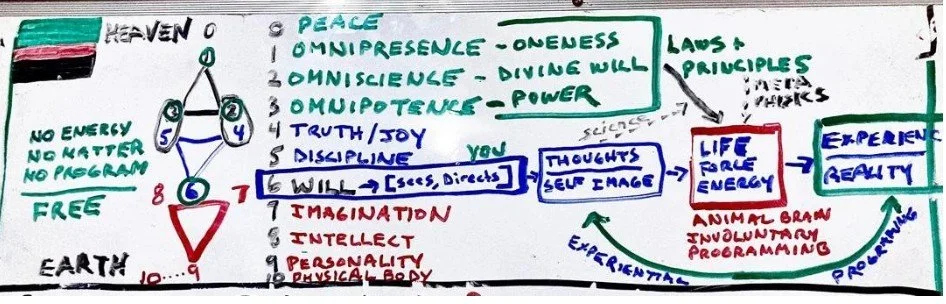
THE PROBLEM OF GOVERNANCE IS A SPIRITUAL ONE
In the image above, there is a diagram with three triangles, the top triange in the shape of a pyramid represents
𝐃𝐢𝐯𝐢𝐧𝐞 𝐂𝐨𝐧𝐬𝐜𝐢𝐨𝐮𝐬𝐧𝐞𝐬𝐬 or in the Kemetic Tradition,
the "𝐀𝐮𝐬𝐚𝐫" Man with faculties represented by spheres
1- 𝑶𝒎𝒏𝒊𝒑𝒓𝒆𝒔𝒆𝒏𝒄𝒆;
2 - 𝑶𝒎𝒏𝒊𝒔𝒄𝒊𝒆𝒏𝒄𝒆; and
3 - 𝑶𝒎𝒏𝒊𝒑𝒐𝒕𝒆𝒏𝒄𝒆.
In the Bible stories, Jesus Christ was such an Ausar Man.
For Rastafari, HIM Haile Selassie I is such an Ausar Man. In fact, Emperor Haile Selassie is who his titles say he is, “King of Kings, Lord of Lords, Conquering Lion of Judah” and thus was sent to earth and humanity in this time in order that an Ausar Man could take the reigns of control and demonstrate God in Man Ruling the Earth in order to prevent man from destroying himself in World War I and World War II and in the current crisis of “might makes right” as displayed by both big nations (USA, Israel) and small nations (Guinea Bissau) alike.
The inverted middle triangle represents the "𝐀𝐛" Man. He posses the faculties of
sphere 4 - 𝐭𝐫𝐮𝐭𝐡 𝐚𝐧𝐝 𝐣𝐨𝐲 (derived from its connection to sphere 2 Omniscience;
sphere 5 - 𝐝𝐢𝐬𝐜𝐢𝐩𝐥𝐢𝐧𝐞 (derived from its relationship to sphere 3 Omnipotence; and
sphere 6 - 𝐭𝐡𝐞 𝐰𝐢𝐥𝐥 which is the faculty of freedom to choose.
Finally, there is the bottom triangle of the "𝐒𝐚𝐡𝐮" Man who posses the faculties of
sphere 7 - 𝐢𝐦𝐚𝐠𝐢𝐧𝐚𝐭𝐢𝐨𝐧;
sphere 8 - the 𝐢𝐧𝐭𝐞𝐥𝐥𝐞𝐜𝐭; and
sphere 9 - the 𝐩𝐡𝐲𝐬𝐢𝐜𝐚𝐥 𝐛𝐨𝐝𝐲.
"The Story of Ausar is to the Kamitic people and tradition what the Old Testament is to the Jews and the Bible is to the Christians. It is the master text of the Ausarian religion, which dominated the spiritual life throughout ancient history. It is the key to understanding the philosophy and way of life . . . of all major religious books." - Ra Un Nefer Amen.
Every person uses his/her "will" (sphere 6) either to utilize the faculties of truth/joy and discipline to become one with the 𝐀𝐮𝐬𝐚𝐫 (𝐃𝐢𝐯𝐢𝐧𝐞 𝐂𝐨𝐧𝐬𝐜𝐢𝐨𝐮𝐬𝐧𝐞𝐬𝐬) and thereby realize one's divine nature or "God in Man" OR one will use his/her will to indulge one's animal nature by using the faculties of the intellect and imagination in order to satisfy one's personality (ego) for the sake of pleasure and remain a 𝐒𝐚𝐡𝐮 𝐌𝐚𝐧.
The Story of Ausar tells how the Ausar Man was spreading the Divine Teachings on Earth and his brother Set became jealous (i.e. the animal spirit or "emotions" took control and guided his behavior instead of Divine Consciousness) and murdered his brother Ausar. Set has been ruling ever since. But Ausar's wife Auset gave birth to a Son named Heru who with the help of guidance from his father through dreams (ancestor spirit and Divine consciousness), Heru wars against Set for dominion on Earth.
In other words, man must sacrifice his animal spirit (Sahu Man) and his human spirit (Ab Man) in order to become Divine (Ausar Man).
This is the struggle of good (Heru, the man guided by Divine Consciousness and ancestral help) vs. evil (Set, the spirit of deception, division, aggression and lies) taking place within the individual.
This is manifested in society when Set uses deception and force to deceive the Sahu Man and the government is controlled by such deceived agents of the evil Set who do not display the wisdom and behaviors of the Ausar Man who rules not by force and lies but by truth and justice, balancing the needs of ALL in society through the falculties of omnipresence, omniscience and omnipotence.
When Amilcar Cabral, representing the Ausar Man in Guinea Bissau, was murdered by his own brothers representing Set and Sahu men in Guinea Bissau, the story of Ausar, the struggle of Good vs Evil, was enacted. That struggle is being played out today.
Only when government is emptied of Sahu men and replaced by Ab men with proven track record of a lifetime of cultivating and being guided by Divine Consciousness and thus becoming Ausar men, will justice and peace be achieved not just in Guinea Bissau, but throughout the earth.
THE WAR BETWEEN GOOD AND EVIL TAKING PLACE RIGHT NOW
Excerpt from 𝐌𝐞𝐭𝐮 𝐍𝐞𝐭𝐞𝐫 𝐕𝐨𝐥𝐮𝐦𝐞 𝟐: 𝐀𝐧𝐮𝐤 𝐀𝐮𝐬𝐚𝐫 𝐓𝐡𝐞 𝐊𝐚𝐦𝐢𝐭𝐢𝐜 𝐈𝐧𝐢𝐭𝐢𝐚𝐭𝐢𝐨𝐧 𝐒𝐲𝐬𝐭𝐞𝐦 by Ra Un Nefer Amen
"𝑻𝒐 𝒅𝒆𝒇𝒆𝒂𝒕 𝒆𝒗𝒊𝒍 (Set) 𝒊𝒏 𝒔𝒐𝒄𝒊𝒆𝒕𝒚 𝒘𝒆 𝒎𝒖𝒔𝒕 𝒅𝒆𝒇𝒆𝒂𝒕 𝒊𝒕 𝒊𝒏 𝒕𝒉𝒆 𝒊𝒏𝒅𝒊𝒗𝒊𝒅𝒖𝒂𝒍. We must remember that Set's power comes from deceiving the 𝐒𝐚𝐡𝐮 𝐌𝐚𝐧 (the man guided only by his selfish animal nature rather than Divine Consciousness) who makes up the majority in the world. He is to be uplifted through the initation program outlined here: https://www.balanta.org/.../anu-spirituality-salvation...
We must also reiterate the fact that before Set can be made to account to the Truth by which men live, 𝒉𝒆 𝒎𝒖𝒔𝒕 𝒃𝒆 𝒓𝒆𝒔𝒊𝒔𝒕𝒆𝒅 𝒃𝒚 𝒂𝒍𝒍 𝒎𝒆𝒂𝒏𝒔 𝒕𝒉𝒂𝒕 𝒂𝒓𝒆 𝒊𝒏 𝒉𝒂𝒓𝒎𝒐𝒏𝒚 𝒘𝒊𝒕𝒉 𝑫𝒊𝒗𝒊𝒏𝒆 𝑳𝒂𝒘 - thus the war between Set and Heru (he who seeks Divine Consciousness and to live by truth and justice). 𝐈𝐭 𝐢𝐬 𝐨𝐧𝐞 𝐨𝐟 𝐒𝐞𝐭'𝐬 𝐠𝐫𝐞𝐚𝐭𝐞𝐬𝐭 𝐚𝐜𝐭𝐬 𝐨𝐟 𝐝𝐞𝐜𝐞𝐩𝐭𝐢𝐨𝐧 𝐭𝐨 𝐮𝐬𝐞 𝐚𝐥𝐥 𝐟𝐨𝐫𝐦𝐬 𝐨𝐟 𝐚𝐠𝐠𝐫𝐞𝐬𝐬𝐢𝐨𝐧 𝐚𝐧𝐝 𝐝𝐢𝐯𝐢𝐬𝐢𝐯𝐞𝐧𝐞𝐬𝐬 (𝐝𝐢𝐯𝐢𝐝𝐞 𝐚𝐧𝐝 𝐜𝐨𝐧𝐪𝐮𝐞𝐫) 𝐭𝐨 𝐚𝐜𝐡𝐢𝐞𝐯𝐞 𝐡𝐢𝐬 𝐞𝐧𝐝𝐬, 𝐭𝐡𝐞𝐧 𝐝𝐞𝐧𝐨𝐮𝐧𝐜𝐞 𝐞𝐯𝐞𝐫𝐲𝐨𝐧𝐞 𝐰𝐡𝐨 𝐮𝐬𝐞𝐬 𝐬𝐮𝐜𝐡 𝐦𝐞𝐭𝐡𝐨𝐝𝐬 𝐭𝐨 𝐨𝐩𝐩𝐨𝐬𝐞 𝐡𝐢𝐬 𝐞𝐯𝐢𝐥. Ultimately, Set can only be fully defeated by bringing him to the court of justice - which is based on 𝒘𝒆𝒊𝒈𝒉𝒏𝒊𝒏𝒈 𝒉𝒊𝒔 𝒂𝒄𝒕𝒊𝒐𝒏𝒔 𝒂𝒈𝒂𝒊𝒏𝒔𝒕 𝒕𝒉𝒆 𝒍𝒂𝒘𝒔 𝒉𝒆 𝒉𝒂𝒔 𝒑𝒓𝒐𝒄𝒍𝒂𝒊𝒎𝒆𝒅. Given his nature and his agenda, he must break everyone of them. In the life of the individual, and freedom fighters, it means that she must always fight by means which do not run afoul of Divine Law. The story of Ausar (and the conflict between Good (Heru) and Evil (Set) shows that such means do not exclude violent means. Set will tell you in a second that his God has rained fire and brimstone on his enemies, and tell his enemies that they must resist non-violently. Of course, Sahu Man who hears, and does not see his way through life, falls for these deceptions."