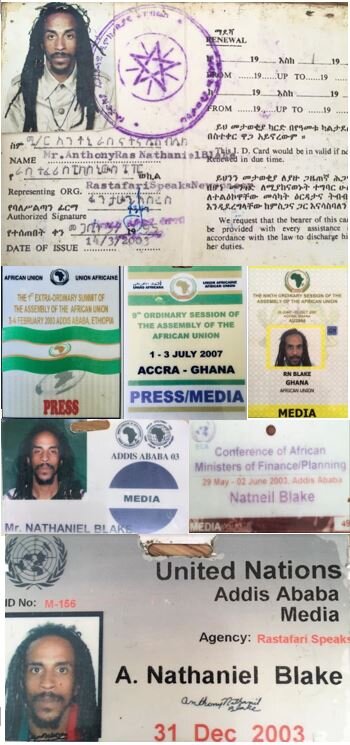
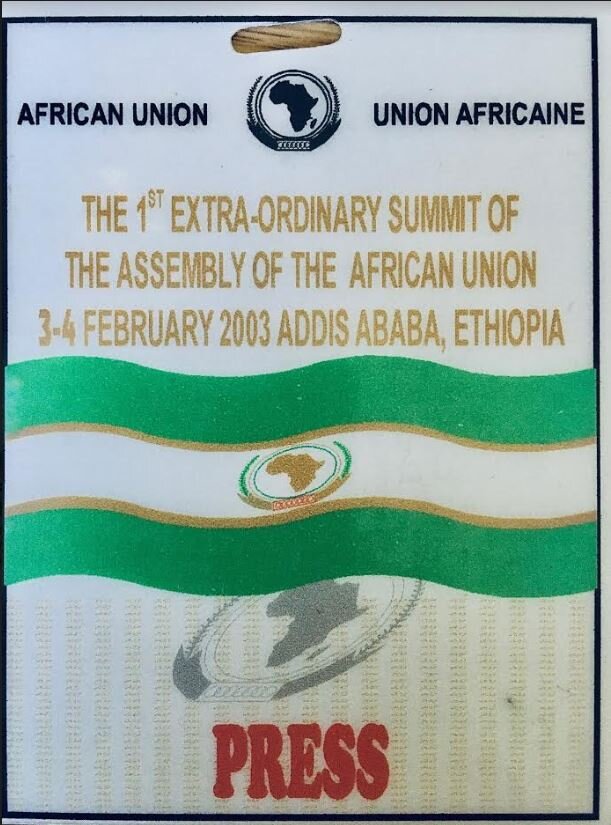
On February 3-4, 2003, the first Extra-Ordinary Summit of the Assembly of the African Union meeting in Addis Ababa, Ehtiopia, adopted the historic Article 3(q) that officially, “invite(s) and encourage(s) the full participation of Africans in the Diaspora in the building of the African Union in its capacity as an important part of our Continent.” From this decision, the African Diaspora would become designated as the 6th Region of the African Union.” A Balanta activist, Ras Nathaniel, was the only African American journalist present in the room at the time. In order to inform the African Union 6th Region of the history of this development, Ras Nathaniel published an 80-page paper for the African Caribbean Self-Help Foundation entitled “Towards Rastafari Repatriation By The Ethiopian Millennium II: Working Within the African Union 6th Region Diaspora Initiative”. Below is the excerpt, “HOW THE AFRICAN UNION WAS ESTABLISHED TO INCLUDE THE AFRICAN DIASPORA.” This is the definitive history of the AU 6th Region Diaspora Initiative up until that time, as written by the only eyewitness member of the AU 6th region from the United States.
HOW THE AFRICAN UNION WAS ESTABLISHED TO INCLUDE THE AFRICAN DIASPORA
Excerpts from the five-volume set, Come Out of Her, My People! 21st Century Black Prophetic Faith and Pan African Diplomacy.
At the 4th Extraordinary Summit of the OAU in September 1999, the Assembly of Heads of State and Government in Sirte, Libya met to amend the OAU Charter to increase the efficiency and effectiveness of the OAU. This Summit concluded on 9 September 1999 with the Sirte Declaration that "Establish(ed) an African Union in conformity with the ultimate objectives of the Charter of our Continental Organization and the provisions of the Treaty establishing the African Economic Community (AEC)."
At the Addis Ababa Council of Ministers in March 2000 they decided to implement their Sirte Decision. Meeting at the Lome Summit in July 2000, they made decisions regarding the African Union and the Pan African Parliament and the AU Constitutive Act was signed on July 11, 2000. In March of 2001 they convened a Sirte Extra-Ordinary Summit to finalize their plans for implementation and drafted the Pan African Parliament Protocol. At the Lusaka Summit in July 2001 the Secretary General was mandated to work out the modalities and guidelines for the launching of the organs of the African Union, including the preparation of the Draft Rules of Procedure of such organs and to also ensure the effective exercising of authority and discharging of their responsibilities. The priority organs are the Assembly, the Executive Council, the Commission and the Permanent Representative Committee. At their meeting in Durban, South Africa in July 2002 they drafted the Protocol Relating to the Establishment of the Peace and Security Council of the African Union. They were now ready to establish the African Union in its headquarters in Addis Ababa, which they did in February, 2003.
THE AFRICAN UNION 6TH REGION DIASPORA INITIATIVE
Of crucial importance in the establishment of the organs of the Union was/is the challenge to move away from the overly state-centric character of the OAU and its concomitant lack of civil participation. The cooperation of African NGOs, civil societies, labour unions, business organizations are essential in the process of cooperation and implementation. Recognizing this, the OAU/AU held to major OAU/AU Civil Society Conferences on June 11-14, 2001 and June 11-15, 2002.
The Lusaka Summit (meeting after the first conference) decided that NGOs, Professional Associations and Civil Society Organizations should be involved in the formulation and implementation of the Economic, Social and Cultural Council (ECOSOCC) Programmes. This provided a very marginal role for members of the African Diaspora.
The second Conference in 2002, included representatives of the Diaspora. That conference also elected a Provisional Working Group, with a two-year tenure, to work with the African Union Commission on a continuous basis in between larger assemblies, which are held on a bi-annual basis. The Diaspora was given two representatives on this working Group - one for Europe and one for the Western Hemisphere including the US and other parts of the Americas.
The African Union then convened the First AU-Western Hemisphere Diaspora Forum in Washington, DC December 17-19, 2002. Though Rastafari People had an extensive history for engaging the OAU, they were not organized and centralized, and therefore had (and still has) no representation at the Forum which established the Western Hemisphere African Diaspora Network (WHADN) to interface with the African Union Commission. The WHADN put forward proposals for effective collaboration between the African Diaspora and the African Union which were refined by the AU Commission. One of those proposals, the Trade & Economic Development Committee proposed the following framework for recommendations as prerequisites to effective and meaningful participation in African trade and development by Africans in the western hemisphere Diaspora:
The African Union should consider the African Diaspora as Business partner, and
- Establish official programs to identify and qualify Diaspora businesses
- Issue a common visa, or eliminate business travel visas for Diaspora businesses.
The African Growth & Opportunity Act The AU should:
- Identify and prioritize products that can be traded (imported/exported) between Africa and Africans in the Diaspora to promote intra-Diaspora opportunities
- Enhance opportunities for Africans in the Diaspora to provide appropriate equipment and technical services to enable African countries to meet AGOA standards
Commodity Markets and Commodity Pricing The AU should
- Create a mechanism to promote trade and investment between Africa and Africans in the Western Hemisphere Diaspora
- Encourage the technological transfer of organic product cultivation.
Reparations
The AU should
- Include in its agenda the 'crime against humanity' concept and work with Diaspora organizations to suggest a process for reparations.
- Review, educate and sponsor open discussion to get insight into slavery In turn, the African Diaspora should:
- Establish a Western Hemisphere Diaspora Trade and Economic Development Committee to coordinate and facilitate the follow-up process to these recommendations with the AU
- Set up a Western Hemisphere Diaspora secretariat in Africa
- Encourage the establishment of a voluntary $5 per year US tax deductible contribution to the AU Trade and Economic Development Fund for the US Diaspora.
- Promote the development of joint ventures and partnerships between the Western Hemisphere Diaspora and African business communities.
- Ensure establishment of an industry specific Western Hemisphere Diaspora data base endorsed by the appropriate Diaspora representatives.
At the First Extra-ordinary Summit of the Assembly of Heads of States and Governments held in Addis Ababa, Ethiopia on February 3, 2003, Senegal proposed an amendment to formally integrate the Diaspora in the policy framework of the African Union. After much debate that still continues over the definition of the "African Diaspora"2, the proposed amendment was refined and adopted by the Summit in a new Article 3 (q) that "invites and encourages the full participation of the African Diaspora as an important part of our continent, in the building of the African Union."
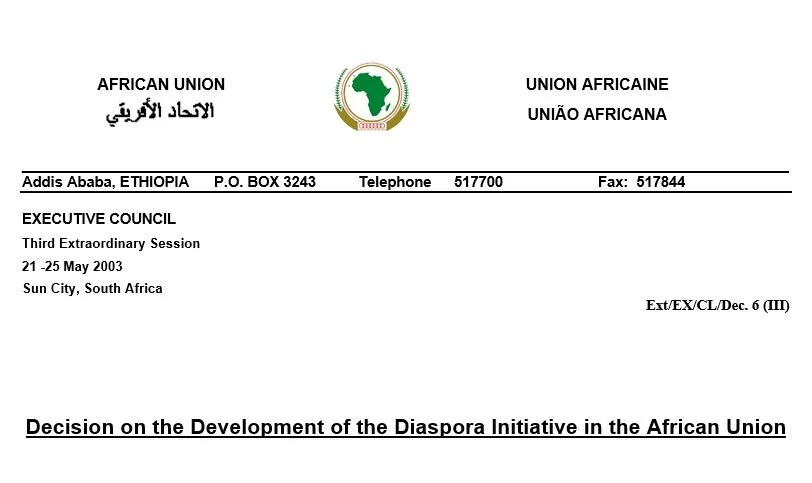
In May, 2003, the Executive Council of the African Union met at the Third Extraordinary Session in Sun City, South Africa and issued the "Decision on the Development of the Diaspora Initiative in the African Union" This decision stated in point 4 that it
"Supports the initiative of the Commission to convene a technical workshop, as soon as possible, to develop a concept paper to generate proposals on the relations between the AU and the Diaspora. The proposed workshop would also address the following issues:
- the definition of the Diaspora;
- the role of the Diaspora in reversing African brain drain in line with the NEPAD recommendations;
- the modalities of the creation of a Diaspora fund for investment and development in Africa;
- the modalities for the development of scientific and technical networks to channel the repatriation of scientific knowledge from the Diaspora to Africa, and the establishment of cooperation between those abroad and at home;
- the establishment of a Diaspora database to promote and facilitate networking and collaboration between experts in their respective countries of origin and those in the Diaspora.
The Decision also stated:
"b. What can the African Union offer the Diaspora?
Discussions during the Washington Forum also offers a picture of some of what the Diaspora may expect - a measure of credible involvement in the policy making processes, some corresponding level of representation, symbolic identification, requirements of dual or honorary citizenship of some sort, moral and political support of Diaspora initiatives in their respective regions, preferential treatment in access to African economic undertakings including consultancies, trade preferences and benefits for entrepreneurs, vis a vis non - Africans, social and political recognition as evident in invitation to Summits and important meetings etc. These deliberations must also focus on possibilities, criteria and qualification for Diaspora representation in the Economic, Cultural and Social Council (ECOSOC), the Pan-African Parliament, etc.
c. What can the Diaspora bring to the AU?
These include technical support for programs of the African Union, public education and sensitization of the wider public in their respective regions, lobbying, provision of a domestic political constituency for AU goals and objectives, advocacy, fund raising, resource mobilization and resource support through such measures as creation of Endowments amongst others."3
The main responsibility for mainstreaming the African Diaspora in the African Union fell upon the Conference on Security, Stability, Development and Cooperation in Africa (CSSDCA) which was initiated in a meeting on Security, Stability, Development and Cooperation attended by OAU Heads of State in Kampala in May 1991. The result of the meeting was the Kampala Document, which encapsulated both the 1990 OAU Heads of State Declaration on the Political and Socio-Economic Situation in Africa and the Fundamental Changes Taking Place in the World and the 1990 African Charter for Popular Participation in Development. The Kampala Document also proposed a Conference on Security, Stability, Development and Cooperation in Africa (CSSDCA). The Document was presented to the OAU Summit in Abuja, Nigeria in June 1991 for adoption; however, it was only noted and referred to the Council of Ministers.
Subsequent OAU Summits in June 1992 in Dakar, Senegal and in June 1993 in Cairo, Egypt could not adopt the Kampala Document in the absence of inputs from member States.
During the OAU Summit in July 1999 in Algiers, Algeria, President Obasanjo called for the refocusing on the Kampala Document in the light of contemporary developments in Africa, and offered to take responsibility for setting in motion the process of re-launching the CSSDCA. President Obasanjo also proposed that the year 2000 be declared as the Year of Peace, Security and Solidarity in Africa.
At the Extraordinary OAU Summit held in Sirte, Libya in September 1999, the Heads of State decided to convene an African Ministerial Conference on Security, Stability, Development and Cooperation in the Continent as soon as possible. As such the CSSDCA initiative was fully endorsed by the policy-making organs of the OAU. This First Ministerial CSSDCA Meeting was held in Abuja from 8 to 9 May 20004
At the AFSTRAG Roundtable in New York, February 26-27,2004, Dr. Jinmi Adisa, Senior Coordinator of the CSSDCA Bureau of the Chairperson of the African Union Commission, stated
"The CSSDCA has four main functions. First, it is the main framework for civil society engagement and thus serves as the pillar for the creation of effective partnerships that would facilitate and sustain the 'people- centered' orientation of the African Union. Second, in this capacity, it coordinates the activities of the nascent Economic, Social and Cultural Council, the Civil Society Parliament, and important advisory organs of the Union. Third, the CSSDCA is also the monitoring and evaluation mechanism of the Union that assesses the extent to which member states have complied with their obligations to implement the decisions they have agreed upon and adopted. The purpose here is to stimulate greater efficiency and all segments of the Union are associated with this endeavor. Fourth, and finally, the CSSDCA has responsibility for advancing the Diaspora initiative as part of its agenda for active and total mobilization of all segments of the African community.
It should be noted, however, that the main inspiration for CSSDCA activities is the Chairperson of the African Union himself, and in this respect, we have been very fortunate to have His Excellency, Mr. Alpha Konare, at the helm of affairs since September 2003.... Under his leadership, the CSSDCA was inspired to give prominence to the representation of the Diaspora in the Draft Statutes of the Economic, Social and Cultural Council (ECOSOC), which will be considered in mid- March 2004 at the 4th Ordinary meeting of the Executive Council of the Union. ECOSOC will enable active interface between organs of the Union and CSOs, women, youth and the African Diaspora .... When ECOSOC becomes fully operational (and we are working to ensure that this is the case by the last quarter of the year) it will necessarily imply the engagement of the African Diaspora in all spheres of activity of the African Union."5
Dr. Jinmi Adisa also gave the Opening Statement to the African Union Technical Workshop on the Relationship With The Diaspora held in the Port of Spain, Trinidad, June 2-5 2004. In that statement, Dr. Adisa stated,
"[T]o help transform the history of our separation during the period of Slave Trade into a beacon of hope and promise. This is the essence of the Diaspora Initiative of the African Union.... The African Union, therefore, seeks to enlist the Diaspora, as an integral part of its asset base, to energize the demand for development and to promote and sustain its unique and dynamic global identity. . . . At the Washington Forum of December 2002 which initiated the process of institutional development and active mobilization of the African Diaspora, the then Interim Chairperson of the African Union, stressed that the character of the relationship that was envisaged is designed to be reciprocal. The implication was that the benefit of this process must be complimentary so that the African continent gives something concrete to the Diaspora and vice versa. The challenge of the Diaspora initiative was how to determine precisely the content of such reciprocal relationship Finally, there is a need to re-affirm our spiritual bond as a support system for collaboration and mutual purpose. Organization of the Diaspora for participation in the Africa Day celebrations on May 25 each year would cement and project this identity.... [This] Workshop is also expected to look into modalities for networking and the creation of effective partnerships to underwrite 'quality dialogues' and concrete projects and programmes. . . .
However, investment of efforts will be only useful in a framework that sets clear, achievable goals, well defined paradigms and appropriate structures and mechanisms that will facilitate success in the pursuit of our common endeavor."6
Indeed, the African Union Technical Workshop On the Relationship With the Diaspora General Report stated:
"The AU sees the Diaspora Initiative as a partnership, which could bring benefits to both sides - i.e to Africans living in the Diaspora as well as those living on the continent. Not all these benefits to the African Diaspora, and vice-versa The AU's Diaspora Initiative urges Africans throughout the world to transform their collective legacy of colonial heritage and common suffering into bonds of spiritual kinship as well as a common reference point for combining efforts, forging a dynamic global identity.... "7
Point 29 of the General Report stated that,
"The [Afro-Neth conference held in The Netherlands in December 2003] noted the need to shift from a focus in conceptual issues, to the identification of concrete practical steps to engage the African Diaspora in Africa's Development. The Conference addressed 4 main issues, two of which were:
a) The need for collective Diaspora Voice in policy discussions; and
b) Mobilization of resources
The conference also considered the need for an African Diaspora Fund that could engage in the development of Africa and Africans in the Diaspora."
Point 37 and 38 of the General Report stated that,
"[Mr Oladeinde of the Western Hemisphere African Diaspora Network WHADN] noted that the conference, held in Washington, D.C. from 17-19 December 2002, defined the mission of WHADN as the encouragement and facilitation of the use of the collective talents and resources of the African Diaspora in North America, the Caribbean, and Latin America, to support economic development and sustained growth on the continent."
Point 40 of the General Report stated that,
"a. Technology transfer, and the contribution of the Diaspora to this transfer, has a crucial role to play in development.
b. It is important to expand research and use the Diaspora in research institutions to exploit their research for Africa's development.
c. For the Diaspora to maintain its engagement with Africa, there is need to provide incentives and a relationship of mutual reciprocity."
Point 44 and 46 of the General Report stated that,
"44. Dr. Adisa gave a short briefing on the AU Commission's interest in having Africa Day, 25 May, celebrated throughout the Diaspora. . . .
46. After considerable debate, the following recommendations were adopted on Global Observance Days:
a) The workshop should convey to the Chairperson of the Commission the need to raise the profile of Africa Day within Africa as well as in the Diaspora.
b) The AU should consider changing "Africa Day" into "Pan-Africa Day".
Point 48 of the General Report stated that,
48. After much debate, the following recommendations were adopted on the Conference of Intellectuals:
b. There exist a sharp cleavage between researchers in Africa and researchers in the Diaspora; researchers need to focus greater attention on the areas of medicine, governance, democracy and the rule of law as one way of bridging this cleavage.
c. The AU should facilitate linkages between African researchers and researchers in the Diaspora.
The Technical Workshop then included the following Recommendations:
52. To these ends, the working group recommends that the African Union consider:
i. That the operationalization of the secretariat for the Western Hemisphere and the establishment of networks in other Diaspora regions (in Europe and Asia- Pacific, etc) be immediately undertaken, and the creation of their secretariats be facilitated. This would enable the AU and the African Diaspora to capitalize on the momentum being created . . . .
ii. That the African Diaspora in their respective regions organize, in cooperation with their regional secretariats, conferences, workshops, and other modes of interaction. This would enable the development of concrete strategies for projects, programmes and policy proposals.
iii. That encouragement, promotion and support be provided for continued multidisciplinary, focused research on the topics of African Diaspora and its linkages to Africa.
vii. That African Diaspora Legal scholars, who are experts in international law as it relates to the African Diaspora, should be included in the process of translating this policy document into legal text. This would allow the new scholarship on critical law theory pertaining to Africa and its Diaspora to be embedded in the formulation of legislation and policy.
53. The Group put forward recommendations on the role of the Diaspora in human resource development in three key area:
- Resources (Skills Bank)
- Reversing the Brain Drain
- Development of Scientific and Technical Networks
55. For the Diaspora to meaningfully contribute to the attainment of the goals of human development in Africa the following policy recommendations were suggested:
a) Resources/Skills Bank:
56. The Resources Bank should serve as the integrating platform upon which all other aspects of the Diaspora development and mobilization of its resources, both organic and virtual knowledge, could be shared and expanded.
Recommendations:
i. The AU should facilitate the development of a template for identifying resource needs at both regional and national levels. Such an initiative would allow for effective organization of data, and make the database user-friendly. The AU may consider using consultants or experts in developing this.
ii. The AU should conduct an inventory of existing human resource databases of the Diaspora. The AU should consider using existing organizations both within and outside Africa. The AU should encourage Member States to commission country-specific inventories of existing databases as these relate to Member States . Results of the inventories should be made Publicly available, via the Internet, print media and other electronic means.
iii. The AU should organize the data thus collected into a Central Diaspora Skills Resource Bank. This database should support information for both individuals and corporations. The AU may consider adopting an existing database platform within the Diaspora.
iv. In considering the magnitude of establishing and managing the database, the AU should consider it as a separate entity with a separate group to govern it. The AU may consider creating a new entity or strengthening any one of its existing organizational structures to support it.
v. The AU should ensure that information in the database is publicly accessible.
vi. Long-term sustainability of the Resource Database should be evaluated in recognition of the cost of hosting, ongoing maintenance and other support services. AU may consider an affordable fee based access for certain retrieval services users.
vii. Information within the database should be protected and secure.
b) Brain-drain: Recommendations:
i. Brain Drain reversal should not be reduced to the physical return of people who have migrated from the continent, but should include access and effective utilization of their skills and knowledge regardless of geographical location.
ii. The AU should facilitate the development of a range of policies, at national and regional levels, to encourage the relocation (both temporarily and permanently) of skilled people from the historical Diaspora. The AU may wish to consider a continent-wide entry card for the Diaspora.
iii. The Au should promote, among Member States, a commitment to creating an enabling environment to stem the continuous outflow of people.
iv. The AU should encourage Member States to design programmes, including a range of incentives to attract skilled persons who have migrated, to return to their country of birth or to any other country on the continent on varying lengths of contracts, depending on needs and availability, or to return permanently.
v. The AU should design programmes to effectively utilize the skills and knowledge of Africans in the Diaspora.
vi. The AU should take the lead in a campaign to extend the concept of the Brain Drain Compensation Fund . . . .
Working Group 3: Modalities and resource support including the creation of A Diaspora Trust Fund for investment in Africa
58. The Group reviewed the four assets of the Diaspora: land, labour, capital and entrepreneurship, in defining the modalities for resource support for institutions whose establishment and operations would benefit both the African continent and the African Diaspora.
In Support of the Diaspora Outreach Project, the following recommendations were made:
Recommendations
a) Support for Diaspora Projects
60. The Diaspora should establish organizational networks to execute its projects and programmes through:
i. Membership dues;
ii. Fundraising activities such as concerts, seminars, congresses, Heads of State and celebrity dinners, corporate and philanthropic sponsorships and government grants;
iii. Publications: magazines, books, newsletters and web sites;
iv. Service fees: match-making, trade missions, event management;
b) Diaspora Charitable Trust Fund
61. It is recommended that the initial trust fund be established under the auspices of WHADN based in the USA. Over time, additional trust funds would be established in the other jurisdictions. The Trust Fund is conceptualized as a series of endowments beginning with health, education, housing and orphans.
The endowments would be funded in the following ways:
i. Each African adult both within the Diaspora and on the continent to contribute a minimum of 1 US $ or its equivalent per year.
ii. African governments, corporate citizens and NGOs both within the continent and in the Diaspora be encouraged to contribute generously to the fund.
Other Recommendations:
62. The working group encourages the AU to convey to its Member States the need to create an enabling environment and policy framework to facilitate investment vehicles which support investments in the Diaspora and in Africa. We recommend the following investment vehicles:
Pan African Mutual Fund
Investment in the mutual fund should be encouraged across the board of public and private sector participation with the requisite legislation to prevent control by any one group.
Pan African Bank
This institution is to be established in strategic locations in the Diaspora to facilitate remittances
- as a depository of assets of Africans in the Diaspora
- as a lending agency
Pan African Venture Capital
This vehicle would make equity capital available in Africa and in the Diaspora for investment in a range of viable businesses. It would be funded by private sectors, institutions and governments. Governments are to be encouraged to launch a campaign to educate their communities within Africa and in the Diaspora with respect to the several financial instruments available.
Working Group 4: Modalities for enhancing effective partnerships between the African Union and the African Diaspora and Diaspora participation in ECOSOC
Recommendations
v. In coordination with regional Diaspora Secretariats, the AUC should promote the organization of summits, conferences, workshops, and other publics which bring together NGOs and/or professional associations and networks, civil rights movements, and state ministries, representing specific major public policy issues which cut across one or more Diaspora Regions and/or Diaspora communities or populations and the continent of Africa or one or more AU member nations.
ix The AU Diaspora Initiative should establish criteria for selecting NGOs, private industries, universities, professional associations, and primary and secondary educational systems for partnership in the AU Diaspora Initiative. Regarding NGOs, this refers to the development or selection and evaluation criteria for the twenty NGO positions allotted in ECOSOCC NGOs. Coalitions of NGOs interested in ECOSOCC representation, and which are recommended by regional secretariats to the AUC, must demonstrate capacity to design, implement, and evaluate services, projects, and programmes which (a) improve the quality of life of African and African Diaspora nations, communities, populations, and institutional sectors; or/and (b) promote education and awareness about African and African Diaspora history and other issues; and (c) establish collaborative partnerships with other NGOs, private industries, cultural organizations, Black social movements, and educational institutions. It is recommended that African Diaspora NGOs and coalitions of NGOs interested in being regional consultative partners with the African Union register with their respective regional secretariats; all NGOs and coalitions of NGOs in the Western Hemisphere desiring to participate in the African Union Development of the Diaspora Initiative should register with WHADN as the first step of membership in this movement.
x. To enable the most effective internet communication in the AU Diaspora Initiative such as the AU/ECOSOCC and other partnership arrangements, the AU should work with WHADN and other partnership regional secretaries to establish an independent, secure, and autonomous internet node in Africa, e.g. Addis Ababa at AU Headquarters. This entails a financial and technical feasibility study examining issues such as touting, common carrier, billing, and security concerns.
xi. In order for the AU to develop effectively African/Diaspora networks and partnerships in a variety of areas, especially in the Western Hemisphere, it would be necessary to develop a more efficient Africa/Diaspora air transportation capacity in order to provide regular and reliable direct air linkages between Africa and Diaspora areas. This would involve the AU promoting airline transportation-related partnerships with nations, African and African Diaspora businesspersons to develop such airline transportation capacity.
xii. The AU should mandate Regional Diaspora Secretariats to coordinate and mobilize when needed Diaspora regional associations, organizations, and institutional sectors and to develop programmes to ensure their capacity to engage in partnerships with each other and with associations, organizations, and institutional sectors on the African continent.
xvi. The AU should consider offering Diaspora federal citizenship options and recommend that the AU establish a task force of distinguished scholars and policy makers to comprehensively study this question and offer policy recommendations to the AU Assembly.
In addition, the Report of the First Conference of Intellectuals of Africa and The Diaspora, October 6-9, 2004 in Dakar, Senegal, stated:
"59. The question on how to structure the Diaspora to make it as the 6th region was raised. To that effect:
- There is need to establish a representative body including the major regions of the world.
- 20 Diaspora organizations will be part of ECOSOCC, the advisory body of the African Union.
Recommendations
a) Setting up of an African experts group to serve as a 'think tank' to the AU.
e) Development of databases of associations to promote networking.
f) To promote the concept of African citizenship and the establishment of an African Passport.
87. Dr. Molefi Asante put forward five recommendations for the integration of the Diaspora and the continent. These include
i. the provision of curricula information from the African Diaspora in African schools,
ii. assigning responsibility to people in the ministries of African states to interface with the Diaspora
iii. operations from a perspective of strength rather than weakness,
iv. the need for African leaders to have precise knowledge of Diaspora communities as a basis for strengthening relations, and
v. the acceptance of the right of return for the African Diaspora.
Key issues and Recommendations
89. Five key issues were subject of recommendation. Preliminary discussions were held regarding the modalities for their implementation.
a. Creation of a specific structure of coordination as a follow up mechanism
i. The African Union should establish a Secretariat as a follow-up mechanism to engage in advocacy and to promote a permanent policy dialogue between intellectuals and policy makers in Africa and the Diaspora.
ii. The African Union should set up or adopt existing institutions to serve as 'Africa Houses' within strategic global and African locations to promote African interests abroad, improve awareness and knowledge about Africa, and support commercial and other links between the Diaspora and Africa
Modalities for Implementation
90. The Secretariat and Africa should:
- Utilize the experience and resources of existing specialized organizations, institutions and individuals;
- Create publications to disseminate information;
- Host follow-p meetings with heads of African Diaspora intellectual organizations to determine their roles in the Secretariat and intellectual programmes of the African Union;
- Promote access to the media for wider distribution of information by creating media and public relations divisions;
- Create strategies to fund the implementation of this initiative;
- Strengthen and publicize data-banks of African and Diaspora intellectuals
b. Creation of a new curriculum for Africa and the Diaspora
- In order to promote an awareness of the historical and contemporary cultures and contributions of peoples of Africa and the African Diaspora, the African Union should create a curriculum council to develop and disseminate print visual and electronic educational materials for all educational levels for Africa and the Diaspora
c. Promotion of an African Citizenship Initiative
- In recognition of the importance of identity as a mobilizing factor for development, the African Union should develop a framework for a wider African Citizenship Initiative."8
Modalities for Implementation
91. The African Union Commission should:
- Develop, in consultation with the Diaspora, proposals for a Bill of Citizenship that establishes rights, entitlements, and duties of African Citizens on the continent and in the Diaspora, including the responsibility of Member States and the African Union, and submit this to the Executive Council and Summit for consideration and approval.
c) Establishing The Diaspora as The Sixth Region of The African Union
- The Diaspora should initiate and, wherever it already exists should, broaden a process of consultation and regular meetings culminating in the establishment of transparent representative organs, to engage with the African Union.
- The African Union Mission, Vision, and Strategy document should be disseminated widely within Africa and its Diaspora, and used as a basis for ongoing discussion and engagement with the African Union.
Regarding the federal citizenship issue, on July 6, 2005, The Post (Lusaka) reported that
"The African Union (AU) is pondering the possibility of Africa citizens to move freely around the continent as it pursues the idea of issuing what it calls an African passport to all African citizens.
This was highlighted by AU Commission chairperson Alpha Konare during his official statement at the opening of this year's heads of stat assembly here. The proposal is also contained in the draft report which was expected to be endorsed by African leaders yesterday.
The draft recommendations call upon AU member states to facilitate and pursue free movement in Africa gradually considering the interdependence of social, economic, security and human rights dimensions of the movement of persons within the African Union.... The Au states that it accepts the concept of an African passport in principle and therefore recommends that further consultations be carried out at national, sub-regional, regional and continental levels to address all pertinent issues including constitutional, legal, social, economic, security and human rights aspects. The AU is also in agreement with the proposal for the issuance of African diplomatic passports and recommends that consultations should be done before the exercise is undertaken.
The AU Commission has since been requested in consultation with member states to consider establishing a committee of experts, charged with providing guidance to the Commission on matters relating to free movement of persons to carry the process forward."
The African Union 6th Region Diaspora Initiative has also included two other components highlighting language and the celebration of "Africa Day" every May 25 as an official AU observance (already mentioned above). Regarding Language,
Point 105. 4 of the Report of the First Conference of Intellectuals of Africa and the Diaspora stated:
"Language is critically important since it is one of the first symbols of identity that we learn. Therefore mastery of one of the African languages by those in the Diaspora becomes a visible symbol of their great attachment to the motherland."
Finally, Africa's Civil Society gathered at the headquarters of the African Union in Addis Ababa, Ethiopia, from March 27-30, 2005 for the launching of the Economic, Social and Cultural Council of the African Union (ECOSOCC). According to the Statutes of ECOSOCC,
"Article 3: Composition
1. ECOSOCC shall be an advisory organ of the African Union composed of different social and professional groups of the Member States of the African Union . . .
3. ECOSOCC shall also include social and professional groups in the African Diaspora organizations in accordance with the definition approved by the Executive Council."9
The definition of the African Diaspora as determined by the Meeting of Experts on the Definition of the African Diaspora, April 11-12, 2005 in Addis Ababa, Ethiopia, is as follows:
"The African Diaspora consists of peoples of African origin living outside the continent, irrespective of their citizenship and nationality and who are willing to contribute to the development of the continent and the building of the African Union."10
[IRIE note: this definition is severely flawed in light of the "Out of Africa" DNA studies. What is to stop a blonde-haired, blue-eyed Swede desiring to contribute to the development of Africa, for example, from claiming status as a member of the African Diaspora since current science states that his or her ancestors (and all human beings) originated in Africa?]
IRIE recommends the following definition:
"The African Diaspora consists of peoples of African origin, descent and heritage living outside the continent, irrespective of their citizenship and nationality and who are willing to contribute to the development of the continent and the building of the African Union."
[Under this definition, the Swede would be excluded on grounds that he or she did not possess an African heritage.]
ECOSOCC Statutes also state, "Article 4: Membership
1. ECOSOCC shall be composed of one hundred and fifty (150) CSO's which shall include different social and professional groups in Member States of the Union and the African Diaspora, in conformity with Article 5 of these Statutes:
a) Two (2) CSO's from each Member State of the Union (106 total)
b) Ten (10) CSO's operating at regional level and eight (8) at continental level
c) Twenty (20) CSO's from the African Diaspora as defined by the Executive Council, covering the various continents of the world
d) Six (6) CSO's in ex-officio capacity, nominated by the Commission based on special considerations, in consultation with Member States
Article 5: Election of Members
2. African Diaspora organizations shall establish an appropriate process for determining modalities for elections and elect twenty (20) CSO's to the ECOSOCC General Assembly
Article 6: Eligibility Requirements for Membership
The requirements to be fulfilled by CSOs seeking membership are as follows:
1. Be national, regional , continental or African Diaspora CSO, without restriction to undertake regional or international activities.
2. Have objectives and principles that are consistent with the principles and objectives of the Union as set out in Articles 3 and 4 of the Constitutive Act.
3. Registration and status:
a) Be registered in a Member State of the Union and/or;
b) Meet the general conditions of eligibility for the granting of Observer Status to non-governmental organizations;
c) Show a minimum of three (3) years proof of registration as either an African or an African Diaspora CSO prior to the date of submission of application, including proof of operations for those years.
4. Provide annual audit statements by an independent auditing company.
5. Show proof that the ownership and management of the CSO is made up of not less than fifty (50%), of Africans or of African Diaspora
6. The basic resources of such an Organization shall substantially, at least fifty (50%), be derived from contributions of the members of the Organization. Where external voluntary contributions have been received, their amounts and donors shall be faithfully revealed in the application for membership. Any financial or other support or contribution, direct or indirect, from a government to the Organization shall be declared and fully recorded in the financial records of the Organization.
7. Provide information on funding sources in the preceding three (3) years.
8. For regional and continental CSOs, show proof of activities that engage or are operative in at least three (3) Member States of the Union.
9. CSOs that discriminate on the basis of religion, gender, tribe, ethnic, racial or political basis shall be barred from representation to ECOSOCC.
10. Adherence to a Code of Ethics and Conduct for civil society organizations affiliated to or working with the Union."
This, then represents THE AFRICAN UNION 6TH REGION DIASPORA INITIATIVE and its progress up to the present.
It should be noted that, according to Ras Nathaniel’s March 3, 2003 report from Addis Ababa at the time,
“According to the REPORT OF THE AD HOC MINISTERIAL COMMITTEE MEETING ON THE PROPOSED AMENDMENTS TO THE CONSTITUTIVE ACT OF THE AFRICAN UNION:
"9. Prior to detailed consideration of this item, the Chairperson gave the floor successively to the Commission and the Senegalese delegation for clarifications on this subject.
10. The representative of the Commission indicated that six proposed amendments had been referred to the Ad Hoc Ministerial Committee but that the one relating to the African Diaspora had been inadvertently omitted from the Items listed on the Agenda of the Meeting. He added that the item had not been examined by the Executive Council Session in Tripoli, because it had not been submitted in time. He then read out the amendment as contained in paragraph 40 of the Report of the First Extraordinary Session of the Executive Council as follows:
'Invite and encourage the full participation of Africans in the Diaspora in the building of the African Union in its capacity as an important part of our Continent.'
11. At the Chairperson's request for more clarification on the categories of Africans that come under the term 'African Diaspora', the delegation of Senegal, the proposer of the amendment, informed the Meeting that the issue could be addressed from two perspectives, namely;
a) a narrow sense, whereby the Diaspora includes all Africans currently residing any where outside the Continent of Africa;
b) a broad and historic sense, whereby the Diaspora comprises all Africans who had left Africa by force and still consider themselves Africans."
12. It was decided at the end of the debate that the overall principle underlying the amendment should be retained and incorporated in the Constitutive Act as proposed. The amendment would read as follows:
Article 3 (0): 'Invite and encourage the full participation of Africans in the Diaspora in the building of the African Union in its capacity as an important part of our Continent."
13. On the question as to how this amendment would be implemented, it was proposed that this matter be examined at a collective brainstorming session of the Committee before the end of the Meeting to come up with proposals for submission to the Executive Council, as it was at the implementation level that all aspects of bilateral cooperation between the two entities would be addressed with greater clarity. It was also proposed that the matter be further considered subsequently at experts' and Executive Council levels for further inputs.
14. Subsequently, at the end of the consideration of all the Agenda Items, the Committee devoted some time to collective brainstorming on the issue of 'the Diaspora' particularly its definition and the modalities for implementing effective collaboration with the African Union.
15. During the discussions, a number of proposals were made, such as the need to convene a forum between the AU and the Diaspora and the setting up of a coordinating mechanism within the Commission to deal with issues relating to the Diaspora. A proposal was also made that the Diaspora could be involved in the work of ECOSOC.
16. At the end of the deliberations, the need was recognized to convene a session of the Executive Council entirely devoted to 'the Diaspora' to further examine all the proposals made as well as others to enable all Member States to have the same understanding of the subject. It was recommended that the work done by the Commission regarding the civil society and the Diaspora should continue and be enriched by the proposed session."
A CRITIQUE OF THE DIASPORA INITIATIVE
Finally, in a paper submitted to THE CODESRIA 30th ANNNIVERSARY PROGRAM, East Africa Sub Regional Conference, Addis Ababa, Ethiopia October 30-31 2003, Ras Nathaniel observed:
“Reconnecting with the Diaspora
"Yet the key link in the African unity project is the linkage of Africa with its Diaspora." [Bankie 2003]
"A united Africa, based on principles articulated within the framework of the African Renaaissance, must make provisions to welcome home Diasporic Africans." [Yawney 2001]
This is so, undoubtedly, for moral, political, economic and social reasons, all leading to accelerated development. However, while a few countries have recently emphasized the "spiritual" element, primarily Ghana and its "enstooling" ceremony with the Diasporan group Fihankra (representing Black middle-class wealth in America), and more recently, Benin Ambassador to the US Cyril Oguin's mission to Louisiana and other US states to apologize for their ancestors' role in the slave trade, most of the current debate focuses on the economic reasons. Tanzania, for instance, is courting African Americans to set up "retirement communities." [Mwamunyame 2003] The African Forum for Envisioning Africa: Focus on NEPAD stated, " . . .wooing capital from the African Diaspora can be instrumental in addressing the challenge of Africa positioning itself in the global trade arena." [AFEAFN 2002] And, the African Foundation for Development stated in a paper to the African Development Forum III that its purpose is to "draw on the perspectives and experiences of the London-based African Foundation for Development to sketch out ways in which the African Diaspora can support efforts towards increased regional integration in Africa." It then noted that Ugandans send home $400m each year, more than the country was earning form its biggest export-earning crop, coffee, and that Ghanians abroad send home between $350m and $400m each year. [AFFORD 2002]
Indeed, the potential of Diasporan resources to "save" Africa is enormous. Paul Henze, a policy analyst specializing in East Africa at the RAND Corporation notes,
“Eritrea is a blank in World Bank and IMF reports. Eritrea appears to be living almost entirely off remittances and donations supplied by its Diaspora in the Middle East and America. [Eritrea's Prime Minister] Isaias's travels during 1999 have been primarily motivated by the need to keep money from the Diaspora flowing." [Henze 2000]”
Thus, much of this kind of literature on the African Diaspora is aimed at harnessing the financial and potential capital inflows and human resources of Africans who voluntarily joined the Diasporan communities after World War II, who have created what is commonly referred to as Africa's "Brain Drain" [Gedamu 2002, Njubi 2002, Shinn 2002, Zeleza 2002, Kalyegira 2003], and not on an spiritual, wholistic, or moral right of return and Repatriation within the framework of African development.
Defining Diaspora
"The average Afro-American citizen of the United States has lost absolute touch with the past of his race, and is helplessly and hopelessly groping in the dark for affinities that are not natural, and for effects for which there are neither national nor natural causes. That being so, the African in America is in a worse plight thatn the Hebrew in Egypt. The one preserved his language, his manners and sutoms, his religion and household gods; the other has committed national suicide." [ Prah 2002]
Marginalization of "old" Diaspora
"As we all know, the historic African Diaspora in the United States is the result of the European Slave Trade that resulted in millions of people being taken from the African continent. Often, the causes, problems and solutions to the African brain drain leave out this population with most of the emphasis and research on the contemporary African Diaspora." [Venney 2002]
For example, in the African Foundation for Development (AFFORD) paper "Supporting Africa's Regional Integration: The African diaspora-prototype pan-Africanist or parochial village-aiders?" presented to the African Development Forum III (ADFIII): "Defining Priorities for Regional Integration", the authors state its purpose is to "draw on the perspectives and experiences of the London-based African Foundation for Development to sketch out ways in which the African Diaspora can support efforts towards increased regional integration in Africa . . . . But who do we mean when we speak of the African diaspora today? We might crudely think of two 'diasporas'; the old and the new. The old diaspora refers to the African Diaspora produced by the Atlantic slave trade-African-Americans, Brazilians of African Descent, people of Caribbean Origin now living in the UK, etc. The new Diaspora refers to those Africans who have left Africa in the post-second World War or even late post-colonial period to settle in the North. . . . . this paper focuses primarily on the newer sections of the African Diaspora." [emphasis added]
Indeed, according to the Ad Hoc Ministerial Committee meeting on the proposed amendments to the Constitutive Act of the African Union Report of the Executive Council 2nd Extraordinary Session, 1 Feb 2003 Addis Ababa, under the section "Recognition of the Diaspora," the report stated,
"At the chairperson's request for more clarification on the categories of Africans that come under the term 'African Diaspora', the delegation of Senegal, the proposer of the amendment, informed the Meeting that the issue could be addressed from two perspectives, namely:
- a narrow sense, whereby the Diaspora includes all Africans currently residing anywhere outside the Continent of Africa [ "new contemporary diaspora"]
- a broad and historic sense, whereby the Diaspora comprises all Africans who had left Africa by force and still consider themselves Africans
Point 14 of the report states, "Subsequently, at the end of the consideration of all the Agenda items, the Committee devoted some time to collective brainstorming on the issue of 'the Diaspora', particularly its definition and the modalities for implementing effective collaboration with the African Union . . . . "
At the end of the deliberations, the need was recognized to convene a session of the Executive Council entirely devoted to "the Diaspora" to further examine all proposals made as well as enable all Member States to have the same understanding of the subject." [Ad Hoc 2003}
Although this author submitted on February 25th recommendations to this special session, he did not receive any response nor confirmation that the special session was held. Nevertheless, the New African, June 2003 reported that:
"Meanwhile, a very positive development has been the attempt to make the African Diaspora a permanent feature of the AU. It will take concrete form in Maputo. On 18 April, the AU in conjunction with the Washington-based Foundation for Democracy in Action (FDA) and members of the Western Hemisphere African Diaspora Network (WHADN), announced plans for implementing recommendation from the first AU-WHADN forum held in Washington DC last December.
The AU delegates discussed the efforts of the Union towards establishing 'technical definitions' of the Diaspora and the process of effectively integrating the Diaspora into the organs and programmes of the AU, notably the Economic, Social and Cultural Council. According to the president of the FDA, Fred Oladeinde:
'The AU has demonstrated its commitment to developing mutually beneficial and functional linkages with its Diaspora by amending its Constitutive Act to include the involvement of the African Diaspora. The significant structural change to the organization provides the legislative framework that the Washington forum recommended."
Examination of the Amendment, Article "q" to the Constitutive Act of the African Union reveals, however, that no such "significant structural change" has occurred. Article 3 (q) reads: 'Invite and encourage the full participation of Africans in the Diaspora in the building of the African Union in its capacity as an important part of our Continent." There is nothing substantive in this. According to the Report Of The Ad Hoc Ministerial Committee Meeting On The Proposed Amendments To The Constitutive Act Of The African Union, Section 15, "During the discussions, a number of proposals were made, such as the need to convene a forum between the AU and the Diasopora and the setting up of a coordinating mechanism within the CoMmission to deal with issues relating to the Diaspora. A proposal was also made that the Diaspora could be involved in the work of ECOSOC." Thus, no such significant structural change has been placed on the table or is being discussed.
Participation of the Diaspora in the Pan-African Parliament, for example, has been blocked. Accordingly, as Bankie notes just as during the building of the OAU, "These Africans were excluded from its deliberations, even though everybody knows the fate of all Africans is dependent to an extent, on the progress of the continent. States populated by a majority of Africans [like Jamaica] could not join the body; diasporans were excluded from the secretariat." [Bankie 2002], so, too, he notes, that "neither the OAU nor the AU make any pretense to include the African Diaspora in their deliberations or administration." [Bankie 2003] [Ras note: see Nabudere 2002, New African 2003 for NEPAD/AU structure outline. Any formal role for Diasporans?] Bankie does provide one answer to why there is such debate and exclusion when it comes to the African Diaspora:
"The January-April 2001 issue of the newsletter of the African Association of Political Science (AAPS) includes the report, reference CAB/LEG/23.15/6/Vol/IV of a meeting of legal experts and parliamentarians on the establishment of the African Union and the Pan-African Parliament held in Addis Ababa, Ethiopia 17-20 April 2000. Paragraph 48 reads -
'On the issue of composition, it was proposed that the prospective members should represent not only the peoples of Africa and those who have naturalized, but peoples of African descent as well. However, other delegations were of the view that only African peoples should be represented in the Parliament . . . .'
At paragraph 55 appearing under the same rubric as paragraph 48 (i.e. Consideration Protocol relating to the Pan-African Parliament) in the section referring to Articles 2 and 3 ‘Establishment and Relationship with the OAU’, it is reported ….
After effecting certain amendments to paragraphs 1 and 2 of Article 3, the reference to members of Parliament representing all people of ‘African descent’ was deleted.’
Africans from outside the continent were excluded from the deliberations of both the OAU and the AU and from working in their Secretariats, even though it should be well understood that the fate of all Africans is interconnected. States peopled by a majority of Africans could not join either body (e.g. Haiti).
Thus, the African diaspora has been excluded from the Pan-African Parliament [Ras note: no outcry was heard from the Diaspora]. It does not take much imagination to determine who those 'other delegations' were who wanted those of African descent excluded from the Pan African Parliament. The hands of that particular lobby are seen as dominant throughout the Rapporteur's Report on the formation of the African Union."‘
Excerpts from the five-volume set, Come Out of Her, My People! 21st Century Black Prophetic Faith and Pan African Diplomacy.

-
January 2026
- Jan 14, 2026 ARCHIVE Jan 14, 2026
- Jan 14, 2026 Balanta Society in America Celebrates the 34th Anniversary of the Founding of the Social Renewal Party (PRS) by Dr. Kumba Yala Jan 14, 2026
-
December 2025
- Dec 19, 2025 SANKOFA - HOW RAS NATHANIEL FIRST RETURNED TO AFRICA AND HOW HE EMERGED AS SIPHIWE BALEKA Dec 19, 2025
- Dec 17, 2025 SANKOFA - REMEMBERING THE AFRICAN UNION GRAND DEBATE ON THE UNITED STATES OF AFRICA : SIPHIWE BALEKA'S REPORTS FROM ACCRA, GHANA IN 2007 TO THE BIRTH OF THE PAN AFRICAN FEDERALIST MOVEMENT IN 2015 Dec 17, 2025
- November 2025
-
October 2025
- Oct 12, 2025 Siphiwe Baleka and Sânebickté Juliana Yala Nhanca Official Wedding Album Oct 12, 2025
-
September 2025
- Sep 17, 2025 A BALANTA RASTAFARITE BIBLE STUDY: FROM ISRAEL, JUDAH, DAVID, SOLOMON AND SHEBA TO MENELIK AND RAS TAFARI - HAILE SELASSIE I KING OF KINGS, LORD OF LORDS, CONQUERING LION OF JUDAH AND ELECT OF GOD Sep 17, 2025
- Sep 16, 2025 A BALANTA RASTAFARITE BIBLE STUDY: IN THE BEGINNING, FROM A BLACK CUSHITIC ETHIOPIAN ADAM AND NOAH TO A MIXED SEMITIC WHITE ABRA-HAM AND MOSES Sep 16, 2025
-
May 2025
- May 23, 2025 Omowale Malcolm X and the Republic of New Afrika May 23, 2025
- May 5, 2025 HISTORY OF THE MODERN REPARATIONS MOVEMENT THAT STARTED IN THE UNITED STATES AND HAS SPREAD THROUGHOUT THE AFRICAN WORLD May 5, 2025
-
April 2025
- Apr 1, 2025 The Military Order of Jesus Christ in Portugal Started the Misnamed TransAtlantic Slave Trade Apr 1, 2025
-
March 2025
- Mar 24, 2025 THE PAN AFRICAN, REPATRIATION, BACK-TO-AFRICA HISTORY THAT YOU WERE NOT TOLD Mar 24, 2025
- Mar 21, 2025 Malcom X Speaks on Reparations Mar 21, 2025
- January 2025
-
October 2024
- Oct 22, 2024 THE TRUE STORY OF THE 9TH PAN AFRICAN CONGRESS - ALL THE BACKGROUND Oct 22, 2024
-
September 2024
- Sep 7, 2024 Dr. John Henrik Clarke - African Americans the lonely nation away from home Sep 7, 2024
-
August 2024
- Aug 31, 2024 AN ANSWER TO THOSE WHO SHIFT THE BLAME TO AFRICANS FOR SELLING THEIR OWN PEOPLE INTO CHATTEL SLAVERY IN THE AMERICAS Aug 31, 2024
- Aug 18, 2024 IMARI OBADELE ON MALCOLM X AND REPARATIONS Aug 18, 2024
- Aug 17, 2024 𝐏𝐆𝐑𝐍𝐀 𝐅𝐨𝐫𝐞𝐢𝐠𝐧 𝐀𝐟𝐟𝐚𝐢𝐫𝐬 𝐇𝐢𝐬𝐭𝐨𝐫𝐲 - Queen Mother Audley Moore's Speech to the Summit Meeting of the Organization of African Unity (OAU) in Kampala, Uganda - July 28, 1975 Aug 17, 2024
- Aug 15, 2024 THE ABSENCE OF THE BLACK NATIONALISTS IN TODAY’S REPARATIONS MOVEMENT IN THE UNITED STATES: A FAILURE TO LEARN THE LESSONS OF HISTORY Aug 15, 2024
- Aug 13, 2024 CULTURAL CARRYOVERS, EPIGENETICS AND CONNECTING THE DOTS: BALANTA, PALMERES AND THE REPUBLIC OF NEW AFRIKA - A TRADITION OF LIBERATION, INDEPENDENCE AND REPARATIONS Aug 13, 2024
-
June 2024
- Jun 28, 2024 THE UNITED STATES AND ITS COLONIAL EMPIRE Jun 28, 2024
- June 2023
-
March 2023
- Mar 14, 2023 Outcome of the 4th Preparatory Meeting for the 8th Pan African Congress Part 1: Pan African TV and Radio Mar 14, 2023
- Mar 14, 2023 Council of Pan African Diaspora Elders Letter of Support to President Emmerson Dambudzo Mnangagwa of The Republic of Zimbabwe for the 8PAC1 Mar 14, 2023
- Mar 9, 2023 Outcome of the 3rd Preparatory Meeting for the 8th Pan African Congress Part 1: Diaspora Pan African Capital Fund Mar 9, 2023
- Mar 3, 2023 TOWARDS THE 8TH PAN AFRICAN CONGRESS PART 1: LESSONS FROM THE 6TH PAC AND 7TH PAC Mar 3, 2023
- Mar 2, 2023 Divide and Conquer Diplomacy of Lisbon and Washington 1973: Coopting the PAIGC and the Balanta People Mar 2, 2023
-
February 2023
- Feb 28, 2023 The African Union and the African Diaspora - Tracking the AU 6th Region Initiative and the Right to Return Citizenship: A Resource for the 8th Pan African Congress Part 1 in Harare, Zimbabwe Feb 28, 2023
- Feb 27, 2023 PREPARING FOR THE AFRO DESCENDANT/NEW AFRIKAN PLEBISCITE FOR SELF DETERMINATION IN THE UNITED STATES: UNDERSTANDING THE BERLIN CONFERENCE OF 1884 Feb 27, 2023
- Feb 27, 2023 PREPARING FOR THE AFRO DESCENDANT/NEW AFRIKAN PLEBISCITE FOR SELF DETERMINATION IN THE UNITED STATES: UNDERSTANDING DECOLONIZATION Feb 27, 2023
- Feb 27, 2023 PLEBISCITES IN WORLD HISTORY Feb 27, 2023
- Feb 27, 2023 African Liberation and the Use of Plebiscites Feb 27, 2023
- Feb 25, 2023 OUTCOME OF SECOND PREPARATORY MEETING FOR THE 8TH PAN AFRICAN CONGRESS PART 1 IN HARARE, ZIMBABWE Feb 25, 2023
- Feb 20, 2023 Outcome of the First Preparatory Meeting for the 8th Pan African Congress Part 1 in Harare, Zimbabwe Feb 20, 2023
- Feb 19, 2023 A BRIEF HISTORY OF THE MODERN RIGHT TO RETURN CITIZENSHIP MOVEMENT SINCE THE BERLIN CONFERENCE 1884: A PRESENTATION TO THE 8TH PAC PART 1 PREPARATORY MEETING DISCUSSING PATHWAYS TO CITIZENSHIP Feb 19, 2023
- Feb 14, 2023 Defining the Afro Descendants' Right to Return (RTR) to their Ancestral Homelands on the African Continent for the 8PAC Part 1 Feb 14, 2023
-
December 2022
- Dec 25, 2022 The African American Case for Independence at the International Court of Justice Dec 25, 2022
-
November 2022
- Nov 3, 2022 Secrets of the Forest People: Learning the Bantu Culture in Cameroon Nov 3, 2022
-
October 2022
- Oct 19, 2022 Celebrating the 50 Year Anniversary of Amilcar Cabral's Meeting With African Americans, October 20, 1972 Oct 19, 2022
-
September 2022
- Sep 7, 2022 THE POTENTIAL OF A MINORITY REVOLUTION IN THE USA - The Crusader, August 1965 Sep 7, 2022
- Sep 7, 2022 THE AFRICAN LIBERATION READER Sep 7, 2022
- August 2022
-
July 2022
- Jul 20, 2022 DESCENDENTES DE BALANTA LIDERAM MOVIMENTO DE REPARAÇÃO NO VATICANO: RESPONSABILIZAM OS REPRESENTANTES DE JESUS CRISTO PELA ESCRAVAÇÃO DOS POVOS AFRICANO Jul 20, 2022
- Jul 20, 2022 BALANTA DESCENDANTS LEAD REPARATIONS MOVEMENT AT THE VATICAN: HOLD THE REPRESENTATIVES OF JESUS CHRIST RESPONSIBLE FOR THE ENSLAVEMENT OF AFRICAN PEOPLE Jul 20, 2022
- June 2022
- January 2022
-
September 2021
- Sep 23, 2021 Lessons From Amilcar Cabral and Siphiwe Baleka: The Dum Diversas War and the Incomplete Independence of Guinea Bissau Sep 23, 2021
- Sep 2, 2021 BRIEF NOTES ON BALANTA HISTORY BEFORE AND AFTER GUINEA BISSAU INDEPENDENCE Sep 2, 2021
-
August 2021
- Aug 25, 2021 BRIEF NOTES ON BALANTA MIGRATION IN GUINEA BISSAU Aug 25, 2021
- Aug 19, 2021 Jornada de Quintino Medi para descobrir a Mãe Fula de Amílcar Cabral na Guiné-Bissau Aug 19, 2021
- Aug 19, 2021 Quintino Medi's Journey to Discover Amilcar Cabral's Fula Mother in Guinea Bissau Aug 19, 2021
- Aug 8, 2021 Space and Time in the African Worldview: Excerpt from Remembering the Dismembered Continent by Ayi Kwei Armah Aug 8, 2021
-
May 2021
- May 30, 2021 Historic Moment in Guinea Bissau: Denita Madyun-Baskerville is the First Balanta Woman to Return to Her Ancestral Homeland Since the Slave Trade May 30, 2021
- May 27, 2021 Sketches of the History of Balanta People in America: Anthology Series 1 now available! May 27, 2021
- May 5, 2021 MAY 5TH - THE MOST IMPORTANT DAY IN THE TWENTIETH CENTURY AND EVIDENCE THAT THE ANCESTORS OF AFRICAN PEOPLE COMMUNICATE TO THEIR DESCENDANTS ON EARTH AND SHAPE WORLD EVENTS May 5, 2021
-
April 2021
- Apr 6, 2021 CLARIFYING THE POLITICAL AND LEGAL STATUS OF 1,108 GENERATIONS OF MY FAMILY Apr 6, 2021
-
March 2021
- Mar 23, 2021 Balanta Marriage Customs: KWÂSSI, B-BÂSTI and MHÂH M-NANHI Mar 23, 2021
- February 2021
-
November 2020
- Nov 24, 2020 Oligarchy: The Spiritual and International Legal Wars Against the Balanta Nov 24, 2020
-
October 2020
- Oct 25, 2020 The Civil, Political and Legal Illiteracy of African Americans: Failure to Apply the Framework of the International Covenant on Civil and Political Rights Oct 25, 2020
- Oct 11, 2020 Notes on Hugo Grotius' Commentary on the Law of Prize and Booty (1604) Oct 11, 2020
- Oct 10, 2020 The Spiritual Protective Function of the Balanta Placenta Tradition, The United States Birth Certificate and the Spiritual Damage of Slavery Oct 10, 2020
- Oct 6, 2020 B’KINDEU & RANSOM: BALANTA PEOPLE REFUSED TO PARTICIPATE IN THE CRIMINAL EUROPEAN TRANS ATLANTIC SLAVE TRADE Oct 6, 2020
- Oct 1, 2020 From Nhacra to North Carolina: The Story of Brassa Nchabra and The Blake Family, 1760 to 1890 Oct 1, 2020
-
September 2020
- Sep 7, 2020 BALANTA AND THE POISON ORDEAL Sep 7, 2020
- August 2020
-
July 2020
- Jul 4, 2020 KNOW YOUR AMERICAN HISTORY: A BALANTA FAMILY ON JULY 4 1776 Jul 4, 2020
- Jul 3, 2020 LAND HAS ALWAYS BEEN CENTRAL TO THE SOLUTION OF AMERICA'S RACE PROBLEM Jul 3, 2020
-
June 2020
- Jun 24, 2020 The Black Liberation Movement (BLM), Balanta, Rastafari, and America's Drug War: Chicago Police Attacks on January 27, 1997 and August 6, 1999 Jun 24, 2020
- Jun 22, 2020 Revolutionary Action Movement (RAM) Reader Jun 22, 2020
- Jun 21, 2020 A BALANTA PANTHER: STEPHEN HOBBS AND THE CHICAGO BLACK PANTHER PARTY Jun 21, 2020
- Jun 9, 2020 REVISITING THE BATTLE PLAN: THE STRATEGY OF THE REPUBLIC OF NEW AFRIKA TO LIBERATE BLACK AMERICANS Jun 9, 2020
- Jun 8, 2020 JUNE 8, 1954: THE MOST IMPORTANT DAY IN 20TH CENTURY AFRICAN AMERICAN HISTORY Jun 8, 2020
- Jun 2, 2020 Marcus Garvey Message to the People: Lesson 16 Propaganda (and War), The Course of African Philosophy Jun 2, 2020
-
May 2020
- May 17, 2020 THE BALANTA STRUGGLE FOR JUSTICE AND EQUALITY: BRIEF SKETCHES OF ONE STRONG FAMILY'S ROLE IN AMERICAN HISTORY May 17, 2020
- May 9, 2020 KNOW YOURSELF, KNOW YOUR ENEMY: UNDERSTANDING EUROPEAN HISTORY PRIOR TO THEIR ARRIVAL IN WEST AFRICA May 9, 2020
- May 9, 2020 THE BOOK AFRICAN AMERICANS SHOULD BE READING: NOTES ON THE ORIGINS OF AFRICAN-AMERICAN INTERESTS IN INTERNATIONAL LAW May 9, 2020
- May 8, 2020 The B'rassa Fight Against the Befera: Learning from the Revolutionaries from India May 8, 2020
-
April 2020
- Apr 10, 2020 Black Bodies of Knowledge: Information Gangsters, Guerrillas and Notes on an Effective History by John Fiske Apr 10, 2020
- Apr 2, 2020 CREDO MUTWA ON THE RACE THAT DIED: A TALE OF TECHNOLOGY AND A WARNING TO THE FUTURE Apr 2, 2020
- March 2020
-
February 2020
- Feb 19, 2020 MISSING MIDDLE PASSAGE DOCUMENTS: THE CONSEQUENCE FOR BALANTA, MENDE, TEMNE AND OTHER SENEGAMBIAN PEOPLES BROUGHT TO THE UNITED STATES Feb 19, 2020
- Feb 3, 2020 THE MALI KINGDOM AND MANSA MUSA WERE IMPERIALIST SLAVE TRADERS: REVISITING AFRICAN HISTORY FROM THE POINT OF VIEW OF THE PEOPLE WHO WERE OPPRESSED Feb 3, 2020
-
December 2019
- Dec 29, 2019 AFRICAN HISTORIANS SPEAK ON BLACK-WHITE RELATIONSHIPS AND THEIR MIXED RACE OFFSPRING Dec 29, 2019
- Dec 3, 2019 Homosexuality Contemplated From African Spirituality Dec 3, 2019
- Dec 1, 2019 Befera: The White Christian Witches of the Balanta Worldview Dec 1, 2019
-
November 2019
- Nov 16, 2019 Balanta and the Banking System: A Case Study of the Criminal Application of Fictitious Corporate Statutory Law Nov 16, 2019
- Nov 6, 2019 SUMMARY OF LEGAL ISSUES CONCERNING BALANTA PEOPLE Nov 6, 2019
- Nov 6, 2019 DEVELOPMENT OF LEGAL ISSUES CONCERNING BALANTA PEOPLE Nov 6, 2019
- Nov 4, 2019 Timeline of American History And The Birth of White Supremacy and White Privilege in America Nov 4, 2019
-
October 2019
- Oct 29, 2019 LEGAL ISSUES EFFECTING BALANTA AS A RESULT OF CONTACT WITH THE ENGLISH Oct 29, 2019
- Oct 29, 2019 LEGAL ISSUES EFFECTING BALANTA AS A RESULT OF CONTACT WITH EUROPEAN CHRISTIANS Oct 29, 2019
- Oct 28, 2019 DEVELOPMENT OF LEGAL ISSUES DURING THE BALANTA MIGRATION PERIOD Oct 28, 2019
- Oct 28, 2019 ORIGIN OF LEGAL ISSUES CONCERNING BALANTA PEOPLE IN THE UNITED STATES Oct 28, 2019
- Oct 25, 2019 HOW THE AFRICAN UNION WAS ESTABLISHED TO INCLUDE THE AFRICAN DIASPORA Oct 25, 2019
- Oct 22, 2019 THE BALANTA FOUNDER OF THE AFRICAN UNION 6TH REGION CAMPAIGN Oct 22, 2019
- Oct 18, 2019 Amilcar Cabral Describes Balanta People Oct 18, 2019
- Oct 16, 2019 AN ANSWER TO THOSE WHO CLAIM THAT AFRICAN AMERICANS ARE HEBREW OR “LOST JEWS” Oct 16, 2019
- Oct 9, 2019 26 Principles of the Great Belief of the Balanta Ancient Ancestors Oct 9, 2019
-
September 2019
- Sep 19, 2019 Reviewing the Sudanic/TaNihisi Origins of the Balanta Sep 19, 2019